Hegel Madness

The philosopher Hegel proposed that knowledge advances in a series of intertwined opposites. A “thesis” was declared, an “antithesis” developed and the combined “synthesis” was closer to “truth”. It’s a comforting thought in these times of polarized political and social dynamics .

But there are problems with this cozy illusion .

With evidence-based observation it is pretty quickly determined which is more right. To state that “iron is hard” is not negated nor modified by spouting “iron is soft”. Even if true under certain conditions such as high heat, soft iron is not what most of us encounter most of the time. No synthesis possible .

Then there is the problem of balance. A bucket of boiling water poured into a bucket of ice water might synthesize to a nice bathtub temperature. But a thimbleful of boiling water into a bucket of ice water will hardly modify it .

Finally – and most important for social views – are we even talking about the same thing? A bucket of boiling oil added to a bucket of ice water will do nothing but give us a horrible mess, mostly separated, but with foul water and useless oil.

I’ve never much appreciated pure philosophers. My mind has been fully corrupted by science. Theorize, test, modify.

Philosophers remain active in all areas we cannot test, such as meaning, future and the many instances when consciousness and life are just too complicated. But I never trust their ideas – not thesis, nor antithesis, nor synthesis .

Drunken Boat

Rimbaud wrote a famous poem called “The Drunken Boat”. Sometimes I feel I am aboard. The world spins by madly and unpredictably, the guide has drowned, the oarsman has gone overboard. I’m not sure where I’m going, have never seen this place, all is mist and rapids and whirlpools and churning danger .

All around me. Yet here I sit, dry and terrified, the last occupant of the vessel. We might crash or overturn any second but – not yet. Nothing I can do about it. Staying aboard is folly, jumping overboard is worse .

So what should I do? Stay calm? Have another glass of wine? Admire the sky and cliffs and spray? Panic when panic is useless? Appreciate the adventure? Hope? Pray? Review my life ?

Ah, anyway, right now an awful lot seems like that voyage. Everything is spinning and changing and even the experts are blind. Plenty of soothsayers, of course, but I don’t really trust any of them. Economy, society, family, self – argggh!

And yet – I sit in the dry spinning boat. Writing calmly, reading about the world, enjoying quotidian routines, delighting in the local. Perhaps – but only perhaps – that is the only sane reaction .

Fit for Spring

Many people know that evolution involves “survival of the fittest” although sometimes that really implies “survival of the luckiest”. Too many also assume fitness is a rabid struggle of tooth and claw. Not always .

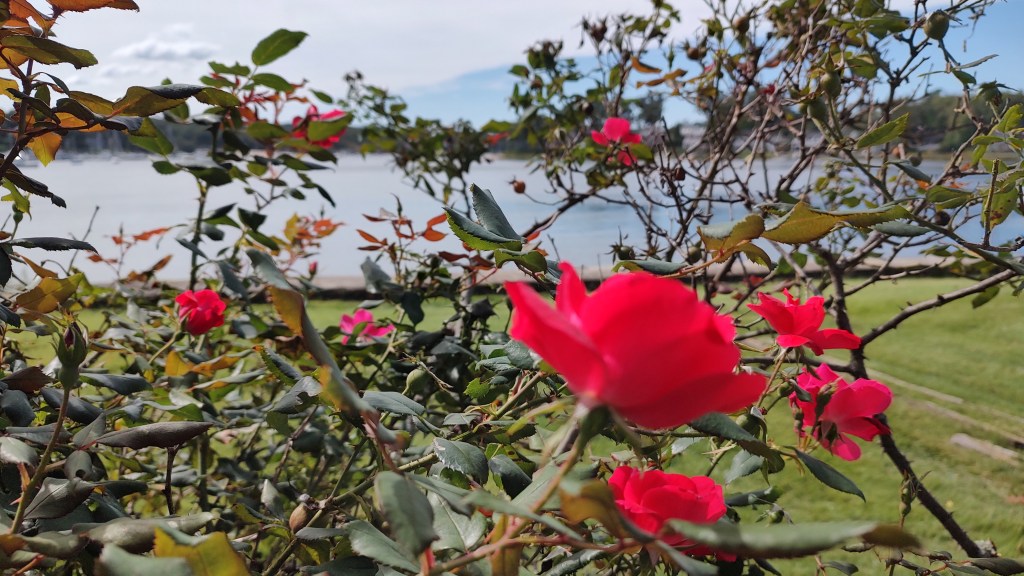
Consider flowers. Yes, they need to be adapted to environment. But for hundreds of millions of years flowers have also “fought” to have attractive blooms for pollinators, and fruit which will be eaten by mobile animals to allow species dispersal .

Odd things can be involved in fitness. Around here, most of the spring blooms – all magnificent right now – are either invasive or human cultivated species. Cherry trees, magnolias, forsythias are breathtaking. Daffodils and tulips blanket flower beds everywhere. In the current suburban environment, pure beauty can be “fitness” for a plant.

Even more surprising, recognizing “beauty” can be fitness for animals. Bees need to head for the right flowers, by sight or scent. Animals need to locate sugary pulp. Surely some of this has actively worked and is still working on our own human sensibilities .

But surprisingly, around me, beauty is its own reward, causing me to smile, neighbors to spend money, and all of us to be delighted with the floral displays of April .

Shock

In art, as in society, bland beauty is out, shock is in. We are inundated with machine replicated loveliness. No real complaints about that – it surely makes our lives better. I’m not about to harp on “bourgeois aesthetics” – taste is always fickle and in the eye of the beholder .

Ah, but to get someone’s attention? That is difficult. Pretty much impossible to out-machine machines – folks can easily buy relatively cheap stuff indistinguishable from the original masterpieces of the ages. And the whole world of artisans, amateurs, and now AI churns out more mountains of stuff hour by hour, day by day, year by year .

All that remains is notoriety. Become famous. A red x on a black splotch done by a celebrity is worth something. A ceiling that resembles a palatial achievement done by Jane Doe – not so much. So shock it is – blood, guts, mess or – as Tom Wolfe called it – aesthetics of “the painted word” – slavishly adhering to an artificial intellectual formulation .

And so it is becoming with work, life, being. Shock everyone to “go viral”. Become well known. Stand out from the crowd. No matter how crude, stupid, senseless – shock the complacent herd into frenzies .

Ah, elusive success .

Medieval Master

In olden days, some kings were good, some bad, some ineffective, some absolute. A few listened to wise educated advisors, others surrounded themselves with mystics and charlatans. Much of the advice of the mystics was, as expected, magical in nature. A lot of wishful thinking and fanciful notions which did not work or worse. 

Kings who listened were sometimes deposed, but just as often ruined their country and tried to blame someone else for poisoning the spell. Perhaps the wicked Jews, or the sinning populace, or a shrill coven of witches .

We naively thought that in a rational age of science we were beyond all that. We were wrong. It turns out any system can produce a megalomaniac who also eliminates all the wise advisors and surrounds himself with mystic charlatan influencers from the media. When their advice proves disastrous, he lashes out at anything handy to blame .

Way back then, there might be tough times and lots of horror, but societies usually survived. In a global nuclear-armed modern world, I’m not sure that part of the scenario will hold. Turns out a determined ego can do it an awful lot of irreparable damage in just a few years .

The medieval ruler syndrome is still in force. And humans remain capable of magical thinking which contradicts all difficult reasoning .

Ostrich

Perhaps there is something useful in the apocryphal legend of the ostrich sticking its head in the sand to avoid seeing trouble. In these expansive times, ignoring obscure and distant threats may be an evolutionary advantage .

After all, in the “big picture” we are all doomed, both personally and in our wider manifestations of society and cosmos. We stand on our tiny patch of desert scrub, and perhaps stay there or run a short distance to somewhere nearby. We ignore our inevitable death, or we would fail to function at all .

So in a time when horizons have become nearly infinite and imaginations run wild, maybe a head underground is not so stupid. We are aware of every sparrow that falls in the world, and we can do little or nothing about it. There is too much awareness, omniscience without omnipotence, and that may poison our souls .

Nobody can withdraw completely. Even that pretend ostrich has to come up for food and water. There is still at least a little truth to “think globally, act locally”. But maybe only a little .

In a hysterical interconnected age, too much awareness might be a very dangerous thing to any single individual. It surely is to my own sanity .

Blizzard

Blizzards, like everything else, are not what they used to be. Oh, snow and wind remain, but consequences tend to be trivial. In 1888, a Long Island blizzard killed hundreds, caught unexpectedly in the fields after a warm spring day. In my youthful 1950s, extended electric outage had my mom chopping up furniture to keep the fireplace going. The current “historic” blizzard of 2026 didn’t even bring down many trees, cause extensive disruption of electricity, close roads more than a day, much inconvenience shoppers or let children have a holiday .

It’s a quite robust world for things that we can prepare for. I not only do not complain, but am in awe at how truly competent our society can be. Not only blizzards, but also other disasters, plagues, and extended patterns like drought, famine. War, of course, remains. And the stubborn, if limited, evil of certain individuals .

Anyway, for a day or so we all enjoyed a true frisson of dangerous disruption. All the better because reality turned out far gentler than imagination. We are quite spoiled .

I try to emphasize that all the time. To be grateful for the normal, the calm, the taken for granted. Glory in how much lives have truly improved for many over the last few centuries. For a little while, to truly embrace the miracles of economic progress .

Legal Childhood

“Childhood” as we know it is a fairly recent invention. Not long ago, many kids would die before the age of five or six and were treated as favored pets. By the age of seven they were often used as near-slaves doing chores for the tribe, family farm, or industry. After twelve or so they were considered fully functioning adults _ married, working, or grittily apprenticed to a future career .

As the European industrial revolution progressed, “childhood” became redefined. Age definitions were gradually raised, partly because of horrendous working conditions, partly from increased middle class wealth and health, partly from a desire to keep youth out of the competitive workforce. The teenager was invented .

Now the plain fact is that in historical terms, “teenager” is a crazy concept. Most 13-year-olds have always been young adults. Our legal conception of teenagers as children is indefensible. 

Admittedly, teenagers and young adults are confused, have a lot to learn, and are not wise (so unlike older adults.) But we should remember that throughout the tens of thousands of years of the existence of our species, the average lifespan was 40 or less. A 16-year-old was in the prime of life .

We should adjust. As all parents have learned, treating a teenager as a “child” is doomed to failure.  Laws which attempt to do the same are not merely wrong, but also immoral.

A Little Knowledge

“A little knowledge is a dangerous thing”. You think you are an expert, but you are not. A very easy trap to fall into, since we tend to overestimate ourselves .

Obviously this is hardly a new condition, but it has certainly been more and more aggravated by media and global electronic connections. We are “aware” of an awful lot of stuff. Unfortunately, that awareness is often shallow, scattered, wrong and only leads to worry about things over which we have no influence. And about which we may have entirely inappropriate background information and deep understanding .

At one time, we left most issues to “experts”. They might have been right or wrong, but it took our minds off such things and – since we rarely are directly impacted by distant stuff – did no harm. But now the internet is flooded with “facts”, stories, and anecdotes that falsely claim to deepen our knowledge about anything and make experts irrelevant .

As we believe we know it all, each of our worries becomes somehow more real and our own responsibility. We MUST do something. We must change things. We think we are fully aware. 

We are wrong. About most of the vast ineffable universe of things, individuals, and society we each know very little except what we directly encounter and we often misinterpret that. The only 

true cure is a bit more humility .

Expected

People are almost infinitely socially adaptable. Almost any condition can be tolerated. We happily navigate through societies where everyone is honest, nobody is honest, haggling is required, bribes are necessary, and even when contacts with certain ideas or groups are prohibited .

Over time, we can adjust, of course. If formerly honest people turn dishonest and so on. But we feel somewhat secure as long as the rules remain more or less as expected. And security, often more than wealth, is what a lot of us desire most. Know what will happen if we do certain things.

Dystopias, such as depicted in “1984”, are often nightmares because expectations constantly shatter. “Interesting times” when the world goes topsy-turvy are rarely happy. When we don’t know if the police are going to save us or destroy us. Even tiny things in our life like whether a food will make us sick or not .

Civilization right now has an odd combination of solid old traditions – meeting expectations – and completely new challenges making every plan fragile. It’s probably not a lot different than living through plague times in an ancient wealthy city .

What never helps is when authority itself becomes irrationally chaotic, so that each day presents new laws and declarations making the old laws obsolete or themselves illegal.

Even when change is what is expected, we may worry nervously .