Elder Myth

Most of us understand our lives as a narrative story. Elders tend to form that into a mythology. Like any good literature, the best exaggerate the highs and lows and often have a structure with a moral. Grandparents especially enjoy inflicting this on their young grandchildren. Or at anyone else when there is a holiday gathering. It’s a way of making a mark on the universe, claiming an importance almost as meaningful as in tales of heroes of old .

Nor is it wrong to do so. There is more to existence than daily meals and bedtime. Formulating one’s place in eternal mystery is important to all of us. And once in a while it is nice to share – even proclaim – that adventure .

Unlike many others, I do not think such tales actually help the young in their own lives. Life and circumstance were always unique, and the days change at a dizzying speed. At best this is just another form of entertainment with the added benefit of being (mostly) true .

Oh, perhaps there is some moral value. But really it helps everyone share and join internal narratives to feel far less lonely in the ineffable cosmos. 

Sanibel Sad

“You can’t go home again” -, well you can’t really go anywhere as it once was. Older folks are often wrapped in nostalgia. As one of them, I remember many places I was privileged to visit before great change. Often merely modernity, sometimes catastrophe. Sanibel Island was one of them .

When my wife and I visited years ago it was – like many places we went – caught between old and new. The new was glitchy, shiny, and inaccessably privatized. The old had a patina of history along with the comfort of the commonplace. 

Hurricane Ian exchanged all that, of course. New things are being rebuilt, but all is shiny, private, glitz. I find myself never wanting to revisit anywhere that once charmed me .

This culture is, I think, testing the proposition that private wealth is always better than public for anything but the most utilitarian needs. Mostly gaudy and ugly, but above all else tightly secreted away. With rare exceptions, America has no grand public spaces, and even fewer that are not merely an attempt at preserved wilderness .

It’s a forward-looking time. Ignoring real history in favor of myth, and ignoring the present in the race to the next great thing .

Sometimes an old man believes all the great things are gone with the wind .

Next Time

We are conditioned by evolution and experience to expect there to be a “next time” for most events. Next time the sun comes up, the next time it rains, an endless procession of recurrences .

We use that knowledge to plan and learn. “Next time will be different” we may say. We hope to do better in things at which we have failed, repeat exactly things we have enjoyed. And for most of our lives, for much of our daily existence, that belief works very well indeed .

Oh, we know there are unusual one-offs. Never again a fifth birthday party. Hopefully not another car accident. We stash those away and hope or fear as “once in a lifetime” .

As I grow older, “next time” becomes more problematic. Almost all the things I used to know have changed. Places are no longer as they were. Some people have vanished. Institutions I took for granted have mutated as in horror films. Some of it is good, I acknowledge, but even that means there is no true next time for a lot of my memories .

And it begins to get a little frightening. Any given day, for any given event, any given encounter, there may never be a next time. Such absences cascade until I feel trapped in a few quotidian routines that I can (for the moment) count on .

And yet – I DO still expect a next time most of the time. 

Entranced

I think throughout history most humans at one time or another have entered a trance state. Often from concentration on something, sometimes from unusual circumstances like pain or fatigue, occasionally from use of drugs or alcohol. Always when dreaming .

In a trance we tend not to be fully aware of our surroundings. The universe has narrowed down to a particular selection of mind and senses. We are hyper aware of a few things and ignore the environment. This condition may last a few minutes, a few hours, rarely longer .

I’ve always been easily entranced. When reading a good book, for example. In my working days, entering a fugue in cyberspace as I worked out problems. Now when I engage with a sketch or drawing .

There’s not much to say about being in a trance. To be honest, I most appreciate it when I return to “real life”. I suddenly realize I’ve been away. I am refreshed, relaxed, and surprised. Wonderful things!

Of course, nobody can or should inhabit dreamland forever. There is truly a big universe to appreciate out there. But as a short vacation from the mundane it is magnificent .

Binocular

Old Dutch Master still lifes make you think you can lift flowers or bugs off the painted surface. Modern photographs have the same effect. Yet in a very real way, they do not match the reality we inhabit .

Two eyes let us see – especially nearby – in parallax to be able to judge depth. For distant objects, of course, we have other references like size and haze and perspective, but they can be quite deceptive. In the real world it has been important to us primates to be able to focus in this weird binocular manner to better use our hands for handling fruit and tools .

That is a long prologue to today’s rant about cults – religious, secular, or political. Cults have beliefs that are strictly monocular. They have little depth and allow by definition for no other viewpoint. The strictest cult outlooks don’t even let one move one’s head to get a better or different view – that’s the definition of “heresy” .

Current culture has unfortunately devolved into a set of cults. Perhaps a saving grace is that complex humans can believe in more than one cult – often contradictory – at the same time .

Binocular vision and its philosophic implications is a gift from the universe we should always acknowledge gratefully .

AI and Pride

Perhaps we have all turned into John Henry, pounding railroad spikes trying to beat a machine. Artists are confronted with the same situation as other intellectual occupations – what used to take skill, pride, thought, and time can now be done by any teenager in a dull moment. The internet is flooded with AI images, movies, stories. Work has similarly vanished. Some of us remain luddites, stubbornly sticking to brush and pencil. Why? A waste of time…

But is it ?

Climbing a mountain or hiking in a forest is not the same as viewing a YouTube video of the adventure (not even – as technology advances – an IMAX immersion). Things we do for ourselves have both an outer and an inner component .

Accomplishment of something difficult brings pride. Even if it is only pounding spikes. Or painting a canvas .

The key is that doing something you like to do, either for the activity itself or for recognition, is a kind of play. The same task forced on you (especially repetitively) is a chore or boring job. We should avoid confusing the two .

Mankind evolved with hand coordination. In spite of our big brains, we remain a physically oriented species. I think AI art robs both the creator and the audience of that heritage. Except for the brief thrill of novelty, pride and satisfaction are completely missing .

Appreciation

I believe the primary goal of art is to instill appreciation. That is true whether one is creating it or absorbing it. All the rest is detail. That outlook applies to all types of artistry. Cooking, dancing, painting, whatever. A warm flush of “wellness” if it works. In current jargon, a re-enchantment with the world .

I approach my current pastels and sketches in such a mood. Not to “capture” what I see – that is done ad nauseum by photographs and photorealistic artists. Not to create salable artifacts, nor even some phantom dream of inclusion in the universal “museum without walls” . Just to fully engage in and appreciate a moment, in my case more easily accomplished by my clumsy actions. 

Oh I admit it’s nice to have a tangible marker of having been alive. A kind of pride at having “done something” rather than just sitting on the couch. Like writing, a verifiable trail to the past .

Nice relaxed attitude, a child again. I don’t much care if what I do closely resembles whatever inspired me. The goal is more the trance of a vision enabled by concentrated action. When I wake out of this state, if successful, I am relaxed and content with everything .

Crude

I was raised in a fairly middling environment. Certainly not poverty nor even “salt of the Earth”, but not high end aristocratic. As I matured, I lost most ambitions of pretentiousness in my quotidian pleasures. I call it my crude peasant outlook .

For example, I enjoy a good steak. I do not go into purple prose ecstasy over exactly how wonderful it is – subtle flavors, tenderness, whatever. I find sauces and garnishes excessive. It’s just a good steak, another fine meal .

Most of the world I read about now seems to have passed me by. Pretentiousness reigns supreme. The “right things” are so much better. Handbags, salads, shoes, schools, cars, swimming pools … The internet sorts it all out for you to aid your expensive tastes .

I don’t pretend I like awful stuff. A dinner of peas and gruel is not enjoyable. Ratty clothes are terrible. But the level of relatively common, useful, and affordable stuff is quite high. And I try to appreciate it .

All in all, I find my crude peasant world a land of luxury and enchantment. I rarely envy all those others who mostly seem to scurry about hoping others will notice and envy them. That pretentiousness seems a terrible waste of our human gift of existence .

Fame

Brought up in an era when singers and pop bands got wealthy, as an admirer of famous artists, I always understood that fame was one of the keys to becoming rich. Unfortunately (or not) I never had enough ambition nor stamina to pursue it seriously – I was more focused on everyday life. But as I created computer programs or paintings it always remained a quiescent dream of maybe .

So I watched the art world sizzle with huge rewards for outrageous works. Was bemused by respected galleries selling what seemed to be junk. Gave up on exotic modern art exhibitions as displays became more and more incomprehensible. Also, living in the sedate suburbs, found the local scene excessively bourgeois. Lots of watercolor from photographs. Lots of super realism from photographs. Lots of purposely kitsch designed to sell online. I happily, isolated, burrowed in and followed my own path. Always secretly hoping the future would vindicate me and (even posthumously) deliver fame .

Now I read that the high end art world has “collapsed.”  “Patrons” have moved on to play with crypto. Galleries are failing right and left. The froth – like the tulip bubble – has vanished. Perhaps never to recover .

The other cliches about fame are that it is capricious and fleeting. Now the goddess mostly dispenses it in viral form on the internet. I remain solitary and happy .

Age and Tide

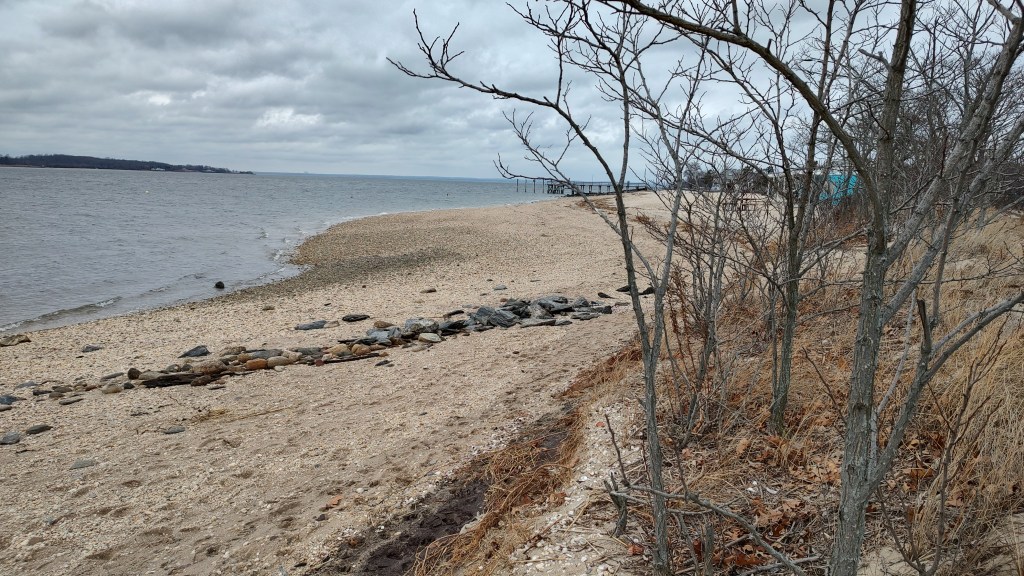
There are multiple ways to turn any natural observation into a metaphor for our lives. Having lived near the sea for most of my life, I am well aware of tides. Age often leaves us casting about for glimmers of cosmic understanding wherever they may occur.

The most famous metaphor is of course King Canute, ordering the tide to cease. A symbol of the uselessness of trying to prevent the inevitable. More deeply, a warning of how stupid it looks to attempt what common sense knows is impossible .

But there is also the idea of ebb and flow, high and low, translated to good times and bad. There will be in any life joy and pain, both of which usually pass one to another in a complex but inevitable rhythm .

For an older person, however, there is yet another lesson, which relates to deceptive normality. The high water mark is indicated with only minor variations day to day and season to season. But suddenly that can change in storm or tsunami, and rage well beyond what we thought we understood as limits. Leaving behind destruction and _ of course _ death .

So here we are, metaphor in hand. Is this next problem merely a usual tide or something worse?

It’s easy to become anxious when the predictable breaks the rules .