
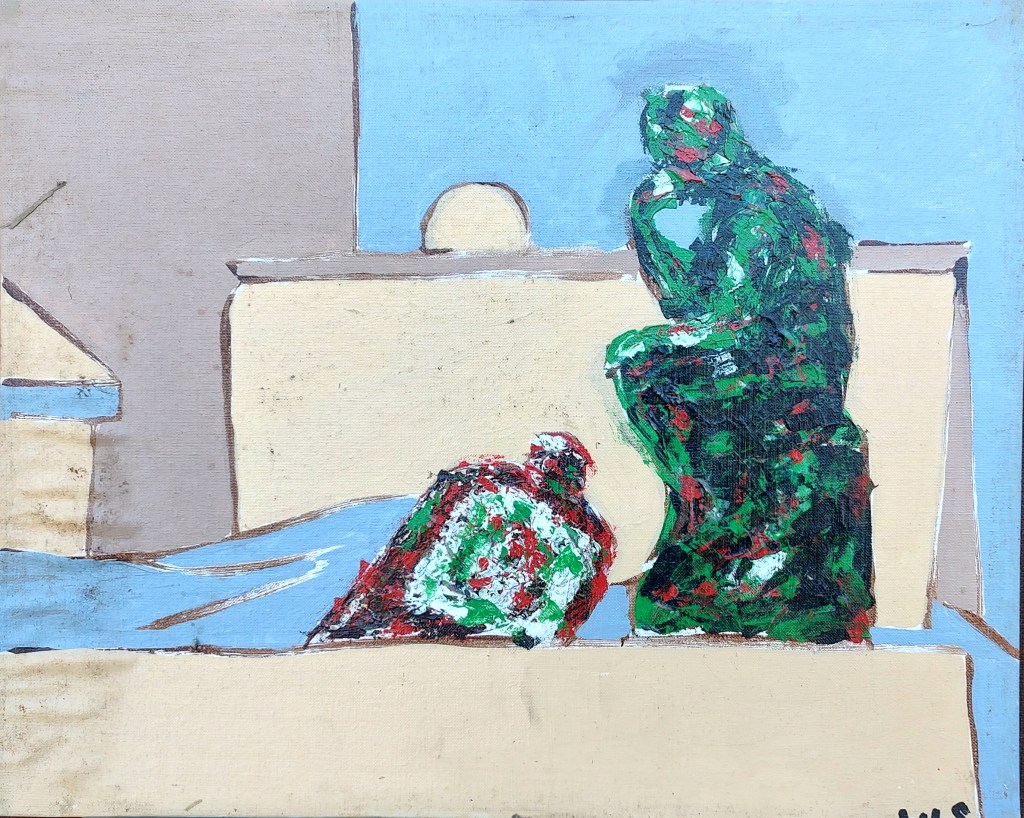
All paintings at: https://sites.google.com/view/cabinetofvanities
Acrylic on Canvasboard, 1970, 16×20
Thinker stilllife
All paintings at: https://sites.google.com/view/cabinetofvanities
Acrylic on Canvasboard, 1970, 16×20
Thinker stilllife
These days, it is quite easy to feel as a god. We eat well, speed along without effort faster than birds, know everything at the flick of a screen, control vast powers. We think we are pretty close to omniscient and omnipotent. Well – compared to the past, at least, we are .
So we tend to take ourselves very seriously. What we do or don’t do must shake the cosmos. Every emotion must be huge and deep and meaningful. Our successes are tributes to our glory, our failures are – someone else’s fault .
Humble is no longer in most vocabularies. As a contrarian, I cultivate it. I do not feel in control. Kind of a god? Yeah I can’t escape that. Important? Responsible for my divinity? Nope. Just damn lucky to have been born into my time and situation. Fortunate to have adapted well . Certainly enjoying the experience. But always very aware that I hardly “deserved” or “worked for” most of it .
Sure, I’m moderately proud of who I am and what I have done. That’s it. I fight hubris tooth and nail. I simply pray that things will continue. I’m a leaf swirling down the stream, but an ecstatically happy leaf.
I know everyone is stressed, often rightfully. I wish they could step back and take a deep breath. But – hey! I’m just humble old me, so nobody listens .

Quasi Resolutions
Resolutions, so rarely kept, are out of fashion. Perhaps merely tendencies to encourage.
Never forget that this is done to enhance my “real life” and never to interfere with my enchantment each moment.
Future posting methodology follows that of the last year:

We seem to find it easier to be against something than for it. Maybe hate is easier than love. What we dislike – noise, clothes, morals – is often in sharper focus than what we are for .
Accordingly it is pretty simple to form social and political groups strongly against what they are certain they do not like. Trying to get people in favor of something often comes down to defining the enemy. Protect the environment, for instance, by hating industry .
The problem with anti-groups is a proverbial observation about always using a hammer because that’s what you have. And the problem with a hammer is that it is very easily turned against almost anything. Those against gay rights easily morph into being against certain ethnicities or religions. Those against certain medicines are easily marshaled against certain foods. Those who hate one modern morality are ready to go against any others .
With luck, very strong anti-groups eventually splinter against each other and dissolve. Without luck, all bets are off .
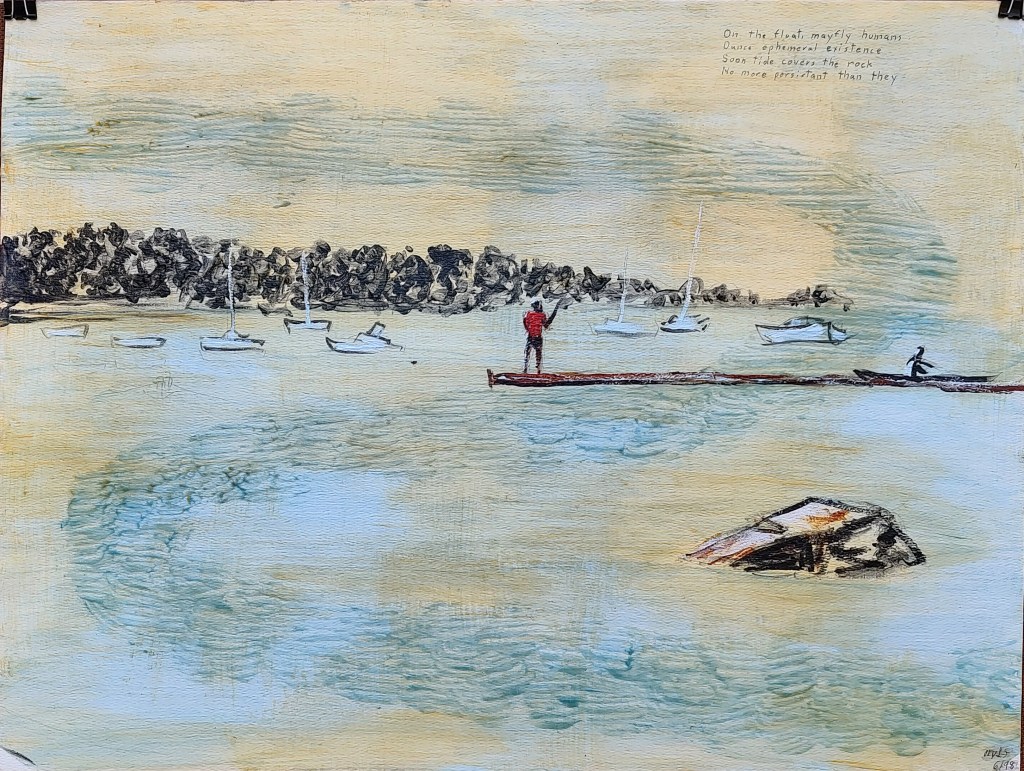
All paintings at: https://sites.google.com/view/cabinetofvanities
Acrylic on Watercolor Paper, 1998, 18×24
On the float, mayfly humans / dance ephemeral existence / soon tide covers the rock / no more persistent than they

We may not exactly count “one, two, three, many”, but we do lose ourselves as numbers become immense. I think most of us understand 100, but 1 million is hard, and anything higher does become “many”. We can easily visualize odds at “one in a hundred”, but “one in a million” is practical infinity .
Our vast outreach of instantaneous knowledge and awareness has jumbled that picture. Odds of winning a lottery may be “one in 372 million”, but – as my wife claims – “somebody always wins”. We hear about that somebody all the time. Hey, it could be me !
With the unusual reported more than the commonplace, our perception of odds becomes strangely distorted. If chances of anything are truly one in a million, then in a country like ours 360 people (each one interviewed in a media moment) will have it happen to them. In a planet of 8 billion, 8,000 folks will. Suddenly it seems like an awful lot of people. Translated to our own surroundings the odds suddenly appear as likely as 50 or more percent .
That’s why anecdotal “evidence” in medicine, science, or society is so damaging. An anecdote seems real, a statistic kind of nebulous. We think “oh, a person just like me was affected”. Winning, losing. Then we act stupidly .
My antidote has always been “how many people whom I actually know have had this happening?” That is quite sobering, and puts odds into much better perspective .
Historians weave bygone “facts” into various narratives, depending on their own outlook and goals. Most intelligent readers know there are many valid aspects to such interpretation. I enjoy the American trilogy of Bernard DeVoto _ tracking the European overrunning of the North American continent .
Unlike many modern writers, DeVoto was able to be both brutally critical and empathetically understanding of some of the horrors and gallantry of the topic. He did not mind stating his opinion, always clearly as an opinion, but with a certain judgment often missing in the more shallow morality tales which treat the same subject today .
Brilliantly evocative, as I read – say – “The Course Of Empire” – I can nearly gasp at some of the appraisals of figures and cultures, which seem whitewashed in later treatments of the same subject. So much now forbidden language, so many prejudicial statements, so blunt a panorama of suffering, heroism, evil, stupidity, and progress .
Years ago I bought print books of these works. I often worry that in the future an Orwellian AI culture existing mostly electronically will hide, erase, or cancel anything like this by whim or accident .
In the meantime, I reread it all periodically as a treasure of my heritage .

All paintings at: https://sites.google.com/view/cabinetofvanities
Pastel and Ink on collaged pastel paper , 2025, 20×26
Odd placement / Not conventional / Just how I saw / Just how remembered

I contend, contrary to current corporate creed, that there is value in public expenditures and public places. Plazas, parks, churches, and, for the purpose of today’s thought, museums .
A public museum is a marvelous place. Its purpose is always to arrange stories and show versions of reality. Sometimes bones or rocks, sometimes paintings or sculpture, sometimes any oddball mix of anything. Objects usually with a story attached to amaze, mystify, or educate .
There are claims that with the advent of virtual spaces on the internet, museums are obsolete. That may be true in terms of tagging objects. But another function of public places is as a setting for everyone’s street theater, to see and be seen by others. A crowd sharing some momentary focus.
You protest that is also true of things like private parties and such. Sports events. I agree. The bounds are fluid. But by being open to all, a public space provides a wide variety of experience. To get back to the title, I love museums. Old, new, whatever. They make me consider what some other folks considered important. They let me see how contemporary peers react .
Such public interaction is a great binding experience, less frantic and directed than a stadium light show .
 HuntingtonHarborThoughts