
More paintings and info at: https://sites.google.com/view/cabinetofvanities
Acrylic on Canvas, 2002, 30×40
Old age lazes quiet/each day a triumph/each thought a victory/oddly beautiful

More paintings and info at: https://sites.google.com/view/cabinetofvanities
Acrylic on Canvas, 2002, 30×40
Old age lazes quiet/each day a triumph/each thought a victory/oddly beautiful

Now that hiring is solely based on “merit”, it is useful to ask what, exactly, signifies “merit”. In a lot of cases that is otherwise described as nepotism, social class, or presentation. Proof that one is a member of the existing tribe. But let’s pretend “merit” means how well one can do the job required.
Throughout history, the main measure – outside of actual performance once hired – has been experience. What someone has done and how well they have done it is almost always the main traditional criteria of “merit”, even if the skill is simply being flexible enough to learn new skills, or showing up on time. The normal route for all that until very recently was apprenticeship .
Today, increasingly specialized experience can be hard to come by, so learning with eventual “certification” became common. It worked a little. But most trades and professions want to be in a guild – which turned out to be well served by erecting barriers to entry involving more and more numerous and baroque certificates.
Certification often fails miserably in telling how meritorious a job candidate is, but it certainly thins down the stream of job seekers. And it’s self-serving since the last employee in wants new applicants to “at least go through what they did” .
The only folks who love all this are the lawyers. And the teachers. For the most part, newbies entering good professions are now facing that tried and true nepotism, social class, and presentation – plastered over with certification .

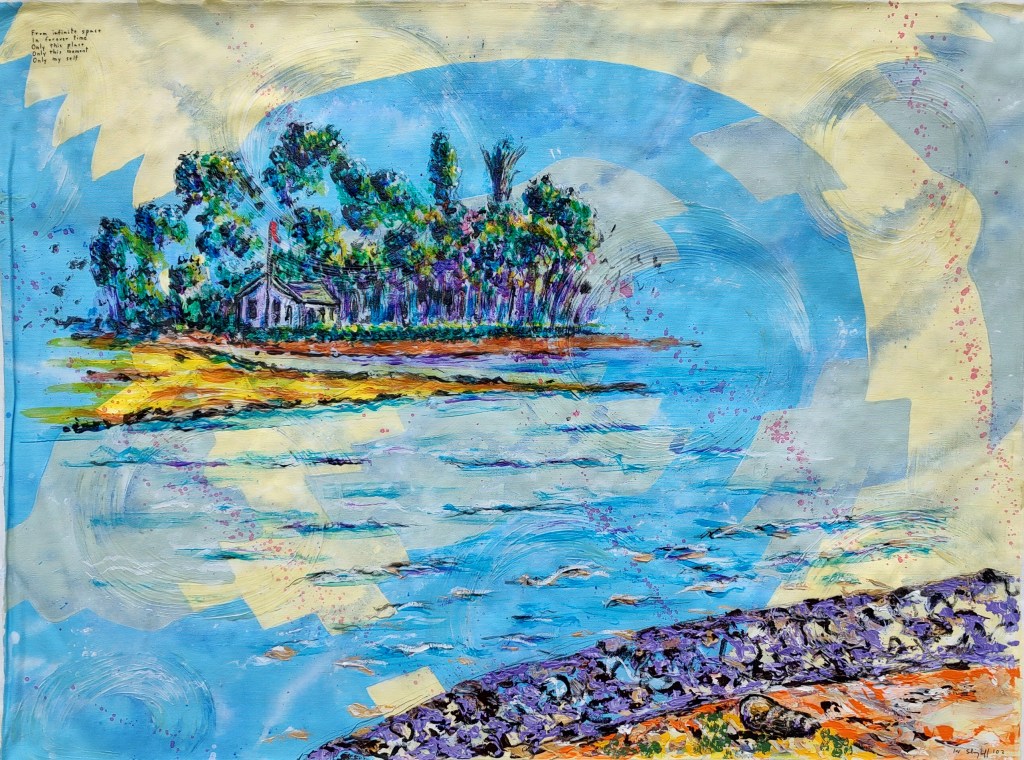
More paintings and info at: https://sites.google.com/view/cabinetofvanities
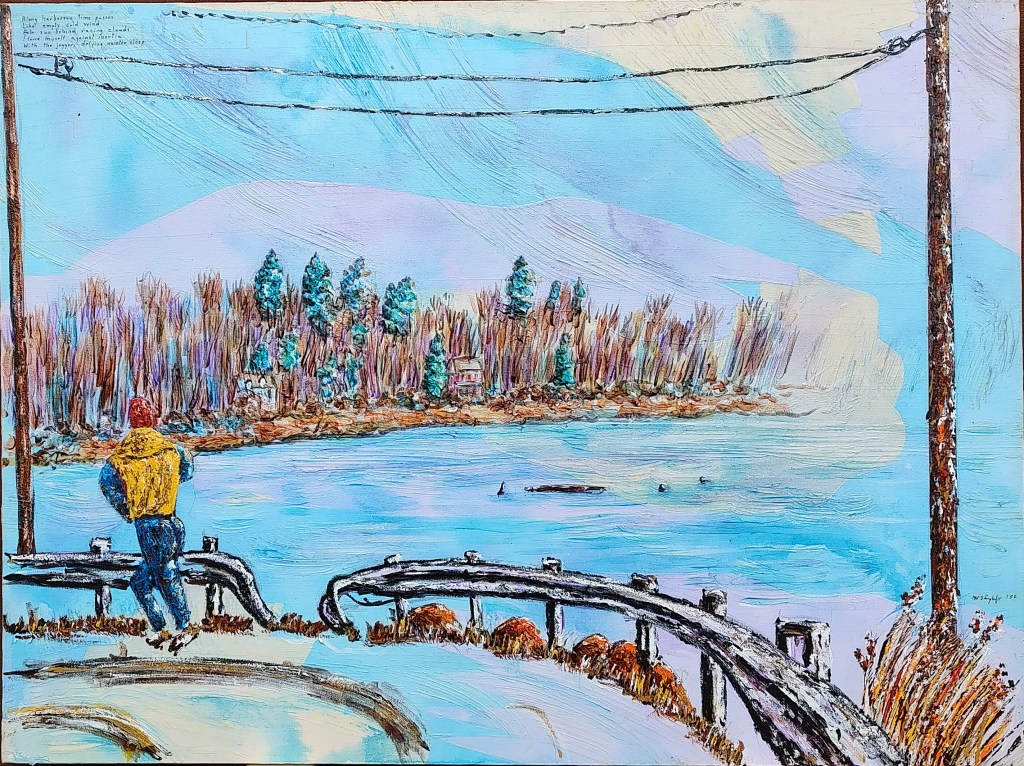
Acrylic on Canvas, 2001, 30×40
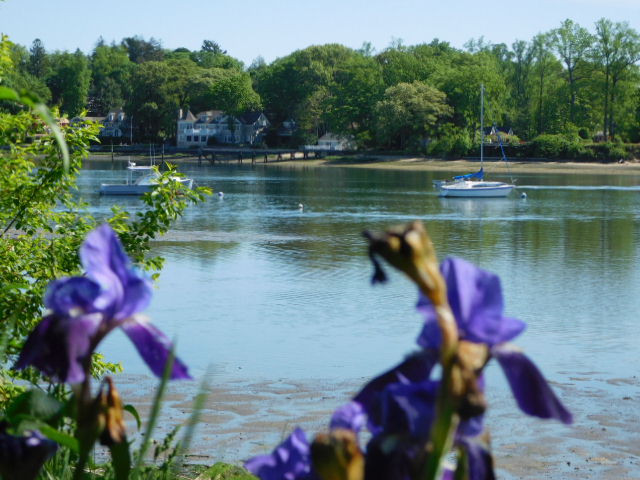
Fishing, but/for what?/the sun, the day, the breeze,/sparkles of the moment/chime of rigging, gull cries/time well spent

There are multiple ways to turn any natural observation into a metaphor for our lives. Having lived near the sea for most of my life, I am well aware of tides. Age often leaves us casting about for glimmers of cosmic understanding wherever they may occur.
The most famous metaphor is of course King Canute, ordering the tide to cease. A symbol of the uselessness of trying to prevent the inevitable. More deeply, a warning of how stupid it looks to attempt what common sense knows is impossible .
But there is also the idea of ebb and flow, high and low, translated to good times and bad. There will be in any life joy and pain, both of which usually pass one to another in a complex but inevitable rhythm .
For an older person, however, there is yet another lesson, which relates to deceptive normality. The high water mark is indicated with only minor variations day to day and season to season. But suddenly that can change in storm or tsunami, and rage well beyond what we thought we understood as limits. Leaving behind destruction and _ of course _ death .
So here we are, metaphor in hand. Is this next problem merely a usual tide or something worse?
It’s easy to become anxious when the predictable breaks the rules .

One thing I learned over the years is that social stability is often a kind of mass illusion. People, for example, tend to believe that prices remain steady, or always go up, or will go down. Or that the future will be better. Or that they should do certain things. Until, almost suddenly, everyone changes their mind.
There are parallels in science. Supersaturated solutions will suddenly crystallize. Some “tipping point” is reached and a structure fractures. All of a sudden, equilibrium is different. Or lost entirely to chaos .
Science prefers – which is to say we prefer – a smooth glide and predictable gradual transitions. Our forecasts generally assume trends are known and that the future will mostly resemble today. We project our own ambitions into a future that in most ways resembles our past .
That all works pretty well until it doesn’t. And, like those supersaturated solutions, things can change fast and in really unrecognizable combinations. Society reaches some point of no return – bread lines turn to looting, the king is killed, whatever – and nothing is ever the same again .
I guess things could all turn out to the good. But. Inflation, AI, automation, internet, fusion energy, ecologic disaster, endless lists. Any one of them could unexpectedly end what we assume to be forever .
And, really, not much we can do to predict or direct the outcome .

More paintings and info at: https://sites.google.com/view/cabinetofvanities
Acrylic on Watercolor Paper, 1998, 18×24
Quiet soft almost fog/drifts the morning/as if centuries gone

I try to be an optimistic person. I generally believe that things will work out for the best. It makes my life happier .
Yet there is a world of ambiguity in any concept such as “optimism”. To begin with, nobody can know anything about the future. Beyond that, exactly what “things” am I selecting for prediction? And what I mean by “best” may in no way relate to what you consider good. No need to belabor the issue. Like “beautiful,” it is a concept that seems to mean something to everyone, but can hardly be pinned down. Nevertheless, I remain an optimistic person .
I try to pick things that have some actual relevance to my personal well-being. I can be optimistic, for example, that I will enjoy dinner tonight. And by a magic mind trick, I could even be optimistic if I think the dinner will be awful – because it will soon be over !
There are infinite outcomes to choose from, and many ways to wonder what might be “best”. Instantly we bog down into dreamy lists and semantics .
At my age the key is really careful selection of discreetly small things, in a pretty short time frame. And a concept of “best” that reduces to how much worse it could be .
I’m an optimist, but hopefully not a complete fool.

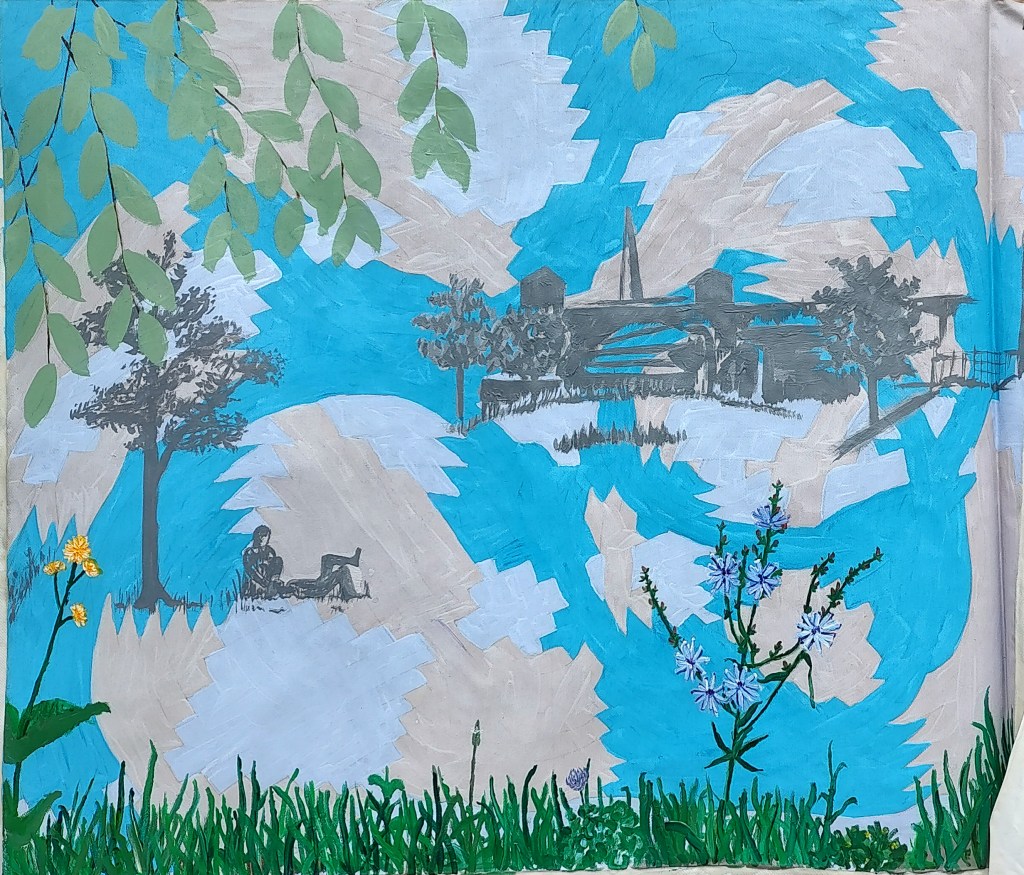
More paintings and info at: https://sites.google.com/view/cabinetofvanities
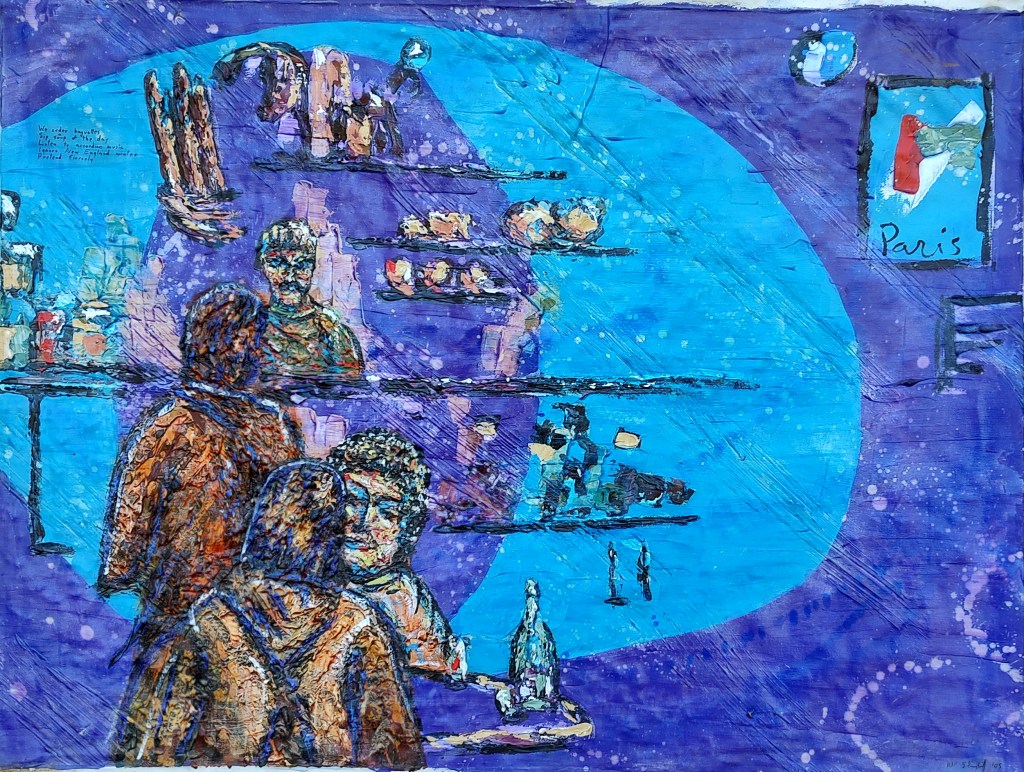
Acrylic on Plastic, 1974, 36×44
Three graces.by Botticelli

Surrounded by babel about infinite multiverses, I have my own fantasy that my soul manages to navigate, pick and choose among them. A thread aware of the past and future, trying for an optimum path in what we call time, freezing yet another life in some new groove, or maybe just replaying it .
It’s all philosophic twaddle of course. I don’t really buy into the multiverse. No idea what time really is, but pretty sure that mostly what we experience is some form of underlying reality. Nobody knows. Nobody can know. I don’t care except in idle daydreams .
It’s been a very fortunate life, so I have the luxury of imagining I live in the best of all possible worlds – for me. My very own best possible life, unconcerned with all the other possibilities.
Oh, of course, much of that outlook is constructed by skillful editing, shaping nostalgia to focus on silver linings, “accentuating the positive”. No apologies. It’s a nice way to view the world, at least as one grows ever more elderly .
Each day now I can look back with fondness, enjoy some happy memories, and not worry at all about what I must do nor regret opportunities lost. I suppose all that is simply symptomatic of truly losing my mind .

Politicians are once again concerned about “socialism” almost as much as they were about “communism” in days of yore. They predict bread lines in New York, no houses for anyone, and dust and empty shelves for all. Just as in the USSR, China under Mao, North Korea now. That economic vision (whatever it is) has been proved by history to fail .
Yet today, there are elements of socialism everywhere, as there are elements of capitalistic free enterprise almost everywhere. There are few bread lines, and few any worse than in the “food pantries” set up for the (more fortunate) indigent in the United States .
The fact is that none of these systems is as it once was. Socialism, communism, capitalism are all far different in current practice than their conceptions of 100 years ago. The ongoing industrial and information revolutions have changed economics mightily. A world of (at least temporary) abundance based on possible ecologic disaster fails to fit any of the classic patterns.
What is unfortunate is that every thinker with an ax to grind pulls out the old unvarnished philosophies instead of coming up with something new, positive, and relevant. Our current drift may sooner rather than later be disastrous .