
All paintings at: https://sites.google.com/view/cabinetofvanities
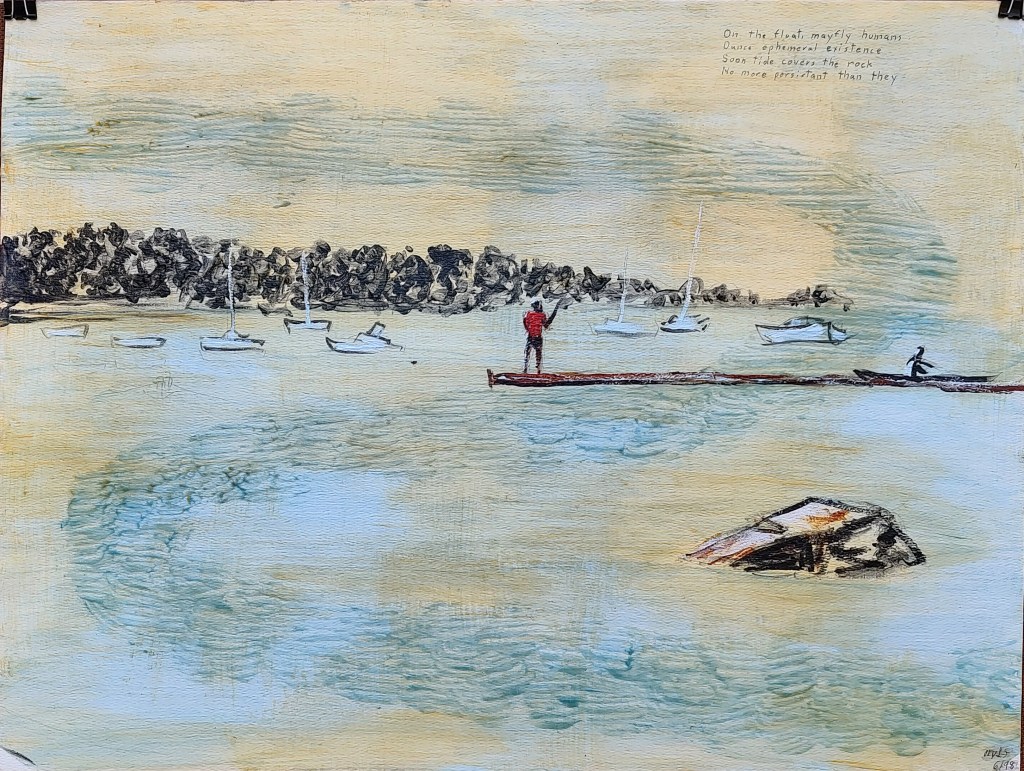
Acrylic on Watercolor Paper, 1998, 18×24
On the float, mayfly humans / dance ephemeral existence / soon tide covers the rock / no more persistent than they
All paintings at: https://sites.google.com/view/cabinetofvanities
Acrylic on Watercolor Paper, 1998, 18×24
On the float, mayfly humans / dance ephemeral existence / soon tide covers the rock / no more persistent than they

We may not exactly count “one, two, three, many”, but we do lose ourselves as numbers become immense. I think most of us understand 100, but 1 million is hard, and anything higher does become “many”. We can easily visualize odds at “one in a hundred”, but “one in a million” is practical infinity .
Our vast outreach of instantaneous knowledge and awareness has jumbled that picture. Odds of winning a lottery may be “one in 372 million”, but – as my wife claims – “somebody always wins”. We hear about that somebody all the time. Hey, it could be me !
With the unusual reported more than the commonplace, our perception of odds becomes strangely distorted. If chances of anything are truly one in a million, then in a country like ours 360 people (each one interviewed in a media moment) will have it happen to them. In a planet of 8 billion, 8,000 folks will. Suddenly it seems like an awful lot of people. Translated to our own surroundings the odds suddenly appear as likely as 50 or more percent .
That’s why anecdotal “evidence” in medicine, science, or society is so damaging. An anecdote seems real, a statistic kind of nebulous. We think “oh, a person just like me was affected”. Winning, losing. Then we act stupidly .
My antidote has always been “how many people whom I actually know have had this happening?” That is quite sobering, and puts odds into much better perspective .
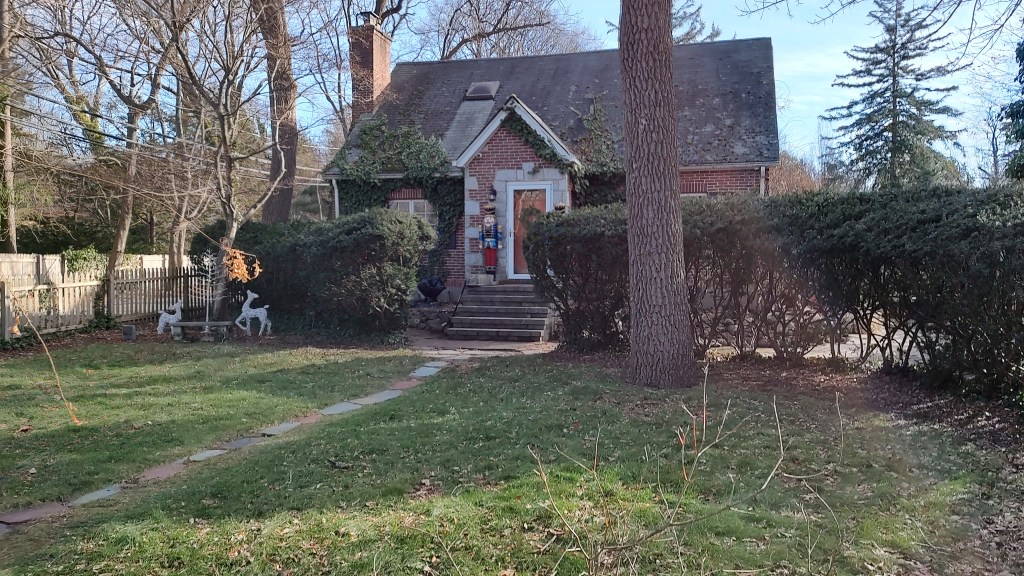
Historians weave bygone “facts” into various narratives, depending on their own outlook and goals. Most intelligent readers know there are many valid aspects to such interpretation. I enjoy the American trilogy of Bernard DeVoto _ tracking the European overrunning of the North American continent .
Unlike many modern writers, DeVoto was able to be both brutally critical and empathetically understanding of some of the horrors and gallantry of the topic. He did not mind stating his opinion, always clearly as an opinion, but with a certain judgment often missing in the more shallow morality tales which treat the same subject today .
Brilliantly evocative, as I read – say – “The Course Of Empire” – I can nearly gasp at some of the appraisals of figures and cultures, which seem whitewashed in later treatments of the same subject. So much now forbidden language, so many prejudicial statements, so blunt a panorama of suffering, heroism, evil, stupidity, and progress .
Years ago I bought print books of these works. I often worry that in the future an Orwellian AI culture existing mostly electronically will hide, erase, or cancel anything like this by whim or accident .
In the meantime, I reread it all periodically as a treasure of my heritage .

All paintings at: https://sites.google.com/view/cabinetofvanities
Pastel and Ink on collaged pastel paper , 2025, 20×26
Odd placement / Not conventional / Just how I saw / Just how remembered

I contend, contrary to current corporate creed, that there is value in public expenditures and public places. Plazas, parks, churches, and, for the purpose of today’s thought, museums .
A public museum is a marvelous place. Its purpose is always to arrange stories and show versions of reality. Sometimes bones or rocks, sometimes paintings or sculpture, sometimes any oddball mix of anything. Objects usually with a story attached to amaze, mystify, or educate .
There are claims that with the advent of virtual spaces on the internet, museums are obsolete. That may be true in terms of tagging objects. But another function of public places is as a setting for everyone’s street theater, to see and be seen by others. A crowd sharing some momentary focus.
You protest that is also true of things like private parties and such. Sports events. I agree. The bounds are fluid. But by being open to all, a public space provides a wide variety of experience. To get back to the title, I love museums. Old, new, whatever. They make me consider what some other folks considered important. They let me see how contemporary peers react .
Such public interaction is a great binding experience, less frantic and directed than a stadium light show .
All paintings at: https://sites.google.com/view/cabinetofvanities
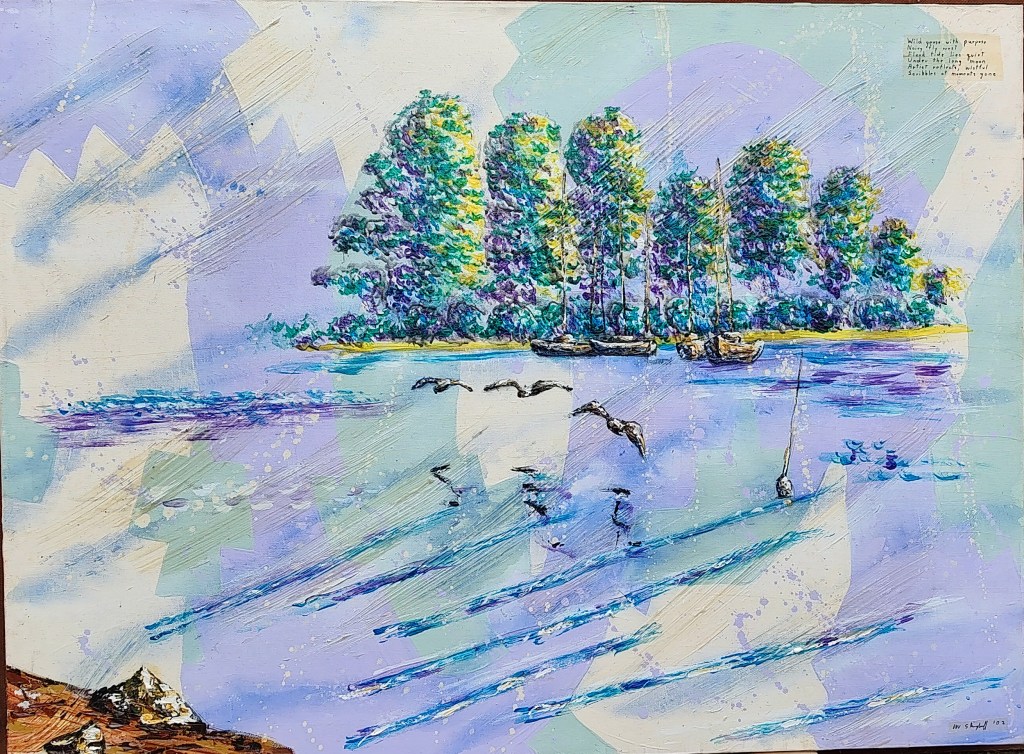
Acrylic on Canvas, 2002, 30×40
Wild geese with purpose / noisy fly west, / flood tide lies quiet / under the long moon / artist reflects, wistful / scribbles of moments gone.

Wealthy elites hire entertaining apologists to glorify and justify their position in society. One of the great meme inventions of such employees was the concept of the “deserving poor”. Those folks were wonderful people laid low by fortune. Obviously they deserved a helping hand .
That usefully left masses of other paupers (mostly those whose views and lifestyle the elite did not agree with) to be ignored and vilified as “undeserving poor”. Such groups should be kept miserable, oppressed, or removed for the general good .
In these days of wealth concentration I propose an equivalent expression of the “undeserving rich”. People who _ unlike Carnegie, Ford, or Gates _ did nothing to deserve their affluence. They gained it through inheritance, financial gambling (with other people’s money) or fraud. They do not deserve the adulation given to the deserving rich .
Specifically, the undeserving rich should pay a lot more to support society. Sure, limit taxes on the few magnates who actually work hard. But tax to the max their children or sycophantic associates. And stop respecting their suggestions about life, consumption, or politics .
I believe the undeserving rich should be targeted just as much as the undeserving poor. And that should give all of us just as warm and fuzzy a feeling when they are righteously oppressed .

Each one of our senses is miraculous and far more complex than we usually give credit for. I hesitate to claim I am primarily “visual” because I truly celebrate them all, but I am often greatly aware of what I see and how I perceive it .
Anyone who gives a moment of thought is amazed at colors, and lines, making sense of the environment by constructing objects in depth. Keenly tuned to any movement. Able to instantly assemble a worldview of depth and perception when we glance around. Focusing on anything for fight, flight, or manipulation. The list is endless, and there is no need to expand the craziness by trying to explain the mechanisms of the eyes, nerves, and brain .
My vision naturally works with everything else. If I hear a noise, I automatically try to see what caused it. Before I eat I view each morsel. When I walk I use my internal visual mapping to aim my steps and avoid bumping into things.
And I am somewhat frustrated when my eyes cannot help . The wind and cold surprise me. Internal issues scare me. Other times I use eyes unconsciously as when I read and my mind ignores all the intermediate processing from printed symbols to dreamlike thought .
Incredible. Miraculous. Instantaneous. Always available. And – unfortunately – prone to errors, incapacity, and age .
All paintings at: https://sites.google.com/view/cabinetofvanities
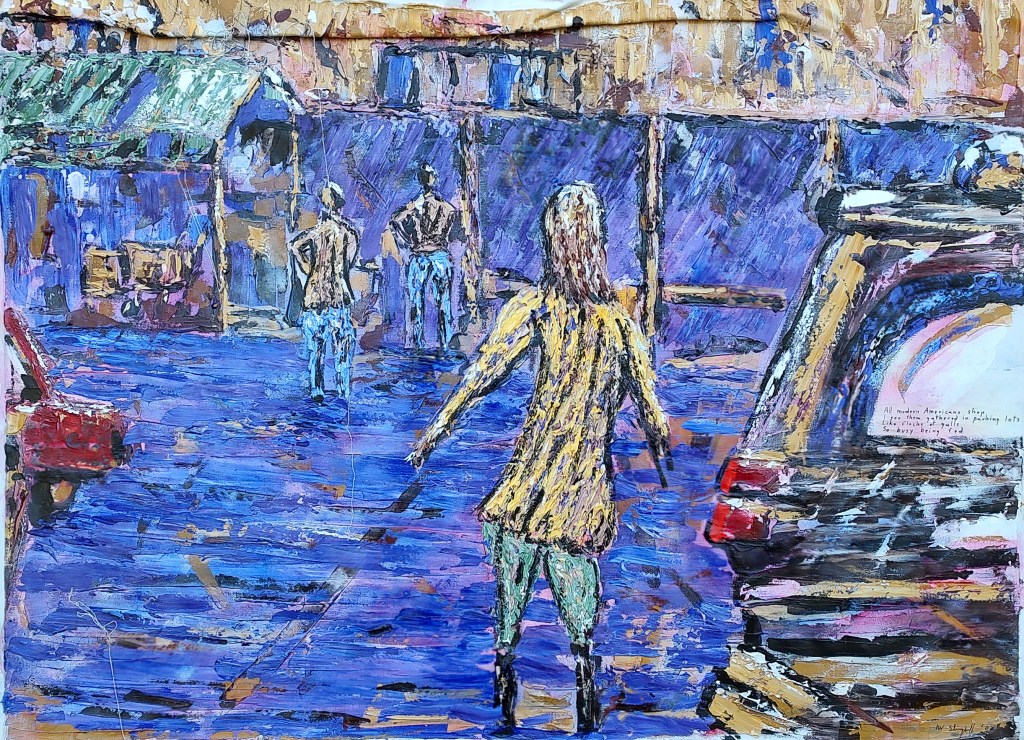
Acrylic on Canvas, 2002, 30×40
All modern Americans shop / I see them gathered in parking lots / like flocks of gulls / so busy being fed
Most of us understand our lives as a narrative story. Elders tend to form that into a mythology. Like any good literature, the best exaggerate the highs and lows and often have a structure with a moral. Grandparents especially enjoy inflicting this on their young grandchildren. Or at anyone else when there is a holiday gathering. It’s a way of making a mark on the universe, claiming an importance almost as meaningful as in tales of heroes of old .
Nor is it wrong to do so. There is more to existence than daily meals and bedtime. Formulating one’s place in eternal mystery is important to all of us. And once in a while it is nice to share – even proclaim – that adventure .
Unlike many others, I do not think such tales actually help the young in their own lives. Life and circumstance were always unique, and the days change at a dizzying speed. At best this is just another form of entertainment with the added benefit of being (mostly) true .
Oh, perhaps there is some moral value. But really it helps everyone share and join internal narratives to feel far less lonely in the ineffable cosmos.
 HuntingtonHarborThoughts