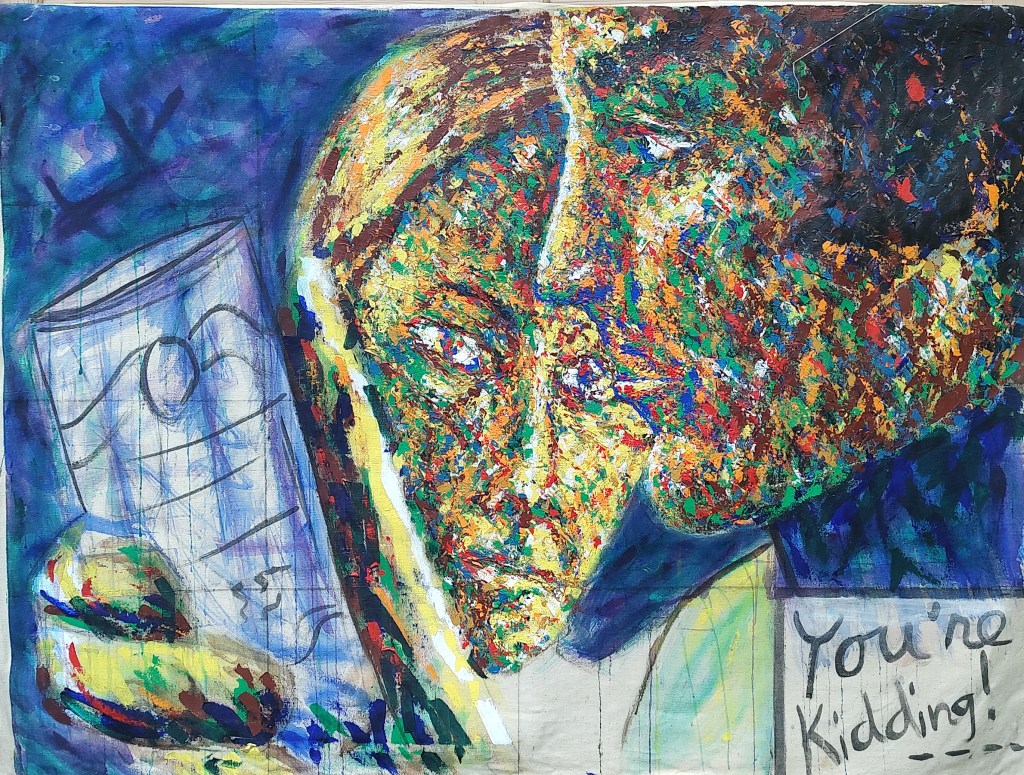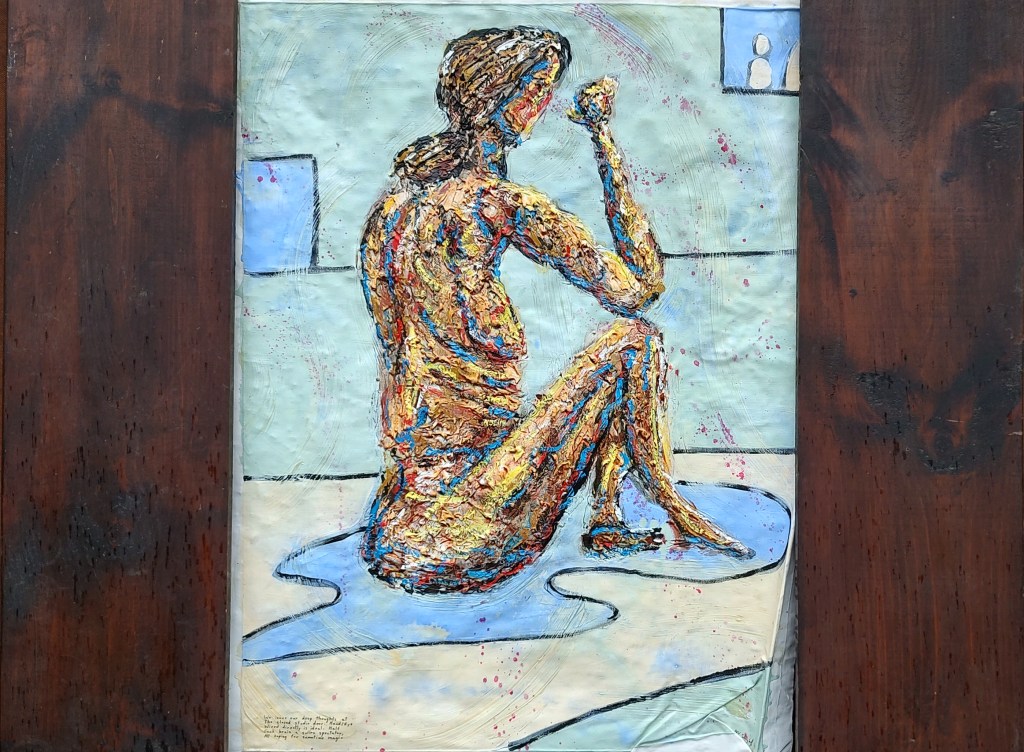
Acrylic on Canvas, 1971, 28×32
*
How Come
,
More of my paintings and writing at: https://sites.google.com/view/cabinetofvanities
1971-ACV-28×32-010

Acrylic on Canvas, 1971, 28×32
*
How Come
,
More of my paintings and writing at: https://sites.google.com/view/cabinetofvanities
1971-ACV-28×32-010
“It’s Simple”

Nouns really mean something. Water, rocks, people – the descriptive power is infinite. We also use them to describe intangibles – “fact”, “right”. And then we use them in declarative exclamations “that’s the truth”, “we did the right thing.” And, of course, the ongoing political and meme darling “it’s simple .”
But “it” rarely is. “An elephant exists” is simple enough. But calling an elephant “simple” would be insane. Defining an elephant one can listen to the various blind men saying “it’s simply like a tree”, “it’s simply like a wall” based on the relative position of the blind man. Even when we grasp the whole and understand an elephant is simply not a mouse, we have no idea of the complexity of an elephant at all levels.
The world is infinitely complex, fractally intertwined, especially when time and conditional decisions are involved. Something can be contradictory, both true and untrue, irrelevant or useful, dependent on circumstances. Only a few actions are irreversibly simple: “jump off the cliff” might be one.
When any leader tells you something “is simple”, beware. It’s one way to end all arguments, but it can “simply” be wrong, untrue, or irrelevant. And certainly ignoring all complexity and conditional options: “it’s simple – we must cross the flooded river” ignores that there are many ways to cross a river, and at various times a river might be lower, and we might really not need to cross the river at all.
But leaders exist to provoke actions. None as simple as they like to pretend .

My wife is always suggesting that we should “partake of the good things in life.” The implication, of course, is that we do not do so often enough, and also that we may be unable to do so in the future. It’s not really unexpected because we do lead a fairly comfortable, sedentary existence.
I find “partake” a fairly cute little word. It conjures images of aristocratic ballrooms or excursions in exotic lands. I never think of folks as “partaking” of a pizza or hamburger. In fact, I rarely hear the word in everyday conversation .
The problem – at least the first problem – is the exact definition of “good things”. I like a walk in the park. She likes shopping. But I guess one cannot “partake” of such commonplace pleasures. No, usually she means something we rarely if ever do. And likely will not. It can generate an intimation that we are somehow being left out of all the fine things everyone else is doing .
A larger problem is that I cannot think of many things that I would rather do than a nice stroll in nature. I am perhaps too much a creature of habit, but that is because over the years I have trained my habits to correspond to my pleasures. Most of the other stuff is, actually, pretty boring .
But what two people want differs. If we ever get around to “partaking” of something she wants, I’m sure I’ll survive .
Acrylic on Canvas, 1975, 40×30

Old history
one rail 2 rail 3 rail four
plants marching back
.
More of my paintings and writing at: https://sites.google.com/view/cabinetofvanities

I am enchanted by the miracle of supermarkets. Others complain of high prices, spot shortages. They dream of olden days when “heritage vegetables” had more taste, or “Paleolithic diets” fortified our ancestors, or …
Until recently, most people ate spare, monotonous diets and famine was always lurking right around the corner. I never envy those ancient times .
Four unrelated inventions have been necessary, along with all the other ignored benefits of modern times. Rapid reliable bulk transportation, refrigeration, manufacture of fertilizer from air, mechanized grain farming. Without all these, food would be limited, expensive, and supermarkets could not exist .
Some pine for old street markets and the local baker and butcher. Those indeed have their charms. And yet _ well, at almost any time I can go to a supermarket, shop for all kinds of fresh or packaged or “ready to eat” food, and be out very quickly with all I could possibly want at a price which in the grand scheme of modern life is almost negligible .
I try to see it as a medieval peasant would. I love to be astonished at the possibilities and displays. It is almost a vision of the garden of Eden or heaven itself. But I admit that like a lot of folks I often take it all too much for granted and even complain when I should be rejoicing .

“Nobody likes a sore loser.” To me, worse by far, is a “bitter winner.” They seem to be in full bloom these days, in politics, corporate life, and even among my acquaintances .
These are the folks who by any normal standards have it all. Charmed lives, power, prestige, and especially great wealth. They think they have gained it by simple hard work and smart moves. They think everyone else is a complete loser. They don’t understand why all those losers don’t worship them (although there are many who do.) And, like Napoleon with Russia, they obsess about doing something so outrageously stupendous that they will “finally” be recognized for how great they are .
Their defining attitude seems to be whining. They have been “cheated of their rightful due.” They are not “appreciated” enough. The peons too often ignore their “invaluable” advice and dispute their “absolutely perfect” opinions. They remain bitter that they have achieved what they wanted, but have never found what they needed .
Bitter winners have existed throughout history, but our affluent world seems to have thrown up a bumper crop. And the weeds surrounding them are filled with lesser folk who also believe that they have been cheated by someone out of their rightful place .
Sad and dangerous specimens of humanity .

There have been many periods in my life when there was little time in the morning for more than getting myself up and out the door. Since I’ve retired I can act a bit more like the rich folks I read about in the Wall Street Journal and make an effort to consciously slow down, celebrate, and appreciate my life so far, my exact moment, and the day to come .
We all have certain habits and rituals. I’ve tried to make mine as joyful and profound as possible. Not quite mindless meditation, more like letting my mind idle and expand my sensory awareness .
Coffee helps. My real trick has turned out to be (as advised by many others) to practice conscious breathing. Not for hours or even minutes. But a few deep breaths or controlled exhalations or simply a heartfelt sigh can do wonders. It sometimes broadens my outlook entirely .
Fear of missing out has become a great burden of modern life. “What am I missing?” “How will I ever get anything done?” “Oh no, what now?” A conscious breath also helps me fully reset my sense of time, which in turn allows me to contemplate my universe in less frantic ways .
So, a bowl of cereal. Deep sigh. Ah _

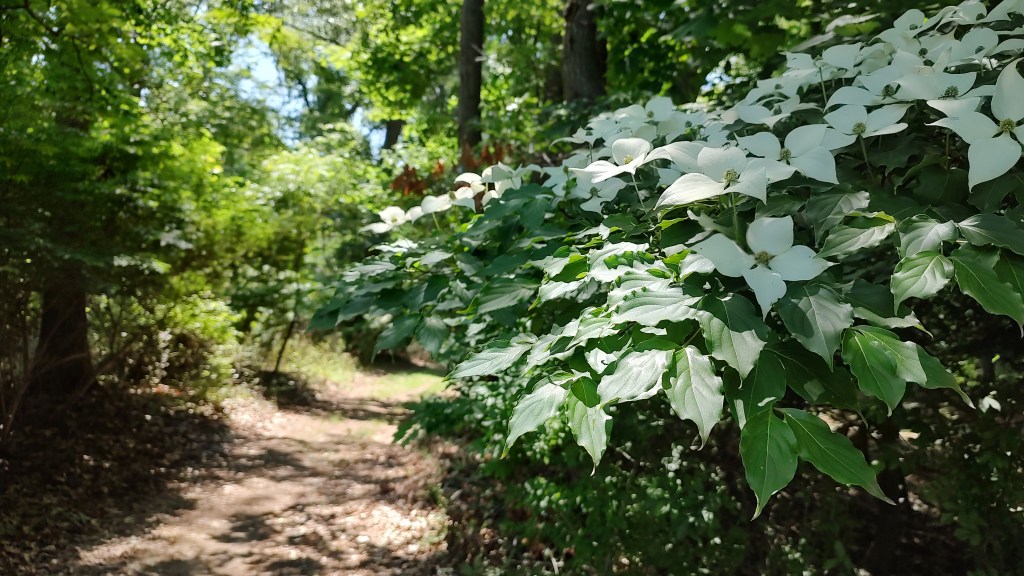
Autumnal equinox has arrived once again. Maples and dogwood are tinged with red, some of the ornamental shrubs have gone even further. Not sure what this one will be like. I remember a brilliant flaming fall in New Hampshire in the 1970s, when foliage almost hurt the eye. And more recently a few here on Long Island had trees just turn brown and drop.
Variety is one of the enchantments. Not only the seasonal changes, but also what kind of season it will be. Most such memories, at my age, are soon lost, embedded in similar long-term remembrances, but living through another period of cool creeping darkness and the Earth’s responses is always fascinating .
I try to greet each day with enthusiasm, each moment with zest. But it is rewarding to recognize the long swell of differing patterns as a solar cycle goes by. Makes a year resemble a lifetime. The coloring of leaves here is a fine marker .
Most songs and poems characterize Autumn as sadness. Winter is coming, harsh and dreadful. The joys of Summer freedom and carefree existence are gone. I never felt that way, and now even less so. I welcome the reminder of impermanence, and the cycles that overcome it .
So I go out and admire the views. Long forest vista, individual masterpieces on a twig. All part of glorious, miraculous existence. And I still appreciate them in wonder .

I do not believe there is or ever could be an absolute universal code of ethics for humans or the cosmos they inhabit. I do believe there is a code of ethics implicit in every civilization. This indicates what should be done even if it is not legally necessary. And cultural rituals enforce and recognize these ethics .
For example as a sign of respect in different places one may offer a handshake, or a bow, or a kiss on the cheek. Customs indicate how strongly one is affected by statements or arguments. Expectations of acceptable behavior when shopping range from blind acceptance of prices to extensive haggling. Beginnings of romances vary greatly. “Telling the truth” means different things in different situations .
Sure, laws are necessary. But the web of “ethical” behavior and its rituals may be the real glue of civilization. In fact, too many “petty” laws trying to enforce former common rituals may be a sign of the decline of any society.
People are, in general, surprisingly social. Amazingly adaptable. And generally quite content to “go native” and “when in Rome .”
A culture which has lost most of its ethical rituals and instead relies on enforced laws is probably not much fun. Rituals have a way of expanding personal freedom, which laws usually do not .

We inhabit an age of miracles. “Impossible” has become a label only used by those ignorant of possibilities. There is no quicker way to be labeled a curmudgeon than to tell someone their dream or plan is “impossible”.
We also live in a society that dislikes absolutes. Most things are considered “relative.” “Impossible” has about as as much finality as can be expressed. It can only be used when politeness no longer matters. The “impractical” then becomes very useful. Since it only indicates “almost impossible”, “unlikely”, “probably a waste of time”, it is relative and less forbidding. Telling someone it is “impossible” that they saw a fairy flying in the garden is nasty. It is much less combative to say it is “impractical to believe that unless proof is offered .”
“Practical” thus would seem to indicate high praise. But it also has limitations. It works best with the short term, familiar, and local. It’s practical to plan what to do tomorrow, less so to schedule a year, decade, or century from now .
Used excessively, “practical” is also limiting. Visions narrow, often too much. It is sometimes healthy to venture into the unfamiliar. Out of the rut. Maybe not quite “impossible”, but dreams that let us stretch .
Too complicated? Ah yes, why it is hard to teach children or reform ourselves. Hard, but practical and never, thankfully, quite impossible .