More paintings and info at: https://sites.google.com/view/cabinetofvanities
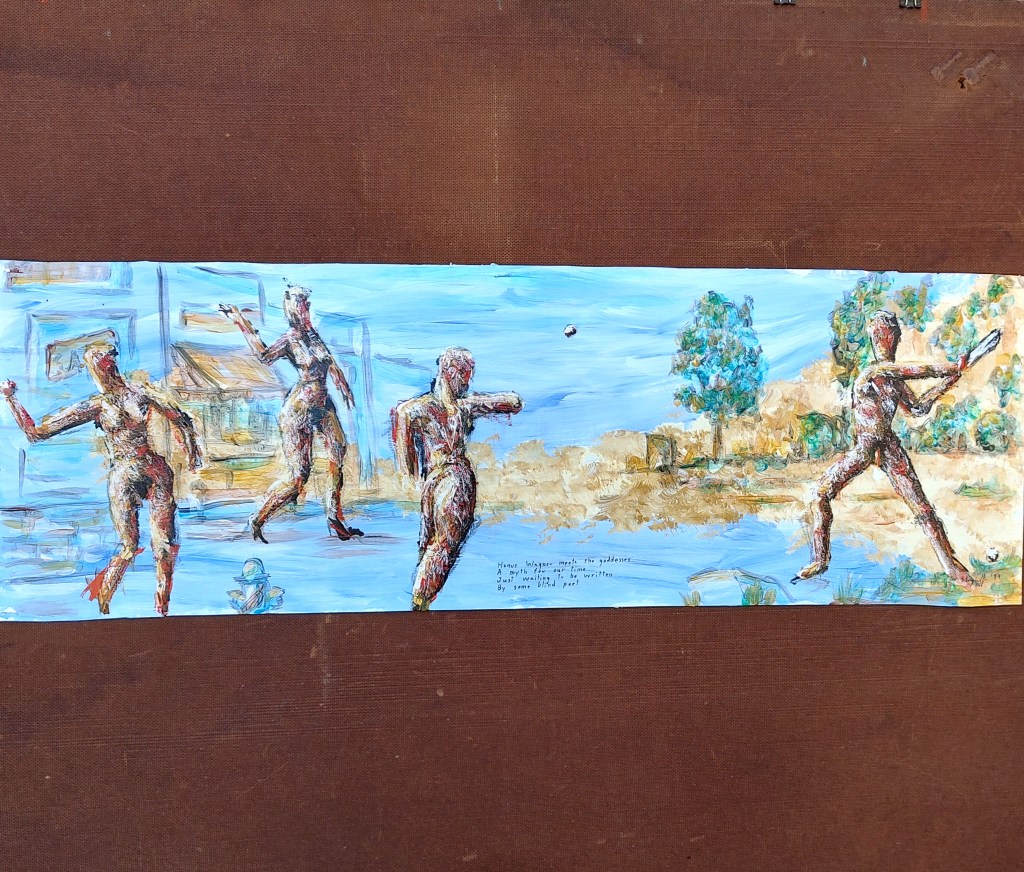
Acrylic on Canvas Paper, 1999, 12×36
Honus Wagner meets the goddesses/a myth for our time/just waiting to be written/by some blind poet
More paintings and info at: https://sites.google.com/view/cabinetofvanities
Acrylic on Canvas Paper, 1999, 12×36
Honus Wagner meets the goddesses/a myth for our time/just waiting to be written/by some blind poet

There are two main purposes for any government. One is to provide group security. The second is to maintain social stability. If either fails, government change will occur .
A new book by Phil Gramm claims government should avoid all economic interaction. Like most capitalist visionaries, he certainly does NOT mean that government should not protect property or enforce contracts. Capitalism, after all, requires a certain amount of coercion .
Most of us have come to agree that free enterprise competition, “within limits” is the best economic system. Yet even fervent capitalists agree that monopoly – a natural tendency of successful business – is hardly free enterprise. ONE fruit seller in the market is not the way to better product and lower prices .
But the second purpose of government is what is in question right now. How many limits (“regulations, taxes”) should be placed on capitalistic enterprises to assure security continues? Zoning laws, poverty relief, public spaces, protection of natural resources (air, water) and on and on. It’s not as simple as the narrow-minded ivory tower economists pretend .
Many of us believe that in the modern world of abundance, a certain minimum level of lifestyle should be provided to all adults and a high lifestyle to all children. Not doing so is not only immorally mean, but also a danger to our civilization itself .
More paintings and info at: https://sites.google.com/view/cabinetofvanities
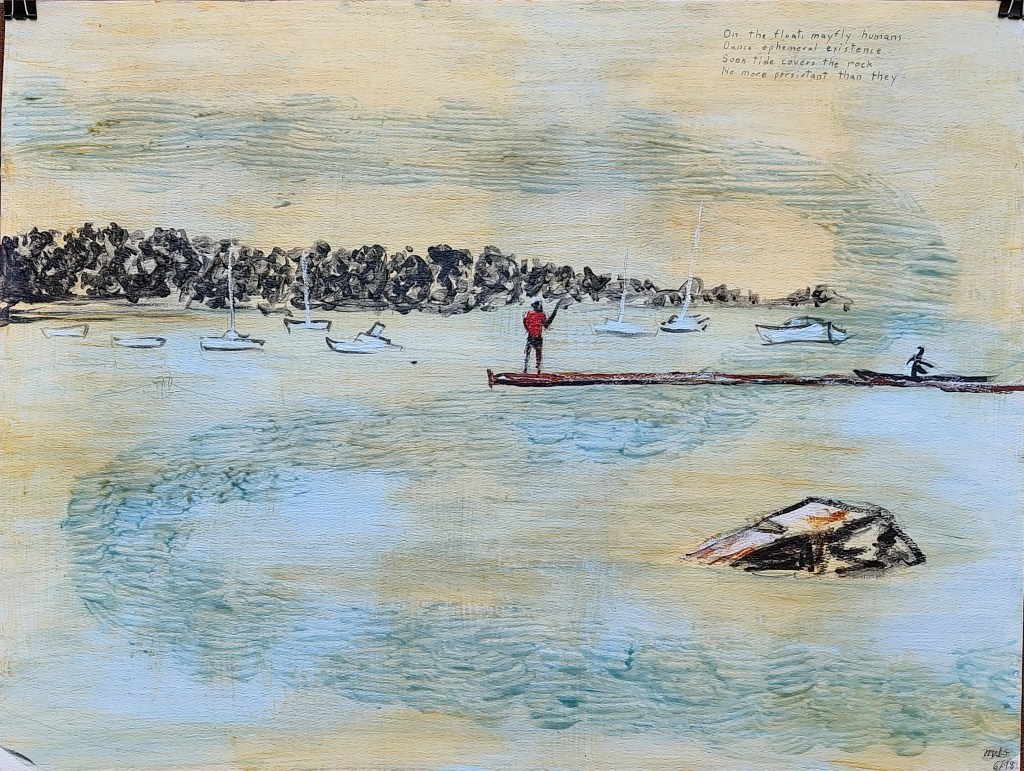
Acrylic on Watercolor Paper, 1998, 18×24
On the float, mayfly humans/dance ephemeral existence/soon tide covers the rock/no more persistent than they

As a modern scientific civilization, we used to think that we had put mythology behind us. Myths were simply fictional morality tales, a “primitive” form of literature. We did not depend on gods and demons, but on facts and logic. Not for us the strange and inexplicable rites of lesser cultures..
Of course, we found we were wrong. An open mind in an open society merely lets us pick and choose among the many mythologies available. In other cultures, you often do not get to choose. But we all live by mythology just the same .
It has been painful to watch the erosion of “fact and logic” over the last decades. People now believe “influencers” as they used to believe astrologers or witch doctors. They attend cable news as they used to go to religious service. Belief is founded on just-so stories and wishes and selected fragments of reality. In this environment, the masses seem to be as easily led as peasants in medieval Europe .
Human nature. Not easily tamed. We must believe in something. And if the reasons for belief in anything are questioned, all bets are off .
So this civilization is not the civilization I thought it was. The current mythologies are darker and more blood drenched. An open mind in an open society has gone with the wind .
More paintings and info at: https://sites.google.com/view/cabinetofvanities
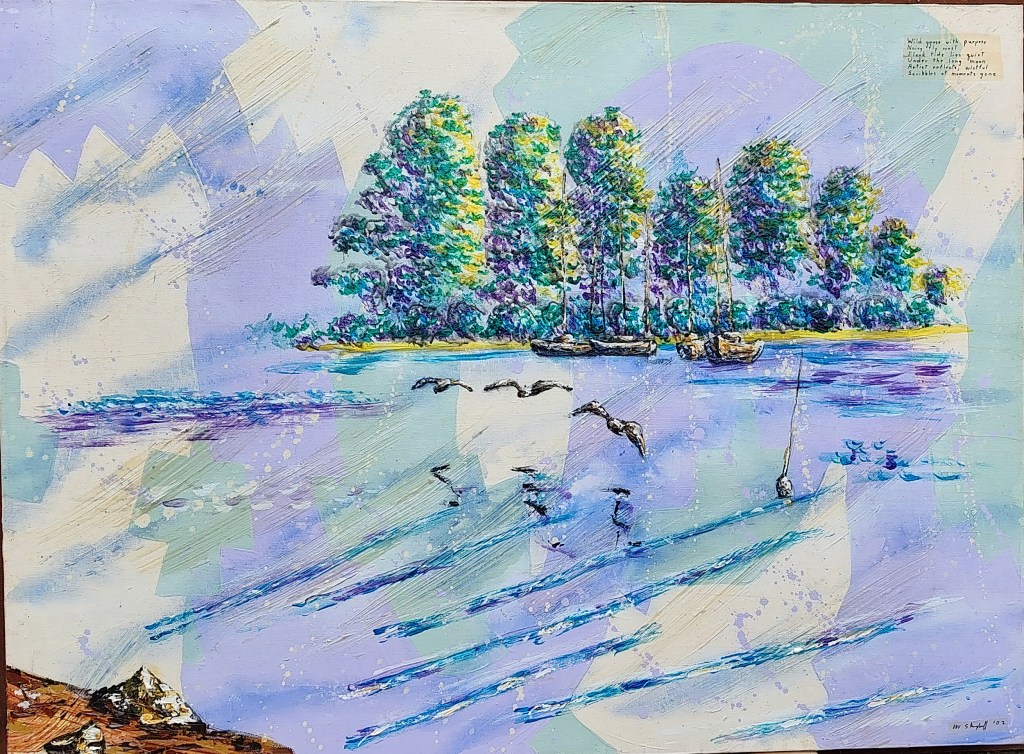
Acrylic on Canvas, 2002, 30×40
Wild geese with purpose/noisy fly west,/flood tide lies quiet/under the long moon/artist reflects, wistful/scribbles of moments gone.

Through many self-identifications with other people – especially artists – I’ve always come back to Rembrandt as one of the finest. Not so much for his immense talent – all my heroes have had talent way beyond my own – as for his immersion in a life filled with ups and downs .
I mostly enjoy the way all of his sketches – and how many of them there are! – live and breathe. Each capturing a moment, as often as not seemingly just for the fun of it. No grand idea of using them later – just pick up a pen or brush and engage.
Oh, it’s a grand conceit. But I like reviewing his life with all its disappointments and hardships, its occasional triumphs. Follow the posthumous evaluation of his major and minor works, right up to the current near deification after for a while being almost trash compared to all those Italians and later French .
Each of us can choose whom we admire, living or dead. Whether or not we are much like them. Pick appropriate characteristics to emulate (even though we may often be wrong objectively).
I find that Rembrandt is one of the few totems with whom I can easily reestablish a resonance. A fresh breath of air whenever my own spirit rises too high or sinks too low .

Or maybe dream and smash? Angry people often believe that every problem is somebody else’s fault. If they can’t find an avatar scapegoat, they blame immigrants, government, society, or vague cabals. Somebody is obviously making them victims, because they’re not doing as well as mommy and daddy told them they would .
So they dream of a better world, like most of us. But they are certain that vague and evil powers will stop their desires. So first they must smash and destroy everything and rebuild in the rubble for a glorious future .
Oh, sure, lots of people will be hurt and die. Maybe even they will die. But they will be happy martyrs, welcomed into their vision of eternal heaven, admired down the future ages. Happy imaginations .
Usually, they expect that right will prevail. A little because it must be true and right. A lot because its purity will make it a strong survivor. To be honest, most of the greatest smashers also believe they will remain since they are the strongest .
Finally successful. Mommy and daddy must be proud .
And now – all settles down to sweetness and light .
Finally, the right people in charge .
The more things change …
More paintings and info at: https://sites.google.com/view/cabinetofvanities
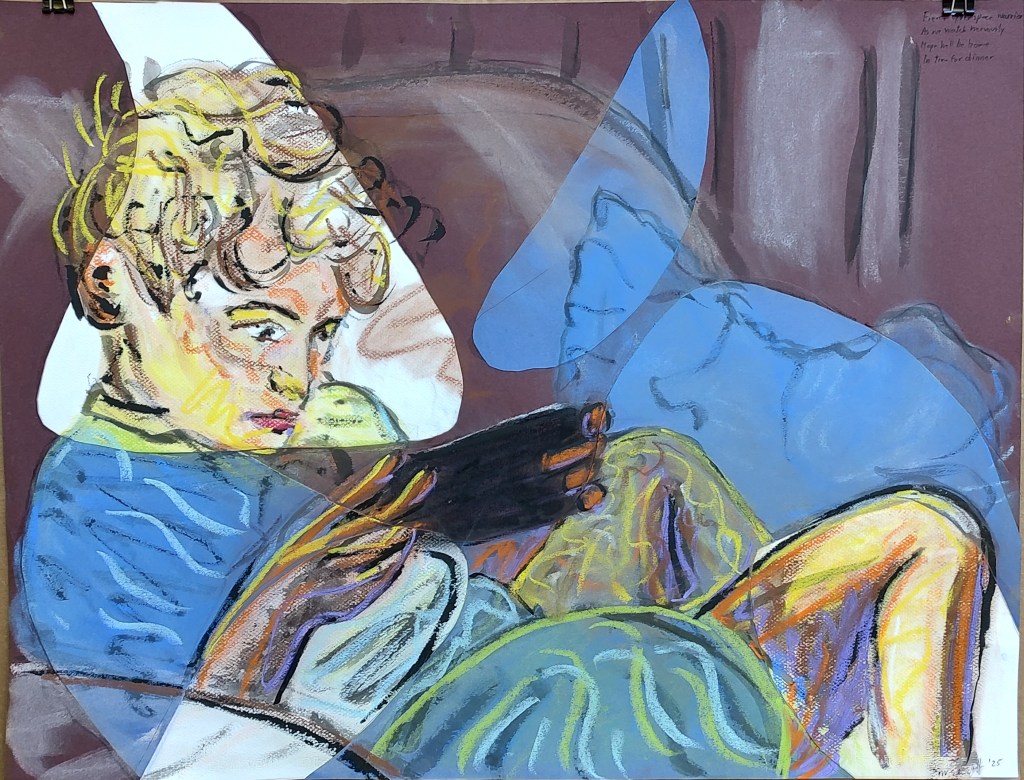
Pastel and Ink on Canson, 2025, 22×302025-PIC-20×26-044
Fierce cyberspace warrior/As we watch nervously/Hope he’ll be home/In time for dinner
George Orwell’s 1984 language easily fits the current government policy of how to treat “unpeople”. Those not worthy of being citizens by virtue of birthplace are easily termed unpeople, to whom few laws or rights apply .
The US has a long history of labeling certain groups as unpeople. The original inhabitants of the country, of course. Anyone with a non-caucasian skin coloration, at one time or another. Certain religious groups .
It’s sad but effective. Unpeople are – well – not really people like the rest of us. They are kind of like intelligent dogs, or possibly smart rats. There is no need to give them rights. They are criminals simply by inhabiting our space .
Furthermore, unpeople cleverly cheat us and use up resources which should be devoted to the real people, the good people, the actual humans. And unpeople breed like crazy, arrive in hordes, try to crossbreed and pollute the population pool.
It’s an old and effective way of appealing to the masses. Convince them that these or those unpeople are the source of all their troubles (rather than blaming the rulers of the country) .
Of course, with the speed of internet virtual transformation, any one of us could turn into an unpeople tomorrow
More paintings and info at: https://sites.google.com/view/cabinetofvanities
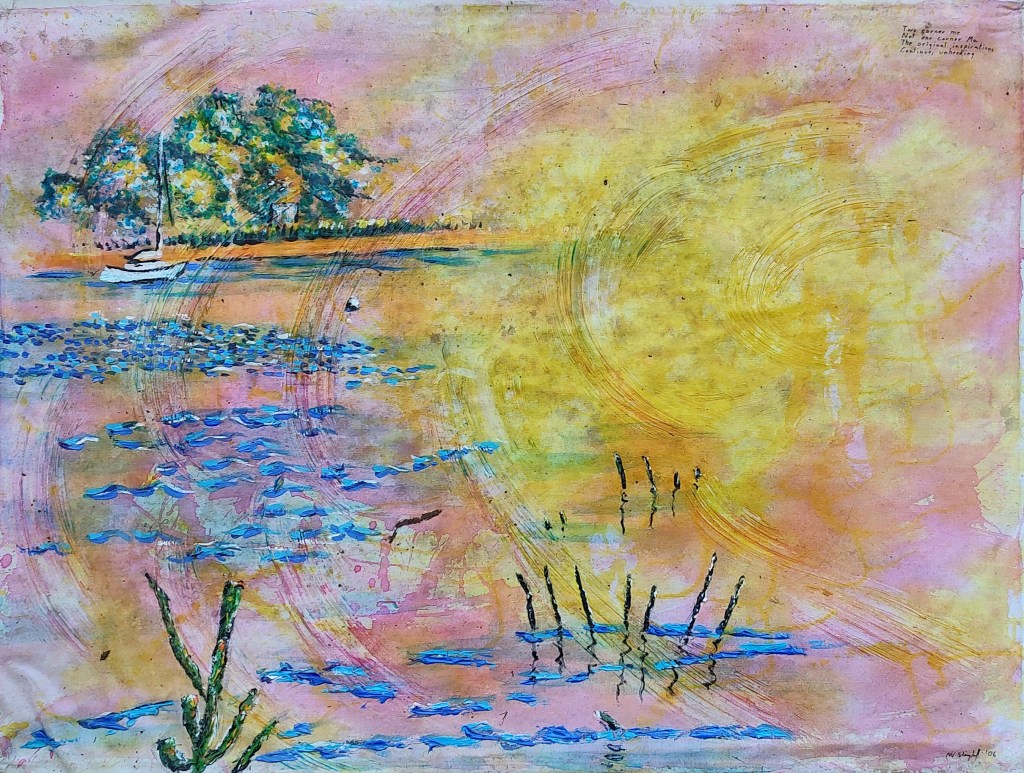
Acrylic on Canvas, 2006, 30×40
Two corner me/not One Corner Ma/the original inspirations/continue, unheeding.

