More paintings and info at: https://sites.google.com/view/cabinetofvanities
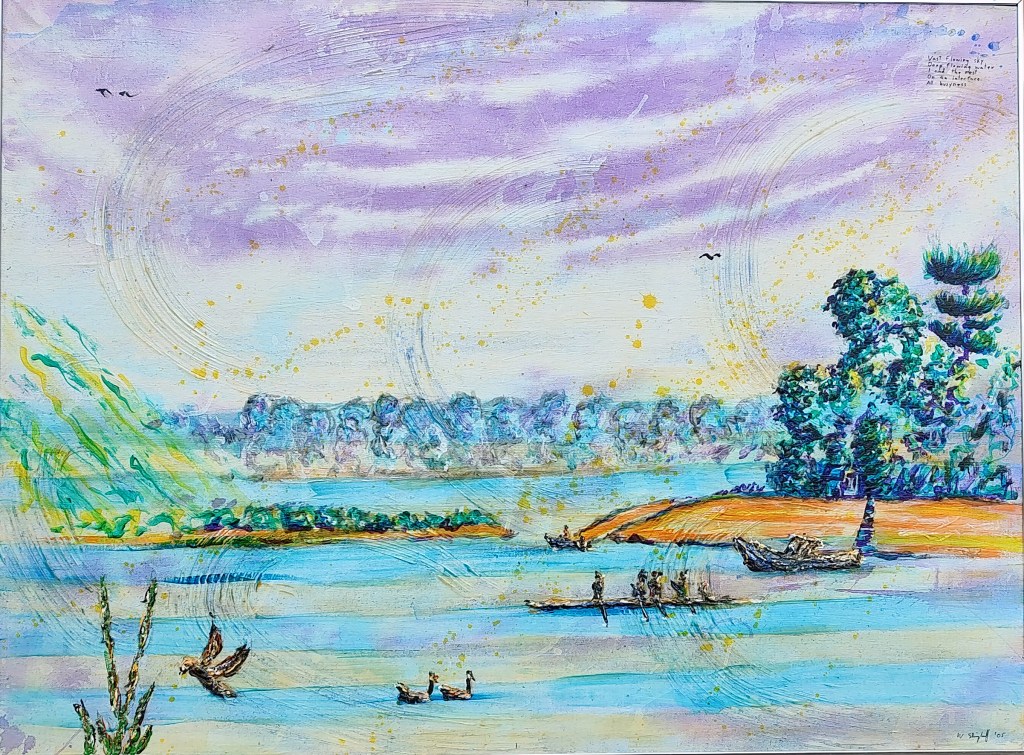
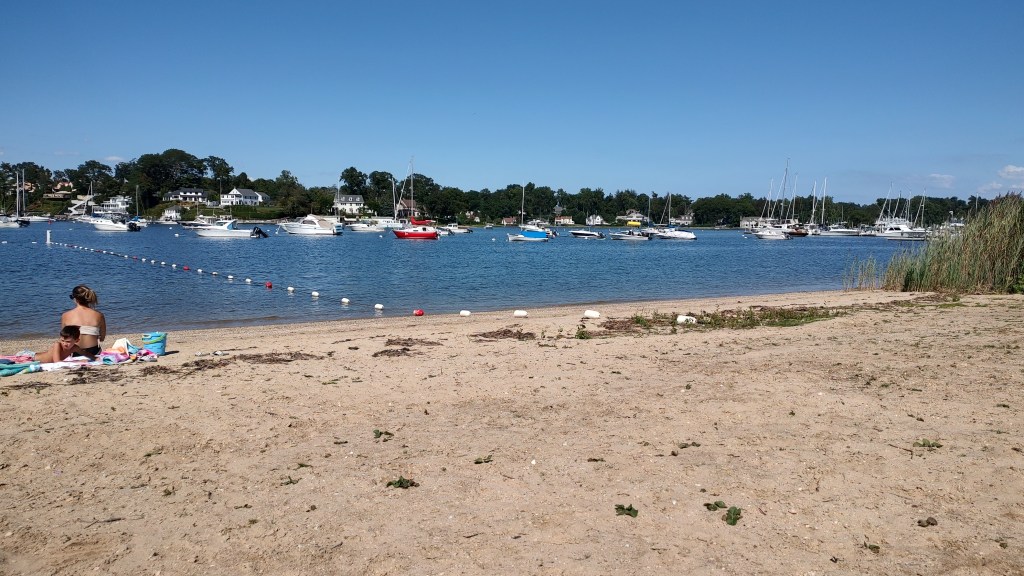
Acrylic on Canvas, 2005, 30×40
Vast flowing sky/deep flowing water/I and the rest on an interface/all busyness
More paintings and info at: https://sites.google.com/view/cabinetofvanities
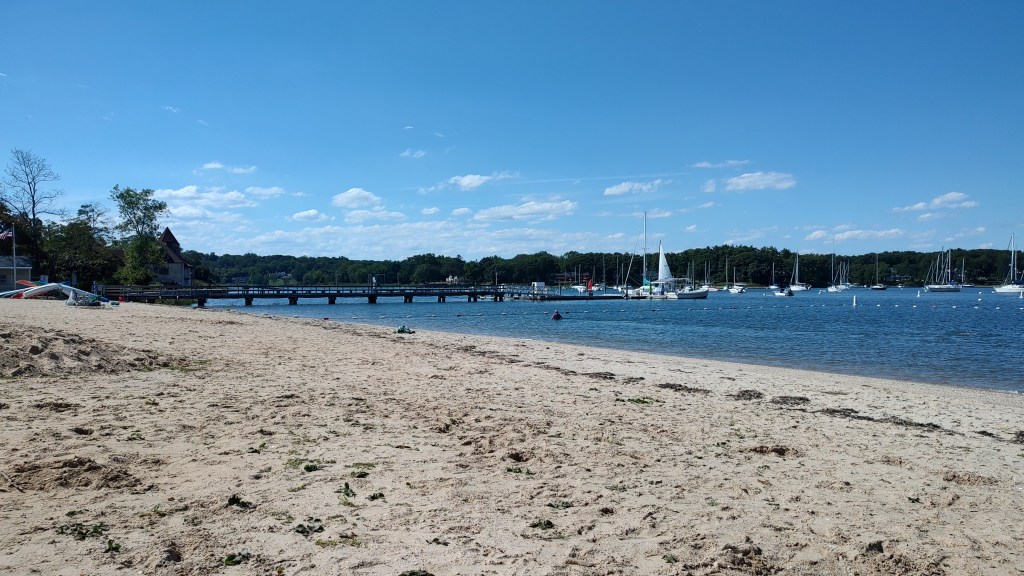
Acrylic on Canvas, 2005, 30×40
Vast flowing sky/deep flowing water/I and the rest on an interface/all busyness
July 4th was a family gathering, senior generations, young adults, grandchildren. As the younger folks spoke of ambitions, hassles, fears and the future, the elders reminisced about what had been and how magically much of life had happened .
Then the party ended and we elders went back to whatever normal lives we each inhabit. And I realized that in this culture – at least for the more fortunate – old age is a kind of coda on reality .
Finally we are free of admonitions about what to do, what we must do, especially what we are supposed to do. Mostly the young – even as they love us dearly – want us to stay out of the way as they race along their narrow paths .
Earlier, that was somewhat frustrating, as we were used to racing ourselves. But sometime in our late ’70s, life truly slows into rocking chair time at least for stretches of our days, however much we may regret it .
And what we learned at the party was to pull out the old memories and nostalgia and personal tales, since it is as raconteurs that the young treasure us most .
More paintings and info at: https://sites.google.com/view/cabinetofvanities
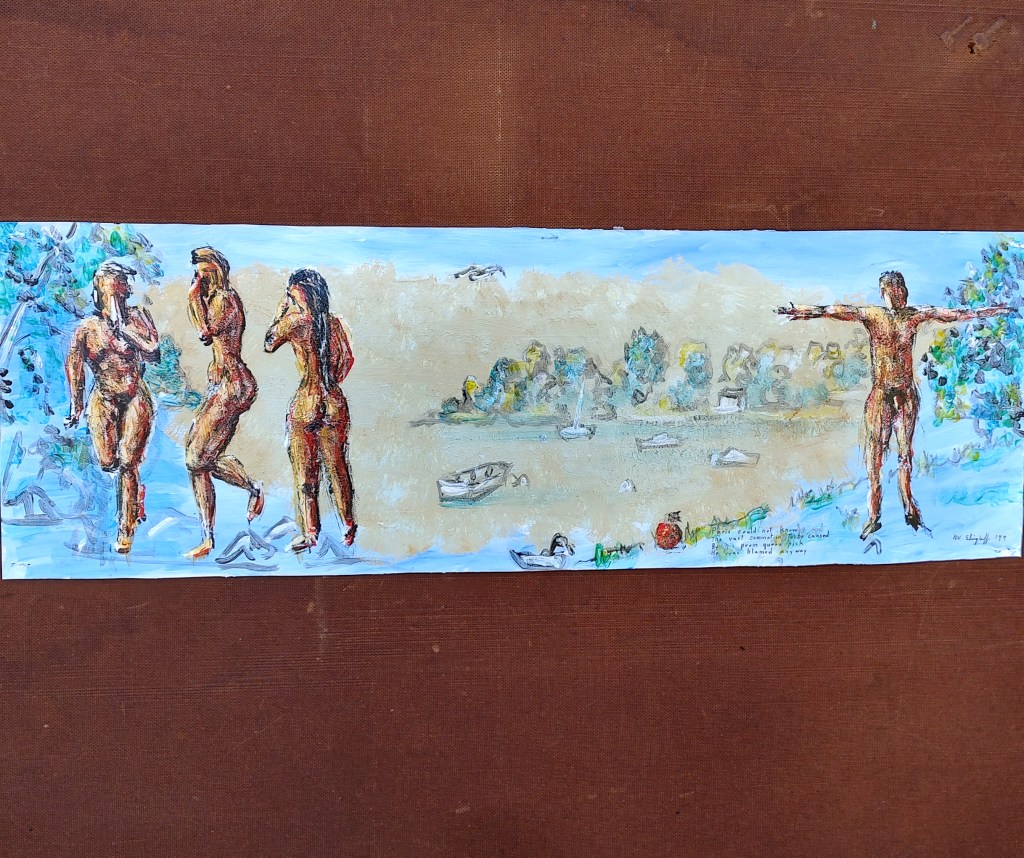
Acrylic on Canvas Paper, 1999, 12×36
Paris could not know/the vast commotion to be caused/by his prom queen pick/he was blamed anyway
All revolutionary, authoritarian, mob rule movements eventually come down to blaming someone else for your problems. MAGA voters are no different .
Once it was aristocrats, or Jews. Now it is illegal aliens who are responsible for crime, minorities who keep you from getting a good job, conspiracies which keep prices up, evil elites who burden good people with rules, fiendish Chinese who enable drug addiction. And on and on .
There’s a lot wrong with the world, and enough blame to go around. Now the populists are in power, rampaging like the directorate of 1793. No one and nothing is safe. There MUST be a simple fix to complex problems. SOMEONE is preventing us from using it .
But since the election, none of the cultists seem to ask: is crime down, are prices lower, are jobs better, does the future seem brighter, has anything actually improved in day-to-day individual life? The standard answer for all leaders in such a fix is “we have not gone far enough.” Punish more enemies. Check if they hide among your acquaintances, friends, family. Roll out the guillotines, send professors to the farms! Double down on what we are sure will work, somehow
It’s an old and continuous disease of every civilization that ever existed. We’ve never found a vaccine, cure, or antidote. Just plain human nature, I guess .
There are many things I do not know nor understand. Some are too complex for my humble brain. Some simply do not interest me. Many I am too lazy to waste time on. But a few have become truly impenetrable .
To me, impenetrable carries a different connotation than “unknowable” _ an article of faith. I accept many things as unknowable – the meaning of life, the purpose of the universe – and most of the grand religious philosophic questions like free will and the true nature of time. Impenetrable rather means that something may have reasons, but they cannot be discovered by me. The best example is other people’s hidden motivations.
The boundaries between impenetrable and unknowable are tenuous and shifty. Which gets to my main focus of this essay: the future. I always accepted its details as unknowable, but I thought I understood the basic outline.
Nope. Now everything is both unknowable and impenetrable. Next year seems a gray goo, with no connection to the present. I can project no trends .
That annoys me because as an avid SF reader from childhood and student of history still, I unaccountably convinced myself I had some idea of what was happening and where the world might be going .
No more .
More paintings and info at: https://sites.google.com/view/cabinetofvanities
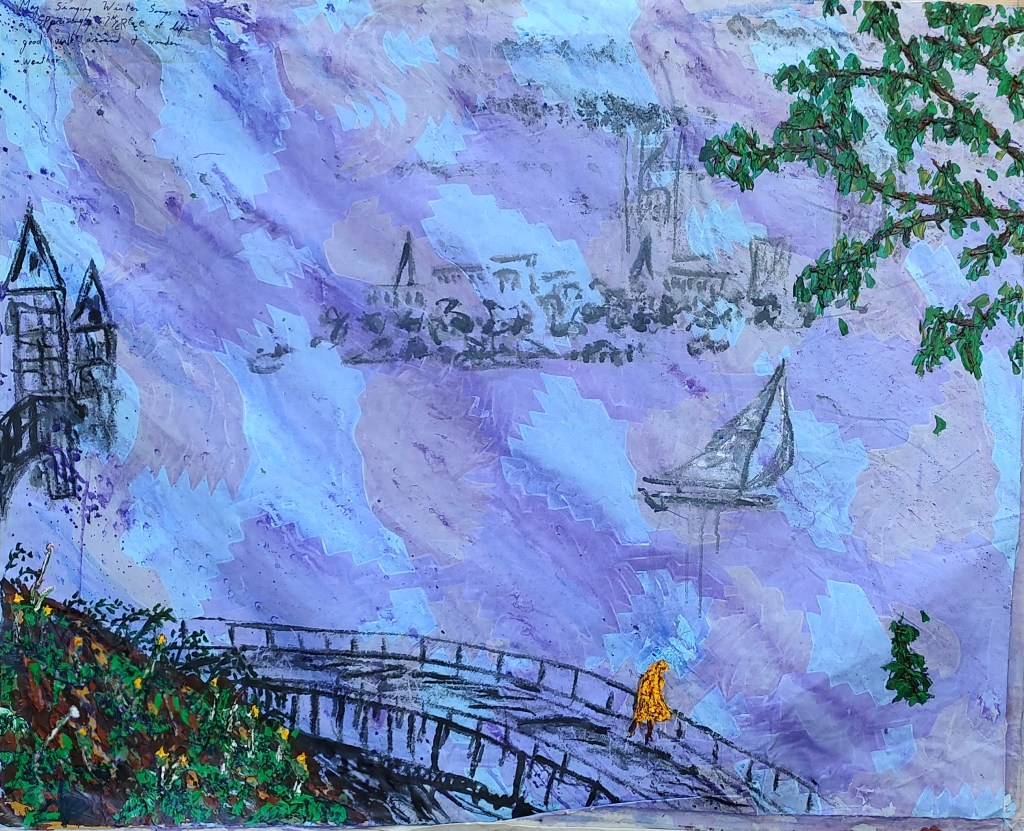
Acrylic on Canvas, 1976, 36×44
May singing winter songs/spring interface of life/good walk around and wonder/weather

Bureaucracy is where most citizens interact with any government. Naturally, it is usually hated. The functions may be necessary, but no one loves a tax collector. Including the tax collector .
In the modern world, bureaucracy is the most stable institution of government. “Rulers come and go”, the tax collector remains. Soon it is all wrapped into a hated “deep state”. Since the days of the ancient empires, no matter who gets in charge, a tax collector or other agent will show up. “Meet the new boss …”
Our founding fathers didn’t think much about bureaucracy. There’s nothing about it in the Constitution. Except for national defense (and even most of that) they left it as a local matter to towns and states. They just figured folks would be temporarily hired at need .
It didn’t work. Bureaucracy grew from the beginning. But who was in charge? Just as corporations became “persons”, bureaucracy magically turned into an “executive function.” That’s surely wrong. It really should be fully controlled by the legislature. One of the big – really big – powers of the presidency that is completely unchecked .
And now, after centuries of civil service reform, it appears to be reverting to a “spoils system”. The second leg (politicization of the military is first) of establishing authoritarianism .
More paintings and info at: https://sites.google.com/view/cabinetofvanities
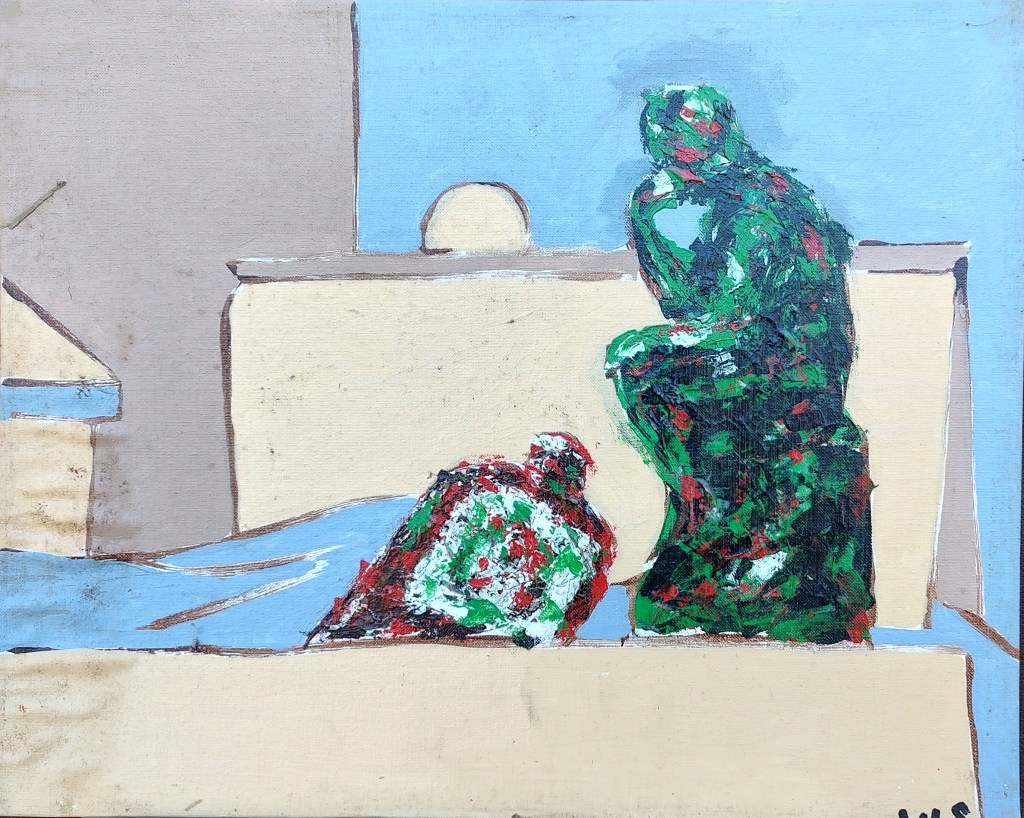
Acrylic on Canvas Board, 1970, 16×20
Still life
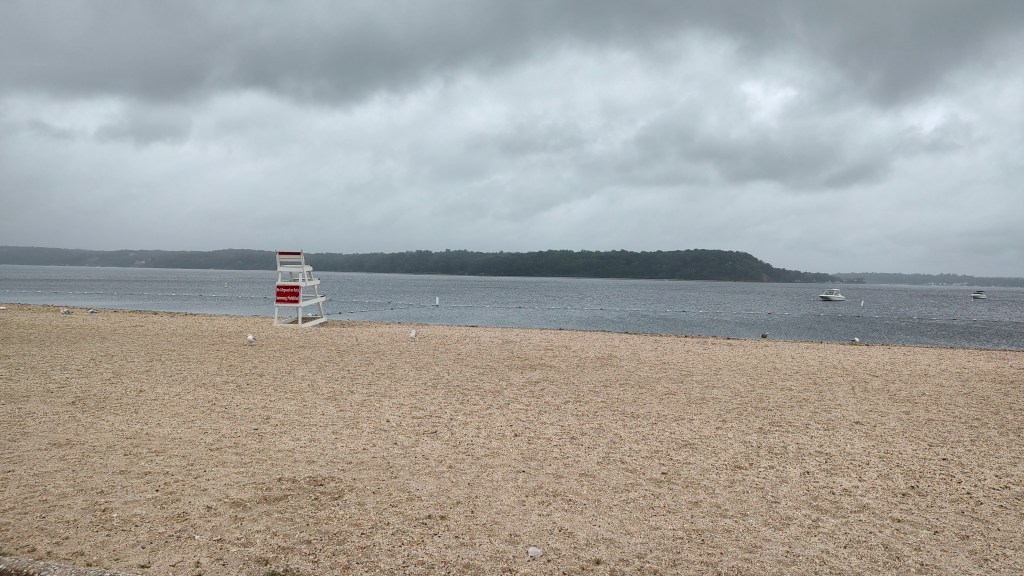
Roman and Greek morality looked back at an imagined golden age in the past and sought to emulate its heroes. A massive outlook change in Western culture (maybe science, industrialization, Christianity, or phase of the moon) had us looking at imagined futures instead.
There is now little respect for those who do not plan future growth. Yet I’ve been shrinking physically for some time now, shorter by at least an inch. My mental agility is declining. As I passed through my ’70s energy waned, senses were less sharp, memories became more important. I accepted that as natural, but society does not .
Young “whippersnappers” tell elders how active they should be, how they must engage in hobbies, how they must struggle to be better. Apocryphal tales speak of “old” people suddenly starting companies and becoming wealthy (although the definition of old seems to be creeping downward into the ’40s …)
In my newly engaged art pastime., I’ve decided to do away with future marvels. I simply want to use my reduced situation – senses and skills – as valid restrictions to construct unique artifacts. If my sight is blurred, let my drawings also be so. If my hand shakes, utilize that in my lines .
Not to get better in the future. Just to enjoy being a shrinking being as much as I possibly can .
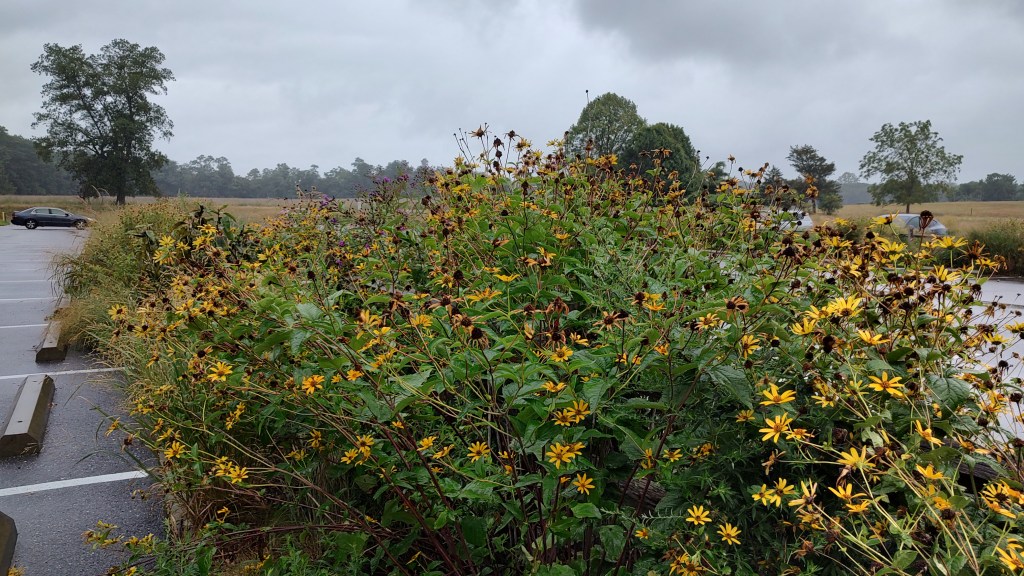
A paradigm shift occurs when former ways of thinking and living no longer work. In personal terms it means our common sense and traditional values no longer apply, and new ones must be created .
Joseph Campbell in his books on mythology made the interesting point that such historic cultural breaks often occurred rapidly (in about a hundred years) then settled in for a long time (thousands of years). A good example is ancient Egypt .
We seem to be in the midst of the whirlwind. Our thinking is forced into new patterns every year or so, sometimes even more often. And unfortunately, it is impossible to tell what will emerge or whether we will like it at all .
My point is that our times may be very unusual. After the dust settles – for better or worse – whatever system of thought survives may last for a very long time indeed .
Okay, a comforting long-term thought. But it doesn’t help each of us now as the storm rages and high waves rock the boat. All we can do is deal with changes as they wash over us one after another .
The curse of “interesting times”. At least we still have the option of imagining various happy outcomes .

