

More paintings and info at: https://sites.google.com/view/cabinetofvanities
Acrylic on Canvas,, 2000, 30×40
Dark clouds attracted me/white gull startled me/insistent wind endlessly/gusted towards tomorrow
More paintings and info at: https://sites.google.com/view/cabinetofvanities
Acrylic on Canvas,, 2000, 30×40
Dark clouds attracted me/white gull startled me/insistent wind endlessly/gusted towards tomorrow
It’s been all the rage for a while for organizations to claim they want to be “lean and mean”. Such a desire will apparently yield greater efficiency, keep costs down, lower prices. What could possibly be wrong with that ?
Not long ago, however, people actually prized other things. They ridiculed those who “knew the price of everything and the value of nothing”. Even today the wealthy expect services far beyond a “wham bam thank you ma’am” approach. We have begun to regret the loss to society as civility has been submerged by nastiness .
More than that, whatever the benefits to a private economic organization, such an approach has never worked socially. “Lean and mean” families generally fall apart or produce monsters. Lean and mean social organizations fail miserably .
So it is with government. As rich technocrats take over and seek to “streamline” everything, they fail to realize that the primary goal of government, as in families and social organizations, is not to produce a product at lowest cost, but to provide a service that keeps a culture healthy, whatever the expense.
Like many slogans, “lean and mean” is a shallow fad of limited utility once the shock wears off and the actual results are evaluated. Even most successful organizations learn they must find ways to happily engage as a collaborative tribal unit. But too often, a lot of things are wrecked before that happens. In a government, that is a massive, and perhaps fatal, tragedy .

Striving suburban schools in the early ’60s would push Latin and calculus on “college track” students. The idea was – as it had been for centuries – that at least it would develop logic skills, language flexibility, and help us think more clearly .
Nowadays these courses are rarely taught in public schools. For one thing there is less overt “tracking” of students supposedly brighter than others. But mostly, Latin and calculus are seen as pretty useless compared to all the things kids “really need to know“.
I admit I’ve rarely used Latin and never touched calculus in almost 70 years. In that sense, I suppose it was wasted time. And yet …
It is good to get a firm logical base. Video games, wrapped in sensory candy, do not have quite the same applicability. The dry, hard exercises of calculus forced one to confront bare bones rules. Latin required a completely new and foreign manner of thinking and writing .
I have over my lifetime frequently felt the effects of that intellectual workout during my adolescence. Clear logic and formal observation of patterns have stayed with me and enriched my consciousness .
I know it’s not for everyone, possibly gone for anyone, but perhaps another meaningful cultural loss in our downward spiral .

More paintings and info at: https://sites.google.com/view/cabinetofvanities
Pastel and Ink on Canson,, 2025, 9×12
Old shack long gone/Old man too/In nearer future/I, my paintings, also

People like to seize on the clearest and simplest explanations of phenomena. Things fall to earth because they “want to be nearer to it”. The Earth is flat. Those explanations are, actually, almost right. They are good enough for everyday life. They only fail if one is trying to predict something or control it. Malaria was associated, rightly, with bad air and swamps. Which just happened to also be filled with disease carrying mosquitoes. Avoiding the bad air in season almost worked very well. But it was useless for an eventual solution which required either draining or spraying the swamps.
I’m reminded of this with the MAHA fanatics, who once again want clean, simple explanations to complex problems. They point out that “science was wrong” in believing that COVID 19 was spread by infected air particles (largely able to be stopped by masks) when it was actually conveyed by tiny free floating viruses (against which most masks were useless). MAHA doesn’t believe science should ever be wrong _ if science gives incorrect advice it’s because scientists have nasty secret agendas .
Probably science has become much too complicated for most of us to understand. And it is still notably wrong or incoherent or provisional in many matters of health. So if flat earth and bad air were good enough for our grandparents, folks are sure they should be good enough for us .
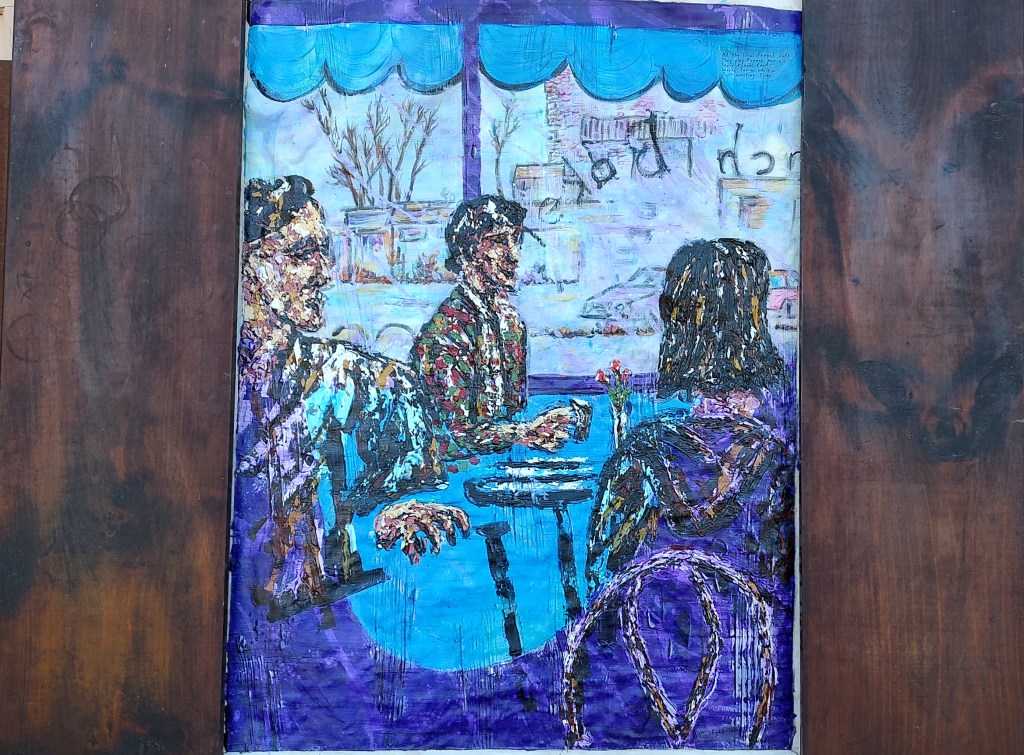
More paintings and info at: https://sites.google.com/view/cabinetofvanities
Acrylic on Canvas, 2005, 30×40
At the local French cafe/they play French music/serve French food/works for a while _ just wasting time
Now that rich white men have seized power, studying dead white men is all the rage. Mostly it’s a social signal to show who has “merit.” Among the things one must know to be admitted to the club is a gloss of Plato .
I’ve read Plato. I found him a boring ignorant old fool. As are the philosophical musings of anything written before the 19th century – particularly before Darwin and Einstein who finally placed humans properly in the universe .
I enthusiastically enjoy history. I freely admit that any human over the last 50,000 years could think as well as I do, experience life just as deeply. People are complex, amazing, and deal with existence in miraculous ways .
But logic – Plato is very logical, for example – is a tricky tool. Useful but easily dangerous. Politicians, preachers, and various madmen are always able to construct wonderful logical castles on completely wrong and stupid foundations. Plato sees visions of “real ideal” and imagines fairy tale perfect men who wisely use logic to rule everything. He includes souls and reincarnation. In fact, he has no idea of everything we actually know about – well – everything .
Oh, there are major things still unknown and maybe unknowable. The nature of time, the meaning of consciousness, the purpose (if any) of life. None of that related to the cold dead weight of writings such as the Republic.

Seeing seems completely obvious to us, but computer researchers have discovered just how weird it is. We combine binocular vision with experience to create objects – some as they are, some different, some imaginary. Nothing is really “objective” or “true”. More than that, we constantly select and focus. Our vision keeps constantly shifting second by second. We learn to find what is relevant to us. A hunter sees signs of prey or movement in the grass. A developer or general maps terrain to possible advantage. Artists look for patterns that are beautiful or interesting .
When I start to sketch, after a period of inactivity, the first thing I notice is how odd my results are. Stuff seems the wrong size or color. Nothing matches what would be on a photograph of the same view .
Ah, that’s a modern dilemma. Old paintings, especially pre-renaissance, had less strict rules – or the rules were different. Important people, for example, were usually larger than less important people. Certain conventions – “city walls” for example – were almost pictograms. Oh, some work was magnificently “realistic” – cave paintings, Roman mosaics, Chinese flowers and birds. But all saw in certain ways, and accepted certain conventions .
As do I. My sketches try to become more and more like photographs. I resist the tendency fiercely, but I am losing. That tension actually provides a lot of entertaining, engrossing, fun.

More paintings and info at: https://sites.google.com/view/cabinetofvanities
Acrylic on Watercolor Paper, 2004, 30×22
Deepest desire? Deepest fear?/just another pretty face?/you decide

Pop psychology asks “is the glass half empty or half full?” I’m a middling type, so I always thought “both”. I was more aware that by tomorrow the glass might be overflowing, dry, or broken .
I’ve led a fortunate life. One of the great gifts – unappreciated at the time – was a spell of near poverty when I was a young adult. It put some perspective into my outlook. Since then, I’ve always been much more keenly aware of the difficulties others have than of their imagined happiness .
It settled into “should be better, could be worse”. That philosophy has served well at work, raising a family, and now in retirement. Half empty, half full, no matter, adjust and seize the day .
Interestingly, most of it is a simple mental adjustment. After all, a monk sworn to poverty can be quite content. Wealthy people with the world at their fingertips can be neurotically miserable. I’ve cultivated a sense of permanent contentment, as opposed to the militant envy screamed by this culture and its commercials .
Anyway, there the glass sits, inertly evoking whatever mood we desire. That trick of permanent uncertainty and our ability to control how we feel about it is one of the greatest glories of being human .
 HuntingtonHarborThoughts