

Acrylic on Canvas, 2001, 30×40
Election day is coming/volunteers snag passers-by/the candidate shakes hands/balloons fly/life goes on
Acrylic on Canvas, 2001, 30×40
Election day is coming/volunteers snag passers-by/the candidate shakes hands/balloons fly/life goes on

An old science fiction novel called the sun “lifegiver.” Obviously true, because without the sun (exactly as it is and has been) there would be no life on Earth, never would have been any life on Earth, never you or me. If it went away this afternoon forever none of us would last long .
Science simply confirms what is intuitively obvious. Solar mythology has existed throughout history and surely long before. Sun dictates our lives, better or worse. At sunset it is normal to evaluate the events of the day, at sunrise it is easy to rejoice .
The sun commands an austere respect. Its location and path cannot _ even in the most fevered visions – be changed with prayer or other magic. Asking it for rain is futile – better to beg clouds – even though without solar evaporation there would be no rain ever .
Now we are ” sophisticated.” We create light in darkness. We know the sun is “just” fusion energy. Some of us concentrate on more important things (like the internet) and ignore it except on special occasions .
A lot of the time, the sun helps me concentrate my exaltation in being conscious. I try not to take it – or anything else – for granted. It is a wonderful aspect of the universe on which to center. And it demands nothing more – or less – then that I be enchanted with being .
Lifegiver indeed .

It’s a truism that the military always prepares for the last war. A new element is that our current leaders want to prepare for war as depicted in movies and video games. Manly men who can savagely destroy all opposition with increasingly massive personal weaponry .
Of course we’re not quite sure what the “last war” was for the US, but we didn’t seem to win it. On the other hand, the Ukraine conflict seems to prove that any tween in her city bedroom can wipe out a squad of bazooka toting cowboys with a remote drone strike .
And if a “real war” starts, both the cowboys and tween are one nuclear blast – delivered hypersonically – away from oblivion .
But manly men want jobs and the military life seems to fit a certain psychology. The problem is that building an elite group of well-paid volunteers (aka mercenaries) who follow politics – which seems to be the current goal of the administration – will surely lead _ as it always does (witness the Praetorians, Mamalukes, Janissaries) _ to that cadre getting rid of leaders they don’t like (i.e who don’t pay them enough .)
Obviously, I am hardly a fan of manly men syndrome. But personal squeamishness aside, I just think the idea is ineffective, historically inaccurate, stupid, and based on adolescent male fantasies .

The classic “idiot savant” is an individual whose brain is wired differently. Brilliant at something – math is a frequent example – but unable to shop for food. We have expanded the idea into “spectrum” to account for the fabulous complexity of human consciousness, but the idea remains useful .
Thus I imagine a new breed of idiot savant, less based on basic brain wiring (although of course genetics may be strongly involved), and more on shallow but focused training. Such a person can become rich and even powerful, but treats other people as if they did not exist – or rather exist only as other objects like rocks or bacteria. Because of such focus, that idiot may have undue influence on society. Like any other amoral cripple, that person may have disastrous effects on everyone else.
Unfortunately we have been educated to admire financial success more than social success. Making more dollars seems much more important than making people happy. We easily offer excuses for the worst behavior of billionaires .
Worst of all, we have let them advance to become rulers, where they fail miserably.
Government is about people, not money. But the “idiot savants” never learn that fundamental truth .

I appreciate democracy (if rights are guaranteed to the minority), and respect people’s opinions as much as I do my own. But I find polls on issues increasingly silly. A good example is one of the current favorites – “is this country on the right track or the wrong track?”.
In my experience, if asked how I feel about the world in general, on any given day my reply might vary considerably. Actually, it might change a good deal from hour to hour. And ” how do I feel” is at least a pretty firm question .
But ask me if I am on the “right track” or not and I would be pretty lost. The thing is, a track goes somewhere. So the first question implied is do I think there is a single destination like Chicago or am I just “heading west.” And am I sure that’s where or the way I want to go?
The second problem is momentary detours with good reason. I want to get to Chicago but this train is heading for Pittsburgh. Is that bad? If it’s heading south to avoid a mountain range, is my journey going wrong? And trains? Tracks? Who uses tracks anymore anyway. So restrictive.
But okay, all of that, bundle it up, maybe I can give an answer in personal terms. But a whole country,? Everyone? The vast future? This is a ridiculous and meaningless waste of time.
But folks like to believe in something. At least asking about non-existent tracks is relatively harmless
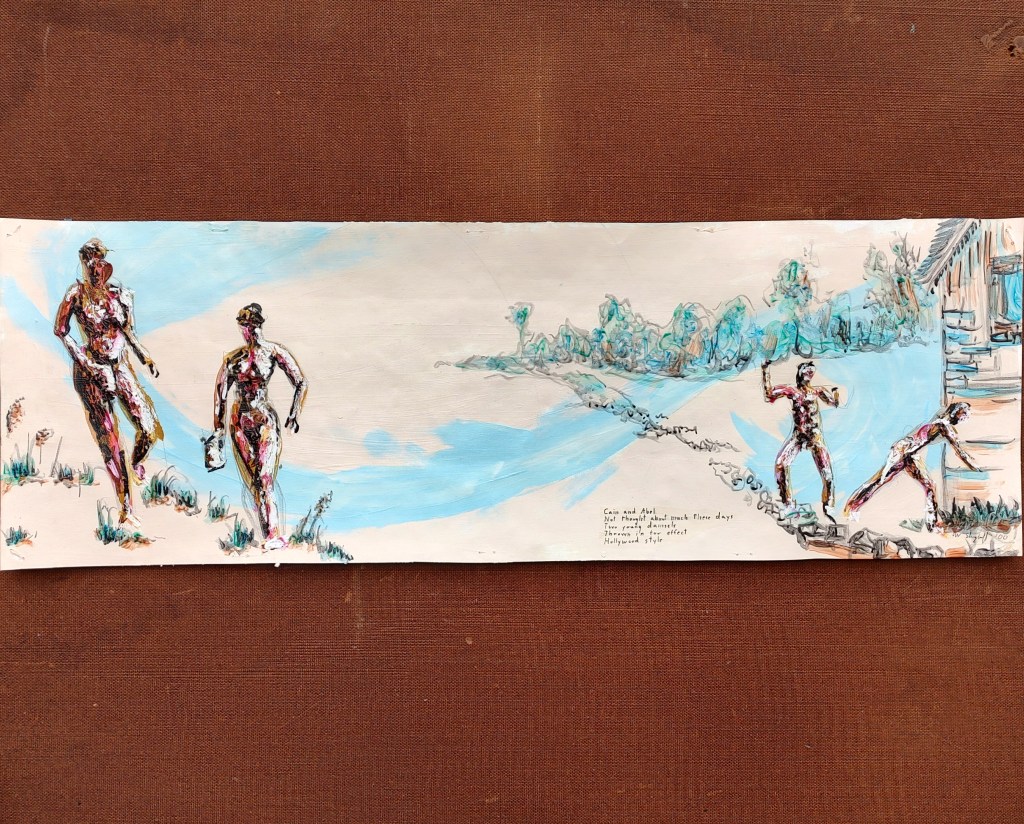
Acrylic on Canvas Paper, 2000, 12×36
Cain and Abel/not thought about much these days/two young damsels/thrown in for effect/Hollywood style
Before writing, humans seem to have existed in almost perpetual ” dreamtime”. There was today, tomorrow, yesterday – and awareness of seasons. But the idea of long time was irrelevant. The world was and is as it always is and was .
Writing gradually evoked a sense of time, a knowledge of change. Rulers followed known rulers. Cities waxed and waned. Heroes might be remembered for a while.
Eventually civilizations got used to the idea that all would be judged somehow in and by eternity. It might be gods, or universal spirits, or culture or history, or simply some limited posterity. That would be preserved forever as a slice of eternity. Such gave meaning to life.
The subsequent loss of really long time perspective created one of the profoundly deep and usually submerged sicknesses of our culture. An engulfing pessimistic nihilism overlays our actions. The gods have dissipated into geologic eons. Nothing – not even the sun – remains forever. No judges, no long-term legacy. Only the insane believe that what they do or do not do matters at all in the long run .
In fact, we need to adjust to this new mental reality of inhabiting dreamtime once more. What we do is what we do now. We can remember our past, in the future we can remain proud of those recent achievements, we can strive so we have happier future memories.
“Legacy” is currently reserved for use by charlatans and others seeking any way to gain or maintain immediate power .

Acrylic on Canvas, 1974, 42×42
More paintings and info at: https://sites.google.com/view/cabinetofvanities

It is well known that we establish certain likes or dislikes at definite ages. Boys center on sports attachments around 10 or 11. People tend to enjoy the music of teenage years as long as they live. It is, of course, possible to change, but there can be a lot of resistance .
Cultures too have some of that stickiness. Religions are long-lasting but centered on origins. Nation states have a definite point of origin and tradition. And then we have social cults like the Amish.
As far as I can tell – I’m too lazy to investigate on Google – the Amish basically picked a date around 1880 as “thus far and no further”. Anything invented before that, fine and dandy. After that – just frivolous garbage .
We may laugh at the arbitrariness of the cutoff, seemingly picked at random without much real logic involved. Yet I have found myself doing the same thing. An old “neo Amish” gentleman. The “new stuff” is “stupid and irrelevant” and just makes me crazy. Current music, film, food, fads – I ignore them all. I froze my electronic usage about 10 or 15 years ago. I like older books. And I don’t care – let the wider world go down its own devil’s route .
A complete curmudgeon. I still enjoy complaining with my peers. But I float along in my neo Amish nostalgia, content with the memories in my own life. And all the things that I accept as necessary. From that personal arbitrary cut off point years ago.

It can be useful to be reminded of both the age and impermanence of the world around us. For those of us aware on Long Island, that is pretty easy. This is a “new” land, formed of sand debris as the last glaciers melted, raised from the ocean when the continent lifted as it was freed of the weight of the ice. Perhaps soon to be submerged by rising seas .
European history here is almost ancient (by European standards). Over 400 years ago – Louis XIV was just building Versailles – the town of Huntington was founded. Before Napoleon, the British defended the island fiercely .
They captured Nathan Hale on the shore line here. They smashed a graveyard to use as a cannon emplacement. And from sandy bluffs, they practiced gunshots at Target Rock, a large erratic boulder lying in Lloyd Inlet .
People and politics come and go. The rock is still there, preserved from use and indignity by its “useless” location. Now the center of a wildlife refuge formed from old Gold Coast estates destroyed by time and taxes .
I love to visit in all seasons, enjoying the trees and birds and wind and shells. Become aware once again of the impermanence of life. Enjoy the connection to “olden times”. Imagine being a native American, a colonist, even a wealthy owner in the gilded age .
But, quite honestly, mostly happy to be exactly like that rock. Contented where I am .
 HuntingtonHarborThoughts