
More paintings and info at: https://sites.google.com/view/cabinetofvanities
Acrylic on Canvas, 2002, 30×40
From infinite space/in forever time/only this place/only this moment/only myself
More paintings and info at: https://sites.google.com/view/cabinetofvanities
Acrylic on Canvas, 2002, 30×40
From infinite space/in forever time/only this place/only this moment/only myself

I’ve just finished volume three of Gibbon’s Decline and fall of the Roman empire. I know I probably skimmed through it many years ago, when I purchased the full modern library edition. But his story is far from the “gladiator” cliches .
Consider the examination of human nature. Gibbon considered the Roman empire to have functioned continuously until the final fall of Constantinople to the Turks in 1453. He reviewed extensive documentation regarding the follies of ruler and ruled, wise men and fools, passions of the day, and the odd beliefs that motivate people to good, evil, or simple daily life .
Lately, I’ve become enamored with historians like Gibbon. They were not so focused on comparisons to today as our current writers. They could be very intellectual, assuming a certain degree of decent education for their readers (which, alas, current writers cannot.) And they were unafraid in calling things as they saw them (although Gibbon did have to be obscure about sex and coy about Christianity) .
All that makes for a deep, provocative, powerful read. I took my time this time through. Much more engrossing than modern digital melodramas. Made me appreciate my own life and times all the more .
A grand subject, to be sure. An obsessive historian, sometimes tedious and confusing (all those names! Dates! Events!) But now, what a fine thing to rediscover .
Laws and regulations are both necessary and infuriating. It all depends. We imagine they have been around in one form or another forever – sometimes as traditions or taboos, sometimes merely as the whims of the strongest ruler or group. It is impossible to imagine a society without them .
And that is really the key to the problem. Because with social tribes, we imagine things to be more fluid. “Let me do what I want or I’ll go somewhere else!” We believe that as civilization takes hold, every individual becomes encrusted with responsibilities and prohibitions until he or she cannot breathe. “What is not mandated is forbidden .”
We further imagine the frontier as freedom. Cities are confining. Run away to open space, where each can do as each desires. There may be some truth in that, but people are complex. For some reason, throughout history, folks often ran away from rural pastures and small farms to the great cities .
The advantage, of course, has been anonymity. In a city you feel free because the mobs (usually) don’t know you. In spite of those pesky regulations on everyone .
Regulations do tend to hinder innovation and progress. Keeping them “under control” or focused on “common sense” is difficult. Yet cities usually manage to work it out .
It’s when the rural yokels with little experience take charge and get rid of regulations that things really fall apart .
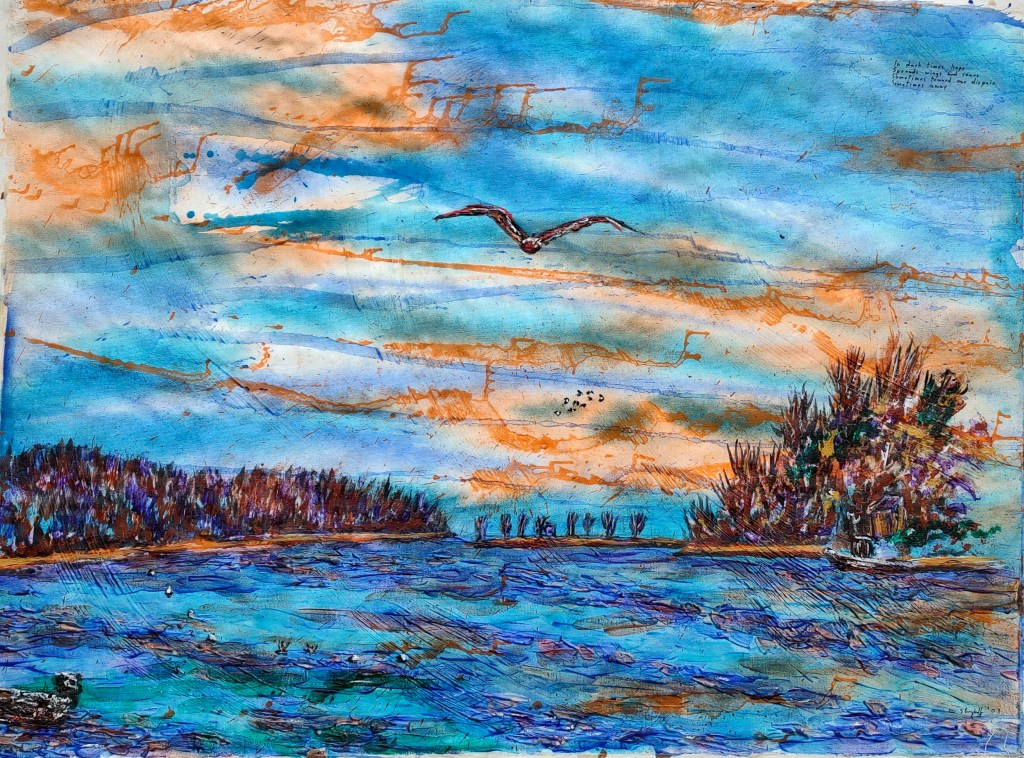
More paintings and info at: https://sites.google.com/view/cabinetofvanities
Acrylic on Canvas, 2003, 30×40
In dark times hope/spreads wings and soars/sometimes toward our despair/sometimes away

“Giving someone enough rope to hang himself” seems to be the current position of the opposition party. Sober and sensible people can see that what “he” is doing is totally wrong, but he’s convinced himself and others that he can pull off a miracle .
In some cases, it’s true that active opposition is useless and often counterproductive. It’s the nature of braggarts to blame others when they fail, and who easier to blame than those who worked against the plan. A glib orator can even carry a lot of his charmed audience along with him .
So let him do what he will and then pick up the pieces after the inevitable destruction .
The problem, of course, is that sometimes the person with the wrong vision is totally drunk and going to drive you home in his car. Giving him enough rope to prove he’ll wreck the vehicle and kill others may end your life as well. Not to mention being morally wrong to let him drive under any circumstances .
We are already in the car. I understand that the “enough rope” approach is tempting. I truly hope it ends short of disaster .

More paintings and info at: https://sites.google.com/view/cabinetofvanities
Pastel and Ink on Canson, 2003, 20×26
“Everyone complains about the weather, but nobody does anything about it.” In this era of massive technology, scientific hubris claims we can . Geo engineering concepts abound, from seeding the oceans, to sulfuric acid clouds and/or reducing certain gas emissions .
So far, it does seem the climate is more extreme. Bigger storms, major variations in “normal patterns.” Pretty clearly this is not simply “better weather reporting”. But equally, it is not immediately disastrous to everyone, nor an existential survival threat .
It may be humanity can change things. If not, some small fragment of our bloated numbers could probably survive anything. Famine and catastrophe first, of course .
But what does it mean to me and you? Obviously most of us should avoid building or living in river valleys or on sandy barrier Islands, among other adjustments. But personal changes are largely symbolic, especially if they are not normalized for everyone.
Brushing my teeth more quickly or dashing in the shower do nothing unless everyone is forced to do so. Also what kind of car I drive or what I eat. Giant problems, unfortunately, require giant solutions. Feeling virtuous about my CO2 footprint is like feeling lucky when I throw a coin down a wishing well .
In the meantime, I better fix my leaky roof.
Digital technology surrounds us, and becomes more immersive by the day. As a person who had a (relatively) happy career programming computers in the good old days (ie until 2010 or so), I should enjoy the advances.
Besides it’s silly to rant against so useful a tool. Might as well claim walking is better than one of those newfangled wheeled contraptions, memory is ruined by written words, or the pride of John Henry is lost to steam machinery. Digital aids are very useful .
I guess my main concern – outside of how radically they are changing society – is their fragile nature. An awful lot of things can make them fail in minor or catastrophic ways.
“Oh come on!” you yell – organic stuff, including especially people, fails all the time. Makes mistakes, dies. That is quite true .
The difference is that life is based on dealing with the unexpected. Organisms have embedded feedback and repair systems that work remarkably well. Adjustments to changing environments usually happen. Life seems almost impossible to create from scratch, but once started it is very hard to stop. Even people are tougher than we usually think .
But digital technology? Especially remote centralized AI? I wonder if it is too much, too soon, and all eggs in one fragile, dizzy basket .
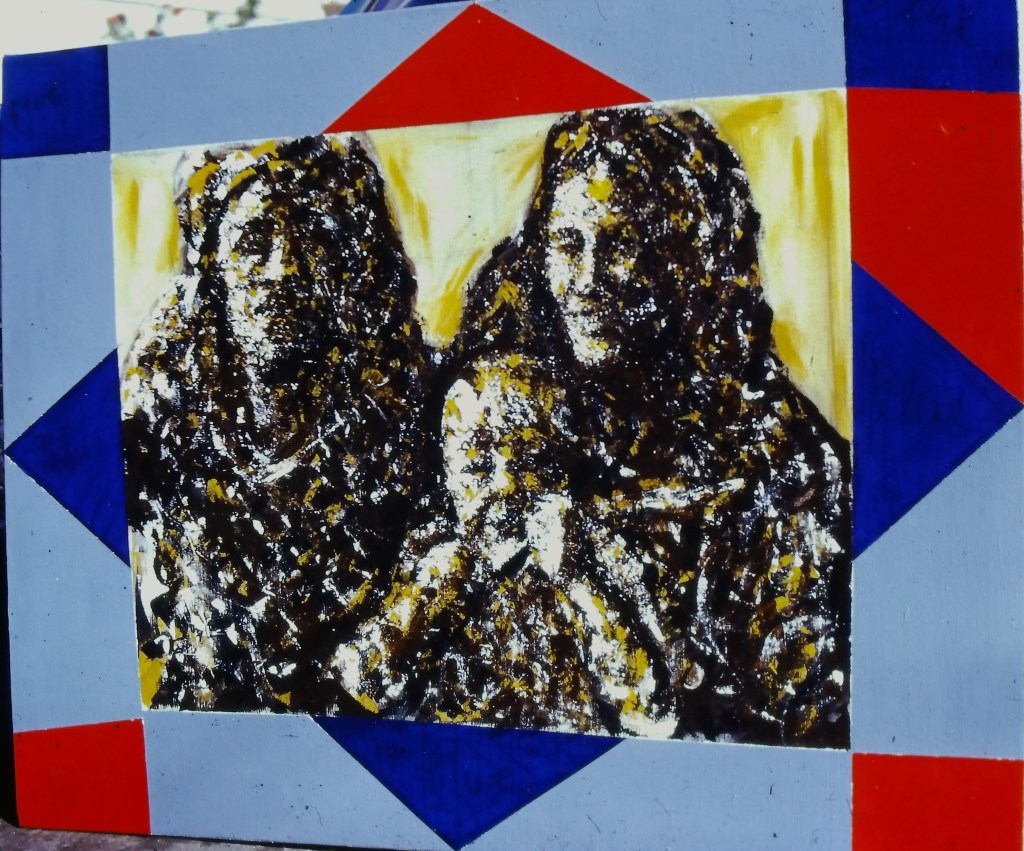
Acrylic on Canvas, 1970, 30×40
Jonas Family Portrait
As a would-be visual artist, I was always annoyed that once a painting was sold nothing remained to the creator. Music and film had “residuals”, books had copyrights. But once a painting was sold (or traded for a meal) the new owner had any right to its future earnings – even if it sold next year for millions of dollars .
Digital copying has evened that out, of course. Very little remains to most originators. Truthfully, even at its peak, most of the people helping the prime creator – backup musicians, studio assistance, even gallery owners – never reaped a future windfall .
Now the art market is entirely strange, where a banana taped to a wall can sell for 3 million. Some of this is simply potlatch behavior from the filthy rich “look what I can do”. Mostly, though, in certain areas – again among the wealthy – it is simply that demand is high everywhere, but supply of most tangible things is vast_ even gold and diamonds once precious. So anything in limited supply – actual painting from a known artist, Bitcoin, ancient automobiles – skyrockets in value .
Why? Mostly so those people can taunt each other with calls of “I have it and you can’t!”
Fortunately, for most artists, creation is its own reward. As, indeed, it must be .
 HuntingtonHarborThoughts