
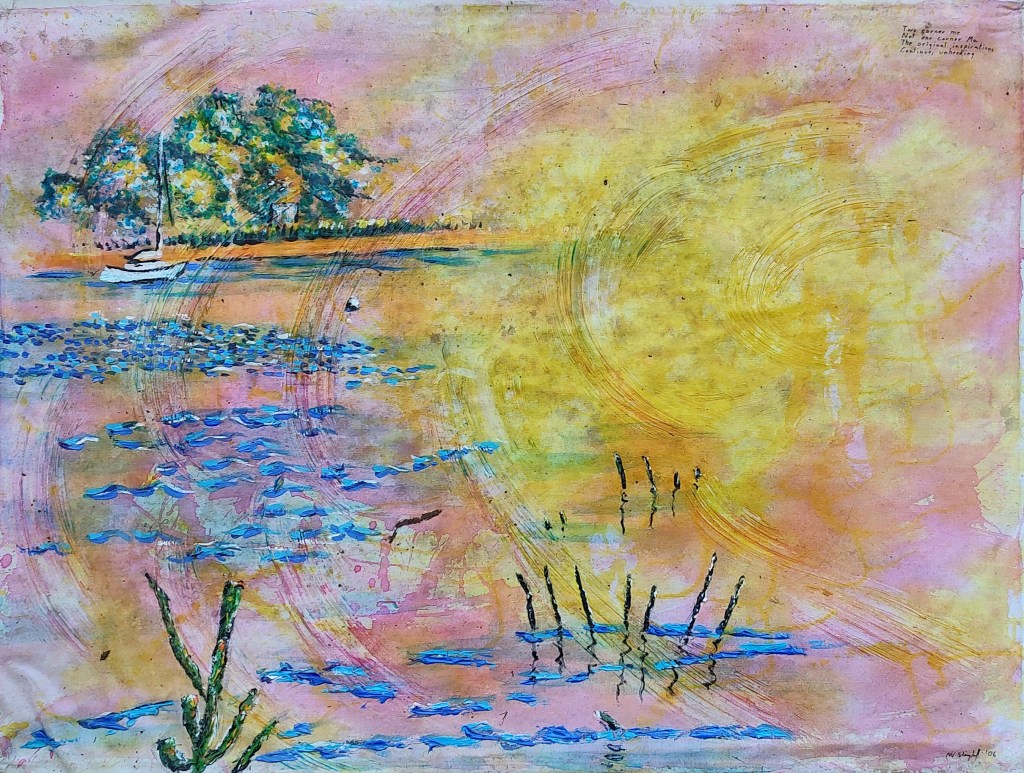
More paintings and info at: https://sites.google.com/view/cabinetofvanities
Acrylic on Canvas, 2006, 30×40
Two corner me/not One Corner Ma/the original inspirations/continue, unheeding.
More paintings and info at: https://sites.google.com/view/cabinetofvanities
Acrylic on Canvas, 2006, 30×40
Two corner me/not One Corner Ma/the original inspirations/continue, unheeding.
I enjoyed Bible stories as a youth. Then those of the “golden age” of science fiction. Even now some space opera and fantasy. All had little twists and turns, many preached a certain view of society. Fortunately, I never confused them with science or history. Sociology – well that hung out somewhere in the middle .
I know the attraction of all those (mostly) male superheroes or charmed individuals who thrive against all odds. But, again, I rarely confused their exploits with what happened in my real life .
What bothers me now is that many people are overwhelmed with a glut of knowledge that still seems unable to predict their individual future usefully. So they cling to militaristic utopias like Heinlein’s StarshipTroopers. Or unfettered economic systems _ some controlled, some free. Or libertarian or dystopian or … And worse, these become not merely touchstones for their own consciousness, which may be a genuinely useful function, but also a blueprint for how society should really be, or actually is, or how they should act .
Ayn Rand is my personal hate. But any fiction is – really – fiction. Each person is more complex than described in a novel. Each society more chaotically unpredictable. Each solution encrusted with its own problems . And each individual life unique.
But not in these tales. “If only” has replaced “once upon a time” in our current fairy tales .
Franklin’s famous phrase is somewhat opposed to the current meme “rule of law.” In some sense, any organized society lives under a kind of rule of law – laws determined by whoever is in charge, even if the “law” is “I can do whatever I want and you must obey me” .
The founders considered a republic to be based on rights grounded in ideas of liberty. Laws which infringed on that liberty were wrong and should be unenforceable.
Those founders did not see much difference between liberty and “rights” owed to any adult white males living in the country. Those folks were supposed to preserve the idea of liberty (even if they treated women, slaves, etc differently.) Fundamental rights included being able to defend oneself, protect property and contracts, and think and say what you wanted. In a libertarian manner – they did not initially see any need to explicitly enumerate a bill of rights – freedom to do anything that doesn’t harm someone else .
All would of course be forever preserved by the innate virtue of the ruling elite. After the founders finished laughing, they constructed a complicated federal system of checks and balances. Alas, over the years, we have deconstructed most of that in the name of “pure democracy” – what the founders called mob rule.
We may be in the final stages of a semblance of a republic. It was, for a while, a nice nearly working dream .
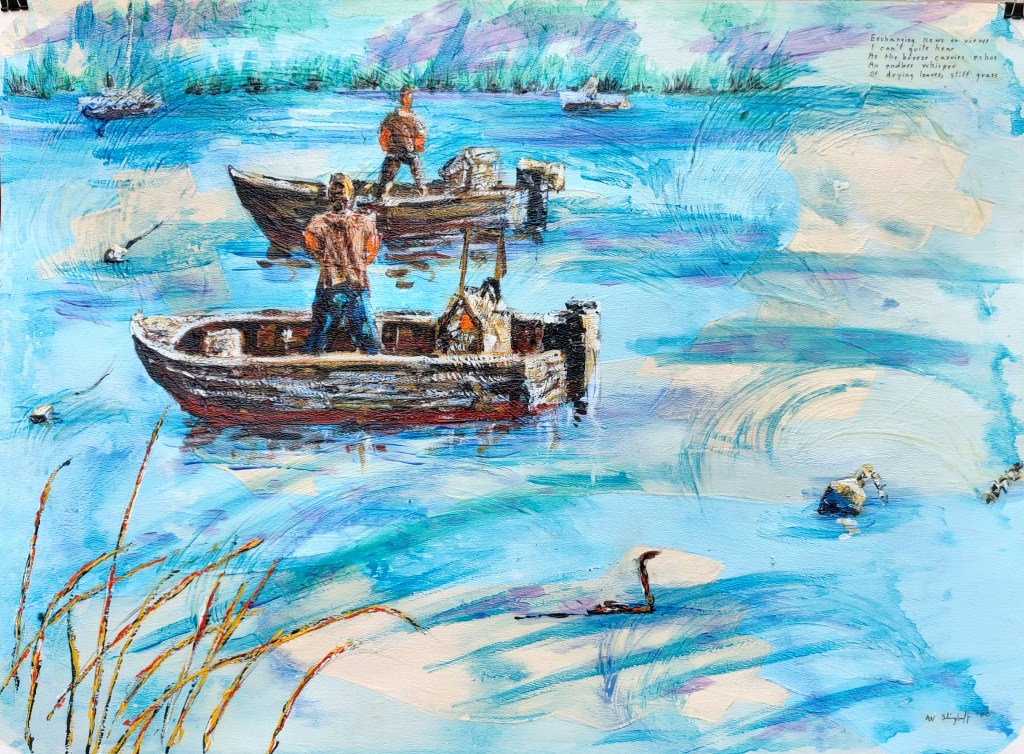
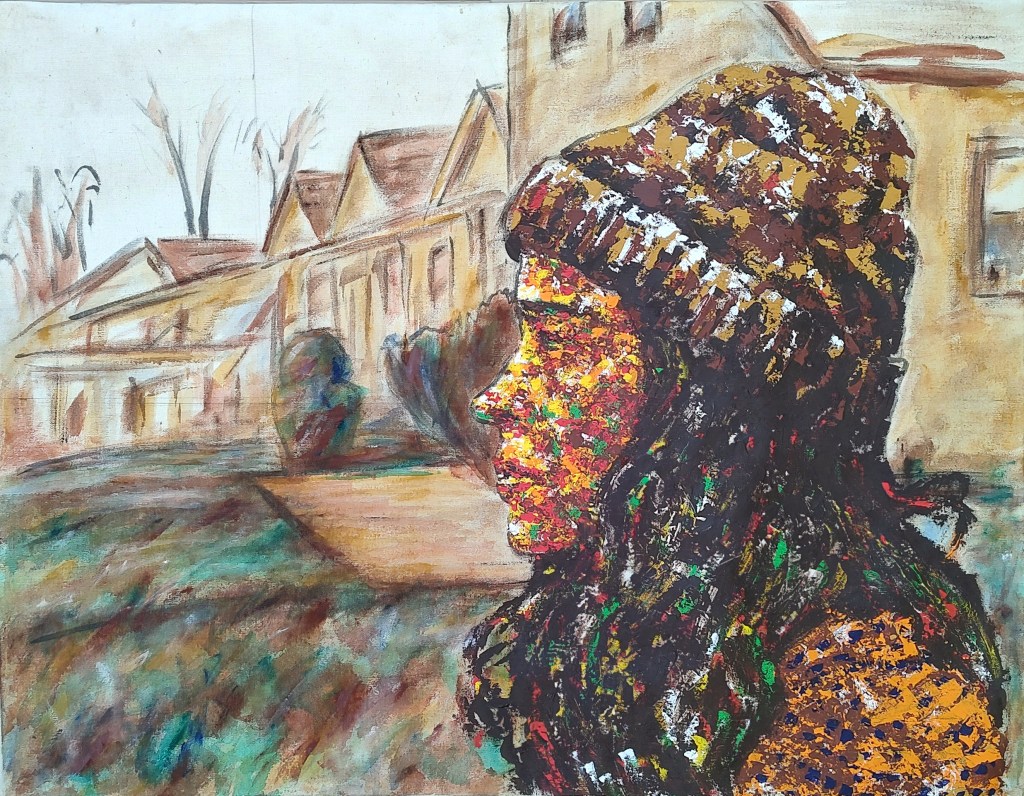
More paintings and info at: https://sites.google.com/view/cabinetofvanities
Acrylic on Watercolor Paper,, 2000, 22×30
Exchanging news or views/I can’t quite hear/as the breeze carries echoes/an endless whisper/of drying leaves, stiff grass
Young people tend to have nightmares or fantasies about old people (to be fair, old people reciprocate.) It is usually annoying to read “youngsters” giving us irrelevant advice, writing ridiculous entertainment scripts about elders, or solemnly discussing our plight.
It is true we have slowed down and become more careful. (But hardly so slow as the memory medicine ads would proclaim.) It is usually true that we gradually lose our taste for grand adventures – adventures occur all around us all the time, sometimes as simple as going to the store. We remain fully human, but (in spite of protestation) not as we were at 30 .
I feel a gradual degradation, which I accept (as I must, since – in spite of those ads for expensive medication – it is inevitable). Perhaps the most annoying are the constant little gaps in mind and memory. Particularly nasty are the constant stream of “lost words.” I know exactly what I want to say, know there is a word for it, know I know there is a word for it – but nothing but blank .
That clues me into other patterns I may not be quite aware of. Reflexes, adjustment to light changes, peripheral vision, and on and on .
In fact, what most amazes me in the whole process is how much I used to have, how much I can lose, and how I nevertheless remain me.
More paintings and info at: https://sites.google.com/view/cabinetofvanities
Acrylic on Canvas,, 1971, 28×36
Portrait of Joanne in Kansas City

“Life is short, but art is long” is one of those old Roman sayings that seem to make sense until we think about it. Up to a few hundred years ago, people conceived of time much differently than we do. Aboriginal tribes existed in a perpetual present, surrounded by “dreamtime” past and future. Civilized folks considered the past as a few hundred or thousand years – back to the Egyptians or some mythical beginning. Deep philosophers assumed the world to always have been as it is, possibly cycling through various stages .
More than that – in direct opposition to current ideas of progress – that past was always better, golden, inhabited by gods or semi-gods. Ancient art was always to be copied or imitated since the degenerate present could not compete. Thus “art is long”.
Now we laugh at a few thousand years. We know the world goes back a few billion, amazing creatures hundreds of millions, people like us over 100,000. And the world keeps changing. And “new improved” is demonstrably better than the old junk .
As for art … well it’s really as “short” as life. Useful for a generation or so at most. Like any legacy, soon gone with the wind, without even the solace of a grave marker .
As for other ” wise”, “golden”, sayings, ideas, and ideals of classic ancient cultures – don’t get me started .
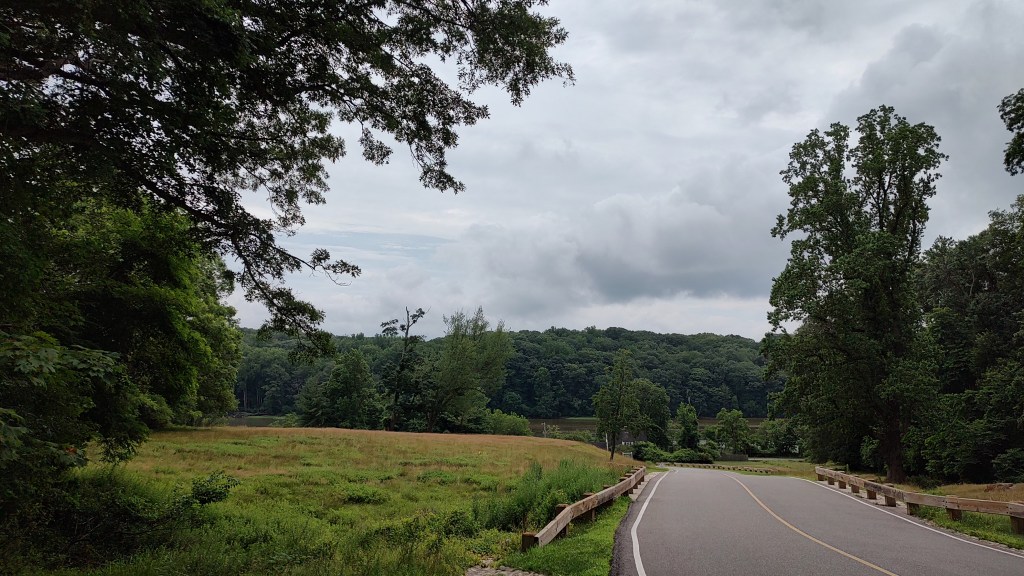
Americans are used to hearing about the “rule of law” which sets the ideals of our Republic above other forms of government. But it seems to have been forgotten that “rule of law” does not mean simply obeying whatever momentary capricious rules are enforced by a government in power. In that sense anyone in an organized state – China North Korea Nazi Germany – lived under a “rule of law.”
The idealized American conception, however, implied more than that. It thought that laws were formulated following certain procedures, that most law was stable, that all classes of people were treated the same and – importantly – that historic “rights” were protected .
When any leader – a king, a military dictator, or a popularly elected official – can arbitrarily not enforce certain laws, artificially enhance others, pardon offenders at will, “go after” enemies legally and economically – that is not what we have considered a “rule of law”. Increasingly, that situation seems to be what we have now .
Elite philosophers through the ages have known that the concept of “rule of law” is fragile. It is hard to establish, easy to destroy. As we are now witnessing .

More paintings and info at: https://sites.google.com/view/cabinetofvanities
Acrylic on Canvas,, 1969, 28×22
Early effort of angry young artist
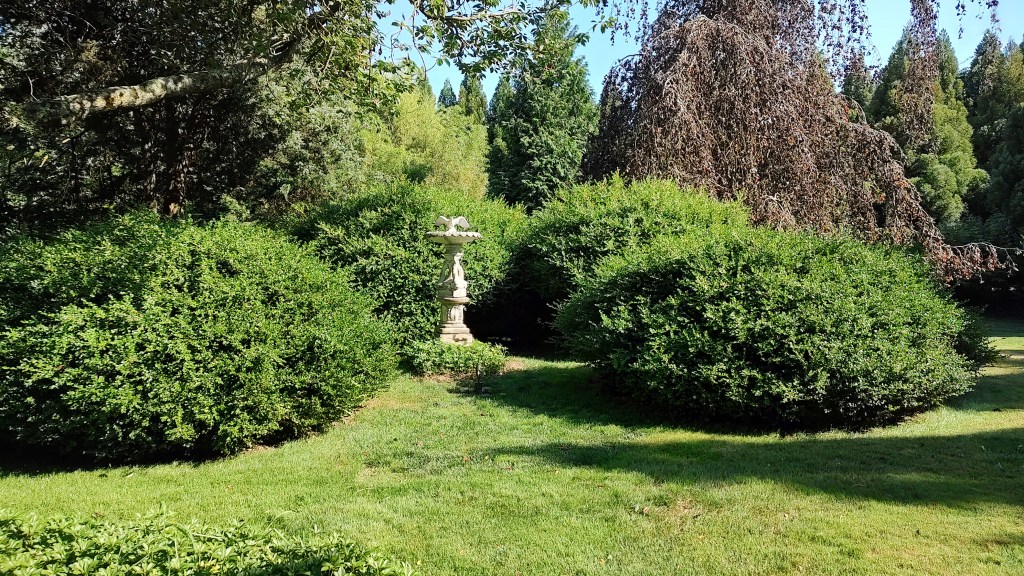
Anything added to an artifact that does not affect its functionality can be regarded as decoration. Such can be seen as one of the most enduring aspects of human creative spirit, serving no purpose but to make something more interesting or attractive .
In any craft, the first approximation of decoration is elegance. At a certain level, we truly regard a craft masterpiece as art. Whether it is ” fine art” or not is a question best left to those who care about such trivia .
People’s ingenuity has been able to replicate (often in mass quantity with machines) any fine original creation. Today we are surrounded by beautiful (at least to some) elegant and often functional objects. Created once by the glory of the craftperson’s spirit and training, now available to all .
For a few of us, a majestic extreme of decoration is a flat-bounded surface on a wall, drawn and colored in a pleasing or informative way. We visit museums to be entranced and amazed by these pictures. Nobody is quite sure why. Photographs usually do not provide the same kick. Children’s work may do so. It’s mysterious .
These days, for the craftsman or artist, the final production must be an end in itself. Only a few friends will notice. There is a glut of decoration – good and otherwise – in the world .
Yet craft, art, even appreciation of decoration, remains a joy of our spiritual life .
 HuntingtonHarborThoughts