
More paintings and info at: https://sites.google.com/view/cabinetofvanities
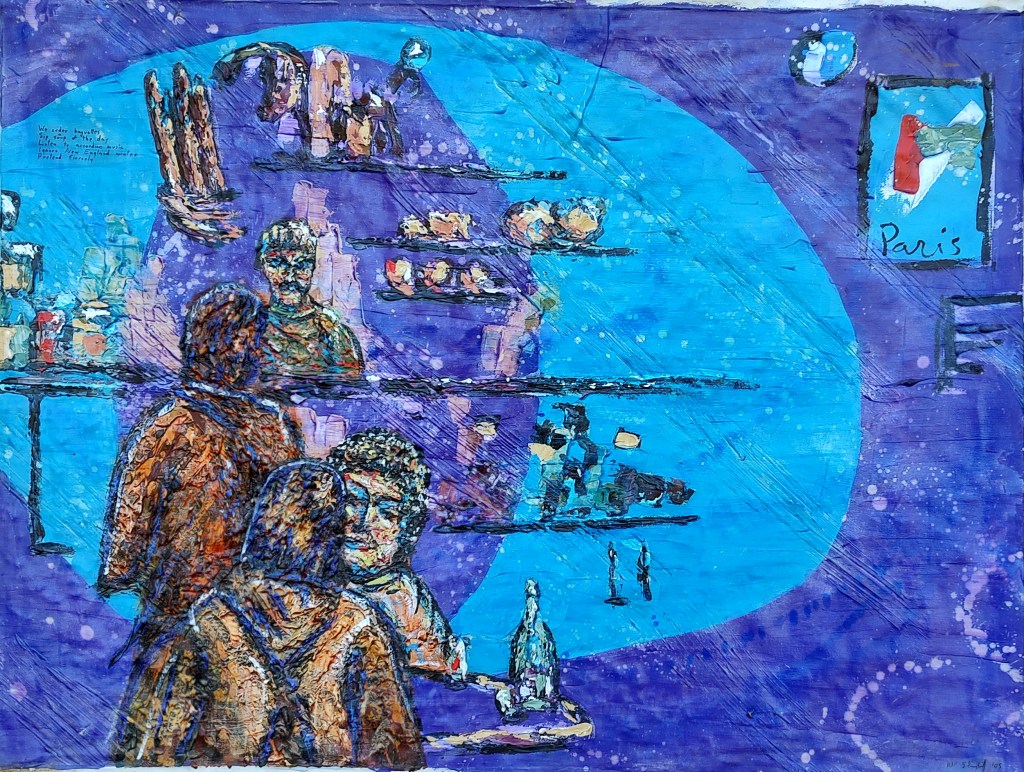
Acrylic on Canvas 2005, 30×40
We order baguettes/sip soup of the day/listen to accordion music/ignore New England winter/pretend fiercely.
More paintings and info at: https://sites.google.com/view/cabinetofvanities
Acrylic on Canvas 2005, 30×40
We order baguettes/sip soup of the day/listen to accordion music/ignore New England winter/pretend fiercely.

Our culture is roiled by assassinations and mindless mass shootings. A cry goes out to “do something”. But what? There are only a few options. Greater limitations, higher protection, or decreased privacy .
In the US, greater limitations are difficult. Everyone wants access to guns – often the biggest baddest guns that exist. Locking potential perpetrators up hardly addresses the problem, since that only addresses low-level “gang violence” where adolescents mostly shoot each other. Higher protection – a security officer everywhere, domes of bulletproof glass for speakers _ is extremely expensive and often impossible .
And that leaves surveillance. Already video footage is so ubiquitous, cell phone records so complete, that those who assassinate are always caught. Most of them know it and embark on suicide missions, almost impossible to guard against .
No doubt, as in China, we will be willing to sacrifice more and more privacy for greater security. Online and in public, all will be known, evaluated, stored, and used for prediction and “interdiction” of potential terrorists. Most of us will welcome the calm .
But such a blessing can easily become a curse, and I foresee no way of preventing that from happening .

More paintings and info at: https://sites.google.com/view/cabinetofvanities
Acrylic on Canvas 2002, 30×40
From infinite space/in forever time/only this place/only this moment/only myself

Ancient Greeks sometimes put “tyrants” in power. Romans used “dictators”. The 19th century had “a man on a white horse”. Whatever the name, they seem to be ubiquitous in the current era .
These leaders gain control because of commonly perceived malaise or crisis in the culture (as understood by those who control or want to control the culture). The avowed goal is to “shake things up,” Get things done, and ignore any of the traditional customs and laws that are getting in the way .
Tyrants usually do manage to address issues, often by wrecking norms. For good or bad, they do make previously “impossible” things happen. Sometimes we all admit it is a necessary – even if harsh – cure .
The main problem, of course, is that “power corrupts”. There is little worse than a tyrant who becomes whimsical, moody, and so self-centered that each momentary passion must be gratified. Usually, any sense of perspective is lost and the tyranny boils down to a small clique of sycophants clinging to and fortifying the “glorious leader” no matter what .
No form of government, no civilization, has ever been immune to the siren call of tyrants. As we are now witnessing .

Brought up in an era when singers and pop bands got wealthy, as an admirer of famous artists, I always understood that fame was one of the keys to becoming rich. Unfortunately (or not) I never had enough ambition nor stamina to pursue it seriously – I was more focused on everyday life. But as I created computer programs or paintings it always remained a quiescent dream of maybe .
So I watched the art world sizzle with huge rewards for outrageous works. Was bemused by respected galleries selling what seemed to be junk. Gave up on exotic modern art exhibitions as displays became more and more incomprehensible. Also, living in the sedate suburbs, found the local scene excessively bourgeois. Lots of watercolor from photographs. Lots of super realism from photographs. Lots of purposely kitsch designed to sell online. I happily, isolated, burrowed in and followed my own path. Always secretly hoping the future would vindicate me and (even posthumously) deliver fame .
Now I read that the high end art world has “collapsed.” “Patrons” have moved on to play with crypto. Galleries are failing right and left. The froth – like the tulip bubble – has vanished. Perhaps never to recover .
The other cliches about fame are that it is capricious and fleeting. Now the goddess mostly dispenses it in viral form on the internet. I remain solitary and happy .
More paintings and info at: https://sites.google.com/view/cabinetofvanities
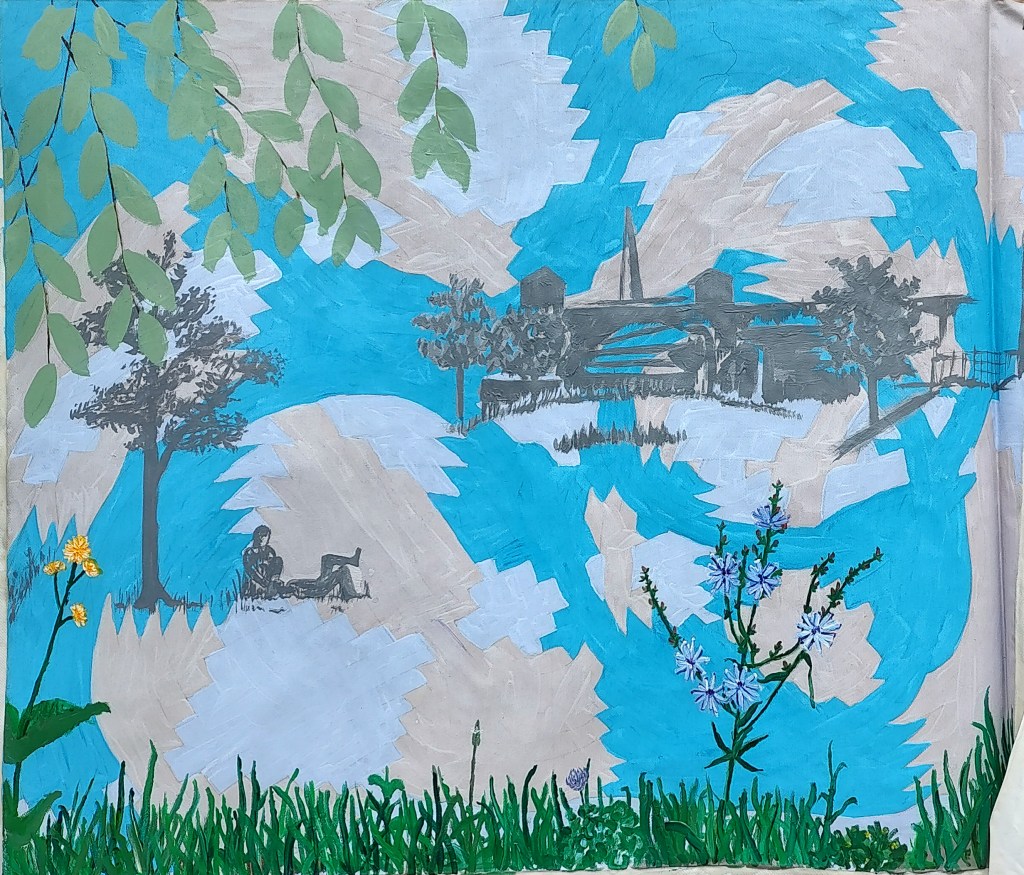
Acrylic on cloth or plastic, 1974, 30×36
Boston park scene

I was brought up through excellent public schools in the scientific aura of the 1950s. I consequently have always had a cosmopolitan outlook. I firmly believe in shallow history, deep history, human evolution, geologic changes. I know there have been innumerable people just like me living in vastly different cultures .
And I accept that religion in some form is necessary to human health. I also went to Sunday church (and Sunday school, and choir) during my formative years .
Joseph Campbell spent a lifetime documenting and comparing all the religions he could get a handle on. He tried to tie together their great concepts and the underlying intuitions that supported them. I have friends who found his work exceedingly shallow, but I accept it and enjoy the widening of my own mind by doing so .
That is why I have such antagonism for the current religious right fanatics. I have rarely met such vacuous minds. I know most of it is probably just a defense mechanism against a turmoil of our times, but it bothers me to find intelligent people crawling into shallow tribal superstition, not to mention side ventures into crystals, astrology, guru’s, and whatever .
I’m happy at such times to reread “The Masks of God” and understand that this too shall pass .
More paintings and info at: https://sites.google.com/view/cabinetofvanities
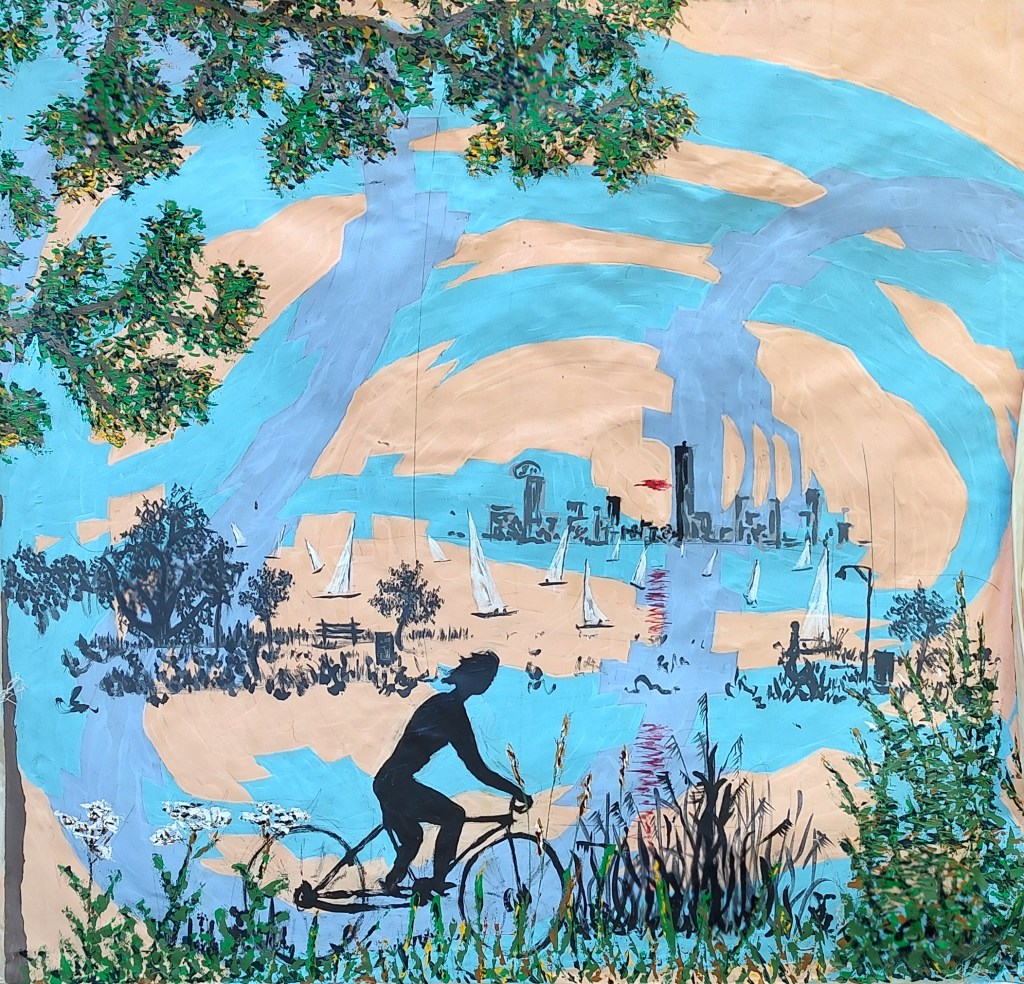
Acrylic on Canvas 1975, 40×40
Boston cyclist

“A sucker is born every minute” proclaimed PT Barnum. The “average American voter” has often been vilified for ignorance, prejudice, whatever. Frozen in collective memory by Menken’s “booboisie.”
And yet, we often found that speaking with each other one-on-one revealed a fairly complete interesting human being. Somehow we trusted that – informed by a free press – such good would shine through in the loneliness of the election booth. Mostly, it seemed to work .
But several generations of being assured that “you are just as good as anyone else” have had evil effects. Even in simple conversation, we discover everyone is as conceited as a god, certain that they know everything, sure that anyone claiming to be an expert (except the internet influencers they follow) is a charlatan.
So conceit has fallen on an entire population, certain that at any moment what they believe is true, fortified by warped electronic propaganda. No longer much fun to talk to. Anything but complete interesting human beings. Conceited know-it-alls, who unfortunately carry their very real ignorance and prejudices into the ballot box .
I used to agree that democracy was “the worst form of government except for everything else.” Now I tend to drop the qualifier .

In the last 150 years, biological understanding has increased tremendously. Much is understood at the molecular level. Statistics on detailed populations and outcomes are massive and readily available. A doctor from the 1800s would be astonished .
Yet we cling to ancient rituals, reinforced by old legalities. Once upon a time “clinical trials” made great sense. They were truly a “gold standard” not only at seeing if something worked, but also if it caused harmful side effects .
True clinical trials required “equivalent groups”, one that receives treatment, one that does not. This is quite cumbersome and expensive – and for that reason is embraced by the pharma industry as a barrier to entry.
In fact with the modern state of knowledge and history, the “control group” is no longer necessary. There is a long detailed chart of what happens to those not treated. There is also a much better idea of what will happen because scientists understand mechanisms and do testing on animals .
Clinical trials have become an annoying barrier to progress. New remedies can be tested on those in need of them, with no necessity to subject another select group to the false hope of improvement .
 HuntingtonHarborThoughts