All paintings at: https://sites.google.com/view/cabinetofvanities
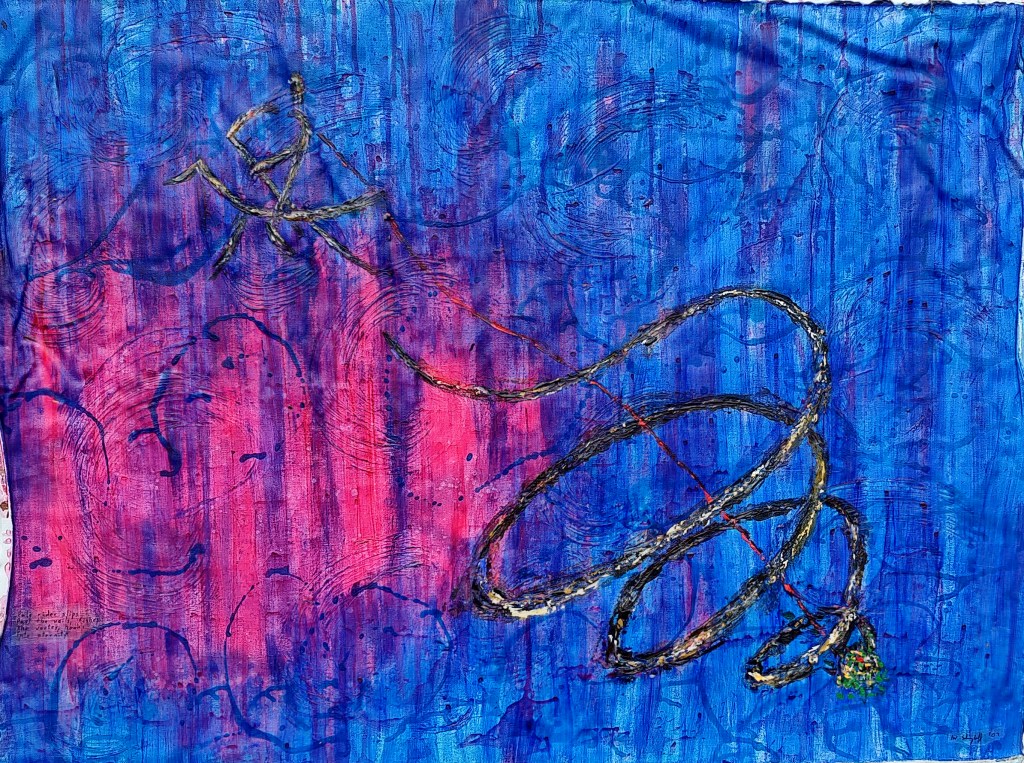
Acrylic on Canvas, 2002, 30×40
All modern Americans shop / I see them gathered in parking lots / like flocks of gulls / so busy being fed

All paintings at: https://sites.google.com/view/cabinetofvanities
Acrylic on Canvas, 2002, 30×40
All modern Americans shop / I see them gathered in parking lots / like flocks of gulls / so busy being fed

Most of us understand our lives as a narrative story. Elders tend to form that into a mythology. Like any good literature, the best exaggerate the highs and lows and often have a structure with a moral. Grandparents especially enjoy inflicting this on their young grandchildren. Or at anyone else when there is a holiday gathering. It’s a way of making a mark on the universe, claiming an importance almost as meaningful as in tales of heroes of old .
Nor is it wrong to do so. There is more to existence than daily meals and bedtime. Formulating one’s place in eternal mystery is important to all of us. And once in a while it is nice to share – even proclaim – that adventure .
Unlike many others, I do not think such tales actually help the young in their own lives. Life and circumstance were always unique, and the days change at a dizzying speed. At best this is just another form of entertainment with the added benefit of being (mostly) true .
Oh, perhaps there is some moral value. But really it helps everyone share and join internal narratives to feel far less lonely in the ineffable cosmos.

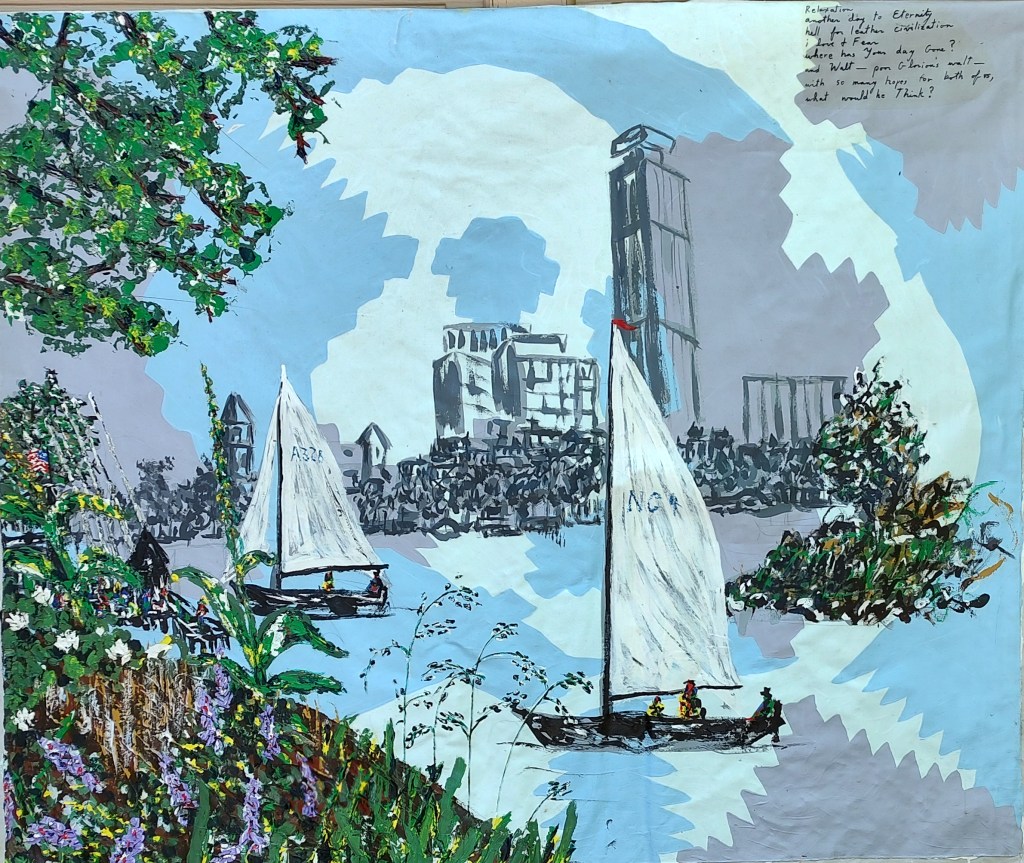
All paintings at: https://sites.google.com/view/cabinetofvanities
Acrylic on Canvas, 2006, 30×40
Two corner me / not One Corner Ma / the original inspirations / continue, unheeding.

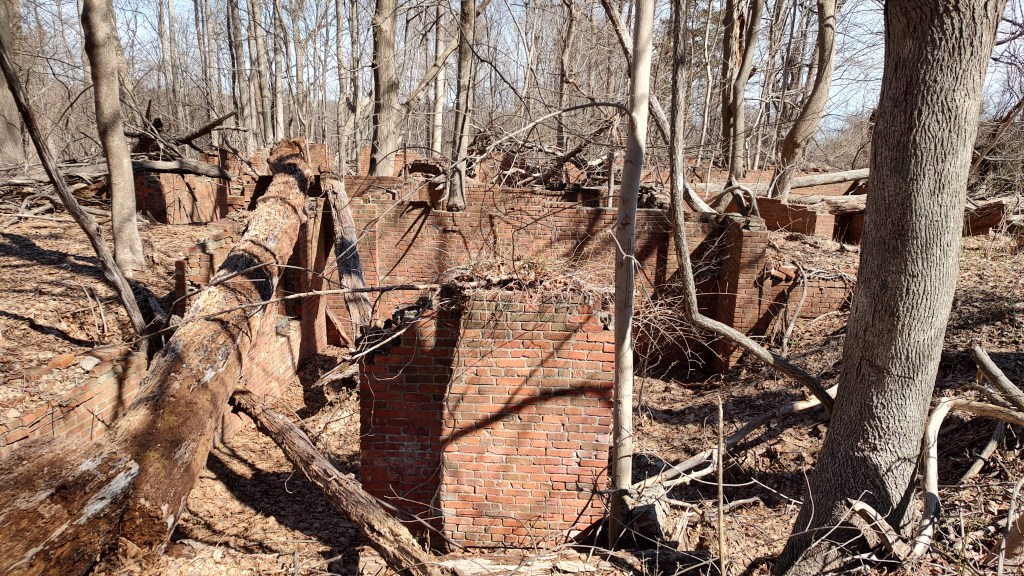
“You can’t go home again” -, well you can’t really go anywhere as it once was. Older folks are often wrapped in nostalgia. As one of them, I remember many places I was privileged to visit before great change. Often merely modernity, sometimes catastrophe. Sanibel Island was one of them .
When my wife and I visited years ago it was – like many places we went – caught between old and new. The new was glitchy, shiny, and inaccessably privatized. The old had a patina of history along with the comfort of the commonplace.
Hurricane Ian exchanged all that, of course. New things are being rebuilt, but all is shiny, private, glitz. I find myself never wanting to revisit anywhere that once charmed me .
This culture is, I think, testing the proposition that private wealth is always better than public for anything but the most utilitarian needs. Mostly gaudy and ugly, but above all else tightly secreted away. With rare exceptions, America has no grand public spaces, and even fewer that are not merely an attempt at preserved wilderness .
It’s a forward-looking time. Ignoring real history in favor of myth, and ignoring the present in the race to the next great thing .
Sometimes an old man believes all the great things are gone with the wind .

Jefferson expected a country of “yeoman farmers” who would have self-sufficiency by day and discuss politics by night. Never happened. He certainly was not much interested for himself, at least if slaves were not available to do the work .
For a while we did have artisan farmers, who would grow some of their own food and sell specialized items for the rest. Soon enough, artisans stopped growing stuff altogether. Then the idea was suburban nuclear families, working for a large company to gain currency. Fuzzy effect of the ongoing industrial revolution on society, as workers were turned into machines. No politics by night, just entertainment .
Now I wonder. Is AI and automation the end of that paradigm as well? More and more we seem to become a nation of “yeoman artisans” bartering our own specialties for livelihood. Not quite worked out yet, but I wonder what work and life may become in the next decade .
Not Jeffersonian. And probably far from Utopian. But the real point is – nobody knows. And hardly anyone is even sure what they would like .
I enjoyed being an artisan computer professional. Artisan pride fit me well. But the other thing I wonder is if there will remain varied niches for varied folks to fit into .

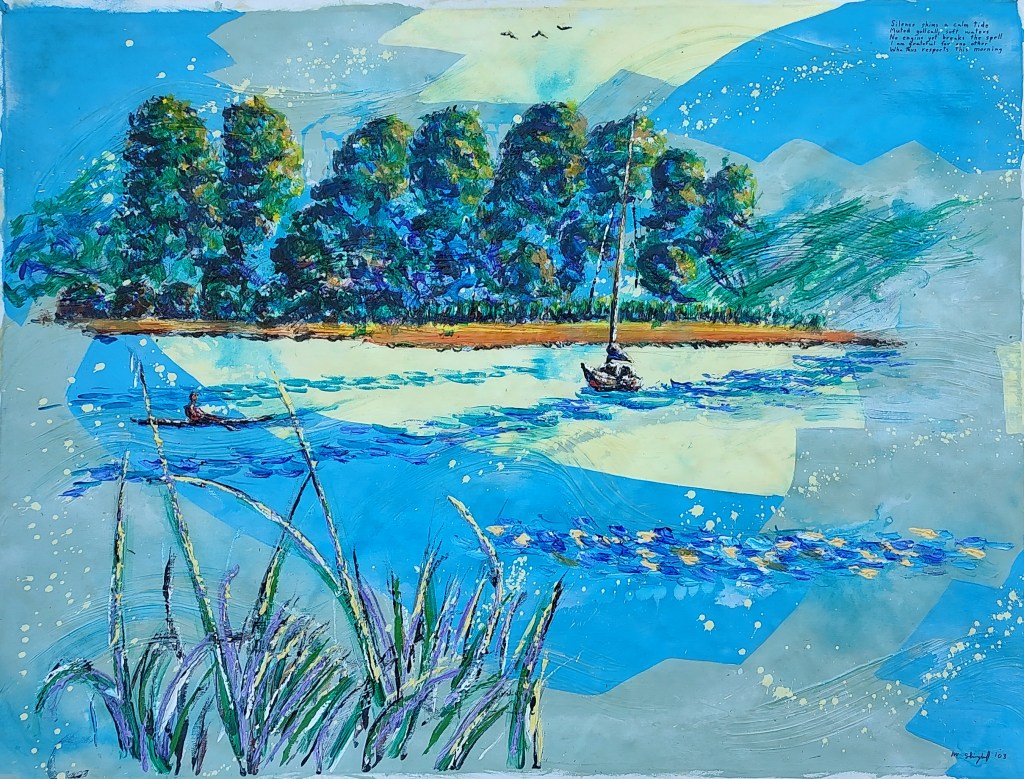
All paintings at: https://sites.google.com/view/cabinetofvanities
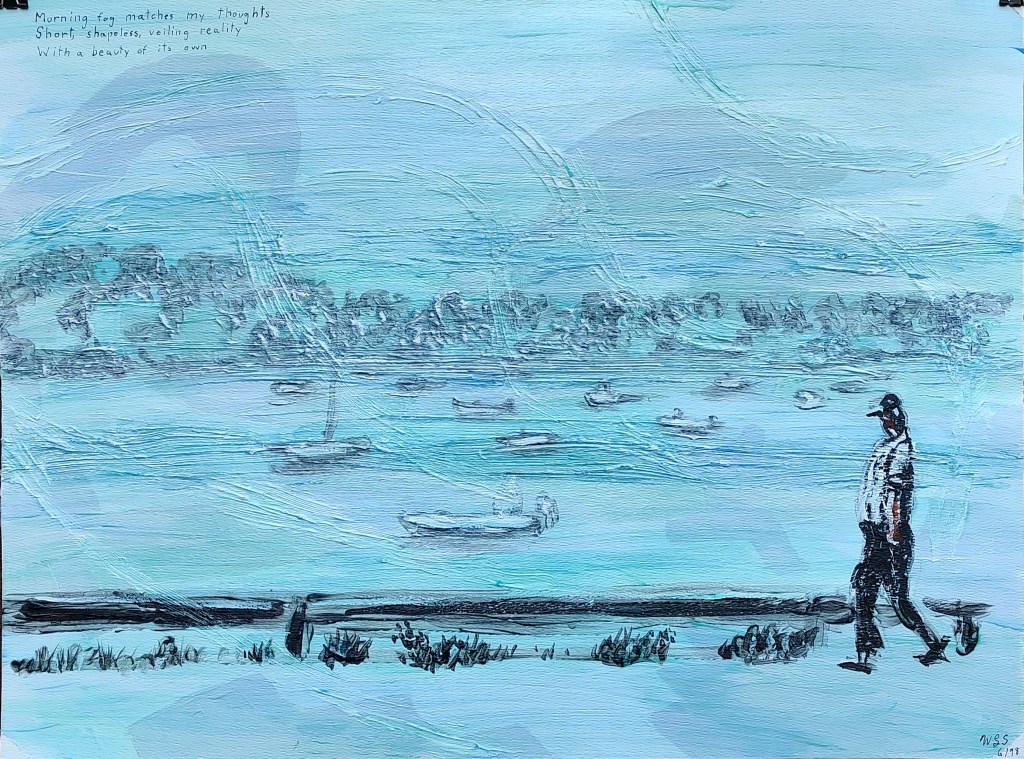
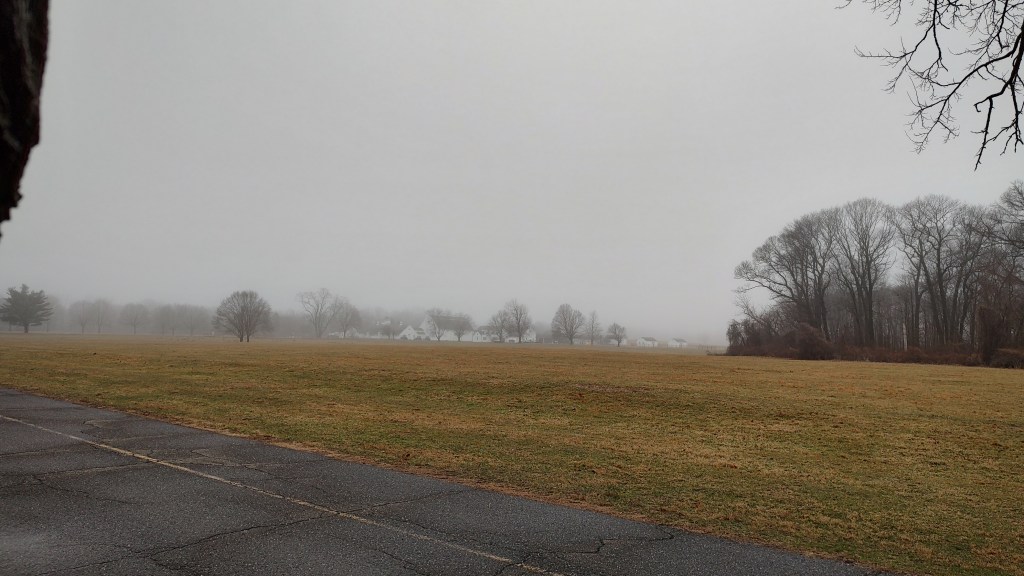
Acrylic on watercolor paper, 1998, 18×24
If a sunlit day can be ugly / this was an ugly day / wind cold and promise of worse / that guy needs solitude, beauty or cash / real bad

Like ” wrong”, beauty is one of those concepts that can never be simply defined. It depends not only on environmental and cultural factors but also on the mood of the observer. We can often agree, but almost as often argue with others and even with ourselves .
It’s fairly safe to say that even considering beauty requires a sense of security within the observer _ you can hardly appreciate the loveliness of a forest while being chased by a bear. . Whether something is beautiful or not occurs way down on the scale of evolutionary fight or flight. A great deal of the time, most of us hardly notice it at all .
We assume that – like other odd traits – there must be SOME biological reason we can respond to beauty. Perhaps it helps social solidarity. Perhaps it is a shortcut to relaxation. Certainly nothing obvious .
I have noticed that in my own life the idea of beautiful has evolved as I age. When young, it was primarily biological. When older, mostly cultural. And now, in an elder, much more simply appreciation of all that is and how it fits together. A miraculous and – yes – extremely beautiful universe .
At least when I am happy, secure, and not doing too much .

All paintings at: https://sites.google.com/view/cabinetofvanities
Acrylic on Canvas, 1971, 28×36
Joanne in Kansas City

My wife usually gets her hair “done” in a salon,. When she gets home, there are inevitable complaints that it “looks different”. Of course – the lighting is changed .
There have always been different light effects – sunset, noon, overcast. And artificial from candles, gas jet, incandescent. In the era of LED, any “temperature” of red or blue or green or yellow mixture can be served up, bright or dim .
We deal with all this amazingly well. Red usually looks red. A landscape picture resembles itself in almost all conditions. But that should indicate to us just how amazing our vision is – both raw data gathering and interpretation .
Painters always knew this. Patrons who bought things done under “Northern light exposure” in studios rarely hung their purchases under similar conditions. Poor artists’ dimly lit barns had different lighting then when the work is hung in a brightly illuminated museum. And forget trying to recreate the conditions of “plein aire” .
My lesson is that much of our life is like this. We may think things are exactly the same, but only because our brains automatically adjust to what are objectively quite different events. It’s part of our amazing ability to compose and generalize, the core of our knowledge.
Not quite obvious, and easy to ignore. Until the hair looks entirely different …

Any society seems to require government, complex societies more so than simple ones. Except under true communism (where the government/people own everything) taxes must be raised to pay for it .
Taxes over the last tens of thousands of years have taken many forms, and involved almost anything imaginable. Fees, income, wealth, property, sales, ethnicity and on and on. But as the industrial revolution morphs into the AI/automation revolution, perhaps machines and processes should themselves provide revenue .
This is heresy to classic economists. More production always enriches society, they say, and should be encouraged. Lately, that may not be true. A marginal gain in output of widgets entirely done by machine instead of traditional labor may actually harm the society more than it helps .
How to directly tax machines? probably with heavy fees and taxes on the input resources they use – electricity, air, water. Large land taxes on the property they occupy. Major levies on associated nuisances like noise pollution or environmental degradation. And, of course, the equivalent of tariffs to equalize all this between nations and regions .
Simple? No. But presumably an AI in charge of government could make it all work .
(As long as that AI was not self-aware !)