All paintings at: https://sites.google.com/view/cabinetofvanities
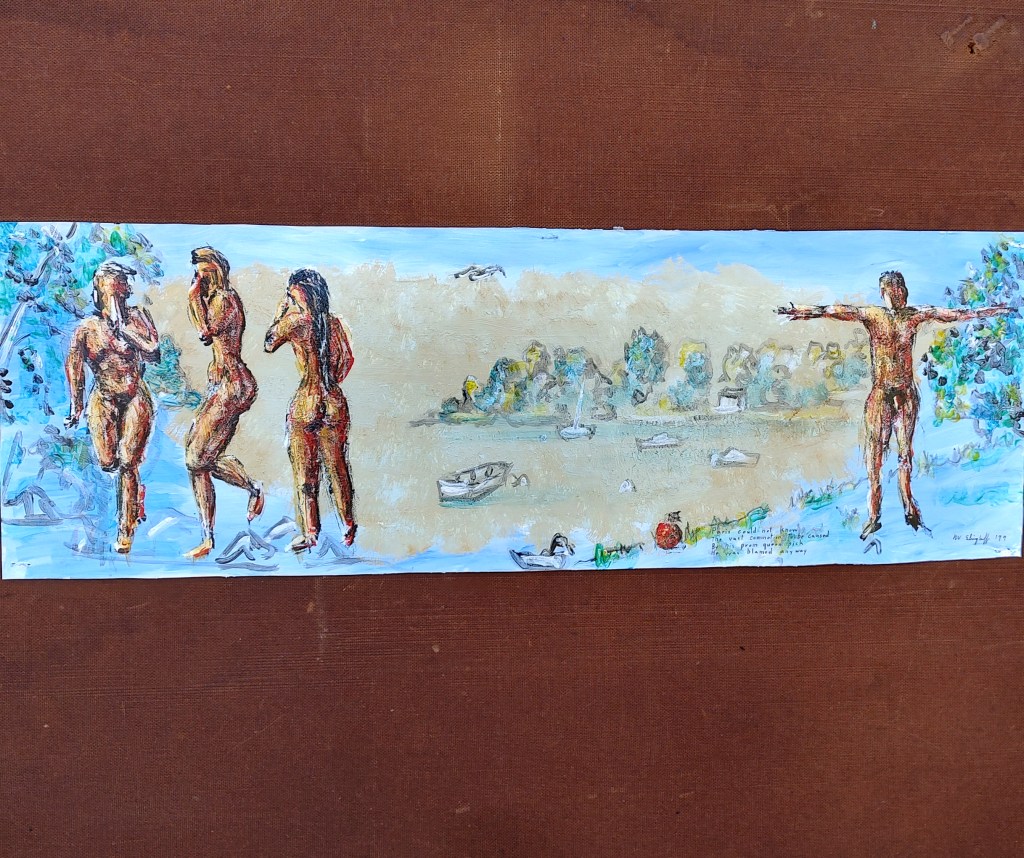
Acrylic on Canvas Paper, 1999, 12×36
Paris could not know / the vast commotion to be caused / by his prom queen pick / he was blamed anyway
All paintings at: https://sites.google.com/view/cabinetofvanities
Acrylic on Canvas Paper, 1999, 12×36
Paris could not know / the vast commotion to be caused / by his prom queen pick / he was blamed anyway
When I retired in my mid-60s, I spent a little time considering what I wanted to do and how I wanted to live for the next 20 years or so. Surprisingly, the answer came down to existing as I did when eleven years old. Even stripped of nostalgia, that was a golden time . I bestrode the earth as a miniaturized colossus. I thought I knew everything, I was quite independent but freed of all the real cares of supporting myself and daily existence . I had a secure place in my family and the world .
Every day – every instant – was new and exciting. I had no desire to return to nor even remember my past. I fully believed the future would be ever more marvelous. There was always something new and wonderful to explore. I had almost no responsibilities, carefree .
All my senses were magnificent, my body tuned. My mind unafflicted. Even hormones still well under control. Energy limitless, sleep effortless. A perfect animal supporting a pristine consciousness .
Thus my desire to do all I could to return to such an existence. Much as living in the garden of Eden, an earthly paradise. Forget about what I could not control, enjoy each moment, assume the future is unknowable.
Out of control. Loving every minute .
Darwin and Einstein are often blamed for the “relativity” crisis of modern culture. In the absence of absolutes, what is right or wrong? How can there be morality, or even sanity, if “anything goes”?
The problem of course, is ancient, as exemplified by the saying “when in Rome, do as the Romans do”. Yet our priests and philosophers still keep searching for the true eternal underlying values that they are certain must exist .
Leaving aside morality, sanity does mostly involve fitting into and surviving or thriving in your situation. And that surely varies a great deal. A Viking berserker might seem sane in 900 CE Sweden, but would be judged crazy in 2025 Times Square. A stubborn pacifist would be in a nearly opposite situation.
As far as sanity itself goes, perhaps there is a Darwinian twist. Sanity simply means continued species survival and reproduction. Perhaps not that simple – warrior army ants hardly care about their own survival while defending the queen in the nest .
Humans are more complicated than anything. For us, the continuance of ourselves within our culture may define sanity, but we easily imagine alternative patterns which we consider better. If those are pursued, we will be judged insane unless the rest of the culture changes its collective mind .
Relative, indeed.
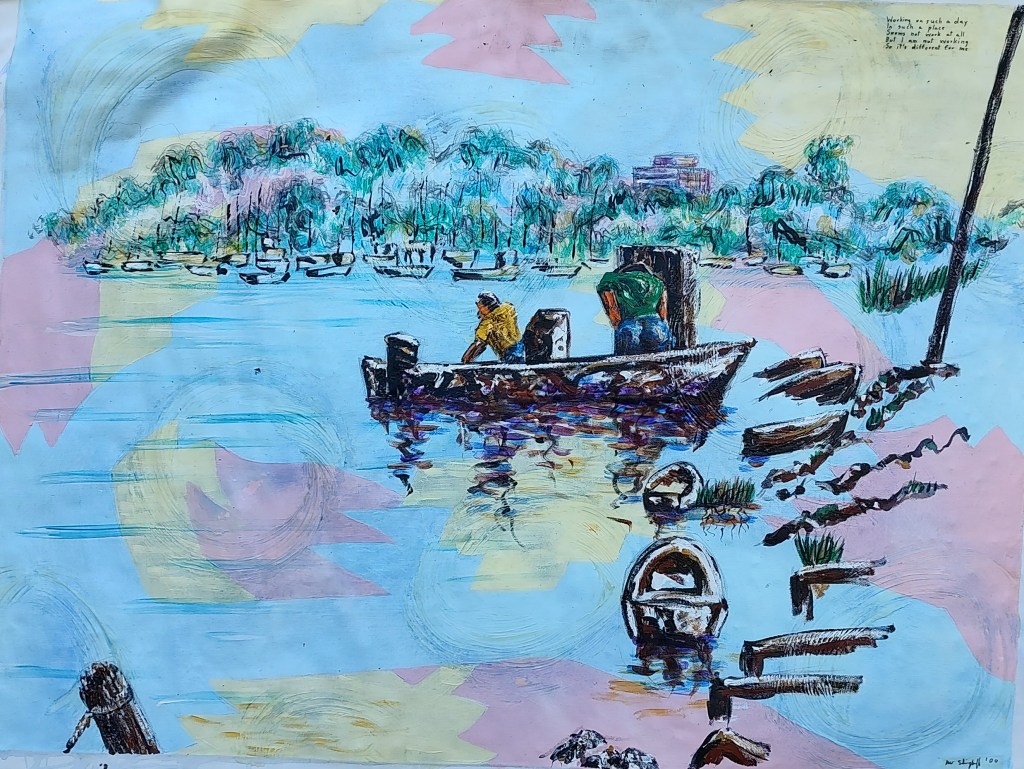
All paintings at: https://sites.google.com/view/cabinetofvanities
Acrylic on Canvas, 2000, 30×40
Working on such a day / in such a place / seems not work at all / but I am not working / so it’s different for me
The world of art is filled with nebulous definitions. “Art” itself is an act, an object, a concept and perhaps more. “Professional” artists earn money and are expected to produce highly skilled astounding work, but some artists considered great – like Van Gogh – never sold a painting. And on this continuum cloud is the designation “fine art” .
In the monetary collector’s world, “fine” has become synonymous with “rare” or even “unique”. To a connoisseur, “fine” implies degrees of difficulty and craftsmanship invisible to most of us. The vast crowd of amateurs more or less need to trust museums and scholarly essays to weed the wonderful from the trash. Lately, that seems to be failing .
I’ve pretty much given up. I like to think that what I create as a hobby is on the borderline of “fine art”, but certainly not as fine as a Michelangelo statue. On the other hand Klee and Basquiat are ranked highly and I would not bother having either hanging on my walls. I can’t even experience some forms of fine art very well – food, dance, film, and areas of music. It’s a big bouillabaisse of all kinds of stuff, junk for some, treasure for others .
I guess what I’m getting at is that “fine”, like many other terms (evil, good, right, proper) has lost common meaning in our culture until things stabilize a lot more .
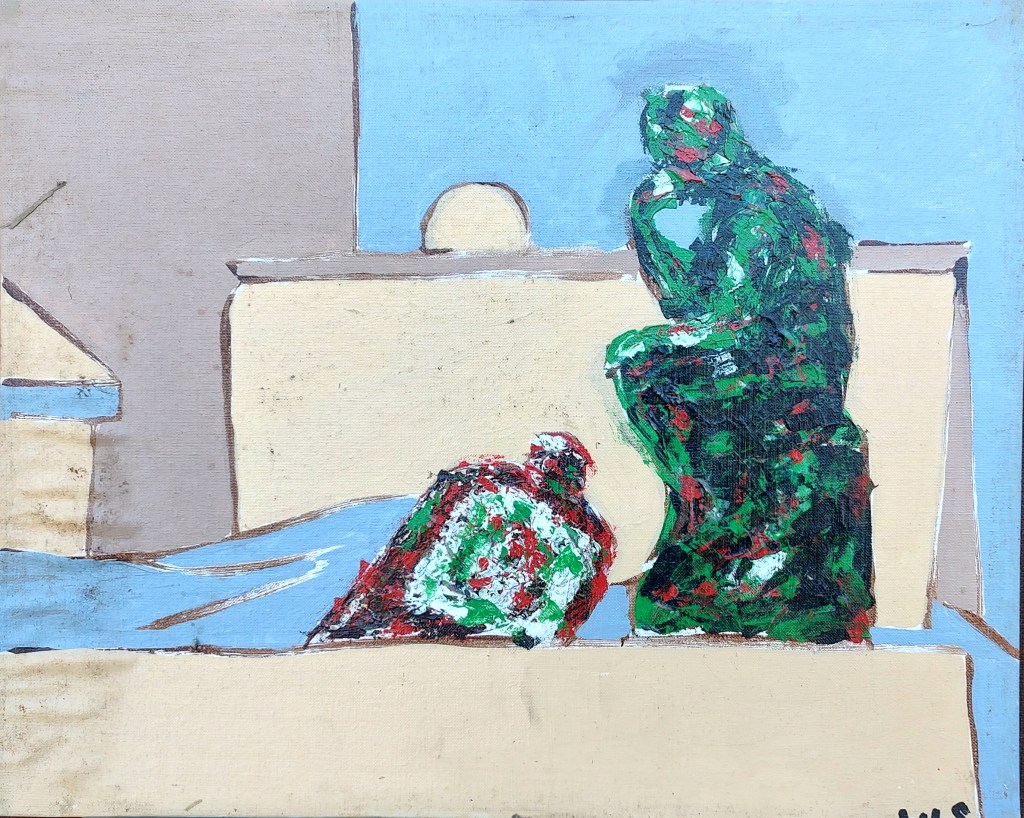
All paintings at: https://sites.google.com/view/cabinetofvanities
Acrylic on Canvasboard, 1970, 16×20
Thinker stilllife
These days, it is quite easy to feel as a god. We eat well, speed along without effort faster than birds, know everything at the flick of a screen, control vast powers. We think we are pretty close to omniscient and omnipotent. Well – compared to the past, at least, we are .
So we tend to take ourselves very seriously. What we do or don’t do must shake the cosmos. Every emotion must be huge and deep and meaningful. Our successes are tributes to our glory, our failures are – someone else’s fault .
Humble is no longer in most vocabularies. As a contrarian, I cultivate it. I do not feel in control. Kind of a god? Yeah I can’t escape that. Important? Responsible for my divinity? Nope. Just damn lucky to have been born into my time and situation. Fortunate to have adapted well . Certainly enjoying the experience. But always very aware that I hardly “deserved” or “worked for” most of it .
Sure, I’m moderately proud of who I am and what I have done. That’s it. I fight hubris tooth and nail. I simply pray that things will continue. I’m a leaf swirling down the stream, but an ecstatically happy leaf.
I know everyone is stressed, often rightfully. I wish they could step back and take a deep breath. But – hey! I’m just humble old me, so nobody listens .

Quasi Resolutions
Resolutions, so rarely kept, are out of fashion. Perhaps merely tendencies to encourage.
Never forget that this is done to enhance my “real life” and never to interfere with my enchantment each moment.
Future posting methodology follows that of the last year:
We seem to find it easier to be against something than for it. Maybe hate is easier than love. What we dislike – noise, clothes, morals – is often in sharper focus than what we are for .
Accordingly it is pretty simple to form social and political groups strongly against what they are certain they do not like. Trying to get people in favor of something often comes down to defining the enemy. Protect the environment, for instance, by hating industry .
The problem with anti-groups is a proverbial observation about always using a hammer because that’s what you have. And the problem with a hammer is that it is very easily turned against almost anything. Those against gay rights easily morph into being against certain ethnicities or religions. Those against certain medicines are easily marshaled against certain foods. Those who hate one modern morality are ready to go against any others .
With luck, very strong anti-groups eventually splinter against each other and dissolve. Without luck, all bets are off .
 HuntingtonHarborThoughts