

All paintings at: https://sites.google.com/view/cabinetofvanities
Acrylic on Watercolor Paper ,2004 22×30
Great whale surfaces / from ocean of conversation / eyes the audience
All paintings at: https://sites.google.com/view/cabinetofvanities
Acrylic on Watercolor Paper ,2004 22×30
Great whale surfaces / from ocean of conversation / eyes the audience
Traditionally, “lame duck” has referred to a politician who for one reason or another cannot be reelected, but still remains in nominal power for the remainder of his term. It is a milder form of “dead man walking” .
Typically, it has been felt such people have lost most of their influence. Who will listen to them? And in this scenario (feared by everyone who grows old), the future seems less and less important, no need to care about consequences. So we have senile seniors living in a home filled with cats, for example. Or driving an automobile when addled on medication .
In politics, “lame duck” always implied impotence. But that was before the geriatrics took over. In an age of senile senior lame ducks, there is an increasing tendency for the official to “go rogue” and do anything, heedless of consequences, reputation, or advice .
This has,unfortunately, always been the pattern when emperors, dictators, or whatever have aged too much in office. But the US, until recently, was spared the antics of such as Tiberius, Stalin, or Mao. No longer .
It’s another effect of concentration of wealth. Wealth is power, power corrupts, and at some point a billionaire or trillionaire feels omnipotent, clever, and invincible and nobody can stop the madness .
An interesting phenomenon to observe, if one can stay out of the way .

“Broken window policing” is well known. Its logic is that if you tightly punish miniscule crimes, big crimes will decrease dramatically. That approach has been seen to work in large cities, at least for a while .
A similar approach is now being taken in regard to those pesky “rights” government often finds so annoying. Persecute the tiniest infringements of nebulous laws – then resistance against large intrusions on public and private rights will be much less. Alas, that seems to be working as well .
The final meeting place of this is naturally the famous “what is not mandatory is forbidden”. Law and order folks are fine with this as long as the law is on their side. After all, they are the “decent” people .
A problem with “broken widow policing” is that it raises the bar of criminality, as law enforcement knows. A suspect internally certain of being killed will shoot it out rather than ever surrender. We already see most horrific crimes as expansive suicides .
And there is always the age-old human adjustment “might as well be hung for a sheep as a lamb”. If I’m going to be harassed for saying something “bad”, I might as well go into all out rebellion mode and do something drastic .
Society is a complex brew of ever-changing adjustments and one shot simple solutions rarely work for long.
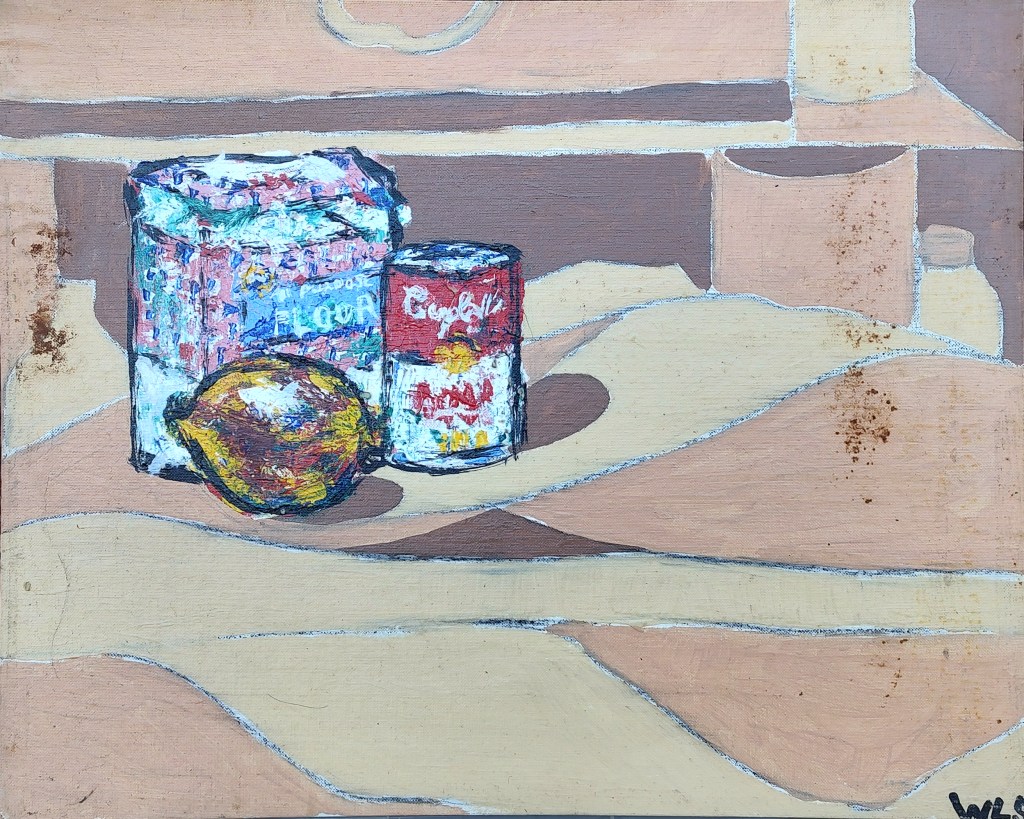
All paintings at: https://sites.google.com/view/cabinetofvanities
Acrylic on Canvas ,1970 16×20
Still life

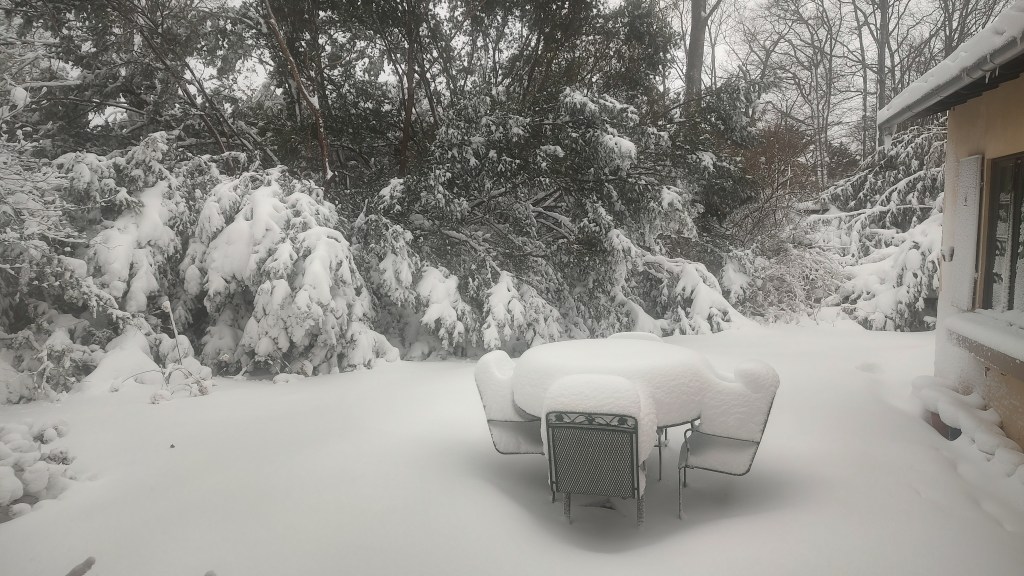
I claim to love living in the Northeast because of the seasons, but the more likely truth is because I grew up here. I do like natural markers of time, such as a noticeable solstice to indicate when winter begins, and the cold weather affecting my usual walks and yard work .
This year has been snowier and much colder than recently. Flu season is immense, and has affected me in spite of vaccination. I sit housebound, almost happily, and rejoice that I live in an era of abundant energy and goods .
I usually enter December wrapping nostalgia around the previous 11 months. At my age if I do not take care the entire past blends into a golden glow, and I quickly forget recent highlights. I accomplish my memory scrapbook with internet cleanups, visits, all the holiday chores and rituals .
And then – January. Looking forward, and during winter but spring is in view. New season tasks popping up already – taxes, travel plans, medical appointments. And a few items – not quite strong nor large enough to be considered resolutions – having to do with lifestyle, hobby, and happiness .
At the moment, however, I look out at snow, cough frequently, and too often say to myself “maybe tomorrow”. I guess concentrating on enjoying each changeable moment is also one of the benefits of very noticeable seasons .
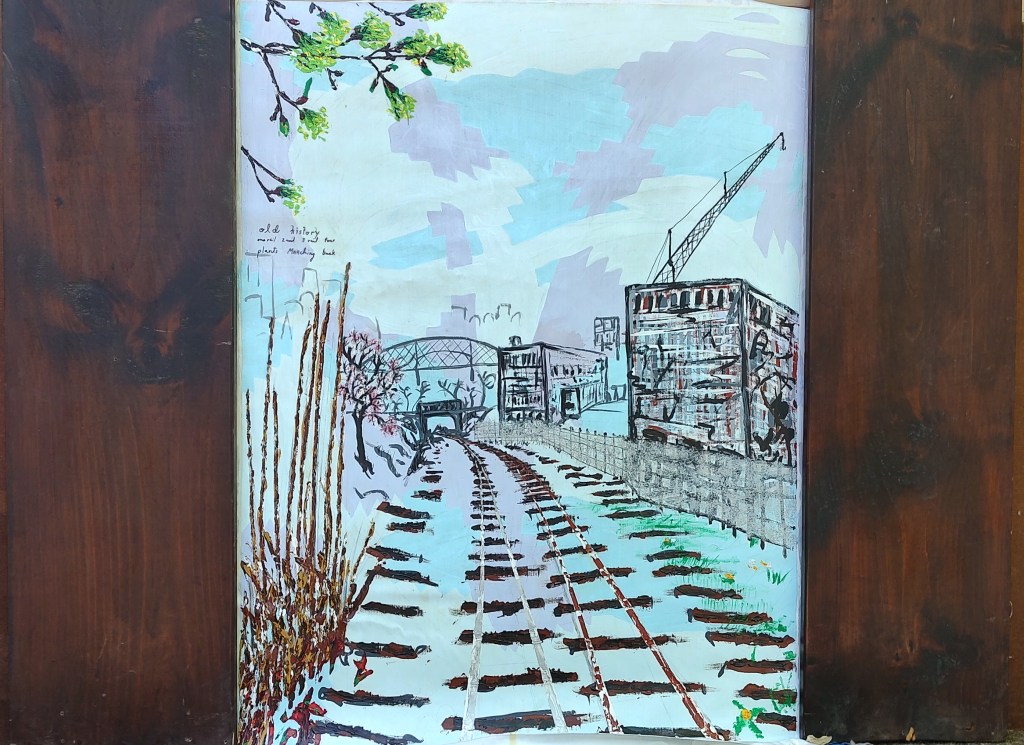
All paintings at: https://sites.google.com/view/cabinetofvanities
Acrylic on Canvas ,1975 40×30
Old history / one rail two rail three rail four / plants marching back

In the 1850s, the powerful Whig party of America broke up into factions and disappeared forever. The main cause was slavery, aggravated by regionalism and leaders who were unable to cope with the divisions .
I’m not sure which party will break up and vanish this time, maybe both. The formal cause will be work and wealth. There are wealthy people who work very little, and – as always – poor people who work very hard. But increasingly not only will working harder not make you wealthier, but the divisions between the classes grow sharper simply in the normal course of events as capital concentrates.
I await the equivalent of “Uncle Tom’s Cabin” to crystallize inchoate feelings into actions. But both parties seem very Whiggish, unable to formulate exactly what they are for, trying to tie together things that resist unity. It’s quite likely we emerge into an unrecognizable new era, hopefully without a destructive war .
The main battle cry on one side will probably be “security and opportunity”. On the other “liberty and merit”. The new plantation owners against the almost but not quite comfortable proletariat. And machine intelligence throwing monkey wrenches everywhere – like the telegraph, railroad, and repeating rifles in the earlier conflict .
Nobody seems to want war except for a few firebrands on each side. Each singing the same songs and nearly identical slogans .

“Your eyes are bigger than your stomach” is an admonition to would-be gluttons surveying a feast. Maybe children eyeing mounds of candy, maybe revelers drinking champagne, maybe elder vacationers at a cruise ship buffet .
The implication is that short-term hedonism and overindulgence will lead to eventual pain and misery. All of us know that this is true in daily life, although unfortunately it is quite easy to ignore common sense .
Ultra-powerful magnates now suffer the same illness. They believe they can do anything of which they conceive. And no matter what visions their eyes view at the moment, their imagination conjures more. More. Bigger, longer, stronger. Candy without end .
I suspect indigestion will follow. Unfortunately, the ultra-powerful can affect us all. The present may be lean as they gobble their resources, but it is entirely possible civilization could collapse in the aftermath .
Most of those industrial paragons are macho males. One wonders if they ever had mothers who warned them about their “big eyes”. Too bad .
They are having their monstrous feast. The rest of us can only fretfully wait for the inevitable outcomes, and the nasty cleanups to follow .
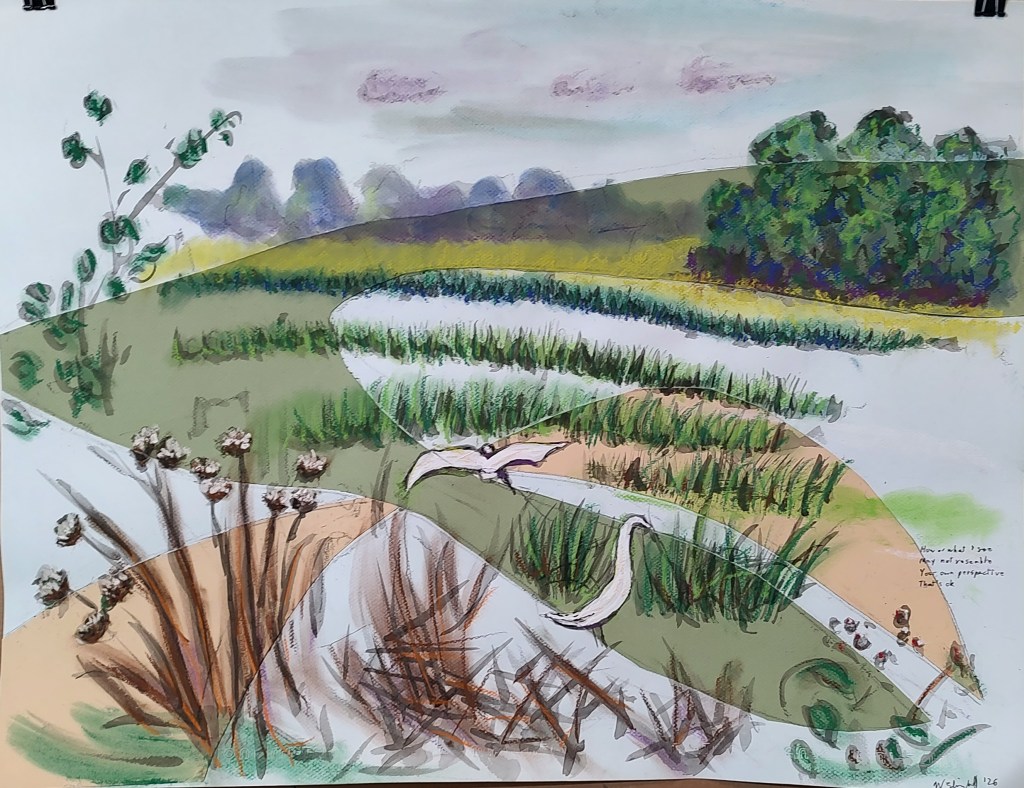
All paintings at: https://sites.google.com/view/cabinetofvanities
Pastel and Ink on collaged pastel paper ,2026 20×26
How or what I see / May not resemble / Your own perspective / That’s ok

Traditional children’s fables often contain valuable nuggets of adult lifestyle philosophy. They were, when created, a form of pedagogic knowledge to teach alongside the somewhat confusing and stern biblical narratives .
The story of the golden goose is easy enough to understand, whether in short form or embroidered. Its overt message is basically not to mess with a good thing, especially one you don’t understand. Its deeper implication is to avoid letting short-term greed destroy long-term bounty .
Perhaps “golden goose” should be a required course for MBAs and venture capitalists. They all seem hell-bent on mashing our current culture – which most of us believe is (or at least was) pretty good – so that they can extract the underlying value of anything in which they have invested, or destroy anything in the way of their economic triumph .
Like the man who killed the golden goose, their blind greed may be threatening everyone’s prosperity and happiness. Some folks admit we are not quite sure how everything works, but at least for a while it has been working .
I’m hardly against progress. It’s just that I’m not sure smashing traditions or killing culture is the right way to achieve it.
 HuntingtonHarborThoughts