More paintings and info at: https://sites.google.com/view/cabinetofvanities
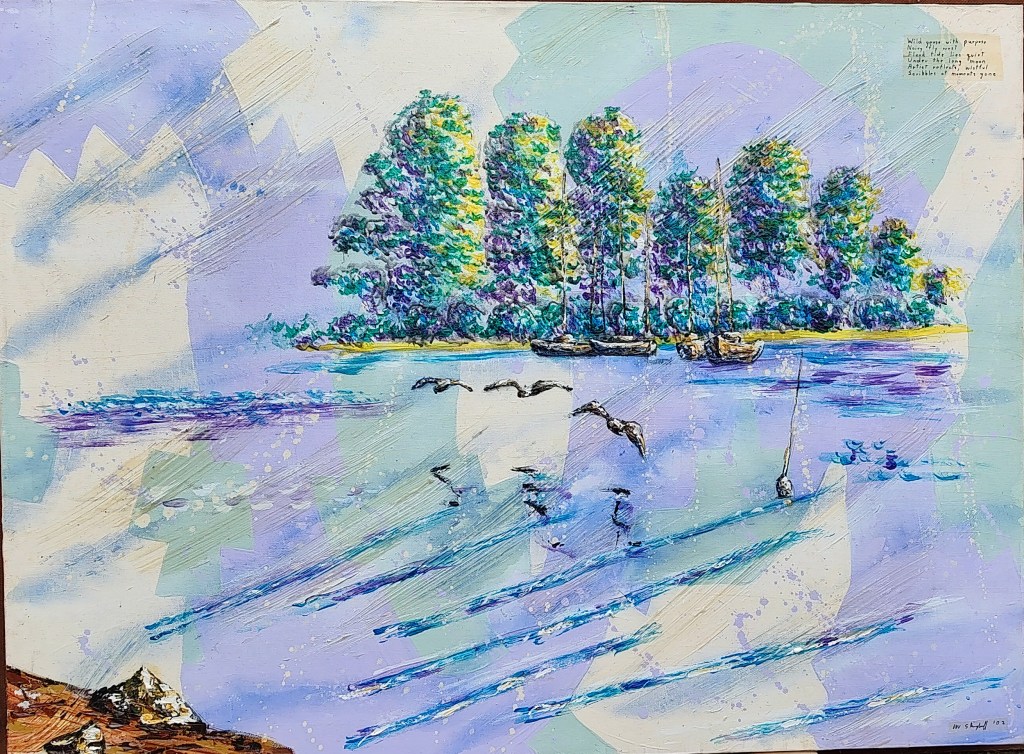
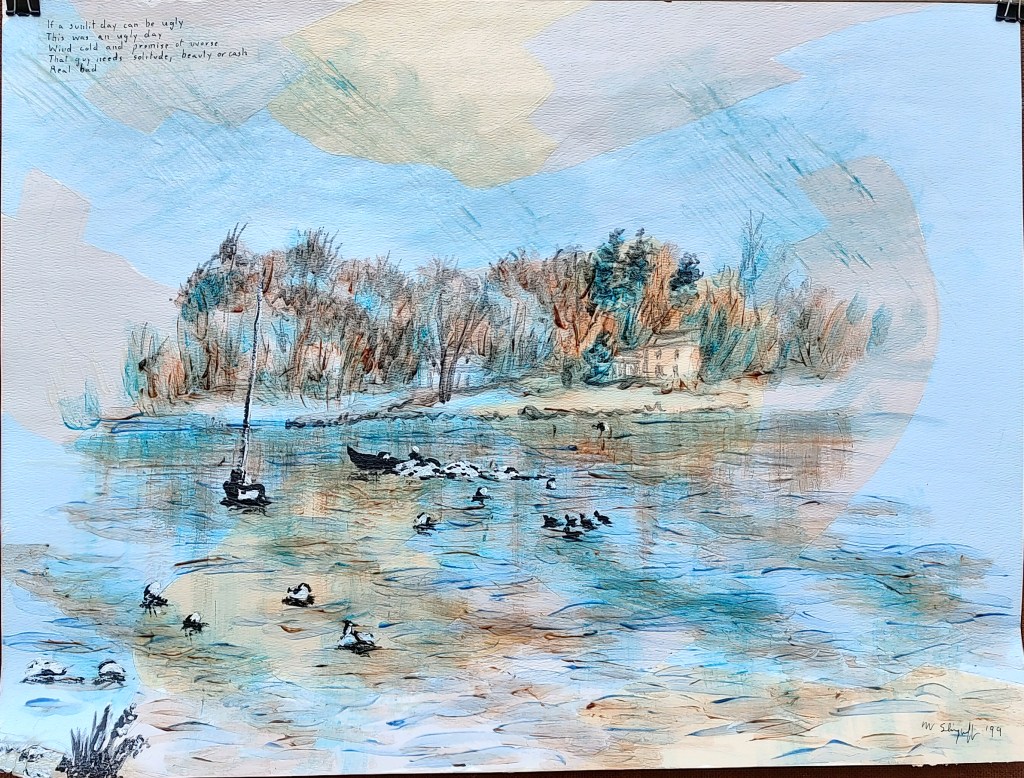
Acrylic on Watercolor Paper,, 2000, 22×30
Exchanging news or views/I can’t quite hear/as the breeze carries echoes/an endless whisper/of drying leaves, stiff grass

More paintings and info at: https://sites.google.com/view/cabinetofvanities
Acrylic on Watercolor Paper,, 2000, 22×30
Exchanging news or views/I can’t quite hear/as the breeze carries echoes/an endless whisper/of drying leaves, stiff grass

Young people tend to have nightmares or fantasies about old people (to be fair, old people reciprocate.) It is usually annoying to read “youngsters” giving us irrelevant advice, writing ridiculous entertainment scripts about elders, or solemnly discussing our plight.
It is true we have slowed down and become more careful. (But hardly so slow as the memory medicine ads would proclaim.) It is usually true that we gradually lose our taste for grand adventures – adventures occur all around us all the time, sometimes as simple as going to the store. We remain fully human, but (in spite of protestation) not as we were at 30 .
I feel a gradual degradation, which I accept (as I must, since – in spite of those ads for expensive medication – it is inevitable). Perhaps the most annoying are the constant little gaps in mind and memory. Particularly nasty are the constant stream of “lost words.” I know exactly what I want to say, know there is a word for it, know I know there is a word for it – but nothing but blank .
That clues me into other patterns I may not be quite aware of. Reflexes, adjustment to light changes, peripheral vision, and on and on .
In fact, what most amazes me in the whole process is how much I used to have, how much I can lose, and how I nevertheless remain me.

More paintings and info at: https://sites.google.com/view/cabinetofvanities
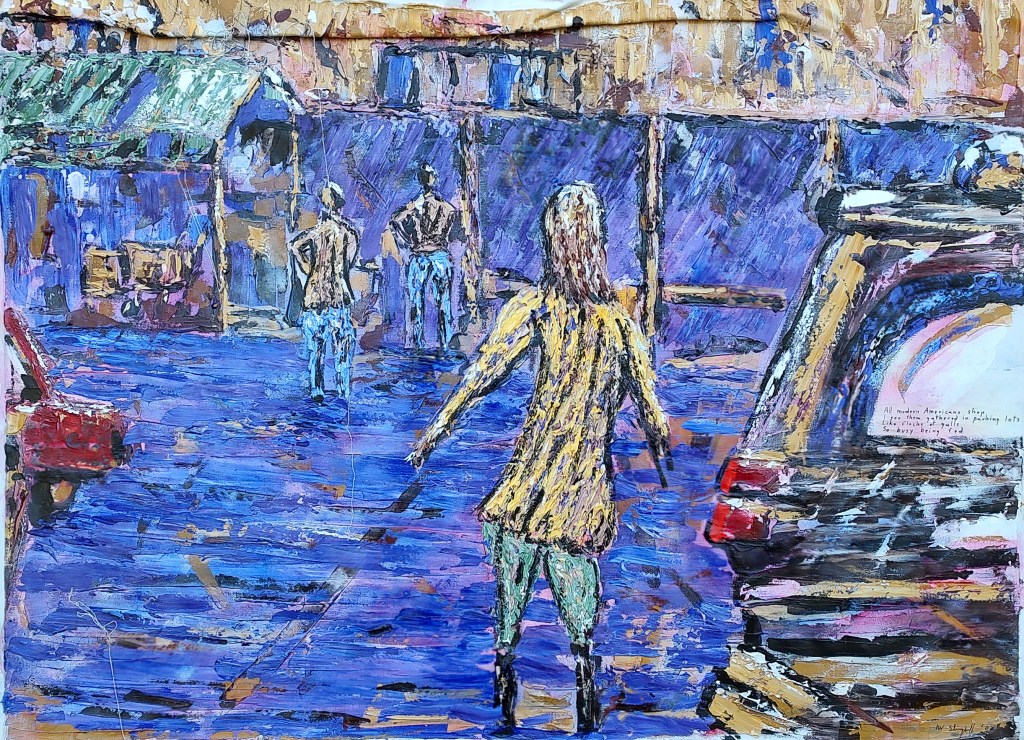
Acrylic on Canvas,, 1971, 28×36
Portrait of Joanne in Kansas City

“Life is short, but art is long” is one of those old Roman sayings that seem to make sense until we think about it. Up to a few hundred years ago, people conceived of time much differently than we do. Aboriginal tribes existed in a perpetual present, surrounded by “dreamtime” past and future. Civilized folks considered the past as a few hundred or thousand years – back to the Egyptians or some mythical beginning. Deep philosophers assumed the world to always have been as it is, possibly cycling through various stages .
More than that – in direct opposition to current ideas of progress – that past was always better, golden, inhabited by gods or semi-gods. Ancient art was always to be copied or imitated since the degenerate present could not compete. Thus “art is long”.
Now we laugh at a few thousand years. We know the world goes back a few billion, amazing creatures hundreds of millions, people like us over 100,000. And the world keeps changing. And “new improved” is demonstrably better than the old junk .
As for art … well it’s really as “short” as life. Useful for a generation or so at most. Like any legacy, soon gone with the wind, without even the solace of a grave marker .
As for other ” wise”, “golden”, sayings, ideas, and ideals of classic ancient cultures – don’t get me started .

Americans are used to hearing about the “rule of law” which sets the ideals of our Republic above other forms of government. But it seems to have been forgotten that “rule of law” does not mean simply obeying whatever momentary capricious rules are enforced by a government in power. In that sense anyone in an organized state – China North Korea Nazi Germany – lived under a “rule of law.”
The idealized American conception, however, implied more than that. It thought that laws were formulated following certain procedures, that most law was stable, that all classes of people were treated the same and – importantly – that historic “rights” were protected .
When any leader – a king, a military dictator, or a popularly elected official – can arbitrarily not enforce certain laws, artificially enhance others, pardon offenders at will, “go after” enemies legally and economically – that is not what we have considered a “rule of law”. Increasingly, that situation seems to be what we have now .
Elite philosophers through the ages have known that the concept of “rule of law” is fragile. It is hard to establish, easy to destroy. As we are now witnessing .

More paintings and info at: https://sites.google.com/view/cabinetofvanities
Acrylic on Canvas,, 1969, 28×22
Early effort of angry young artist

Anything added to an artifact that does not affect its functionality can be regarded as decoration. Such can be seen as one of the most enduring aspects of human creative spirit, serving no purpose but to make something more interesting or attractive .
In any craft, the first approximation of decoration is elegance. At a certain level, we truly regard a craft masterpiece as art. Whether it is ” fine art” or not is a question best left to those who care about such trivia .
People’s ingenuity has been able to replicate (often in mass quantity with machines) any fine original creation. Today we are surrounded by beautiful (at least to some) elegant and often functional objects. Created once by the glory of the craftperson’s spirit and training, now available to all .
For a few of us, a majestic extreme of decoration is a flat-bounded surface on a wall, drawn and colored in a pleasing or informative way. We visit museums to be entranced and amazed by these pictures. Nobody is quite sure why. Photographs usually do not provide the same kick. Children’s work may do so. It’s mysterious .
These days, for the craftsman or artist, the final production must be an end in itself. Only a few friends will notice. There is a glut of decoration – good and otherwise – in the world .
Yet craft, art, even appreciation of decoration, remains a joy of our spiritual life .

More paintings and info at: https://sites.google.com/view/cabinetofvanities
Acrylic on Canvas,, 2000, 30×40
Dark clouds attracted me/white gull startled me/insistent wind endlessly/gusted towards tomorrow

It’s been all the rage for a while for organizations to claim they want to be “lean and mean”. Such a desire will apparently yield greater efficiency, keep costs down, lower prices. What could possibly be wrong with that ?
Not long ago, however, people actually prized other things. They ridiculed those who “knew the price of everything and the value of nothing”. Even today the wealthy expect services far beyond a “wham bam thank you ma’am” approach. We have begun to regret the loss to society as civility has been submerged by nastiness .
More than that, whatever the benefits to a private economic organization, such an approach has never worked socially. “Lean and mean” families generally fall apart or produce monsters. Lean and mean social organizations fail miserably .
So it is with government. As rich technocrats take over and seek to “streamline” everything, they fail to realize that the primary goal of government, as in families and social organizations, is not to produce a product at lowest cost, but to provide a service that keeps a culture healthy, whatever the expense.
Like many slogans, “lean and mean” is a shallow fad of limited utility once the shock wears off and the actual results are evaluated. Even most successful organizations learn they must find ways to happily engage as a collaborative tribal unit. But too often, a lot of things are wrecked before that happens. In a government, that is a massive, and perhaps fatal, tragedy .

Striving suburban schools in the early ’60s would push Latin and calculus on “college track” students. The idea was – as it had been for centuries – that at least it would develop logic skills, language flexibility, and help us think more clearly .
Nowadays these courses are rarely taught in public schools. For one thing there is less overt “tracking” of students supposedly brighter than others. But mostly, Latin and calculus are seen as pretty useless compared to all the things kids “really need to know“.
I admit I’ve rarely used Latin and never touched calculus in almost 70 years. In that sense, I suppose it was wasted time. And yet …
It is good to get a firm logical base. Video games, wrapped in sensory candy, do not have quite the same applicability. The dry, hard exercises of calculus forced one to confront bare bones rules. Latin required a completely new and foreign manner of thinking and writing .
I have over my lifetime frequently felt the effects of that intellectual workout during my adolescence. Clear logic and formal observation of patterns have stayed with me and enriched my consciousness .
I know it’s not for everyone, possibly gone for anyone, but perhaps another meaningful cultural loss in our downward spiral .