More paintings and info at: https://sites.google.com/view/cabinetofvanities
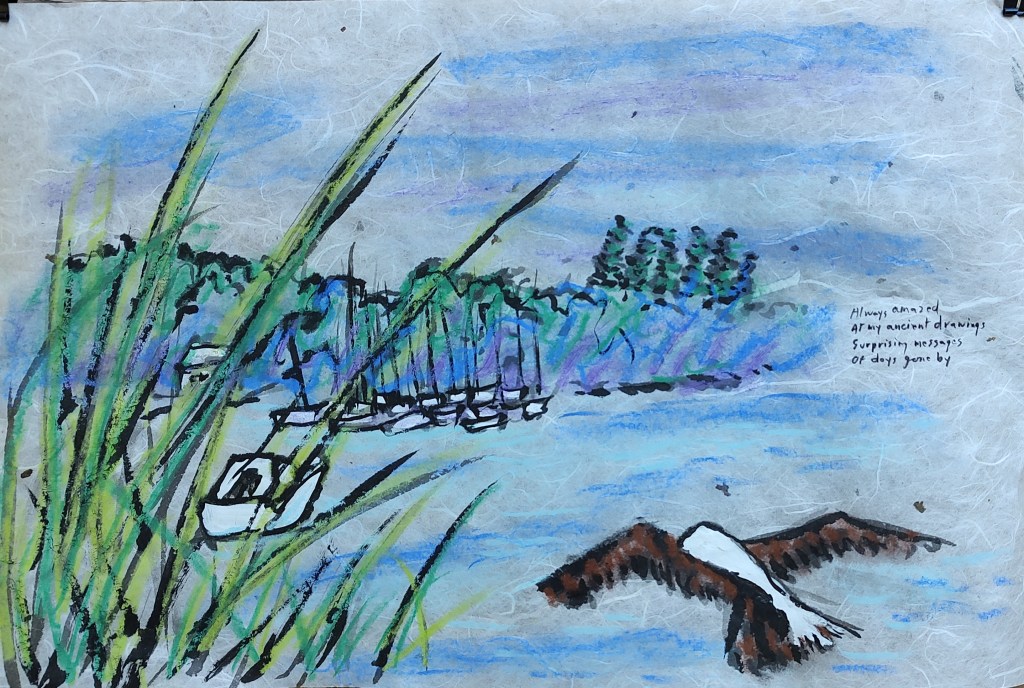
Pastel and Ink on Mulberry Paper, 2025, 11×15
(Inspired by 2002 sketch)
Always amazed/At my ancient drawings/Surprising messages/Of days gone by
More paintings and info at: https://sites.google.com/view/cabinetofvanities
Pastel and Ink on Mulberry Paper, 2025, 11×15
(Inspired by 2002 sketch)
Always amazed/At my ancient drawings/Surprising messages/Of days gone by
It was fashionable for a while to say that the current administration, like the ancient vain king, “had no clothes” when he claimed to be clothed in resplendent (but invisible) robes. Over time, however, power prevails.
The more appropriate fable is Ianesco’s “Rhinoceros” where normal people keep looking out the window and seeing everyone else, one by one, turning into that beast. Written in the ’30s it was of course a metaphor for everyone becoming nationalistic fascist .
At a gross level, the current rhinoceros is the nationalistic white supremacists. But the more troubling deeper change is that everyone, on all sides, have become sloganistic liars. They take one true “fact” and amplify it to great generality. As if finding one rotten apple in a barrel means there is an apple disaster, or one perfect apple indicates the crop is magnificent .
The “elite” used to at least pretend to intellectual rigor. No more. Anything can be said, and anything can be used to support what is said (and done) and if necessary anything can be fabricated as “virtually” true .
I look out the window and am becoming terrified. The horned herds grow bigger and bigger .
More paintings and info at: https://sites.google.com/view/cabinetofvanities
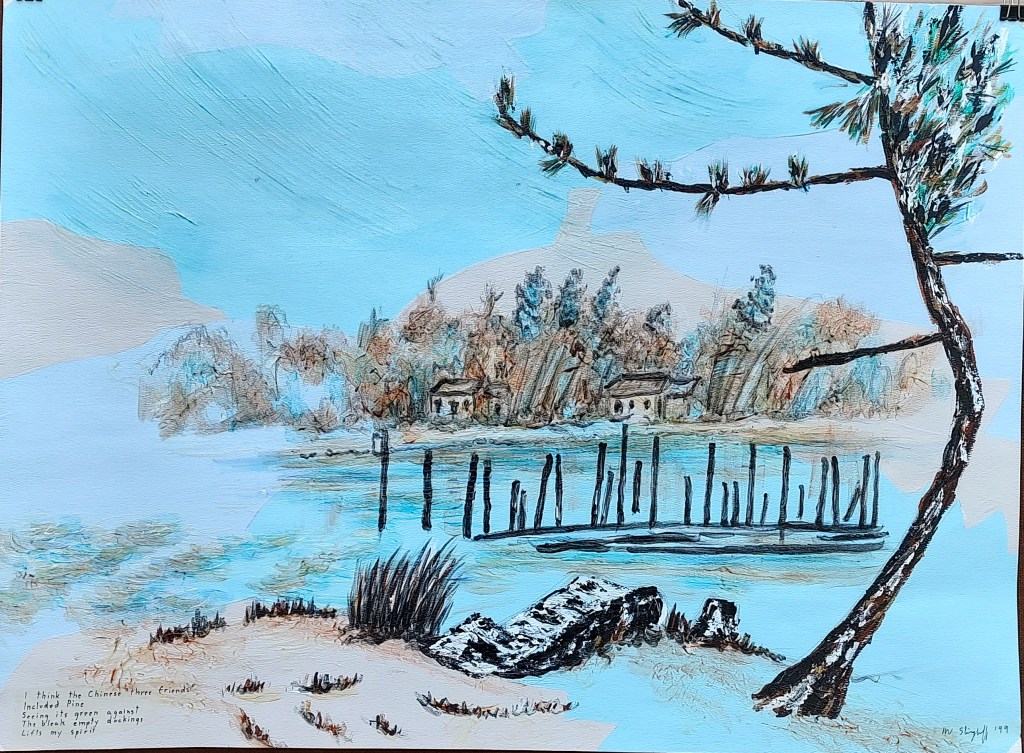
Acrylic on Watercolor Paper, 1999, 22×30
I think the Chinese “three friends”/included pine/seeing its green against/the bleak empty dockings/lifts my spirit

The 1789 French reign of terror has come to symbolize how a revolution can get out of control, turn on its leaders, and devour itself (along with lots of other people) . Robespierre is seen as a kind of parody of Hollywood kings constantly shouting “off with his head” to anyone who talked back or looked at him in a strange way .
Yet Robespierre was not really an evil guy. Throughout his short life he held ideals familiar and endorsed by most of us – the rights of citizens, abolition of slavery, women’s empowerment, rational society. He wanted a just society maintained by an uncorrupted government, where merit counted for more than class of birth .
What went wrong? Did power corrupt ?
No, not really. It seems to have been a sad, unintentional slide into hell. Things went wrong at home and abroad. Robespierre tried to deal with them. “Opponents” became “enemies”. Then “traitors” then “evil incarnate” which had to be eliminated for the glorious new world to arrive .
No matter how many went to the guillotine, troubles continued and multiplied. Finally Robespierre and the rest of the directorate fell, ending the senseless internal slaughter and opening the way for the senseless external slaughter of Napoleon .
We may rightly call Robespierre a fanatic, especially at the end of his life. There may be lessons there for many of us .
According to Edward Gibbon, the Roman Empire did not completely fall in the late 400s, but continued at Constantinople, speaking Greek and a little Latin for about another thousand years. The Byzantine Empire ruled parts of Asia, the Middle East, Africa. It fought and traded with all the other world powers of the time (Charlemagne, Persia, China). The city inhabitants were, it seems, mostly well fed and well off for those times, going about their daily business as we do ours .
But in all this eon, did the masses care much about the larger issues of civilization? No! They spent most time rooting for and betting on the horse races in the hippodrome. Rulers rose and fell depending on support of the “blue” or “green” factions. Mercenaries fought all the wars, while the citizens rooted for charioteers .
Today it is hard to find an equivalent to blue and green mobs, unless it is maga versus woke. Mostly our obsessive enthusiasms are splintered on the internet. We still hire mercenaries, don’t think much about the larger issues of civilization, and go about our “normal lives” .
Who knows? Maybe this civilization will also last a thousand years .
But if I were one of those gambling fanatics, I know where I would place my bet …
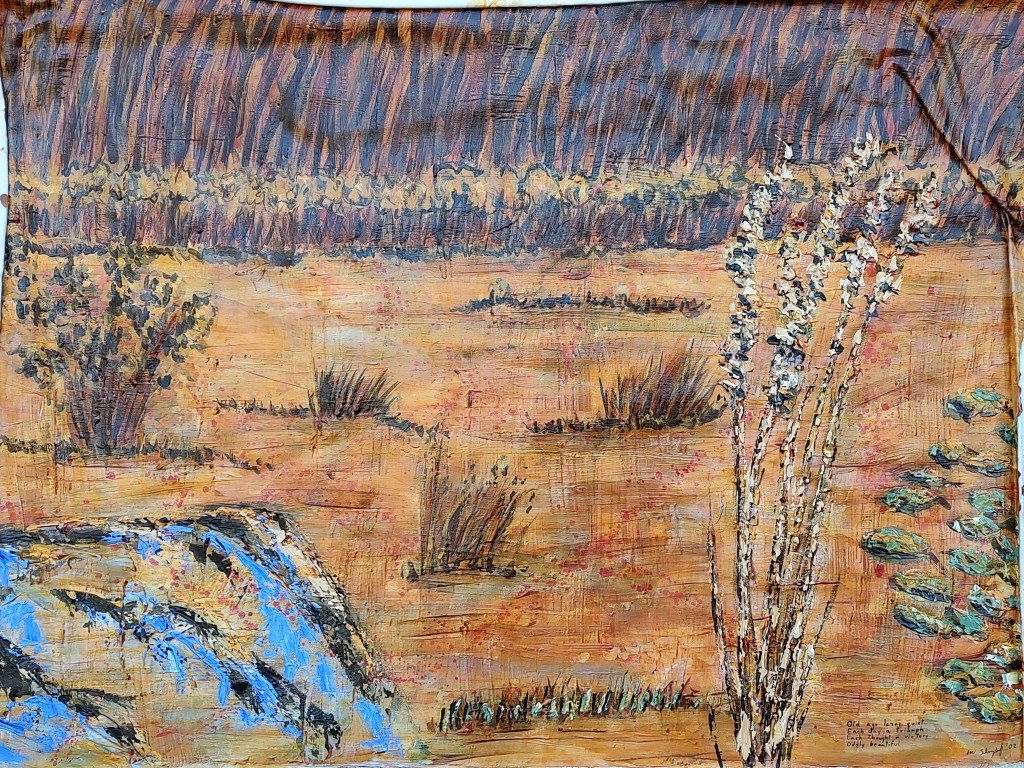
More paintings and info at: https://sites.google.com/view/cabinetofvanities
Acrylic on Canvas, 2002, 30×40
Old age lazes quiet/each day a triumph/each thought a victory/oddly beautiful

Now that hiring is solely based on “merit”, it is useful to ask what, exactly, signifies “merit”. In a lot of cases that is otherwise described as nepotism, social class, or presentation. Proof that one is a member of the existing tribe. But let’s pretend “merit” means how well one can do the job required.
Throughout history, the main measure – outside of actual performance once hired – has been experience. What someone has done and how well they have done it is almost always the main traditional criteria of “merit”, even if the skill is simply being flexible enough to learn new skills, or showing up on time. The normal route for all that until very recently was apprenticeship .
Today, increasingly specialized experience can be hard to come by, so learning with eventual “certification” became common. It worked a little. But most trades and professions want to be in a guild – which turned out to be well served by erecting barriers to entry involving more and more numerous and baroque certificates.
Certification often fails miserably in telling how meritorious a job candidate is, but it certainly thins down the stream of job seekers. And it’s self-serving since the last employee in wants new applicants to “at least go through what they did” .
The only folks who love all this are the lawyers. And the teachers. For the most part, newbies entering good professions are now facing that tried and true nepotism, social class, and presentation – plastered over with certification .
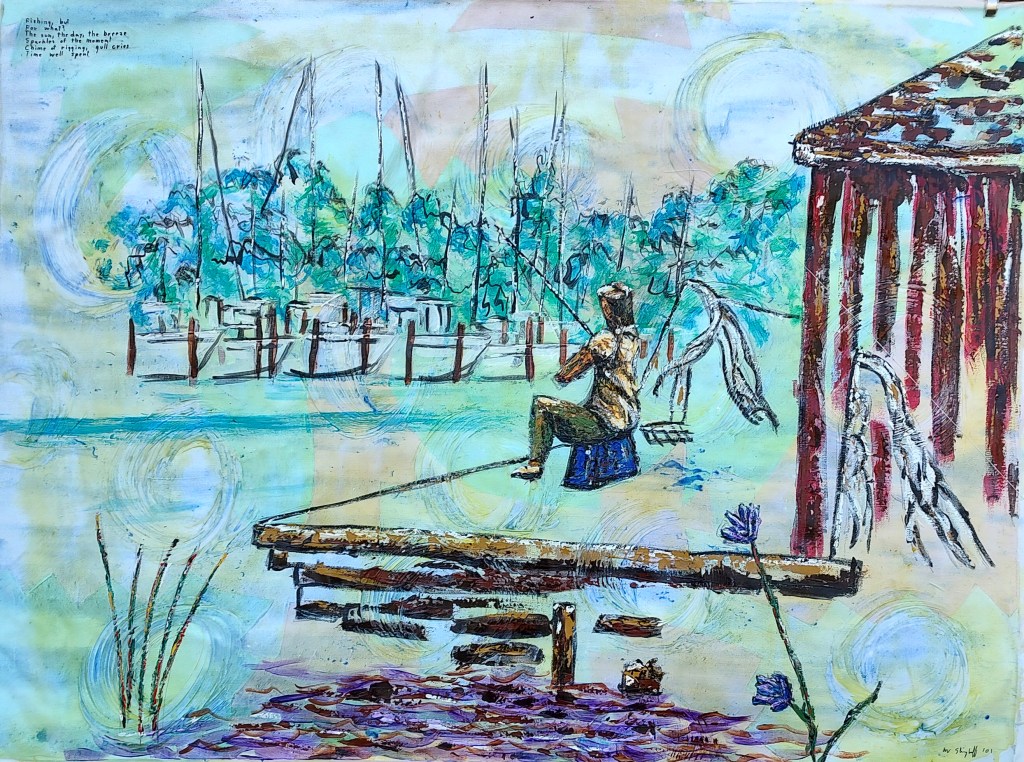
More paintings and info at: https://sites.google.com/view/cabinetofvanities
Acrylic on Canvas, 2001, 30×40
Fishing, but/for what?/the sun, the day, the breeze,/sparkles of the moment/chime of rigging, gull cries/time well spent
There are multiple ways to turn any natural observation into a metaphor for our lives. Having lived near the sea for most of my life, I am well aware of tides. Age often leaves us casting about for glimmers of cosmic understanding wherever they may occur.
The most famous metaphor is of course King Canute, ordering the tide to cease. A symbol of the uselessness of trying to prevent the inevitable. More deeply, a warning of how stupid it looks to attempt what common sense knows is impossible .
But there is also the idea of ebb and flow, high and low, translated to good times and bad. There will be in any life joy and pain, both of which usually pass one to another in a complex but inevitable rhythm .
For an older person, however, there is yet another lesson, which relates to deceptive normality. The high water mark is indicated with only minor variations day to day and season to season. But suddenly that can change in storm or tsunami, and rage well beyond what we thought we understood as limits. Leaving behind destruction and _ of course _ death .
So here we are, metaphor in hand. Is this next problem merely a usual tide or something worse?
It’s easy to become anxious when the predictable breaks the rules .
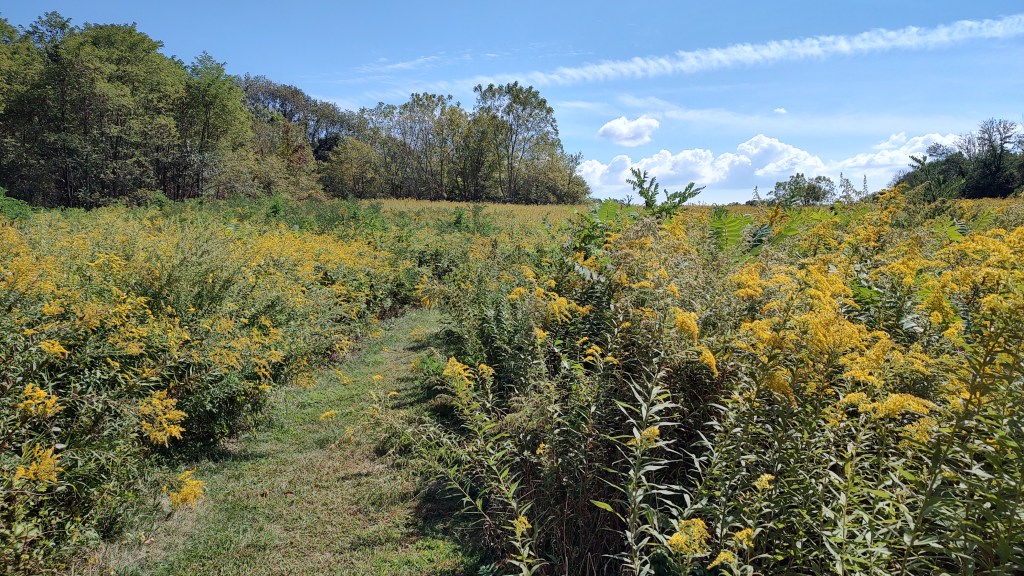
One thing I learned over the years is that social stability is often a kind of mass illusion. People, for example, tend to believe that prices remain steady, or always go up, or will go down. Or that the future will be better. Or that they should do certain things. Until, almost suddenly, everyone changes their mind.
There are parallels in science. Supersaturated solutions will suddenly crystallize. Some “tipping point” is reached and a structure fractures. All of a sudden, equilibrium is different. Or lost entirely to chaos .
Science prefers – which is to say we prefer – a smooth glide and predictable gradual transitions. Our forecasts generally assume trends are known and that the future will mostly resemble today. We project our own ambitions into a future that in most ways resembles our past .
That all works pretty well until it doesn’t. And, like those supersaturated solutions, things can change fast and in really unrecognizable combinations. Society reaches some point of no return – bread lines turn to looting, the king is killed, whatever – and nothing is ever the same again .
I guess things could all turn out to the good. But. Inflation, AI, automation, internet, fusion energy, ecologic disaster, endless lists. Any one of them could unexpectedly end what we assume to be forever .
And, really, not much we can do to predict or direct the outcome .
 HuntingtonHarborThoughts