Good Ol’ Summertime

Monday

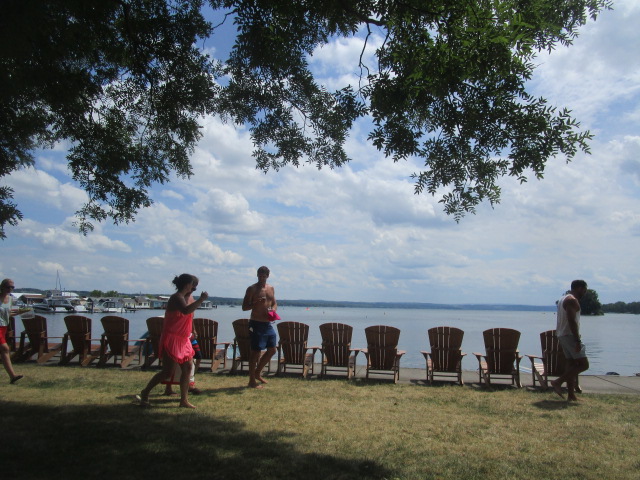
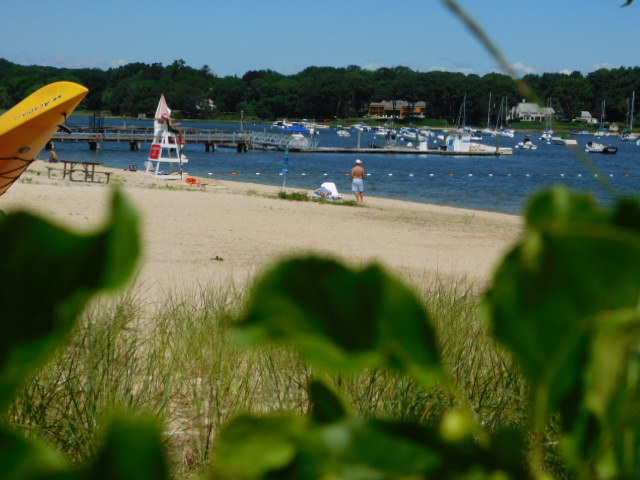
  • Right here, right now, is “the good old summertime” for some people .  Those who can find it _ by no means everyone in this 24x7x365 world, even on Sunday _ enjoy the bliss of leisure.  Children playing on the beach, swimming in salt tide will remember hot afternoons of sand and sun fondly.  Teenagers flirt, old folks lie for hours remembering or trying to forget.  Nostalgia, past and future, ripples like heat waves off the parking lot asphalt. 
  • These may be the last decades that July is to be treasured so fondly.  Future generations may yearn for the “good old wintertime,” when it is cool and children are allowed outdoors.  Already much of the nation is beset with record heat, huge fires, extreme droughts, “thousand-year” floods.  For that matter, not too long from now, there may not be many sandy beaches from which to dream.  But this year, this summer, this month _ I see “good old days” forming before my eyes.  

Tuesday
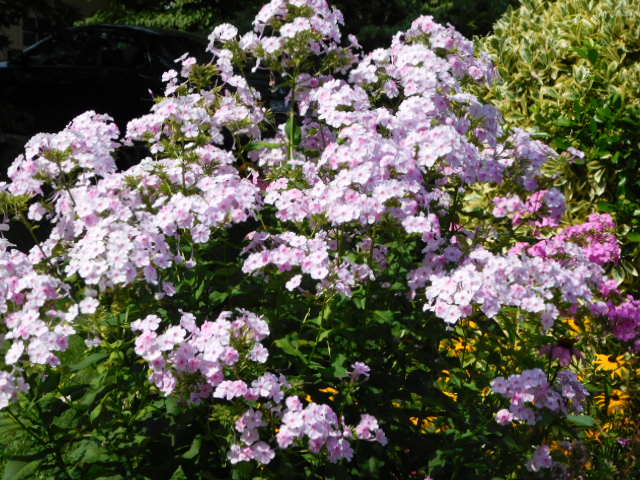
Celebrating summer too easy
Takes a real poet

To charm with snow, freeze, ice, flu.

Wednesday

  • Kids at summer camp catching (or at least trying to catch) things in nets above and in a pond.  Seems timeless, but of course childhoods like these are a relatively recent invention.  Always amazing that in suburbs and even urban areas dragonflies, tadpoles, minnows, butterflies and so forth are still managing to survive _ and even to surprisingly thrive.  Like catching glimpses of dense schools of bait fish in the harbor, or frequent flights of hawks and ospreys overhead.  The natural world is damaged, but still vital.
  • Most astounding to me locally is how many fish can be caught, how many berries can be seen on bushes.  In the world, how vast quantities of seafood are still caught in the wild _ even in the presumably heavily polluted Mediterranean.  I sometimes wonder how distorted a view of our environment those of us who live in urban or suburban enclaves may be receiving.  But I also know that the truly horrible wreckage of nature goes on away from most people _ on chemical-drenched factory farms, on remote wasteland coal and oil fields, in endless pits dug to retrieve industrial minerals, and everywhere in the pollution of air and water where no one can see.  No dragonflies, tadpoles, or hawks are likely to be sighted in such places, nor groups of children to complain at their absence.

Thursday

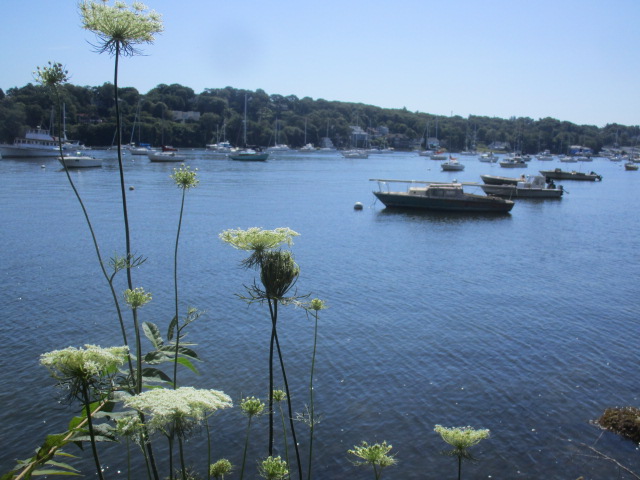
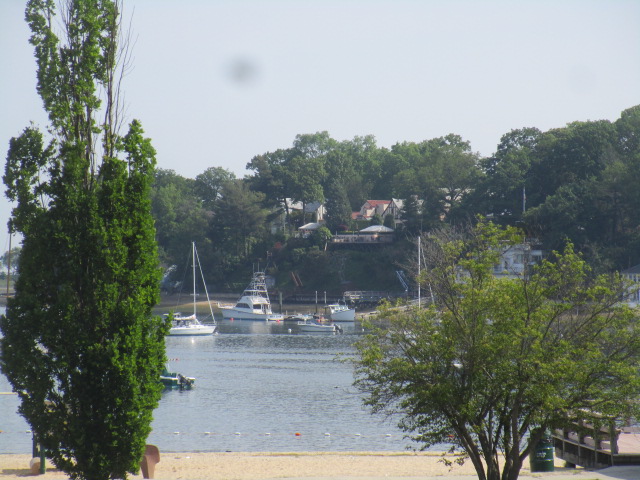
I sit back, surveying the end of the harbor with a happy sigh.  Boats are being set into the water, kayaks explore alcoves, stand-up paddle boats threaten to dump their rowers any moment.  Once in a while a noisy jet-ski putters towards open space, or a sailboat under motor power arrives to tie up at the dock.  An egret struts on low-tide mudflats. “Just like I remember over fifty years ago, when I was a boy,” I remark to Bill, reading a paper on the bench alongside.
“A lot has changed,” he responds, sourly.  “The similarities may be deceiving.  You know, I grew up here, and back in 1955 or so this was nearly wilderness.”
“Not so,” I protest.  “I’ve read the local histories.  This place has been civilized for a few hundred years, cleared, farmed, built up, polluted, industrialized, decayed, repopulated.  You just caught a fragment in the grand mix that looked less civilized.”
“Wrong,” he states.  “My perception counts.  It was more wilderness back then.  This clutter” he waves at the bulkhead, the dock, the busy street behind us, the marine stores lining the shore “this garbage was not here.”
“OK,” I agree reluctantly.  “Maybe you’re right.  Was it better?”
“Ah,” he takes a deep breath.  “That’s a hard question.  So much has changed, on the surface anyway.  But so much remains the same underneath.  People were people, I suppose.”
“What will the kids today grow up to think?  How will they remember this?”
“Oh, for them I guess it will be recalled as a different kind of golden age.”  He watches a gull swoop by just over our hats.  “Depending on what kind of dystopia they end up with in fifty years, of course.”
“Cheery, aren’t we?” I laugh.
“A lot of good things are happening, I suppose.  A lot of good has happened.  I can’t complain much.  But I wonder,” he pauses.
“You wonder?” I coax him, curious.

“I wonder how fragile this web of wonderful stuff really is, and how close we are to losing it all.”  An extra-loud low jet bound for Kennedy cuts off conversation, as a wail rises from the fire station and an insanely thundering helicopter swoops towards the hospital.

Friday
  • Annual trip upstate to visit our son in Rochester.  This is some 400 miles of expressway driving, through farms and mountains and old cities, along rivers and railroads.  An hour in the tangled infrastructure of New York City, and days of strolling sidewalks and visiting areas of what is supposedly a devastated upstate economy.  From listening to news, one expects to see something similar to the pictures coming out of the Mideast tragedies.  Not so.
  • The roads, even in NYC, are well maintained and being more so.  Traffic, both pleasure and commercial, is everywhere _ trucks loaded with wares fill the roads.  Fields are fat with corn and cows, barns and houses sparkle in the sun, fantastic local artisanal produce fills the public market.  Mountains are blanketed in dense green forest, rivers are full flowing, lakes are plentifully supplied with power and sailboats as masses of people watch from restaurants and bars along the shore.  Rochester itself seems to be gentrifying older areas and rapidly building newer ones, and few of the people I passed _ day or evening _ seemed terrified by their environment and clinging to guns for protection against looming menace.  All in all, I decided perhaps I was better to trust the evidence of my own eyes than the words of politicians, journalists, and editorial writings.  Not a surprise, but I sometimes need to be reminded.   

Saturday

  • Like all our memories, nostalgia is unique for each of us.  We recall different moments in different ways.  Some we blank out, some we enhance, some we even invent.  And each is a special mélange of sight, sound, taste, smell, visceral physicality, emotions, thoughts, and layers we have embroidered in afterwards.
  • By definition, nostalgia indicates some positive connection with the past.  Nobody is nostalgic for the horrors of war or the ravages of disease, although there may be certain elements of such (the comradery of fighting units, or triumph over adversity) that can be polished to a warmer glow.  Since most nostalgic recollections imply some distance in the past, their very foundational truth is questionable, as is often obvious by comparing stories with those of others who were present at the same events.
  • For my baby-boomer peers who grew up in the fifties, summer remains one of the finest nostalgic periods.  Back then there were few demands once away from school, except for perhaps some “good for you” summer reading that, if done, was often accomplished less than a week before new classes started.  Many parents could truly relax for a weekend or a week or so, getting away to some quiet and inexpensive resort, doing nothing but what happened to be around, never interrupted by calls from work.  Was it true?  I don’t know, that’s how we experienced it.  At least, in my own nostalgia, that’s how I remember experiencing it.
  • As Proust noted to such grand effect, a scent can trigger an unconscious tumble into a nostalgic fugue.  My own nudges seem to be more visual and kinesthetic.  Walking in humid heat, sweat beginning to drench my shirt, hot sun glaring all about, easily pushes my deeper consciousness back to childhood, and to the happiness of innocence when the who world was available for the taking, and all the time in that world to accomplish whatever I wanted.

Sunday
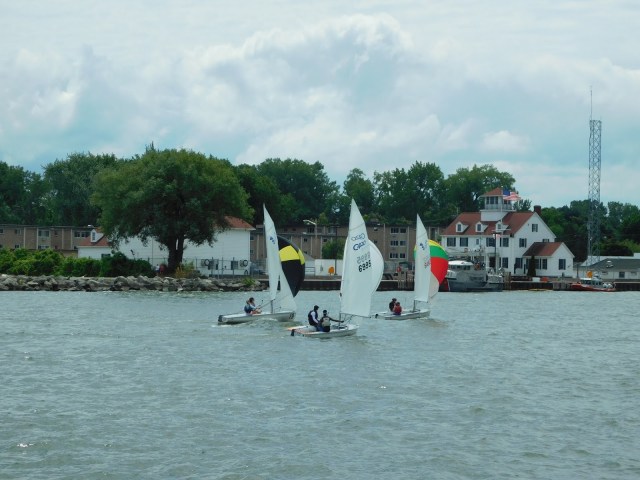
  • Surprised to find so many people lining parkland shores of Lake Ontario on a bright Sunday morning.  Turned out there was a colorful regatta offshore in strong winds _ here boats return to the “Port of Rochester” through the rock jetties lining the mouth of the Genesee river.  On the other side, an official beach-volleyball tournament was in progress, families swam in waves that were almost surf, and barbeques were being prepared in huge smokers under leafy canopies alongside numerous picnic shelters. 
  • None of this appears in national news, rarely enough on local media.  We learn of each fire, each car accident, each criminal event.   I think we start to think that the only sanity that exists is some magical bubble around us, that the rest of the world is a hellish expanse of horror (a favorite cliché word of the moment.)  But evidence remains that this is a happy and fat land filled with pretty good times for most of the people, most of the time.   The world has never seen its like before.

Hotcha!

Monday

  • Noel Coward’s song “Mad Dogs and Englishmen go out in the midday sun” seems to apply to local joggers who grimly exercise as humid heat reaches into the nineties, with blazing sun piling on.  They assume they risk degradation and death to pursue dreams of fitness. Certainly to listen to self-qualified “experts” in such matters, mankind was never meant for such conditions.  We should be burrowing underground until weather becomes more favorable.  Or at least leave the heat to the leaves, and limit excursions to air-conditioned malls, cars, and _ in the words of Henry Miller _ nightmares.
  • I grew up in a time when as I recall only movie theaters and a few larger supermarkets had cooling facilities.  The Delaware Valley is famous for nearly 100% humidity, stifling stillness, and blazing solar beams.  Farmers never cared, neither did we, and my friends and I played and worked outside shirtless without a care in the world.  Somehow,  apparently against all the odds, most of us are still alive.  Either we were exceptionally hardy or the experts are not quite so expert.

Tuesday

Dog days of summer settle
Named for rise of Sirius
Back when folks could still see stars.
Today seasonal tribute is less cosmic
We seal our boxes tightly

Flick a switch from Heat to Off to Cool.

Wednesday

  • Thunderstorm sweeping by last night brought heavy downpour and colder Northern air, temperature is ten degrees cooler today, accompanied by a dry breeze.  Even in the midst of our most extreme seasons, we experience great variations.  It’s doubtful that the rest of nature notices _ it’s warm or not, there’s water or not, food or not, predators or not.  Life in instants has no time nor means to reflect on longer patterns.
  • People, on the other hand, can attune themselves ridiculously.  Some think any variation beyond 72F _ give or take a degree or so _ is uncomfortable.  For them, 80 remains a heat wave, with danger at 90 or _ Heaven forbid! _ 100! Connoisseurs of climate.   Our individuality and worth seems too welded to acquired specialization.  I’m as guilty as anyone, as I stroll about thinking how grand I am.  We should cultivate contempt for any expert who becomes too obsessively expert.  We must experience narrow vivid instants, but also holistic perceptions which require no particular delicately encrusted expertise.

Thursday

Trying to prevent drips from my peanut butter sandwich at a Halesite picnic table.  Even in the shade, sweat dripping into my eyes makes the lovely water scene waver and sting.  I’m startled by Ed’s loud shout _ “Hot enough for you, young man?”
“Oh, hot enough, I guess.  Not really a roaster.” I sadly indicate my lunch. “This is just a mess because it was in the sun while I was walking here.”
“I think it’s about as hot as it should ever get!” declares Marie, bedecked in in wide-brim tan straw hat.
“I, on the other hand, still consider it slightly cool,” maintains Ed.
“Normal variations, I guess, we’re all different that way.”
“Well,” he looks around at boats large and small, “I know you’re right, but you’d never guess we knew that from reading or watching things lately.”
“What’s that got to do with heat?” demands Marie.
“Just this,” he continues.  “I’m sick of the grouping of people as if they were sacks of rocks.  ‘White college males think …’ for example.  People are complicated.  No two people think the same about any issue any more than we do about whether it is too hot or not.”
“But if you took a poll here,” I point out, “they’d all agree it was generally hot.”
“Well, OK,” he admits.  “But the politics today is on the tweaks.  I’ve never seen such lather over Tweedledum and Tweedledee.”
“Controlling nuclear arsenals is hardly tweaks,” starts Marie …
“Hey!  Hey!” I try to calm them down.  “I just want to eat my sandwich in a lovely spot on a perfectly fine afternoon _ without paying too much attention to exactly how fine it may be _ and enjoy this moment of being. “
“But don’t you think …” insists Ed.
“Nope.  Not now.  No opinion.  Undecided.”
“But …”
“Ed,” I say ge
ntly.  “Hate to tell you but nobody cares if you or Marie or I think it is too hot, just right, or not hot enough.  No more than what we think about the state of the state.  Would you like a grape?”

A loud horn sounds nearby and we pause to watch some private behemoth easing out from a nearby dock.  

Friday

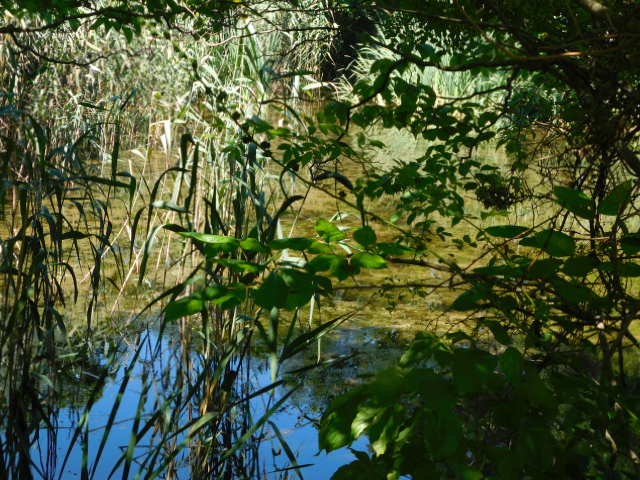
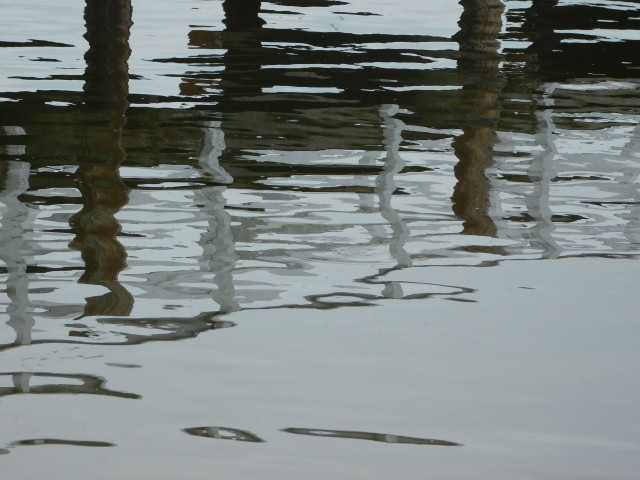
  • Optical illusions demonstrate how easily the mind slips from one conception to another when presented with visual evidence.  Similarly artists have woven illusions or abstractions to enlighten or confuse thoughts.  At first glance, this picture might well be a Monet water pond, or a Pollock abstract, or some meaningless scatter painted by an unknown.  A second look picks out reeds and reflections and makes sense of the photograph.
  • We have only recently realized exactly how arbitrary and fragile our vision.  The eye may see what a camera lens does, but only an interpretive brain can produce “common accepted reality” or an artistic revelation or some internal Quixotic interpretation of the scene.  I enjoy unfocusing almost as much as deciphering the photons reflected into my retina.  The world is marvelous not only because it may be “just so”, but also because it may not be at all what we so confidently imagine.

Saturday

  • Conventional wisdom claims we live in places that would be impossible without modern technology.  Florida and Arizona before air conditioning were terrible places to settle, at least for Europeans.  Without rapid transportation of bulk goods the vast grain farms of the Midwest and the cattle ranches on the parched plains of Texas would be impossible.  No matter where we look, we seem to be tied into a social and technological grid without which we could not survive more than a week.
  • That is obviously true.  But it is not new.  Civilization has been like that since the taming of agriculture, which just about everywhere in the old and new world required bureaucratic government and irrigation.  Only disease and harsh conditions, which thinned populations dramatically, let some humans avoid that fate, but we could seriously question whether the nomadic and brutal life of native Americans and the short and uncertain lives of all other “primitive” peoples in places like Africa were better than the lash and the wheel. 
  • Intellectual contemplations like those do not matter.  The fact is that generally people today, whether by choice or force, live or aspire to live with access to full consumer comforts.  Few parents would willingly consign their infants to aboriginal life with a tribe in the Amazon rain forest, or any other such “romantic” notion of going back to nature. 
  • What we have, however, learned over the last few centuries, is that such “progress” has costs, many of them not immediately apparent but accumulating nearly fatally over time.  That is what we are dealing with today, in life, in outlook, in hopes, in politics, in every phase of life.  What will we trade for what, and what will we not?
  • I think we have been living through a few years of grace, while these profound cultural questions sink in and various answers rebound not only by word but by entire lives.  When there is little more to strive for, as an example, is the only proper response a hermit-like lethargy, or a constant chatter of games and conversation and arts, or a drug-induced internal withdrawal, or an artificial fanaticism leading to active anti-social madness? 
  • Hot times, for the mind as well as the body.  We wonder if this period is our summer, with decline to follow, and if so, how long the heat can last and how well the water will hold out.

Sunday

  • “Heat Dome” seems to be as bad as predicted, although hard to tell how much of it is psychological.  No question sweat pops out with the slightest exertion in the shade, spontaneously in the sun.  Thick haze a constant reminder of bad air quality.  Fortunately, Huntington by the harbor has at least a steady light breeze, barely waving flags but cooled by evaporation.  From all accounts, it is one of the more fortunate areas of the country this weekend.
  • Nevertheless, I stayed in yesterday, perhaps deciding to act my age, perhaps merely being lazy.  I only went out to do some necessary watering, or to read on the patio later in the afternoon until the mosquitoes arrived.  What surprises me is not how lethargic this lack of normal exercise made me feel, but rather how dull my mind became.  Stimulation through motion and exposure to nature seem to be necessary if I am ever to have a creative thought. 

Wonder & Worry

Monday

  • Looking out the window, walking through a meadow, watching a brilliant sunset,  catching flashes of lightning bugs at night, and hearing the shrieks and melodies of birds all day long, this seems the most perfect of places in the most perfect of times.  Flowers bloom everywhere in this benign climate, entertaining storms pass quickly by, squirrels play.  Inside, the larder is always full, there are infinite wise books to be read, marvelous distractions available on media all the livelong day.  Yet we are warned not to be fooled, for all is falling apart.
  • A favorite phrase of essayists these days is “the best of times, the worst of times.”  Global warming, falling test scores, increasing racial tension, defunct political consensus,  neonicotinoids,  GMO’s, the list is endless and increasing with each ever-more hysterical dawn.  I’m getting older and _ in the words of the old Kingston Trio “Merry Minuet” _ I don’t like anybody very much.  But I have come to accept that “best” in the present is worth a bunch of “worst” in the future.  An intellectual hedonism.  Perhaps I am condemned by such an attitude _ but perhaps pure appreciation also counts for something.

Tuesday

I wonder at this grand fine day
I worry of tomorrow
Wonder as we dance and play
Worry at our sorrow
Our universe is grand and free
Until it kicks our teeth
We carpe diem just to be
But may find no relief
I wonder who I am and why
I worry what to do
Wonder at the earth and sky

Worry if it’s through.

Wednesday

  • Amazingly, in one of the most populated areas on Earth, it is possible to slip away to a few places where there are few signs of people.  Astoundingly, in spite of centuries of industrialization and pollution, the air still seems clearly scented with flowers, the water tangy with salt and little else.  Birds fly endless rounds, insects flit about the marsh, flowers bloom on the sand.  And most surprising of all, parts of this scene are wilder than they were a century or two ago.
  • We have become increasingly urban.  Our own experiences are often of home after home, building after building, traffic on streets with no scrap of land visible.  Our essayists flit from megapolis to megapolis, in sealed aircraft, not noticing the “flyover” barrens below them.  Yet most of the world remains open land.  A few hours away even from here are vast tracts that _ if not untouched wilderness _ are nonetheless unused wildness, filled with decaying buildings and the rusting scraps of an older era.  Rural residences, farms, small towns are depopulating almost everywhere.  Perhaps, walking in empty fields and wetlands, I can yet preserve hope for the future while contemplating that fact.

Thursday

Jim and I exchanging banter during some demonstration or other at Hecksher Park.  The banner says something like “Save your shoes, save the Earth,” sponsored by Nike.  Almost a hundred folks of all ages are grimly striding around the lake, happily engaged in this godly duty of environmental repair through consumerism.
“More dystopian thoughts,” I venture.
“Oh, haven’t we had them during our lifetime?” muses Jim.  “Gee, I lived through the communist red menace, certain nuclear war …”
I add “irrecoverable river and air pollution, no birds or wildlife because of DDT, cities going up in flames, race riots, cultural disintegration from the sexual revolution.”
“Yeah,” smiles Jim, taking up the theme, “the end of oil, population explosion like locusts, nuclear meltdown,  Japan buying the world.”
“Starvation from a new ice age …”
“What?” he exclaims.
“I was reading an old book.  That was a common theme of the seventies _ we were about to move out of an interglacial warm spell and into cold desertification of our grain belts.”
“Oh, right, I forgot.  And then …”
“Don’t forget we were all going to die of AIDs, China buying everything, computers running amok,”
“Y2K!” we both laugh.
“The end of metals and all other commodities, autism plagues, social revolution redux, united Islam conquering a fractured West.”
“And here we are,” Jim waves at the crowd.  “Still worried, still hysterical, still inventing problems.”
“And solving them,” I interject.
“Well, or letting them solve themselves,” he notes.
“Here we are,” I say slowly, “Practically in utopia, and still inventing insoluble problems and certain death.”
“Well, it keeps life interesting.”

More people stream by, the sun shines, and swans glide majestically across the calm waters.

Friday

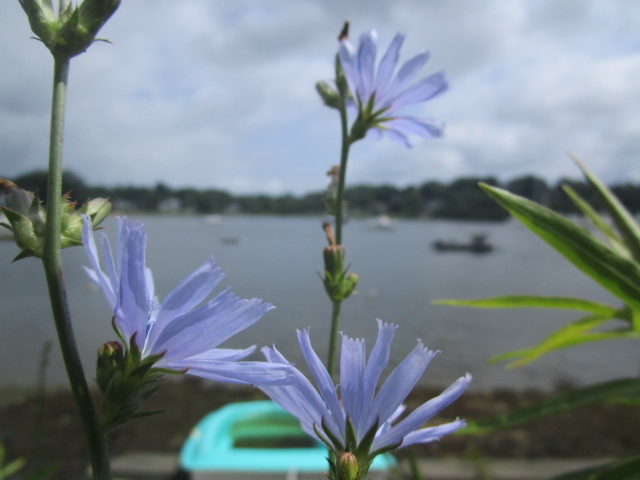
  • Bindweed and morning glories now blooming _ surprise _ every morning, along with the chicory. Other summer flowers are following their genetic pattern.  Meadows are filled with daisies, butter-and-eggs line the roadways, hawkweed offers bright yellow spots and thistle and vetch provide patches of purple.  It is as if views have been orchestrated for pleasure.  Terns and swallows swoop, hawks and ospreys float in circles, sparrows and finches dash from bush to bush.  Ah, another fine mid-summer.
  • People don’t conform to predetermined patterns, not even those of their parents.  Older folks know the younger generation is failing to measure up to their own lofty achievements.  For example, nobody under fifty can read maps and is hopelessly lost without a GPS nearby.  Such complaints, often humorous but with sarcastic bite, fill media.  The young, like the meadow flowers and larks, laugh it off, knowing that the world is theirs and will remain so until the next even more awful generation happens along.

Saturday

  • The fascinating dichotomy of the times _ this so much better, that so much worse _ extends through science and technology into nature and human existence.  At no other period have we been so aware of the entire world, so deeply understanding of its underlying complexity.  Yet with that awareness and understanding has come the horrible realization of how rapidly much is vanishing and destroyed forever, and how fragile the rest remains.
  • For those willing to make an effort, the complex intertwining of physics and life reverberates in a grand symphony back to the big bang itself.  For those open to marvels of our mind, the mysterious rapid evolution of the human species and its implications is an infinitely engrossing study.  We are on the verge of a true useful philosophy of being, even though it remains sadly out of reach at this moment.
  • Technology, meanwhile, hands its marvels and curses as always.  For every wonderful advance _ miracles as trivial as being able to eat strawberries all year round or major triumphs over diseases like heart disease and cancer _ there seems to be some counterbalancing evil.  And yet, on the whole, which of us would willingly roll back the clock even a hundred or two hundred years, in terms of knowledge, technology, society, or any other part of our mostly happy and comfortable existence?
  • I could make predictions, but like all predictions, they would be wrong.  I could wish for things, but since my time remaining is brief, my wishes tend to have a limit of decades rather than centuries.  I could fear much, but fearing that which one cannot control or affect leads only to madness. 
  • So another day dawns.  I revel in new discoveries from my immediate environment, from my extended media, from my inner thoughts.  It appears I have another day of wonders before me, and that Is more than satisfying at this stage of my life.  Tomorrow, as always, will have to take care of itself. 

Sunday

  • Above ground, this is a festival of peace and plenty.  Nothing is grabbing ground furiously, the only real struggle is finding enough water, but plants have evolved to handle that.  Everything has its place and is either preparing the next generation or storing resilience for the coming winter.  Inexorably, the sun provides less and less power for doing so each day.  Goslings and cygnets and all other cutely named baby birds are nearly full-grown, feasting on unlimited abundance.  Under the barely rippled surface of the water, however, a frightening Darwinian massacre continues as fish eat fish eat fish. 
  • So it may look like peace and plenty, calm and stability, but struggle continues, and if species could worry they no doubt would do so.  We are blessed with imagination, so a lack of water signifies more than itself, high heat may mean global disaster, bright sun may even now be starting a later skin cancer.  And even if all is well nearby, the distant world certainly has problems.  I think such perspective is a trap.  Life is a gift _ it is always unstable, what matters most to you and me is what is local to you and me.  

Go Fourth!

Monday

  • Fireworks have been exploding loudly in the evenings all weekend, three days of colored flashes and sudden bangs.  The wildlife seems to take it in stride _ what are those crazy humans up to this time?  Just about all the boats that have a prayer of being used this summer are now in the water, after frantic activity at the marinas and ramps.  Beaches have been jammed in spite of cool breezes and hazy sunshine.  Today will be filled with scents of burning meat from shortly before noon until after midnight.  And, of course, somewhere all day someone will be intoning how solemnly this day should be celebrated ….
  • I’m actually as patriotic as the next guy.  This country has been good to me _ I’ve lived a life much more complete and pleasant than almost anything I have read about in history or travel.  Our United States and its ideals has been something special in the world, and I hope it will continue so.  The anger, moans, and groans of today may yet transmute into some interesting pathway into the future.  For if our country is anything, it is about experiment, and letting individuals together try different ways of thinking and living.  As for me _ well it’s unfortunately come down to less great thoughts and more grilled hamburgers and sunscreen.  Some of the fun in life is once in a while to have no deep thoughts at all.

Tuesday

This land was nothing under ice
Then glaciers left huge rocks and sand
As seas retreated from the land
Forests grew as seeds were spread
By wind, or birds, or human tread
This land was here before the strife
Of English, Dutch, German, French
Before disease and wars left stench
Of rotting corpses, blood and gore
From all who had lived here before
This land was here as it was torn
Cleared to graze or grow rich grain
Filled with farms again, again
Leveled, ploughed, dammed and worst
Waters polluted as if cursed.
This land was here when I was born
Although I did not know it then
I’ve heard fine tales of other when
Much has changed to elder eyes
While all lament lost paradise
This land is here while I sing song
Still glorious when sun shines bright
Luxuriant from storms at night
Stuffed with traffic, beaches, stores
Yet still the youngsters cry for more
This land will not be here for long
As water rises topping waves
Will overflow roads, houses, graves
And all will be as once had been

Perhaps pre-fated, from our sin

Wednesday

  • Mathematical considerations and Newtonian mechanics split the year into 4 equal seasons, controlled by orbits and axial tilt.  But nowhere are seasons exactly equal, neither within a year nor between years.  Huntington is rather normalized, but spring sometimes ends abruptly somewhere in May, while winter may arrive in late October.  This year, the more shocking aspect is that signs of autumn have sprung forth because of drought almost before the flowers of spring began to transmute to seed and fruit.
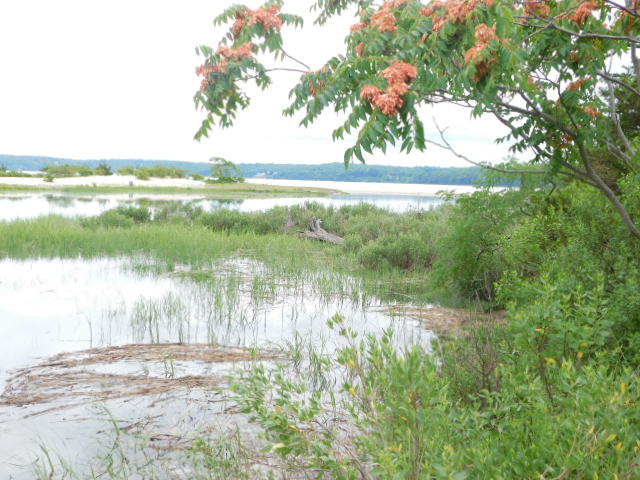
  • No matter, people ignore all that anyway.  Summer traditionally and narrowly unfolds between July 4 and September 7 or so.  For my childhood family and friends, this was our unique vacation _ nobody took a week or two off any other time of year to ski or fly south.  Happily, as promised and expected, full summer has finally brought high temperatures, humidity, lots of green and increasing insects.  Wonderful times for beach and sunsets _ even though earlier nightfall and these pesky reminders hanging on ailanthus trees murmur subconsciously that what seems endless time has not actually paused.

Thursday

A bunch of us were gathered outside the library, waiting for the parade to begin.  Ellen had been a teacher and was complaining “The young folks today don’t know any real history about the Founding Fathers or anything else.”
“What?” asked Jeff, eyebrows raised.  “They don’t remember George Washington leaps the broad Potomac in a single bound?”
“I forget,” said John, picking up the thread. “Was that before or after he single-handedly cleared a path through the Allegheny wilderness with a machete for Braddock’s troops?”
“Nah, that was after,” chimed in Mary.  “First thing, he killed a bear when he was only three.”
“Don’t forget about him blowing over his father’s cherry tree orchard with one mighty breath.”
“Ah, Washington, Washington,” Anita remarked disparagingly, “what a wimp.  The real hero in that bunch was Hamilton.  After all, who plowed the Erie Canal, straight as an arrow East to West, Albany to Niagara Falls?”
“With his mighty blue ox Babe!” shouted Tom.
“In just one day!” chirped Mary.
“Oh, yeah?  What about Jefferson?  He cleared the forests of Virginia for his friends, started the French Revolution, and wrote the Encyclopedia Britannica when he retired.”
“The kids,” Ellen interjected darkly, “have no idea what an encyclopedia is.”
“Then how will they ever find out that Franklin electrocuted Philadelphia while he was inventing the steamboat and automobile?”
“Me, I prefer my heroes a little more human,” mused Karin.  “Take John and Abigail Adams.  Forcing the British out of Boston with brilliant legal maneuvers in Faneuil Hall.”

“Happy Fourth of July anyway,” laughed Dave.  “And we should never forget the brave men who fell at Waterloo this day to keep our country safe from tyranny.”

Friday

  • Hot, humid, occasional thunderstorms.  Wildlife seems not to notice, although there appears to be a shocking lack of insects this year.  Will swallows and terns starve?  People at the beach are grateful for less bites.  They remain afraid to swim because of declared high bacterial levels. 
  • Bacteria, of course, rule our world, both in numbers and sheer biomass.  They are far more helpful companions in our biosphere than antagonists.  In any case, the harmful ones are largely kept in check by salt water.  These beachgoers are presumably the same people who worry about “chemicals” in their food, not realizing that all food and they themselves are nothing but chemicals.  I wonder if any of the sunbathers worry about no insects?  I’d like to believe it’s just a local phenomenon, but I fear that “local” is increasingly identical to everywhere else.

Saturday

  • As Lincoln pointed out, the real American Revolution was not in establishing a constitutional republic, but in acting on and holding sacred human rights as proclaimed in the Declaration of Independence.  Yes, such ideas were a common theme of eighteenth century intellectuals, but nowhere had a body of people acted on them as the reason for their nation and government.
  • Why, exactly were the notions of “self evident,”  “all men created equal,” and “life liberty and the pursuit of happiness” so shocking in the context of rebellion and foundation of government?
  • In spite of latter-day evangelists hanging on the word “Creator” with all their might, the very notion that anything could be “self-evident” is non-religious.  “Self-evident” implies lack of authority from experts or writ, each person as interpreter of the meaning of the world, the protestant idea run amok.  The notion that anyone can make up their own mind about meaning and righteousness continues to annoy and frighten rulers and the wealthy.
  • Debunkers of the American Myth denounce the phrase “all men” as limiting.  What about women, slaves, the poor, the ugly?  But the key is in the selection of a huge group.  “All men” has a far different connotation than “all kings” or “all nobles” or “all priests.”  “Men” in this context is inclusive almost to the point of meaninglessness.  It invites expansion, and resists narrow definitions.
  • That everyone must be granted equal self-determination is explosive fuel. “Life, liberty, and the pursuit of happiness” sparks the ignition.  In spite of libertarian contradictions, this phrase is harnessed because all the others in society have the exact same rights _ no more and no less _ than anyone else, however certain they may be of their own ideals or however much temporal power they have accumulated.
  • America has warts, as all societies do.  But its devotion to the spirit of the Declaration of Independence _ and not to any of the other dinky procedural claptrap in the Constitution and Bill of Rights _ is what made America great, and what continues to make it exceptional in the world.

Sunday

  • An easy interim period for most plants, enough water, sun, warmth _ winners have won their struggle.  Animals,
    on the other hand, are having it harder.  Young birds, mammals, and fish are watching their companions being hit by cars, eaten by cats, devoured by bigger fish, and dying in countless other ways.  Older specimens are already beginning to lose the edge they need to survive the winter.  People may worry about faraway news and distant concerns, but for everything else in our environment survival is real, instant, and constant.
  • Our natural companions are probably not attuned to our inner concerns and thoughts.  One of the most surprising things about us humans is that the more secure we become, the more neurotically we consider what might go wrong.  Evolution on Earth planet did not get this far by thinking ahead.  Sometimes, we might be better off paying attention to what is, and less engrossed in what might be.

Animism Light

Monday

  • Animism is belief that spirits are everywhere _ trees, birds, puffs of wind.  At this time of year particularly, when there is still room for all bursting life and winners and losers are yet to be determined, animism is an easy faith.  I have a hidden spirit, why should a tree not have the same?  Certainly something unknown or unknowable makes each living organism grow and strive.
  • There is a comfort in believing everything, no matter how small and insignificant, fits together meaningfully.  Why should not only mighty oaks, but even each leaf on the oak, each acorn, each rootlet have a genie shaping and protecting and guiding?  Why should not I have the same?  Science, at least modern clinical science stripped of its early poetry, fails dismally at grand explanations.  Animism in that sense is as good a religion as any other for celebrating our amazing existence and the consciousness with which we have been gifted.

Tuesday

An ocean of spirit, or spirits in each
Spirits we never can see
Tantalize dreams, just out of our reach
Wondering what might be
We do not know, we cannot
Today like tomorrow, and yesterday too
Our logic informs us that’s so
Always been like that, if memory is true
If false we’re unable to know
We do not know, we cannot
So here’s to fair dryads, nymphs, and such sprites
Thunder gods riding through rain
Fairies in daffodils, angel delights 
Perhaps just as real as your brain

I do not know, I cannot

Wednesday

  • Birds _ dinosaur-descended distant cousins _ seem to possess intelligence and sense.  Flights of birds were interpreted by augers in Classical Rome to predict the future, in the belief that some cosmic spirit guided the flight’s patterns.  It is well-established that hunting peoples frequently performed ceremonies for their prey, both before and after capture or death.  The belief that the world and all it contains possesses spirit is universal.
  • I rarely take pictures of birds, insects, fish, or mammalian roadkill.  That is not because I do not notice them, just as I do not ignore people as I amble about.  I simply prefer compositions of slightly more permanence, which means I am often engaged with flowers, leaves, and distant horizons.  As is often true, I find that deeply studying or contemplating one particular aspect of life inevitably leads me to a better appreciation of all the rest that it contains or that lies about it.

Thursday

Startled by a sudden splat, I glance at my companion whose arm now displays a smear of blood. “Why Steve,” I mockingly remonstrate, “don’t you know ‘You should never swat a fly’?”
“Got him!  What?” Steve exclaims in grand confusion.
“Old Jim Kweskin, Maria Muldaur jug band tune about insects having their own value ….”
“Don’t care about your ancient songs,” he states.  “Bible gave me dominion over anything that bothers me, you know.”
“Ah, but some Eastern religions believe …”
“Look, I’ll pick whichever damn songs or religious texts I want whenever I need them.  Besides, wasn’t a fly anyway, just a mosquito.”
“Same difference.  Your karma is damaged. Each living thing may possess ….”
“Nope, nope nope.  According to the most up to date modern scientific theories, my karma is all balanced out, thank you.”
My turn to be startled.  “What are you talking about?”
“Each moment,” he lectures smugly, “is an intersection of infinite possible worlds in some vast incomprehensible multiverse.  In some of them I hit the mosquito, in some of them I miss.  I suppose in some of them it gives me a deadly disease.  This particular me just happens to inhabit a universe time line where I was able to squash the pesky devil.”

“But …”  unfortunately at that moment I had to slap at my own bloodsucking annoyance, which rather definitively put an end to our philosophical conversation.

Friday

  • The role of spirits when material manifestation is gone?  Who knows?  A flower looks alive in a water vase for a long time, but is its spirit still there, doomed to a short sterile existence?  What of a bloom perfectly preserved?  The special name for the invisible residuals of life is, of course, “ghost.”  Here at the Huntington historic cemetery should be many ghosts, but all that can be seen are quietly inert scribbled rocks and weeds.
  • Ghosts of people are memories among the still living, and a few somewhat longer-existing objects such as tombstones, artifacts, and place names (Reverend Prime has a street named after him.)  In spite of speculation and elaborate attempts, no real contact has been made with folks once “departed.”  Why we would ever wantmore than memories, artifacts, and place names to haunt us is something I never quite understood.

Saturday

  • True science depends on repeatable experiment with fully observable results in the “real world.”  True science would correctly claim that in such a sense nothing spiritual is “true” or “real.”  I yield to that argument and agree that spirit is not real and cannot be real as a scientific construct.
  • A less provocative, but absolutely similar, problem arises as to whether “hope”, “love” and so forth are “real” or not.  Science will claim they are caused by hormones, learning, neurons, obscure brain networking, and what not.  But science cannot account for their reality in our experience.  Surely for me love and hope are just as real as a cup of coffee or the clear light of a bright morning.
  • Some theoreticians now speculate that intelligence and consciousness is a result of networks, which need not be brains.  That network intelligence functions just as well for a colony of ants or an immune system as it does for dendritically connected neurons in our skull.  That perhaps there is an evolutionary intelligence guiding Gaia itself.  If so, we are part of it.  And, if so, perhaps hope, love, and the belief in spirits are essential parts of our existence itself.
  • Who would live without hope or love?  And isn’t a belief that there is some kind of guidance and meaning in everything we encounter far more life-enhancing than a cold psychopathic dismissal of all there is as just differently scattered energetic particles? 
  • But ignoring all the deeper, or perhaps more idiotic, thoughts, perhaps even if animism is simply a fine fairly tale, a myth to comfort us, surely that also has survival value.  There are metaphoric truths necessary for life that will never be proven in a test tube or on a survey form.  We reject them at our peril.

Sunday

  • Humans inhabit an ecology of phantoms _ spirits and other concepts that are only with difficulty discussed and never adequately defined.  Happiness, meaning, love, beauty _ the list is endless and important.   Imagination _ what things mean, what the future may be, what happened in the past _ imagination is the lodestone of consciousness.  It creates magic from sensation.  Sometimes such thoughts are easily wrapped into unconscious metaphors, which is when sprites and dryads seem to play in meadows and trees.
  • I think this is what we really are _ I know it is what I really am.  I reject any other definition of myself, for all such dry and objective evaluations are eventually false.  I love beauty, I seek understanding, I rejoice in empathy.  The only limit I am willing to accept in this spirit world is that my world is mine, and I would never force it on anyone else.  I can thus follow my superstitions and metaphors and imaginations wherever they may lead, accept whatever comforts they provide, hesitate only when I encounter another human in this vast cosmic mystery.

Top Sun

Monday

  • Longest day of the year!  Druid festivities!  In northern temperate climates, summer solstice makes sun worshippers of everyone.  Of course, high sun itself is rarely pictured _ a boring brilliant spot of yellow high overhead.  For those shots we must rely on specialized equipment, NASA, space telescopes and expensive filters.
  • There will be innumerable spectacular pictures of sunsets, fewer of sunrise (takes an early bird indeed to capture sunrise at this time of year!)  But few if any of the prime disk in all its glory. I’ve been taught since toddlehood that to stare up at noonday will blind me.  Even sketchy instructions on a digital camera warn of burning out sensing arrays by pointing directly at our solar powerhouse.  Besides, almost anything is much more interesting than the source itself _ that’s like taking a photography of a light bulb.  How quickly my silly mind can denigrate the most critical element in our lives. All it does is illuminate and warm everything, without it there would be nothing.

Tuesday

Constant, predictable, overwhelming sun
Day, heat, light, life
Nowadays taken for granted

Too obvious to worship

Wednesday

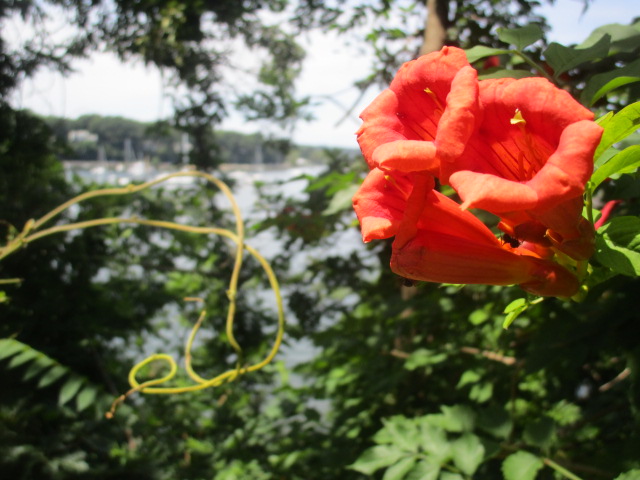
  • Honeysuckle in full bloom is as beautiful as any other flower, but also stuns those passing by with a blast of unexpected strong sweet perfume.  The olfactory shock encountered when entering a cloud of fragrance from less obvious privet hedge or linden trees is even greater.  Of course, few experience such glorious surprise anymore _ the ambient temperature is over 72, so they generally rush past in hermetically-sealed air-conditioned obliviousness.  On the positive side, they never catch the occasional whiff from rotting garbage or low tide mud flats.
  • I recently read some woman explaining how liberating it was to go to an expensive spiritual retreat and stare at a single flower blossom for an hour.  I fortunately find it equally (and less costly) spiritually satisfying to sit on a sandy beach viewing sparkling waves and hazy far shore, or to lounge in my back yard watching clouds, leaves, and birds, as time drifts by.  Detaching from our annoyingly intrusive world is difficult but rewarding, and well worth any effort to accomplish.

Thursday

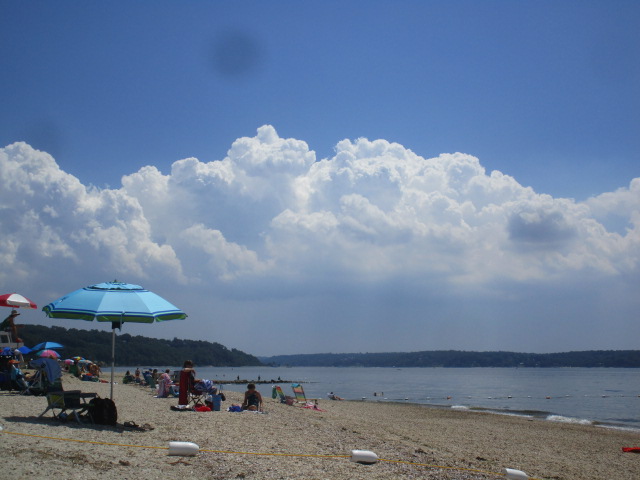
Joan and I are under our umbrella in bathing suits at West Neck Beach a day after solstice.  A surprisingly large weekday crowd is enjoying the afternoon.
“I’m amazed everyone is not sheltering in place at home,” I remarked, “terrified of Zika and the new killer jellyfish.  Not to mention left over West Nile Virus, Lime disease, or stepping on the spike of a horseshoe crab.”
“And skin cancer,” added Joan.   “Hand me that sunscreen, please.”
“I guess it’s the novelty,” I continued.  “It’s the first time it’s been this hot, and everyone is excited to be nearly naked outside.  By the end of the summer …”
“Well, those girls you’re staring at are certainly nearly naked,” snorted Joan in a huff.  “Good figures, though.”
“Ah, when you’re as young as they are it all comes naturally.”
“Including ignoring warnings and common sense.”
“Well, after all, so are we,” I noted.  “We’re here just like them, mosquitoes or not.  To tell you the truth, harmless but painful greenhead flies bother me a lot more than imagined terrors.”
 “You’ll change your tune if one of those new jellyfish sends you to the hospital …”
“Maybe.  I suspect we’re in more danger driving here and back.”
“Beautiful, anyway,” Joan leaned back and adjusted her sunglasses.  “We used to spend hours …”

Happily under the blazing sun, we drifted off to shared memories about supposedly simpler wonderful days gone by.

Friday

  • Local schools are finishing up their year.  This weekend, commencement parties commence.  Cars will line streets, late night booming music, laughter, and yells, young bellies full of beer and god knows what else, sexual rites _ or at least sexual rites dreamed of.  Followed the next day by prost
    rate sun worship on the beach, weather permitting. We pray for no human sacrifice, but automobile carnage after midnight on twisting roads will probably appease the dark gods.  Our culture’s exact analogue of ancient solar festivals.
  • We are not so far removed from stone age Druids as we may like to believe.  Every day we encounter irrationality and superstition, in everyone else of course, but also in our own urges and thoughts.  Most of it is harmless enough, and a big part of what makes us interestingly human and not merely wet logical intelligence.  I envy those young folks their enchanted and fearsome realm, but I dread the nasty sorcerous and disastrously righteous politician/priests into which some of them may grow.

Saturday

  • Apparently our universe, filled with explosions and emptiness, began almost 14 billion years ago.  The sun only about 5 billion, almost contemporaneous with the Earth itself.  Primitive life more than 3 billion back.  Then evolution, rush, us.
  • During all that time, the noisy racket all around did not much affect this ball of rock.  Only a mere infinitesimal flicker of the Sun’s immense ongoing power reached it, and much of that was deflected by magnetic shield, or reflected by high atmosphere.
  • In other words, the universe has wasted a hell of a lot of energy and time if you and I are supposed to be the outcome.  Not an efficient effort at all.
  • Most of the energy we use is in some way solar-based _ photoelectric, hydropower, wind, fossil fuel compressions of ancient biomass, new biomass.  Only nuclear, geothermal (also nuclear), and tidal are not in some way related to the sun’s output.  And most of our energy conversions to electricity are horribly inefficient, passing through a mechanical generator stage to do the work.
  • But should we care?  We are not using energy efficiently, but even the solar power we do utilize is hardly an efficient capture of the full output of that reactor.  Life hardly uses all its solar-based energy efficiently _ at least for individuals, although a case can be made that the entire biosphere and Gaia itself is about as efficient as possible.
  • Efficiency has never been the measure of our relation to the sun.  We accept its gifts gratefully, except when they become extreme.  More efficient delivery of its output would instantly burn us to a crisp.  A slight reduction would starve and freeze us.  What we mostly get from our sun _ and what we probably should aim for in the rest of our complicated systems _ is not efficiency, but absolute stability over long periods.  That is probably something worth praying for.

Sunday

  • Long days, short nights, bright light, warm afternoons, carpets of flowers exploding, greenery in glorious control of every vista _ a perfect time, filled with daily happiness and hope.  Yet already the sun sets a little sooner, some plants have begun to hibernate waiting for the next spring season, and insects start to have their way chewing through the feast spread around.  The cycle back to cold and dark has begun, even if it is easy to ignore, impossible to remember.
  • Hard not to compare it to political and social events of the day.  We like to believe we have escaped cycles, that the future will be filled with ever more glorious wonders of science and ingenuity.  Yet many civilizations have felt the same, not least that of the industrialized nations in 1913.  Unlike the classic Newtonian majesty of solar astronomical events,  human affairs are unpredictable, harsh and often catastrophic.  Unlike the billions of years adjustments of the biosphere taking solar rhythms into account, we have only our day of which to be certain _ I may not exist in another year, our culture may crumble.  The biosphere has little imagination _ but imagination may end up being the Achilles heel of our entire species.

Grasseous

Monday

  • Any introductory biology textbook will likely state “flowers changed the world.”  Which may be true, but the heavy lifting had already occurred in DNA and the biosphere.  A person transported back to the era of cycads, ferns, and conifers shortly before flowering plants appeared would be able to breathe air, drink water, eat food, contract diseases, and die of organic  toxins.
  • We first think of flowers as gorgeous blooms of roses and lilies, then perhaps of fruits and vegetables like apples and zucchini.  Perhaps more important than all of those for you and I were the grasses.  Primates left trees to begin walking upright when climate change expanded the African savannahs _ grasslands.  Civilization for the last ten thousand years has largely depended on domesticated grains and animals that can turn grass blades into protein.  Without grasses, it is almost inconceivable that I would be writing this now, nor you reading it.  

Tuesday

Wild wheats which once waved on wide plains
Our ancestors bred into grains
Civilizations were fed
With production of bread

While we’re worried now of weight gains

Wednesday

  • Grass is almost as adaptable as humans.  Patches of it exist in deserts or frozen tundra.   There are high grassy alpine meadows, waterlogged grassy marshes.  In temperate areas with rainfall too slight for trees, vast steppes, plains, savannahs stretch to the horizon in all directions.  Even more impressively, it coexists easily with people, who cultivate it for crops or beauty everywhere they can.
  • Perhaps that is why I hardly notice it most of the time.  Something that is always present tends to fade into the background, so I am only shocked to awareness at its absence.  Even the meadows and estate lawns that I favor as open spaces, created by grass, are interesting to me more for the butterflies, grasshoppers, flowers, and birds that they nourish than for the common denominator and most dominant species of all.  Like air, I just take it for granted and continue looking for alternate treasure.

Thursday

“And, so you see, humans and civilization as we know it are largely a result of grass,” I finished grandly, waving an extravagant arm gesture to the fields around us a Caumsett State Park. 
“I don’t know,” replied Dave as we paused on the gravel driveway.  “I see your point, but people eat a lot more than cows and sheep _ fish, bears, dogs on occasion, shellfish.  And they have more staples than grains _ potatoes, breadfruit, coconuts, yams, peanuts. “
“Well, yeah, ok.”
“I mean,” he continued, “South Sea Islanders had a pretty interesting civilization and I’m pretty sure they had no grain at all.”
“Exceptions, I guess.  All grand theories have exceptions, you know.  Heck, the law of gravity has exceptions.”
“Look,” Dave was trying to be nice, I could tell, “Maybe I’ll give you the thing about primates onto the savannahs, but we don’t really know.  Maybe I’ll give you that the whole Guns Germs and Steel primacy of the Eurasian land mass was tied up in cultivated agriculture like rice and wheat and what not, or even in nomadic domestication of grass-eating food supplies.  But I think there is a lot more to it than grasses, that’s all.”
“But it’s such a nice theory…” I whined.
“Even if it were true, so what.  How does it help calm our current world?  What does it do for you or me today or tomorrow?  You might as well be writing fairy tales.”

And that was that.  He had me.  Nice speculations, and lots of fun, but not worth a nickel at the supermarket, and even less in most conversation.  Well, at least the grasses spread on the rolling hill before us were still beautiful.

Friday

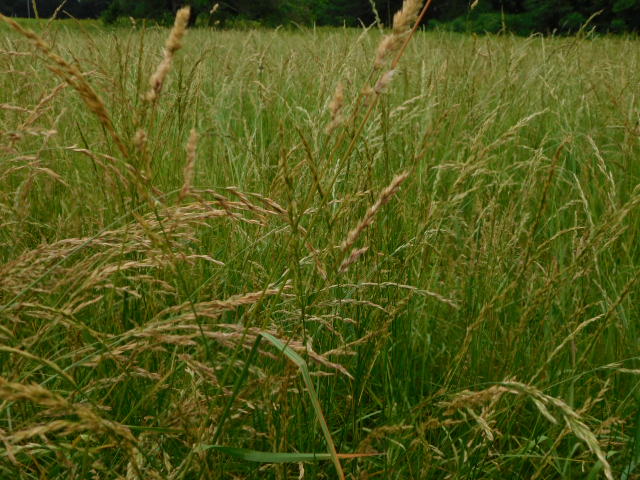
  • Grain crops are bred to yield abundant and nutritious harvest, of course.  But they are also selected to be hardy and to survive in marginal conditions.  Inevitably some, such as these oats, escape into the wild to compete in the rest of the environment.  Ornamental grasses such as bamboo are notorious for overwhelming local vegetation.
  • The saving grace so far has been that our crops are annual, and must be sown from seed each year.  With modern genetic techniques, it is increasingly likely that future wheat and rice will be perennial.  Thick overwintering deep roots will not only eliminate erosion and sowing,
    but may also be tailored to host nitrogen-fixing bacteria so no fertilizer would be required.  If such strains should be developed, native grasses on steppes and plains will stand little chance against them.  Like Japanese Knotweed and Kudzu, modified grasses may come to completely dominate entire ecologies.

Saturday

  • Are we just blades of grass in a vast field?  We feel like more.  Surely no stalk of wheat ever considers itself master of the universe, or abject victim beset by untold cares of the world.  There is so little resemblance between us, what should I care about such a lowly organism?
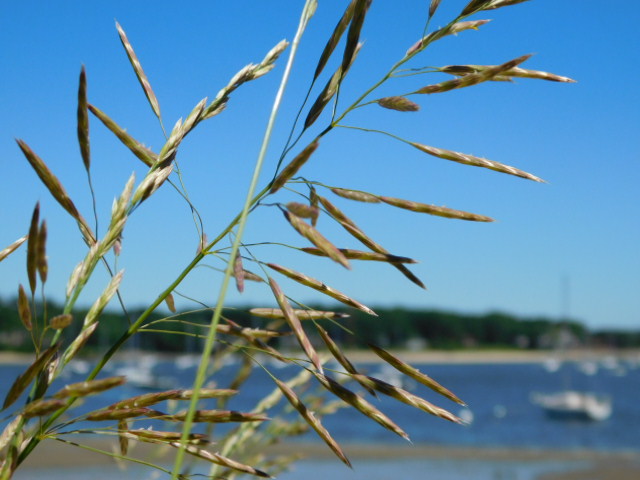
  • One of the problems of our civilized, globalized, wealthy, and generally secure and insulated modern lifestyle _ at least around where I live _ is that I become too easily removed from nature.  In many ways that is wonderful _ I have no desire to desperately search for my next meal, nor endure clouds of mosquitoes in summer nor heavy snows in winter for lack of shelter.  I appreciate electricity and running water and even _ on occasion _ fume-belching automobiles and noisy suburban machinery.  But I can end up turning inward to a good book, a television entertainment, or the momentary pleasures of window shopping in large mall and big-box bazaars.  I miss sunsets while mindlessly being shown distant disasters.
  • Spending time regarding a field _ its multitudinous inhabitants, its imagined past, its possible future, its stage of growth as summer solstice approaches _ is an exercise in humility.  No doubt in the grand scheme of things _ if there be a grand scheme of things _ I am exactly as a blade of grass or possibly this field itself.  A humble part of a greater biosphere, a bit player in the adventures of Earth.
  • But what I most enjoy is my magnificent duality.  That I can feel important _ not merely a little important but supremely important _ is a gift of heaven.  That I believe I can experience and know and enjoy and reflect on the cosmos and myself and all I can possibly imagine is a treasure beyond price.  And that _ in all this self-absorbed hubris and pride _ I can also somehow manage to contemplate being humbled by a field of grain or a blade of grass is possibly the most astonishing ability of all.

Sunday

  • Gazing along parkland lawn, everything back to its accustomed place.  Lawn no more than green open stretch to allow framing with trees and spectacular flowers.  Like sun, like harbor waters, just another landscape element.  Nothing to see here, folks.  At least nothing much worth noting.
  • I will rarely again think of what composes that emerald carpet.  I will scarcely notice stiff brown stalks or dusty green blades as I seek color and unusual patterns.  My focus moves on to more exciting and unusual thoughts and visions.  I suppose I should feel guilty, but the world is rich and inexhaustible, and I know I am missing everything whenever I pause to concentrate on something.  A happy dilemma, indeed.

Fluidities

Monday

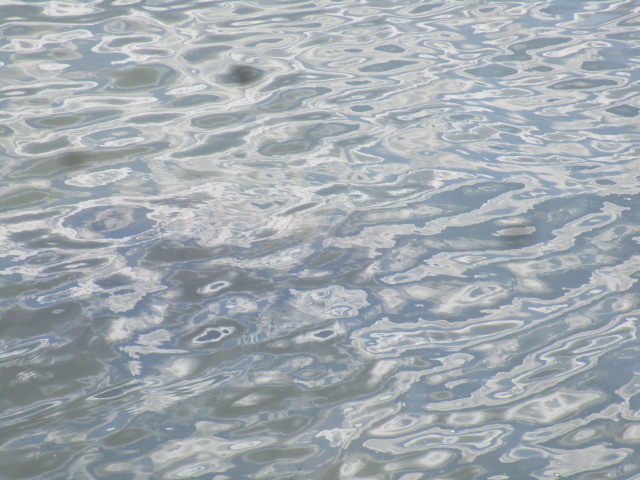
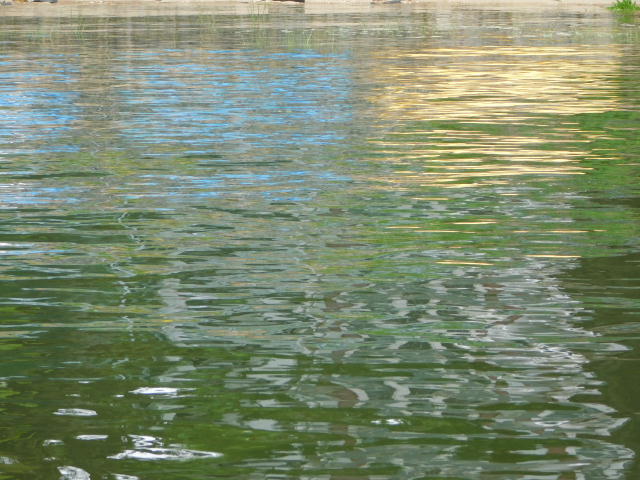
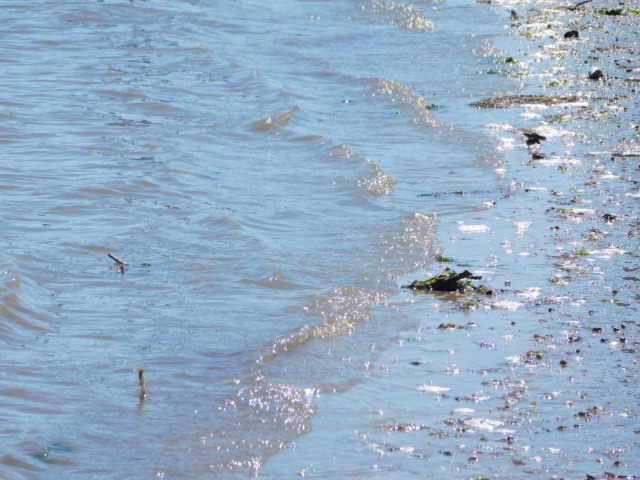
  • Nothing exposes limits of still photography like water patterns.  Water does not look like its picture.  Even videos, more faithful, fail to capture the experience, because when there is no central focus, such as on a distant scene, the eyes wander and see differently all the time.   Sometimes refracting almost (but not quite) geometric patterns , sometimes ongoing glints of sunlight, sometimes resolution into tantalizing reflections.
  • Gazing at a water surface seems a good metaphor for how I view my life.   There also lies shifting focus, things appear one certainty, then another.   Impossible to capture, impossible to remember exactly, and impossible to decode into Newtonian or mathematic schematics.  Beautiful but frustrating, and, most important, impossible to truly know.  

Tuesday

Go with quick flow, glide over tide
Inspect what reflects, gaze ranks of waves
Nothing is ever the same
See flowing seas, sight ripples bright,
Astound each rebound, stare into glare

Never exactly again

Wednesday

  • Water views are disorienting when presented out of context.  In real life a viewer is aware of looking down or out, of what is up or sideways, always peripherally focused by what surrounds the framed image.  An isolated water view requires complicated investigation and intuitions.  Even this pond’s calm reflecting surface is difficult to decipher.  A photographer might claim a photograph such as this approaches the “modernity” of abstraction.
  • When not confronted with survival-level challenges, too much leisure in hand, I become obsessed with transitory passions.  I may, for example, deeply examine weeds or wildflowers or historic markers.  People I know turn into connoisseurs of cooking or craft beer or social media.  Such personal myopia bores other people.  A saving grace is that each pursuit remains fluid enough that I may drop it in the blink of an eye to move on to something else.  

Thursday

Waves drift in endless lines, encountering other disturbances, bouncing and reflecting and picking up glints of sunlight.  I try to make sense of it all, then fall into a reverie.  “Hi Wayne,” brings me back to my body here on the dock.  Oh, our neighbors Joe and Linda.
“Watcha up to,” asks Joe,  staring where I had been looking.  “I don’t see anything.”
“Just being hypnotized by ripples and reflections,” I answer, “doing nothing.”
“Ah,” he intones dramatically, enunciating  slowly in a deep fake voice “You will now jump in the water …”
“If you were a wave,” I laugh, “I probably would.”
“It is beautiful here,” Linda murmurs.  “Especially when the sun is setting over those trees.”
“Just looking at the surface activity is always wonderful to me,” I add.  “Kind of an aid to mindless meditation.”
“So do you do this often?”
“Probably not often enough,” I admit.  “Like everyone else, I always seem to have something more important to do.  But when I force myself, this can seem just as critical to my thought balance.”
“Know what you mean,” Joe gestures to his boat.  “When I’m out there fishing I can get into the same kind of trance.  Refreshing.”
“Given the problems of the world,” muses Linda, “I suppose mindless is good.”
“I don’t know,” I reply.  “Seems to me mindless is the cause of a lot of the problems of the world.”
“Well, we’re off to the deeper waters,” says Joe as they start down the gangplank.  “Give us a minute to fire her up and we can add some big action to those waves of yours.  No, no, don’t thank me now.”

“Have a great afternoon.”  I turn back to the circles and flickers and darks and intimating patterns, lost in complexity and happy for it.

Friday

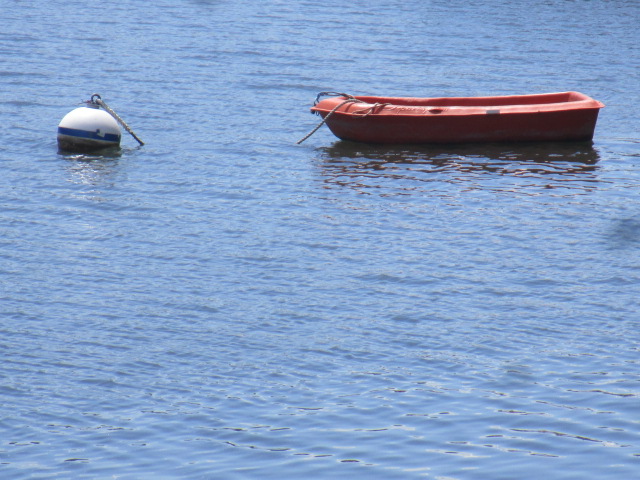
  • Until the late Renaissance, artists hardly attempted the depiction of water.  Rembrandt showed interesting spills from a goblet, but even Courbet and Homer painted waves that appear more like copies of photographs than reality.  Canaletto’s intricate and beautiful wavery flecks around gondolas (this skiff as close as Huntington gets) are hardly what the grand canal looks like, but are accepted useful convention.  Marvelous abstractions of Turner and the Impressionists are all but meaningless unless a viewer is already familiar with water, mist, and waves.
  • We laugh at the schematic efforts of small children, who put a blue line on the bottom of their picture and draw their tree as a green lollipop with brown stick.  Yet I see that way most of the time.  A car is a box on wheels _ all I really need to know is if it is moving and in what direction.  Houses are giant covered boxes with holes cut in.  And, yes, most trees are lollipops.  The world is so complex and fantastic and liquid that without use of schematics I would never be able to concentrate on what is required for my current task.

Saturday

    • Liquidity refers to how quickly we can turn assets into cash.  Cash will let us buy a candy bar, video game, steak dinner, car, boat, milti-million-dollar house, or election, depending on our level of affluence.  Liquidity determines how quickly and easily those purchases could be used to get something else. 
    • Fluidity is different.   A gas is intangible, has no shape, and offers little resistance to anything.  A solid will break your nose if you try to walk through it because it resists everything.  A liquid, on the other hand, flows around and modifies, but still has presence and resistance to change.  A fluid can be contained, but not grasped.
    • American morality is oddly fluid.  We claim to admire rock-solid values, never deviating, break-your-nose if you waver or flip-flop.  Yet we profess a gaseous mantra of forgiveness and understanding.  Adjectives applied to a more liquid morality are hardly admiring _ oily, sleazy, shifting.  Contradictions pile up, and it must be so, because in fact all of any society is more fluid than static.  Rigid societies crack under tension, and are unable to handle real changes in their environment.
    • I suppose Karma comes as close as anything to the nature of our fluid interactions.  What we do will bounce back, reflections will affect us, what we accomplish is less eternal than we think.  Ripples in a small puddle.  Yet without some anchor of moral certainty, however arbitrary, we drift queasily on unsettled waters.
    • Mostly, fluidity is a concept of play, to let me try out different viewpoints, evoke unusual fantasies, make ridiculous judgements.  A game, but possibly a very serious one.   Meanwhile, I stare from the shore and let my mind flow as the waters, hopefully sparkling internally once in a while like the breaking foam.

    Sunday

    • Three quarters of the surface of this globe is water,  almost the entire human body is constructed of it.  Although apparent solids remain the center of attention, liquids are the essence of being.  Fluidity is not some cosmic fantasy of consciousness, but the essence of life itself.  And even after that is acknowledged,  for the most part all the liquid which is noticed is the mere skin, reflecting light, rippling along.  The much more extensive lower internals are forgotten or ignored.
    • Do I think of what lies beneath the surface?  Not often.  I am too concerned with the pretty baubles readily available to vision, to easy photographs.  My thoughts are often limited to “is that fresh or salt?” unless there is an unusual tide or storm.  And so it is with fluidity itself.  That whole concept, with all its complexities, is a reason I distrust silicon “thinking” machines.  I do not think artificial solid intelligence can ever mimic fluid intelligence, and I believe we should all spend more time considering the vast difference.

    Fleurs de June

    Monday

    • Impossibly well-endowed rhododendrons, carpets of showy roses, brief delicate appearances by irises and orchids such as ladies slipper _ June arrives with a flourish.  Depending on temperature, some will last a few days or a week, others extend the entire month.   In a few weeks, as solstice arrives, almost all annual blooms will reach peak.  Some will continue all summer, others will quickly be pollinated and work on the important target of producing fruit. 
    • A few people claim this is absolute perfection, and believe a continuous floral world would be heavenly.  Such exists in tropical zones.  But I truly enjoy the wild madness of seasons, when solar energy must be seized as conditions are right, and every day is preparation for another cycle of dormancy.  Maybe I am just a masochist, but that aspect of nature presents a continuous morality play and entertainment unmatched by the stifling dripping sameness of an equatorial jungle. 

    Tuesday

    Stein sighs a rose is just a rose
    Exactly true, yet also wrong
    Several billion years of death,
    And birth, and glorious strife
    Enclose each rose
    As they do you,

    As they do me, who is just me.

    Wednesday

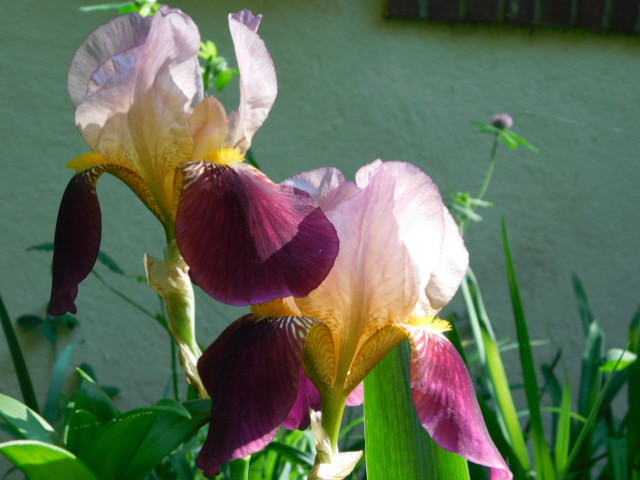
    • Swordlike leaves, sultry voluptuous flower, an iris resembles something out of medieval mythology.  Adding to the mystery is the impossibility of telling exactly which plants will bloom, if ever.  When display does appear, it almost instantly vanishes, broken by wind or rain or some internal process of shyness.  Like a unicorn, the more it is pampered, the less it thrives, dying of attention.  An impossibly perverse plant, but gorgeous.
    • Ours came with the house, originally started by Joan’s mother, under whose care they thrived.  We have had no such luck, but we keep nursing them along, and hoping, and are occasionally rewarded.  This specimen, in particular, lasted exactly three magical days, racing into high heat, destroyed by heavy downpour.  I could force a lesson into that, but for once I will rest content at simply having enjoyed its moment.

    Thursday

    “Your patio is amazing,” remarked Jean as the four of us settled into our chairs.  “How did you get it all so early?”
    “Joan does all the work,” I said, “she’s been shopping for weeks.  We had some of the stuff in the garage for a while when the weather was so bad.”
    “And then I have to plant it all,” noted Joan proudly.  “Lots of work.”
    “Not as much work as the shopping,” I reply.  “She needs everything just exactly the right color.”
    “They usually don’t have just what I want.  I need to keep going back and grab the right plants when they come in.”
    “So all of this is new every year?” asked Richard, amazed.
    “No, there’re a few annuals,” Joan pointed a few out almost defensively.
    “I was reading about making a really natural garden in one of my magazines.”  Jean likes to have a point of view.
    I laughed.  “If we let this become natural it would look like any vacant lot in town.  Does anyway, if we don’t keep up with the weeds.”
    “But I read it’s not as good for bees and birds and butterflies if you just put in common stuff from the store.”
    “Well, I like what I like.  I know how I want it to look.”  Joan is, in gardening, a true artist.
    “We get lots of birds in any case,” I added, trying to find a middle ground.

    Fortunately, at that point the conversation swerved into families, and we could relax for a while to enjoy our drinks in peace.

    Friday

    • Roses star in Huntington’s June.  Not only are many insanely beautiful, but the wide varieties include native or naturalized species that thrive like weeds (which is, remember, the classic definition of a weed _ a rose in a cornfield.)  Some fill the air with perfume, some climb thickly as if by design on old buildings and walls, some stun with intricate internal folds and patterns.  For the next few weeks
      , they are ubiquitous.  After that, they become less clamorous, although there always seem to be a few blooms somewhere until frost.
    • Years ago, my own statements would have sent me racing to reference materials.  “How widespread are roses?”  “What does the species include?”  “Which were originally found on Long Island?”  Now I rarely bother.  That may be a failure, or sheer laziness, but I prefer to think of it as a deepening wisdom.  It is well to know the accepted details of many things which can expand my worldview, but enchantment does not really require massive common knowledge.  Enchantment with life is what I now seek.

    Saturday

    • Now almost a century on, back in my mother’s day, there were small crystal globes filled with liquid in which was preserved a flower _ typically a rose or orchid.   Often it held memory of some special moment _ a dance, a wedding.  Like a soothsayer’s apparatus, this small keepsake would hold place of honor on a shelf, mantle, or table.  We would examine it closely once in a while, the curved glass acting as a magnifying lens, a strange curiosity.
    • I sometimes think of my life that way, as a bloom to be preserved in the equivalent of one of those spheres.  I am not of the generation that thinks in terms of being embedded in a matrix, nor of the persuasion that my disembodied spirit will somehow flit free of worldly ties and do something else.  I like my fleshy envelope, and would be quite unhappy and quickly bored without it.  But, like most humans, I find it is a little frightening to consider that all ends, and the universe continues on as if I had never been.
    • Ah, but preserved as some rare bloom _ I like that.  Some creature out of time free to examine my prides and faults, to admire or point out blemishes.  I imagine a kind of envy such as I sometimes have reading a particularly good biography.  Time, of course is the last frontier, and we are so entangled with it that I doubt we shall ever comprehend how life and the arrow of entropy really intertwine with the cosmic surge of leptons and branes.
    • Am I a weed or lovely hothouse production?  Does it matter?  All such judgments are in the eye of the beholder, and as far as I know I remain the sole beholder.  Misty fantasies for a rainy, meditative afternoon.

    Sunday

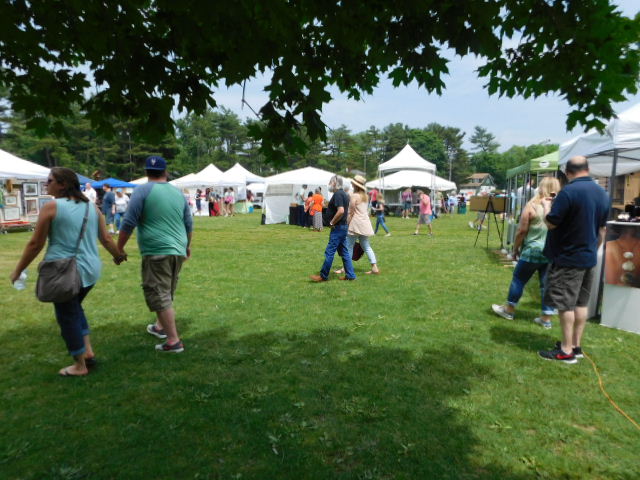
    • Assorted festivals and fairs, like this art show in Hecksher Park, are part of the human efflorescence of the month.  Weddings, of course, are the other tradition.  People and their crafts of amazing inventiveness bloom as much as any flower.  Passersby are merely amazed at what they can see, touch and purchase.  This day was perfect, but rain washed out the next.
    • From conversations, most of the artisans here are dilettantes, in the sense that all their income is not dependent on what they make and sell.  Quality is as high or higher than that of professionals.  I understand that those who live and breathe and sell and perfect art are wonderfully able to craft things nobody else can.  But in the American market, at least, those who seek to earn a living from their efforts find they must devote huge amounts of time to sales,  and warp their skills to continually provide artifacts which require more novelty than vision and technique.   

    Greenleaves

    Monday

    • Suddenly the great vegetal switch has been thrown.  Following warm spring rains, all is instantly green and becoming more so.  Early trees which flowered before foliation fade as blossoms hide behind newly developing leaves.  Ground perennials and annuals explode early spurts of stalk and shadow, competing for increasing sunlight before bothering with flower and fruit.  After all, just over a month to solstice.  A few beauties , such as dogwood and azaleas, break the pattern, but they provide bright accents, rather than the show itself.
    • I admire these miraculous temperate zone cycles.  The constant equilibrium of more equatorial regions seems boring.  Spring around here is an athletic contest, a race for life, a display of hope and ambition by every species.  Even evergreens break their staid majesty to push out bright buds of cute soft miniscule needles.  A fine time to lounge around and enjoy _ except, perhaps, for ongoing warm spring rains.

    Tuesday

    So many synonyms for green
    All strung together can’t describe

    Exactly what I see
    Wednesday

    • Even a casual glance at the newly verdant horizon reveals an astonishing assortment of hues, textures, shine, patterns, and transparency.  In another month,  things will dry and settle into a darker, duller, generality.  In May, however, both long views and close up inspections of anything yield pure amazement.  So much variety and so much effort that is usually just taken for granted as folks rush on their busy way.
    • I try to compose pictures, sometimes with a theme in mind, sometimes hoping the theme will leap from the photograph later.  I have to admit that often I repeat almost exactly _ my brain may be infinitely adaptable, but my thoughts travel well-worn paths.  The freedom is in the “almost.”  After all, this spring itself, this fine cool day, is almost like the season last year, almost like yesterday, almost like tomorrow.   And you and I are almost identical.   But from our restricted perspectives, almost is an infinite universe of its own.

    Thursday

    Winding through dirt paths snaking in copses of trees around the pond at Coindre Hall, I almost literally run into Kevin who is staring up in concentration at a large maple.  “Oops, sorry,” I stumble to a halt.
    “No problem,” he laughs.  After all he’s nearly twice my size. 
    “What are you so excited about?  Some unusual bird up there somewhere?”
    “No, no, I was just amazed at how high these things are, how heavy the branches get, and how they ever manage to stay together through rain, wind, and snow.”
    “Some don’t,” I gesture at broken limbs back up the trail, the main reason I hadn’t been paying attention to where I was going.  “I tend to be more astonished that we get so much out of such a tiny little layer of biosphere.”
    “What, you don’t think this guy is large and magnificent.”
    “From one perspective, sure.  But think of how big the Earth is, and how short the height from deepest roots to topmost leaf.  We take it all for granted.  I find it humbling and a little scary.”
    “Well, my friend,” he responds, “then I won’t scare you even more by mentioning that three quarters of that little space is water, and an awful lot more of it is covered in sand or rock.”
    “Somehow, it all works.  But I am always humbled by how tiny our realm is compared to the universe.”
    “Be as humble as you want, but you still need to respect each individual specimen, especially one like this.”
    “A secret woods-worshipper, are you?”
    “Maybe,” he chuckles.
    “I don’t think you were looking at branches at all.  I think you were trying to find a dryad or nymph.”
    “Even if I found one, why would I tell you?”

    “Ok, be that way.  Give her my best.  I’m going down to the shore to see if any mermaids have stopped by.”

    Friday

    • With herculean effort, the entire arboreal canopy has been regenerated for another season, thick and all but impenetrable.  From the air, Long Island now looks more like virgin forest than one of the most densely populat
      ed places on Earth.  The colors, like the leaves, are sharp and clean and clear, with no insect, drought, nor wind damage marring their newborn outlines and vein structures.
    • Like ourselves from age twenty on, it’s all downhill from here.  Each tiny chlorophyll factory is put to work mercilessly, with barely a rest because solstice nights are short.  Should a worker leaf falter or become sick, it is abandoned and dropped.  And the grand reward at the end of a long summer’s job well done is brutal recycling into the forest floor.  But right now _ ah all is hope and magnificence and wonder.   Why I should concentrate on today.

    Saturday

    • It’s easy for us to get too caught up in cycles.  Already there are signs of coming winter, summer weeds like dock are in full bloom, we say “Oh, June already?” and dread next November.  Most of the permanent leaves are fully grown, degradation and decay have set in on a few, there are brown masses indicating flowers gone already.  Trees may regenerate crowns even now, for example if defoliated by caterpillars, but that costs so much that many die over the next year or so.
    • It’s easy for us to get too caught up in the arrow of entropy.  The seas will rise, the glaciers may come, the sun shall dim, in a few tens of billions of years the universe itself will be gone.  Today is useless, what we do has little value, and in the end everything is dead.   Or we shorten our view slightly and decide we can always make things better, or things will always get worse, or things will over the long run stay the same _ why fix a leaky roof when tomorrow may bring sun?
    • It’s easy for us to get too caught up in the moment.  Carpe Diem.  Have another glass of beer.  It’s all the greatest highs or the deepest lows.  We can’t predict the future, so why worry. 
    • Trees, we assume, have none of these problems.  They are driven by local genetics, with no central control.  Animals can be trained, but they have little conception of the long run beyond a season or year or possibly decade.  Only humans face such delicate balances of perspective, which unlike leaves, can spring up instantly and occasionally cripple our thoughts.
    • Some of this is intellect, some of this is hormones.  The wonder is that wonder can be provoked.  The miracle is that most of us, most of the time, do not slide into a pit of viewpoint, and that we can always regain perspectives on cycle, entropy, and moment.

    Sunday

    • Branch of Japanese maple glows crisply in fresh morning sun, as the desk calendars would put it.  This small example contains almost uncountable individual leafs, each working to provide food to the rest of the organism.  Yet were it torn by wind or pruning, the tree would recover, because there are so many more.  Imagine the not-quite-infinite number in Huntington, Long Island, North America, or the world!  Yet in some ways the whole assemblage is as fragile as this branch itself.  
    • “Normal” appearance for me tends to be around arm’s length.  My binocular vision is working at that point, yet I still have the advantages of perspective.  Anything further away tends to become part of masses and shadows and other elements of landscape.  Anything closer is extravagantly weird right down to the sub-microscopic level.  Except in certain odd religions or scientific philosophies, my observational point has little to do with “objective reality,” in which the “actual” size is fixed at some defined measurement.  But truly my reality has little to do with that “objective” fantasy.