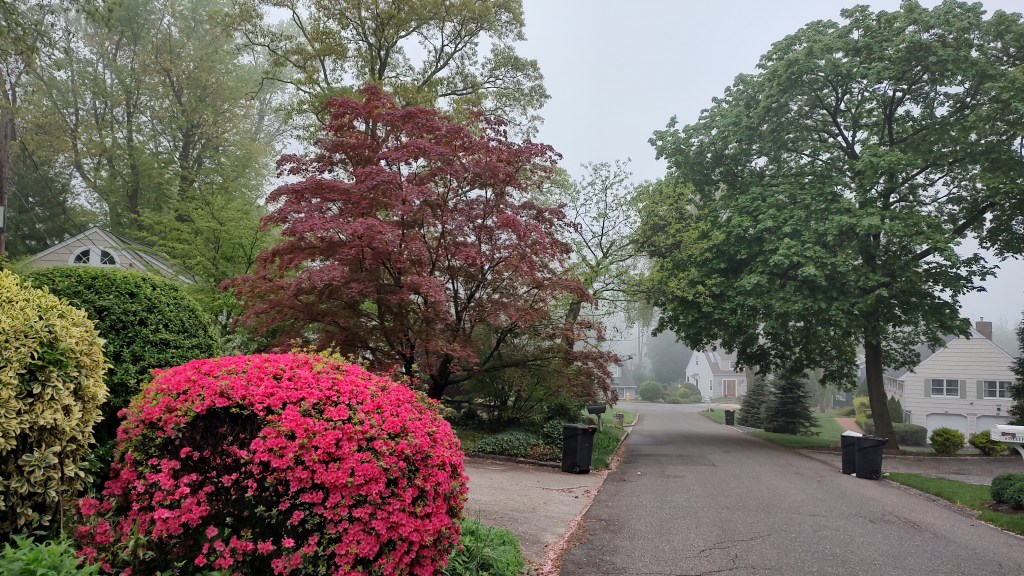

Bavarian Daffodils

Once again daffodils are blooming in Huntington. As I am sure they did in the spring of 1938 in England and Bavaria. No doubt folks as old as I am tottered out of their cabins and admired the sight, dreaming of warmth and summer gardens .

There is, of course, always trouble in an unknown future. People mostly stay sane by ignoring the possibilities and concentrating on the exact day in the immediate neighborhood. Events just move along and we deal with them as best we can when and if they impact us .

I imagine that like today some people had strong resentments based on old horrors and current difficulties. Some yelled loudly. Some hoped things would work out. Few 78-year-olds thought they had much say in how the world was run .

The daffodils bloomed again a few years later, in spite of bombs and tanks. But life had changed drastically for most of the old folks who gazed at them fondly in that final spring of relative calm .

Well, I also go out and admire the daffodils. I touch the internet gingerly. I’m afraid I strenuously avoid thinking about possible futures .

It is not a good time to dream of what may come. Anyway for now, after the daffodils, surely the roses .

Old Mr. Gibbon

I’ve just finished volume three of Gibbon’s Decline and fall of the Roman empire. I know I probably skimmed through it many years ago, when I purchased the full modern library edition. But his story is far from the “gladiator” cliches .

Consider the examination of human nature. Gibbon considered the Roman empire to have functioned continuously until the final fall of Constantinople to the Turks in 1453. He reviewed extensive documentation regarding the follies of ruler and ruled, wise men and fools, passions of the day, and the odd beliefs that motivate people to good, evil, or simple daily life .

Lately, I’ve become enamored with historians like Gibbon. They were not so focused on comparisons to today as our current writers. They could be very intellectual, assuming a certain degree of decent education for their readers (which, alas, current writers cannot.) And they were unafraid in calling things as they saw them (although Gibbon did have to be obscure about sex and coy about Christianity) .

All that makes for a deep, provocative, powerful read. I took my time this time through. Much more engrossing than modern digital melodramas. Made me appreciate my own life and times all the more .

A grand subject, to be sure. An obsessive historian, sometimes tedious and confusing (all those names! Dates! Events!) But now, what a fine thing to rediscover .

Fire, Flood, Drought

“Everyone complains about the weather, but nobody does anything about it.” In this era of massive technology, scientific hubris claims we can . Geo engineering concepts abound, from seeding the oceans, to sulfuric acid clouds and/or reducing certain gas emissions .

So far, it does seem the climate is more extreme. Bigger storms, major variations in “normal patterns.” Pretty clearly this is not simply “better weather reporting”. But equally, it is not immediately disastrous to everyone, nor an existential survival threat .

It may be humanity can change things. If not, some small fragment of our bloated numbers could probably survive anything. Famine and catastrophe first, of course .

But what does it mean to me and you? Obviously most of us should avoid building or living in river valleys or on sandy barrier Islands, among other adjustments. But personal changes are largely symbolic, especially if they are not normalized for everyone. 

Brushing my teeth more quickly or dashing in the shower do nothing unless everyone is forced to do so. Also what kind of car I drive or what I eat. Giant problems, unfortunately, require giant solutions. Feeling virtuous about my CO2 footprint is like feeling lucky when I throw a coin down a wishing well .

In the meantime, I better fix my leaky roof. 

Mercenary “Warriors” 

It’s a truism that the military always prepares for the last war. A new element is that our current leaders want to prepare for war as depicted in movies and video games. Manly men who can savagely destroy all opposition with increasingly massive personal weaponry .

Of course we’re not quite sure what the “last war” was for the US, but we didn’t seem to win it. On the other hand, the Ukraine conflict seems to prove that any tween in her city bedroom can wipe out a squad of bazooka toting cowboys with a remote drone strike .

And if a “real war” starts, both the cowboys and tween are one nuclear blast – delivered hypersonically – away from oblivion .

But manly men want jobs and the military life seems to fit a certain psychology. The problem is that building an elite group of well-paid volunteers (aka mercenaries) who follow politics – which seems to be the current goal of the administration – will surely lead _ as it always does (witness the Praetorians, Mamalukes, Janissaries) _ to that cadre getting rid of leaders they don’t like (i.e who don’t pay them enough .)

Obviously, I am hardly a fan of manly men syndrome. But personal squeamishness aside, I just think the idea is ineffective, historically inaccurate, stupid, and based on adolescent male fantasies .

Legacy

Before writing, humans seem to have existed in almost perpetual ” dreamtime”. There was today, tomorrow, yesterday – and awareness of seasons. But the idea of long time was irrelevant. The world was and is as it always is and was .

Writing gradually evoked a sense of time, a knowledge of change. Rulers followed known rulers. Cities waxed and waned. Heroes might be remembered for a while.

Eventually civilizations got used to the idea that all would be judged somehow in and by eternity. It might be gods, or universal spirits, or culture or history, or simply some limited posterity. That would be preserved forever as a slice of eternity.  Such gave meaning to life. 

The subsequent loss of really long time perspective created one of the profoundly deep and usually submerged sicknesses of our culture.  An engulfing pessimistic nihilism overlays our actions. The gods have dissipated into geologic eons. Nothing – not even the sun – remains forever. No judges, no long-term legacy. Only the insane believe that what they do or do not do matters at all in the long run .

In fact, we need to adjust to this new mental reality of inhabiting dreamtime once more. What we do is what we do now. We can remember our past, in the future we can remain proud of those recent achievements, we can strive so we have happier future memories. 

“Legacy” is currently reserved for use by charlatans and others seeking any way to gain or maintain immediate power .

Target Rock

It can be useful to be reminded of both the age and impermanence of the world around us. For those of us aware on Long Island, that is pretty easy. This is a “new” land, formed of sand debris as the last glaciers melted, raised from the ocean when the continent lifted as it was freed of the weight of the ice. Perhaps soon to be submerged by rising seas .

European history here is almost ancient (by European standards). Over 400 years ago – Louis XIV was just building Versailles – the town of Huntington was founded. Before Napoleon, the British defended the island fiercely .

They captured Nathan Hale on the shore line here. They smashed a graveyard to use as a cannon emplacement. And from sandy bluffs, they practiced gunshots at Target Rock, a large erratic boulder lying in Lloyd Inlet .

People and politics come and go. The rock is still there, preserved from use and indignity by its “useless” location. Now the center of a wildlife refuge formed from old Gold Coast estates destroyed by time and taxes .

I love to visit in all seasons, enjoying the trees and birds and wind and shells. Become aware once again of the impermanence of life. Enjoy the connection to “olden times”. Imagine being a native American, a colonist, even a wealthy owner in the gilded age .

But, quite honestly, mostly happy to be exactly like that rock.  Contented where I am .

Sex, Drugs, and Golden Old

Wealthy scions who are taking over our country are well trained in the ways of technology, finance, and getting what they want. These paragons know nothing about the rest of society or history, and think all other people are just plug-in employees to be used like any other tool (when useful and inexpensive) and discarded when they wear out. Of course, their own daddy’s old days were perfection.

I think of them as the rich “frat boys” I always hated. They believe rules are made for lesser folks. The “brothers” can drink and carouse without limit. They talk the talk, walk the walk, and hire each other on the “merit” of being alike, and having the same background, and knowing the right people. Grudgingly, they may admit nouveau riche to their closed club room .

Currently, their goal is to enshrine a 19th century capitalistic corporate mentality into government. This requires a strong authoritarian CEO who is only removed by actions of the “board” _ meaning them. Citizens are either consumers (who can like it or lump it) or employees (who are simply another inert productive input.) If they could, they’d fire everyone when times get rough .

It’s sad. We’ve seen such fanaticism before in Europe in the guise of socialism, in China in the guise of communism, in South America in the guise of superman magic fables. 

Ah, but the dream of capitalistic government must surely be different .

Consolations of Continuity

Boethius wrote his enduring classic Consolations of Philosophy after he had been condemned to death by his Roman emperor. A sad story, we think, but with a smug twinge of admiration at his accomplishment at a difficult time.  

Like the rest of us, Boethius was mortal. Like the rest of us, condemned to death sooner or later. For us elders, of course, it’s sooner. We may have less time to do anything then Boethius. We may have far less chance of producing anything significant. He was after all in the literate elite of Rome – a tiny fraction of a powerful population. We inhabit a world of 8 billion, all of them equally literate (or illiterate) on social media .

I suspect from all the chatter, few classics will emerge, let alone endure for thousands of years .

So my attempts in the face of fate have been reduced to revisiting my life, producing a stream of continuity – in words and artifacts, memories and conversations and even hidden thoughts. Directed at me. A consolation, if only for an hour, or late at night. Recall of a thread of being, meaningful in spite of its cosmic insignificance .

A philosophy? I guess. At this point, I’m happy to discover and utilize anything that increases my enchantment with existence. A busy pen, a happy mind .

Analog Tradition

Law is binary. You are either guilty or not. Lawyers make lots of money “proving” one thing or another. In general, you can push right up against the line (and even tiptoe a little over it) and still be completely “innocent” .

Tradition, on the other hand, is analog. It is also where we spend most of our lives. There is rarely, for example, a thin line dividing rude behavior from acceptable, but it is certainly possible to act more and more rudely .

When we interact with society, we expect rules based on law to be in place, but those are almost invisible most of the time. We are buffeted by tradition and its expectations – how far to stand apart, how loudly to express opinions, what to wear, general demeanor and behavior .

It is therefore far more jarring when traditions change dramatically then when most laws do. Old people especially can be blindsided and upset by all the terrible erosion of “normal” behavior as the young sweep away the “olden days”. 

Everyone eventually settles into the “new normal” and adjusts their expectations accordingly. Traditional change – lacking enforcement apparatus – is often less jarring than law change. 

The old people do occasionally try to get their revenge by passing laws to formalize those old traditions .

Rural

Since antiquity, common sense and solid values were supposed to reside in country folk. Not the unwashed peasants (of course) so much as a virtuous landowner. Cincinnatus returning overnight to his plow. Western Europe – the English in particular – made a fetish of the landed aristocracy .

In the US, Thomas Jefferson created the myth of a country-filled with yeoman farmers, who lived on small self-sufficient farms and in their spare time discussed philosophy and engaged in politics. The countryside contained value, cities were filled with vice. That has congealed into a nostalgic view of “olden” days when (“real”) men were men, and everyone else knew their place and stayed in it .

These days, of course, most people live in suburban situations, neither quite rural nor quite urban. Suburbs contain few of the virtues and most of the vices of each. The global Internet further scrambles the mix .

Ah, but we continue to be told how solid rural living is. No matter that farming is done with huge complicated machines produced elsewhere. It suits the ruling oligarchs to fan the embers of this mythology, since the actual potential power of this constituency is so small .

All harmless enough. Unless, of course, the ruling class becomes ignorant and stupid enough to take it seriously .