
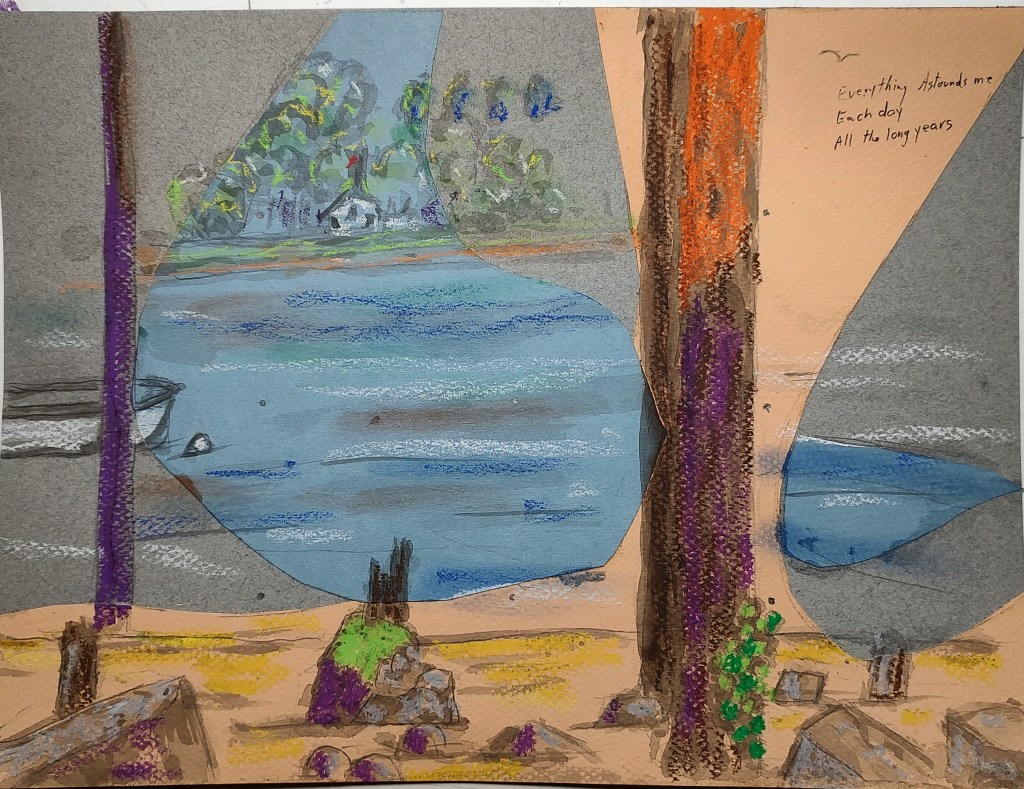
Pastel and Ink on Canson, 2025, 9×12 Note Date
Everything astounds me/Each day/All the long years
More of my paintings and writing at: https://sites.google.com/view/cabinetofvanities
2025-PIC-9×12-006
Pastel and Ink on Canson, 2025, 9×12 Note Date
Everything astounds me/Each day/All the long years
More of my paintings and writing at: https://sites.google.com/view/cabinetofvanities
2025-PIC-9×12-006

Since antiquity, common sense and solid values were supposed to reside in country folk. Not the unwashed peasants (of course) so much as a virtuous landowner. Cincinnatus returning overnight to his plow. Western Europe – the English in particular – made a fetish of the landed aristocracy .
In the US, Thomas Jefferson created the myth of a country-filled with yeoman farmers, who lived on small self-sufficient farms and in their spare time discussed philosophy and engaged in politics. The countryside contained value, cities were filled with vice. That has congealed into a nostalgic view of “olden” days when (“real”) men were men, and everyone else knew their place and stayed in it .
These days, of course, most people live in suburban situations, neither quite rural nor quite urban. Suburbs contain few of the virtues and most of the vices of each. The global Internet further scrambles the mix .
Ah, but we continue to be told how solid rural living is. No matter that farming is done with huge complicated machines produced elsewhere. It suits the ruling oligarchs to fan the embers of this mythology, since the actual potential power of this constituency is so small .
All harmless enough. Unless, of course, the ruling class becomes ignorant and stupid enough to take it seriously .

Acrylic on Canvas Paper, 2004, 12×36
Self-confidence/can be worn like clothing/so we hardly notice
More of my paintings and writing at: https://sites.google.com/view/cabinetofvanities
2004-ACP-12×36-029

There, that got your attention! And such is the real purpose of shock words these days – to condense a slur, rally a slogan, and sometimes promote a hidden message. I remember when students would shout “hey hey LBJ, how many kids did you kill today .”
Some issues are tangled, mysterious, insoluble. Abortion and women’s rights _ or potentially crippled-child rights _ is one of the toughest. Definitions are almost impossible. The world refuses to be solved .
For the record, I am in favor of all children, everywhere, being born normal, healthy, and into circumstances where they are well cared for until their late teens. For the record, in our real world, even if babies are born normal and healthy, society often lets them die or suffer from neglect, starvation, war, disease, or other violence. And genetic luck guarantees that many embryos do not produce normally healthy babies. It used to be far worse – nature was never kind .
But “baby killer” is an effective slur. Nobody wants to be so labeled. The problem is that those who use it are – like those anti-war demonstrators – really pursuing a deeper agenda One in which it is the duty of women to produce and raise children and leave the rest of the stuff to men.
I dislike such people and their agenda. Perhaps one day I too will have to find something simplistic to shout back. Isn’t that really the true problem with our civilization? Not stupidity, not evil, just fatigue at complex, seemingly insoluble, issues .

We generally admire the extraordinary individuals who through intelligence, drive, or structured vision lead their companies to heights and influence. In the old days Ford, Carnegie, Vanderbilt. In modern times, Gates, Murdoch, Musk .
They are generally saluted as less evil embodiments of human ambition – helpful to society rather than disruptive politicians like Napoleon or Hitler .
No doubt there is some truth in that. Corporations are often a force for good, producing wealth which eventually trickles down to all. A cornerstone of our affluent modern world. Almost forgotten are the days when they were labeled (with some justification) “merchants of death.”
Remember, however, that all of those leaders were human. No matter how ruthless, they were constrained to mortal existence and secondary desires. I believe that, increasingly, AI driven business will become ruthless in ways we cannot imagine, completely morally bankrupt from a social point of view .
The dangers of treating employees like machines has long been luridly documented in literature. AI goes a step further, since it cannot understand any fundamental difference between flesh and metal, nor any obligation to consciousness versus obedience .
Today’s specialized titans of industry, unfortunately, are already well down the road to AI sterility.
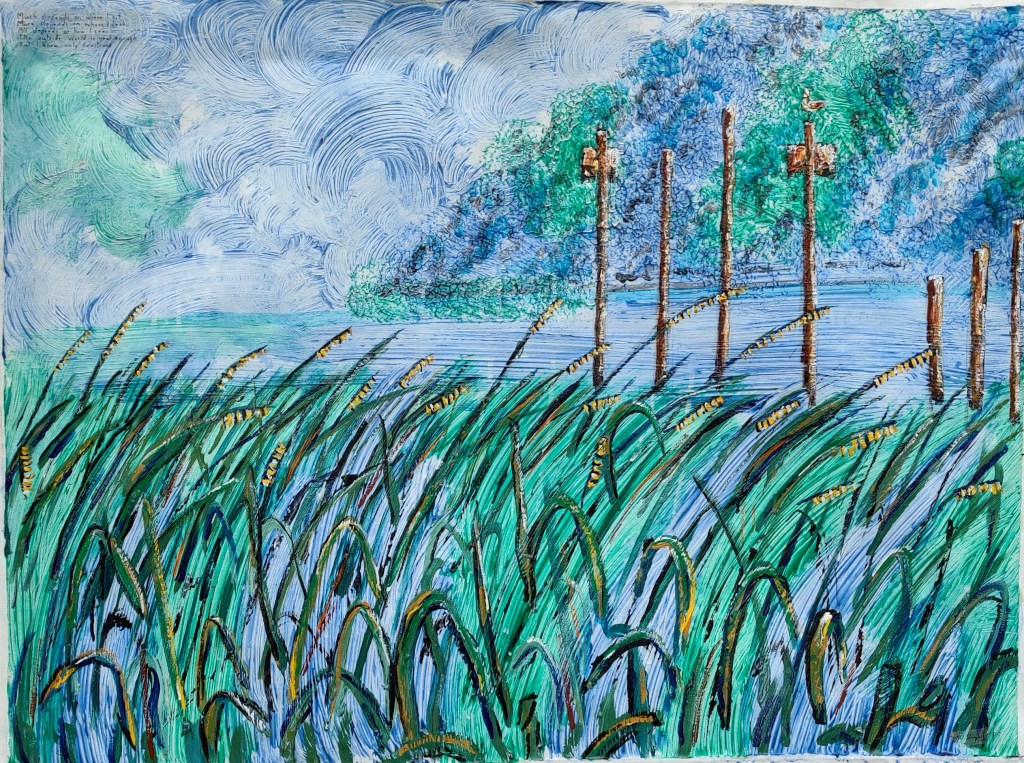
Acrylic on Canvas, 2000, 30×40
Much depends on where I sit/more depends on where I look/and all depends on how I see/the outside world is real enough/but I know only fractions of it
More of my paintings and writing at: https://sites.google.com/view/cabinetofvanities
2000-ACV-30×40-018

Everyone says they want to be happy. The Declaration of Independence proclaims people have a right to pursue it. We say we want others to be happy, our children to be happy. And on and on . Unfortunately, in a competitive society, there are problems with happiness. It just doesn’t fit with the rest of the ethos .
For one thing it cannot be quantified. There is no “standard unit of happiness” as there is for money or distance. You cannot say a person with eight units of happiness is better off than one with two. How then, can you tell who is winning ?
We also prize property, which like other possessions, tends to be stable. Unfortunately happiness is a kind of transient illusion. It can appear for no apparent reason, and vanish just as quickly. We can’t store it in land holdings or a bank vault .
Worst of all, it is fickle. Clearly a person with more dollars is better off than a person with fewer. A clear winner (we like winners!) But somehow a beggar with the right attitude can actually be happier than those refusing to give him alms. Irrational! Yet we all want happiness.
And we work really hard hoping and believing that more money will bestow more joy. I guess sometimes it does. But that “sometimes” is pretty annoying .
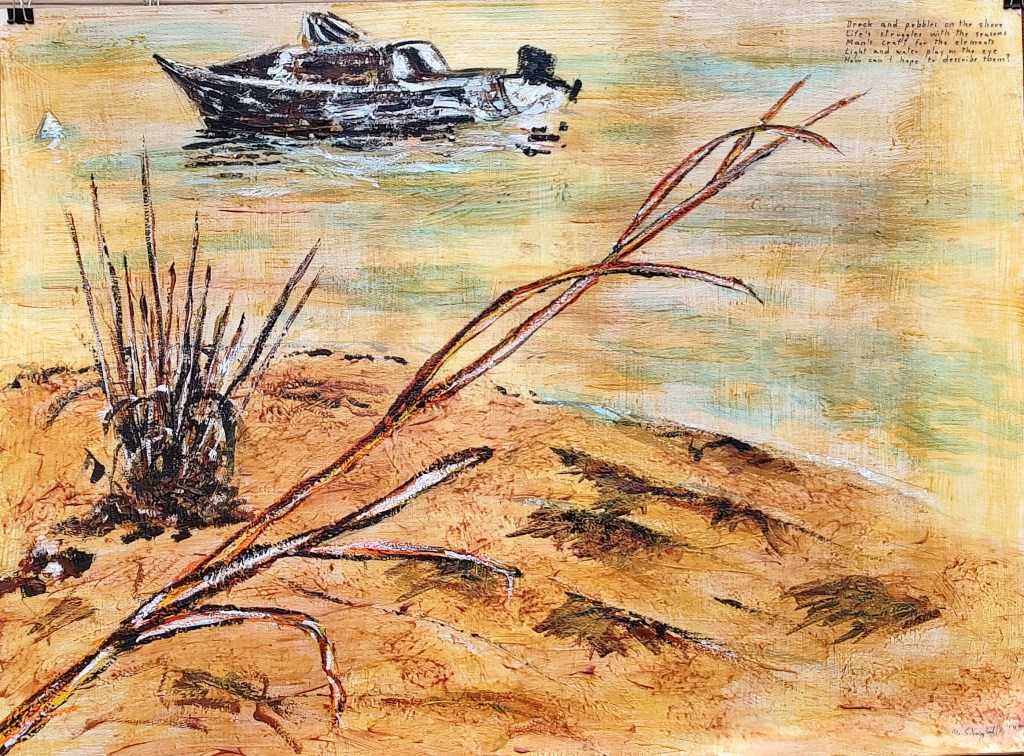
Acrylic on Watercolor Paper, 1999, 22×30
Dreck and pebbles on the shore/life’s struggles with the seasons/man’s craft for the elements/light and water play on the eye/how can I hope to describe them?
More of my paintings and writing at: https://sites.google.com/view/cabinetofvanities
1999-AWP-22×30-105

Evangelical Christians blather on about how the United States – “western civilization” in general – was founded on “Judeo-Christian” values. The Bible as the ultimate source of morality. They wish to establish a kind of “Judeo-Christian” state, kind of like Iran but (of course!) different .
Real history shows that “Western Civilization” arose from three major and almost unique cultural foundations. One was the classic Greeks who invented a worldview of logic and observation, and who regarded their deities about as we do comic book figures. The Romans generated a true rule of law in which order was maintained by professional bureaucrats, rather than priests or warlords. The Romans paid lip service to gods the way we do superstitions – Romans always believed they were the reality. And finally – not least – the Teutonic worship of individual power and rights – a healthy counterpoise to logic and rule .
The “dark ages” and “middle ages” were cruel and Christian. Only by reversion to Greek/Roman/Teutonic did the West break into the Renaissance and all that followed .
The United States’ Founders were steeped in classism, and based the Constitution on Greco-Roman-individual rights values. The Bible was a convenient shared cultural experience with some useful moral ideas, kind of like television in the ’70s .
But – until the last few elections – most of us never wanted interpretations of holy scripture to circumscribe our daily lives. Its rise is another example of the failure of social education in this country .

Exaggeration is often welcome in conversation. We love to claim we caught the biggest fish, had the worst day of our lives. Casual talks with friends are lighter if we stretch the truth, or even invent things out of whole cloth .
But that is entertainment. Serious discussions are not aided by stretching facts to fit desires. Unless, I suppose, you are a lawyer … Seriously, using exaggeration to win an argument is a time honored practice .
The problem is when exaggeration turns to lies. If someone says the water tastes bad, fine. If they say it is dangerous to drink, that should require proof. Lies and truth require more than merely saying something is so .
Unfortunately, in the heat of the moment or when trying to achieve power, exaggerations slide easily to lies taken as facts, for exaggerated goals without foundation or nuance. So we get orations, such as “gypsies are ignorant dirty thieving people and should all be run off or shot on sight.” No proof, no nuance, but unfortunately effective especially when combined with other equally shaky statements like “we would all be better off if there were no gypsies.”
We used to think “lying” politicians were bad, but now we seem to believe “exaggerating” ones are merely cute .
 HuntingtonHarborThoughts