Harvest Equinox

Monday

  • Nights have turned chilly.  No danger of frost yet, but crops are either ripe already or heading into the final stages of harvest.  Tomatoes, for example, may still ripen, but nothing is going to grow much.  Apparently the local drought has produced apples half the normal size, and deeply shrunken pumpkins.  On the other hand, farmers in the Midwest are cursing their third year of spectacular returns _ their income drops as quantities overflow storage.
  • Full moon, or close enough, with crickets and other night creatures chirping merrily.  Lightning bugs few and far between.  Odd mists in odd places here and there, sometimes a haunted feeling in the cool breeze with patches of warmth.  I try to force myself out once in a while after dark, for I find somehow being in the night calms me and eases the nervous artificial energy of reading or watching television.

Tuesday

Dark and light exact the same
Like good and evil some would claim
A useful cosmic metaphor.
As for me, I’m not so sure
I sleep the night, use daytime more,
My memories are most of day
Regardless, I could never say
Cosmos is like me anyway

I am unique, imbalanced, pure.

Wednesday

  • At least on this apple tree this year there are no apples at all, even half-size or shriveled.  Everything else happily received an inch of slow rain yesterday and most of the landscape seems pretty normal for the time of year.  Immature acorns are beginning to scatter the ground along with dogwood pips.  Dogwood leaves are halfway to desiccated descent showing orange and sickly greenish-yellow.  Crickets sound even by day, a harsh insistent chorus at night.
  • I’m grateful for the showers, even though in practical terms it means I must once again mow the lawn.  Each day presents a challenge in dressing correctly _ rain or wind or heat or humidity or cold and how much of each.  Almost impossible to guess until I am out walking, and then it is basically too late to change.  Ah, that all my complaints may remain so inconsequential.

Thursday

Joan and I are strolling the busy sidewalks of Northport on a perfect late September afternoon.  A cooling breeze sweeps up from the bay at the end of the street, as sun warms everyone benignly.  We run into Linda outside Artisans, while Joan is window shopping the various displayed craft items.
“Happy equinox!” I greet her.
“Huh?” she manages to project confusion through her huge mirrored sunglasses.
“He means Fall,” says Joan.  “Happy Fall.  He gets a little crazy about this stuff.”
“I just think we should celebrate the natural seasonal events, that’s all,” I get a little defensive.
“Do you paint yourself blue and run around the woods naked?” queries Linda with an ironic smile.
“Only when he was younger,” mutters Joan.
“I did not!  Anyway, solar events are important.  The days, the night, the tides …”
“Do you go out every month and howl at the full moon, too?” asks Linda maliciously.
“Only when he was younger,” repeats Joan.
“But our holidays are so artificial,” I protest.  “July 4, Labor Day, Valentines, Christmas …”
“Right,” Joan turns to Linda, “Exactly why we are here.  Time to start shopping for presents, isn’t it.”
“Right you are.”

They turn and march into the store, leaving me with my own inner contemplations and a nagging sense that maybe I am wrong after all.

Friday

  • Hot days linger a while, making thoughts of autumn more a concept than a reality.  The usual casual apparel remains shorts and T-shirts, cafes do
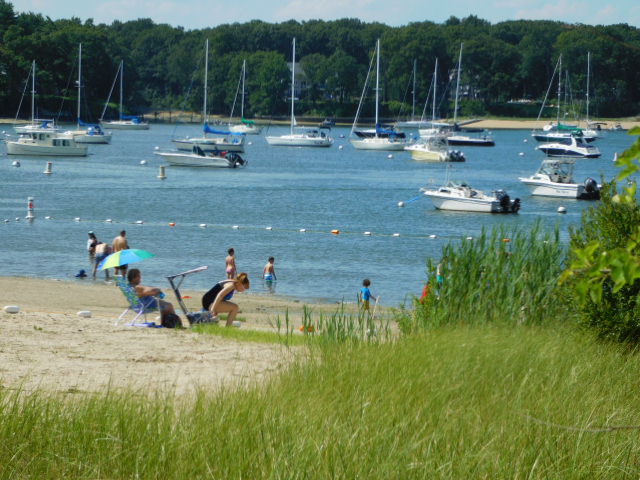
    a brisk business on the sidewalks, children queue up for ice cream.  More boats than normal stream through the waters on weekends, now that leisure mariners realize each warm sunny day is precious and will soon be unavailable for at least another half year.  Landscapes are green, birds sing, flowers continue to bloom.
  • Huntington is as lovely as anywhere else this time of year.  Parks are tranquil, beaches open to contemplation, busy sidewalks filled with shreds of global civilization.  I keep reminding myself that I have been privileged to live through and amazing and wonderful period of our world.  I continue to be awed by what still remains of nature, and also of what civilizations have built.  My years on Earth have been during a pretty amazing balancing act, and my main fear for the future (not so much mine as a half century or so from now) is that the balance will be lost and all I have enjoyed become either vanished or reserved for a privileged few.  But _ well I only have this moment _ and this moment, today, hot and beautiful is as miraculous as any I have ever experienced.

Saturday

  • Like most people, I suppose, I tend to consider where I live as “normal.”  So I expect longer days in summer, and shorter days in winter.  If I lived on the equator, I would find no daylight differences by season, although precipitation might vary greatly.  Near the poles the sun barely rises or sets at appropriate equinox.  That would seem strange at first, then I would adjust to the new normality, and wander happily along.
  • Yet even here at home, where I know changes are occurring each day, by minutes or clumps of minutes,  I fail to pay attention until some sudden jolt.  Perhaps I realize that I must turn on a light to read sooner, or that it is already dark when I put out the garbage.  Weeks go by, and all is the same, until suddenly it is not.  I am shocked, but soon fail to observe, once again, that such trends continue.
  • Probably I should remark that we are caught in this trap with climate change.  The temperature is changing, but gradually.  The storms are bigger, but only once in a while.  Suddenly, we will certainly notice weather and climate are not what they used to be.  I hope we adjust as well as we do to seasons.
  • Most of that lack of awareness is, of course, because we filter it out.  Daylight hardly matters when we can turn on lights any time, and too often our entire days are spent one way or another under artificial illumination.  We hardly care what may be happening around us because most of our basic needs are taken care of elsewhere, presumably with better weather for crops than the local fields.  We might never notice until there are few “elsewheres” left.
  • Only by making an effort to enjoy the outdoors do I ever retain a sense of place in the universe.  Being inside all the time has always been a personal torture.  I do not have to be outside for hours and hours each day, but a full hour is perhaps minimum.  And when I do so, I seek to embrace it with as little baggage as possible _ no electronic doodads to distract my meditations and observances.
  • So I see the sun rise a bit later, the shadows weave a bit more northernly, the sun sets magnificently much more to the left over the neighbor’s property.  I pay attention to equinox because it marks the big final turn when this area of Earth begins to radiate more heat back into space than it receives.  Cosmic consequences from gigantic events, while I scurry like any busy ant only paying attention to the trail I think I must follow.

Sunday

  • Cool air swept in with an overnight cold front, a tangible reminder that one season has gone, another takes its place.  Here at Caumsett park, fields are filled with drying brown annuals and masses of goldenrod, while butterflies and grasshoppers frolic about heedlessly.  Sighting a last lonely monarch butterfly has the bittersweet aura of encountering a lingering passenger pigeon.  
  • Heedless of warnings of ticks which effectively seem to frighten everyone else into staying on paved roads, I roam meadows and dappled forest dirt trails all alone.  Quiet mostly prevails, only an occasional airplane breaks into the rush of gentle breeze, rustling leaves, insect murmur.  High blue sky with accented white clouds seems artificial.  A few hours and I am refreshed in soul, tired in legs, happy in mind.  I ask myself why I do not do this more often, and myself replies there is no good answer. 

Biologic Imperative

Monday

  • Gusty winds rushed a line of ink-dark ominous clouds across the sky, ripping leaves, whipping whitecaps, threatening rain which never fell.  In minutes, weather cleared.  A portent such as ancient astronomers would perceive in comets staining their heavens. 
  • Our first grandchild is to be born today.  Coincidentally, we are also to attend the wake of one of our most long-term neighbors.  There are no stronger symbols than birth and death, except that birth and death render all symbolism trivial.

Tuesday

A baby is born
A cute little gem
Hard to believe
I was once just like them
How could I teach him
Of hassles and strife
All the decades it took me
To understand life
A child of our child
On that same crazy slope
Exactly that cycle
Of worries and hope
And will he remember
Or reflect, moving on
Of pasts or of ancestors
Once we gone
A baby is born
Such a common event
Such a miracle moment

Such a wishful advent

Wednesday

  • Half a century ago, everything was simple.  The body was a machine to be disassembled and repaired.  Evolution proved the “fittest” survived.  Genes were all that mattered, and once they were reproduced in the next generation, any individual’s biologic function was complete.  Neat, complete, and totally wrong.
  • Our body is a community organism.  Humans are a social species _ like bees _ where the genetics of individual fitness hardly matter compared to what an organism can contribute to group survival.  We are only gradually realizing that, to some extent, what all our ancestors knew _ before the rise of prim and hubris-laden mathematical science _ is in some ways far more relevant to our actual lives and meaning than any grand recent discoveries.  Such as understanding that another human consciousness in this universe should always begin with celebration.

Thursday

John sits morosely staring into space when I intrude into his vision and shake his hand.  Big smile on my face.
“You on drugs or something?” he asks sarcastically.
“Beautiful day,” I reply.  “And our first grandchild arrived this week.”
“Oh,” he shrugs.  “Well, guess that could make you happy.”
“Me a little,” I admit.  “The parents a lot.  My wife ecstatic.  Happy wife, happy me.”
“Well me, I wouldn’t want to be born today,” he rumbles along.  “Too much falling apart, too many bad things happening, the future looks pretty awful from what I see. Crazy nasty times.”
“Always like that,” I challenge.  “Always.  For every bad thing you could pick out I could find something grand.  Matching until we were hoarse.  Half full, half empty.  Me, I’m the optimist.”
“I know,” he answers.  “Usually annoyingly so.  Congratulations, I guess.  I reserve the right to my dim perspective.  Cold realism.”
“Cold, for sure.” I fake a shiver.  “I’ve always thought of life as an adventure.  I think challenges remain opportunities.  Life now is the same as always.  I admit, however, that the challenges are worldwide and immense.”
“Glad you retain a little sanity after all ….”
“But so are the opportunities.  Anyway, I’m not sure that vast picture matters anyway.”
“Sounds stupid.  Why?”
“All our lives are localized.  Anything beyond our immediate control and perception is in some sense not real.  Being born here today is still pretty good compared to any other time in history.”
“Would you trade your life?” he asks, raising an eyebrow.
“Nah, I’ve been really happy with how mine worked out.  I just don’t think the next generation will be as grim as you think.”
“We’ll see,” he mutters.

“No, we won’t.  But that’s ok.  See you around.”  Refusing to be deflated, I continue my idiotically happy mood and smile my way down the sunlit sidewalk grateful for the times and the morning.

Friday

  • Flush times for birds.  Lots of weeds, lots of fish.  Time to stock up and put on some fat for the coming seasons.  They are surely unaware of why they are hungrier, but that does not matter.  Were they able to think, they might reason that their increased consumption is because of shorter nights or the cooler days.  Reason often rushes to answer questions with any explanation it finds convenient.
  • I like to feel superior, but I am no different.  I like to think I know why I feel as I do, on any given day, for any given feeling.  But in fact I often do not.  The usual cure for me is, curiously, simply to find something _ anything _ to laugh or smile about.  Not unlike locating those tiny little fishes in the shallows, or delicious roots easily pulled from the mud.

Saturday

  • As I watched my son holding his day-old son gently and protectively, as I saw the joy my wife felt also cradling the child, later as I sat outside in the warm September sun, I realized anew how much closer we are to other mammals than we are to machines.  Only recently has consciousness been scientifically explored in dogs and elephants and apes.  I have certain reservations on exactly what consciousness may be among other species _ humans are unique in so very many qualitative and quantitative ways that we are practically supernatural _ but I am sure of one thing:  it would be much easier to transfer whatever is “me” to some being based on a dolphin or giraffe than it would ever be to do so into infinite transistors.
  • Reason is an extremely useful tool of our consciousness.  But it is by no means most of our consciousness, and the logic woven by our brains is well-separated even from reason itself.  We are complex, and that complexity resides in body and tissue and hormone and symbiont and trillions of non-neuronic cells as fully as it does in our magnificently wired, rewired, and overwired brains.  Whatever comes from artificial intelligence of machines may well be dangerous, might destroy us all, but can never replace or replicate the incredible illuminated wonders that we provide to our cold and forlorn universes.
  • Part of our being is that we need to consider ourselves immortal and important _ part of some grander purpose, able to further a perceived design.  Our reason coldly informs us we should know better _ and we respect our reason.  To an extent.  Then we have another bite of dinner, or feel a soft breeze, or catch the eyes of a lover, and reason flees back to its tool shed.  The cause of that is simple _ without such innate beliefs and drives _ and in fact there must have been many failures extinguished for lack of them over billions of years of life evolution _ an organism cannot struggle on, and contribute to the continuation of its species.  Those beliefs are not merely built in, they are necessary.
  • Babies should remind us of that.  Babies are hardly tiny little computers, but they are fully wondrous consciousnesses.  Our technologic scientific intellectuals should spend more time contemplating that.

Sunday

  • Earth continued its busy way all week, humans adding mischief.   Typhoons, hurricanes, huge fires, floods around the world.  Nuclear testing, ongoing war, civil strife, political chaos.  Everybody has reason to be cosmically worried about just about everything.  Although, to be honest, for many all these usually distant disasters are more entertainment than impact.
  • Meanwhile people like us discovered how quickly focus can shift from the far to the near.  Some folks received unhappy news, or endured loss or sickness.  We were most fortunate in welcoming a healthy new baby, which will undoubtedly shake up our routines for a while.   We are told to keep perspective, but perspective is actually an ever-shifting reality, depending on what our mercurial minds decide is the central factor.  

Back Too

Monday

  • This weekend is North America’s signal for “back to.”  Back to class, back to school, back to work, back to getting ready for winter, back to thinking about end of year holidays.  Back to pulling boats out of the water for storage.  “Back to” always has a tinge of resentment _ nobody on Memorial Day in the spring sighs deeply and mutters “Oh, it’s back to summer vacations.”
  • We have conquered the worst impacts of the cycle of seasons.  But perhaps humans enjoy cycles, and if they are not provided by nature we can invent our own.  Industry and advertising, of course, are all for it.  Ironically, “Labor Day” is supposed to be a celebration of the liberation of workers, when it has really come to mostly signal a return to our socially regimented shackles.

Tuesday

Tensions extensions
Dark matter, dark energy, dark time
Incandescent consciousness

Meet my moments

Wednesday

  • Cruise control.  Leaves keep pumping out oxygen, birds constantly flock for food, flowers bloom, squirrels rush about.  Too early for the most dramatic changes in behavior or appearance, but beyond the frantic struggle to get ahead.  As things wind down, so will everything else.  Drought now will defoliate branches without green replacement,  inevitable colder evenings will tinge meadows with yellow and red.  In a month or so gardens will be just a memory.
  • Nice metaphor for retirement.  Cruise control as we finally get a chance to do all day whatever we always wanted to.  But not pushing too hard, not really frantic, just mellowing along.  Anyway, for the lucky ones.  I know some folks regardless of age remain hassled and fritzy.  Being fortunate, I just sit back and enjoy the free entertainment.

Thursday

Jean, Joan, and I are down on the dock, watching seagulls swoop in the steady breeze.  A loud backfire startles us into glancing at the road, where a yellow school bus is just lurching off, having discharged a few youngsters at the bottom of the hill.
“Ah, that brings back memories,” I say.  All those days up and down my hill at home, all kinds of weather,  books and lunchbox.  Boy, did I hate September.”
“What?” asks Joan.  “I thought you were good at school.”
“Yeah, but just like now I’d rather be outside.”
“I was glad to get back with more friends,” remarks Jean.  “Summer got a little boring at the end.”
We all stare into the distance for a while, remembering.
“Well, then of course I worked as a teacher for a while.  I kinda dreaded going back too,” Joan finally says.
“Oh, you loved that.  You were ready with lesson plans and all.  I was the one that hated when work geared up again every year.”
“Me too,” says Jean.  “Right up until the end a few years ago.  September was never any fun, in any way.”
“Now, of course, it’s different,” I remark.  “We’re lucky enough to keep doing what we want without alarm clocks and schedules and demands.”
“Just like the seagulls,” puts in Jean poetically.
“Well, I have things to do!”
“Sure, Joan, but the difference is now you can do them when you want to, not when you are told.”

The wind keeps  blowing and the gulls continue their acrobatics as life goes on from all perspectives at once.

Friday

  • After days of cool clouds and brief sprinkles, heat and sun have returned.  Summer flowers are actively blooming, boatyards are still empty, weeds choke every available space with greenery.  Summer continues its merry way.  Only the lack of people outside on this fine weekday betrays the idea that the social world continues as it was, say, two weeks ago.
  • I admit that my problem is that I actively notice changes, rather than continuity.  I see the browning leaves.  I observe that swimming floats have been taken in, that lifeguard stands are put away.  A boat used to remove moorings is now cruising the harbor.  I force myself to rejoice at the wonderful weather, but the crucial and sad fact is that I must force myself to do so.

Saturday

  • For over a week, a hurricane recently meandered around.  In spite of supercomputers and massive reams of data, nobody could predict where it would go when, nor what it would do.  Weather is a chaotic system, which means that even if you know everything, you cannot tell exactly what might happen.  The illustration often used is that a butterfly flapping its wings in China may affect a hurricane in the Atlantic.  But chaos theory really states that it may not.  Like quantum jumps, you just can’t predict.
  • Weather is simple compared to society.  Butterflies may flap wings, but each person is a complete chaotic system unto themselves, and each individual’s acts (or lack of acts) may affect a society profoundly or not at all or in some obscure unexpected way.  The sooner we accept that social studies are not sciences _ except in vaguely and often useless statistical trends _ the better.
  • Most thinking people _ I try to be one _ realize, for example, that grouping and generalization of people is generally futile.  To say most folks are “back to” something ignores the fact that a technological culture grinds on relentlessly without cessation.  Electricity is being generated, goods are being delivered, sales are being made.  Nothing stops.  There is nothing to go back to, because nobody ever left.  Oh, statistics will try to prove that indeed students are back in class, indeed most vacations are over.  But none of that really counts for much.
  • That’s part of why politics is so maddening.  Everyone involved is frantically trying to split the world into groups and factions, and then generalize about what each group and faction is doing or desires.  And, for any given moment, a crowd may agree.  But the minute individuals leave such a crowd, they go their own unpredictable and unique ways, and all bets are off. 
  • Sometimes I prefer the hurricane.

Sunday

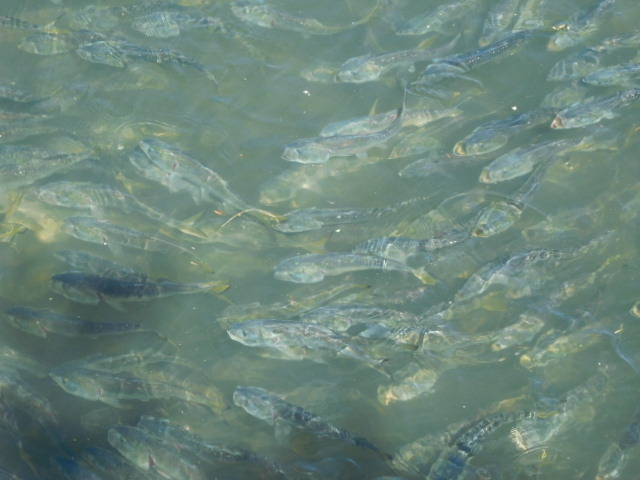
  • Nature is also briefly back to summer with a near heat wave of high temperature and humidity.  Only quickly descending earlier darkness provides awareness of the march of the season.  Seeds are ripening quickly now, nuts on the trees swelling to their final dimensions, birds beginning to pass through on migration.  Fish in the harbor endure the final stages of feeding frenzy _ there are frequent disturbed jumps and flashes in the water as rapidly growing bluefish snappers devour smaller ones.  Sunsets turn spectacular.
  • I try to get back to my normal cheerful optimism, but for some reason I am stuck in the melancholy contemplation of what is to come, rather than what is here.  The heat feels too hot, life seems to drag.  My inner soul sometimes fails to heed my reason.  That is a great fault, but I also realize it is part of my humanity.  There are, after all, things wrong with our world, as well as miracles everywhere.  But real life always beckons, and I remain sure that a nice long walk, a quiet natural meditation, will put me back to the normally cheerful spot I desperately try to retain.

Closer Inspections

Monday

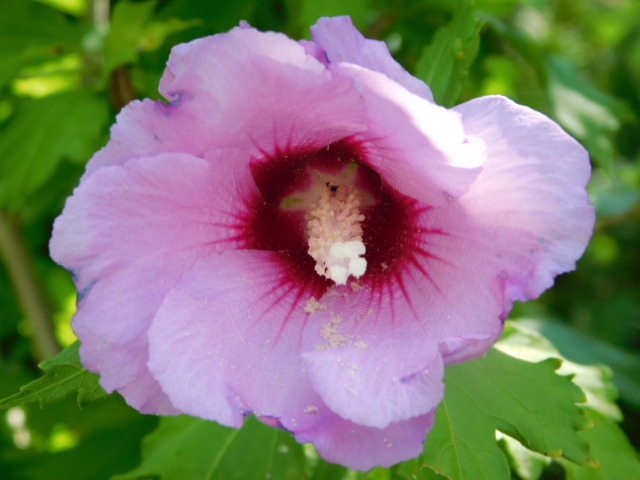
  • Among other waning-season signs are the profuse blooms of rose of Sharon, now showing off in yards everywhere.  But even were those absent,  crowns of trees have taken on distinct reddish or yellowish tinges, and close inspection of the leaves finds bits of rust, areas of brown, gangrenous insect-caused holes.  This is all caused not simply by heat and drought, but also by the ever-lowering angle of the sun and shortening evenings.  Schools of snappers now agitate the water as they seek to escape larger predators.  Even the mix of outside birds has begun to include early migrants.
  • So I vow to look a little more closely at the small picture.  Not the microscopic, which is fascinating in its own right, but the visible bits of which reality is composed.  A single branch or leaf, one bloom, a stalk of grass.  In the loveliness of summer I have sometimes become too enamored of wide distant scenes, waves and shores, clouds over hills.  Time to return to the scale of reality at which I actually exist.

Tuesday

Seeing worlds in a grain of sand
Perhaps a little too abstract
Too hard to focus with these eyes
I need some slightly larger facts
“If there were world enough and time …”
Torn wisdom fragments from my youth
I question from my greater age
What such young poets knew of truth
And yet I know I once knew more
Of sandgrains, stars, and even time
Now just today is what I crave

To stare at any leaf I find.

Wednesday

  • This thistle has terminated its destiny of sprouting, growing, flowering, seeding, and sending forth the next generation.  Most of its offspring are doomed, a few will thrive next year.  Even those that fail will enrich the planet with oxygen and food.  Such cycles of all plants and animals create Earth’s incredible biosphere.
  • People always accepted that we were related to animals.   Darwin’s great sin was to show we are just like them.   Beauty, meaning, purpose are in that sense unnecessary.  Humankind has now spent over a hundred years trying to replace the certainty that there was “more to it” with other systems: religion, political movements, social crusades, science, technology, art, individual lifestyle.  Nothing has healed the damage.

Thursday

Enjoying the feel of a dusty road at Caumsett, I ran into Stan and Myra coming up the hill the other way.  We were all soaked in sweat, so the natural greeting was “Hot enough?”
“Sure is,” panted Myra, seizing on the chance for a hiking break.  “Summer won’t give up this year.”
“But we were noticing,” added Stan, “that there are lots of signs of it reaching an end _ look at those brown fields…”
“Well,” I exclaimed cheerfully, “After all, tempus fugit.”
“Wayne!” scolded Myra, “watch your language!”
“I think he means tem-pus foo-jit,” Stan said.  “Time flies.”
“Everything in nature except people seems to be getting that message,” I ignored the correction.
“Everything in nature has to endure this heat, drought, freezing cold, snow, and predators all the time,” pointed out Myra.
“Yeah,” Stan remarked, “but the only cycles we really notice are those of work and politics.”
“I can only agree,” I sighed.
“And aging,” chimed in Myra.
“Depressing thought.”  I waved around.  “Contemplating nature is supposed to be uplifting.”
“But, even so,” she continued stubbornly, “we are, in the end, as impermanent as everything around us here.”
“Take her away!” I laughed.  “I still have a ways to go here.  See you around …”

We parted happily, our thoughts perhaps a little more profound, as hawks circled overhead.

Friday

  • Hooray!  Something does eat this plant!  At this time of year, bindweed is the scourge of any gardener, who discovers that overnight beautiful beds of phlox and roses have been strangled in a thick mat of nearly impenetrable vines and leaves.  And if not cleared immediately, it goes to flower and seed.  Then that space may be nearly unusable for a few years, even with diligent care.
  • Our world hurtles on.  Pessimists wail it is hell-bent for destruction.  Optimists dream it is rocketing towards paradise.  Most likely, as always, contradictory bits of heaven and hell will intertwine.  But no matter what, like weeds and the world itself, we all hurtle on.

Saturday

  • There’s great satisfaction in discovering signs and assigning patterns.  I watch a changing leaf here and a browning seedpod there and suddenly the world of autumn unfolds before me.  I immediately imagine what will come, and seek confirmation of expectations.  That is essential human (and animal) mental behavior.  It is, after all, the basis of training anything.
  • Such information is useful.  Properly leveraged, it can make some people rich.  More importantly, having the foresight of possible and probable future problems is one basis of civilization.  Knowing there will be a winter is why we sow and grow and harvest crops.  Knowing there would be a dangerous night with predators active is why our ancestors built camps and utilized fire.  Knowing the Nile will flood … well of course the list is endless and ongoing.
  • One problem I have already discussed.  In concentrating on signals about what may come, I may forget the thing in itself.  It is well to guess what the future may hold, but the present is already full and I should try to take advantage of it.  Besides that, I can easily lose myself in the game itself, rather than the actual reality that game is trying to reference.
  • The other problem is that my connections may be wrong.  Since I, like any other human, am the center of my universe, I assume unconsciously that the universe is all about me.  I become certain that if I wear a lucky sock my team will win, if I pray to the right gods it will rain.  Most of those me-centered predictions tend to be incorrect.  That doesn’t stop my brain from happily constructing them from gossamer patterns of invisible connectivity. 
  • Summer is ending.  Fall arrives soon.  The signs are all about me.  So what?  I need to take out the fiddle and play up a storm, for until summer does end, it still remains.

Sunday

  • Until a few hundred years ago, things seemed remarkably simple.  Not systems, of course, nor life itself; but those objects which constituted reality.  A bird was a bird, a tree a tree.  Thunder was mysterious, but nevertheless a certain event.  There might or might not be gods.  A solid framework was resolutely present.   Since then, of course, everything has been revealed as infinitely complicated, no matter how closely examined.  A bird, its components, its atoms, those atoms, their subatomic structure _ nothing ever really clarifies except at its proper level.  There is always more to it.
  • The wonder is that there is no end of wonder.  No matter how deeply we peer, how closely we examine, how devotedly we concentrate, there is even more to amaze.  And yet, as we move up to broader view, outward, there remains enchantment.  A night horizon with moon, sky and stars is as amazing as any set of chemical bonds.  Beyond and out into the vast universe, continually astonishing.  And yet _ being human _ I can sometimes become blasé and bored with it all anyway.  That in itself is worthy of wonder.

Ragged Climax

Monday

  • Like many gardeners, nature itself seems to have given up on the weeding.  Whatever vegetation has survived this far extends out of control, taking over every vacant bit of light and moisture, yet hardly making a dent in the survival of any nearby plants.  A glance at any exposed space would convince a neutral observer that this land is well on its way to becoming jungle.  Unchecked, this growth would quickly return fields and towns to primal wilderness.  But the season grows late ….
  • Oppressive heat and humidity has many of us longing for the cooler breezes of autumn, of which we will tire of in turn.  It is easy to forget how not long ago weather was a local matter of life and death, rather than a seasonal entertainment.  Blizzards and floods could kill on vast scales; drought, heat, and cold could bring starvation;  any extreme condition represented misery.  Technological civilization insulates us from such intimate connections, which is on the whole better for everyone.  I know it may all collapse, wilderness triumphing after all, but at this moment I am very content to be able to experience any meteorological inconveniences innocuously.

Tuesday

Streams of sweat drip sting my eyes.
I’m thirsty, heated, happy, slow
Watch gentle waves in absent wind
Nowhere to be, nothing to know
An empty bottle cast on shore
Residues of memory
Phantom dreams drift of our past
My contemplative lazy me
This cannot last, no worries, cares
Soon worlds of problems must appear
Tomorrow will _ but this is now
Sunshine seas erase my fears.
Beach nirvana, is it wise?
Or lotus-eater melody?
A stream of lassitude allowed

A moment to be fully free

Wednesday

  • Exercising an innate capacity for appreciating beauty is a constant joy.  Some approach it with exclusivity, as if true beauty is perfection in an imperfect world _ and consequently rare.  Their primary ability becomes locating flaws great or small which mar that which they wish to experience.  Others claim beauty is everywhere, even in trash and tragedy.  They seek to adjust their perception to cast an enchantment on whatever exists.
  • I am obviously prone to the latter.  A glass of cool clear water is as satisfying and wonderful as a perfectly prepared cup of coffee or tea, although coffee and tea (however prepared) are also fine.  Of course, I understand some things should be changed _ a house on fire may be majestically beautiful, but it should be extinguished.  Trash on a beach may add ironic visual highlights, but should be removed.  Overall, however, I exist in an environment much of which I cannot control nor modify except within myself.  I prefer to find most of what I encounter there an echo of the harmony of the spheres.

Thursday

Joan waves another fly into the onshore wind, as the muffled sound of a distant speedboat blends with thunder from an overhead low jet heading for landing thirty miles away.  Waves sparkle below tree-greened horizons as families splash in bathtub-warm mid-tide.
“Not too many people, for such a hot day,” I break our silence.
“Well, it’s starting to get low and a little dirty.  They probably don’t want to get an infection,” she replies.
“Oh, people like you are afraid of everything,” I chuckle.  “I swim in all the tides, head under water, and nothing ever happened to me.”
“It will, sometime,” she notes darkly.  “I heard on the news …”
“That’s the problem!” I break in.  “That stupid news.  Someone somewhere got an earache, someone somewhere drowned, someone somewhere always something.  Zika, skin cancer, West Nile, paralyzing jellyfish, cataracts, and probably food poisoning from eating a popsicle from the ice-cream truck.”
“Well, things do happen to people, all the time,” she says in a reasonable tone.  “We
need to be careful.”
“Compared to our ancestors, we are about as safe as it is possible to be,” I look around at well-fed folks lying half naked, protected by life guards, help a phone call away.  “And yet everyone still worries.  What if one of those backpacks explodes …”
“Don’t even think about it,” she grimaces.

“Fear of fear itself,” I mutter.  More loudly, “Ready for another dip?”  She nod’s agreement and we head down to water’s edge, challenging fate once again.

Friday

  • Deep drought continues at lower soil levels, but the surface has been periodically refreshed with frequent thunderstorms and short downpours.  Grass remains green, everything continues to grow.  Nevertheless, the blooms of summer are quickly turning to seed, autumn flowers are showing, and all vacant areas have been overrun with massive bunches of ragweed and crabgrass.  Summer remains in force, but is beginning to strain with the effort.
  • I’ve already heard folks complaining about our protracted spell of sun and heat.   What seems a perfect month or two to a few of us is wretched for others.  Isn’t that too true about an awful lot of things these days, from food to entertainment to future hopes and fears?  Such diversity of opinion is wonderful, as long as we can somehow manage to hold common ground, which is one thing that sometimes seems in question lately.

Saturday

  • “Let a thousand flowers bloom” is a nice sentiment, but ignores the fact that in the real world over 900 or so of those will be crowded out, withered, eaten or killed off in some other manner.  What is left is magnificent, but nature remains ruthless. 
  • Since at least the time of the ancient Romans, each generation has produced a few people who miss the “good old days” of their fevered imaginations.   According to them, the golden era has passed and these are degenerate and wretched times, with everyone (except them) too lazy, too coddled, too ignorant.   I’ve been hearing a lot of this claptrap lately, starting with making us “great” again.
  • I’m the first to admit I’ve led a fortunate life, and there are others who do live in eternal misery.  I would never have chosen to be alive in any other era.  Discoveries are happening daily, but there remains mystery in the world.  We are overpopulating the planet, but there is still enough for most. 
  • As for purpose, which is frequently said to be missing, we’ve been doing all right.  There have been no major wars for over fifty years, whole populations which would formerly have been starving are now fed and clothed.  Everyone everywhere has hopes of a better future.  All we need is to decide to clean up the environment and spread the wealth and that would provide purpose enough for quite a while.
  • Glass half full?  More like almost overflowing.  And yet there are angry folks everywhere, and agitators who stir the pot, and even those who are obscenely wealthy think they are god’s gift to the world and why couldn’t everyone else just work hard like they did.  I’ve gotten to the point where it is almost painful to listen to the news or read editorials.

Sunday

  • Days of brutal humid heat have kept much of the population safely hidden into air conditioning.  No such luck for the outdoor flora and fauna.  Lack of rain, air pollution, all the usual complaints of late summer.  Meanwhile, everyone frantically realizes that regardless of how it feels, the season is drawing to a close.  Panic to enjoy the last weeks has set in for boaters and other vacationers.
  • I’ve been more or less confined to the house, not wishing to run into big box stores for relief.  In some ways it is worse than cabin fever when blizzard-bound.  Even the few times the temperature let me venture out to read on the patio, mosquitoes have quickly driven me back in.  So I too am trying to throw off my recent lethargy and low spirits in a final summer fling of activity.  

Nervously Normal

Monday

  • Sometimes the mood is that of an approaching hurricane.  Calm now, nothing anyone can do here except make futile preparations, and wait to see what exact track it takes and how severely it hits the neighborhood.  Everywhere in the world, which attained an all-time high in average warmth last year, there seem to be 100-year droughts, 1000-year floods, massive devastation both directly from weather and as a result of its anomalies (vast forest fires, immense insect infestation, death of species.)  An apocalyptic outlook is fairly easy to feed in such times, even though locally everything remains as it has always been.
  • We tend to forget exactly how bad some local and even regional events used to be for the people living through them.  The year without a summer in 1816 causing starvation in New England, famine in France in 1787, widespread deep snow killing crops and hastening the black plague in 13thcentury Italy.  Middle Eastern ancient religious texts speak of vast floods, as do Chinese chronicles.  From an individual standpoint, the past was just as bad _ and often far worse _ than what we are experiencing.  And we should not forget that through everything there were always people who blamed themselves, their neighbors, or their society for what was going wrong.  But will “think globally, act locally” be enough this time around?

Tuesday

On the beach _ a summer glory
On The Beach _ a frightful story
Doomed insects dancing in the wind
No gods to care if they have sinned
Fish flashing, brightly wild and free
‘Til swallowed whole when they can’t flee
Birds growing fat on bugs and seed
Triumphant conquest by the weeds
I see it all, I simply pray

I’ll watch again another day

Wednesday

  • Long Island has large parks in addition to vast stretches of sand and wetlands shoreline.  So for those fortunate enough to have time and leisure, shady lanes wind through forests, and dirt paths wander surrounded by ferns.  This year there is a minor drought, so insects are less annoying than usual for August _ not good for swallows or bats, nice for someone striding along trying to flick gnats out of their eyes.  In such moments the world seems benign and well.
  • I used to take these hour or two strolls with improvement in mind.  Although that is still true as an exercise and a mental contemplation, I often no longer fill my moments with attempts to identify trees and flowers, nor to visualize scenes “as an artist,” nor to follow deep and often futile trains of thought concerning philosophy or the cosmos.  I am, finally, content to not know so much, to just enjoy the experience, and to be grateful for a sense of well-being.  I recognize that we must preserve wilderness and rain forests and coral reefs, but truthfully for myself what must really be fought for are these nearby refuges that can be reached and experienced without great preparation.

Thursday

Only our heads show above the waves as we notice Harry and June plopping down their beach chairs next to ours.  Temperature in high eighties, so they are soon along side, June and Joan pairing off to discuss offspring and other social gossip. 
Harry comes up dripping and smiles.  “Ah, global warming.  Good for something, anyway.”
“Right,” I agree.  “Water really beautiful this time of year.”
“I wonder what we’d do if a tsunami happened right now?”  Harry likes the oddball and even ridiculous non-sequitur in his conversation.
We both glance at the narrow inlet a half mile away through which all the tides must ceaselessly flow.  “Outrun it, I suppose,” I say, figuring not much would get in very quickly and would dissipate as it spread.
“Probably right.” Harry agrees.  “But there’s so much concentration on catastrophes that I find them almost interesting to imagine.”
“Black swan events don’t need global warming,” I note.  “That’s the trouble with projections.  A hundred years before the big asteroid, any intelligent being would assume dinosaurs would still be ruling the Earth today.  And nobody still knows where the ice ages came from, or when they might return.”
“Don’t forget the Black Plague,” he added.  “And the Huns and ….”
“Oh, I know, there’s enough to go around.  What’s that got to do with the price of bread, anyway?”
“Well, it’s one way to avoid guilt.”
“Ah, guilt,” I ponder.  “Well, I don’t feel all that guilty about all that.  Our generation worked out a few problems, as did generations before us.  The next ones will just have to do the same.  But I’ll tell you one thing…”

Harry ducks his head again and looks at me expectantly.  I continue “I doubt if we have any idea what those problems will really be.”

Friday

  • Sticky hot thunderstorm weather has settled in for the week.  Peeking outside the door causes sweat to break out.  Taking a walk will lose a few pounds of water.  Any moment, tropical downpours may empty buckets on the unsuspecting, then stop as quickly as they began, almost without warning.  Nevertheless work must be done, often outdoors, and humans are surprisingly well adapted to such conditions.  Well, people did come out of Africa, after all.
  • Generally, those who can avoid going out in such conditions do so.  For the last hundred years or we’ve been able to fully control internal temperatures, and the use of those has spread.  Many folks seem to rush from air conditioned home to (pre-) air conditioned car to air conditioned store or office.  Soon, no doubt, they will be wearing air-conditioned suits as well.  Maybe it is nature evolving us to finally move off-planet.  In the meantime, I enjoy the hot and sticky, at least for moderate amounts of time, although I admit I also hide away in my burrow a good part of some days.

Saturday

  • Little doubt of climate change any more.  The world has not only hit record highs on average the last few years, but the immediate consequences of energy-activated weather are too prevalent and destructive to be ignored.  The acceptance is odd, in that only a decade or so ago there were fierce protestations of how silly the idea was, massive counter-examples being utilized to prove nothing was happening. 
  • But prevailing wisdom has changed, just as the arguments against air and water pollution control eventually fell into disuse in the sixties and seventies.  Anyone with half a brain now knows the biosphere is heating up, and those without half a brain don’t matter anyway.  The only remaining question is what can be done about it, if anything.  More importantly, what adjustments and preparations are appropriate _ individually, locally, and globally.
  • Some say nothing.  I think they are wrong.  I lived through the times when we were reliably informed that dense smoke in Pittsburgh, toxic smog in Los Angeles, fires on the Cuyahoga River in Cleveland  were simply necessary adjuncts to our consumer lifestyle, and of little consequence.  DDT was the only way we could manage insect-borne diseases _ what’s a bird’s life against a child’s? they asked.   But somehow, civilization moved on, and all that has become almost a forgotten past and prelude to new challenges.
  • Consensus does eventually filter up from accepted common sense in the masses to those in power.  In spite of our predilection to see the worst in humanity, most people do care about their immediate environment and want the world to remain habitable for their children.  I suspect in the next few years, climate change will become one of the driving forces of political decision-making, if only for how to handle its increasingly devastating effects and increasingly costly preparations.  Putting New York under a bubble will not come cheap.
  • I have faith in our technology.  With will, we can still find a way.  An easy start is a large carbon tax.  I believe that once we all start to act for real  _ just like the pollution crises _ significant solutions will arrive in a decade or so. 
  • Until then, we have the opportunity to swelter, watch historic fires and floods and winds, and imagine catastrophe around every corner.  In the meantime, I will poke my head out the door yet again and maybe even venture out on a short stroll to warm my bones.

Sunday

  • Dew-drenched air forms a light haze in early morning.  Soon enough, sharp low sunbeams will slash that into sparkling clarity.  By this afternoon, only distant features will be dimmed, the Connecticut shoreline across the sound a vague blue ribbon, if it can be seen at all.   Fish are leaping frantically, spoiling calm reflections.  It seems a summer moment from forever.
  • Forever, we have learned, is a scientific fiction.  We swim in change, for better or worse.  It once seemed cruel that we are born, age, and die _ some cosmic joke in an eternal universe.  Although it is hardly comforting that the universe itself shares our fate, we can no longer complain about being singled out.  Like the universe, we just have to deal with things as they are _ and at this particular moment, right here, they are lovely indeed.

Livin’ Easy

Monday

  • Residual industrial residue along the great falls of the Genessee.  At one  point this water _ diminished now due to a moderate summer drought _ provided enough energy that the millstones grinding western wheat renamed Rochester the “flour city.”  Later it drove machinery for the largest button factory in the world,  generated electricity, and was tapped for countless other uses, not least of all several large breweries that still exist on the high cliffs alongside the river gorge.  Maybe in the future it will once be utilized for renewable energy, not so great for the scenic view.
  • Industrial architecture and ruins in North America only go back a few centuries, hardly touching the older debris of Europe, Asia, and Africa.  Yet they too insinuate tales of rise and fall, great commercial empires, individual struggle and triumph.  Weaving such reminders into the fabric of our cities’ revitalization is one of the supreme architectural challenges of this age.

Tuesday

Summer half gone
Half to go
Shimmering afternoons, endless
(but growing shorter)

Slowly transient paradise

Wednesday

  • Huntington home, back by the beautiful bay.  Salt water instead of fresh.  Anxious people following anxious activities, afraid of missing something or losing a possible future option.  Long Island is marvelous, but laid-back it is not.  Quite a contrast with some other places, although not quite as hassled as New York City proper.
  • People everywhere have worries.  But certain places emanate cultural tension, and others are more laid-back.  Of course, I’m only looking at summertime _ it’s quite likely that come the cold season everyone buckles down to business at the same pace.  I remain amazed that in relatively short distances, attitudes can so differ.  George M. Cohan immortalized that idea in “Only 45 Minutes from Broadway …”

Thursday

George was as usual reading his paper with half an eye on the activities on the boat launch.  “Hey, Mr. Lazy, ain’tcha got anything better to do?” I call.
“Nope,” he replies.  “Done my time, back when.  This here is now my work, my passion, and my purpose all rolled into one now.  Enjoying my life, appreciating the world, artistically shaping each day as I want.”
“My, my, a deep philosopher.  You should have a long white beard, toga, and sandals.”
“Maybe next week.  Anyway, I’m well glad to be out of the rat race.  It seems to be even less fun today than when I remember.”
“I think,” I muse, sitting down on the wooden bench next to him, “or at least I remember it being pretty nasty when we were working.”
“Well, I didn’t get calls all times of day or night.  I didn’t worry about losing my job any given month or day.  I still had a life of my own, with my family.  And nobody tried to tell me that selling communications equipment was the justification for my being alive.”
“I don’t know,” I begin to argue, “there were long hours, and homework, and …”
“For those who have jobs now,” he points out, “your work is everything.  Twenty hours a day, no letup, no relief.  For those without, finding work seems to be just about everything.  No time for much else ….”
“Sourpuss.  Too many papers …”
“Hey!  I’m happy!  Look at that blue sky, those lovely hills!  Whatever the problems of the world may be, at least they are no longer mine.”

We spend a little more time watching nautical activities.  My legs finally well rested, I nod goodbye and continue on my way, mind filled with new thoughts, senses telling me to ignore them.

Friday

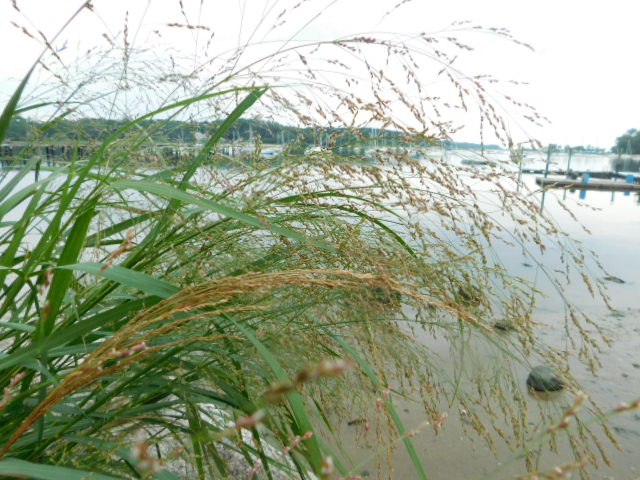
  • Almost all late bloomers are now in action.  These spartina grass blades prepare seeds for next year, even though as perennials the same patch should return next year.  Depending, of course, on tides, storms, sand shifts, and grinding ice floes.  Birds relax a bit, fattening up either to survive the rigors of winter or to migrate elsewhere.  Birdsong is notably less melodic, restricted largely to shrieked warnings of nearby predators.  There are even occasional hints of the final act of summer opera _ a few yellow goldenrods, rose of sharon.  Numerous fish jump and skip the surface,
    disturbing lightly riffled harbor waters.
  • I could dwell on what may come, worry about snow and cold, regret the missed chances of July.  Or I could glory in the heat and bursting vitality of this morning.  Or I might ignore it all and be disturbed by events in faraway places, or by intellectual and social actions “of great pitch and moment.”  I believe, however, I shall settle for what I usually do, which is to sample many things in due measure and occasionally let my thoughts fly off into meditation or fantasy, occasionally swoop down to fully sample my engaged senses, occasionally pursue some fleeting chain of logic.  Seems like a good season to become unfocused and simply accept enchantment as it arrives.

Saturday

  • Retirement and aging in general are often compared to autumn.  That may well be, as time goes by.  But for the more fortunate it is more like perpetual late summer.  Crops are planted and taking care of themselves, harvest and preparation for winter is indefinitely delayed into the future.
  • One major fault of our culture, I believe, is to try to ignore differences in age.  We see “ageism” even in relation to how we consider ourselves as some kind of deep sin.  An old person, we chant, is just as good as a young person.  Elders themselves are encouraged to see themselves as young. 
  • A consequence is that ages of man _ which should be encouraged and celebrated _ are mushed together and afflicted with insipid constant philosophy.  Childhood, instead of a being a time of exploration and carefree play, is increasingly a nasty directed mini- adulthood.  Youth is chained and restrained and encouraged to think like an old miser saving for an improbable future.  Middle age is filled with achievement, limits, triumph and despair _ as always _ but has incorrectly become the onlytrue standard of who one really is.  And those who manage to grow old are seen as hedonistic freeloaders who ought to be working and playing as hard as anyone else.
  • Hedonism, laziness, accomplishment, and all the other good and bad attributes society assigns to individuals, especially those outside norms, must be placed in relation to one’s situation to have any meaning.  An essential part of that situation is age. 
  • Retirement, like late summer, is a time of reflection and wise contemplation.  The frozen past resolves itself into meaning, and a more gentle purpose can seize each ambition of each day.   Livin’ easy, perhaps, but eliminating nagging guilt for doing so is sometimes a challenge.

Sunday

  • Green dominates the natural world pervasively.  Only sky and water manage to compete, if an open view emerges.  Patches or points of color from flower or fruit are lost unless one observes closely.  As always the unnatural world _ if human activity is so termed _ remains an exception.  Houses, cars, clothing, trash, roads, anything may be any hue at all, and as large as conceivable.  But in late summer, even those stalwart standouts or eyesores get a run for their money from the verdant vegetation.
  • Leaves are as varied as snowflakes are supposed to be, if I bother to examine them closely.  Every glance through vines and branches presents a unique picture of our universe.  I am not willing to believe that each miracle of creation is striving to match some universal perfect form.  Each of these bits of life is in itself its own perfection, unique in all time and space.  But _ well admittedly, it is all just green and more green endlessly, and just a little boring as well.


Good Ol’ Summertime

Monday

  • Right here, right now, is “the good old summertime” for some people .  Those who can find it _ by no means everyone in this 24x7x365 world, even on Sunday _ enjoy the bliss of leisure.  Children playing on the beach, swimming in salt tide will remember hot afternoons of sand and sun fondly.  Teenagers flirt, old folks lie for hours remembering or trying to forget.  Nostalgia, past and future, ripples like heat waves off the parking lot asphalt. 
  • These may be the last decades that July is to be treasured so fondly.  Future generations may yearn for the “good old wintertime,” when it is cool and children are allowed outdoors.  Already much of the nation is beset with record heat, huge fires, extreme droughts, “thousand-year” floods.  For that matter, not too long from now, there may not be many sandy beaches from which to dream.  But this year, this summer, this month _ I see “good old days” forming before my eyes.  

Tuesday

Celebrating summer too easy
Takes a real poet

To charm with snow, freeze, ice, flu.

Wednesday

  • Kids at summer camp catching (or at least trying to catch) things in nets above and in a pond.  Seems timeless, but of course childhoods like these are a relatively recent invention.  Always amazing that in suburbs and even urban areas dragonflies, tadpoles, minnows, butterflies and so forth are still managing to survive _ and even to surprisingly thrive.  Like catching glimpses of dense schools of bait fish in the harbor, or frequent flights of hawks and ospreys overhead.  The natural world is damaged, but still vital.
  • Most astounding to me locally is how many fish can be caught, how many berries can be seen on bushes.  In the world, how vast quantities of seafood are still caught in the wild _ even in the presumably heavily polluted Mediterranean.  I sometimes wonder how distorted a view of our environment those of us who live in urban or suburban enclaves may be receiving.  But I also know that the truly horrible wreckage of nature goes on away from most people _ on chemical-drenched factory farms, on remote wasteland coal and oil fields, in endless pits dug to retrieve industrial minerals, and everywhere in the pollution of air and water where no one can see.  No dragonflies, tadpoles, or hawks are likely to be sighted in such places, nor groups of children to complain at their absence.

Thursday

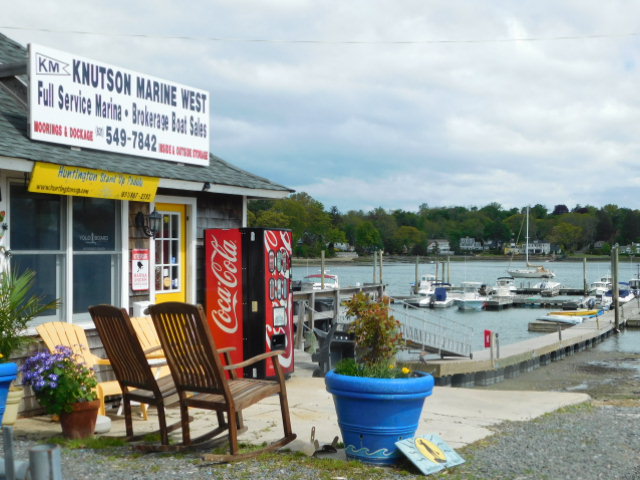
I sit back, surveying the end of the harbor with a happy sigh.  Boats are being set into the water, kayaks explore alcoves, stand-up paddle boats threaten to dump their rowers any moment.  Once in a while a noisy jet-ski putters towards open space, or a sailboat under motor power arrives to tie up at the dock.  An egret struts on low-tide mudflats. “Just like I remember over fifty years ago, when I was a boy,” I remark to Bill, reading a paper on the bench alongside.
“A lot has changed,” he responds, sourly.  “The similarities may be deceiving.  You know, I grew up here, and back in 1955 or so this was nearly wilderness.”
“Not so,” I protest.  “I’ve read the local histories.  This place has been civilized for a few hundred years, cleared, farmed, built up, polluted, industrialized, decayed, repopulated.  You just caught a fragment in the grand mix that looked less civilized.”
“Wrong,” he states.  “My perception counts.  It was more wilderness back then.  This clutter” he waves at the bulkhead, the dock, the busy street behind us, the marine stores lining the shore “this garbage was not here.”
“OK,” I agree reluctantly.  “Maybe you’re right.  Was it better?”
“Ah,” he takes a deep breath.  “That’s a hard question.  So much has changed, on the surface anyway.  But so much remains the same underneath.  People were people, I suppose.”
“What will the kids today grow up to think?  How will they remember this?”
“Oh, for them I guess it will be recalled as a different kind of golden age.”  He watches a gull swoop by just over our hats.  “Depending on what kind of dystopia they end up with in fifty years, of course.”
“Cheery, aren’t we?” I laugh.
“A lot of good things are happening, I suppose.  A lot of good has happened.  I can’t complain much.  But I wonder,” he pauses.
“You wonder?” I coax him, curious.

“I wonder how fragile this web of wonderful stuff really is, and how close we are to losing it all.”  An extra-loud low jet bound for Kennedy cuts off conversation, as a wail rises from the fire station and an insanely thundering helicopter swoops towards the hospital.

Friday
  • Annual trip upstate to visit our son in Rochester.  This is some 400 miles of expressway driving, through farms and mountains and old cities, along rivers and railroads.  An hour in the tangled infrastructure of New York City, and days of strolling sidewalks and visiting areas of what is supposedly a devastated upstate economy.  From listening to news, one expects to see something similar to the pictures coming out of the Mideast tragedies.  Not so.
  • The roads, even in NYC, are well maintained and being more so.  Traffic, both pleasure and commercial, is everywhere _ trucks loaded with wares fill the roads.  Fields are fat with corn and cows, barns and houses sparkle in the sun, fantastic local artisanal produce fills the public market.  Mountains are blanketed in dense green forest, rivers are full flowing, lakes are plentifully supplied with power and sailboats as masses of people watch from restaurants and bars along the shore.  Rochester itself seems to be gentrifying older areas and rapidly building newer ones, and few of the people I passed _ day or evening _ seemed terrified by their environment and clinging to guns for protection against looming menace.  All in all, I decided perhaps I was better to trust the evidence of my own eyes than the words of politicians, journalists, and editorial writings.  Not a surprise, but I sometimes need to be reminded.   

Saturday
  • Like all our memories, nostalgia is unique for each of us.  We recall different moments in different ways.  Some we blank out, some we enhance, some we even invent.  And each is a special mélange of sight, sound, taste, smell, visceral physicality, emotions, thoughts, and layers we have embroidered in afterwards.
  • By definition, nostalgia indicates some positive connection with the past.  Nobody is nostalgic for the horrors of war or the ravages of disease, although there may be certain elements of such (the comradery of fighting units, or triumph over adversity) that can be polished to a warmer glow.  Since most nostalgic recollections imply some distance in the past, their very foundational truth is questionable, as is often obvious by comparing stories with those of others who were present at the same events.
  • For my baby-boomer peers who grew up in the fifties, summer remains one of the finest nostalgic periods.  Back then there were few demands once away from school, except for perhaps some “good for you” summer reading that, if done, was often accomplished less than a week before new classes started.  Many parents could truly relax for a weekend or a week or so, getting away to some quiet and inexpensive resort, doing nothing but what happened to be around, never interrupted by calls from work.  Was it true?  I don’t know, that’s how we experienced it.  At least, in my own nostalgia, that’s how I remember experiencing it.
  • As Proust noted to such grand effect, a scent can trigger an unconscious tumble into a nostalgic fugue.  My own nudges seem to be more visual and kinesthetic.  Walking in humid heat, sweat beginning to drench my shirt, hot sun glaring all about, easily pushes my deeper consciousness back to childhood, and to the happiness of innocence when the who world was available for the taking, and all the time in that world to accomplish whatever I wanted.

Sunday
  • Surprised to find so many people lining parkland shores of Lake Ontario on a bright Sunday morning.  Turned out there was a colorful regatta offshore in strong winds _ here boats return to the “Port of Rochester” through the rock jetties lining the mouth of the Genesee river.  On the other side, an official beach-volleyball tournament was in progress, families swam in waves that were almost surf, and barbeques were being prepared in huge smokers under leafy canopies alongside numerous picnic shelters. 
  • None of this appears in national news, rarely enough on local media.  We learn of each fire, each car accident, each criminal event.   I think we start to think that the only sanity that exists is some magical bubble around us, that the rest of the world is a hellish expanse of horror (a favorite cliché word of the moment.)  But evidence remains that this is a happy and fat land filled with pretty good times for most of the people, most of the time.   The world has never seen its like before.

Hotcha!

Monday

  • Noel Coward’s song “Mad Dogs and Englishmen go out in the midday sun” seems to apply to local joggers who grimly exercise as humid heat reaches into the nineties, with blazing sun piling on.  They assume they risk degradation and death to pursue dreams of fitness. Certainly to listen to self-qualified “experts” in such matters, mankind was never meant for such conditions.  We should be burrowing underground until weather becomes more favorable.  Or at least leave the heat to the leaves, and limit excursions to air-conditioned malls, cars, and _ in the words of Henry Miller _ nightmares.
  • I grew up in a time when as I recall only movie theaters and a few larger supermarkets had cooling facilities.  The Delaware Valley is famous for nearly 100% humidity, stifling stillness, and blazing solar beams.  Farmers never cared, neither did we, and my friends and I played and worked outside shirtless without a care in the world.  Somehow,  apparently against all the odds, most of us are still alive.  Either we were exceptionally hardy or the experts are not quite so expert.

Tuesday

Dog days of summer settle
Named for rise of Sirius
Back when folks could still see stars.
Today seasonal tribute is less cosmic
We seal our boxes tightly

Flick a switch from Heat to Off to Cool.

Wednesday

  • Thunderstorm sweeping by last night brought heavy downpour and colder Northern air, temperature is ten degrees cooler today, accompanied by a dry breeze.  Even in the midst of our most extreme seasons, we experience great variations.  It’s doubtful that the rest of nature notices _ it’s warm or not, there’s water or not, food or not, predators or not.  Life in instants has no time nor means to reflect on longer patterns.
  • People, on the other hand, can attune themselves ridiculously.  Some think any variation beyond 72F _ give or take a degree or so _ is uncomfortable.  For them, 80 remains a heat wave, with danger at 90 or _ Heaven forbid! _ 100! Connoisseurs of climate.   Our individuality and worth seems too welded to acquired specialization.  I’m as guilty as anyone, as I stroll about thinking how grand I am.  We should cultivate contempt for any expert who becomes too obsessively expert.  We must experience narrow vivid instants, but also holistic perceptions which require no particular delicately encrusted expertise.

Thursday

Trying to prevent drips from my peanut butter sandwich at a Halesite picnic table.  Even in the shade, sweat dripping into my eyes makes the lovely water scene waver and sting.  I’m startled by Ed’s loud shout _ “Hot enough for you, young man?”
“Oh, hot enough, I guess.  Not really a roaster.” I sadly indicate my lunch. “This is just a mess because it was in the sun while I was walking here.”
“I think it’s about as hot as it should ever get!” declares Marie, bedecked in in wide-brim tan straw hat.
“I, on the other hand, still consider it slightly cool,” maintains Ed.
“Normal variations, I guess, we’re all different that way.”
“Well,” he looks around at boats large and small, “I know you’re right, but you’d never guess we knew that from reading or watching things lately.”
“What’s that got to do with heat?” demands Marie.
“Just this,” he continues.  “I’m sick of the grouping of people as if they were sacks of rocks.  ‘White college males think …’ for example.  People are complicated.  No two people think the same about any issue any more than we do about whether it is too hot or not.”
“But if you took a poll here,” I point out, “they’d all agree it was generally hot.”
“Well, OK,” he admits.  “But the politics today is on the tweaks.  I’ve never seen such lather over Tweedledum and Tweedledee.”
“Controlling nuclear arsenals is hardly tweaks,” starts Marie …
“Hey!  Hey!” I try to calm them down.  “I just want to eat my sandwich in a lovely spot on a perfectly fine afternoon _ without paying too much attention to exactly how fine it may be _ and enjoy this moment of being. “
“But don’t you think …” insists Ed.
“Nope.  Not now.  No opinion.  Undecided.”
“But …”
“Ed,” I say ge
ntly.  “Hate to tell you but nobody cares if you or Marie or I think it is too hot, just right, or not hot enough.  No more than what we think about the state of the state.  Would you like a grape?”

A loud horn sounds nearby and we pause to watch some private behemoth easing out from a nearby dock.  

Friday

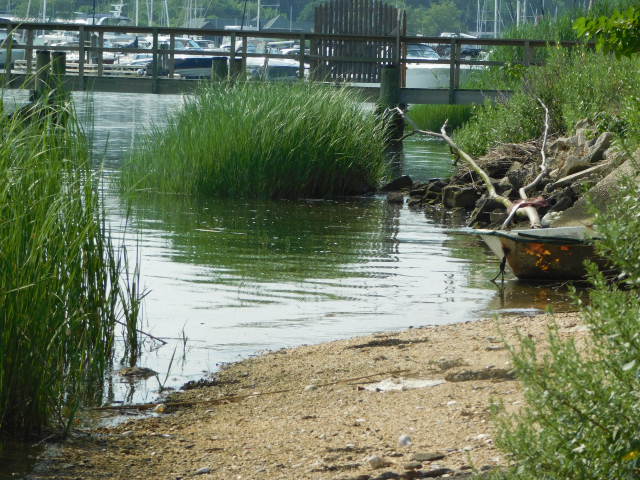
  • Optical illusions demonstrate how easily the mind slips from one conception to another when presented with visual evidence.  Similarly artists have woven illusions or abstractions to enlighten or confuse thoughts.  At first glance, this picture might well be a Monet water pond, or a Pollock abstract, or some meaningless scatter painted by an unknown.  A second look picks out reeds and reflections and makes sense of the photograph.
  • We have only recently realized exactly how arbitrary and fragile our vision.  The eye may see what a camera lens does, but only an interpretive brain can produce “common accepted reality” or an artistic revelation or some internal Quixotic interpretation of the scene.  I enjoy unfocusing almost as much as deciphering the photons reflected into my retina.  The world is marvelous not only because it may be “just so”, but also because it may not be at all what we so confidently imagine.

Saturday

  • Conventional wisdom claims we live in places that would be impossible without modern technology.  Florida and Arizona before air conditioning were terrible places to settle, at least for Europeans.  Without rapid transportation of bulk goods the vast grain farms of the Midwest and the cattle ranches on the parched plains of Texas would be impossible.  No matter where we look, we seem to be tied into a social and technological grid without which we could not survive more than a week.
  • That is obviously true.  But it is not new.  Civilization has been like that since the taming of agriculture, which just about everywhere in the old and new world required bureaucratic government and irrigation.  Only disease and harsh conditions, which thinned populations dramatically, let some humans avoid that fate, but we could seriously question whether the nomadic and brutal life of native Americans and the short and uncertain lives of all other “primitive” peoples in places like Africa were better than the lash and the wheel. 
  • Intellectual contemplations like those do not matter.  The fact is that generally people today, whether by choice or force, live or aspire to live with access to full consumer comforts.  Few parents would willingly consign their infants to aboriginal life with a tribe in the Amazon rain forest, or any other such “romantic” notion of going back to nature. 
  • What we have, however, learned over the last few centuries, is that such “progress” has costs, many of them not immediately apparent but accumulating nearly fatally over time.  That is what we are dealing with today, in life, in outlook, in hopes, in politics, in every phase of life.  What will we trade for what, and what will we not?
  • I think we have been living through a few years of grace, while these profound cultural questions sink in and various answers rebound not only by word but by entire lives.  When there is little more to strive for, as an example, is the only proper response a hermit-like lethargy, or a constant chatter of games and conversation and arts, or a drug-induced internal withdrawal, or an artificial fanaticism leading to active anti-social madness? 
  • Hot times, for the mind as well as the body.  We wonder if this period is our summer, with decline to follow, and if so, how long the heat can last and how well the water will hold out.

Sunday

  • “Heat Dome” seems to be as bad as predicted, although hard to tell how much of it is psychological.  No question sweat pops out with the slightest exertion in the shade, spontaneously in the sun.  Thick haze a constant reminder of bad air quality.  Fortunately, Huntington by the harbor has at least a steady light breeze, barely waving flags but cooled by evaporation.  From all accounts, it is one of the more fortunate areas of the country this weekend.
  • Nevertheless, I stayed in yesterday, perhaps deciding to act my age, perhaps merely being lazy.  I only went out to do some necessary watering, or to read on the patio later in the afternoon until the mosquitoes arrived.  What surprises me is not how lethargic this lack of normal exercise made me feel, but rather how dull my mind became.  Stimulation through motion and exposure to nature seem to be necessary if I am ever to have a creative thought. 

Wonder & Worry

Monday

  • Looking out the window, walking through a meadow, watching a brilliant sunset,  catching flashes of lightning bugs at night, and hearing the shrieks and melodies of birds all day long, this seems the most perfect of places in the most perfect of times.  Flowers bloom everywhere in this benign climate, entertaining storms pass quickly by, squirrels play.  Inside, the larder is always full, there are infinite wise books to be read, marvelous distractions available on media all the livelong day.  Yet we are warned not to be fooled, for all is falling apart.
  • A favorite phrase of essayists these days is “the best of times, the worst of times.”  Global warming, falling test scores, increasing racial tension, defunct political consensus,  neonicotinoids,  GMO’s, the list is endless and increasing with each ever-more hysterical dawn.  I’m getting older and _ in the words of the old Kingston Trio “Merry Minuet” _ I don’t like anybody very much.  But I have come to accept that “best” in the present is worth a bunch of “worst” in the future.  An intellectual hedonism.  Perhaps I am condemned by such an attitude _ but perhaps pure appreciation also counts for something.

Tuesday

I wonder at this grand fine day
I worry of tomorrow
Wonder as we dance and play
Worry at our sorrow
Our universe is grand and free
Until it kicks our teeth
We carpe diem just to be
But may find no relief
I wonder who I am and why
I worry what to do
Wonder at the earth and sky

Worry if it’s through.

Wednesday

  • Amazingly, in one of the most populated areas on Earth, it is possible to slip away to a few places where there are few signs of people.  Astoundingly, in spite of centuries of industrialization and pollution, the air still seems clearly scented with flowers, the water tangy with salt and little else.  Birds fly endless rounds, insects flit about the marsh, flowers bloom on the sand.  And most surprising of all, parts of this scene are wilder than they were a century or two ago.
  • We have become increasingly urban.  Our own experiences are often of home after home, building after building, traffic on streets with no scrap of land visible.  Our essayists flit from megapolis to megapolis, in sealed aircraft, not noticing the “flyover” barrens below them.  Yet most of the world remains open land.  A few hours away even from here are vast tracts that _ if not untouched wilderness _ are nonetheless unused wildness, filled with decaying buildings and the rusting scraps of an older era.  Rural residences, farms, small towns are depopulating almost everywhere.  Perhaps, walking in empty fields and wetlands, I can yet preserve hope for the future while contemplating that fact.

Thursday

Jim and I exchanging banter during some demonstration or other at Hecksher Park.  The banner says something like “Save your shoes, save the Earth,” sponsored by Nike.  Almost a hundred folks of all ages are grimly striding around the lake, happily engaged in this godly duty of environmental repair through consumerism.
“More dystopian thoughts,” I venture.
“Oh, haven’t we had them during our lifetime?” muses Jim.  “Gee, I lived through the communist red menace, certain nuclear war …”
I add “irrecoverable river and air pollution, no birds or wildlife because of DDT, cities going up in flames, race riots, cultural disintegration from the sexual revolution.”
“Yeah,” smiles Jim, taking up the theme, “the end of oil, population explosion like locusts, nuclear meltdown,  Japan buying the world.”
“Starvation from a new ice age …”
“What?” he exclaims.
“I was reading an old book.  That was a common theme of the seventies _ we were about to move out of an interglacial warm spell and into cold desertification of our grain belts.”
“Oh, right, I forgot.  And then …”
“Don’t forget we were all going to die of AIDs, China buying everything, computers running amok,”
“Y2K!” we both laugh.
“The end of metals and all other commodities, autism plagues, social revolution redux, united Islam conquering a fractured West.”
“And here we are,” Jim waves at the crowd.  “Still worried, still hysterical, still inventing problems.”
“And solving them,” I interject.
“Well, or letting them solve themselves,” he notes.
“Here we are,” I say slowly, “Practically in utopia, and still inventing insoluble problems and certain death.”
“Well, it keeps life interesting.”

More people stream by, the sun shines, and swans glide majestically across the calm waters.

Friday

  • Bindweed and morning glories now blooming _ surprise _ every morning, along with the chicory. Other summer flowers are following their genetic pattern.  Meadows are filled with daisies, butter-and-eggs line the roadways, hawkweed offers bright yellow spots and thistle and vetch provide patches of purple.  It is as if views have been orchestrated for pleasure.  Terns and swallows swoop, hawks and ospreys float in circles, sparrows and finches dash from bush to bush.  Ah, another fine mid-summer.
  • People don’t conform to predetermined patterns, not even those of their parents.  Older folks know the younger generation is failing to measure up to their own lofty achievements.  For example, nobody under fifty can read maps and is hopelessly lost without a GPS nearby.  Such complaints, often humorous but with sarcastic bite, fill media.  The young, like the meadow flowers and larks, laugh it off, knowing that the world is theirs and will remain so until the next even more awful generation happens along.

Saturday

  • The fascinating dichotomy of the times _ this so much better, that so much worse _ extends through science and technology into nature and human existence.  At no other period have we been so aware of the entire world, so deeply understanding of its underlying complexity.  Yet with that awareness and understanding has come the horrible realization of how rapidly much is vanishing and destroyed forever, and how fragile the rest remains.
  • For those willing to make an effort, the complex intertwining of physics and life reverberates in a grand symphony back to the big bang itself.  For those open to marvels of our mind, the mysterious rapid evolution of the human species and its implications is an infinitely engrossing study.  We are on the verge of a true useful philosophy of being, even though it remains sadly out of reach at this moment.
  • Technology, meanwhile, hands its marvels and curses as always.  For every wonderful advance _ miracles as trivial as being able to eat strawberries all year round or major triumphs over diseases like heart disease and cancer _ there seems to be some counterbalancing evil.  And yet, on the whole, which of us would willingly roll back the clock even a hundred or two hundred years, in terms of knowledge, technology, society, or any other part of our mostly happy and comfortable existence?
  • I could make predictions, but like all predictions, they would be wrong.  I could wish for things, but since my time remaining is brief, my wishes tend to have a limit of decades rather than centuries.  I could fear much, but fearing that which one cannot control or affect leads only to madness. 
  • So another day dawns.  I revel in new discoveries from my immediate environment, from my extended media, from my inner thoughts.  It appears I have another day of wonders before me, and that Is more than satisfying at this stage of my life.  Tomorrow, as always, will have to take care of itself. 

Sunday

  • Above ground, this is a festival of peace and plenty.  Nothing is grabbing ground furiously, the only real struggle is finding enough water, but plants have evolved to handle that.  Everything has its place and is either preparing the next generation or storing resilience for the coming winter.  Inexorably, the sun provides less and less power for doing so each day.  Goslings and cygnets and all other cutely named baby birds are nearly full-grown, feasting on unlimited abundance.  Under the barely rippled surface of the water, however, a frightening Darwinian massacre continues as fish eat fish eat fish. 
  • So it may look like peace and plenty, calm and stability, but struggle continues, and if species could worry they no doubt would do so.  We are blessed with imagination, so a lack of water signifies more than itself, high heat may mean global disaster, bright sun may even now be starting a later skin cancer.  And even if all is well nearby, the distant world certainly has problems.  I think such perspective is a trap.  Life is a gift _ it is always unstable, what matters most to you and me is what is local to you and me.