We inhabit an era in which all has changed completely from what it was three centuries ago.
Except philosophy.
Scientifically-oriented people rely on two sets of old thinkers. Ancient Greeks who were basically an ignorant prejudiced elite, none of whom could have passed third grade. And those prolific Enlightenment dilettantes who might have been able to do so with a little summer schooling.
Anti-science people, in opposition, point out that everyone was always just like us. They seek wisdom from the remnants of tribal superstition or solitary religious vision. Usually, the stranger and more illogical, the better.
Neither of these approaches are relevant when both the quantity and quality of human knowledge has changed multi-exponentially. We may be happy and sad just like our ancestors, but we also control and understand why we control a great deal of our physical environment.
Unfortunately, it has turned out that the increased specialization necessary for a person to thrive in current culture creates geniuses in one field who are morons in another.
Philosophy, when considered at all, retreats to tired simplistic tales of shadows in a cave, or the matrix, or libertarianism, or life with a purpose. Neighbors shout slogans because we are too worn down to think with complexity.
Yet we do live just like everyone always has. Philosophy should be brought up to date.
From a true modern perspective the whole edifice of current philosophic thought should be bulldozed into the ocean and the site cleared for something new.
Our grandson, like many toddlers who have spent most of their conscious lives in the pandemic, has recently developed an off and on desperate fear of germs.
I wanted to write a little booklet to explain my interpretation.
This ended up being an interesting project for me, even if he never pays any attention to it.
I learned how to use google docs, then google slides, then turn it all into a video and upload. I was amazed at the ease with which this could all be done.
So for what it’s worth, you can use this link
or type nicholasgerm into either google or youtube to see the results
This pandemic has allowed me to review my home library. A few weeks ago, I rediscovered an old battered paperback copy of Walden. This time, instead of speed reading out of sense of duty, I have been taking my time and listening to what he says. Turns out to be somewhat different than the memories and mythology I had about a young man who rejected everything to live humbly in the woods.
Thoreau was, of course, well educated, and the events related took place in a sedate and settled community, not in raw wilderness. Finally, I realize he did not so much reject the consensus of his civilization as stand a bit outside of it _ for a while_ to see how it related to what he wanted to do with his life. All of us have been there, but many of us fail to act on our meditations. He did so, but only for a while, and only moderately, and with an eye to writing about it.
What I had missed in an earlier rushed read, was that he was not really advising anybody to do anything different. Walden is not a polemic against civilization. Thoreau appreciates a lot of modern comforts. He is not against using iron nails, precut boards, shirts, or even occasional meals from friends. He simply wonders how much he really needs to be happy, and what he should be willing to pay for it in hours of his short time on the planet. But he constantly reminds himself, and us, that he hardly believes that his conclusions have much if any relevance to anyone else’s life.
That is a standard problem. Almost all of us work out our own approach to life in a more or less satisfactory manner. We think we have done about what we could have and should have. As we grow older, most of us become more proud of our life accomplishments, and more content in the paths we have taken. But then, rather than stop there, we try to tell others that such is what they should also do, or should have done, or compare their (poor) choices and actions to our (correct) legacy. Even if we end up bitterly hating our lives, we try to tell everyone else how to avoid our mistakes, or at least how to fight those who we think made our life a disaster.
Thoreau brazenly states that he has never met a sixty year old who had anything of value to tell him at thirty. More uncommonly, as he discovers his inner peace, he makes no pretense that his conclusions will apply to you or me. He just lays them out and challenges us to challenge ourselves in a similar manner. Compared to fanatic diatribes of current philosophers, that is a refreshing approach.
Contemplation of the right way to live automatically drifts to definitions of utopia. How do I live the best life for me, how does society provide the best life for everyone? Thoreau is the proper starting point, not with solutions glibly offered but with profound questions. More interestingly, in these times when everyone is admonished to “be all that you can be,” he questions just how much “all” in socially defined terms is really important.
A pathetic new plea by Karl Rove reiterates the false mythology of Republicans as the party of small government. This has been a mantra (when they were out of power) since Reagan’s famous line about “I’m from the government and I’m here to help,” followed by “starving” Leviathan with tax cuts as fantasized by Gingrich. But everywhere, in everything, all the time, bigness has won.
The only national players _ superpowers and others _ are the big countries with bigger militaries. Amazon has destroyed the corner stores and regional malls, big fast food chains have driven out smaller competitors, big citizens make billions of dollars, superstars dominate entertainment, big media reigns, big pharma produces drugs, and each small success startup is quickly gobbled by some giant corporation. Saving a local park or recycling household bottles means nothing in the face of global climate change and mass animal extinction.
Meanwhile in the US there are only two big political parties, each fighting the other as if in a war, with only a winner or loser for whatever “base” supports it. The good of all is tangential to simply having power. And that power _ bureaucracy _ must be big to keep the other big parts of society _ police, military, corporations, billionaires, states, media _ under control so that civilization does not rip itself apart. The deep state is a necessary infrastructure for remaining socially cohesive.
I admire small things. The local entrepreneur, contractor, restauranteur, professional are to be encouraged. But each of them is supported by large networks, especially the huge protection of our immense court system. They purchase what they need, generally, from appropriate goliaths _ contractors, for example, frequent big national home-goods centers. But they exist largely on sufferance and are likely to be snuffed out by a change in taste, or a pandemic, or new legal consensus.
I admire representative democracy when it is organized as a republic whose purpose is formally to respect the rights of its inhabitants. But I am not sure what these rights _ in a modern technological crowded and globally connected world _ should be. I have lived through vestiges of “blue laws” and worry about the fanatic beliefs of evangelicals because the freedom of one may be the chains of another.
So what should a conservative _ or for that matter libertarian _ mindset consider? Simply how is all this bigness somehow subordinated to an individual’s rights. I do not want to be told what to do by billionaires, deep state, or corporations _ yet I also know that if these and the huge military keeping us protected from other countries and each other would cease to exist, my life would be awful indeed.
We’ve gone about as far as we can with enlightenment philosophies _ generated before electricity and the global community. We need some new ideas. And if current conservatives or anyone else cannot provide them, they should step aside. But I guarantee that whatever the solutions or outcomes, smallness will not play much of a part. Current civilization and its needs have killed that forever.
Everything is big now. A small government would be crushed by other governments and other forces, and would in fact be a pitiful and useless annoyance.
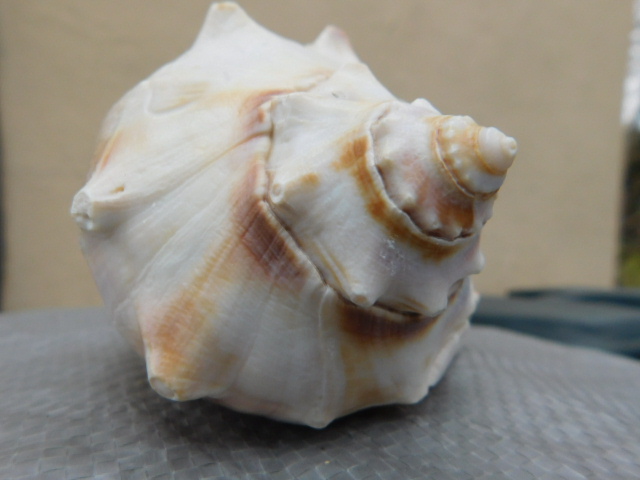
An atom is a weird assemblage of leptons and strangeness. There are 100 trillion atoms in each of our cells. Current Cosmology outlines the astonishing path required to create each of the 118 elements in the universe, and the distribution, accretion, explosion, and implosion to get them all here now. Geology and Biology add more layers of ineffable wonder with tales of molecules, force, erosion, decay, and evolution. Properly understood, a shell on a beach is an impossible object.
There are about the same number of cells in our body. Some are symbiotes or parasites, most are parts of complex systems. Each of these cells is undergoing incalculable chemical and electrical internal interactions at each moment. A breath or heartbeat is incomprehensively complicated. Digestion, disease control, all our basic functionality, let alone consciousness and memory, are infinitely convoluted and intertwined. We happily assume that such “natural” conditions continue as we enjoy holistic health.
Understanding environment and social structure can be frustrating. How is oxygen level maintained, where does water come from, why can humans build and maintain cities _all the “simple” questions of children _ are really only partially answered, no matter how much we think we know. Yet at this level, at least, we have always claimed a certain amount of understanding and control. Hunting, farming, tribalism are part of our nature. We try to figure things out and then use tools as necessary to make them better or at least keep them from getting worse.
A primary mental tool is belief in cause and effect. It did not require Newton to grasp that when an object hits another object, there are consequences. Since we can manipulate the “cause” in many cases, it is natural to assume that something else controls what we cannot _ such as making lightning and thunder and rain. This idea of agency requires a guiding principle or intelligence for everything we do not understand. Usefully, it allows us to ignore deep and often irrelevant underlying issues so we can deal with how to move that rock from here to there.
People conflict when seeking to control that agent. Praying to a spirit which brings rain is inconsequential to society unless a tribe decides such prayers require human sacrifice. Which brings us to current civilization. Science has discovered too much cold complexity; we dream of comforting simplicity. Cults fill that need with slogans and beliefs _ for example, “my job and life are bad because of immigrants.” Even if we can do nothing about it, it is a solid backstop in our confusing existence.
Little of that is new or necessarily bad, everybody needs illusions. Unfortunately, we are also at a point where slogans have taken on the varnish of unquestionable writ, at which point those who oppose it are seen as blasphemers who must be silenced. As frequently noted, this is the opposite attitude to that of science, which questions everything. But surrender in the face of complexity is not only intoxicating, but also paradoxically allows us to sleep peacefully at night, happy in knowing the simple truth.
When the coronavirus pandemic ends _ or at least becomes controlled _ most people seem to believe the world will return to “normal.” But I think we will discover that very little will be the same. Ancient customs we took for granted will be gone forever. New outlooks and practices which would formerly have taken years to come to fruition will be in place. We will be just like Rip Van Winkle, waking up after a two or three decade sleep into a society we hardly recognize.
A short essay can hardly enumerate even the broadest changes. A quick survey would note that the nine-to-five job at an office is probably gone with the horse and buggy. Travel will be vastly more complex. Restaurants will never return as they once were. Technologies which were only gleams in inventor’s eyes will be rampant. And society itself _ its makeup of families and property and rules and ideals and goals _ will frighten any who cannot adopt. Short term confusion clears with new paradigms invisibly but firmly in place.
Will it be better or a kinder and gentler world? Probably not. Changes are just changes, society may take routes none of us ever desired (like an acceptance of security over freedom.) We may pine for the nostalgic golden age before the plague, but nothing will bring back that imagined sunny world. Climate change will become increasingly vicious, forcing adaptations that would frighten our ancestors. The struggle to determine what is truth or fact may play out in internal wars as vicious as those of the European Reformation.
There are good and bad options in all this. Technology affords all kinds of possible wonders. But, unlike the politicians, I am not going to say that those of us now living in American and Europe can much influence the path of history. Environmental destruction is far advanced, industrial societies with different core ideologies challenge global supremacy, the comforting predictions of the enlightenment that an educated free populace will be progressive and “better” are obviously wrong. No matter whether we adhere to the idea of historic trend and imperative or to the hope that great leaders change the future, neither of us is one of those great leaders.
Rip Van Winkle eventually just decided to have a drink and watch the world go by. No use starting over and becoming frustrated. The new world will be for the young and the very young, and to them that environment will be the “normal” _ and they will laugh and cry at what we were and had and did with our lives and the lost fortunes of the Earth before.
Lately, we are being told that America is divided and should try to heal. “Reasonable” folks, especially conservatives and Republicans encourage me to do so. I find it increasingly impossible. More than that, I think it is an irresponsible course of action.
I believe in science, enlightenment values, tolerance, and American idealistic patriotism of the fifties. I worked most of my life, am grateful for our country and culture, admire capitalism, and like to consider myself decently open-minded, well-educated, and aware of my own faults. Furthermore, I think this is a wonderful peak of world civilization, even though it faces existential threats from climate change, automation, nuclear-armament, and civil strife. I like to believe there are ways to continue the long climb to paradise.
The “other side” frightens me. It appears to be composed of self-victimized losers who apparently cannot find good jobs and blame everyone but themselves. It is funded by nostalgic fat old people who think their thirtyish drugged children are just having fun down in the family basement where they live and constantly play violent video games while caressing firearms and dreaming of a cleansing apocalypse. Why should I try to “heal” with such vicious racist louts who have enclosed themselves in a cult mentality that despises me and has no desire to change?
I curse the enablers who have tried to forge that mob into a power base, much as the French aristocracy and bourgeoisie did with the poorest peasantry (to their ultimate chagrin) before 1789. Some “conservative” cable personalities are demagogic spokespersons who ignore truth and decency to improve ratings. Some companies mindlessly fund wretched bigoted politicians simply out of habit against possible increased regulation. Well-meaning intellectuals put up with it all because they consider it free speech.
Unlike many of my peers, I am worried about the glorification of our military. That has turned into a pretty good, pretty elitist job, with lots of benefits. Not least of which is increasingly becoming part of the militarized police departments when soldiers leave the service. I know we need the armed forces. I continue to regard them as a necessary evil. I have never disliked soldiers themselves, but like the founding fathers and Eisenhower, I mistrust the institution.
What can I do? Life is complicated, but lately lazy people want it simple. Slogans like “stop the steal,” “black lives matter,” or “lebensraum” are far more effective than well-thought-out four-hundred-page philosophic tomes. I am afraid the answer is I cannot do much. But of all my limited available actions, refusing to “heal” with the other side probably remains the most viable.
My notion of the day is that smoke inhalation is a decent metaphor for coronavirus. This is because of the concepts of toxic dispersion and viral load. In other words, it does not matter if one encounters a few viral bits, but rather if enough bits are present to overwhelm the normal filtering defenses of the body.
Think of smoke outside. You hardly notice smoke from a campfire unless you are sitting right on top of it for a while. Even being near a forest fire hardly matters, although the air quality declines. One rarely hears of a person dying from smoke inhalation while they are in a field.
Inside, it is a different story. Smoke is trapped depending on ventilation and size of the room, and quickly becomes lethal. A bandana or towel (mask) may help for a while, but eventually it is useless and only the rescue equipment worn by first responders is effective.
Think of infected people as campfires, some very smoky, some less so. The rest of us go about with or without bandanas, near them or further away, rarely affected by smoke outside, but potentially stricken by being near them for a while in close quarters, somewhat like death from carbon monoxide poisoning. These people may put blankets over their own fires, but this is only partially effective.
And finally, to stretch the metaphor perhaps a bit too much, think of age as height. Those breathing air higher up in a room will be more affected than those (like children) near the floor. And, of course, a lot depends on the state of your lungs.
Kayaks and paddleboards have multiplied quickly over the last decade.
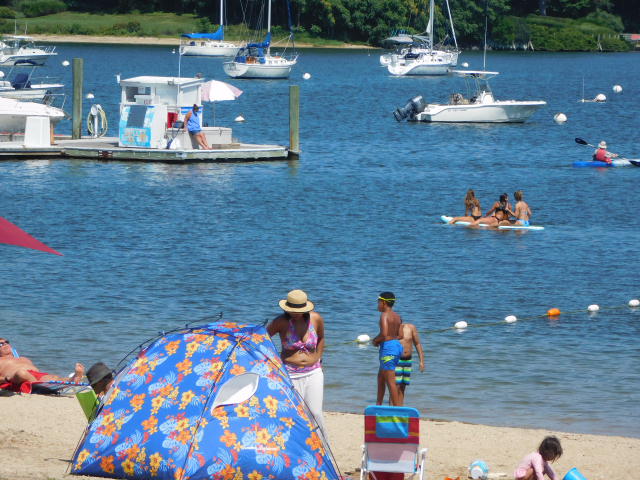
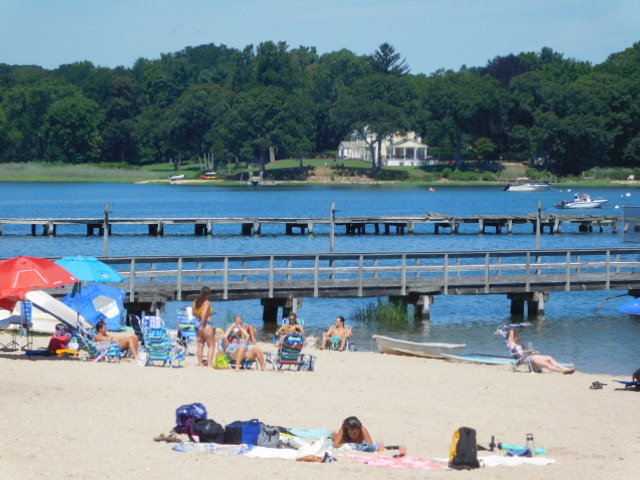
Heat wave has temperature in lingering humid nineties; with many others I sit on the local bay beach, dipping in every few minutes as I overheat while enjoying the scenery. Children and grandparents and couples, and teenagers, and parents, and solitary old people mill around, splash, or sleep. If a few of them were digging clams, I could almost believe myself back in the social environment of the late Pleistocene, on summer shores before bathing suits were necessary or invented.
This is a social scene. An unarmed lifeguard provides security enough. Everyone is enjoying themselves, their group, nature. Nobody is staking out private property, everyone is pretty happy. A few loud screams and laughs from young kids, perhaps a voice too loud here and there. But all is calm and seems to show people well-adjusted and content just to be alive, not at all the ferocious beasts of Darwinian struggle, nor the mobs of dystopian fantasies.
Armed with only moral authority, Lifeguards easily maintain common courtesy.
One of the inherent problems of “social science” is on full display. None of these individuals is a “typical person.” The two year old is different than the 8 year old. That old woman has different outlooks than the braying fat young man. Some are smiling at children’s antics, others merely annoyed. Even those exactly in the same age group _ like the various toddlers in their puddle jumpers _ are doing very different things _ some scream, some splash, some cry, some just build sand castles. To say they are all “equal” is a stretch, to claim each can be defined in the manner of a chemical element is insane. The full complexity of human existence and its meaning is out in the open, on sunny sand.
In this pandemic summer, “clumping” of subgroups is more common than usual.
Oh, you exclaim, but this is not typical. These people are on vacation from “real life,” the true daily grind. They are sated with food, content with existence, mindlessly escaping (temporarily) from worries. When they leave, they will be totally different. They will never have enough food, they will never be content, they will always worry. They will struggle endlessly against each other for their never-achieved place in the world. Why, even as you watch them now, some get bored, some leave, some even begin to annoy others. This shows our basic restlessness. We quickly revert to prowling predators.
Hot overhead sun symbolizes stability, ceaseless waves breaking on shells signal ongoing patterns, and just maybe the way these individuals and groups interact in this setting is more appropriate for science and social engineering studies than what crazed teenagers do on the battlefield. Humans are a social species, and they conquered the world not as individuals, but as tribes. The most successful tribes took over others not as single warriors, however fierce, but as organized bureaucrats with an elite skimming production from complacent masses.
Except for marks of tides, this bay shore resembles a lakeside resort.
Imagine, then, that we have not a glimpse of utopia, but rather of our ancestral heritage, when the world gave us all we needed to live without too much work. Like those ancient South Sea Islanders of whom we read, before they were corrupted by the modern world. Work? No, almost everything, even the daily fishing routine, becomes a kind of non-hassled play. Can’t machines somehow make our world like that all the time?
My utopian fantasies fade as a cloud covers the sun. Letting thoughts wander far from the daily grind has always been useful. We remember Archimedes running naked down the street shouting “Eureka!” or Darwin slowly cogitating on strolls through the woods. People lately have wanted politicians to “do more” and keep their noses to the grindstone. Others scream everybody should get back to work. Just maybe that is exactly the wrong methodology to figure out a better way to control and appreciate this world.
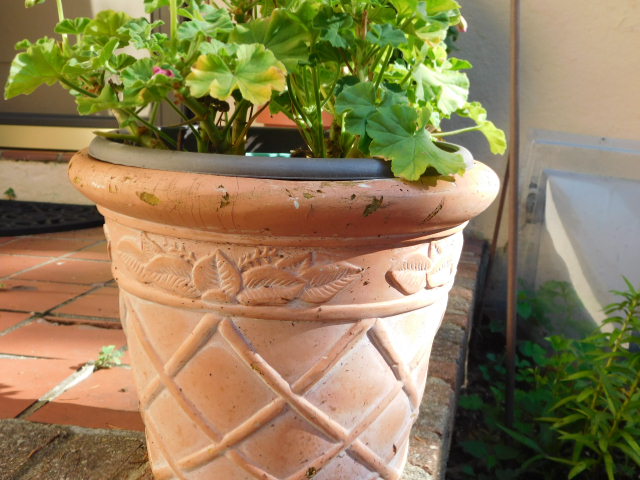
Serves its purpose nicely, but will never be in a museum.
As my wife carefully tends patio pots filled with treasured annuals, I am reminded of the poem Ode on a Grecian Urn (1819) by John Keats. In the course of a relatively long meditation about the decorations on an ancient vase, he provides the famous lines:
… Heard melodies are sweet, but those unheard
Are sweeter; therefore, ye soft pipes, play on;
… ‘Beauty is truth, truth beauty’—that is all
Ye know on earth, and all ye need to know.
Over the course of a long life, I have discovered that my idea of truth constantly changes. I resist the word “evolves” because that seems to imply the idea of progress or at least increased complexity. I find that sometimes I agree with philosophic or religious points of various types, and later I do not, and then I may change my mind again. Beauty is a fine concept, but exactly how would it ever relate to Truth? When truth is, for example, being swamped at sea in a hurricane or attacked by a grizzly bear, it would be had to appreciate the beauty of the situation. And I have heard many melodies much finer than any I could imagine on my own.
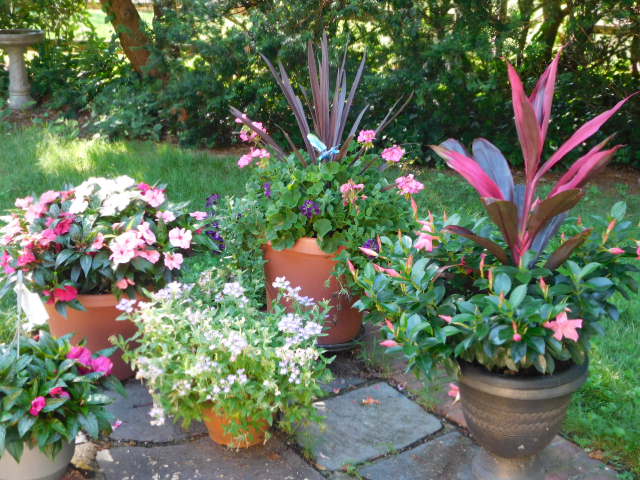
Patio arranged with almost Mediterranean sensibility.
Part of the charm of this poem, of course, is its focus on a rare ancient product of Classical Greece, an admired culture. Youths, surrounded by flowery fields, chase each other without a care in the world playing flutes. Captured in artistically painted ceramic, they will never know pain nor grow old nor have to work for a living. Utopia in a nutshell.
Such esoteric fancies would probably not arise from plastic containers in the back yard. As it turns out, none of ours are painted with delicate thoughts, but even if they were, they would be disregarded as common, trashy products of mass production. No plastic urn will survive millennia. Besides, I suspect that Grecian urns were pretty common in Greece at the time. It is only the ravages of centuries that have made them rare and thus worthy of contemplation.
I do happen to agree (at the moment) that life is beautiful. At least for me, right now. But I also am aware that there is a lot of ugliness around, and a lot of “just so” that is hardly worthy of assigning some aesthetic judgement. Truth, on the other hand, turns out to be complicated, fractal, and contradictory. I can always manipulate my judgement to appreciate beauty, but no matter how carefully examined, truth remains elusive and almost never fully welcome.
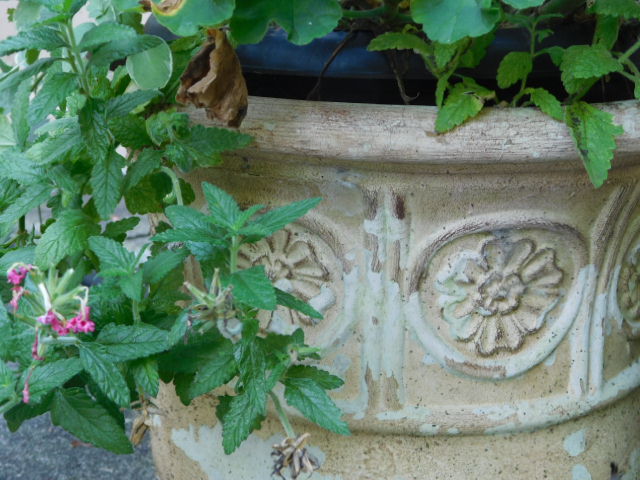
Is this beautiful? Depends, like all aesthetics, on who you ask.
Beauty is quite enough, sometimes. Flowers provoke reflections on nature and time and meaning, as well as being simply marvelous in themselves. Colors are magic, patterns are enchanting, bees hum harmonies of ecology. Blossoms constantly fade as others promise bloom. Once in a while perfume lingers in sultry wisps. Birds chirp anthropomorphic happiness, squirrels playfully dash everywhere.
Joan has provided the human touch, selecting and arranging perennials, pots, hanging baskets, and plastic urns to display what she considers the most perfect arrangement. She shapes high and low, red and blue and orange, small leaves and large, other infinitely complex internal judgements of aesthetics, until she considers it as right as can be. Or at least as right as it can be on our budget. I simply sit and marvel, and pretend the plastic is ceramic, the molded decorations done by some master craftsman, and even project a ghostly image of a goatherd and his sweetheart racing through verdant meadows.
A nice niche to provoke minor thoughts, all I ask in summer.
No Keats, I, but revised:
… Heard melodies are sweet, all those unheard
Are nothing; whatever plays, I listen;
… ‘Beauty is truth, truth beauty’—that is one
Of many lovely thoughts, each contradicts the last