
All paintings at: https://sites.google.com/view/cabinetofvanities
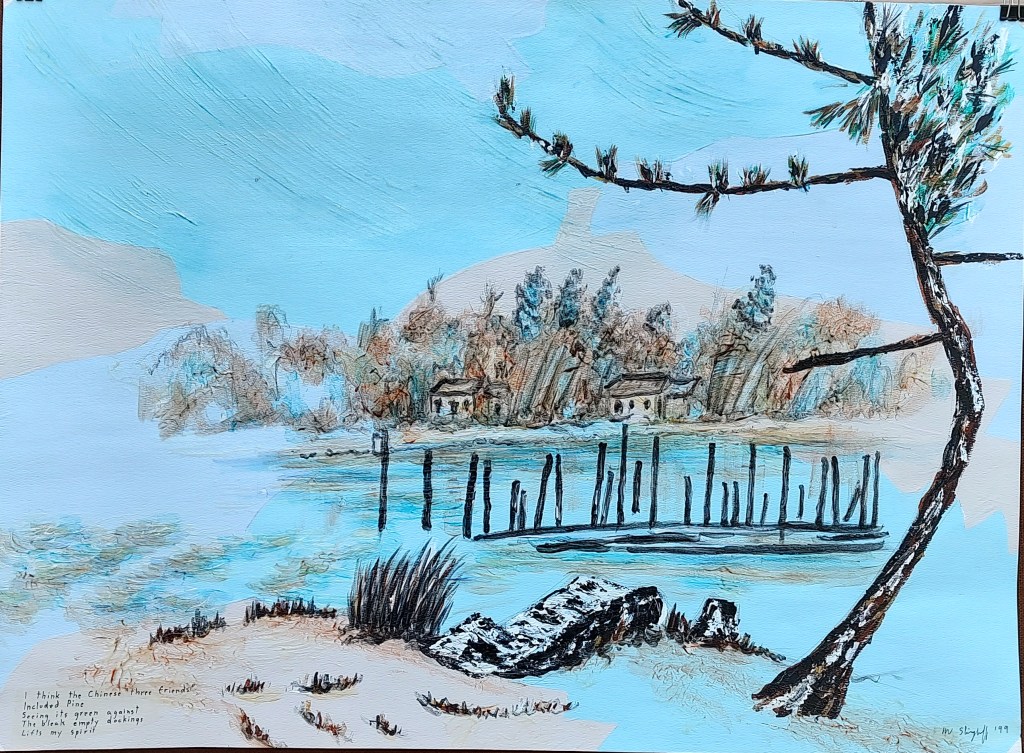
Acrylic on Watercolor Paper,1999 22×30
I think the Chinese “three friends” / included pine / seeing its green against / the bleak empty dockings / lifts my spirit
All paintings at: https://sites.google.com/view/cabinetofvanities
Acrylic on Watercolor Paper,1999 22×30
I think the Chinese “three friends” / included pine / seeing its green against / the bleak empty dockings / lifts my spirit

Sometime in late adolescence I read about the “dreamtime” of Australian Aborigines. Back then, it was presented as an irresponsible immersion in the moment, without regard for the past nor plans for the future. And, from the standpoint of what was still a highly puritan culture, a primitive decadence, hedonistically doing nothing to become better .
Now, as an advancing senior, I find myself also in a perpetual dreamtime. Not particularly hedonistic, but pleasant enough. The past becomes foggier each day, and the future is hardly worth thinking about. But this moment, now, is as wonderful as I wish.
Of course my original perception of ” dreamtime” was wrong. Like all human activities, it was a useful adaptation to a tough environment. More survival than hedonism. And fully sane, given the conditions .
My own dreamtime has a few aspects of that, and although my conditions are more paradisical than harsh, I inhabit the land of cockaigne, where pigs run around pre-cooked with forks stuck in them. Yet each day, even more importantly what I do each moment, is ever more precious. What I did – well, what of it? What will I will do? Forget about it .
No complaints, here at the water hole .

I accept that what is called the “religious impulse” is an important component of human mental sanity. It is good to understand that in terms of our senses and logic, the universe is ineffable, unknowable, and awesome. In the face of that frightening immensity, we find comfort in unsupportable (by reason) beliefs of faith .
All well and good. Each of us should happily adapt and go about our lives. Even discuss our inner convictions with others. Perhaps form common bonds, or at least a wider set of meditations .
What I can’t stand is evangelicals. Of any stripe – religious, political, nationalist, whatever. People who must convert you to the truth only they know. Who pretend to converse when all they are interested in is stomping out your “wrong” understanding. “Open dialogue” that is nothing but preaching .
If something is truly ineffable and can only be “known by faith”, there is sinister hubris in claiming any vision is the only true one. Perhaps I can make a case logically that going along with what everyone else in the culture believes is a better way of life than lonely fighting and rejection. But not because any of the beliefs are cosmically “true”.
Fervent evangelicals who prefer what is evil to me must be ignored if possible, eliminated if not. I also have a right to my irrational convictions if I do not force them on you or your life .
All paintings at: https://sites.google.com/view/cabinetofvanities
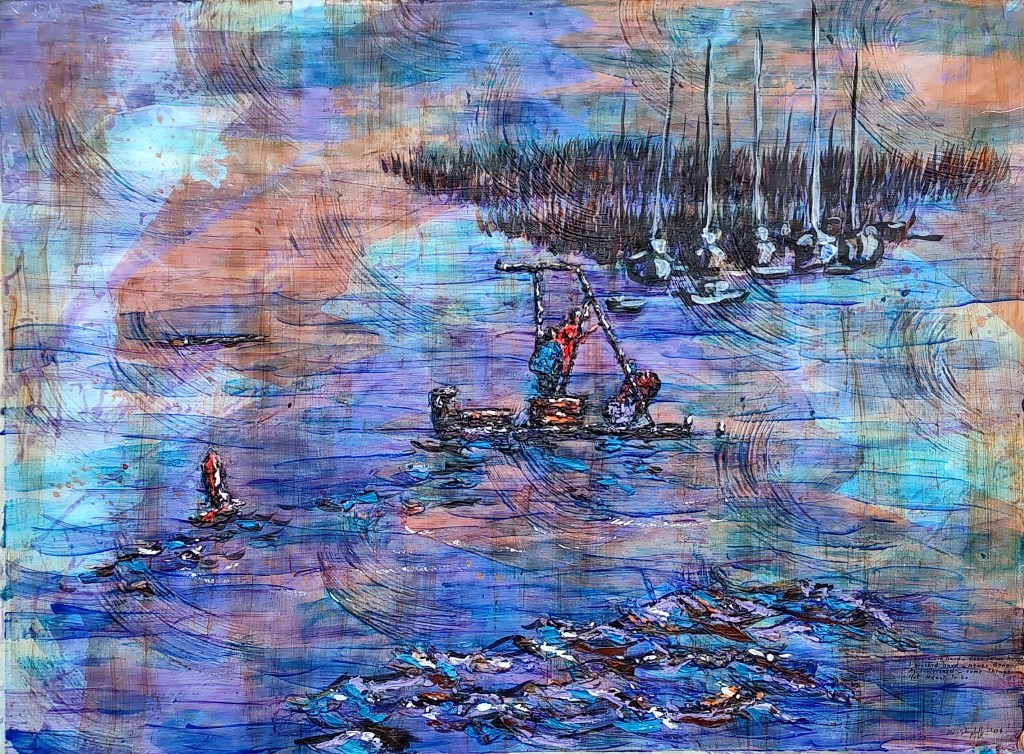
Acrylic on Canvas, 2004 30×40
They work hard – done in an hour / I worked hard – never done / as I visioned – some things / not meant to be

In feudal Europe, everyone had to pay taxes to the lords above them. Protection money. But almost everyone had to also belong to the Catholic Church, which required an annual tithe of 10%, variously from “income” (paid in kind) or property .
The church tithe was actually the social tax. Kings could not be bothered with caring for the aged, sick, or poor. They and their underlings were too busy fighting huns, infidels, invaders, neighbors and each other. Or trying to collect taxes …
The church took care of everything else, at least in theory and in line with what could be done in those “dark” times. Frequent failures were at least backed up by the guarantee that the righteous would be well rewarded after death .
Today mega churches continue the practice and take care of their own flock, like the ancient church – taking good care of the priests first. They resist the idea that the state should do anything more than fight against the enemies of the moment .
Most of us are less sure the righteous will be rewarded. But we share the common idea of the peasants of that time that taxes (and tithes) are too high .

All paintings at: https://sites.google.com/view/cabinetofvanities
Acrylic on Canvas, 2001 30×40
Fishing, but / for what? / the sun, the day, the breeze, / sparkles of the moment / chime of rigging, gull cries / time well spent

Can anything be “simply wrong?” We live in a complex society, full of relative judgments. “In olden days a glimpse of stocking was looked on as something shocking”, but no more .
Almost nothing seems to lie beyond the pale. Apologists and psychopaths can make the most heinous acts seem logical and correct. The gods have vanished, and the visions of gods that remain for the credulous are increasingly mean, exclusive, and bloodthirsty .
Rationally, I would claim that Western civilization is built on the ideal of the worth of each individual person. It becomes, therefore, “simply wrong” to hurt another human being .
That leaves three escape clauses, unfortunately.
The first is how we define “hurt”. Almost anything can be claimed as being for someone’s “own good”. And everyone, and every tribe, will define hurt and severity of hurt differently .
The second, truly evil, path is to merely claim a given human or tribe is not really individual at all. Either born as animals, or having forfeited human inclusion. Then we can do with them as we will .
And, of course, our own often imaginary projected visions that “I had to do it to them before they did it to me.”
And so, in these strange times, even simple becomes complex, and wrong turns into a puff of smoke.

I’m writing this a week before Christmas when holiday rage on the roads seems to be at its worst. Everyone behind schedule, in a hurry, overwhelmed. Better watch out !
It’s an annual fever. I used to think it was mostly caused by people leaving the quotidian comforts of their regular routines and having to compare their lives to that of relatives and friends. Having their noses rubbed in promises not kept and ambitions unfulfilled. Competitive juices and anger, but always with an undertone of failure .
This year it feels different. There is still rushing, but less of an edge. The environments have flipped. Daily life no longer feels like comfortable security. Ancient rituals and close relationships loom more important in what is coming to be a scary, out of control, threatening future. It may never be this good again …
Yes, yes, this is just me. I know I project my own thoughts over everything. Ash colored glasses on what may come. But I also try to read enough and stay in touch to at least catch some of the zeitgeist of the age. The flavor of the times is not optimism and happiness .
Meanwhile, I drive carefully and continually dull my own fears .
All paintings at: https://sites.google.com/view/cabinetofvanities
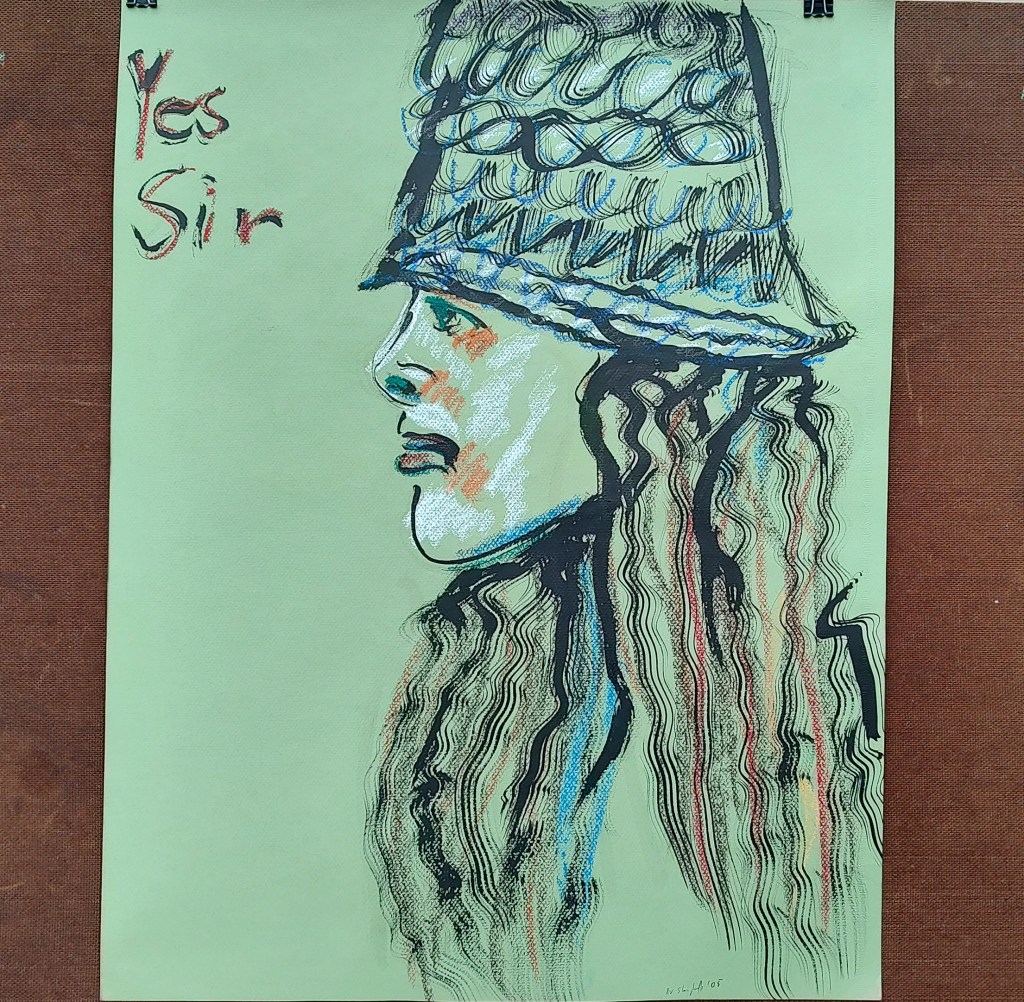
Pastel and Ink on pastel paper, ~2002 26×20
Yes Sir

Anyone who has ever served on a committee of a dozen or more people knows pure democracy does not work. It’s why we choose leaders, more or less representative, somewhat expert, to take on the roles of leadership. The only real check in a democracy is the periodic elections, if actually free and fair .
But what do we mean by “representative?” The founders had clear ideas. In the US, the House would be composed of men from the mob, the Senate of men from the elite, and the president a paragon selected by the elite. We have come to decide that all positions should be filled by persons from the mob, chosen by the mob. We naively believed that in a well educated free society the mob would actually become the elite.
When I was schooled in civics back in the 50’s public school, “representative” meant something like a person who shares my views and judgment – emphasis on judgment – and acts more or less as I would if I were in that position. Lately, however, it has come to mean a rigid avatar, a cartoon image of what I think I want, who always votes as I think I should (not, mind you, as I really do because – hey! – life is too complicated, and time is short) .
Like the founders, I do not trust the mob – or rather the mob mentality – even my own. But with instant communications, mob rule is here to stay as long as civilization can handle it .
 HuntingtonHarborThoughts