
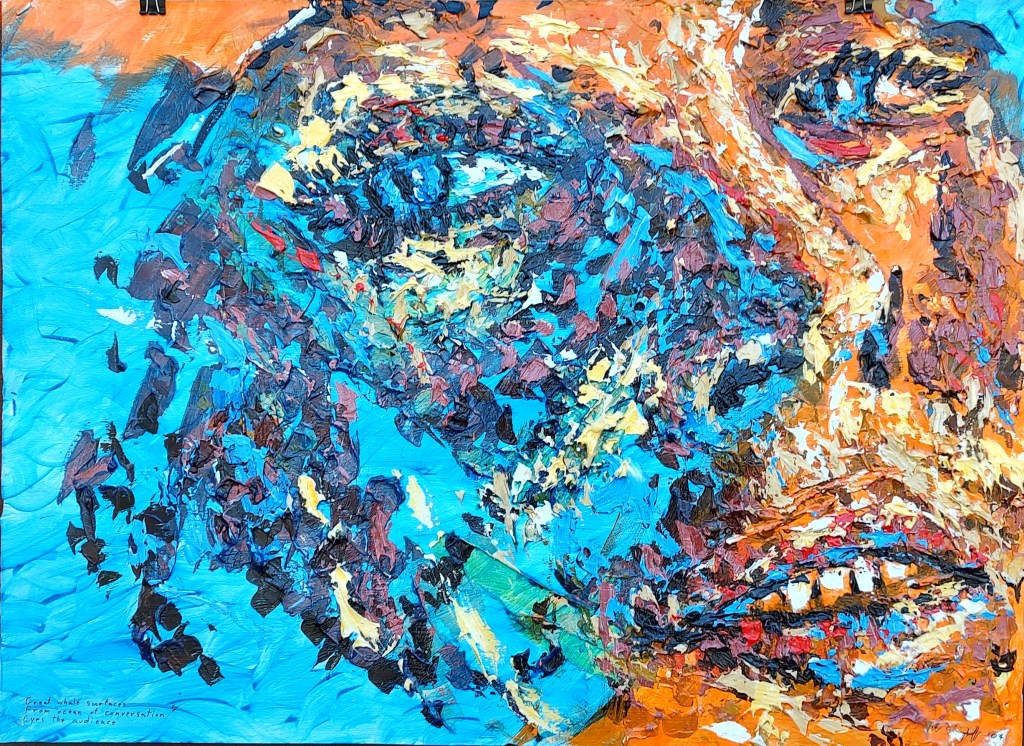
All paintings at: https://sites.google.com/view/cabinetofvanities
Acrylic on Watercolor Paper ,2004 22×30
Great whale surfaces / from ocean of conversation / eyes the audience
All paintings at: https://sites.google.com/view/cabinetofvanities
Acrylic on Watercolor Paper ,2004 22×30
Great whale surfaces / from ocean of conversation / eyes the audience
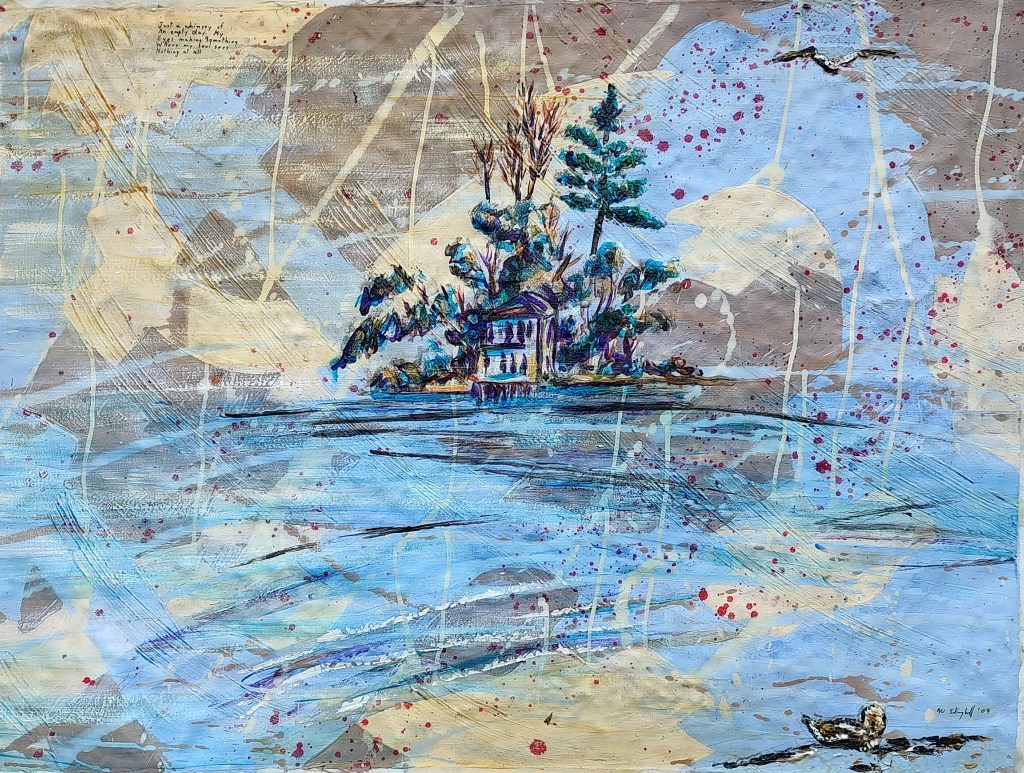
More paintings and info at: https://sites.google.com/view/cabinetofvanities
Acrylic on Canvas 2004, 30×40
Just a whimsy of / an empty day. My / eyes making something / where my soul sees / nothing at all
Through many self-identifications with other people – especially artists – I’ve always come back to Rembrandt as one of the finest. Not so much for his immense talent – all my heroes have had talent way beyond my own – as for his immersion in a life filled with ups and downs .
I mostly enjoy the way all of his sketches – and how many of them there are! – live and breathe. Each capturing a moment, as often as not seemingly just for the fun of it. No grand idea of using them later – just pick up a pen or brush and engage.
Oh, it’s a grand conceit. But I like reviewing his life with all its disappointments and hardships, its occasional triumphs. Follow the posthumous evaluation of his major and minor works, right up to the current near deification after for a while being almost trash compared to all those Italians and later French .
Each of us can choose whom we admire, living or dead. Whether or not we are much like them. Pick appropriate characteristics to emulate (even though we may often be wrong objectively).
I find that Rembrandt is one of the few totems with whom I can easily reestablish a resonance. A fresh breath of air whenever my own spirit rises too high or sinks too low .
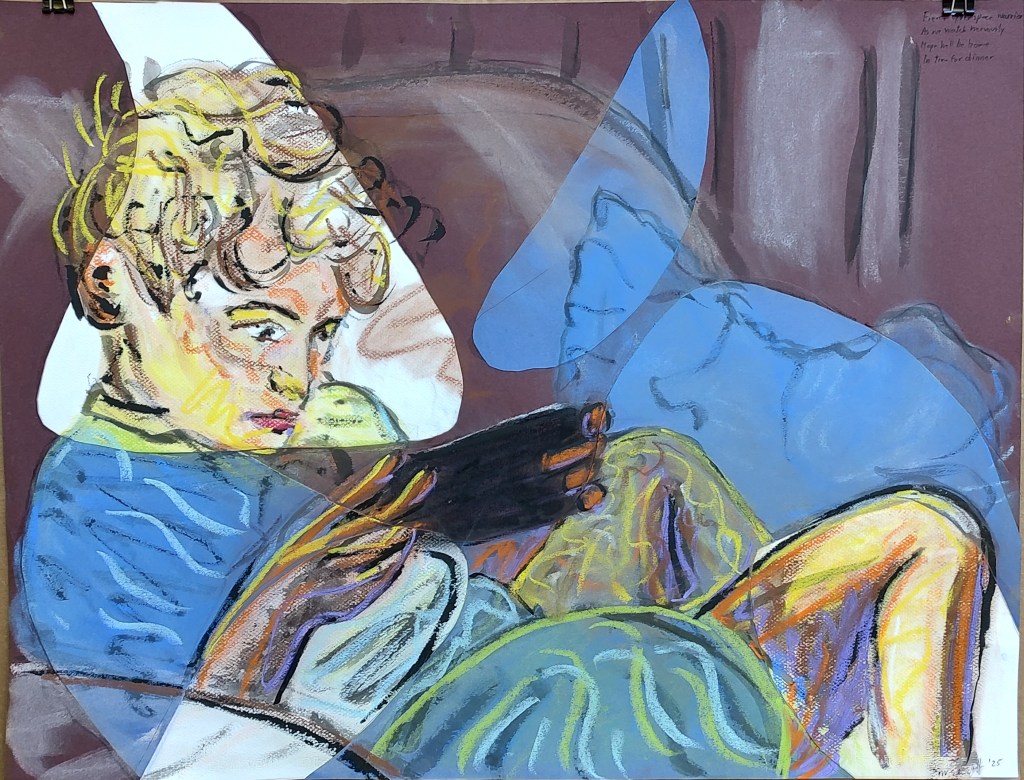
More paintings and info at: https://sites.google.com/view/cabinetofvanities
Pastel and Ink on Canson, 2025, 22×302025-PIC-20×26-044
Fierce cyberspace warrior/As we watch nervously/Hope he’ll be home/In time for dinner
George Orwell’s 1984 language easily fits the current government policy of how to treat “unpeople”. Those not worthy of being citizens by virtue of birthplace are easily termed unpeople, to whom few laws or rights apply .
The US has a long history of labeling certain groups as unpeople. The original inhabitants of the country, of course. Anyone with a non-caucasian skin coloration, at one time or another. Certain religious groups .
It’s sad but effective. Unpeople are – well – not really people like the rest of us. They are kind of like intelligent dogs, or possibly smart rats. There is no need to give them rights. They are criminals simply by inhabiting our space .
Furthermore, unpeople cleverly cheat us and use up resources which should be devoted to the real people, the good people, the actual humans. And unpeople breed like crazy, arrive in hordes, try to crossbreed and pollute the population pool.
It’s an old and effective way of appealing to the masses. Convince them that these or those unpeople are the source of all their troubles (rather than blaming the rulers of the country) .
Of course, with the speed of internet virtual transformation, any one of us could turn into an unpeople tomorrow

We like to believe that as a civilized people we are rational and informed. We’ve left behind meaningless taboos and idol worship. Our enlightened goals are carefully crafted .
But, of course, the important ones are not. We are as driven by hormones and ignorance as any of our pre-dawn ancestors. Our knowledge is too vast and complicated to understand, so we fall back on what we believe we know to be true from personal experience .
The problem with that is that personal experience tends to be limited. Folks claim, for example, that everyone always used to get “married” in some conventional modern sense. Even a brief glance at history or ethnology would prove that wrong. But who has the time? And do I trust a book or my own intuitions and memories?
Factions construct ideals into taboos which they honestly feel reflect eternal truth. Which is fine. Then they try to impose that on others. Which is not fine. If rulers become infected with those ideas, society is in for a terrible time.
Individuals are incredibly complex. Society is infinitely messy. Shiny ideals soon tarnish. Frozen ideals are a disaster. Everything always changes, and those who do not change to fit new circumstances are usually doomed .

In my extreme youth, there was a comic strip “Blondie and Dagwood” about a sensible housewife and her hapless husband. Each Sunday the newspaper would print it in color. A kindly voice from New York would even read all the “funnies” over the radio .
Anyway, one of the ongoing antics was for the main character to build a “Dagwood sandwich.” He surveyed the contents of the refrigerator. Enticed by everything he’d pile it all on a tiny square slice of industrial white bread until it was 3 ft or so high and top it with another tiny slice. Then settle in for the feast .
As a naive explorer, I tried this one day. Needless to say, it not only didn’t work well and tasted awful, but also upset my parents somewhat at seeing the empty fridge and the mess in the kitchen. I did learn my lesson. It often pays to think and limit one’s selection .
This all came to mind as I watch the Muskie and Donald comic strip. They keep piling declarations and actions on top of one another in an orgy of doing everything at once. A lot of good ideas get mashed together and become indigestible. The fridge is left empty. The only remaining question is will their parents be as angry as mine .
Fortunately, kindly conservative narrators still read the episodes to us and explain how funny it all is .
More paintings and info at: https://sites.google.com/view/cabinetofvanities
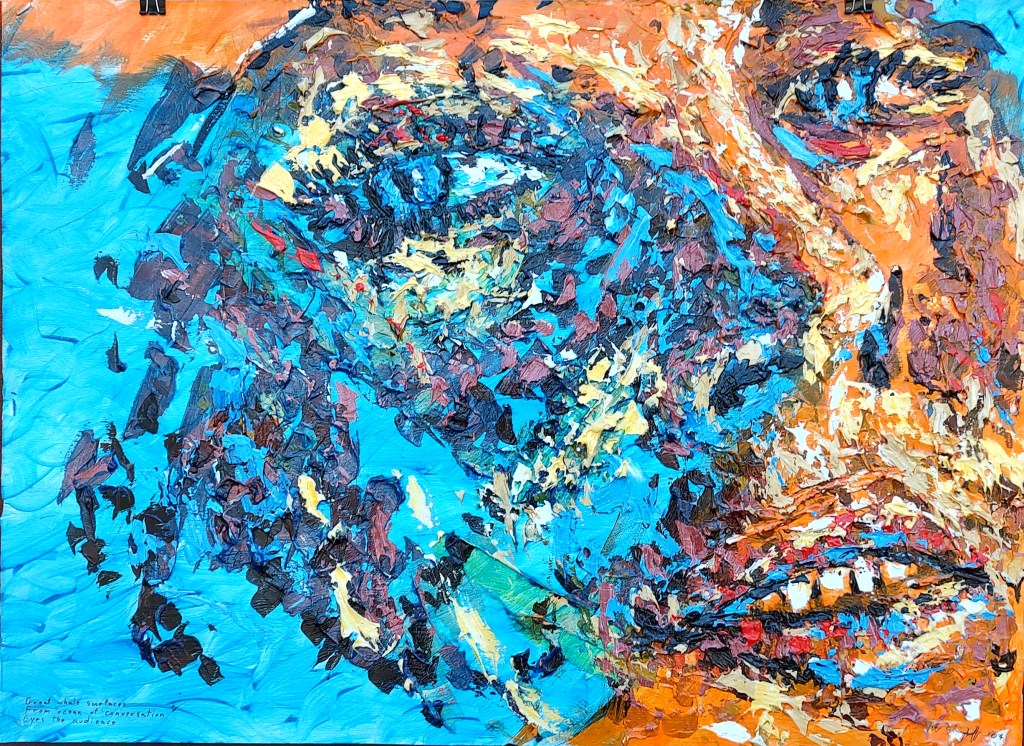
Acrylic on Watercolor Paper, 2004, 22×30
Great whale surfaces/from ocean of conversation/eyes the audience

Humans must grow up in a social environment – a baby alone is soon dead. For the rest of our lives we live in a hierarchy ruled by parents, bullies, leaders or amorphous entities like society or government. Naturally, like fish who take water for granted, we assume the universe must be structured the same way .
The easiest concept is animism, where everything has a spirit and connects with a greater spirit. This seems to have been practiced for all ahistoric people for a very long time and still seems sensible to those who like to imagine a vast spiritualism to the universe. Sometimes it is refined into religions like Taoism .
Historic agrarian cultures with writing and formal government organization imagined a kind of supernatural governing elite. The most fun of those were the Greek gods, awesome and stupid at the same time. The worst was the Old testament God of the desert. But all those superheroes needed to be appeased and prayed to .
The question has always been who speaks to or for the spirit or god. Shamans and priests and prophets claim exclusive rights. Individuals claim intimate direct communication. Skeptics explain bits of cheese or festering neurons .
I admit to being somewhat of a skeptic, while at the same time feeling the natural (as if I were a fish) belief that there must be more to existence than we are aware of .
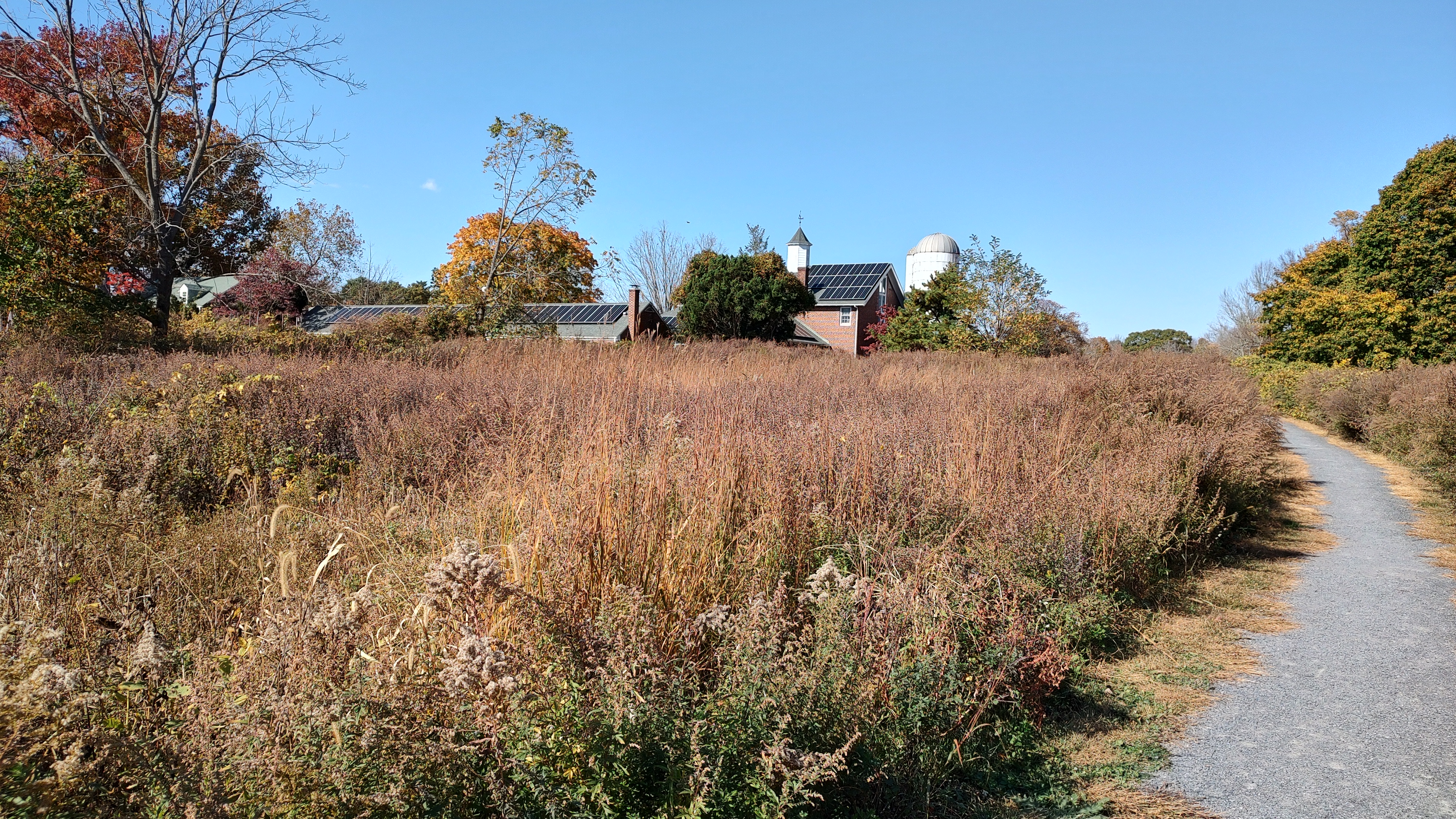
Many times I have emerged from an art museum seeing the world totally differently than when I entered. We all know a simple mood change can reset our outlook. And mental illness produces severe distortions such as paranoids believing the world is out to get them when everyone is in fact ignoring them entirely. Or, of course, love.
Since printing we’ve had to deal with at least two realities – that of the ‘larger’ world and our own local one. News lately has focused on the sensational – crime and disaster. Cable news began to focus on singular scenarios. And now we can spend our lives immersed in worlds only manifest within computer screens .
Most notably, the Republicans claim that we live in a dystopian country. Cities are burning, if you notice before you are shot or cannibalized. Foreign hordes sweep up from the border like Mongol hordes of old, looting and burning all in their path. Evil bureaucrats spread all their time assuring that the good people will be cheated of their rightful wealth and respect .
And then we open the door and in our local reality (unless we are mentally ill) the sun shines, people smile, and we enjoy the greatest security and standard of living in history .
The world will always have problems. Some of each our lives involves tragedy and misery. But there are different worlds about us if we simply reset our outlook once in a while .
 HuntingtonHarborThoughts