More paintings and info at: https://sites.google.com/view/cabinetofvanities
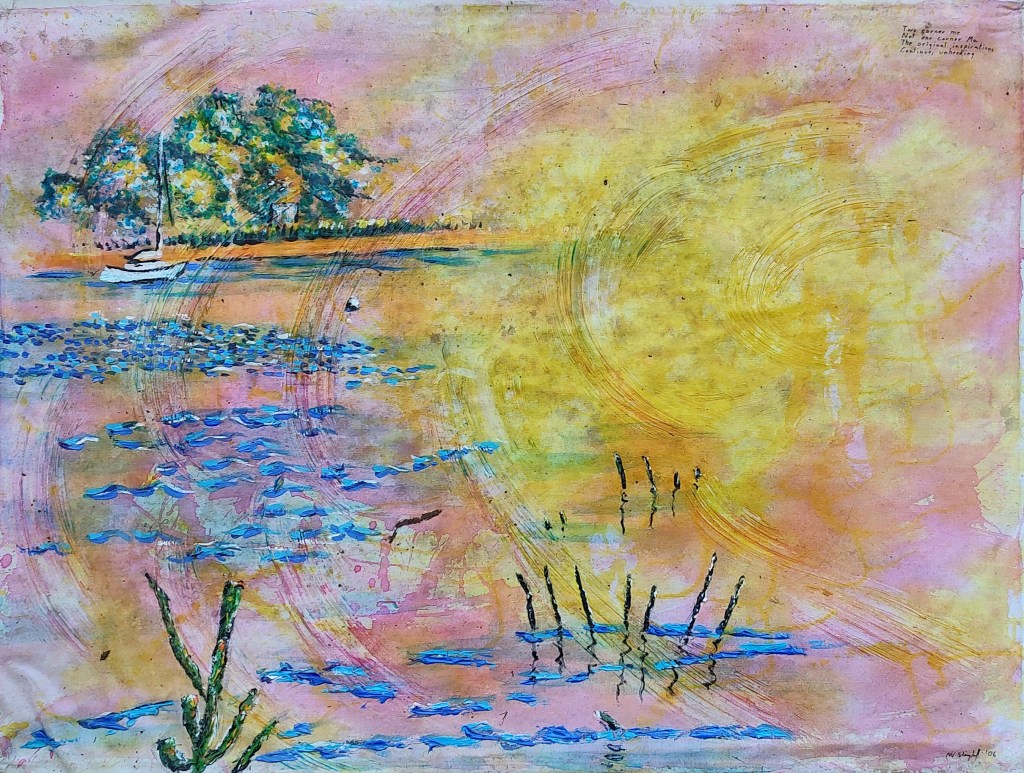
Acrylic on Canvas, 2006, 30×40
Two corner me/not One Corner Ma/the original inspirations/continue, unheeding.
More paintings and info at: https://sites.google.com/view/cabinetofvanities
Acrylic on Canvas, 2006, 30×40
Two corner me/not One Corner Ma/the original inspirations/continue, unheeding.
More paintings and info at: https://sites.google.com/view/cabinetofvanities
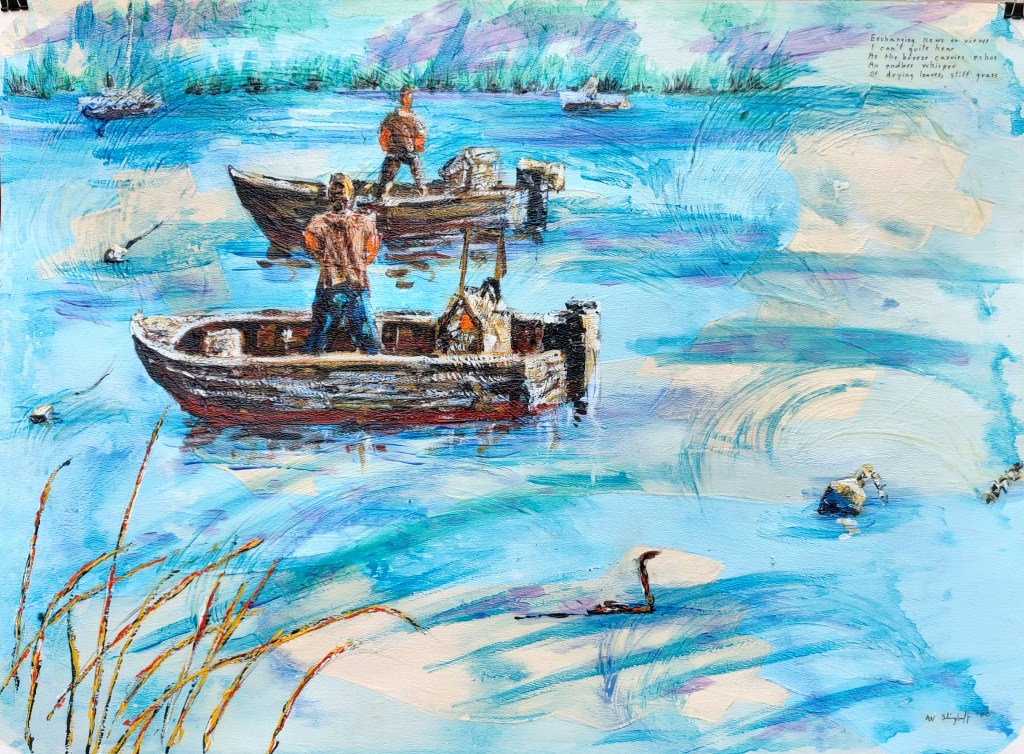
Acrylic on Watercolor Paper,, 2000, 22×30
Exchanging news or views/I can’t quite hear/as the breeze carries echoes/an endless whisper/of drying leaves, stiff grass
More paintings and info at: https://sites.google.com/view/cabinetofvanities
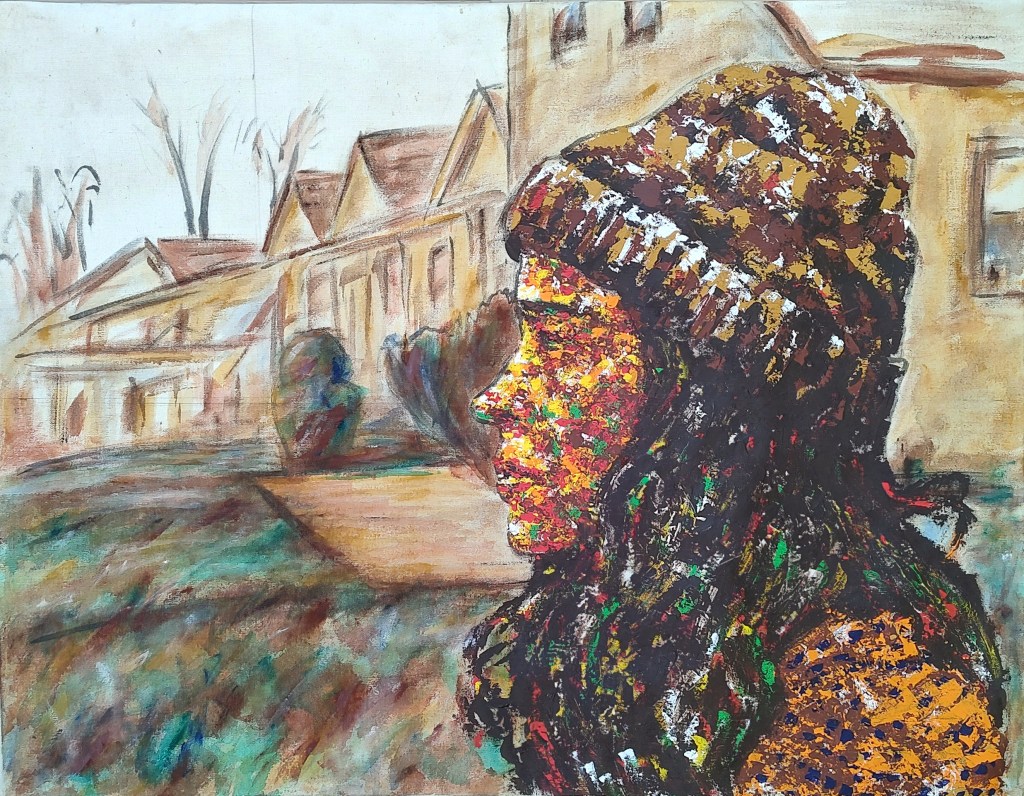
Acrylic on Canvas,, 1971, 28×36
Portrait of Joanne in Kansas City
“Life is short, but art is long” is one of those old Roman sayings that seem to make sense until we think about it. Up to a few hundred years ago, people conceived of time much differently than we do. Aboriginal tribes existed in a perpetual present, surrounded by “dreamtime” past and future. Civilized folks considered the past as a few hundred or thousand years – back to the Egyptians or some mythical beginning. Deep philosophers assumed the world to always have been as it is, possibly cycling through various stages .
More than that – in direct opposition to current ideas of progress – that past was always better, golden, inhabited by gods or semi-gods. Ancient art was always to be copied or imitated since the degenerate present could not compete. Thus “art is long”.
Now we laugh at a few thousand years. We know the world goes back a few billion, amazing creatures hundreds of millions, people like us over 100,000. And the world keeps changing. And “new improved” is demonstrably better than the old junk .
As for art … well it’s really as “short” as life. Useful for a generation or so at most. Like any legacy, soon gone with the wind, without even the solace of a grave marker .
As for other ” wise”, “golden”, sayings, ideas, and ideals of classic ancient cultures – don’t get me started .

More paintings and info at: https://sites.google.com/view/cabinetofvanities
Acrylic on Canvas,, 1969, 28×22
Early effort of angry young artist
Anything added to an artifact that does not affect its functionality can be regarded as decoration. Such can be seen as one of the most enduring aspects of human creative spirit, serving no purpose but to make something more interesting or attractive .
In any craft, the first approximation of decoration is elegance. At a certain level, we truly regard a craft masterpiece as art. Whether it is ” fine art” or not is a question best left to those who care about such trivia .
People’s ingenuity has been able to replicate (often in mass quantity with machines) any fine original creation. Today we are surrounded by beautiful (at least to some) elegant and often functional objects. Created once by the glory of the craftperson’s spirit and training, now available to all .
For a few of us, a majestic extreme of decoration is a flat-bounded surface on a wall, drawn and colored in a pleasing or informative way. We visit museums to be entranced and amazed by these pictures. Nobody is quite sure why. Photographs usually do not provide the same kick. Children’s work may do so. It’s mysterious .
These days, for the craftsman or artist, the final production must be an end in itself. Only a few friends will notice. There is a glut of decoration – good and otherwise – in the world .
Yet craft, art, even appreciation of decoration, remains a joy of our spiritual life .

More paintings and info at: https://sites.google.com/view/cabinetofvanities
Acrylic on Canvas,, 2000, 30×40
Dark clouds attracted me/white gull startled me/insistent wind endlessly/gusted towards tomorrow

More paintings and info at: https://sites.google.com/view/cabinetofvanities
Pastel and Ink on Canson,, 2025, 9×12
Old shack long gone/Old man too/In nearer future/I, my paintings, also
More paintings and info at: https://sites.google.com/view/cabinetofvanities
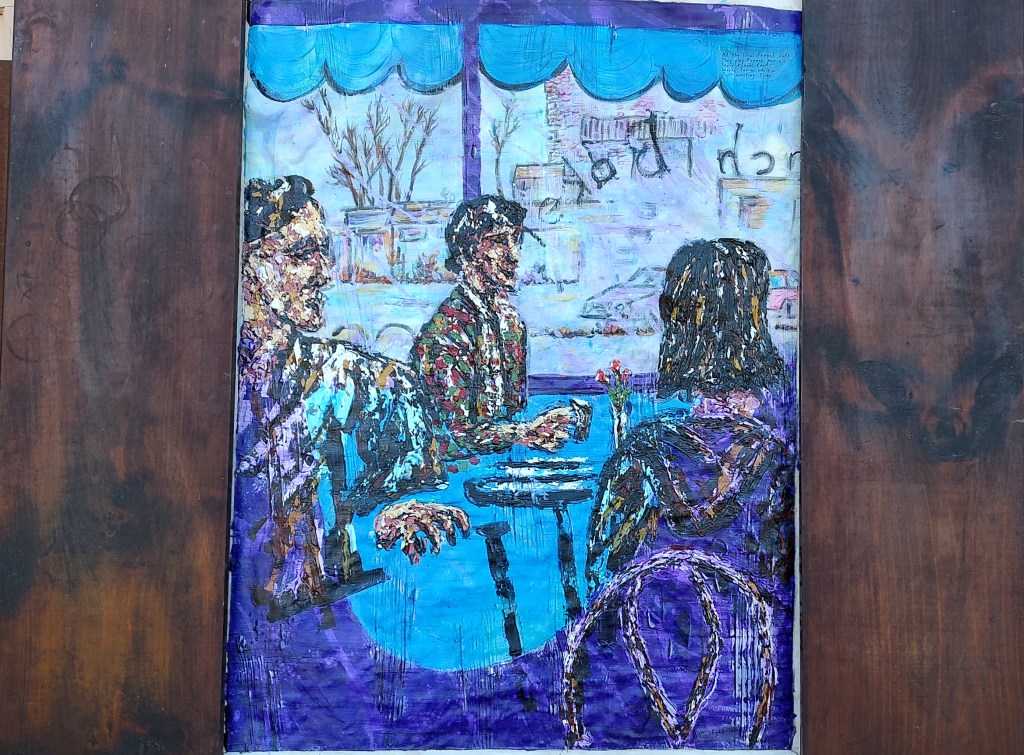
Acrylic on Canvas, 2005, 30×40
At the local French cafe/they play French music/serve French food/works for a while _ just wasting time
Seeing seems completely obvious to us, but computer researchers have discovered just how weird it is. We combine binocular vision with experience to create objects – some as they are, some different, some imaginary. Nothing is really “objective” or “true”. More than that, we constantly select and focus. Our vision keeps constantly shifting second by second. We learn to find what is relevant to us. A hunter sees signs of prey or movement in the grass. A developer or general maps terrain to possible advantage. Artists look for patterns that are beautiful or interesting .
When I start to sketch, after a period of inactivity, the first thing I notice is how odd my results are. Stuff seems the wrong size or color. Nothing matches what would be on a photograph of the same view .
Ah, that’s a modern dilemma. Old paintings, especially pre-renaissance, had less strict rules – or the rules were different. Important people, for example, were usually larger than less important people. Certain conventions – “city walls” for example – were almost pictograms. Oh, some work was magnificently “realistic” – cave paintings, Roman mosaics, Chinese flowers and birds. But all saw in certain ways, and accepted certain conventions .
As do I. My sketches try to become more and more like photographs. I resist the tendency fiercely, but I am losing. That tension actually provides a lot of entertaining, engrossing, fun.
 HuntingtonHarborThoughts