Dagwood Sandwich

In my extreme youth, there was a comic strip “Blondie and Dagwood” about a sensible housewife and her hapless husband. Each Sunday the newspaper would print it in color. A kindly voice from New York would even read all the “funnies” over the radio .

Anyway, one of the ongoing antics was for the main character to build a “Dagwood sandwich.” He surveyed the contents of the refrigerator. Enticed by everything he’d pile it all on a tiny square slice of industrial white bread until it was 3 ft or so high and top it with another tiny slice. Then settle in for the feast .

As a naive explorer, I tried this one day. Needless to say, it not only didn’t work well and tasted awful, but also upset my parents somewhat at seeing the empty fridge and the mess in the kitchen. I did learn my lesson. It often pays to think and limit one’s selection .

This all came to mind as I watch the Muskie and Donald comic strip. They keep piling declarations and actions on top of one another in an orgy of doing everything at once. A lot of good ideas get mashed together and become indigestible. The fridge is left empty. The only remaining question is will their parents be as angry as mine .

Fortunately, kindly conservative narrators still read the episodes to us and explain how funny it all is .

Bavarian Daffodils

Once again daffodils are blooming in Huntington. As I am sure they did in the spring of 1938 in England and Bavaria. No doubt folks as old as I am tottered out of their cabins and admired the sight, dreaming of warmth and summer gardens .

There is, of course, always trouble in an unknown future. People mostly stay sane by ignoring the possibilities and concentrating on the exact day in the immediate neighborhood. Events just move along and we deal with them as best we can when and if they impact us .

I imagine that like today some people had strong resentments based on old horrors and current difficulties. Some yelled loudly. Some hoped things would work out. Few 78-year-olds thought they had much say in how the world was run .

The daffodils bloomed again a few years later, in spite of bombs and tanks. But life had changed drastically for most of the old folks who gazed at them fondly in that final spring of relative calm .

Well, I also go out and admire the daffodils. I touch the internet gingerly. I’m afraid I strenuously avoid thinking about possible futures .

It is not a good time to dream of what may come. Anyway for now, after the daffodils, surely the roses .

Relaxed Art

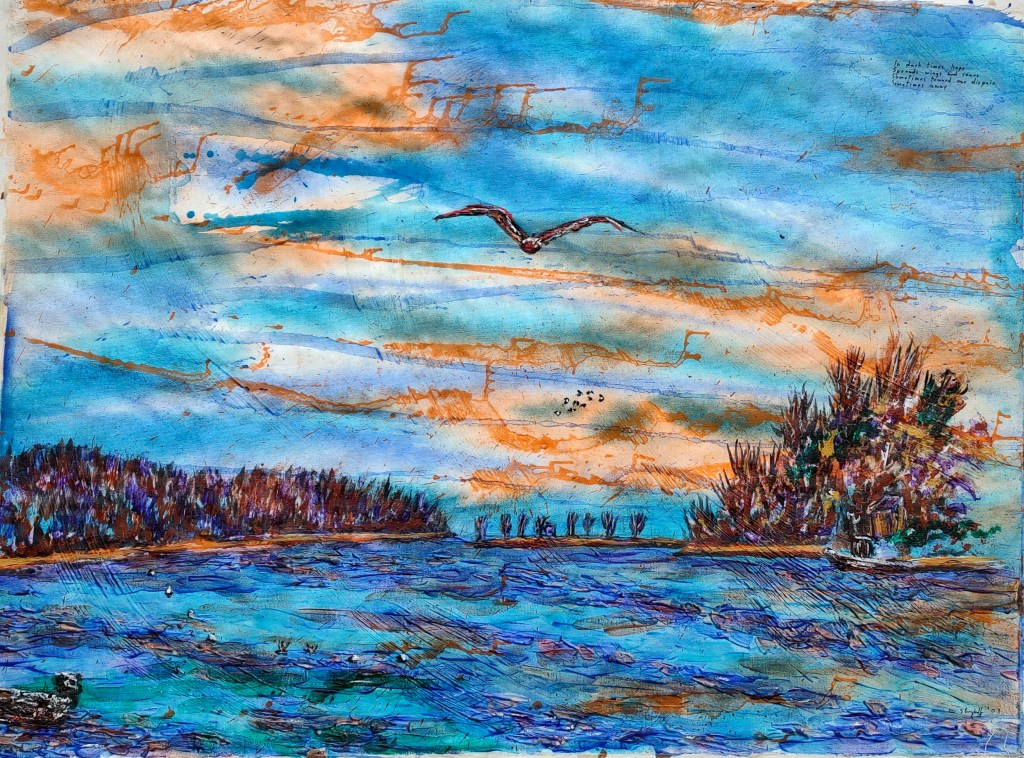
Off and on through the years, I have sketched and painted seriously. As many people have discovered, art (or serious craft) can be magical. There is a wonderful sense of accomplishment and a re-enchantment with the world .

Decoration has served many purposes throughout the ages, and I am not one to judge degrees of worth. These days of abundance surround us with inexpensive beautiful artifacts, often in limitless quantities, turned out by machines. A miracle in itself, also enriching our lives .

Now Joan and I participate in an art group, and I have reason to contemplate what I am doing, why I want to do it, where I want to take it. I’ve always tended to be hasty and immersive – I like to totally “lose myself” in what I am doing for as long as necessary. I rarely linger over detailed cleanup after the trance fades .

I cultivate the exploitation of my enthusiasm, my limitations, my ambitions, my competence. I do not try to outdo the machines. I find little joy in reproducing machine work. I don’t like working off photographs – too much detail, two little focus, and often artificial viewpoint .

Creating as a child. Others have their own ways and their own valuations. We all are expanded by doing something active .

Old Mr. Gibbon

I’ve just finished volume three of Gibbon’s Decline and fall of the Roman empire. I know I probably skimmed through it many years ago, when I purchased the full modern library edition. But his story is far from the “gladiator” cliches .

Consider the examination of human nature. Gibbon considered the Roman empire to have functioned continuously until the final fall of Constantinople to the Turks in 1453. He reviewed extensive documentation regarding the follies of ruler and ruled, wise men and fools, passions of the day, and the odd beliefs that motivate people to good, evil, or simple daily life .

Lately, I’ve become enamored with historians like Gibbon. They were not so focused on comparisons to today as our current writers. They could be very intellectual, assuming a certain degree of decent education for their readers (which, alas, current writers cannot.) And they were unafraid in calling things as they saw them (although Gibbon did have to be obscure about sex and coy about Christianity) .

All that makes for a deep, provocative, powerful read. I took my time this time through. Much more engrossing than modern digital melodramas. Made me appreciate my own life and times all the more .

A grand subject, to be sure. An obsessive historian, sometimes tedious and confusing (all those names! Dates! Events!) But now, what a fine thing to rediscover .

Deregulation

Laws and regulations are both necessary and infuriating. It all depends. We imagine they have been around in one form or another forever – sometimes as traditions or taboos, sometimes merely as the whims of the strongest ruler or group. It is impossible to imagine a society without them .

And that is really the key to the problem. Because with social tribes, we imagine things to be more fluid. “Let me do what I want or I’ll go somewhere else!” We believe that as civilization takes hold, every individual becomes encrusted with responsibilities and prohibitions until he or she cannot breathe. “What is not mandated is forbidden .”

We further imagine the frontier as freedom. Cities are confining. Run away to open space, where each can do as each desires. There may be some truth in that, but people are complex. For some reason, throughout history, folks often ran away from rural pastures and small farms to the great cities .

The advantage, of course, has been anonymity. In a city you feel free because the mobs (usually) don’t know you. In spite of those pesky regulations on everyone .

Regulations do tend to hinder innovation and progress. Keeping them “under control” or focused on “common sense” is difficult. Yet cities usually manage to work it out .

It’s when the rural yokels with little experience take charge and get rid of regulations that things really fall apart .

Enough Rope

“Giving someone enough rope to hang himself” seems to be the current position of the opposition party. Sober and sensible people can see that what “he” is doing is totally wrong, but he’s convinced himself and others that he can pull off a miracle .

In some cases, it’s true that active opposition is useless and often counterproductive. It’s the nature of braggarts to blame others when they fail, and who easier to blame than those who worked against the plan. A glib orator can even carry a lot of his charmed audience along with him .

So let him do what he will and then pick up the pieces after the inevitable destruction .

The problem, of course, is that sometimes the person with the wrong vision is totally drunk and  going to drive you home in his car. Giving him enough rope to prove he’ll wreck the vehicle and kill others may end your life as well. Not to mention being morally wrong to let him drive under any circumstances .

We are already in the car. I understand that the “enough rope” approach is tempting. I truly hope it ends short of disaster .