In the Moment

This instant is all we truly possess, and it is mysterious indeed. In some ways, right now does not even exist, though we might see it coming and remember it afterwards. And, of course, it is also the only real intersection where we can actively interact with the real world. 

Some perceive it as if it were viewed from the future. How will whatever is done be judged tomorrow or in a few years? How can what is accomplished lead to better outcomes or choices then if they were not done? That is a valid and useful perspective.

Others perceive it as the result of a long line of past moments, good and bad. Some actions done or undone, some luck, some inevitabilities. This moment just another like all the others, to be handled as well as possible. That is also useful and valuable.

And then there is the nimbus of the moment itself, an infinite grid of worry, reflection, appreciation, and action. Trying to make the most of this magical instant which is life and consciousness. And, somehow, balancing that with all the other possibilities.

Confusingly, we bounce from one viewpoint to another, feeling more than only the moment, but knowing we are not. An odd situation, which is what being human really is.

Child’s Play

Childhood can be difficult. One is gaining all kinds of abilities very rapidly. At the same time, one is being constantly instructed in when to use them or suppress them. And then one learns about hard and final limits, such as never being able to fly.

Child’s play provides an outlet for all those distressing complications. Your toy figures can fly or turn invisible. Characters can yell and fight. Buildings can go up in one instant, get destroyed in the next. Limits are non-existent. 

When an adult plays, it can be amazing how much forbidden stuff a child can work out. Characters are allowed to say and do things already taboo in polite society. They can hate school, refuse to eat vegetables, act out tensions with adults. A keen grown-up observer is constantly educated and entertained.

The more fortunate among us never completely abandon childhood outlook. We can still build castles in air, even if now they are dreams of ambitions. We can imagine outcomes to our anger forbidden in real life. And, most important, we can occasionally escape all our limits and wallow in the wonder of the world.

Blame

Technological hubris believes that civilization can now control everything everywhere. We quickly extend that into assuming somebody somewhere is responsible for all that happens. Including our troubles.

Nothing new. In the old days when God or the gods controlled the universe we could blame them. Or perhaps the evil subset summoned by witches. It’s human nature. 

Also human nature to try to make a quick buck, which is why our civilization is also chock full of lawyers, who invoke the incantations and exorcisms in a dead language. Probably better than trying to punish the imagined culprits ourselves.

Naturally we dream of recourse. Our current superhero movies are nothing more than extravagant revenge fantasies. Find those causing our problems and eliminate them and all will be sweetness and light.

The problem, of course, is that we first pick scapegoats like those ancient witches. Then we elevate some plain old general or politician to superhero status. And if we are really deep in the blame game we let them have all the power they say they need.

Meanwhile the plain fact is that civilizations are a lot less powerful and knowledgeable then we hope. The universe itself is chaotic and unpredictable.  Nobody and nothing controls much of anything.  Which is truly frightening.

Forest Cathedrals

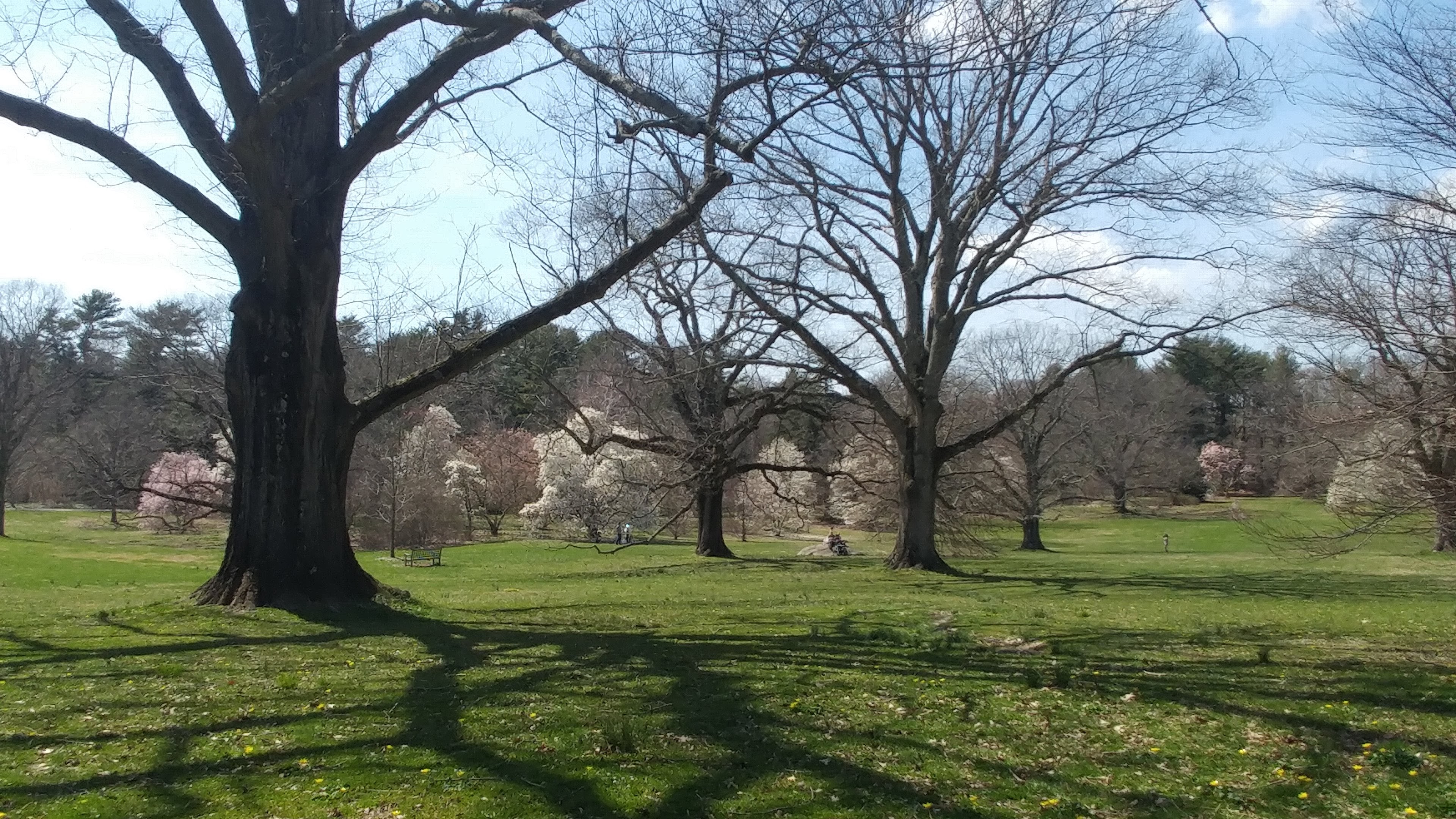
Winter walks in hardwood forests remind me of Gothic cathedrals. I suppose it is the columns rising all around, and the vaulted tracery of branches overhead. Even the sunbeams shining at low angle through a maze of branches seem like the effect of stained glass.

I know it should be the other way around. Ancient as the European masterpieces may be, they are infants compared to the forest. If there is any reminding to be done, it should be buildings reminding me of nature. Perhaps that would happen were I there, but I am here in a large park and my memories run backwards.

Of course, architects would claim form follows function. The churches and the woodlands both reach for the sky and a covering canopy. The methods end up being a convergent evolution of pillars and overarching ribs. Simply a consequence of the constraints of gravity on the necessities of a desire to get higher. 

Be that as it may, quiet January strolls down the dead leaf paths are religious. Meditations on grand themes come easily, at least until one trips over a rock or root to be yanked back to local reality.

I am sorry for those who cannot or will not find such restorative retreats. Grateful that I can still do so. 

Binary

In this age of relativism, we are often cautioned not to view things in “black and white.” There are so many shades of gray, we are assured, that to focus on extremes is not only wrong, but almost sinful. It is claimed that such is a scientific attitude.

But the truth is that human consciousness does, in fact, inhabit a fairly binary world. Most of us easily tell the difference between night and day, sky and ground, and there are few moments of confusion between the two. We know if we are on land or at sea. And yes we easily discriminate if something is light or dark which is why drawings make sense.

Much of our perception seems to work on a “U” curve _ very high at each end, sloping sharply, to a small middle _ a reverse “normal curve.” We do not see the world as shades of gray.

Now I do not claim there can not be differences of opinion, particularly with regard to abstractions. And certainly in some areas _ color or taste, for instance _there is a more level gradation. But our evolved tendency is to judge quickly to one side or the other. We must flee if that disturbance in the grass is a creeping lion rather than just wind waving.

Relativism is a happy tool for lawyers and others who win arguments with convoluted words. For the rest of us, black and white often makes a lot more common sense.

Assume

Life seems manageable when you assume things. Even if you assume the worst, it allows focus, perspective, and planning. Sometimes it is absolutely necessary because questioning everything all the time just leaves us paralyzed. Any assumption _ even if it turns out wrong _ is sometimes better than being undecided.

I like easy assumptions. Tomorrow will be like today, today is a lot like yesterday. People are pretty much like me. My current situation is pretty much okay. And on and on in an absolutely Panglossian fantasy of optimism.

Of course, it is quite easy to assume exactly the opposite. All the pain and fright and worry. As they say, the pessimists left the country, the optimists died. Day to day, I assume optimism is a more useful outlook for a well-balanced life.

Questions are not only hard to do all the time, they are often useless. Most of what we face moment by moment is, after all, trivial. “Why should I assume I will have coffee for breakfast?” is not a conundrum that shakes the world. Like the brain that only seems to awaken after we somehow automatically arrive at a usual destination, consciousness focuses on major issues better when it can assume away the little things. A useful tool to glide through an infinitely crowded and interesting world.

And there we go. “Question everything” doesn’t work. “Assume everything” doesn’t work. And when to question, or assume, is what wisdom and survival itself are all about.

All Topics Taken

Some days it seems there is nothing I could ever think or write in a novel way. No reason to try, with so many others doing or having done the same thing. In the words of Louis Armstrong “everything’s been done before.”

As in that song, sometimes it is just fine to want to do what has been done before. Enjoy beauty, eat dinner, write a blog, even think about meaning and what is right. Even though repetitious, fun and useful and after all most of our lives are habitually monotonous. Which can be good.

Of course I am aware I live in different times. No ancient Greek drove a motor car 60 miles an hour when at the age of 75. No medieval scholar contemplated quantum effects or the big bang theory. Each day something new and different roils my contemplations.

But with the proper attitude I try to assume that each thought, like each day, is fresh _ even though just another thought, just another day. I’ve thought this before? Okay. I had the same breakfast? So what, it still tastes good right now.

Living truly in the moment requires a certain degree of willful amnesia. Wonder is often spiced by surprise. And so I say _ well, just what I have said, along with everyone else.

Tree

Retired people _ especially those who retired by getting fully out of the rat race and using time for themselves rather than “volunteering” _ are often seen as drones. Useless folk who suck resources and sing and dance all day. For which they are supposed to feel more guilty than joyful.

A mature tree does not flip about the landscape, grow several inches a day, rearrange its local ecology. I like to think of myself in the same way. A stable, useful, long-lasting but transient result of my youth, still a quiet part of the forest.

“Oh,” claim the childish detractors, “but a tree is storing carbon and making oxygen. What are you good for?” In fact, I am still a full participant in consumer society even when I stay on the couch at home. I use electricity and gas, eat and utilize media, accrue various taxes and fees. I even do a few things like mowing my lawn, doing yard work, babysitting, cooking meals _ all of which I would get paid for if performing them for a complete stranger.

So I hang on to that tree image whenever I get a little rattled by imagined social pressure. And I also think supporting my family and friends socially must count for something. But mostly, importantly, I just am. And that is good enough

Society

Lip service is always paid to our species being composed of social animals. We are well aware that without cultural learning we would be not only worse off than any savage, but also worse off than most animals and quite probably dead. It is uncertain, for example, if we can even think without use of language.

A baby is genetically constructed to be able to learn. Adults have little trouble learning even more. All it requires is the cultural package which is always much the same in type even as it varies in specific content. Then the individual fits into its place and all is well _ usually.

Lately, it turns out that there is more to it. Epigenetics shows that just as certain steps at certain times must be properly taken as the baby is being formed, so certain stimuli and actions are required at certain times if a child is to be able to become a normal adult. All, for humans, supplied by society.

The most striking outcome, however, is that once basic social features and language and so on have been imprinted, each of us becomes our own complete society, carrying a full complement of voices internally. Once grown, people may become happily solitary, yet still remain sane, and even fully independent of others.

That might be a sad development. Nevertheless, without our social experiences at the proper time, no odd old hermit would ever exist.

Wetware

Computers are built of hardware which allows software to be programmed. Someone cleverly observed that our brain is “wetware” supported by meat which produces thought and consciousness.

I accept wetware as my whole body. A computer is hard elements suspended in air. My body is some 35 trillion cells of my own DNA and an almost equal number of visiting bacteria, fungi, and viruses. All sloshing fluidly in water, incessantly unimaginably active.

The difference, of course, is that one can turn a computer off and on. The uncountable chemical transactions in each of our cells cannot be stopped. Death is pretty permanent.

Cryogenicists claim suspension will work. I doubt it. Futurists claim a singularity where hardware is more capable than wetware. I think not. But these are irrelevant to me today.

I try to know myself well, but I am mostly ignorant of all that is happening in me as I composed this and write. I could say “well I am instructing my fingers,” but I am not _ I am writing this as a singular mature entity. Mysterious, expansive, and incapable of expressing as language.

Pretending we are like machines, or like programs, or like anything at all can be fun and even instructive. But we must never confuse playful analogies with the infinitely intricate real thing.