Blissful Apathy

Monday

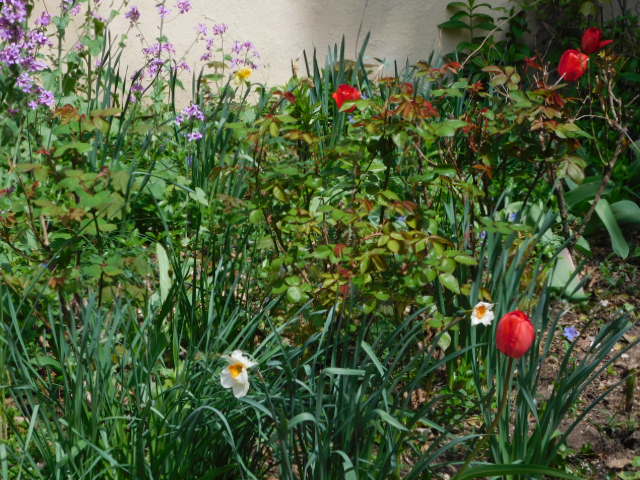
Bleeding hearts march along playfully although too easily overlooked.

  • A week in which I will pay no attention to newspapers, talking TV heads, nor worried contemporaries.  A retreat into meditation, self-imposed, visible only to myself.  Seven days of staring at skies simply as skies, flowers only as nature, food only as a gift gratefully received.
  • Fashion demands that I attend the fall of sparrows eight thousand miles away, gasp at troubles of endless places I shall never visit, care about tangents and projections of various experts.  Fashion may be correct, but I have rarely allowed myself to be constricted by it.
  • Perhaps one form of reality is correctly described by such fashion.  Religion, politics, future visons may all be right, may all be desperate, may all be horrible.  I wonder if such be true, if it may not then be wise to retreat into a lonely monastery somewhere away from the world, and contemplate happily all that has been and especially all that I have known, as the empire crumbles around me.

Tuesday

A young ailanthus frantically bursts forth to join leafing madness everywhere.
  • Surprisingly, for rapid-growing, beautiful, and useful trees, dogwoods have an average lifespan of around eighty years, which makes them about the same as modern American males.   At this time of year they are massively lovely (the trees, not the males.)  It always seems that their petals float in the sky, and in my mind they are always white or pink clouds hovering above.
  • For too long, I took them for granted, as springs went by.  I had other more important tasks to attend.  Then, when I began to notice the world as more than something I must shape, I was more astonished by unusual sights than by the steady companionship of the familiar.  Even now, our old pink dogwood out back _ almost generational, there since my wife grew up here when young _ and unfortunately slowly dying year by year _ is just a part of the everyday landscape.
  • As am I.

Wednesday

Our old pink dogwood not what it once was, still vital and beautiful, some lesson there for me.
  • “Apres moi, le deluge,” said Louis XV on the eve of the French Revolution, which indeed carried off his son and most of the royalty and aristocrats.
  • I’m afraid we boomers are beginning to feel the same way.

Thursday

Every inch of ground space crowded with impossible struggles for sun and water.
  • One enduring cultural fantasy has been that of the ancient familial homestead.  Sunny pictures of well-off farmers on ancestral grounds, gathering beneath an ancient oak tree on a hot reddening evening to pass wine with the wonderfully cooked dinner filled with home-grown produce.  Generations gathered around laughing, no doubt joined by a few convivial neighbors from the farms next door.
  • In that scenario, we usually see ourselves as somehow masters of the land.  Without too much hard work, shaping the very hills, taming the vineyards, plucking the fruit, gathering milk (rather mysteriously, for we are really city dwellers) and somehow creating wonderful artisanal cheese.
  • Dreams are fine things.  But historic reality is that many fled existences that were never like this to become urbanized or suburbanized or even to begin farming in a modern style.  And although they shaped much of their lives in better, newer ways, there were always constraints.  Few manage to go through life never encountering a barrier.
  • Amazing things can happen in a lifetime.  But the fact is most of us do not actually change our entire culture with a single vote, nor our lives with a single action, nor the world with a well-spoken point of view.  We are constantly told we can make a difference, but the difference we make is usually extremely limited.
  • Our true ambition should be not to seek literal Tuscan fantasies, but to embody in our actual existences the calm, peace and joy we believe existed there.

Friday

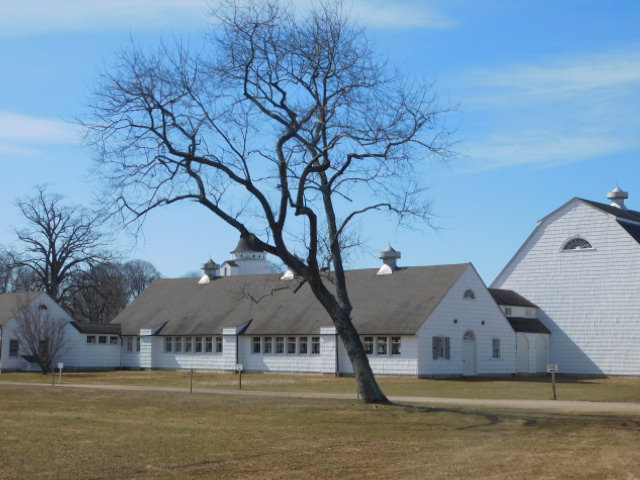
Surprising hillside horse hollow at Caumsett looks more like spring in Kentucky.
  • Heat in mid-spring New York is grudgingly granted.  Not so cold as Maine nor Canada, but often the world looks a lot warmer than it actually feels outside.  Winds sweeping over the chill waters of the harbor continue to bite, mists can cause involuntary shivers.  Occasional hot days only make the cold ones more annoying.
  • We take our Cinderella planet for granted.  A few days _ a week _ of too much heat, sun, rain, cold, dry, wind, anything _ can cause us to wonder what went wrong.  Are gods or nature angry with us?  Humans are so perfectly adapted to “normal” conditions that incredibly trivial variations seem important.  On occasion, I try to take a deep breath, stand still, and appreciate whatever heat
    , whatever precipitation, whatever light there may be in the sheer ineffable joy of existence.

Saturday

Clouds condensing in a cool oceanic breeze defy promises of warm sun.
“Sarah, Sarah,” whispers Simon, without trying too hard.
“Almost here, almost,” drifts back from whiteness coalescing in the clear azure sky.  “Ahh, that feels good.  Good morning, everyone.”
Nearby clouds nod politely, with an occasional grunted “g’morning.”  Quite a crowd of puffs today, Sarah notices.  Spots of shadow dotting the waters below.  “Anything exciting while I was away?”
“Nah,” says Simon, “All the excitement due tomorrow when Harry blows in.  Hard cold rain, whipping wind, nothing fit for the likes of us.  Low class, like all his stormy friends.”
“Thunder too?”
“Nah, Thor claims he won’t come by until later _ not warm enough yet, he says.  Likes to stay south as long as possible.  Did you have a nice nap?”
“Yes, lovely, thank you.  Immaterialization is such a relaxing joy, you’d expect more of us to do it more often.”
“I like seeing things and being seen,” answers Simon.
“You like seeing Daphne,” giggles Sarah.  “Little Miss Diaphanous,  you can see right through her half the time, just a constant tease.”
“I love seeing you, Sarah.”

Sarah swells a little and lets her brightness shine.  Happy times, she thinks, under a brilliant sun.

    Sunday

    Mid-spring natural cathedrals can inspire more awe than any human construction
    “Om” they say, just rest and be
    Unburdened in eternity
    Perfume, sunshine, sounds of bells
    Hunger, fear, manmade hells
    Ignore distractions, empty mind
    In emptiness peace you will find
    I sniff and think and hear and see

    Happy, afraid, content, and free.  

    May Be Local

    Monday

    Don’t want to get much closer than this to lovely, ubiquitous, nasty poison ivy.
    • Now I speak as an old man, which few are willing to do in these age-obsessed times.  I never accepted the current cultural wisdom about life, which is that children must be grimly groomed for adulthood, adolescents must be grimly culled into the successful or lost, young adults must grimly save pennies for a grim future, the middle-aged must grimly and selfishly grasp everything around them, and elders must never admit that they have become grimly less competent than they once were.  This is an outlook that attends a magnificent feast and can only (grimly) count calories.
    • Such despondent and hopeless attitudes are primarily formulated in response to remote events rather than local reality.  The paper says this and that, books say this and that, experts say this and that, media says this and that, strangers in the street say this and that.  We may never encounter this and that in our own lives, but obviously it is important because everyone else knows about it.
    • Each day of life, even for many of those in intolerable positions, is a potential feast.  And this is where I also have some difficulty with what everyone says.  For I am not sure that my happiness in my local existence should be grimmed down by far-away predicaments and events.  I have an infinite world of joy around me.
    • I wonder _ given that I have power only over my local bubble _ if I am really spiritually cleansed by ceaseless whispers from distant places that all is not well everywhere, and that my current happiness is temporary and somehow sinful.  Or is that just an echo of American puritanism now decayed into a kind of self-righteous guilt.

    Tuesday

    Fluorescent green algae coat low tide rocks beneath a persistent, almost Irish, mist.
    • Nothing is more global than air.  Smoke from a burning forest eight thousand miles away reaches us within weeks.  Radioactivity from any disaster does the same.  We are constantly amazed that weather on the other side of the continent sweeps eastward and affects us in days with showers or sun.  The atmosphere is a frothy mix of everything stirred constantly all the time and if anything is exactly the same anywhere on the planet it is the air we share.
    • Yet as I walk around air varies tremendously.  It blows hard in one spot, but can be calm a few feet away.  It has no scent here, yet a hundred yards further on may be putrid enough to make me gag, or sweet enough to evoke ancient memories.  A whiff of poison gas can kill me instantly, floating puffs of microbes may be just as fatal if more lingering.  One day it is wet enough to almost drown, another so dry that breathing rasps the throat.  As for temperature …
    • For all the local variations, it remains global.  But the local variations are what I notice, and sometimes I feel that local variations are all that matter _ even though I logically well know that is completely wrong.

    Wednesday

    Green is overwhelmingly resurgent, between silver sky and sea as rainfall departs.
    • All politics is local
    • Unfortunately, everything else is global

    Thursday

    Lilac is beautiful, but its glory is scent, which I can neither capture nor share.
    • Our biosphere is a master of recycling.  I am composed partly of atoms which were also used by tyrannosaurus rex, a blue pansy, Julius Caesar,  a giant pine, Lucretia Borgia, a nasty shark and _ well _ everything.  DNA has also exposed our family relationships.  There is only one kind of life on Earth, and given the rules of evolutionary engagement, that would probably be true anywhere _ although not necessarily the same kind of life as we enjoy.
    • In some ways, there is eternal serenity in that.  Whatever happens after I die, at some point part of me will be part of it.  Possibly a wonderful utopian civilization.  More likely a turgid sea of restless radioactive bacteria.  But atoms I have used will be swirling around in that mix.
    • Our minds have not become what they are by being humble.  Each of us contains a deep cosmos, a complete certainty of importance, an automatic filter on what is relevant.  Truly each of us considers ourselves meaningful in some way or other, even if it is only to help others be more meaningful.  That is hubris, but hubris is the core claim of humans, and we ought not write it off too casually.
    • On the other hand _ there are those recycled atoms telling a very different story …

    Friday

    Nearly infinite green hues may have names assigned by decorators, but naming doesn’t enhance reality.
    • Once upon a time, long ago, all North America was “public property.”  Then the Europeans arrived with their new-fangled sense of entitlement to common heritage and began carving the land into private enclaves, based on papers which granted o
      wnership in perpetuity to the original speculator.  It was a time of grand fantasies by philosophers like Locke and Hume and other partisans of individual rights.  One of these was that death is irrelevant to ownership. As it turned out in the American judicial interpretation of the constitution, even being a human person is irrelevant to ownership. 
    • I’m pretty sick of conservatives singing the hosannas of three-century-old philosophers and two-century-old merchant princes and landed squires.  Someone should look at the idiocy embedded in assumed sacred rights to private property.  Right now, the issue is a convenient legal fiction which has gone cancerous and is likely to destroy civilization.
    • If there is one certainty, it is that no matter how long we live _ even if people live for thousands of years in the future _ we all just borrow things while we exist.  Dreaming of control after death is insanity.  All property should pass back to the common wealth upon death, and all land should merely be rented from some political entity representing everyone.  Corporations should not be allowed to “own” anything at all.
    • This is a new era. People do not light homes with whale oil,  disease does not come from bad air, this world and its knowledge is vastly different from that several hundred years back.  Ditch the stupid reverence for “ideals” which are insanely out of date and didn’t even work well at their inception.  

    Saturday

    Between rains and seasons, new growth begins to overwhelm leftover stubble.
    Tommy slowly climbs the grassy bank,  bumping his way among other turtles who have already staked out prime sunning spots.  Finally he locates an open space and begins to bask. 
    Desmond’s foot has been disturbed.  He raises himself enough from a pleasant torpor to complain “Tommy, have some respect for your elders, eh?  You need to learn to be polite.”
    “Sorry, sorry.  I came out of hibernation late, that’s all.  Why do we all have to use this one place, anyway?”
    “Only one with sun, son.  You’re welcome to circle around the freezing water trying to find a better branch, but I’ve been around long enough to know what’s best.”  Desmond is a lot larger than Tommy.
    “Well, why don’t we leave here and find somewhere with more islands instead of on this cramped little space.”
    “Tommy, an adventurous little turtle is a dead little turtle.  Believe me, I’ve known a few.  Stick to what we all do.”
    “But there must be lots of wonderful places …”
    “Maybe so.  Maybe so.  But maybe no better.  Hecksher park is turtle paradise, and smart little turtles understand that or they never become smart older turtles.”
    “Oh.”
    “So leave me alone to soak up some rays and warmth.  I suggest you do the same.  Quietly.”

    Tommy thinks a moment, and then as is the way of all his friends, does not think at all.

    Sunday

    Impossibly overflowing azaleas light landscapes everywhere.
    Spring hormones surge, their net effect
    Seems nowhere rage.
    Peaceful beauty bathes the land
    Vast harmonious gentle shared.
    Underneath lush loveliness
    Survival struggles
    Tooth and claw
    Bud leaf and seedling

    Vicious calm.

    Here and Gone

    Monday

    Brilliantly emerald weeds add to the general exuberance of an exploding season.
    • Spring now launches into a period of wild bursts of activity.  Flowers suddenly blossom, hang around for a while hopefully awaiting early insects, then fade and vanish.  Overnight any tree can transform from bare brown to nearly full green.  A brilliant afternoon can suddenly turn viciously grey cold and rainy, or vice versa.  People learn to dress for anything and to expect the unexpected.
    • Naturally, such times recall old memories.  Some things are gone forever.  We had a large cherry tree that right about now would send showers of pink blossoms on every breeze, a fantasy scene.  Alas, it came down in a storm some years ago.  An old apple tree in our backyard has been missing for decades, and yet I still remember it blooming, with bees everywhere.
    • I try sometimes to meditate calmly and remember distant places and times, often anchored by the season in which I am located.  I do not dwell on summers or winters while April surrounds me, but rather concentrate on other Aprils elsewhere and elsewhen.  Usually, I fail.  Memory preserves only the most exceptional events in our lives.  Spring and April just flow by, creating gentle but fuzzy recollections.
    • So I do my best to appreciate April now.  That is what I have.  And that is an awful lot.  And I am extremely grateful for the opportunity to watch this season through its normal course, even if I will have forgotten most of it next year. 

    Tuesday

    Cherry blossoms overlooking harbor; not exactly Japan but Hokusai would appreciate the motif.
    • April showers are generally more appreciated in nursery rhymes than in real life.  A quick drip or two is dandy, but weeks of constant clouds racing by, a few delivering moisture, can be quite depressing.  Always expecting rain can also complicate apparel choices and what we carry with us on walks.
    • Of course, this is a hermetically sealed age, and I suppose I am more aware of meteorology than anyone except farmers and fishermen.  A retiree tends to focus on such things, having time to look out the window and the freedom to decide what to do today based on what is seen.  When I was working it was simply a dash from house to car to office and back,  the only notice of weather being in how it affected traffic.
    • I find it an exercise in contrast.  A brilliant sunny day around here is all the more exceptional for not being a dark rainy one.  A dark rainy day can sometimes even be a relief from enforced sunshine.  At least, I can try to make that my attitude, and I often succeed.    

    Wednesday

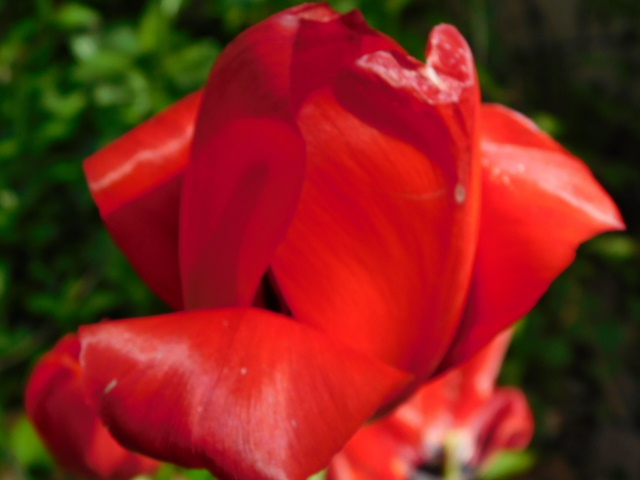
    Tulips require a farmer’s foresight and optimism; planting bulbs months and seasons before any results.
    • Where are the snows of yesteryear?
    • Gone into forever with the blooms of last spring. 

    Thursday

    Finally our Cinderella landscape is getting dressed for the ball.
    • Our minds are so constituted as to embed important patterns that let us make sense of our world.  Once a pattern is in place, we tend to ignore the particulars.  A tree is just a tree, a cloud is just a cloud.  I may enjoy watching a robin, a blue jay, or a cardinal outside my window, but I have no overlays of such birds in other times and places, not even from last year.  I surely know what a robin, cardinal, or jay look like, but it is a single composite picture, not a series of snapshots from the past.
    • I contrast that with unusual sights seared into memory.  A bald eagle flying along route 17 one year, buzzards at a park in Florida another, hawks swooping below us at Letchworth state park.  These I may never see again, but they remain somehow vivid. 
    • And so it is with many things.  That is why travel is supposed to broaden the mind by filling it with the strange and new and out-of-pattern, so that we come home with enriched imaginations and enhanced perceptions.  Sensory and mental tools sharpened, we are prepared to pay more attention to local experiences that we previously took for granted.
    • Growing older, of course, is a constant evolution of mental fog.  We claim to remember some things well, especially from childhood and adolescence, but the fact is we have a lot of trouble saying what we did any given day last week.  Probably part of that is we now have had so many days to recall, but a bit of it is sheer neuronic decline.  The flip side of that _ a bonus if we treat it correctly _ is that any view of a cardinal, robin, or jay can be a delicious and astounding event that we can enjoy as if it were the first time.

    Friday

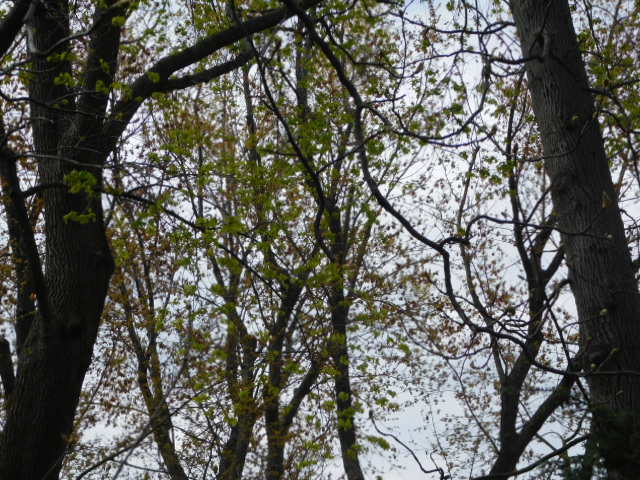
    Overhead canopy unfolds in a variety of pastel brilliances.
    • Huntington tulips are not invasive and never naturalize.  It is possible to see entire hillsides covered with daffodils lasting for centuries, or to come upon untended crocus patches in secret for
      est glens.  Tulips require care, and replenishment, and human intervention.  But they are so beautiful that everyone plants them anyway, year after year.
    • They do cause problems for towns and sites that advertise their “tulip festivals.”   In Holland, blooms last a while in relatively predictable weather.  Here, blooms may come and go in a day or two if the weather is too hot, may never happen if the ground is too dry, may open brilliantly only to be destroyed by a sudden harsh rain.  And the timing is never certain, even when varieties are planted together to hopefully give an extended bloom.
    • There is probably a life lesson in tulips.  Fortunately, for me right now, the sheer esthetic pleasure of viewing them overwhelms such arid intellectual thoughts. 

    Saturday

    Lonely cherry tree blossoms profusely in the parking lot at a local harbor deli, mostly ignored by hungry passers-by.
    “Larry, Larry, hey, what’s new?” Anthony glides slowly onto the sand next to his friend.
    “Hey Tony, yourself.  Nothing much.  Holding the fort.”
    “Where’s the gang?” asks the great grey gull loudly, as usual.
    “Here and gone, mostly gone.  Bob and Tina said they were tired of the local food options, she couldn’t stand raw clams anymore, they flew down to the city a while ago.”
    “Boy, they should have checked out the south shore.  You would not believe what you can get at some of the ocean beaches if you hit the right day ….”
    “And Patsy, Heather, some of their friends _ young crowd you know _ into the city too.  More excitement, easier pickings, tired of the same old fare.”
    “Who can explain this younger generation,” grunts Anthony.  “But what about Mark, Bob, Marsha?  Nothing but dynamite would make them move.”
    “Gone, just gone, I’m afraid,” responds Larry.  “The winter was going so well, even for them at their age, but then that last unexpected ice storm just hit too hard.”
    “Ah, ah.  Life goes on, I suppose,” Anthony sighs.  “Well, good to see you here at least.”  He glances at the long stretch of empty beach.  “Sure not like the old days.”

    “Nothing is.  Nothing is.”  They squawk a while longer, then wing out over the whitecapped waves.

    Sunday

    Wind-ripped pink blossoms
    Innumerably strange
    Float

    Evoke ancient dreams

    Rejoys

    Monday

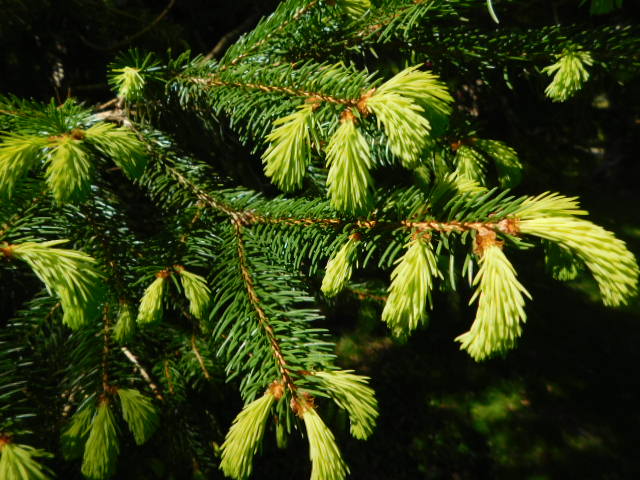
    Almost unnoticed, pines also begin annual renewals of leaves and cones.
    • A few days of much above average temperatures and a return to “normal” temperatures have transformed outdoors immensely.  Bushes are in full bloom or well on their way, yellow patches sparkle on newly verdant lawns and roadsides.  Birds are in full throat, even managing to occasionally drown out the leaf-blowers and lawn-mowers also just out of hibernation.  People smile, children jump about happily, and all the world is an optimistic place.
    • Some would wish to be nothing more than logic.  Cybernicists dream of pouring themselves into cold silicon and living forever as frozen circuits.  Spring days are a reminder that we are not mostly logic, but rather emotions and senses and memories and flesh and blood and none of that translates to transistors.  We should glory in being who we are, which is more than we can possibly imagine, in an infinite world still perfectly suited to our needs.

    Tuesday

    Early boat traffic is now constant, but most docks remain winter empty.
    • Robins are everywhere, hopping about the lawn, seeming to listen intently, pecking away.  Supposedly they search for worms, even in frozen ground when they arrive a bit too early.  That hardly explains their journey across vast asphalt driveways with the same rhythm.  So concentrated on their task that they often ignore people until someone is right on top of them.  A wonderful mark of returning spring, a certain sign that real winter has ended.
    • Once upon a time I would have tried to see if my conventional wisdoms are true.   What do robins really eat, where do they overwinter?  Now that my curiosity is aroused, I may even take a few seconds to look up the facts.  But lately my pleasure in noticing such things is not particularly enhanced by knowing more.  I am content to watch and enjoy and simply rejoice that there are still wild birds with mysteries (at least to me) in the world. 

    Wednesday

    Two confused ospreys, after their nest was cleared off a boat by the owner.
    • Biblically, this is the day the lord has made, ee cummings called it the sun’s birthday.
    • Each day is the present day, the feast day, the important day, and the only real day we experience.

    Thursday

    Hills change hue day by day, almost hour by hour, as sap rushes about frantically waking things up.
    • In conventional jargon,  spring in Huntington has reached a tipping point.  It is possible to imagine a late blizzard or freeze, but events like that are nearly in the category of imagining nuclear war.  Under normal circumstances _ another cliché _ flowers and leaves are so far advanced that there is no going back.
    • Only humans can even conceive of things like points, concepts like going forward or going back.  A “tipping point” is a convenience with no actual existence, like the imaginary square root of minus one (minus one itself being another such concept.)  The world just rolls on as it will, changing as it must, becoming whatever it will become, no matter what we think.
    • Of course we worry, especially at our own actions.  I am amazed there are still so many birds, still insects, that I can still breath the air.  Humans have ruined so much, and do so at an increasing pace, and it is all too easy to understand other concepts like a “silent spring.”
    • We are stuffed with concepts, and perhaps like statistics, too many concepts and facts dull us to specific instance.  A million birds dying somewhere does not affect us as much as one blue jay wounded by a cat in the back yard.   That intellectual gap, unfortunately, may be what destroys us and our civilization. 
    • Then whatever comes next, if anything, can invent their own concepts and document the tipping point that drove us into our own extinction. 

    Friday

    Maple flowers adding to high sneezable pollen invisible in clear cool air.
    • Often maple trees have begun their stately progression to full foliage by late February.  After all, in much of New England the syrup season ends in mid-March, as the sap changes its nutrient levels to accommodate flowers and leaves.  By April, florets usually hang thickly on trees, providing a reddish or greenish tinge to the horizon and surprising those who examine nearby overhead branches closely.
    • Not this year.  Even mid-April, the twigs are mostly bare and brown.  There are a few indications of growth here and there, but it requires a close inspection to notice.  Trees are overwhelmed, for once, by the actions nearer the ground.  The surprising and varied patterns of seasonal cycles are one of the joys of having the leisure to appreciate them.  I admit that in my working days, I was usually more concerned with getting somewhere than with looking around where I was.  Today, I try to remember what I saw anew each day, a
      nd be constantly amazed at the wealth surrounding me.

    Saturday

    Busy robin munches away at something, or maybe just gathering for a nest.  It wouldn’t answer my questions.
    “Hey Sophia!” yells Brandon, racing across the playground towards another ten-year-old on the jungle gym.  “Did you see that huge bird over us a minute ago?”
    “Sure did.  What a monster.  I wonder what it was?”
    “My mom says it’s an osprey _ it builds huge nests out of sticks and eats fish.”
    “Raw fish?  Yuck.”
    “Well, if you like them you like them.  We have sushi sometimes …”
    “I don’t even like fish cooked,” notes Sophia authoritatively.
    “My mom says an osprey is a kind of eagle.”
    “Oh,” muses Sophia.  “Dad showed us an old painting and told baby Carl that eagles carry away bad little boys.”
    “Cool!  Wouldn’t it be fun to be a bird, nothing to do all day, float around and look down at everything?”

    “And if anybody bothers you,” she sticks out her tongue at Brandon, “you can just fly away.”

    Sunday

    All day fog settles in again, preserving daffodils and tulips in cool mist.
    I am
    No mover, shaker, one percent
    Not three percent nor five
    As rich and poor as anyone

    Who knows they are alive

    April’s Full

    Monday

    Lovely porch to view opening forsythia if you’re wearing a parka.

    • Having become certain that I understand the new destructive patterns of the world more completely, it has been refreshing to be reminded that surprises continue.  After long spells of drought, higher than normal temperatures, calamities predicted, there have occurred months of low temperatures, snow, rain, and gloom.  An unexpected normal,  at least for what used to be considered normal.
    • I believe climate is changing ferociously, and industrial activity is at fault.  I do not believe it will wipe out all the species on the planet (we are doing that quite well on our own.)  Humans will cope, as they always have, as they did through surprisingly swift and devastating climactic changes over the last two thousand years.
    • The oceans may be a different story, as they continue to absorb immense quantities of CO2 and limit the damage we perceive.  As for the rest …
    • I don’t know.  I have today, and the last few months, and it has been unusually chilled and my old bones do not appreciate that as they should.  In any case, I remain unsure of my predictions, after being been corrected so thoroughly by natural reality.

    Tuesday

    If it were only rare and hard to grow, this would probably be a prized specimen.
    • Dandelions prove reliable indicators of spring.  Sometimes they bloom late into the fall, but I’ve never seen one in February or earliest March.  The first is a welcome sight, popping up on dirt tracks or unmown lawns, bright yellow amidst otherwise pale hues.  And then they just keep blooming and blooming and blooming.  Each individual flower is marvelous, each fluffy seed head dreamlike.
    • Around here they’re regarded as pests.  Much money is spent keeping them at bay chemically on lawns, and nobody dares or cares to make dandelion wine, which I’ve heard is not as excellent as its name.  I admit that after a few months they fade from notice in my own mind, and I pay little attention to them until fall again marks their prominence.  Their very abundance detracts from their appreciation _ a lot like water.

    Wednesday

    Resembling the three graces, swans in cold water, warm air, bright sun, winter landscape.

    • Like a watched pot of boiling water, spring lawns never seem to be growing until they are suddenly deep, ragged, and bushy

    Thursday

    Natural abstraction glows in early afternoon, with full multimedia provided by birds.
    • Our minds are filled with symbolic archetypes such as a tree represented by a green ball on top of a brown stick.  “Spring” recalls a single perfect day with birds singing and daffodils blooming and us lying happily in green grass feeling a somewhat chill breeze in pleasantly warm sunshine.  Perhaps another day of gentle rain flicking off brilliant pink azaleas.
    • But spring is a whole season, filled with events great and small, usually running out of synchronization with our calendar beliefs.  My mind has it laid out as a formal ballet, beginning sometime in late February, like Tchaikovsky’s dance of the flowers _ a progression of floral displays, average temperatures progressing, leaves unfolding on trees.  A calm and orderly three months.
    • Last year, I seem to remember (but I am old and who knows?) it was like that.  This year will be more compressed, running fast-forward for a while as lingering hibernations try to catch up.  I am arrogant enough to even resent that they will force me to adapt to their pace with all my outdoor chores already behind my perfect visions.  On the other hand, at least we are arriving at some fine days at last.  

    Friday

    One or two days of high heat has been enough to instantly activate pond scum.
    • In completely residential areas, the notion of “native,” “wild,” and “introduced” becomes murky and meaningless.  There are no undisturbed soils nearby, no virgin forest, no connected tracts of ancient lands.  Amidst the houses, lawns, and dense road networks,  all uncultivated plants equally eke out a living on marginalized forgotten areas, temporarily open spaces, or overtrodden parks.  So my distinction (applied only to those species which do not need direct human intervention to survive year by year) becomes more one of “weed,” “native,” and “semi-wild.” 
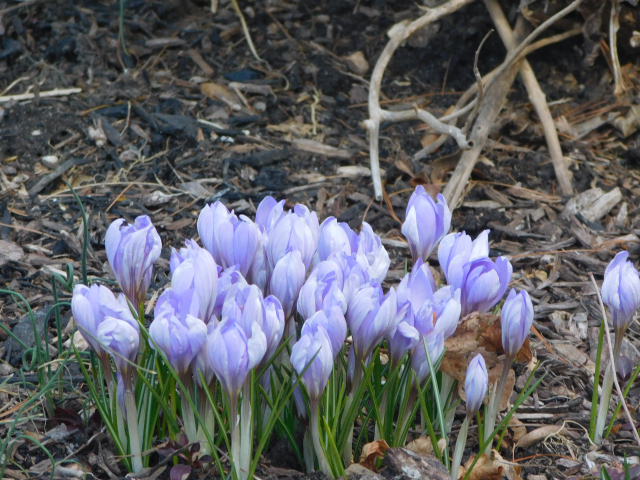
    • By that standard I can count roses, forsythia and crocuses as semi-wild.  They escape quite well and thrive in local habitats, even though I suspect that if people were to vanish entirely they might disappear a few centuries thereafter.  But in the meantime, I come across patches of crocuses in secluded forest glens, roses surprising me almost anywhere, and forsythia marking the sites of former estates.   I would like to be considered akin to them, but alas I myself require too much cultivation and ongoing care.

    Saturday

    Green or red blush haze floating around vines and shrubs resolves to unfolding leaves on closer inspection.
    Sitting quietly on a warm April day, listening to the chatter of emerging leaves.
    “Ah so tired ah so tired,” drone curling limp exhausted garlic clumps, up for over a month.
    “Gushwatchout gush watch out,” sing tiny green ragweed rosettes spreading thickly everywhere.
    Briars and wild roses sharply unfold from thorns “Buzz crack saw buzz crack.”
    Under it all echoes “swish clang clip swish” from infinite blades of grass posed en garde.
    Overhead, trees in various states of exertion “yawn maybe stretch maybe yawn” buds swelling a few beginning to spread.
    “At work, stand back, at work, just work” vines along the road magically sprout and fill everything with green.

    A reverie only partially fantasy.

    Sunday

    April March together run
    Normal two months less than one
    Too fast each morning something new
    Flowers, grasses, trees all grew
    Too slow when dark clouds shadow hills
    Sharp winds strip heat with damp and chill
    Nature ignores me and my views
    With more important tasks to do
    Days or weeks, months as it will
    Whatever pace, nothing stands still
    I may complain of rain or sun

    No matter what, I must have fun.

    Remarkable

    Monday

    Seems a shame, daffodils defiantly spurt into bloom, only to be battered by heavy rain.
    • Only a romantic living on the British Isles in the last century could think April is the cruelest month.  For most of history, at least in Western Europe and North America, just about any month would have its share of possible horror and disaster.  Famine, plague, war, crop failure, weather misery.
    • Well, we’re temporarily at least beyond all that.  Each day is marvelous.  But still, we manage to worry a lot, mostly that it will all go away.  I don’t know if that is basic human perversity or just a lack of grace in the cultural soul of United States citizens.  
    • Fortunately, life usually grabs us by the throat and forces us to exist in the moment.  It’s hard to encounter a bright red cardinal, a newly returned robin, a pair of gamboling squirrels, without breaking into a grin.  Hard to ignore crocuses and daffodils and an explosion of forsythia bushes or puffs of maple flowers high overhead.  Right now, this instant, warm and safe and well fed and happy _ isn’t life fine?
    • Well, yes, we admit grudgingly.  But you know …. And off we go into a litany of possible, probable, massive, apocalyptic looming disasters. 
    • I stop myself there,  I force myself back to the birds and flowers, back to the sky and water, back to my berries and milk, back to the reality that right now for me this is a great time.  I should make the most of it.  

    Tuesday

    Nice one day, brutal fog next, again grateful to not be an ancient mariner.
    • Water.  Fog, rain, reflections, ripples, breakers, drinks, baths:  infinite lists, infinitely present.  Life itself.  And, underlying all which is obvious each day, the transformations of weather and scenery and well-being,  are magical chemical properties in an astounding atomic structure.  So easy to take for granted, even easier to seize on one aspect or notion.
    • Spring in Huntington can be the season of overt rain.  It falls heavily or lightly from mists, mixes into mud, forms sparkling droplets on bare branches.  After days of precipitation, our mood longs for it to go away, but after a long spell of dry cool wind we are grateful for its return.  The most remarkable thing about water is that we usually end accepting it as not remarkable at all.

    Wednesday

    • April showers bring May flowers.
    • But April flowers are more welcomed.

    Thursday

    Grass is greening but most of the landscape remains February mode at Coindre Hall.
    • How remarkable it all is.  Every morning I wake amazed to be alive, to be here, to be me, to have an entire new world to explore.  Infinite things to enjoy, discover, ignore, or complain about.  Bits of pain and hardship to accent joys and comfort.  What a world!  What a life!
    • Yet I become as jaded as anyone.  My senses quickly filter all immensity into streams I can accept without overload.  I fail to notice most of the ongoing information.  Sight, sound, touch, scent, taste, internal rhythm _ all of it fades away to be replaced by the pale cast of organized logical thoughts or wandering daydreams.  My mind immerses itself in the swamps of cosmic mysteries contemplated, and leaves all mundane reality behind.
    • What a fine thing it is to live in a chaotic, unpredictable universe!  How dull it would be if we really were to inhabit some perfectly controlled environment, a Newtonian nightmare with no surprise nor mystery.  This morning, this day, I am overwhelmed with happiness.
    • Yet, already, I fade into a land of desires and begin the cycle of desires anew.

    Friday

    Some dark rainy days the only available colors are cheerful yellow oil-restriction booms.
    • Humans breed plants for varied reasons _ better food, nicer flowers, drought resistance, leaf color or shape, and so on.  Few, however, concentrate on buds.  Like all the intricate miracles of life, buds are all different and all fascinating to stare at, at least for a while.
    • The ephemeral nature of buds, of course, makes even the thought of growing a plant for its bud structure a little odd.  Buds are usually even more ephemeral than the flowers or leaves they will eventually produce.  This time of year is truly the season of buds.  We observe them anxiously, awaiting their promise of finer things to come.  I guess they would think it’s good enough to be noticed _ even for a short while _ than to be ignored all the time.

    Saturday

    No new shoots on reeds, no leaves on trees, boats still high and dry, spring seems later than ever.
    “Hey, hi there, handsome!”
    Dan perks up on his hind legs, balancing, almost forgetting the seed in his squirrel paws.  “Gosh, hi Suzi!  What a surprise!  You’re looking good.”
    “You too, with that big strong full tail ….”
    “That’s not all that’s big and strong and full,” barks Dan salaciously.
    “Oh, you boys are all the same this time of year,” little coquette Suzi responds.  Suddenly she twists upward.  “Oh, look!  Something strange!  I must dash!”  She runs up the thick trunk behind her.
    “Wait Suzi Wait!” Dan scampers after.
    “Catch me if you can!”  she flies from a hemlock branch onto a nearby roof and races across.
    Dan follows, ignoring danger, finally draws close as she pauses for breath on the limb of a distant hickory.  “Why do you have to be that way?” he pants.
    “If you can’t keep up,” laughs Suzi, “I just might go see how Ralph is doing ….”
    “Aw, Suzi …”

    Day continues bright, cold, clear, spring, endless time for both of them entranced in the instinctual dances of nature.

    Sunday

    April sings seductive songs, pied piper of the North
    Blooms pop, robins hop,
    Squirrels play, bulb shoots sway,
    Trees’ verdant buds burst forth.
    Sunshine streams so bright it seems a crime to stay inside
    Rush out to see, immediately
    Skin gets cold, joints ache old,

    Patience whispers wait, abide.

    Seventy Springs

    Monday

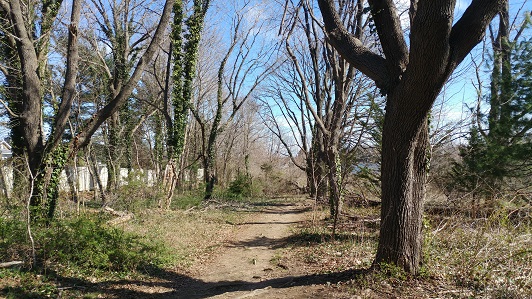
    Fewer and fewer public forgotten woodland scenes remain in Huntington in this era of aerial real-estate treasure hunting.
    • I notice that my Monday entries for the last two weeks have been basically identical.  Another sign that short term memory is becoming less clear.  Although, I admit that throughout my life I have had brilliant new ideas that somehow on examination seem to be the same as some great old ideas I once had.
    • Accepting limitations on our minds is just another part of aging, no matter what people say.  After twenty or so you cannot run as fast as you once did.  After thirty the muscles begin to weaken a bit, the gut to enlarge.  By sixty the skeleton is chorusing complaints with the various joints, skin is cultivating blemishes, hair is thinning, all the senses are less sharp.  And god knows what is happening inside.
    • Speaking of God, it was nice once in a while to accept a Calvinistic or Greek outlook on ambition and achievement  and regard myself as a pawn of fate.  I could relax because I was hostage to situation and genetics.  In the short run I could affect my world, subject of course to luck.  Calvin provides a lovely fatalistic crutch when things go badly, and an equally good dissolver of hubris when things are good.
    • Now, of course, ambition and hubris have all melted into the great pot of looming mortality.   As hard to ignore as an iceberg sighted from the bridge of the Titanic.  Thus I am back to where I always was, day by day.  As more and more of my bloated elderly peers make fools of themselves in politics or economics, a decision to exist mostly to remember and appreciate and help others now and then seems completely rational.    

    Tuesday

    Fog softening shoreline is common in March, but picture doesn’t convey damp chill nor cries of overhead geese.
    • Tides are almost the swiftest of the many signs of cycles which are never exact cycles.  Rocks vanish twice a day, reappear, but every grain of sand and each shell has been shifted or broken.  Most of the algae grows or breaks off.  No wave, no sparkle on any wave, ever repeats.
    • I have witnessed many cycles, cycles within cycles, cycles that still continue, and cycles that have ended forever.  I remember many springs past, although not so clearly as once, filled with adventure and hope and love and all the many annoyances of life.  Now there appears another _ thankfully.  A new cycle has continued with a grandchild.  But what I most realize, peering back and trying to recall thing honestly, is that what I thought might be permanent has gone forever. 

    Wednesday

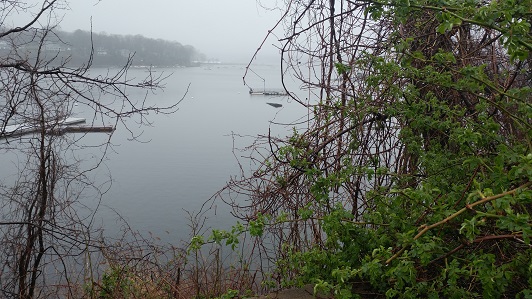
    Reflective tidal pools in constantly renewing marshes harmonize with cold fog and plaintive cries of gulls.
    • Act your age.
    • Imagine yourself whatever you wish.

    Thursday

    Wet days bring out the glow of reeds.
    • I get a kick out of young men on a Paleolithic diet.  After all, most science shows that our distant ancestors died at forty or younger, worn out by, among other things, their diet.  The most striking thing about culture _ the last forty thousand years of human existence _ is that it has allowed a few people to live well beyond their normal biologic destinies.  Some even claim that our relative longevity evolved to help culture itself survive. 
    • So I am well beyond my Paleolithic destiny, but still within a prehistoric cultural norm.  The head Druid could have easily been a septuagenarian who knew all the ancient rites and directed everyone else on what to do.  My only function may be in helping civilization and my family continue, but that is a relevant function.
    • One of the difficulties of achieving elder status in some comfort is that I find it easier to pause or even stop than to go.  I should of course be content with my day, but if I don’t struggle a little bit with destiny I risk sinking into a couch and only getting up to find a new bag of snacks. 

    Friday

    Gloomy cold fog, spring that refuses to say goodbye to winter.

    • Sometimes physically, more often virtually, I revisit places I have been.  Some things have remained the same, and spark my memories into greater clarity.  More often so much has changed that I am nearly lost.
    • My local wanderings have dulled that transition.  I scarcely remember what Huntington harbor nor the town itself looked like forty years ago.  There are enough vestiges of the ancient remaining to give the illusion of permanence.  But certain picturesque spots have vanished forever, huge houses crown the hills and engulf the plains, immense automobiles speed along highways.  Everywhere there is more signage and less nature.  Even the nature that exists tends to be more manicured, less a spot of wildness than a cultivated garden.
    • I don’t claim that is bad or good.  I do know it is different.  All my past is different from today, as yours will be different from tomorrow.  And it is at such times of recogni
      tion that I most keenly feel my own years speeding past.

    Saturday

    No professional photographs, blurred, but the idea is there ….
    I turn around after closing the gate to the dock carefully.  Sure enough, there’s a darkly cloaked figure resting nearby.  “Welcome,” he greets me in somber tones.
    “Ah, Grimm, I don’t need you this fine morning.  Why don’t you save your visits for the deep of night, as usual?”
    “Omnipresent in your thoughts.  Another year gone by.  Another step closer…”
    “For seventy years, on the other hand,” I laugh, “it’s been another moment gone by, another bit closer.  What’s so special about now?”
    “You must admit the end is nearer, anyway.”
    “Not really.  As an adolescent possibilities of nuclear war were just as omnipresent.  And in my twenties I was sure all really good would-be romantic artists died before they were thirty.  Nothing new.”
    Grimm is not about to give up easily.  “Quake, mortal.  Fear that false beat in your chest, that minor pain in your arm, that moment of dizziness, that strange queasiness in your bowels.  Signs, portents, forebodings …”
    “Tra la,” I mock.  “Eternal dance, I suppose, but I still have this real morning, and you own only the imagined future.  I suppose I could tell you to begone, but honestly, I do not mind the company.  Stick around for a while and watch the gulls.”

    He scowls and groans and fades away.  I return to my pleasant untroubled solitude.

    Sunday

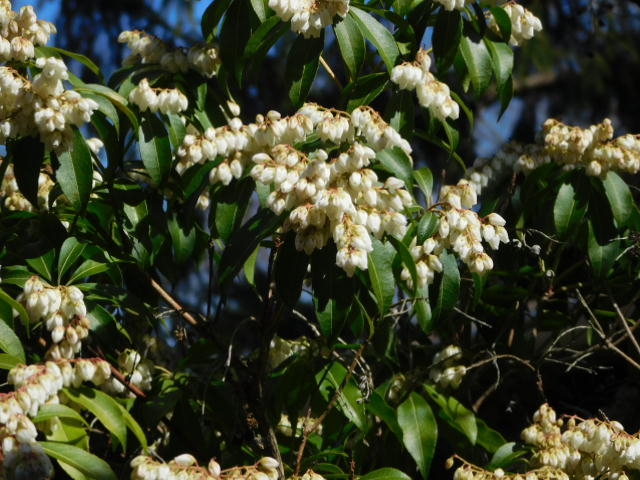
    Andromeda blooming late this year,  heavy fog at noon
    Seventy springs have flown the years
    Innumerable months, days, hours, moments
    Most inevitably forgotten.
    Sometimes I think I’ve done everything
    Sometimes I strain to do just a little more
    Mostly I’m just glad I’m here,
    I’ve been there,

    Unique in all the universe and time

    Home Sun

    Monday

    Tiny newborn wild rose leaves along the shore seem impervious to even hard frost.

    • I retain enough of my childhood upbringing to have an occasional tinge of the religious rituals I followed faithfully in early years.  One of those, of course, was Lent, a season of deprivation meant to make Easter all the more glorious.  This year is practically a reenactment, as winter seems determined to make us appreciate better weather when it finally arrives.
    • In less parochial terms, the solstice sun will be gladly welcomed as daylight outlasts darkness once more.   Obviously a few minutes more here or there do not add dramatically to Earth’s heating, but psychologically the next seasons are already in view, and all of them promise optimistic adventures.  Adjectives describing spring and summer are rarely depressing, and even fall _ inevitably tinged with sadness _ is more reflective than despairing.  Simply said, we are glad to see winter depart, even if that only occurs on a calendar.
    • Equinox is the true start of the new year for those of us at this latitude, on this continent.  Once the latest blizzard snow melts away _ more quickly by far than would happen in January _ we will be back to the almost too rapid changeover from white and brown to glorious color.

    Tuesday

    Stubborn snow drifts from our recent ice blizzard resist the notion that spring has arrived. 

    • As has happened for eons, weeks of mild weather were recently followed by deep frozen nights, inches of ice, and northern blasts of wind.  Bulbs and low plants were protected by blankets of snow, but some opening leaf buds have been blasted back into black crumbles.  Perhaps they can survive, perhaps their branches will be lost as well.
    • It’s always good to be reminded of the capriciousness of nature.  I become too used to predictability and think it is normal.  After all, store hours are set, food is always available, my life attends seconds clipped by electronic quartz crystals.  Each day can be much the same, regardless of outside conditions, if I so choose.  I only need expose myself to what was once known as reality when I want to.  So a blizzard is a nice slap in the face delivered by fate, reminding me how lucky I usually am. 

    Wednesday

    Looks like an ancient Canadian trapper’s cabin, but just another remnant of Gold Coast Heritage on Lloyd Neck.
    • I was taught to sing “Faith, hope and charity.”
    • I suppose nowadays it goes “Greed, fear, and misery …”

    Thursday

    Unnoticed minuscule flowers carpet disturbed ground, getting a head start on the competition.
    • Just when it had seemed this would be nearly a year without chill, like some late patron of opera, winter arrived with  flashy fanfare.  It was not so much days of snow, nor inches on the ground, nor sleet itself, nor even deep freeze the day after.  What annoyed was malingering and refusal to make way for the next stage of spring.
    • Snowdrop flowers, delicate crocuses, half-up tulips, nearly-open daffodils were encased deep under a layer of solid ice.  They may have been the luckiest.  Exposed buds and leaves  were brutally eliminated by prolonged temperatures near the lowest of this year.  Now we wait and see what, if any, permanent damage has been done.
    • Waiting for spring in March is a lot like waiting for utopia.  We keep hoping it will arrive any minute, and that perhaps there is a little we can do to guide it along, but soon enough all plans are smashed and we are cruelly reminded that reality is reality, and all the old patterns will always remain.  Old patterns will always triumph.  And, in spite of that, things will probably work out ok.

    Friday

    No blush of spring yet in these trees and woodlands.
    • Even on the coldest days, in the strongest winds, under the bleakest skies, birdsong is becoming louder and more continuous.  No matter the conditions, birds are taking to flight, often in pairs.  Territoriality has broken out on the shoreline and around the bird feeder as the breeding season approaches.  Life may be tough, food may be hard to find, but the avian population is driven by instincts honed to the timings of sunrise and sunset.
    • Bird watchers anxiously peer through binoculars to add new species to their life lists, or to reacquaint themselves with old friends.  Many marvelous guidebooks now provide an infinite resource for such hobbies.  I am less detail-oriented, perhaps because I now find that for each fact I acquire each day, I seem to forget a few others I used to know well.  My most important task has been to replace attitudes like “oh, it’s just some birds,”  with “wow, what a wonderful woodpecker!”

    Saturday

    Winter detritus litters high tide marks along a dormant beach as it awaits community cleanup.
    “Hey Alice,” I call to a neighbor passing up the hill while walking her dog in the bright morning.  “Happy Spring!”
    “Just thinking the same thing,” she replies, “although it’s sometimes hard to tell,” she continued, gesturing to the piles and sheets of snow all around.
    “Yeah, this week we’re living up to being called the North Shore.  We were just visiting the South Shore yesterday and the white stuff is basically gone.”
    “Well, my yard looks like the North Pole or Greenland,” notes Alice.
    “Ours too.  And no matter how warm the sunlight, the air is going to stay cold until the ice goes away.  At least the sun is getting hot.”
    “Don’t forget it’s out longer too,” she adds.  “I for one love daylight savings time, when the evenings have returned as useful parts of our day.”
    “Me too.  Well, enjoy the day.”
    “Oh, that’s easy enough, with April around the corner.  C’mon Duff,” she tugs her pet onward.

    I wonder if it is still too early to get some pansies to brighten up our patio.  The sun says no, the ground and air say yes.  I think I’m gonna give this decision to the sun.

    Sunday

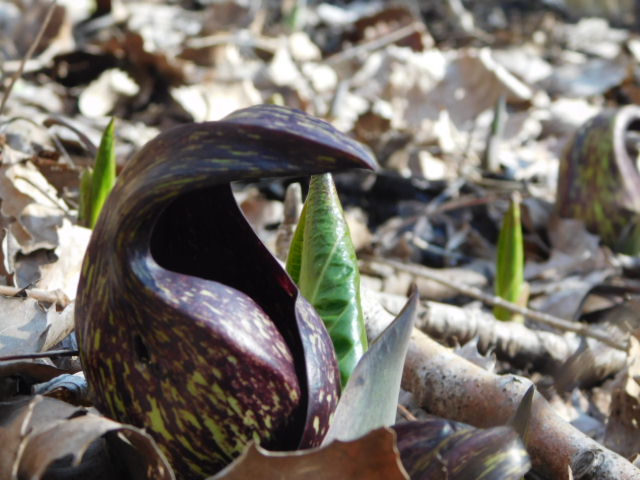
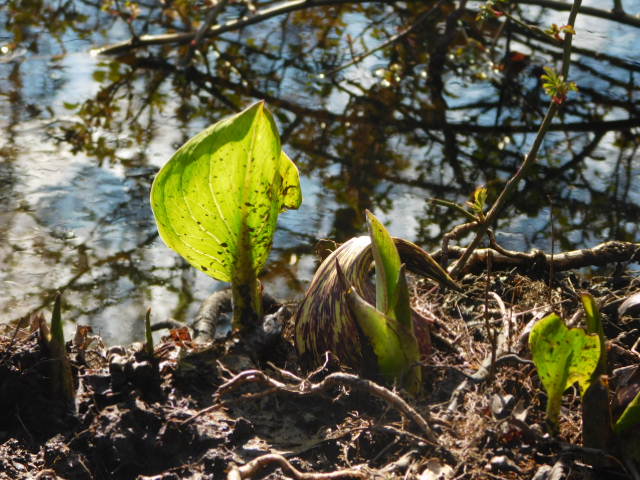
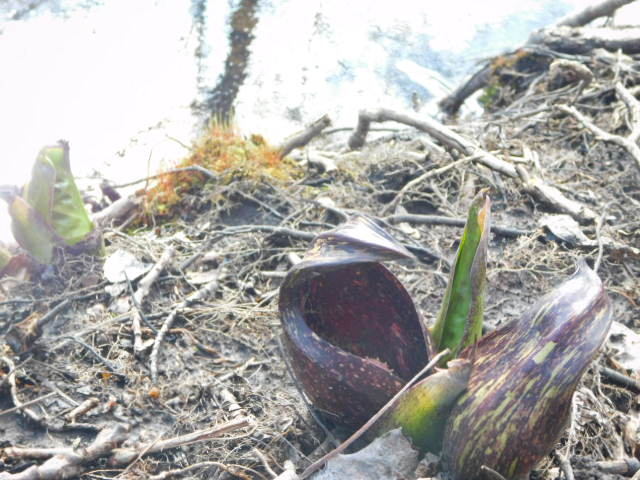
    Skunk cabbage blooms already beginning to shrivel as leaves begin unfolding.
    Just might rain, or maybe snow
    Might feel warm or sub zero
    Might blow winds or calm as glass
    Just might stay brown or green the grass
    Just might  be brilliant, or thick fog
    Might sprout flowers, mud might clog
    Might be predicted or perverse

    Just might get better, or get worse

    Marching On

    Monday

    • Sometimes I fall back into the religious moods of my youth.  This time of year does remind me of Lent, a time of penance and deprivation before the full joy of Easter springs forth.  The weather promises wonderful things, then suddenly removes fine days as quickly as they have arrived, replaced with snow and cold and harsh windy rainstorms.  But always there is a gleam of promise in the near future.
    • In another metaphor, perhaps it is that nature begins to wake from what seems a long coma.  Signs are everywhere if I look, from small buds to grand flowers and emerging green shoots.  The entire local environment is in renewed ferment, if I search deeply.  Just, perhaps, not moving quickly enough to suit my impatience.
    • Magically, the mornings are darker and the evenings lighter.  Daylight savings time does not affect anything except people and their artificial hours, but perhaps even birds notice that the rhythms of those crazy humans have unexpectedly lurched an hour.  Or maybe everything ignores me as completely as I too often do everything.

    Tuesday

    • March always seems a youthful season, a screaming newborn infant, juiced with potential and fully formed aspirations, but difficult to deal with.  Whereas autumn can seem morose in spite of its colorful beauty, spring is culturally a time of hope and optimism, in spite of the actual external conditions that may hang around (here at least) through mid or late April.  Certainly the signs of life are everywhere, forcing their way restlessly from hibernation or seed. 
    • Even heavily bundled up, I notice clumps of brilliant crocuses, glints of verdant tiny leaves, expanding buds fuzzing the outline of trees and shrubs.  If I pay more attention, on warmer days, there are solitary bees or other insects, and once in a while a swarm of gnats seemingly lost in the wilderness.  Life is awakening rapidly.  When I do not notice that, it is entirely my own failure of observation.  Another year, another spring, another launch into presumed happy times to come.

    Wednesday

    • It’s an ill wind that blows good to no one.
    • Chill blustery gales at least make me appreciate my snug home. 

    Thursday

    • Spring has become my season of anticipation.  I anxiously watch daffodils and crocuses, garlic and chickweed, swans and ducks,  bees and gnats,  willows and maples,  as they progress day to day.  So much is happening, so much is unwrapping.  Santa Claus rides down the wind every night, leaving presents to observe the next morning.
    • Sometimes it can get out of hand.  Why, I wonder, has the forsythia _ primed for weeks now _ not yet bloomed?  What is holding back the dandelions?  Who ordered this snow cover?  Too much worry, too much desire, and certainly an eroding memory which has jumbled up memories of what comes next.
    • March is all about hope.  I accept that this is still mostly winter, and each indication to the contrary is a miracle.  April, on the other hand, is mostly disappointment that it is not quite May.  On equivalently nice days, March can seem benign, but next month can appear brutal.  All is determined by context and expectation.
    • You may tell me I should anticipate less, expect nothing.  But I would answer doing so dulls and diminishes my happiness, perverse though it may be.  In the meantime, I am glad that March is finally here, dark mornings and all, blustery winds, chill frost, iced lands, with lovely gifts enough even for me if I simply open them with gratitude.

    Friday

    • Each year around this time it seems appropriate to write a paean to skunk cabbage.  This unnoticed and unrespected native flower inhabits bogs and creek beds,  pushing up its odd and disturbing fleshy flowers well before anything else.  It is immune to late freeze, because it generates its own heat.  And all summer it brightens what would otherwise be dark mud with brilliant large green leaves.
    • But, precisely because of the conditions it requires, no one notices it.  I do not tramp through swamps with their clouds of insects.  I will not build a bog in my back yard to cultivate it.  It cannot be cooked, consumed, picked, nor really aesthetically appreciated.  But, for all that, I admire that it has found a niche in our modern world.  Not like the ragweed, taking advantage of humans disturbing soil, but able to flourish in all the dark hidden places that are just too much bother for us to rework to our needs.
    • Note: the picture planned was not taken since everything is at the moment under several inches of ice.  This frozen field caused by an extreme high tide during a late spring storm.  

    Saturday

    “Hey, watch where you’re poking that thing,” comes the plaintive thin cry.
    “Sorry, sorry, didn’t see you there, Alice” responds Rob Robin to the tiny daffodil he has almost pecked.  “Trying to find some unfrozen soil and not paying much attention.”
    “You should have stayed away longer,” notes Alice, nodding in the chill breeze.
    “You should have slept longer,” retorts Rob.
    “Yeah, we’re all captives of capricious climate,” sings the flower.
    “You can joke if you want.  For you it’s all a game.  You don’t even care if you’re covered in six inches of snow.  Me, I go hungry or worse.”
    “I’m sure it will be better soon.  Here, you can try closer than that,” says Alice sympathetically.

    “Thanks.  Sometimes it’s not so easy being the early bird …”

    Sunday

    Chilled snow frowns
    Blinding sun smiles
    Which, this day,

    Shall I accept?

    Desperately Seeking Solace

    Monday

    • My friends and I are now late sixties, early seventies, and we have generally accepted that each day represents borrowed time.  There are too many reminders to ignore.  Our role models mostly long gone, well-known public personalities dying unexpectedly, relatives and those we loved afflicted terribly or vanished. 
    • Intellectually all lives are borrowed time.  Logically, we accept that we are mortal.  But viscerally, we expect to live at least one more day, one more year, one more always.  As personal times become more ominous, we often project our own fate onto the larger world, and see it crumbling like our own memories.
    • Solace is easily found in this wonderful abundant culture.  Food, leisure, warmth, distraction abound even for those of few means, and for those with even slight affluence the daily feasts and entertainments are far better than those of any ancient emperors.  But nagging thoughts curdle occasionally.  Our importance has generally shrunk, we are often ignored, sometimes in the way, tolerated or taken for granted.  We shrink active spheres to grandchildren or volunteerism, all noble, but not world-changing in the ways we thought of affecting the universe when we were twenty.
    • I get out with the sun and wind, listen to birds and waves, smile at passerbys in their hassled rush, enjoy the screams and laughs of children.  The news on various media is one vast soap opera. 
    • Life remains good.  I adjust my mind.  Borrowed time, like borrowed money, can be a useful commodity.

    Tuesday

    • Compared to chattering civilization, nature seems secure and stately.  Hills and trees do not move, vistas seem wrapped in eternity, birds follow ancient scripts of activity and migration, seasons progress without variation year to year.  That perspective is comforting, but false.  Sand cliffs along the sound are eroding rapidly, even without the frequent incursion of humans, hills themselves are cut by streams, vistas disappear from view as forest grows larger, and the most ancient and massive trees eventually fall.  Bird patterns are harder to determine, but mixes and ranges of species change all the time.
    • The biologic term for rapid change in the global environment is “punctuated equilibrium.”  As long as things remain relatively steady, there is an orderly progression of life into various niches.  But on occasion, probably including the period we are living through, there are immediate far-reaching losses and opportunities.  After the nearly tropical winter we have been experiencing, I begin to wonder if in a decade we may see palm trees lining the harbors here.  Extinctions are numerous.  Great chunks of ecology have been erased _ particularly isolated pockets of uniqueness _ but vast common opportunities such as city and suburb have been opened up.  I try to accept all that without too much sadness, just as I try to remember vanished ancient social patterns of my youth without regret.

    Wednesday

    • It can’t happen here.  It won’t happen here
    • It might happen here.

    Thursday

    • We are now in the midst of the Bannon administration.  The president is an ignorant bitter old miser, who enjoys performing mean-spirited stand-up comedy.  Some see Steve Bannon as Hitler, he sees himself as Savonarola. I view him as Rasputin.
    • He’s beefing up ICE, a massive centralized police force answering to no one, which can act without warrants on mere suspicion, arrest people without cause, hold presumed-guilty arrestees indefinitely in concentration camps _ oops, make that “detention centers” _ until they can prove their innocence, ship the “guilty” off to probable death.   Probably soon all non-citizens will be required to wear some badge such as a yellow star when they are in public.  He encourages neighbors to report neighbors, just as Stalin-era children were encouraged to report parents.
    • In Russia, in 1913, nobody could foresee that in ten years they would be in the middle of a communal experiment, that another decade would bring mass famine and gulag slavery.  In Weimar German, few suspected that in ten years they would be living in a terrorist dictatorship, nor that a decade later everything would lie in ruins all around them.  Societies can change faster than we think.
    • Bannon has massively armed private armies _ oops, make that “citizen militias” _ that he can muster to clear the streets of opposition.  He screams epithets at immigrants and other scapegoat groups to direct the anger of his alt-right followers towards a simple reason for their troubles and failures.  He publicly declares that he wants to destroy everything that has made America the beacon of the world following World War II.  He performs his black-magic rites and whispers evil persistently into the empty shell of his nominal ruler.
    • It can happen here.  It is happening here.

    Friday

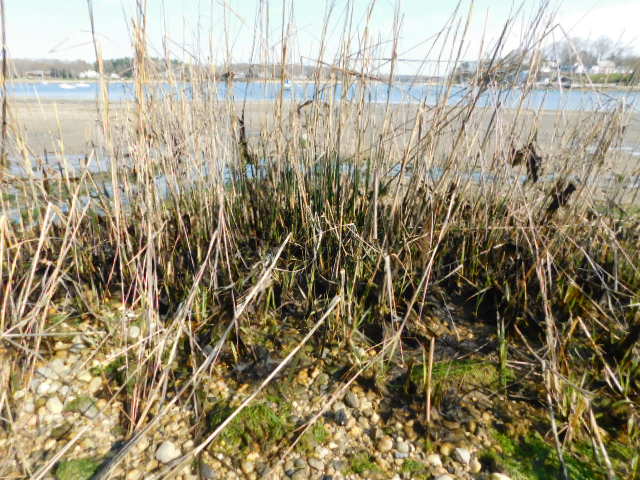
    • Late winter salt marsh lies dormant and soggy, under heavy skies, continually filled with the salty pump of the tides.  A quiet place, abandoned even by waterfowl.  In another month, standing in this spot will become uncomfortable with clouds of gnats, to be followed by swarms of mosquitoes, but right now insects bide their time in winter storage.  So there are on
      ly patterns of color, contrasts of blue and brown, interesting reflections and rotting signs of older usage such as fence posts along the drainage ditches.
    • People too are absent this afternoon.  I have as much solitude as is possible in this little overcrowded corner of the Northeast.  I’m grateful for such unexpected moments, which I didn’t even know I needed until they came upon me.  Away from the worries, and the hassles, and the chatter, I can imagine that the world goes on calmly as always, that it is greater than me and my trivial concerns, that the sheer mass of what exists can overcome transient stupidity.  Easy to believe, alongside this marsh.  Doubts will return as I head home.

    Saturday

    Starlings have swept into the backyard like a ravaging horde, emptying the bird feeders in less than an hour, thick in the trees, making a terrific unmusical racket.  “Karl, hey Karl!  What’s been going on?” shouts one glistening blue-black marauder to another.
    “Usual, usual.  Clogging old maple trees in town, coating the cars underneath with well-placed shots, making patterns in the sky.  Been a good winter.”
    “Sure has.  I don’t think I’ve been hungry an hour.”
    “And cold?  No cold.  Why, this is almost as good as my aunt Burga describes Rome itself.”
    “Ah, they’re always talking about the old country, aren’t they?”
    “We’re just as good here, this season.  Wow, these idiots put out some kind of spread, don’t they?”
    “Hey! You!!  Get out of here!!!” screams Wilhelm, jerking menacingly towards a terrified chickadee trying to grab a seed.  “Stupid little things act like they own the place.”

    The flock takes up the common squawk,  and as the din reaches a crescendo, all wing off together to see if there might be more fun somewhere else.

    Sunday

    Each twelve hours, more or less
    Surging tides relentlessly
    Smooth sand shores with waves blown free
    Leave no signatures to guess
    What went before, to touch smell see
    My random shards of memory
    Resist oblivion’s soft process
    No simple tale for history’s key
    Like flashing ripples of bright sun
    May blind my eyes but quickly done
    Nevermore exactly run
    Identical, yet ceaselessly

    All transient in time’s caress