Ethical Morals

In spite of some commonalities, morals are local and tribal. They tell us who is like us, but only after we accept someone as in one way or another part of our extended tribe or family. Even someone with “no morals” must already have some basic relation to us. Outsiders don’t count – they have no more morality than animals. 

Morals tend to be habitual. They are acquired during the socialization of growing up human with caregivers. They naturally blend with those of the caregivers. Most have a rational basis for social success, and the most important are enforced by tribal law. 

Ethics, on the other hand, are generalized fairy tales. They may claim to be a distillation of morality, but they are anchored in a fragile logic that ignores the fundamental fact that many morals address our illogical and contradictory existence. Like passion or mood. What does ethics ever say about passion? 

As I aged, I came to distrust a reliance on logic as a basis for existence. Consciousness is not logical. It is an ineffable gift. How it is experienced cannot be tied to ethics. 

Morality may be crudely but effectively reduced to written law. But it can never be elegantly or sufficiently expressed in mathematic logic or brittle words. 

In the Country of the Specialists

“In the country of the blind, the one-eyed man is king.” Or he is seen as a madman, or a danger to society. We have fables and stories on all this. Yet in our own days, we live in a country of the specialists, and those who see more generally are usually in trouble. 

It is believed that specialization leads to wealth, fame, and happiness. You don’t get anywhere by being a jack of all trades _ okay but not excellent. That is a road to disaster. 

Unfortunately, being a specialist _ in terms of life and joyful consciousness _ is a terrible way to get through life. We have enough examples of fanatic obsession which worked in a tiny restricted area, but led to a life in ruins. 

The other odd observation is that lately specialists tend not only to be eccentric, but also to be unaware of anything else and afraid of certainty even in their own spheres of knowledge. Subconsciously they may realize that, for example,  staying out of direct sun, eating tons of nutritional supplements, or whatever other faddish notion (or actual discipline) they practice may not be the be-all and end-all – nor even the most important component – of a meaningful human existence. 

In the land of the specialists, the one-eyed generalist does not become king, must keep a careful facade to avoid being considered mad, and should just enjoy the universe that nobody else around him seems able to see.

Fake Food

Obviously, I follow the ancient maxim “when in Rome, do as the Romans do.” So I eat meat, fruit and vegetables, grains, and processed foods because everyone else does, not because I think it is right or best.

Honestly, I am morally queasy about slaughtering badly raised animals, enjoying strawberries and broccoli picked by near-slave labor, enjoying oats whose monoculture destroys the ecology, and encouraging the use of weird chemical treatments to enhance sales. But _ well, there they are. Some things I cannot affect. 

In the future, I suppose the “ultra processed” becomes the standard fare even of those in Rome. I can easily imagine folks happily living on a diet of corn curls, potato chips, and fried whatever all fortified with all the stuff necessary for healthy nutrition. I think of it as the “spaceship diet”, mostly made out of something like algae and seaweed. People would accept such a diet if it were healthy. Heck a lot of them and most kids do already when it is not. 

I know it would be better for animals, farm labor, and the entire environment. 

For now – not so much. The transition may take a while although I suspect that in only a hundred years our descendants will look back at our habits with a gentle amusement bordering on disgust. 

I need to be satisfied with cheese doodles. 

Daffodil

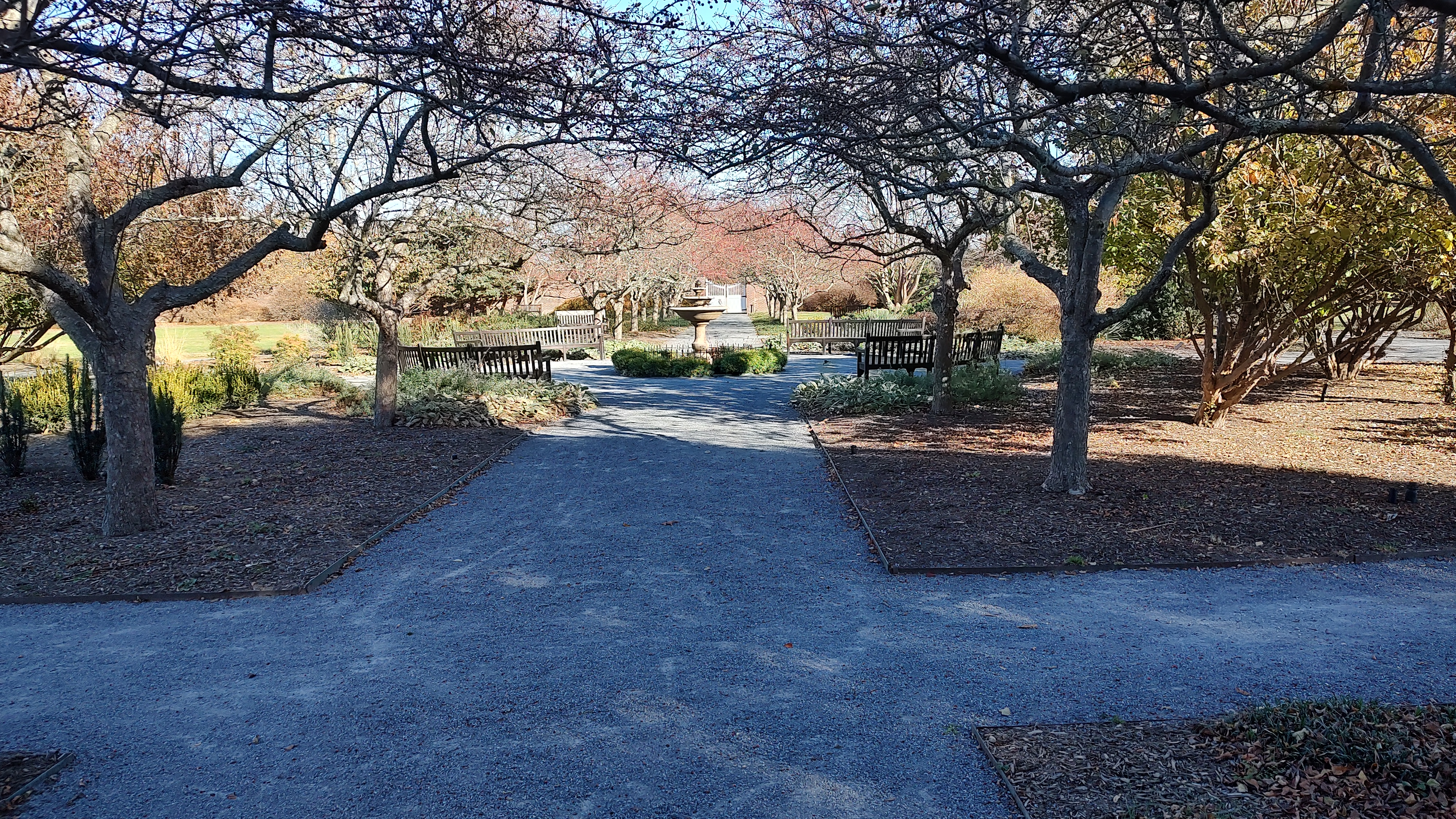
As I sit in mid-April, it’s been a good year for daffodils. They came up on time, but cool weather has kept them at peak form for weeks. Drifts of yellow cover patches of yards and hills. A complement to the also abundant forsythia. Golden spring with winter wind. 

Now the magnolias and cherries are beginning to spot the landscape with pink and white fluffs. Green leaves remain future visions, the background is blue sky, brown trunks and leaf litter, emerald lawns. 

I know daffodils are not native to Long Island. I’ll never know what was here a thousand years ago, nor even what Thoreau and Whitman might have seen. But the bulbs have naturalized completely, like the rest of us immigrants, and they do their part in spreading beauty. 

I’m grateful that so far the displays around here are pretty public. Daffodils do not hide behind the bricks of high walled private gardens. They crowd roadsides and parks. Even if a child plants a few somewhere, they may come back or even multiply for decades. 

I don’t want to make more of this than it is. The great meaning is simply the wonderful moment of existence, my appreciation to be part of it. Others may spin stories, and moral tales, and metaphors. I just like looking.

Soon enough this display will be over for another year. But wow – what a few weeks it has been!

Censorship

In order to survive as a social species, we all must practice a form of self-censorship. This can be as simple as never telling your boss what you really think, telling “white lies” to family to preserve the peace, or simply remaining quiet in the face of an obnoxious (or belligerent) fanatic. 

The typical “red line” to truly awful censorship is crossed when expressing an opinion becomes legally enforced. Can you be thrown in jail or worse for criticizing your boss, arguing with your wife, telling a neighbor he is wrong? In western civilization we try to retain as much “right to free speech” as possible.

This is in the possibly misguided belief that if all sides of an issue can be heard, the correct opinion will prevail. It’s almost as quaint as the idea that everyone no matter how ignorant or stupid should have an equal share in selecting a leader. Yet, for the most part, these two ridiculous propositions have often worked out. 

The problem has always been imagination. Although in the past limited by reality, opinion can now float free and unencumbered by hard checking. Upon a time, a person who said he could fly after eating a special food could prove it by jumping off a cliff before an audience. In the media age, no such luck.  We can no longer trust anything except what is right around us. And since we are sure of what we “know” we are certain the rest of the population would be better off if they never heard differently. 

Hard to figure out. We may need more cliffs 

Marijuana

I dislike crusaders, as I dislike almost all blind fanatics. There are always people telling us to change our ways, or to change the ways of others, save them from themselves, save society from their influence. Get the government to ban… 

Well we all know about US prohibition. And it is the nub of the problem. Our species, like many, enjoys the effects of alcohol. But these effects can be disastrous in the short run, debilitating in the long run, especially if drink is abused. 

The clear solution – to crusaders – is to simply ban it. Most of us know someone who has had awful experiences or even ruined their lives from alcohol. We also mostly know many more who have glasses (and even a lot of glasses) day after day and are quite happily normal. Experience tells us that it is not quite the “demon” portrayed by fanatics. 

And crusaders never really consider trade-offs. We endanger our lives every day we leave the house, but life is a pretty poor thing if we are afraid of everything all the time. Some people enjoy the dangers of swimming, or hiking, or eating a good dinner. Or, yes, having a glass of wine or smoking a marijuana cigarette. 

There are substances that mostly kill, and surely they should be controlled. But there are others – like alcohol and marijuana – which are simply part of the many awesome contradictions of life for most of us.

And the reason for existence for some crusaders. 

Sitting

I sit a lot more than I used to.  In spite of a sedentary career of computer coding, I always managed to take a daily walk – not for health as much as happiness. But now I quite enjoy hanging out on the couch. 

Alarming “new studies” come out periodically of how awful a sedentary lifestyle can be. Typically these ” scientific researches” include a big group of people tracked over a fairly short time – say a thousand folks over 20 years is the best case. 

Results are prepared on outcomes for the whole bunch. Hardly even a breakdown by age, weight, height, diet, job, or any of a thousand other factors. And, to be honest, for that reason many of them seem to be useless. And that is before panic laid-in statistics along the line of “sitting 4 hours a day triples risk of heart attack.” Not mentioning perhaps that for a 30-year-old the risk “triples” from 0.1% to 0.3%. Nor if said adult stuffs himself with Twinkies daily and binge drinks on weekends. 

I’ve always paid attention to my body, always gave heed to common sense, and all in all reasonable activity has seemed a good thing. But a senior who does not sit a good part of the day is, in my experience, a freak who has bigger issues than a sedentary lifestyle.

Rule of Law

I’ve already noted that some words and phrases – like “homeland” or “freedom through work” – leave me cringing. They disguise an often troubled core belief in a trivialized honey coating. Another one _ which I hear a lot lately _ is the “rule of law.”

Humans exist in a social contract. Much of that _ a good example is a family, another the work group _ formalizes ancient principles of cooperative interaction. There may be all kinds of rules, strict and otherwise, but they are always applied _ at least in successful tribal/units _ with a great deal of common sense. Flexibility using rules supports a known consensus of behavior.

The “rule of law”, on the other hand, implies that law should be applied ruthlessly and by the letter. “Rules of law” are tools of the rulers manipulated by the slickest minds available.  “Rule of law” supported Nazis, Confederate slave owners, the aristocracy in 1785 France, and _ for that matter _ the gang leading the reign of terror in 1790s Paris. 

One typical response is for the ruled to revolt and rewrite the laws. However, what we desire is an enforcement of common consensus. Obviously that is nebulous, but then so is the “rule of law” after it has been twisted, misapplied, and otherwise ignored so as to be practically effective. “Mitigating circumstances” and all that. 

No, I would much rather not live in a “rule of law” society. Unfortunately, it’s all we’ve got. But I can wish there were something better and I refuse to glorify our current methods. 

Paleolithic Dreams

Not me. I’m 77 today, and studies of “hunter-gatherers” holds only terror for an old man. I’d hate to live even a hundred years ago. It is hard to conceive how hard it was to live back then, when one was long past the bloom of youth. 

The young tend to be romantics. They plan on great deeds, wonderful accomplishments. They regret that they cannot be old time heroes, saints, generals, priestesses. Some of them try strange diets or rituals to be more like their ancestors who were supposedly more connected to the ways of the Sun, Moon, and Earth spirits. 

Not me, not now. Not long ago half the “civilized” people would have been dead by 50, in terror at 60, definitely gone soon thereafter. Three score and ten was largely a pleasant fantasy, and even in that time frame no guarantees of being healthy nor active. 

I’m not the new 30 or 40. But I’m quite good. And I never ate paleolithic, nor lasted long on most other dietary fads. In fact, I tended to avoid fads altogether and mostly trust my own body senses, and brain. Not perfect, I know, but here I am.

What most astonishes me these days is how little understanding the young have of how good they have it compared to how my parents and grandparents lived. Some of them secretly covet a desire to have everything go smash and return to the good old days, full of toothache and other horrors they never now endure. 

Well at least I can be aware and grateful that the paleo era is long gone.

Profile

Current Chinese governance worries us because it is the first advanced technological civilization to impose full identification on everyone for all acts at any time. Street lamp cameras record every action anyone does, and permanently file the good, the bad, the ugly, the generous, the illegal _ a computer replacement of an omniscient god who never forgets anything.

Meanwhile, tribal profiling does not work anymore. Stores used to be able to ban whole groups of people they did not much like _ blacks, Jews, Italians, Irish, or hippies. Until now there has been more to gain by letting masses of those folks shop than by keeping a few criminals out. 

A modern workaround has been places like Costco and online retailers who can simply refuse membership to anyone who has done something bad to them in the past, a form of profiling. In fact, it is hard to see how these trends do not soon merge, replacing profiling with intimate ID recognition. 

There continue to be those fighting for the dream of privacy. I suspect that is already as vanished as the ancient wild frontier. Most people already accept the benefits of being economically well known _ credit scores _ or socially famous over the internet. It’s not a slippery slope, but a free fall.

Of course, as always, “the honest citizen has nothing to fear.” Believe that and I’ll head over to sell you a bridge.