Amateur

In these degenerate days, “amateur” means doing something without concern for money. Because, of course, everything else is supposed to be about money, or at least tangible gain. The obvious goal for all amateurs is to become “professional” and get paid for what they do. 

But originally, amateur had more the connotation of what “passion” (as in “follow your passion”) does now. Just doing something because you enjoy it or feel an internal reward. For a short while, even in a completely capitalistic society, being an “amateur” was kind of noble, even as the term inevitably took on connotations of not being particularly excellent. 

My own take on this is that I generally observe that the transition from amateur to professional is also a warp which not only removes some of the joy, but also transforms a pure approach into something constrained by what an audience demands. For a “professional” truly requires an audience more than the original passion. 

Nothing new. In the olden golden days, and even now, the true amateurs and those “following passion” are those with the resources and time to do so regardless of what anyone else thinks. As always, an endeavor usually rewarding but frequently misunderstood by others, to the point of generating loneliness.

I’ve been a proud amateur in some areas of my life for a long time _ still am, as this essay proves. People kept telling me to grow up and _ get serious _ and I’m glad I often ignored them. As almost any other true amateur would. 

The Right To Less

I have always admired the Anatole France quote that the rich as well as the poor are forbidden by law from sleeping under a bridge. It summarizes the false illusion of an equality of power which does not exist. It is a position frequently sermonized by the elite wealthy who control any legal system. 

Not only laws of course. Any belief in equality where none is possible. The “right to work” assumes an individual laborer enters into contracts with the same power as the employer. That is a ridiculous thought to anyone who actually has been a laborer. The “freedom of choice” to pick insurance or medical coverage too complicated and convoluted for any person to read. The constant aggravating requirements of needy people to obtain any help. 

Sure, in such confrontations a few individuals have more clout than others. They and their friends who run government and media don’t see the problem. 

Not simply the wealthy, of course. A legion of the arrogant, the liars, the criminals, and the easily mobilized ignorant are convinced that they also can sleep under any bridge they feel like because they are sure that they can afford the fine, talk their way out of any problem, or simply run away and ignore consequences. 

If they can’t, they decide they are “victims.”

Civilization requires a rule of law, and the law will always favor those with power. That’s okay. But there is a limit to how cohesive a law which encodes “might makes right” can remain over the long term. Extending such simple truth to cosmic moral principle – and a hollow one at that – is what annoys me. 

Enshrining the “right to less” as holy writ is an insane way to run a country. 

Game Theory

“Game theory” is a segment of pure mathematics. It explains the possibilities of what “rational actors” can do when there is perfect knowledge, rules are known and enforced, and actions are limited. Left unsaid is that goals are usually clear and often singular. 

That works well in the math world _ obviously little of it truly applies in human social “real life” where actors are irrational, knowledge is imperfect, there are no rules, goals are multifaceted and vague. And possibilities are infinite and change instantly depending, for example, on the mood of the actors. 

I worry because my young grandson is growing up in a world of video games, like all his elementary school peers, adolescents and young adults. They tend to assume their real life will  resemble the electronic worlds they have continuously inhabited. They are shocked – often into semi-catatonic withdrawal – when it is not so.

A pernicious fallacy of all games is that you can start over and play under the same conditions again and again. Military organizations and whole civilizations have discovered _ to their chagrin and sometimes catastrophe _ that such is not the case. “Fighting the last war” is not a way to get better prepared for the next. 

I imagine that sometime the kids will have to grow out of it, as once-upon-a-time children left fairy tales behind and even I recognized that science fiction was a limited real-world skill. All grand theories tend to crash and burn whenever a few people and life situations are involved.  

Political Avatars

The US founders, who thought long and hard about the mechanics of government, put strict limits on their constitutional version of representative democracy. People only directly voted for a  “mob” of House of Representatives who would yell about the issues of the day. More mature senators were to be appointed by state legislators. The elite would nominate the best “electors” in the land who would pick the wisest of the wise to be temporary leader. Party politics were never to arise. 

How’d that work out for ya?

We seem to be completely in an age of reviled or idolized avatar democracy. We seek not politicians to consider our “interests”, but rather politicians who are us – with all our prejudices, fears, hopes and especially anger at just about everything. 

More than that, we’ve decided the role is the person. Staff and bureaucracy does not count or is the enemy. Only the symbolozed candidate _ who should be exactly like us _ is acceptable. Very much like a video game avatar. 

Like a video game, short, dumb, and irrelevant. As the avatars are played by the mob, the real governance is done by the wealthy, who _being defined by their wealth _ care only about their wealth. 

Interesting to observe. Distressing to live through. 

Social School

“Educators” are bemoaning how “far behind” children are academically because of the pandemic. It’s the latest silliness as our society continues to believe that it must turn out masses of technocratic robots to keep industry and capitalism working. 

The teaching of reading, writing, and arithmetic has always been less important than socialization of children into groups. Not to mention the acclimatization of children into industrialized work habits. 

The wealthy have always known this, of course. Children were sent to private or boarding schools -_and are still targeted into elite colleges _ less to learn artisan skills than to meet the right people. And, truthfully, less to even meet the right people than to find out how to get along with them and bond into the upper levels of society. 

Beyond that, it seems we are rapidly heading into a deskilled, post literate world. Automation does all the skilled work. Computers read, right, translate, and analyze. Nobody needs to do that stuff anymore. Just listen and talk and get along with others. 

Western ideal for a long time has been to enable everyone to live like the upper class classic Greeks, free of chores, just thinking, discussing, and enjoying all the time (when they were not fighting each other). If civilization holds, that scenario seems likely. In a post-apocalyptic world, social skills would still be the best tools, as they have been for the last hundred thousand years or so. 

The kids will be fine. The teachers _ not so much.

Multiple Choice

Two choice is true choice _ this or that or neither. A fork in the road, one way or the other or go back. But multiplying the number of options rarely gives more honest choice, and the choice that is made is often done in much uncertainty and confusion. 

I mention this because of the vast number of “choices” given Americans in various areas of insurance, savings, career, healthcare, etc. We are assured that so much diversity gives us freedom to select what is best for us. 

Yet what actually occurs is that these numerous choices lead to other hidden choices down the road, ones which we cannot easily evaluate without a lot of time and willingness. The insurance companies, for example, have single-minded teams to sharpen their offerings. An individual does not.

If it is either “A, B, or neither” _ we can all manage. If it is A or any of 10,000 others _ not so much. And how do we truly compare all the infinite obscure sub branches? The short answer is _ we cannot.

Thus the more choices we get _ at least in certain circumstances such as health care or car insurance _ the less true choices we have and the more likely it is that there is no way to evaluate everything and choose rationally. 

Perhaps AI will fix this or change the paradigm totally. One frail human brain is absolutely unable to rationally cope. Massive choice _ another of life’s grand illusions

Snow Drops

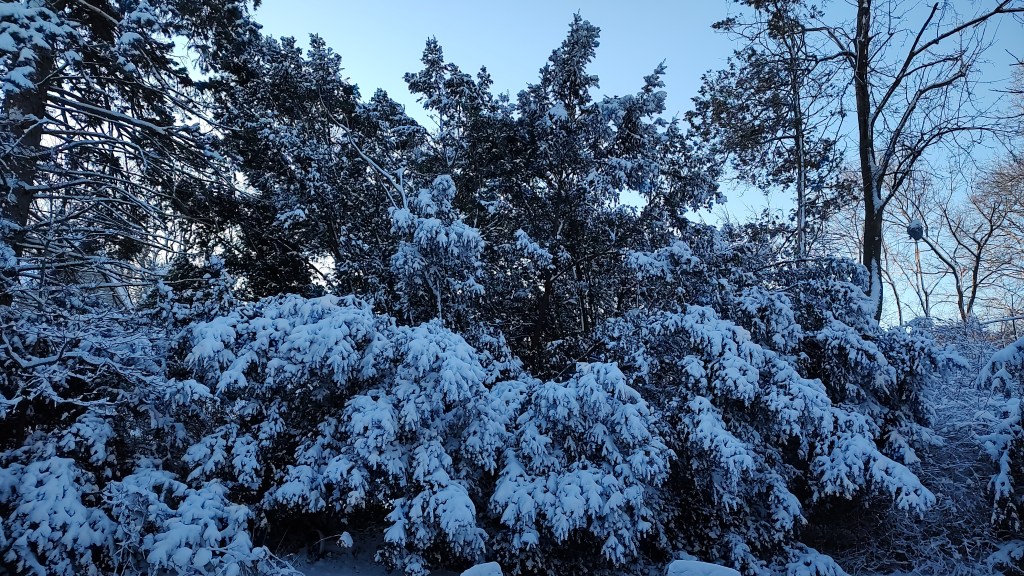
Snowdrops are small white flowers from bulbs that bloom in late winter. We have a patch at the end of our driveway. With a mild winter they were in full display at the end of January before being buried in a couple of snowfalls last week. 

Here in New York we have seasons to remind us of change. Perhaps the metaphor of “death and birth” is a bit too romantic _ it really is “dormancy and rejuvenation.” The thing is, unlike the similar metaphor of sleep and awakening, the environment really does undergo vast and rapid transformations. 

Everywhere on Earth is always changing. Some landscapes vanish quickly in volcanic eruption or flood. Some _ like drought or invasive species _ take a long time. The more drawn out, the less we notice, day-to-day all seems normal. Seasons merely compress that sensibility into a yearly cycle of surprises. 

And, I admit, a fair amount of suspense, especially these days. Will a given tree or shrub survive the winter and leaf out again? Will certain new insect pests live through the lesser chills and expand their malevolence? Will even more birds and butterflies be missing or gone forever? 

It only took a few years for all the once thriving lobsters to vanish from Long Island Sound _ following the more extended demise of most colonial wildlife around here. Planetary tipping points are much in our minds. Sure some ecology will survive almost anything, but will we like it?

All that wrapped into a meditation on a quiet, overcast, cold February morning, with certain spring, but uncertain details, right around the corner.

Coffee Miracle

On the one hand, it is easy to think of our lives compared to that of a relatively affluent Roman of 2000 years ago. Same brain, same body, same thoughts and a fair amount of various comforts. 

On the other hand – no nothing at all like. No plumbing, electricity, medicine, books (only rare hand copied scrolls) and lousy food. No sane person would make the trade. High on the list of things I would miss would be my morning cup of coffee. 

It has been wonderful during my adult life to begin each morning sipping a cup of steaming coffee. Nothing fancy, often instant. Taking the half hour or so as caffeine kicks in and my mind regains focus. A personal ritual as sacred and meaningful to me as any Eastern tea ceremony. 

The fact that coffee has been plentifully global for centuries, and continues to be relatively inexpensive, always astounds me. I take it for granted. Sometimes, as I begin, I do try to imagine it as a metaphor for our very complex modern trade system, and how fragile all the things we accept as normal really are. 

Finally, for all of that, to be able to concentrate on this precious instant between sleep and wake _ the other side of what many usually worry about. Ignore the possible futures good or bad and simply celebrate who and where I am. 

A lot to ask from a simple cup of black liquid. Yet it always delivers.

Numinous Trillionaire

The ancients thought that a human was essentially a special mud activated by some god-given magic. Even after cells were discovered, people believed we were made out of protoplasm that could be activated or reactivated by electricity or prayer. Death was a knife switch condition that could be reversed with the correct impetus. 

Mostly, there was corporate flesh, an amorphous collection of limbs and organs, and the spirit which inhabited and animated this conglomerate. I admit I still intuitively feel that way. My mind seems to float well beyond my aging body. 

Medicine, however, advances and examines and has now found we are each composed of some 37 trillion cells. I have trouble understanding beyond 10, certainly get lost over 100,000. 37 trillion busy little chemical factories just doesn’t seem right. And any of them at my age can go horribly wrong. My true mind still refuses to accept a direct connection to them.

That’s the real problem. With the astonishing knowledge of the modern truth, I still think as the old superstitions dictate. Beyond those 37 trillion, it still seems there should be something more. An astounding number, that, but just a number.

I’m certainly a numinous trillionaire. But I can’t quite grasp what that means. Perhaps it is better that way.

Eco Footprint

I once had a boss who proclaimed “take care of the pennies and the dollars will take care of themselves.“ Absolute nonsense, of course. If we take care of the big expenses, the little things are unnoticed. A wealthy person never cares about trivial daily expenses. 

All my life I’ve tried to take care of the dollars _ overestimate expenses for example, always round up. Expect big ticket items to cost (a lot) more over time. And _ for sanity’s sake _ have a lower limit _ $1, $100, whatever depending on my financial circumstances _ below which I don’t worry nor care at all. 

I apply the same rules to my health and particularly to rampant ecology memes. No, my recycling food waste will not affect the future of the planet. Picking up bottles or plastic bags as I walk does not save wildlife. The gas mileage of my car is inconsequentially polluting compared to airline trips of millions of other people. 

It’s not cynical. Because big problems require big solutions, and mostly those must be achieved by organizations, including government. A ban on plastic bags does make some difference. But saving pennies never bought a house or (these days) even a slice of bread

Taking care of pennies is simply an obsessive waste of time letting one mistakenly feel virtuous.