Common Sense

Common sense gets a bad rap these days. “Contrary to common sense” is as frequent a phrase in some journalism as  “it was a dark and stormy night” is in bad novels. Science, logic, “just the facts, m’am.“ No need for your silly superstitions. 

But I have come to mistrust logic more than I do my own common sense. I find some “facts” dubious, many too many “facts” irrelevant. My own intuitions are composed of an almost infinite set of experiences, each tied with each other, forming a tough fabric of how my environment works. And that bundle of intuitions is what I use to judge anything using common sense. It works quite well. 

The problem is not only that facts can be wrong, but that they can take on more weight than they should. The fact that immense numbers of people are killed or injured in car accidents does not prevent me from driving. Contrarywise the “uncommon” side effects of a drug may give me pause before I take it. I tie all my actual experiences into evaluating these facts.

And logic _ the narrative produced by certain arrays of facts _ is also suspect. The clearest examples are the stories spun out by lawyers and conspiracy theorists. Logical analysis is often far removed from common sense truth. 

Of all the worries I have concerning artificial intelligence, the greatest is that it contains no common sense whatsoever. Dangerous. 

That is my common sense take this morning.
Gray Skies

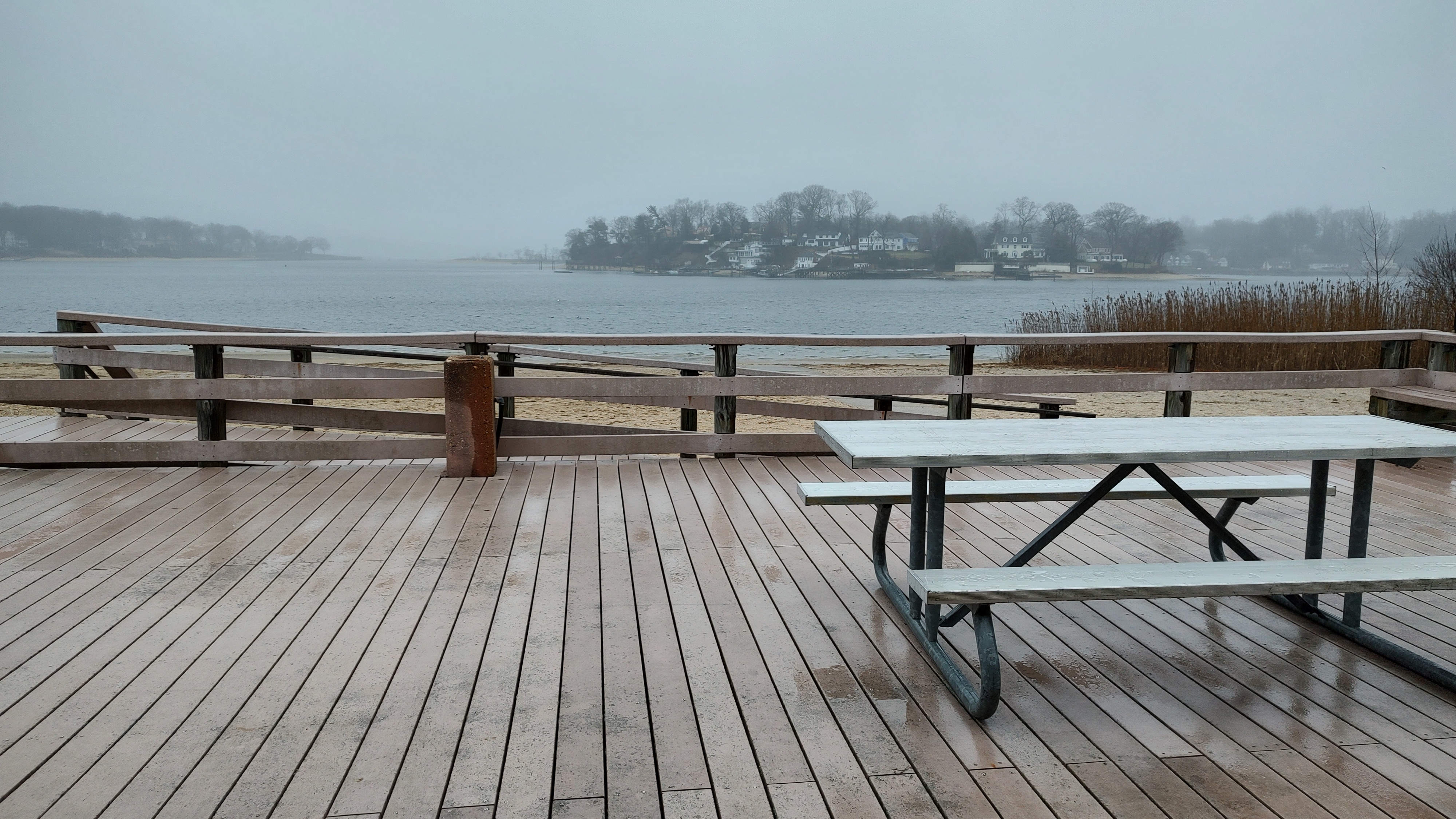
Blue skies inspire songs. Dark and stormy skies begin bed novels. What can be said of gray skies? Monotonous, dreary, enervating, but not actually awful, hardly noticed, simply endured by most as an interlude between sunshine and downpours. 

We’ve been in a two-week pattern of gray skies around here. A week or so of cold fog and misty drizzle. Another week of brisk winds and glowing monochrome. For January, much better than ten degree temperatures or ten inches of new snow. 

Other than praise for what they are not, do gray skies have any positive value? Well, of course they do, if I make the effort. I find them calming, for one thing. And with proper viewpoint, quite beautiful. Often they are layered in opalescent horizontal cloud blankets. Colors glow under their luminescence. 

One or two gray days is no big deal, often refreshing after too much of any other meteorology. A time of rest. The problem for me is when they settle in for a long time. My psychology projects oppressiveness, or boredom, or whatever, anxiously waiting for them to end. 

That’s wrong. It’s crucial to appreciate every moment for what it is in itself, not merely how it connects to past and future. Enjoy the beauty and calm. Even if those particular moments of gray might add up a bit too much.

Eternity Uncertainty

Scientific understanding postulates that there is no such thing as what used to be considered “eternity.“ The time of the universe begins and ends, and all inbetween is constant change. No perfect clockwork, no Olympian gods. Theoretical mathematicians sell books about it. 

As far as we can tell, culture before history was focused on the present moments. Recognition of past and future was extremely limited. More than that, it was hardly important. To learn the rules of the tribe, the simple artifacts, traditions, the cycle of the seasons was about as long as anyone needed. Shamans sold visions of beyond on request.

Agricultural civilization brought record-keeping, which led to writing, and history was invented. Suddenly there were long periods to consider, people who had died to be aware of. A sense of more than the moment. Priests sold maps of the ineffable to the gullible.

Expanded time horizons _ actually a new sense of extended linear time. And wonder about death, speculation about what happens after death. What do these speculations mean for the living. Folks sold themselves wills, great works, promises of being remembered forever. 

Well, we still don’t have answers. Some fear death, some search to overcome it with mighty deeds, some ignore it. Probably as a condition of sanity, most of us live in the moment still. Science is little help. We do not _ most likely we cannot _ truly understand the nature of time. Nor our place in time, nor how our consciousness fits into what used to be eternity. 

But for a nickel or a dollar, there are still lots of folks who are quite willing to sell you what they think they know.

Sensational

Artificial Intelligence is all the rage. It is dry computer logic linking dry computer “facts.“ Sometimes, it is difficult to remember that humans – and life – are hardly composed of such barren logic. 

Life is sensational, in the full sense of the word. The fabulous five _ sight, sound, taste, smell, feel _ of course, but also kinesthetic and others such as balance. Meanwhile we are internally washed by hormones and directed by moods. Sense flood-ins are transmuted by all our internal mediations, and are finally available for us to use as memories, situations, or even logic.

But note that logic is very far down that list. Human consciousness is multiplex and frequently irrational and infinitely indescribable. Logic is a nice tool to use once in a while, but it is only a tool. Nobody is about to pour their being into a “singularity” which is simply a big hammer.

Logic is extremely dangerous_ as is obvious from every religious war ever fought, and every nihilistic philosophy ever conceived. Supercharged logic with no grounding in sensation is awesomely horrible. And that truly, is artificial intelligence. 

No need to turn to surrealism as a balance. Just taste a cookie, look at a bird, scratch an itch. Enjoy the full joy of being sensational. Because that is our heritage, our existence, and our glory.

Certified Silly

Most people favor competition unless it is directed against their own hard-won position. The famous Bastiat petition of candlemakers protesting the free light from the sun is the best example. 

In our world, equivalent regulations are the certifications of just about everything. They are often legislated as being in the “common good,” but are mostly promulgated by established businesses and would-be guilds of skilled workers. And all of them involve obtaining a license before committing harm, unlike other laws. 

Maybe it makes sense to license or certify restaurants, although even that gets silly when applied to bake sales or kids selling hot dogs or lemonade. But there is truly no sense at all to certifying bankers, nail specialists, or bicycle riders. Or teachers.

Petty irritations like this mount up and give government a bad name. In fact, outside of taxes, it is where almost all of our irritation with government occurs.

Our mythology in the US is that of the frontier. You didn’t need fancy papers to do anything, you just did it (or not.) Evil was punished but not prevented except by example of earlier criminals. We still dream of such freedom. 

For ourselves, anyway. Because those damn neighbors and immigrants better not impinge on my hard-earned situation. Let them get their own certification and license, just as I had to.

Old Brains

Gifted young athletes are marvels. They can perform feats that astonish us all. Yet as they grow older, their abilities are lessened. Sometimes they themselves recognize the deterioration in reflex and muscle. Sometimes recognition is forced on them by younger athletes able to better do what they once achieved easily.

Metaphors can be treacherous, yet I propose old brains are similar to old athletes. They are no longer as capable, a little slower, less permeated with hormones, fewer neurons, decaying synapses. Sometimes the elderly see it in themselves, but much too often they are blind to the changes unless compared to younger people.

I worry that industrial civilization has become a land of geriatric politics. The old brains rule. They’ve accumulated power, they think they are wise, and most obviously they think they are at least as capable as they once were. Those around them can see they are wrong in that, but _ well _ power. 

The main problem is that old brains become pretty rigid. Their logic runs in tight circles, always centering on the same point, unable to assimilate new outlooks. Elders call it experience, wisdom, balance. But a lot of that is truly illusion and rationalization.

I’m an old person, but one of those who actually recognizes that I am less capable. Usually it doesn’t bother me much, but then I do not have to perform much. I wouldn’t want me flying a huge jet or doing brain surgery. Or, for that matter, running the hundred yard dash as I used to do quite well.

Future Tense

We’re pretty good about predicting and using the immediate future. Without too much trouble I can tell you what will happen to me in the next hour, maybe even tomorrow or next week. I admit it gets more unpredictable after that.

Science and business have concentrated on much longer terms. It takes a while to build a corporate empire, to construct a bridge. Examinations of the past lead science to predict climate, eclipses, species survival. And to some extent that is all valuable and true. We enjoy our bridges, our economy, our control of destiny. A farmer only sows because in the future she expects to reap.

In these days of troubles, dire predictions of what is to come in futures near and far are a dime a dozen. It has always been so. Cassandra is nothing new. Early Christians continuously predicted the end of the world by next week, month, year, or decade for millennia.

But in the “long run” we don’t truly know much. Why should we be so concerned, especially since many of us will not be here? Our offspring, like our dreams, are a kind of fantasy. The future will be what it will be, like the present largely out of our control beyond today and what we can actually touch. 

The main problem with horrible futures expectation, as with despair in general, is that it cripples our ability to live fully now.

Irritation Perspective

I learned early on in software maintenance that what we IT professionals considered “minor irritants” often bothered clients more than the ” important true issues” we were concerned with. That meaningless blinking red dot in the corner of a screen was _ to the user _ much more aggravating than the speed of the subroutines. 

It’s human nature _ based on our primarily sensual grasp of the universe _ that it be so. An arthritic thumb or constant migraine may be “medically harmless,” but they seem much worse to patients than, for example, “truly” important things like high blood pressure. 

And I suspect politics is in the same fix today. What is really important may get legislative or bureaucratic attention, well focused on important big problems. But the constant unimportant irritants trickle down to make everyone unhappy. Trying to control dangerous speeding motorists is a worthy goal, supported by almost everyone. But in application, tickets are often issued for trivial “violations” to make up quotas or increase revenue. And everyone ends up hating all traffic laws. 

The only cure for this is to _ yes _ fix that blinking light first. All laws should mostly apply to egregious behavior. All laws should also be applied by “spirit” rather than “letter”.

But, alas, we are in a “rational” society. Only the dry letters of the law are used. The blinking light is never fixed. Everyone gets angry and more rigid.

Blink.

Maggies

We are a social species. Part of our makeup is to clump into tribes or cults where we feel securely surrounded by those we believe are “just like us.“ In music there are groupies, Swifties, Deadheads. In politics, lately, the Republican Maggies who follow their idol.

None of these cults _ few modern cults actually _ care much about the particulars. Oh, they like the music or politics. But it is really about the ambience of themselves, the band, or the leader, or the assumed “movement.“ After a while it all freezes into an unthinking, illogical, jingoism.

Some of it is genuine. But a lot is just the joy of being in a mob. Some is to feel young again (especially the case with Deadheads or Maggies). And some of it is just a way to either celebrate power or let off steam.

Since crowds have always acted this way _ there are examples throughout history and the current world _ the only real surprise is how the cult of democratic government actually believes _  against all evidence _ that voters can be logical and not carried away by carnivals and torch light parades.

So I sit back in my impotent neutrality and hope this really is just like Swifties and Deadheads, and that we are not about to turn into Northern Ireland of the 1920s or Germany of the 30 years war.

Estimation Skills

The sheer estimation inadequacy of people I know is confounding. Maybe because media tends to report everything as an unanchored percentage or number. Maybe because humans simply cannot cope with the extremely large or extremely small.

For example, suppose you learn that something ” doubles your risk of cancer.” Well, if the original chance is that one cell out of a trillion might get cancer, this increase to two out of a trillion doesn’t mean much. Especially if it is a “one shot” cause like “smoking” and not “for every cigarette smoked.” 

But worse than that, life is complicated. There are lots of other things that are awful that may affect you first. 

I find it useful to carry trigger numbers in my head, usually not based on percentage but on raw figures. For example, a meal should cost less than $50, a good sleep is 8 hours, and so on. Some are clearly wrong, some grow out of date, but they are handy “common sense” guidelines. They can send warning signals clearly, and if they do I can examine the relevant data more clearly. 

We are constantly bombarded with “new studies” that claim all kinds of universal application. But often they do not, and they are usually personally irrelevant. Again, it is important to be able to estimate just how much they mean to us. A 90-year-old probably need not worry much about general diet discoveries. 

Exciting stuff, this “science“ which is often “pseudoscience.“ Hard numbers that need themselves to be put in perspective.