Aftermath

Perhaps one day of glorious color, one blustery downpour, and remains nothing but memories.
  • After math, there will be geography …  The etymology of words and phrases can seem strange.
  • Peak color passes quickly, as do many strong climaxes.  A furious blizzard or hurricane transitions to deep calm.  An election leaves winners and everyone else figuring out what happens next.  Soon, such moments of reflection recede.
  • How much snow has fallen, how many branches are down, how many bags of leaves must be picked up, what does this election mean for laws and taxes?  What next? Sometimes it is as trivial as picking up the detritus of foliage, sometimes there are life-changing repercussions,  sometimes the political landscape actually shifts enormously.  Making sense of what happened can take a while.
  • But mostly, after these cyclical happenings, life just adjusts and goes on.  There will be another week of peak color a year hence, other elections, more storms.  We will overlay their fresh challenges onto fading memories of past excitement.
Not the primrose path _ leaf drifts lead only to snow, ice, bitter cold, and dreams of another summer.
  • After the excitement of events, when the circus leaves town, there remain lingering changes.  The leaves are down and cannot be put back up.  The government will do things it would not otherwise have done.  I must clean up the driveway, I must endure the new regime.  I fit my life, as always, to my environment, changed as it might be.
  • Aftermaths take a while.  Leaves cling to trees in some cases well into winter.  Inertia in government guarantees that few dramatic changes will be in place until next year, if then.  Meanwhile, I must sleep, eat, and carry out the mundane business of staying alive each day.
  • That does not mean changes are not real.  Trees become bare, snow falls.  Taxes and laws change.  I enjoy each day partially in the recognition that it is unique in all time and space, and will never exactly occur again.
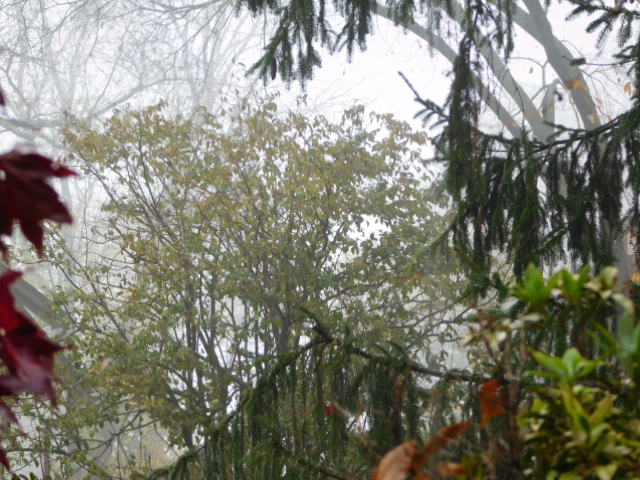
Fog is common this time of year, warm to cold, cold to warm, air different than water _ but always mysterious and quieting.
  • Fog is a good metaphor to illustrate aftermath.  Nothing is certain _ there may be immense upheavals or the stability of the world may return everything to “almost normal.”  As we pass through, we cannot tell, dim outlines prove deceptive.  Only when looking back, as time clears our vision, can we truly evaluate the final effect of intense events.
  • Another perfect metaphor, of course, is sex.  So much anticipation leading up to frenzied climax.  Then endorphin lethargy (which used to be accompanied by a cigarette.)  And finally _ sleep.  Followed by days exactly as days have always been all our time before.
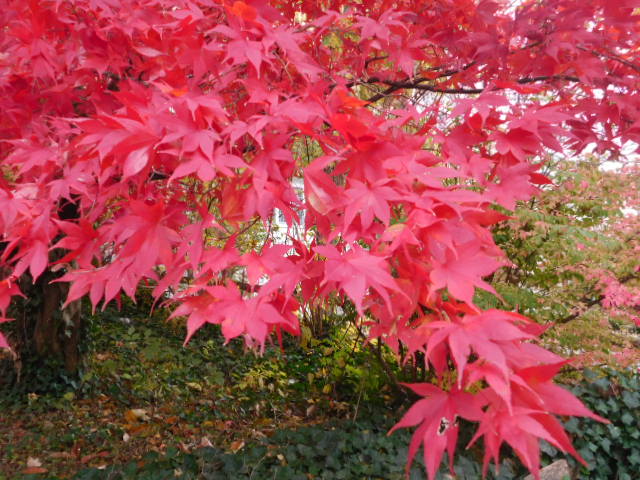
Peak Peek

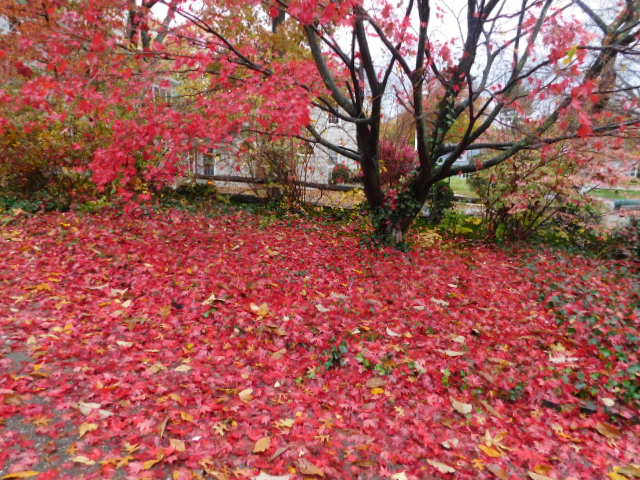
Furious wonderful flaming days, then litter, then trash to be collected and decomposed.  Such are the days of our lives _ oops, I mean of these maple leaves.

  • Peak canopy color this year has arrived nearly simultaneously with peak political fervor.  Foliage is spectacular, campaigns less so.  In either case, I wonder who is paying attention.
  • Colorful trees are easily ignored.  Children are in their own world, enjoying everyday miracles without need for extra attention to flowers in spring or leaves in fall.  Teenagers and young adults are wrapped up in each other, with other events a mere shadow background.  Working folks are glued to smartphones _ possibly the only nature ever encountered in their busy busy lives is viral video.  Retirees have time but are easily distracted. 
  • Nasty politics are monopolized by ignorant fanatics, cranky ancient crones, and blubbery old gents who are angry that the world they anticipated never happened.  Nature in their world is basically invisible except, perhaps, on their private postage-stamp property where others dare not tread.  Brightly colored drifting detritus will not distract them from raging self-importance. 
“Old Faithful” the most colorful maple, or possibly sugar maple, in the area.  I am instantly nostalgic for its color each season.
  • When pressed, millennials and other young voters claim that votes do not matter.  It is easier to accomplish real change with social media.  I hate to agree, but they have a point.  The bedrock of cultural custom, the vagaries of civilized fads, are transmitted and if necessary enforced by tweets, videos, and funding pages, just as they used to be by churches and newspapers.  Distant and glacial Eighteenth century modes of government seem increasingly irrelevant in this age, especially when all rulers appear to be corrupt pawns of global plutocracy.
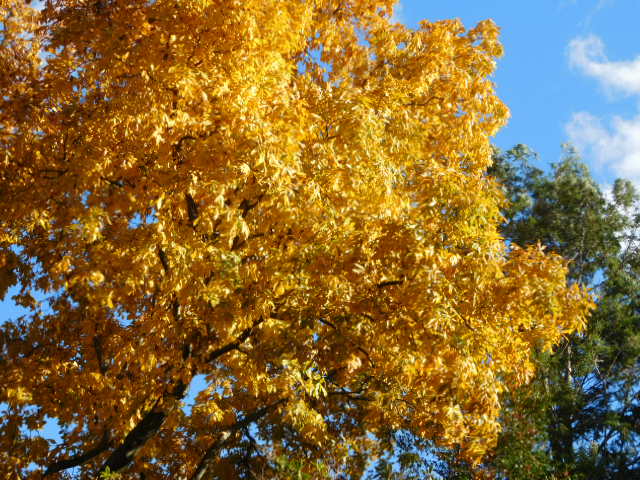
  • Voting, compared to enjoying seasonal landscapes, even seems pretty sill to me.  My vote in this district, in this country, makes no difference at all in a population of 360 million.  Better I should stare at a brightly backlit orange sugar maple,  or yellow hickory leaves shimmering in the breeze,  
  • Once upon a time I did believe in political discourse, in trying to compromise, in understanding other’s points of view.  The fanatics have left me behind.  I prefer to ignore their brittle shouts and listen to calls of migrating birds or the rustle of boughs as they lose their covering.  But as a hopeless romantic, I will go and vote anyway.
Somewhat menacing beauty portents long brown vistas which will soon settle in.
  • Elections and seasons occur with cyclical regularity.  Like sunsets, each easily overlays all other similar experiences.  I hardly remember any particular elections nor autumns.  A few sharp experiences _ a flaming woodland dell in New Hampshire decades ago _ may stand out, but usually I can only remember, at best, what happened this year or last.
  • Politics fade too.  The great debates of my youth, the great angers of today, inevitably yield to the passions of the future and monotonies of daily life.  Voting seems to have little impact _ even the most momentous changes such as civil rights or losing the Vietnam War were, on later analysis, just as much from social momentum as from new representatives gaining power.  Politicians often go with the flow just like the rest of the human herd.
  • Peak foliage is wonderful.  Peak politics is tiresome.  After this peak, life will go on.  But I am kind of glad I have been stirred by either, as spice to my daily existence.  

Contemplating Art

Acrylic on Paper, 1999, 24×18

This west wind brings autumn

To the waves, to my soul
I think too much about the future
And what tomorrow’s winds may bring.
  • A new book details the fights among various folks who made money revising and publishing Emily Dickenson’s poems after her death.  Of course, she herself, by intent, never profited monetarily.  As a person who once enjoyed and practiced visual art, I recall some of my own confused grappling with action versus artifact.
  • One of the painful realizations of becoming old is to recognize that tangible traces of my time on Earth will soon be buried or burned.  Paintings, poems, old software programs, changes to the house and yard, all become one with the snows of yesteryear, forgotten even more quickly.  They join that which I knew was ephemeral at the time, from enjoyment of a vacation to interactions with other people to solitary momentary moods and experiences.
  • When art was an attraction, why was it an attraction?  What captured my almost obsessive interest?  Why are there still large museums, books, fairs, and _ yes _ artists still working and creating what is _ from a practical standpoint _ mere useless decoration?  Professional artists respond that they are working for a living, some amateurs respond that they are hoping for a lottery payoff, but I suspect most folks _ like me back in the day _ do it simply because art enhances life.
Acrylic on paper, 2003, 22×30
Who knows where
She’s been.  Or why.
No one
Really
Cares
  • Some science now indicates that toolmaking and control of fire by Homo Erectus, our predecessor species, led to rapid enlargement of brains.  But there is little understanding of what suddenly happened to Homo Sapiens less than a hundred thousand years ago that led to our frighteningly rapid, and possibly disastrous, mastery of the planet. 
  • One primary suspect is either cultural or neurological mutation that allowed people to imagine what will be, what might be, why something is as it is.  To add narrative to the instantaneous impressions of life.  In other words, in one way or another, to become artists.   
  • Perhaps we are too quick to seek one “silver bullet.”  What makes us different in quality from animals is not a single trait, but a conglomerate which art encapsulates.  Thinking is basically all that is unnecessary in an immediate moment.  Dance, paint, music _ yes those are art _ but so are any of our imaginings of why leaves turn color, or smiling at unexpected actions of children, or anything at all fleeting and floating in mind.  Consciousness itself is our most glorious form of high art.
Acrylic on canvas, 1999, 30 x 40
High seas never, actually,
Reach the harbor
Waves may chop, like my life
But disaster happens elsewhere
  • Even as I crafted art, I was conflicted about professional or personal aims.  I realized that most artists I admired had led miserable lives _ and I was never willing to sacrifice that much.  Nor did I much enjoy what I fantasized about becoming famous in the art world _ well, maybe the wealth, once in a while.  I tried to think of myself as an ancient Chinese literati, even though I realized that even they were a mixture of professional artisan families and true amateurs.
  • Eventually I understood that permanence was hardly what I sought.  Even fine dinners and impromptu dances have their place in the infinite and eternal “museum without walls.”  Even stone temples and magnificent marble statues eventually wear away, most art is dust almost instantaneously.  So what I created was done for the sake of creation, for what creation did for me, and that was and is enough.
  • Finally, I accepted that I could also be other than an artist or artisan for part of my life.  We can fully enjoy phases of being, then move on.  I look back on my paintings and my thoughts and my journals with pleasure, but with no desire to reenter those corridors of being.  One of the most wonderful gifts of my life has been that I need not always be what I have been. 
  • Sadness.   Nostalgia.  New different joys this morning.

Expected Surprises

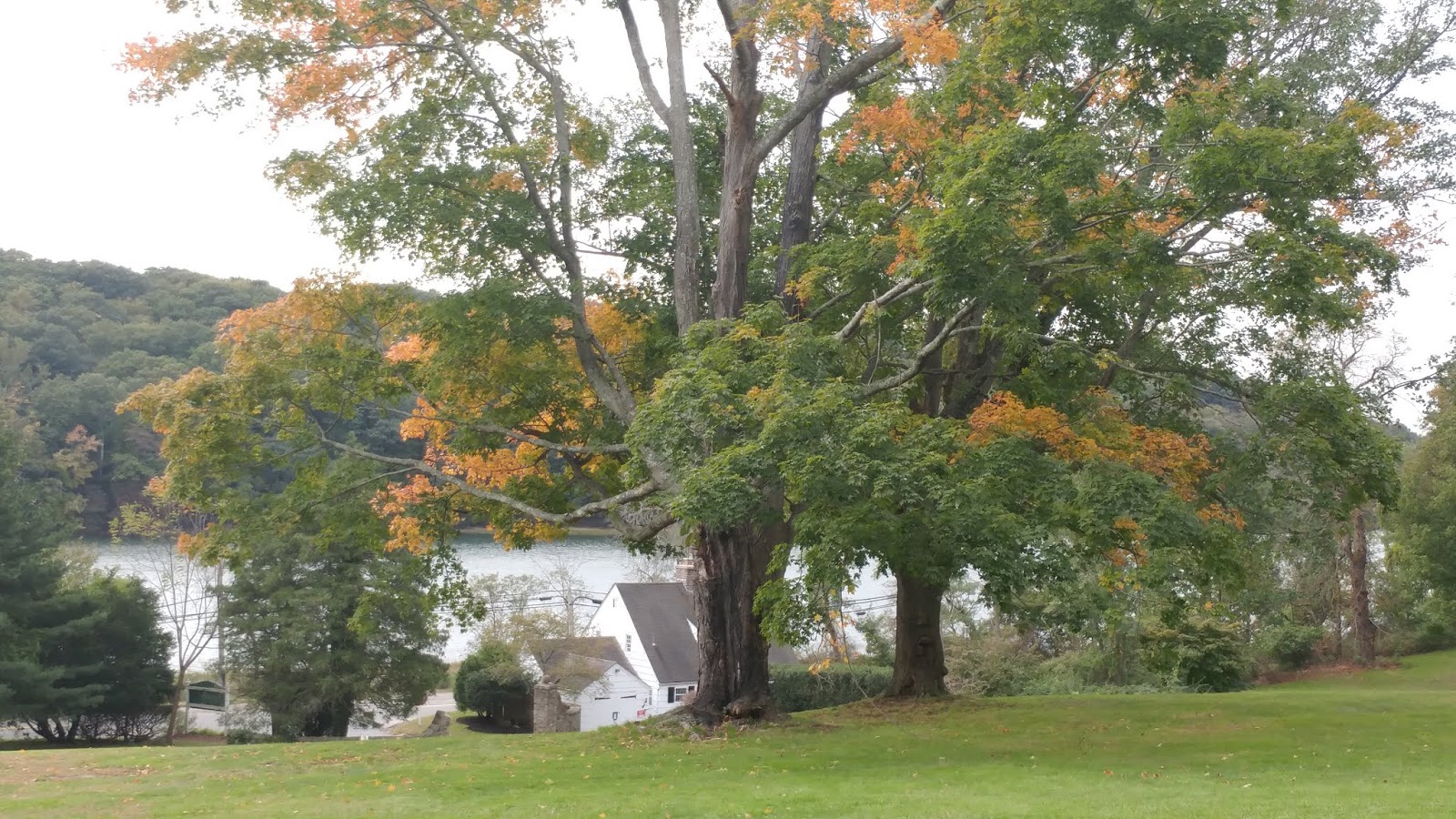
Tree in the middle of a quick change.

  • Summer lingered long and warm.  Even though autumn had been anticipated for some time, the abrupt arrival of deep and persistent cold was a little shocking.  Suddenly leaves change, nuts fall, fragile summer blooms turn to mush, and jackets, hats, and gloves are once again fashionable.  This weekend the first fierce northeaster of the year may strip foliage before it can reach full glory.
  • Old folks can see such actions in almost every phase of life.  We anticipate without happiness that friends will get sick or die, that we ourselves face declines and incapacity, that social conventions or development or technology will leave us confused and sometimes angry.  But we are nevertheless taken aback when any of those certainties actually come to pass.
  • Like all humans, we adjust quickly enough.  But we always remember what once was, and sometimes are shocked at how the familiar is suddenly gone forever.
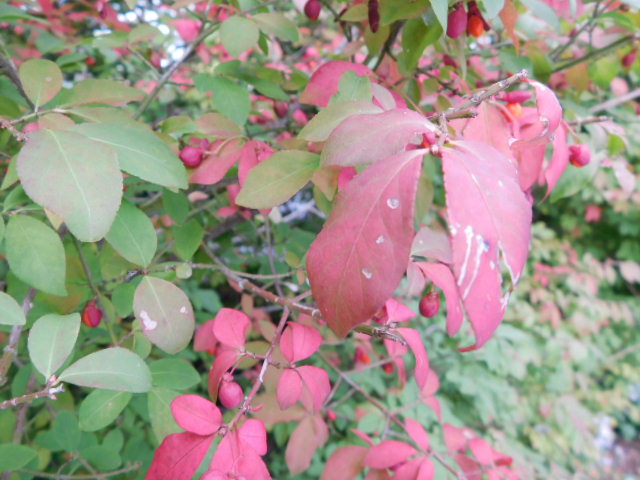
Halfway to scarlet, berries complete, another cycle fulfilled.
  • Change of seasons is less a metaphor than an omen.  There are many worrisome indications of declining possibility, as if this summer of civilization itself is passing into winter.  I hope it is only my own fey fancy that holds such grim foreboding.
  • Like autumn cold and rain, indications of future problems have been revealed in worrisome bits and flashes.  Climate change hides its tipping point under huge storms and dying reefs.  Overpopulation remains a straining but irrelevant nuisance.  Breakdown in civil morality and general decency _ not to mention high ideals _ has only ripped minor tears in the fabric of daily life.  Global interdependence and global fragility deliver goods reliably in spite of growing difficulties.
  • I concentrate on being an optimist.  Yet there is a fin de siècle tone to much of what I observe, a general twilight of the gods brooding undercurrent of what may come next, that I cannot ignore. 
  • For now, I simply put on metaphorical hat, gloves, and jacket, and hope that the weather holds back its worst for just a little bit longer so that I can enjoy what remains.
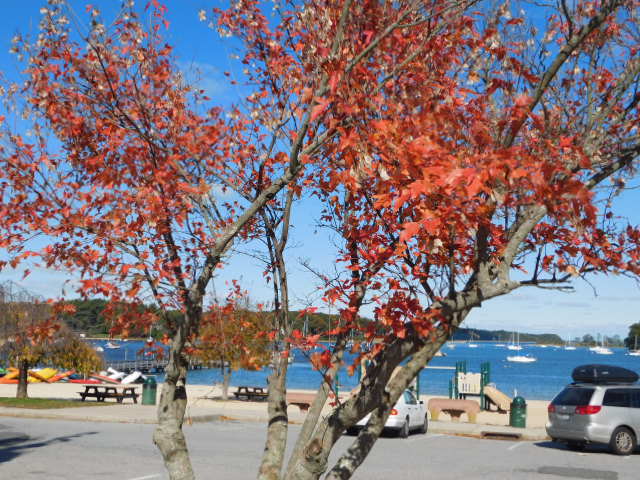
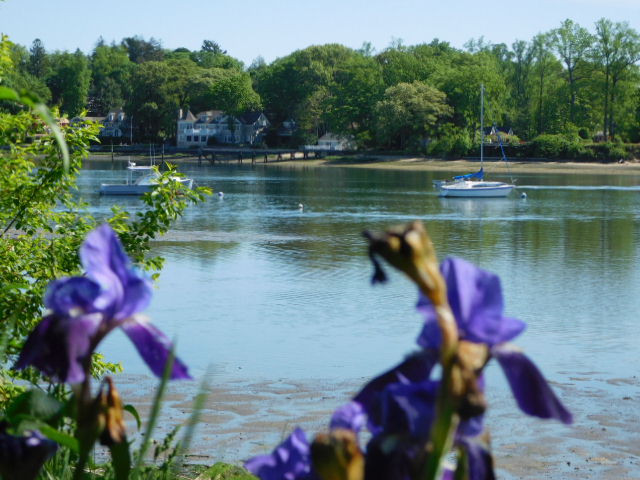
Borderline between summer and autumn, bright leaves overlook an empty beach with green trees on horizon.
  • Philosophical surprise is my outlook while growing older.  To myself, I am important.  To the universe, I am an insignificant speck in space and time.  Somewhere in between lies the actual limit of my power, but I suspect that is closer to universal impotence.  LOL.
  • I’ve enjoyed, and still enjoy, each day immensely.  Nature remains filled with wonder.  People provide constant entertainment, even if much of it is misanthropic.  A key to such enjoyment, like that which triggers laughter, is being suddenly tricked.
  • To fully appreciate continuing miracles, I encourage the ability to be surprised by everything, all the time.  Kind acts, noble thoughts or deeds, woolly bear caterpillars, extravagant northeasters, the laughter of a child.   I may regret horrors in our world, but I can no more change them than the path of a storm or the sweep of the tides.  Some say I run away from responsibility _ I agree with them.  Perhaps the greatest surprise is that all this stuff gets along without me quite well.  

Magic Mushrooms

Hiding under a huge fir in our front yard.
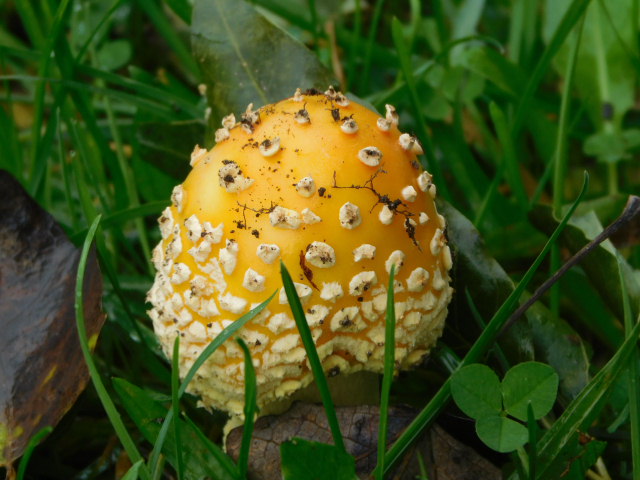
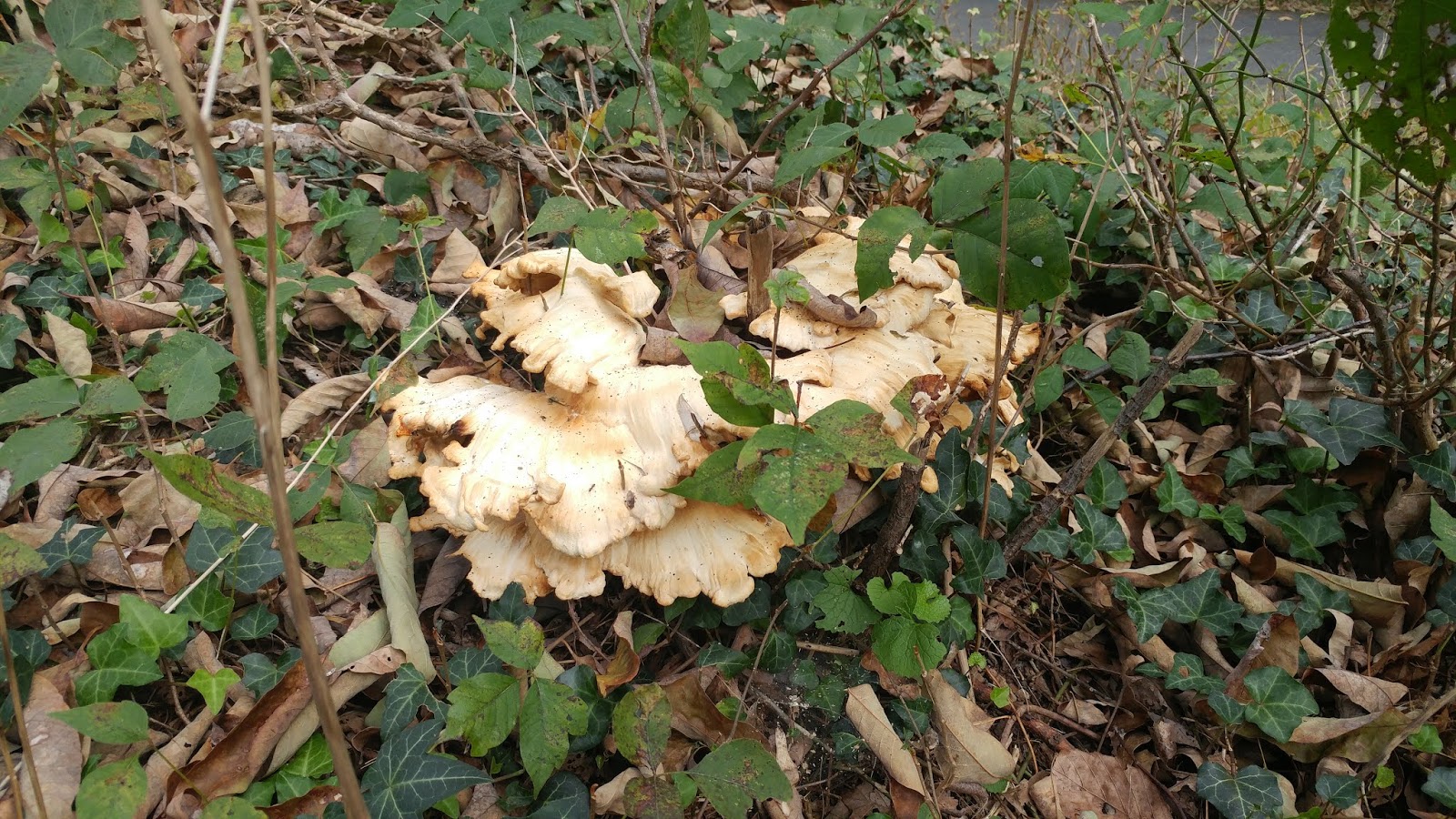
  • Since the heyday of the counterculture, “magic mushroom” has implied drug use.  This year, probably because of a very wet season, the magic in mushrooms is their size, shape, and color popping up everywhere in the most unlikely places.  There are some bigger than a softball, some brilliant yellow, some scarlet, some strangely twisted.  And almost all completely undisturbed because I, like almost everyone else, do not have the faintest idea which are safe to eat nor even if I would eat them if I did know.
  • We ignore a great deal of the biomass of the planet _ all the bacteria and of course the insects come to mind.  But fungi contribute a great deal of living matter, and almost all of it is out of sight and unknown to us until a massive underground network pops up a temporary fruit.  We hardly realize how much of the forest decay we take for granted is actually the work of the subterranean tendrils silently and efficiently decomposing cellulose and other organic materials.
  • So I am taken aback at a sudden visitor to my yard.  If I am lucky, I pause a moment to reflect on what must lie beneath my feet to be able to put forth such a structure.  If not, I am merely amazed that such a wild lifeform should show up unannounced, only to vanish totally in a day or two.
Exotic apparition by the bay in Cold Spring Harbor
  • Most of a mushroom is underground, as we once learned most of an iceberg is underwater.  Much of my unconsidered life is like that. 
  • I try to realize how complicated even my “simple” breakfast of coffee, juice, cold cereal with berries and milk must be.  Coffee from the tropics, bagged by hand, roasted, heated with electricity produced by oil or gas from deep underground wells.  Juice from apples picked, crushed, transported.  Oats grown and  harvested, ground, toasted, packaged. Berries plucked from greenhouse or field by hardly paid labor.  Milk from herds of cows.  Industries relying on other industries for metals, tools, labor.  All of it magically transported and presented to me in a vast cornucopia market, where I can purchase it with money earned decades ago.  So I can have my simple breakfast. 
  • Nature is vastly more complicated than I normally realize.  My own body is incredibly intricate _ I take it for granted.  Civilization is a web of marvels.  I am glad that even at my age I can be granted the privilege of realizing just how magical a mushroom is, and by extension how much of everything else is just as impossibly intricate and wonderful.

Samples from Caumsett on a brisk morning.

  • So much to see, so much to do, so little time _ and less energy than when I was younger.  Alas and woe.  Well, truly, when I was younger I hardly noticed the mushrooms anyway.  There seems to be a time and season for everything, even for noticing as much as possible.

Global Warming

Wild asters are among the most welcome weeds in any garden.
  • Unusually sultry days linger on this October.
  • According to a recent extended article in the Wall Street Journal, insurance companies have firmly decided that a warming planet is real, has real world effects, and are making adjustments.  Now, the WSJ is fairly schizophrenic at this point, with its four or so back pages and online front page almost reading like the National Enquirer.  Those cater to a group of subscribers best described as old right-wing grumps and younger trolls.  But the rest of the paper remains a bastion of solid reporting, because the business community still uses such information to make corporate life and death decisions concerning money.
  • Insurers are reacting ( https://www.wsj.com/articles/chubbs-ceo-on-the-problem-with-government-flood-insurance-1534125961?mod=searchresults&page=1&pos=7) quickly, because their bottom lines are heavily impacted when risk is calculated incorrectly.  The main differences now are not, as one might naively expect, that some areas are getting hotter, or even that sea level is rising rapidly.  Insurance problems have to do with new patterns of weather, which affect and will increasingly affect our daily lives.
  • For one thing, even if annual average rainfall remains the same in a certain area, it often arrives in a different periodicity _ months of drought followed by months of flood, rather than the former weekly cycles of wet and dry.  Agriculture is obviously affected, but so are forested areas increasingly at risk of fire.  Formerly desirable sites along rivers, streams, lakes, and seacoast are becoming practically uninsurable, which means unable to obtain a mortgage, which means that only the rich can buy with cash, which lowers the average prices for sellers.  Crops like wine grapes have been increasingly destroyed by hail in Europe _ what used to be a 1% chance of damage in the southern part of the continent has jumped to 18%.
  • Another issue is calculating risk.  Insurers once used averages obtained over hundreds of years _ they now consider those relatively worthless, and only use the last few decades.  Some are even ignoring averages in favor of trends.  Extreme “black swan” events are no longer unusual _ storms carry more rain, more violent winds, and linger for extended periods.  Or never arrive at all.
  • Eventually, this reaches our pocketbook, even if crops are not wiped out, even if we do not live in a fire or flood zone.   Public services must pay more to respond, taxes go up.  Patterns of where to live change dramatically and affect specific housing prices.  Some foods become more expensive or unobtainable.
  • Bottom line _ this is all real and happening now no matter what the trolls and editorials may say.  The companies which are impacted do not survive on fairy tales.
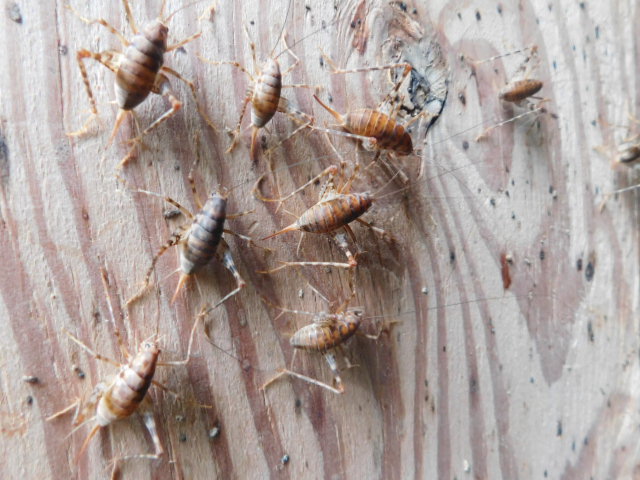
Hordes of crickets this year seemingly unaffected by environmental change.
  • Evolution is a fascinating field of study, still filled with uncertainty.  Are the driving forces gradual adaptation, punctuated equilibrium, massive disaster, Lamarckian epigenetics?  The fossil record provides evidence of all of these at one time or another.  And, for relaxation, there are all the tall tales and fantasies of pre-scientific people and current religious fanatics.
  • I fear, with accumulating professional agreement, that we are in the middle of one of the massive disaster scenarios.  It is hard to see how the world escapes extreme warming, industrial pollution, and the ravages of human exploitation without a stupendous die-off of many species.  Only the bacteria and viruses are unaffected.  My own “anecdotal” memories indicate a great loss of birds, animals, fish, insects, and reptiles since I was young.  Where did you see the last once-common box turtle or garter snake?
  • The real problem is that this ending is everywhere.  Once upon a time the last box turtle in New York City made no difference, since there were so many elsewhere.  But now, with monoculture, warming air, changing rain and fire, human habitation _ there is no elsewhere.  Only more of the same monotonous survivors of widespread ecological niche destruction.  Cheer up.  We will always have bacteria, viruses, and probably ticks, flies, and mosquitoes.
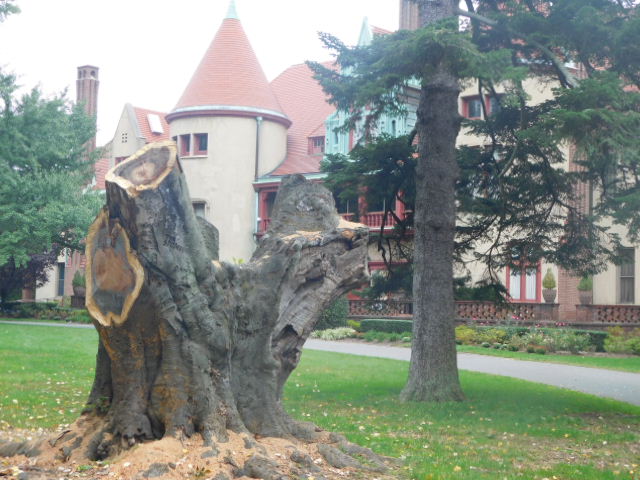
Who knows if this ancient tree died from simple old age or environmental change?
  • We have a hard time getting a rational handle on global issues.  Far away places _ filled with storm, plague, and famine _ are far away.  Local events _ fire, flood, drought _ are anecdotal and fogged by the overlay of memory. 
  • We all share the defect I remember from an old science fiction story.  A group of people are huddled under a tree as rain pours down.  One worries what they will do when the tree begins to drip.  “Don’t worry,” says another.  “We can just move under a different tree.”  When we can’t eat one species of fish, we will just eat another.  And so it goes.
  • The biggest paradigm shift since the 1950’s has been the realization of global effects and limits.  We put up with regulations that would horrify our ancestors.  They could just move on to somewhere else on the frontier.  We cannot. 
  • Today the remnants of a huge, “unexpected” hurricane arrive.   But these things happen so often that “unexpected” is losing much of its power.  Once upon a time we could move to another tree, another fish, another place to avoid them.  Today _ “global” is almost a curse.

Winds of Change

Early morning construction site, all day roar and whine.
  • Usually summers have passed modestly since retirement, as we spent a lot of time just sitting in our back yard, reading and enjoying birds and flowers.  But not this year.  Our Italian-heritage neighbors have decided they need a piazza in their own yard.  Leveled, paved, cleared of ancient trees and shrubs.  I expect the monumental Michelangelo statue to arrive any day.
  • Since town regulations are honored only in the breach lately, each morning began with vast crews of foreign-language workers and massive amounts of construction noise.  Bulldozers, stone saws, jackhammers _ everything except blasting.  Up to ten trucks on the road in front of our house.  Like living next to an expressway, all day, every day, nearly dawn to dusk.  I had to escape to New York City for some peace and quiet.   And perhaps the most annoying thing is that this family _ if it maintains its usual patterns _ will only use this monument to nouveau-riche futility five or less days a year, when the lawyer in charge can impress his friends.
  • Of course the same horrors happen everywhere.  The Hamptons are a prime example.  America at her strongest defense of private property guarantees that residents such as this will spend a fortune on things that nobody can share, but will continuously vote against any public improvements in the local area.  Lower taxes, they cry, as they pour money into backyard concrete and imported marble which will languish unused forever.
  • Ah, these old people, they complain about everything.

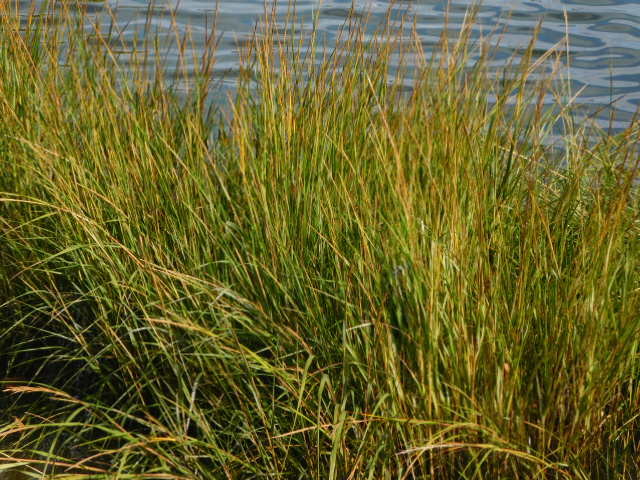
Grasses slowly maturing into autumn colors as high tide swirls.
  • Strong erratic winds under broken purple clouds yesterday, but in spite of strong overnight storms, summer lingers.  People are still wearing shorts and light shirts.  Trees are mostly a jungle green, although salt meadows are half gold, and a few poison ivy leaves show crimson.  Some flights of geese appear to be heading south, although since so many overwinter here now that is not too much of an autumn sign.
  • A few folks complain that the heat remains.  Others are excited to still be able to walk woods, sit on the beach, or in some cases continue to do laps in the salt tide.  Mostly though, everyone is too busy at work or school to pay much attention to the weather.  The old agricultural rhythms die hard.
Sun burns through mist that enchants the most prosaic scenes
  • Heavy fog this morning has not stopped the neighbor’s bulldozers and stone saws, but it does indicate no wind.  Wind and fog rarely exist together, except in social metaphor, when we can easily be buffeted about with change at the same time we are blinded by cultural mist.
  • I grew up with the typical American exceptional belief that we had achieved ultimate human stability.  Things would get better, hard work would gain appropriate riches and fame, the rest of the world must follow us, I could confidently predict what others around me were thinking.  All naïve and innocent balderdash, of course, until it metastasized into current political sloganeering and personal victimhood.  Everyone seems to be truly becoming a rhinoceros _ there goes another one down the street now _ my neighbors metamorphosed overnight.
  • Knowing I will quit the planet fairly soon, I’ve had my share and be somewhat philosophical about stuff.  I can’t affect the world which my grandson will inhabit.  I couldn’t control my own. 
  • And yet, as the winds howl, I maintain faith.  Humans are remarkable, and mostly work together in social situations amazingly well.  I strolled NYC sidewalks Monday, amazed at how well everyone gets along.  I am amazed that our own culture is so little filled with actual violence.  There can be hope.  But sometimes the gales blow fierce, and all seems lost, and I worry if the storm will ever end.

Just In Time

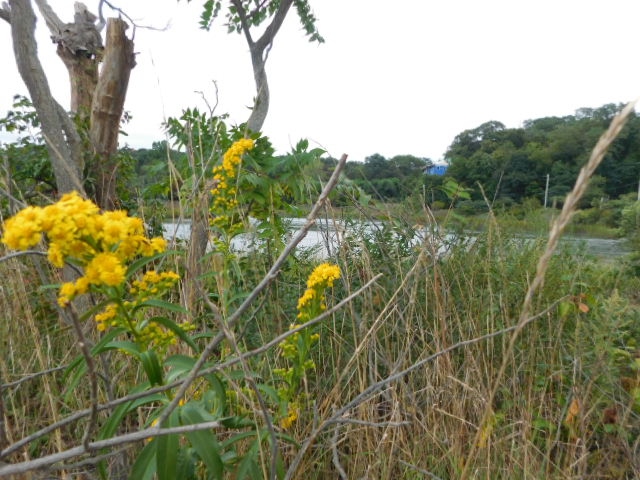
Goldenrod signifies that surrounding green will vanish as chill settles each evening.
  • Joyous summer has been devoted to considering time, when considering anything at all.  What should I mine from the richness of past memories, how should I conduct my present, what is the best way to deal with fears of the future?
  • Looked at in the broader view, the world continues to seem to spin out of control.  I try to encapsulate all fleeting news into a category of “entertainment.”  There has been an awful lot of such entertainment over the last few months. 
  • At a small personal level, time has pushed its way to our forefront, as we once again encounter nearly instantaneous growth of a young grandchild.   We are amazed at how much had been forgotten about experiences with our own children way back when.  But such immersion in each fleeting moment, and the rapid changes of days and weeks, have been instrumental to my meditations on the nature of my own years.

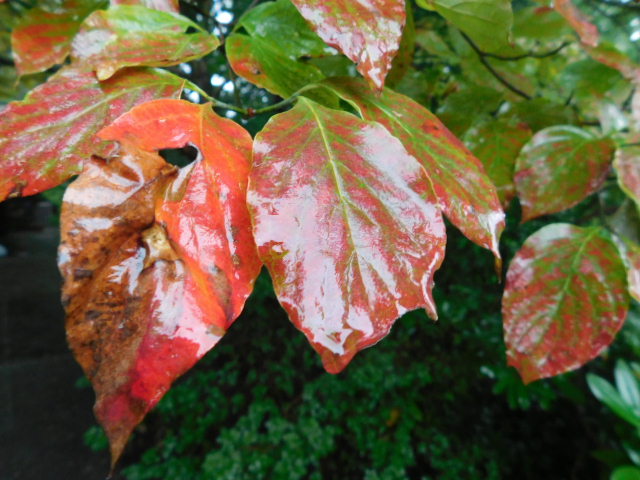
Gentle chill rain highlights first leaves displaying autumn color.

  • Einstein famously tied time, light, and space into relativity.  His theory does not match our  experience. Science declares each second equal to any other, but our perception ignores some hours, stretches other hours endlessly, and sharpens certain moments into near eternity.  We are left with nothing but memories of what we think happened as the clock ticked.
  • We learn to not worry too much about time, take it for granted more than the air we breathe.  Yet without time, there is no existence.  In fact, a case could be made that life is unique simply because it cruises through time in a manner different than other matter.  Our consciousness of time undoubtedly is what truly separates us from other animals.
  • We cannot manipulate time.  We can barely contemplate it.  A marvelous, mysterious, and integral part of our being.

Stormy sky along a deceptively quiet roadway shoreline.

  • Time closely resembles Western conceptions of God.  It is mysterious, omnipotent, omnipresent, fractal, and unknowable.  It begins our lives, permeates them, and ends them.  The present forces itself into our consciousness of all we are and do.  It even includes the all-in-one inexplicable trinity of past present and future.
  • An awful lot of religious arguments center on time.  If God is master of time, is there free will or is everything predetermined forever?  Can even time change the events that happen in time?  Even now, we debate what is fated, what can we change, what is overwhelming.
Asters indicate the season even without support of swift cool breeze.
  • Science tries to pretend that each chunk of time is constant.  I wonder.  Was an hour in the Roman Empire the same as an hour watching news tonight?  I know my evening and morning hours pass differently.  Is my perception flawed, or is science missing something important?
  • Science claims, for example, that exactly when a given particle decomposes cannot be predicted.  But maybe time, as well as the other properties of the universe, runs oddly at that level. 
  • Science, in fact, has no meaningful logical grasp of time as anything other than the grand, mysterious, unknowable entity it has always been to human minds since the beginning of _ well, you know.
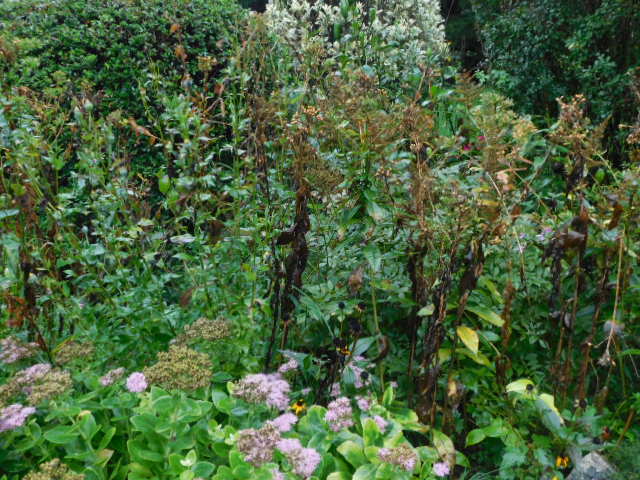
End summer, begin fall, late flowers and dry detritus, elements of reflection.
  • If time were classically worshipped, its center would be “this moment.”  In spite of memories,  incredible vistas of eons opened by intellectual logic,  and imagining the future, each moment is all we experience.  Relentlessly.
  • This moment is unique, and yet seamlessly embedded with all others.  It is the only element we can truly know of time.  It flows by and through and around and permeates our universes more surely than any physical phenomena. 
  • Time remains so elusive that eventually we ignore its majesty, take it for granted, and just go along for the ride.  As indeed we must, to exist.  Like this essay, delving too deeply is basically futile.  And now, I turn from such useless philosophy to a glorious day before me, grateful for its length and breadth and, yes, for its infinite and unknowable mystery.


Why Kavanaugh doesn’t matter

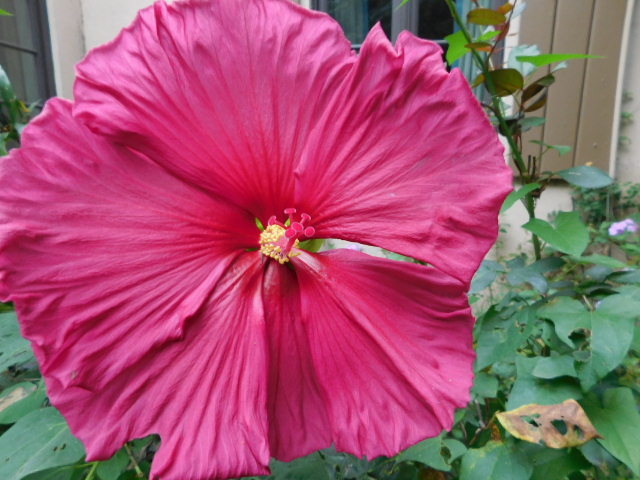
Our hibiscus, like our mosquitoes, has had a very good year.

A lot of well-watered vegetation seems to be clinging to summer mode as desperately as I do, this first day of nominal autumn.
=
  • Republicans and their supporters are fighting an “any means justifies the ends” battle to shape the Supreme Court for “generations to come.”  That faith is misplaced.
  • Not much need be said about the candidate himself, a smarmy product of elite male privilege, other than that his shallow mind is focused on two social “truth systems” advanced as holy writ.  About one of those, composed near the dawn of agriculture, little need be said.  The other _ our constitution _ was written by well-meaning rich men who had no knowledge of electricity, steam power, internal combustion, women’s equality, modern science, evolution, medicine, and so forth.  It is not bad, but each word is not so contextually immaculate that it need never be interpreted, as Kavanaugh rigidly postulates.
  • The country is changing.  This is the last gasp of mean old white men and women, and a few scatterbrained younger folks who blame all their woes on something other than themselves.  In a few years,  the Republican Party will be one with the Whigs.  Their gerontocracy will crumble, before or after it destroys our current political system forever. 
  • But no matter what, a social “blue wave” _ which will no doubt fragment but which will shift power _ is going to be out for blood revenge against the current batch of senile bullies and young “freedom” punks.  Lying under oath is the least of the real or imagined malfeasance which will end up impeaching any obstructionist judges in the politics of the near future.

===

  • I am creeping back into this blog, pictures and text.  During my self-enforced summer hiatus in composition I thought that maybe by cutting back on daily typing I would have more time for some other things.  It has not worked out that way.
  • I miss my daily nature musing.  I miss trying to snap an appropriate picture.  It has been wonderful to let my mind clearly freefall, without conscious direction.  But, like all vacations, that gets a little boring after a while. 
  • I should apologize, I guess, for the old geezer rants on politics and the perceived ruin of the world.  But if that is the fuel I need to restart, so be it.
  • I’ve managed to preserve my daily morning handwritten journal, which has devolved into a diary of activities.  And the summer has been busy, with lots of babysitting, a few travels, and the usual round of walking, swimming, eating, reading, yardwork, and a lot of babysitting. 
  • We shall see where this goes, if anywhere, but a journey needs to begin somewhere.

Supreme Court

Supreme Court
Authors of the constitution worried about mob rule and dictatorship.  For that reason they tried to set up a system of what has come to be known as checks and balances. 
Mob rule was to be curtailed by only allowing direct citizen elections for the house of representatives _  local voting qualifications determined by each state.  The senate was to be provided by state legislatures, and the president selected by a committee of wise men.   Assuming that these three branches would fight tooth and nail for power and money, the judiciary was provided as a non-elected referee.  Regardless of what originalists may fantasize, our current government does not resemble that designed by the founders.  Majority mob rule directly elects executive, senate, and house.
Federal checks and balances are now provided by three conflicting power centers:  (1) elected mob-rule formal government (president,senate, and house), (2) ongoing immense bureaucracy implementing accepted laws and rules, and (3) corporate plutocracy headed by the military-industrial complex.  The judiciary still tries to referee, but recently politics has become weaponized into strict party mob rule which threatens judicial independence.
Note that the number of justices is set by law, not by constitution.  There have already been attempts to “pack” the supreme court _ simply appointing new judges until a majority favoring the current mob is in place.  It is likely that packing will become commonplace over the next decades until a new consensus of political boundaries is reached.
Conservative principles used to mean something important about preserving individual rights.
An “originalist” who refuses to understand the founders’ proper fears of executive power is no traditional conservative.  A “textualist” who does not understand that power centers now reside in massive international corporations never conceived of by the authors of the constitution is no traditional conservative.
And  a judge who believes eighteenth century beliefs should not be modified by the realities of modern technology, philosophy, and being should be rejected by real conservatives concerned about the imperial direction this country is suddenly rushing into.