Aware

I had a good laugh the other night at an ad for a new expensive ergonomic chair that would make anyone more productive and _ by implication _ healthy, wealthy, and wise as well. My mirth was from the recollection of long hours when I programmed oblivious to the world. And all those times reading or watching a movie when we ignore all else.

Humans can be incredibly aware. Our senses are fine-tuned to this planet and ecosystem. Whatever was relevant to past survival can be called up at a moment’s notice _ a flash in the woods, a squeak in the night, a bad taste in a mouthful of food.

But all that input must be filtered last we dissolve in sensory overload. We can be aware of much, but usually ignore as much as possible. Inner churnings, external stimuli, even flashes of thought. We pick what we need and all the rest magically vanishes.

There have been times when, deep in a logical problem, I have awoken from a working trance trembling and stiff from the cold of a computer room, legs barely able to stand, eyes unfocused, and even thoughts confused. Would that ergonomic chair have helped? Nah.

In fact, I think such comforts are precisely designed for those who cannot concentrate and who are much too aware of the discomforts they are forced to endure to earn a paycheck. A hedonistically formed chair will hardly help with their tasks.

Happy

It is surprisingly easy for us to be distracted into happiness. Give candy to a crying child and all may be well. Even a hug will do the trick.

Being happy is one of the acknowledged goals of life, so much so that “more noble” goals such as honor and duty require giving it up. A person happy all the time is considered lazy with little ambition. Seeking only immediate happiness is thought to be the road to addiction and eventual death from shortcuts used to attain pleasure.

Philosophic treatises have innumerable elephants in this vast room, but surely one of the greatest is the role of being happy. Should it be a goal or a distraction from deeper values which require patience and sacrifice? And under what circumstances and when should it become positive or negative? But how often does one find such questions clearly addressed? 

Clearly, in the short run, there are conditions when one should be less happy now in order to be more happy in the future. But given the uncertainty of the future as it extends farther away from the moment, is such a cause and effect link ever really valid? You end up with a miserable slave being happy over the idea that paradise will arrive with death. Even if such happiness is real, is it moral? 

Considering nibbles like this is essential to the beginning of wisdom.

Human Beans

“Greatest good for the greatest number” is a great meaningless flim-flam. It is typical of all social thinking which reduces human beings _ who actually exist _ to human beans. Human beans are supposed to be little identical pebbles, easily washed and manipulated by the currents of historical process.

But neither I nor anyone I know is such a “bean.” I have been a unique and sometimes perverse individual from the time I was born. Moreover, each moment of my life I have been a somewhat _ sometimes radically _ different person than at other times. And often, I actually seem to be many conflicting personalities at the same time.

We can deal with what could possibly be meant by “greatest good” in a different essay. But the supposedly easy part about the “greatest number” is equally fallacious. Yes, I suppose I want myself, my tribe, my family to prosper _ at least unless I am mad at them. But even then I am not sure if my strange estranged uncle should count… There is _ even on the most fundamental level _ no adequate way to make piles of “almost identical” human beings.

Nor do most of us truly believe that all or even most humans are equally needy, equally deserving, or equally responsive.

Time to retire this meaningless phrase.

Bad Numbers

Proudly, a child learns that one plus one equals two. It is a useful way to organize and abstract the world, the gateway to control. Numbers are a magical and important tool of civilization. We cannot imagine life without them.

But we must always be careful to understand the limits of such abstraction. No real world manifestation is truly equal to another. Even a molecule is different from all other molecules by virtue of its leptons and quarks.

A child can understand this. One rock plus one rock is two rocks. But if one is a pebble and the other a boulder the idea seems a little silly. If two are equally sized but one is made out of gold, other considerations come into play.

We find that constraining definitions are required _ are we counting apples, oranges, or a mixture? By the time we load on all the qualifications, one plus one equals two seems a lot less glorious and absolute.

We thus need to be extremely careful with numbers, even before we get to concepts of “many.” And that is the root of the problems we have with statistical valuation, and the application of enumeration to ethical concepts.

Academic Dues

Just read a newish book What do we owe the future which is a take on academic philosophy. That will inspire a few essays. Overall, I was impressed at the earnestness, but dismayed at the irrelevance. A lot like trying to read through an ancient theological paper explaining the hierarchies of heavenly hosts.

In short, I could hardly accept the basic assumptions. After that, I found most of the logic indefensible. And of course that would make all conclusions suspect, except that the author had only the most nebulous conclusions. And none at all that relate to our actual daily lives.

A perfect foil for my own approach, which is to avoid the ineffable and concentrate on the philosophy of breakfast. 

What most amazed me _ as I suppose a medieval peasant would be amazed at writers _ is that some people can make a living in such a way. In fact one of the admired philosophers described raced about like a madman, constantly coming up with algebraic formulations of morality while ignoring, as far as I could tell, all else about him.

Yet, I am grateful for the kick in the mind, to give me a pleasant week or so of my own ruminations on the subject.

Mud

Mud may not sound like much _ wet dirt after all _ but it is often a sign of civilization. Muddy fields are more common than muddy forests; muddy roads have churned across landscapes for millennia.

But it is in building things that various types of mud are most useful. Mud on thatch, mud huts, and, of course even today, bricks. Without mud a lot of the humans in the world would be without shelter.

Mud can be slimy and smelly and dangerous. It can be slippery and soothing and delightful. Especially for kids.

Sculptors form it into statues and other shapes, either to stand on their own or as models for sculptures constructed of other materials. And we still use plates and tiles and high-tech ceramics.

Today it is often hard to contemplate origins. We are too busy and rushed. How many times do we consider the cow when we sit in a leather sofa? How much time can we waste wondering how our cereal bowl was made? And bricks are just stones somehow magically shaped into standard sizes. Mud _ugh _ get the mop. 

Possibly there are too many marvels demanding our time. The simple things are lost in the shuffle. Just possibly, that is too bad.

Soil

Sand and dust may exist on almost any asteroid or planet _ a few may even have water beaches. But only life can create soil, a mixture of sand, dust, and organic matter.

Oh, I know science fiction blandly declares that we could grow food in the “soil” of Mars or the moon, but that is simply a substrate _ like hydroponic water _ until it crawls with fungi, bacteria, and the residues of plant decay.

Soil is amazing stuff, truly a world in a thimbleful. And a lot more rare than we like to believe _ three quarters of the earth’s surface is water after all, and chunks of the rest are solid ice or bone-dry desert. Even where it exists, soil forms a very thin veneer on the local geology.

Soil is necessary for most human crops, and even remote Islanders surviving on products of the sea like to grow a few things. Soil is more an indication that life on land exists and how healthy it is, rather than a requirement.

Like everything else, soil is easily contaminated by the products of our industrial civilization. Once its organic properties are killed off, it returns to dust and sand. Possibly never to become soil again, depending on what the pollutants were.

We ignore soil at our peril. Easy to take for granted, dirt underfoot, but the core of many of our experienced ecologies.

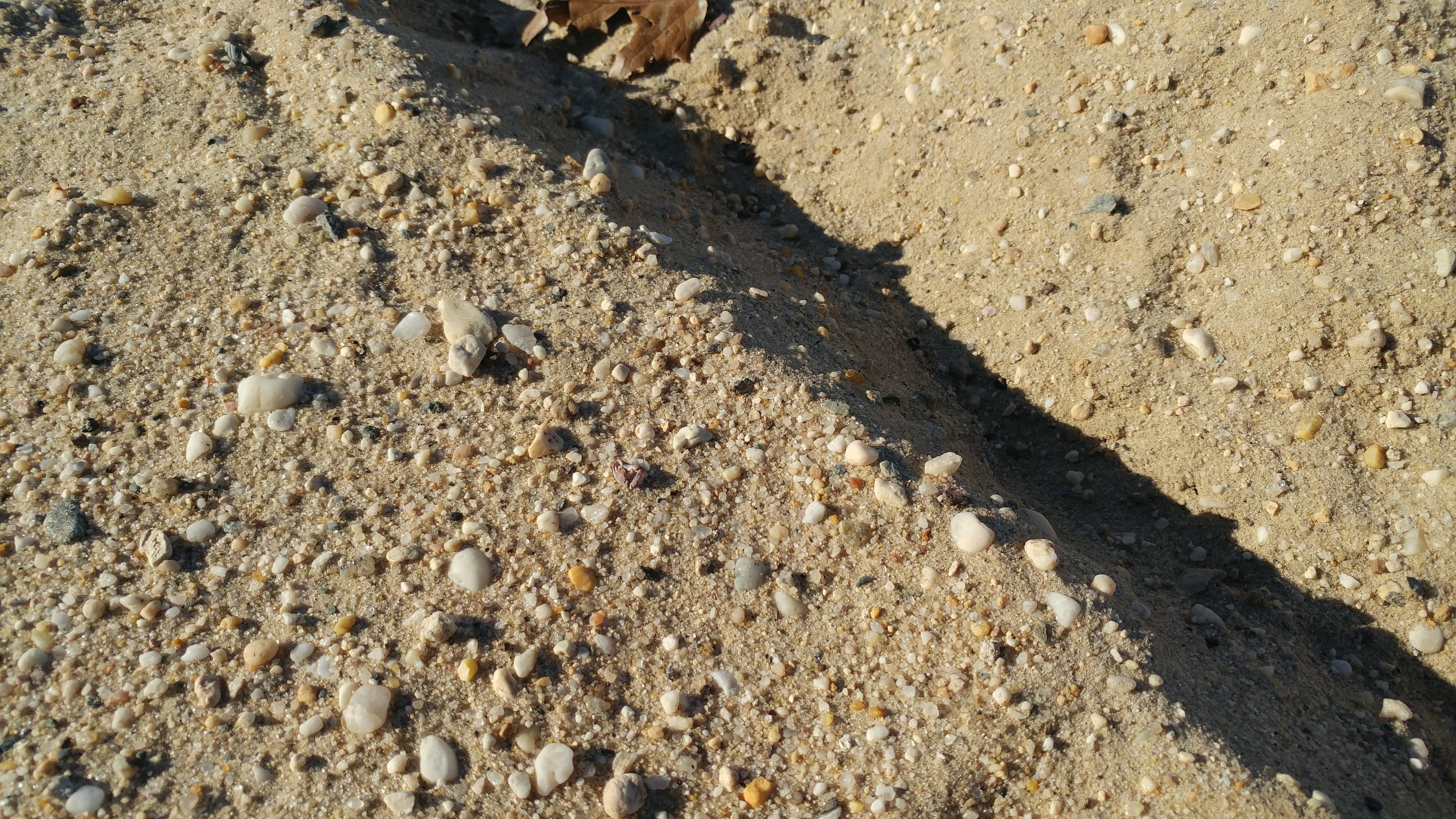
Sand

Sand on the beach is a wonderful, mysterious, transcendent miracle. I let it run through my fingers grain by grain and dream of eternity. It represents not the foundation or beginning of everything, but a perfect implausible marker of this exact time.

After the big bang, there were billions of years of solar formation and explosion. Elements like silicon forming out of hydrogen and helium. Trace minerals here and there that grouped to form more suns, asteroid clumps, planets, the earth beneath my beach chair.

And over more billions of years, after the world formed, creation of rocks, creation of water, change in air, erosion by rain ice and sea to form pebbles, wear the pebbles into grains, compact them once again into rock, erode them once more into sand, pile them up with the help of the moon tides. And here I am, billions of years trickling out of my palm.

The sand was here before life began, it may outlast it. But, like us, as the universe runs down it will cease to be.

I don’t worry much about that. I am more intrigued by the fact of what its existence implies.

And I realize once again that one need not travel far to arrive at wonder and wisdom.

Dust

“Dust to dust” is sanctimoniously intoned at many funerals, as a sober reminder and warning of human origins and endings. I expand that to encompass the entire universe. Dust arises from quantum effects, we suppose, and everything follows from its later behavior. Dust clouds drift in space, suns accumulate, burn, explode. Elements form and clump into planets and eventually all may be cold dust once more.

Life is little more than a drive to survive. Conscious life seems to center on the importance of continuation. Once a person or a tribe escapes a desperate hardscrabble existence, the mind reaches for “what next.” A thousand year Reich, an eternity of heaven or hell, generational estates and so on. Some even dream of the continuation of their own civilization.

But with eight billion people around these days, dust to dust remains true. Not only my body, but also my hopes, fears, accomplishments good and bad. In time _ if there really is such a thing as time _ we are all inconsequential.

But those moments between dust and dust have been very important to me. In fact it is me. And accepting that fact _ not claptrap about the future _ I become and remain real. At least as real as the dust at my feet.

I am not against life, or accomplishment. I remain proud of all I have done. However I will know that whatever the future may be, it does not care.

Clowns

Political season brings out the worst in everyone. I often think the old saying should be amended to “those that can do; those that can’t teach; those who can’t figure out either run for office.”

My image of a clown is always Emmett Kelly. Sad, clueless, dressed to attract attention. Attempting simple tasks, failing at everything. The only real difference between him and the media buffoons who now become serious candidates is that he was silent.

Clowns often perform in groups. Some are the out front stars, but behind them are ranks of lesser performers, these days represented by publicists and ad creators. And of course running the whole show, almost unnoticed, the ringmaster billionaire.

It helps to think of most of these well-meaning but often frightening figures as relatively harmless clowns. After the show ends they will fade away. Inconsequential sidelights to the main events. Back to shouting on street corners and complaining to friends over beer and wine.

Elections roll by, civilization usually survives. Momentary frenzy jolts the system, then just about all of us return to our daily lives. And the clowns retreat behind the sideshow tents and become almost normal.