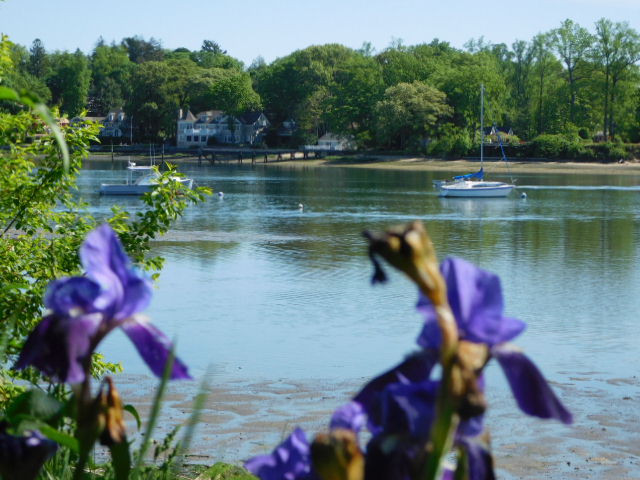
Remarkable

Monday

Seems a shame, daffodils defiantly spurt into bloom, only to be battered by heavy rain.
  • Only a romantic living on the British Isles in the last century could think April is the cruelest month.  For most of history, at least in Western Europe and North America, just about any month would have its share of possible horror and disaster.  Famine, plague, war, crop failure, weather misery.
  • Well, we’re temporarily at least beyond all that.  Each day is marvelous.  But still, we manage to worry a lot, mostly that it will all go away.  I don’t know if that is basic human perversity or just a lack of grace in the cultural soul of United States citizens.  
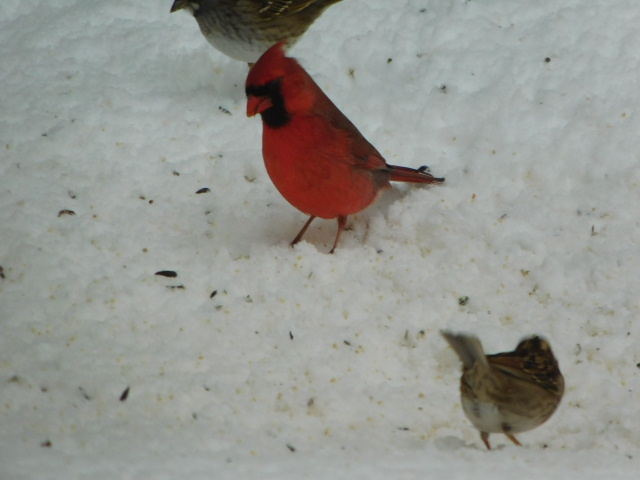
  • Fortunately, life usually grabs us by the throat and forces us to exist in the moment.  It’s hard to encounter a bright red cardinal, a newly returned robin, a pair of gamboling squirrels, without breaking into a grin.  Hard to ignore crocuses and daffodils and an explosion of forsythia bushes or puffs of maple flowers high overhead.  Right now, this instant, warm and safe and well fed and happy _ isn’t life fine?
  • Well, yes, we admit grudgingly.  But you know …. And off we go into a litany of possible, probable, massive, apocalyptic looming disasters. 
  • I stop myself there,  I force myself back to the birds and flowers, back to the sky and water, back to my berries and milk, back to the reality that right now for me this is a great time.  I should make the most of it.  

Tuesday

Nice one day, brutal fog next, again grateful to not be an ancient mariner.
  • Water.  Fog, rain, reflections, ripples, breakers, drinks, baths:  infinite lists, infinitely present.  Life itself.  And, underlying all which is obvious each day, the transformations of weather and scenery and well-being,  are magical chemical properties in an astounding atomic structure.  So easy to take for granted, even easier to seize on one aspect or notion.
  • Spring in Huntington can be the season of overt rain.  It falls heavily or lightly from mists, mixes into mud, forms sparkling droplets on bare branches.  After days of precipitation, our mood longs for it to go away, but after a long spell of dry cool wind we are grateful for its return.  The most remarkable thing about water is that we usually end accepting it as not remarkable at all.

Wednesday

  • April showers bring May flowers.
  • But April flowers are more welcomed.

Thursday

Grass is greening but most of the landscape remains February mode at Coindre Hall.
  • How remarkable it all is.  Every morning I wake amazed to be alive, to be here, to be me, to have an entire new world to explore.  Infinite things to enjoy, discover, ignore, or complain about.  Bits of pain and hardship to accent joys and comfort.  What a world!  What a life!
  • Yet I become as jaded as anyone.  My senses quickly filter all immensity into streams I can accept without overload.  I fail to notice most of the ongoing information.  Sight, sound, touch, scent, taste, internal rhythm _ all of it fades away to be replaced by the pale cast of organized logical thoughts or wandering daydreams.  My mind immerses itself in the swamps of cosmic mysteries contemplated, and leaves all mundane reality behind.
  • What a fine thing it is to live in a chaotic, unpredictable universe!  How dull it would be if we really were to inhabit some perfectly controlled environment, a Newtonian nightmare with no surprise nor mystery.  This morning, this day, I am overwhelmed with happiness.
  • Yet, already, I fade into a land of desires and begin the cycle of desires anew.

Friday
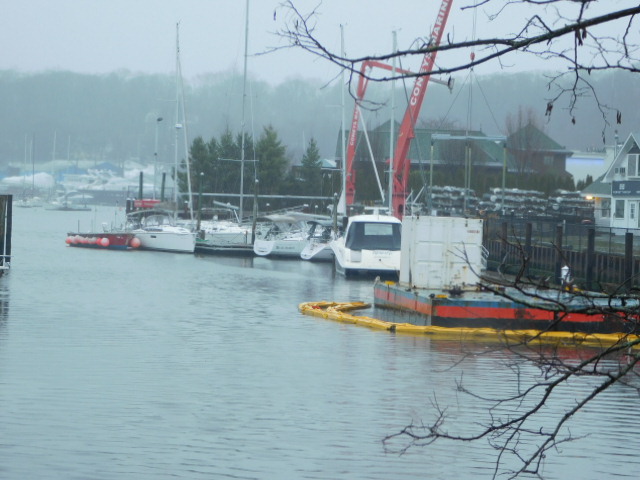
Some dark rainy days the only available colors are cheerful yellow oil-restriction booms.
  • Humans breed plants for varied reasons _ better food, nicer flowers, drought resistance, leaf color or shape, and so on.  Few, however, concentrate on buds.  Like all the intricate miracles of life, buds are all different and all fascinating to stare at, at least for a while.
  • The ephemeral nature of buds, of course, makes even the thought of growing a plant for its bud structure a little odd.  Buds are usually even more ephemeral than the flowers or leaves they will eventually produce.  This time of year is truly the season of buds.  We observe them anxiously, awaiting their promise of finer things to come.  I guess they would think it’s good enough to be noticed _ even for a short while _ than to be ignored all the time.

Saturday
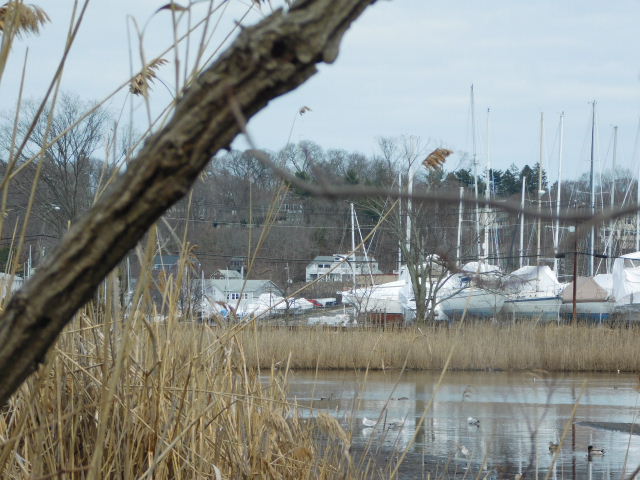
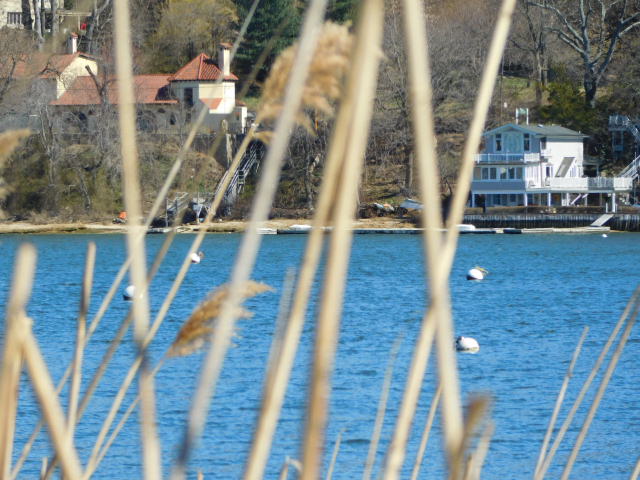
No new shoots on reeds, no leaves on trees, boats still high and dry, spring seems later than ever.
“Hey, hi there, handsome!”
Dan perks up on his hind legs, balancing, almost forgetting the seed in his squirrel paws.  “Gosh, hi Suzi!  What a surprise!  You’re looking good.”
“You too, with that big strong full tail ….”
“That’s not all that’s big and strong and full,” barks Dan salaciously.
“Oh, you boys are all the same this time of year,” little coquette Suzi responds.  Suddenly she twists upward.  “Oh, look!  Something strange!  I must dash!”  She runs up the thick trunk behind her.
“Wait Suzi Wait!” Dan scampers after.
“Catch me if you can!”  she flies from a hemlock branch onto a nearby roof and races across.
Dan follows, ignoring danger, finally draws close as she pauses for breath on the limb of a distant hickory.  “Why do you have to be that way?” he pants.
“If you can’t keep up,” laughs Suzi, “I just might go see how Ralph is doing ….”
“Aw, Suzi …”

Day continues bright, cold, clear, spring, endless time for both of them entranced in the instinctual dances of nature.

Sunday
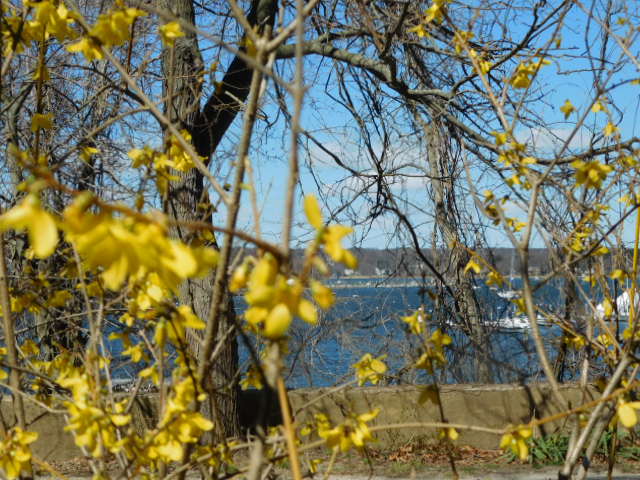
April sings seductive songs, pied piper of the North
Blooms pop, robins hop,
Squirrels play, bulb shoots sway,
Trees’ verdant buds burst forth.
Sunshine streams so bright it seems a crime to stay inside
Rush out to see, immediately
Skin gets cold, joints ache old,

Patience whispers wait, abide.
Seventy Springs

Monday

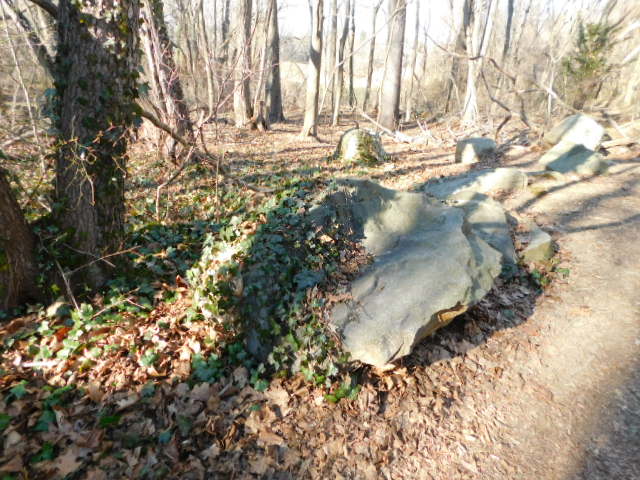
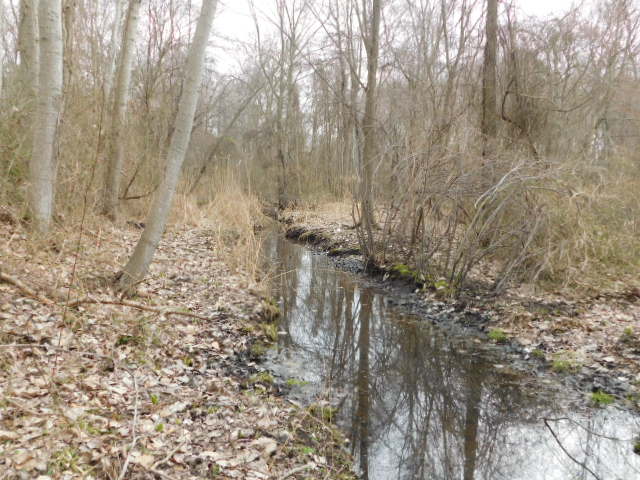
Fewer and fewer public forgotten woodland scenes remain in Huntington in this era of aerial real-estate treasure hunting.
  • I notice that my Monday entries for the last two weeks have been basically identical.  Another sign that short term memory is becoming less clear.  Although, I admit that throughout my life I have had brilliant new ideas that somehow on examination seem to be the same as some great old ideas I once had.
  • Accepting limitations on our minds is just another part of aging, no matter what people say.  After twenty or so you cannot run as fast as you once did.  After thirty the muscles begin to weaken a bit, the gut to enlarge.  By sixty the skeleton is chorusing complaints with the various joints, skin is cultivating blemishes, hair is thinning, all the senses are less sharp.  And god knows what is happening inside.
  • Speaking of God, it was nice once in a while to accept a Calvinistic or Greek outlook on ambition and achievement  and regard myself as a pawn of fate.  I could relax because I was hostage to situation and genetics.  In the short run I could affect my world, subject of course to luck.  Calvin provides a lovely fatalistic crutch when things go badly, and an equally good dissolver of hubris when things are good.
  • Now, of course, ambition and hubris have all melted into the great pot of looming mortality.   As hard to ignore as an iceberg sighted from the bridge of the Titanic.  Thus I am back to where I always was, day by day.  As more and more of my bloated elderly peers make fools of themselves in politics or economics, a decision to exist mostly to remember and appreciate and help others now and then seems completely rational.    

Tuesday

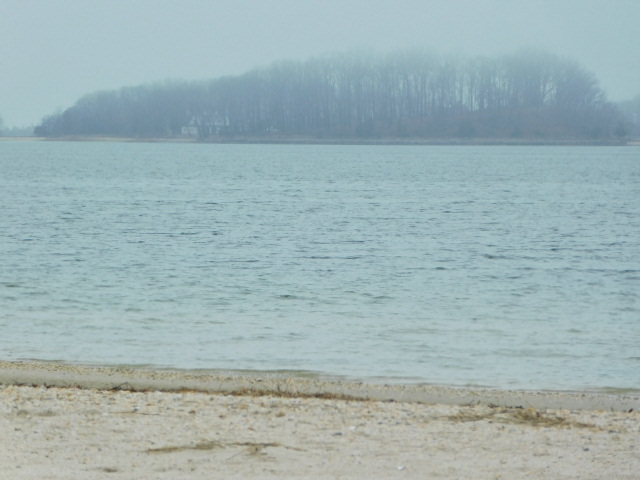
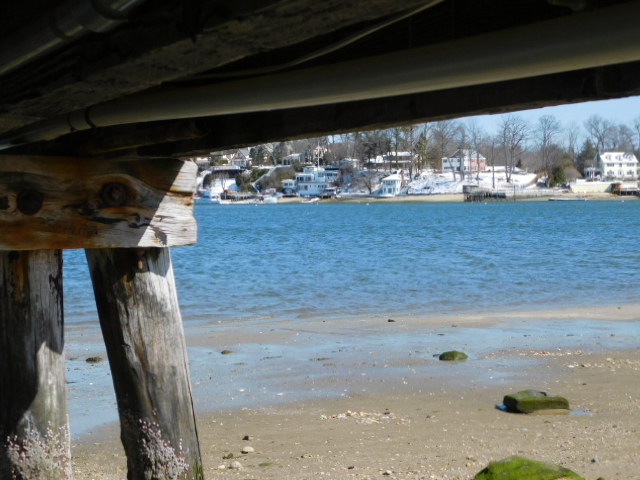
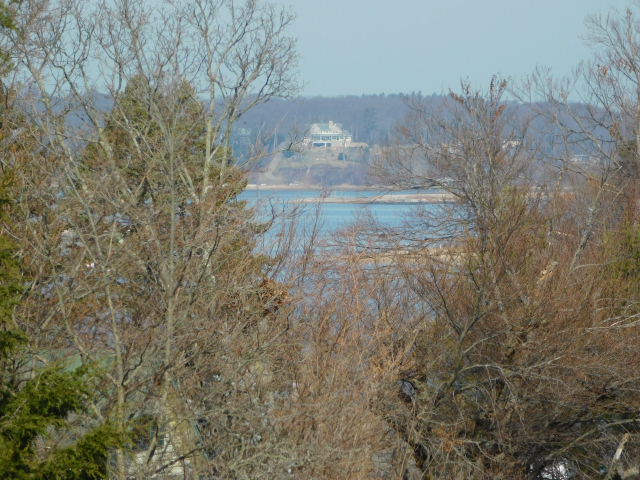
Fog softening shoreline is common in March, but picture doesn’t convey damp chill nor cries of overhead geese.
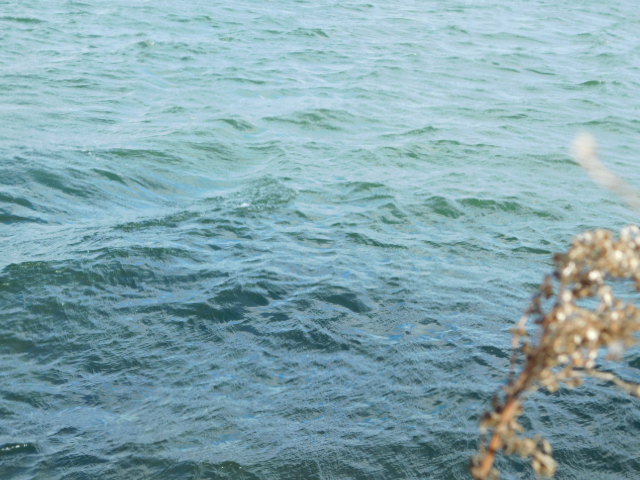
  • Tides are almost the swiftest of the many signs of cycles which are never exact cycles.  Rocks vanish twice a day, reappear, but every grain of sand and each shell has been shifted or broken.  Most of the algae grows or breaks off.  No wave, no sparkle on any wave, ever repeats.
  • I have witnessed many cycles, cycles within cycles, cycles that still continue, and cycles that have ended forever.  I remember many springs past, although not so clearly as once, filled with adventure and hope and love and all the many annoyances of life.  Now there appears another _ thankfully.  A new cycle has continued with a grandchild.  But what I most realize, peering back and trying to recall thing honestly, is that what I thought might be permanent has gone forever. 

Wednesday

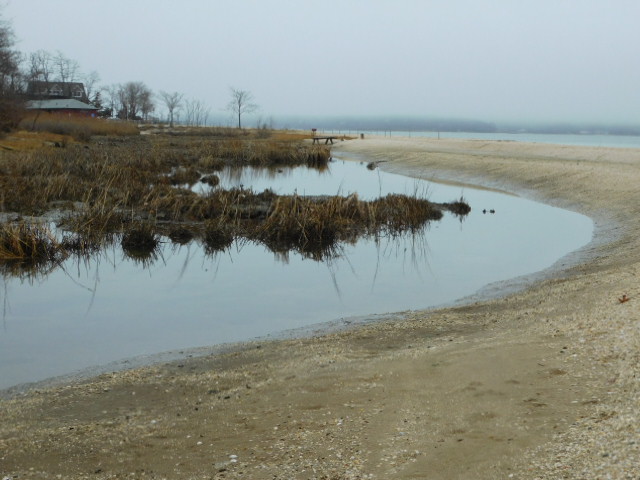
Reflective tidal pools in constantly renewing marshes harmonize with cold fog and plaintive cries of gulls.
  • Act your age.
  • Imagine yourself whatever you wish.

Thursday

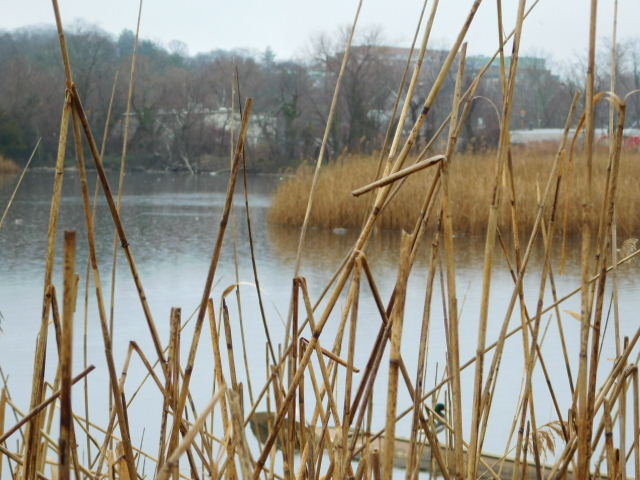
Wet days bring out the glow of reeds.
  • I get a kick out of young men on a Paleolithic diet.  After all, most science shows that our distant ancestors died at forty or younger, worn out by, among other things, their diet.  The most striking thing about culture _ the last forty thousand years of human existence _ is that it has allowed a few people to live well beyond their normal biologic destinies.  Some even claim that our relative longevity evolved to help culture itself survive. 
  • So I am well beyond my Paleolithic destiny, but still within a prehistoric cultural norm.  The head Druid could have easily been a septuagenarian who knew all the ancient rites and directed everyone else on what to do.  My only function may be in helping civilization and my family continue, but that is a relevant function.
  • One of the difficulties of achieving elder status in some comfort is that I find it easier to pause or even stop than to go.  I should of course be content with my day, but if I don’t struggle a little bit with destiny I risk sinking into a couch and only getting up to find a new bag of snacks. 

Friday

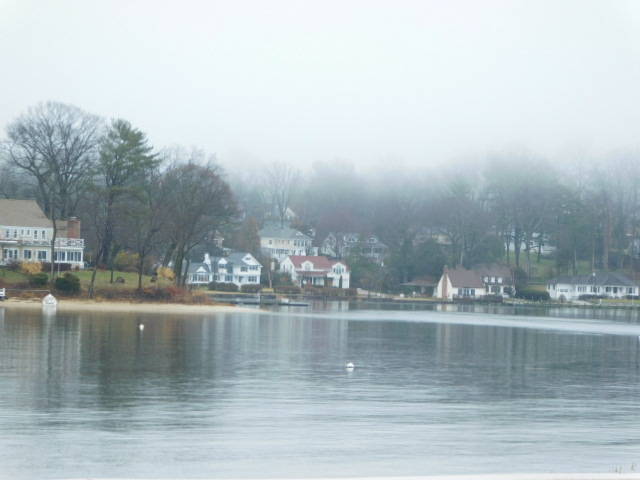
Gloomy cold fog, spring that refuses to say goodbye to winter.

  • Sometimes physically, more often virtually, I revisit places I have been.  Some things have remained the same, and spark my memories into greater clarity.  More often so much has changed that I am nearly lost.
  • My local wanderings have dulled that transition.  I scarcely remember what Huntington harbor nor the town itself looked like forty years ago.  There are enough vestiges of the ancient remaining to give the illusion of permanence.  But certain picturesque spots have vanished forever, huge houses crown the hills and engulf the plains, immense automobiles speed along highways.  Everywhere there is more signage and less nature.  Even the nature that exists tends to be more manicured, less a spot of wildness than a cultivated garden.
  • I don’t claim that is bad or good.  I do know it is different.  All my past is different from today, as yours will be different from tomorrow.  And it is at such times of recogni
    tion that I most keenly feel my own years speeding past.

Saturday

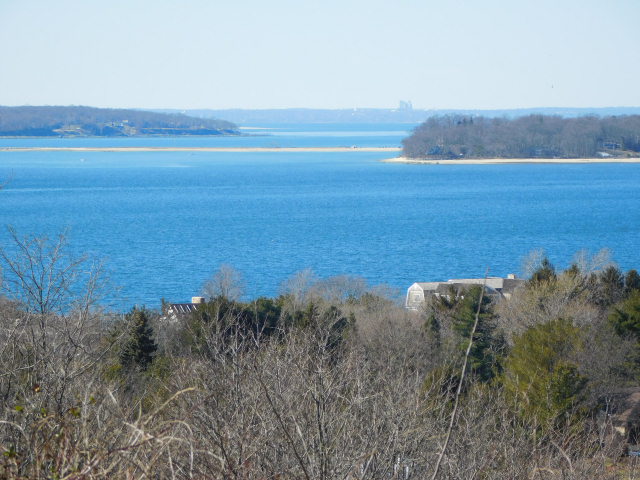
No professional photographs, blurred, but the idea is there ….
I turn around after closing the gate to the dock carefully.  Sure enough, there’s a darkly cloaked figure resting nearby.  “Welcome,” he greets me in somber tones.
“Ah, Grimm, I don’t need you this fine morning.  Why don’t you save your visits for the deep of night, as usual?”
“Omnipresent in your thoughts.  Another year gone by.  Another step closer…”
“For seventy years, on the other hand,” I laugh, “it’s been another moment gone by, another bit closer.  What’s so special about now?”
“You must admit the end is nearer, anyway.”
“Not really.  As an adolescent possibilities of nuclear war were just as omnipresent.  And in my twenties I was sure all really good would-be romantic artists died before they were thirty.  Nothing new.”
Grimm is not about to give up easily.  “Quake, mortal.  Fear that false beat in your chest, that minor pain in your arm, that moment of dizziness, that strange queasiness in your bowels.  Signs, portents, forebodings …”
“Tra la,” I mock.  “Eternal dance, I suppose, but I still have this real morning, and you own only the imagined future.  I suppose I could tell you to begone, but honestly, I do not mind the company.  Stick around for a while and watch the gulls.”

He scowls and groans and fades away.  I return to my pleasant untroubled solitude.
Sunday

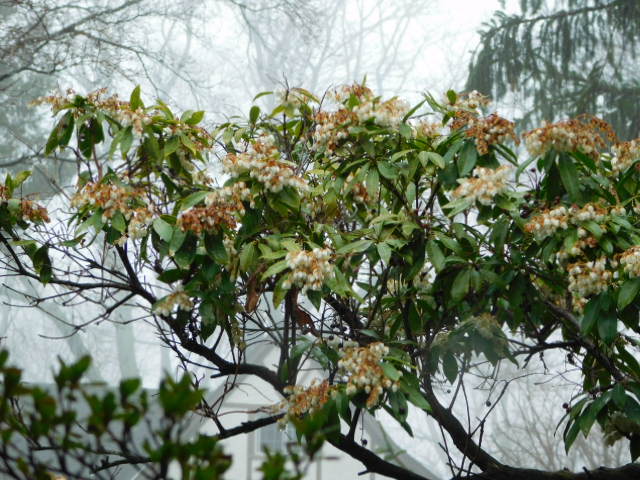
Andromeda blooming late this year,  heavy fog at noon
Seventy springs have flown the years
Innumerable months, days, hours, moments
Most inevitably forgotten.
Sometimes I think I’ve done everything
Sometimes I strain to do just a little more
Mostly I’m just glad I’m here,
I’ve been there,

Unique in all the universe and time

Home Sun

Monday

Tiny newborn wild rose leaves along the shore seem impervious to even hard frost.

  • I retain enough of my childhood upbringing to have an occasional tinge of the religious rituals I followed faithfully in early years.  One of those, of course, was Lent, a season of deprivation meant to make Easter all the more glorious.  This year is practically a reenactment, as winter seems determined to make us appreciate better weather when it finally arrives.
  • In less parochial terms, the solstice sun will be gladly welcomed as daylight outlasts darkness once more.   Obviously a few minutes more here or there do not add dramatically to Earth’s heating, but psychologically the next seasons are already in view, and all of them promise optimistic adventures.  Adjectives describing spring and summer are rarely depressing, and even fall _ inevitably tinged with sadness _ is more reflective than despairing.  Simply said, we are glad to see winter depart, even if that only occurs on a calendar.
  • Equinox is the true start of the new year for those of us at this latitude, on this continent.  Once the latest blizzard snow melts away _ more quickly by far than would happen in January _ we will be back to the almost too rapid changeover from white and brown to glorious color.

Tuesday

Stubborn snow drifts from our recent ice blizzard resist the notion that spring has arrived. 

  • As has happened for eons, weeks of mild weather were recently followed by deep frozen nights, inches of ice, and northern blasts of wind.  Bulbs and low plants were protected by blankets of snow, but some opening leaf buds have been blasted back into black crumbles.  Perhaps they can survive, perhaps their branches will be lost as well.
  • It’s always good to be reminded of the capriciousness of nature.  I become too used to predictability and think it is normal.  After all, store hours are set, food is always available, my life attends seconds clipped by electronic quartz crystals.  Each day can be much the same, regardless of outside conditions, if I so choose.  I only need expose myself to what was once known as reality when I want to.  So a blizzard is a nice slap in the face delivered by fate, reminding me how lucky I usually am. 

Wednesday

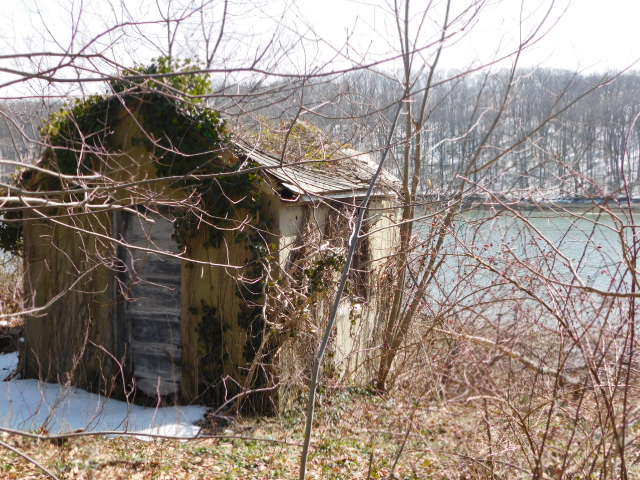
Looks like an ancient Canadian trapper’s cabin, but just another remnant of Gold Coast Heritage on Lloyd Neck.
  • I was taught to sing “Faith, hope and charity.”
  • I suppose nowadays it goes “Greed, fear, and misery …”

Thursday

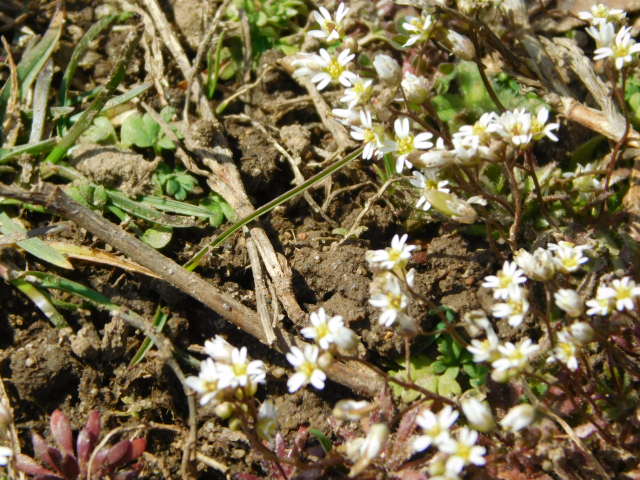
Unnoticed minuscule flowers carpet disturbed ground, getting a head start on the competition.
  • Just when it had seemed this would be nearly a year without chill, like some late patron of opera, winter arrived with  flashy fanfare.  It was not so much days of snow, nor inches on the ground, nor sleet itself, nor even deep freeze the day after.  What annoyed was malingering and refusal to make way for the next stage of spring.
  • Snowdrop flowers, delicate crocuses, half-up tulips, nearly-open daffodils were encased deep under a layer of solid ice.  They may have been the luckiest.  Exposed buds and leaves  were brutally eliminated by prolonged temperatures near the lowest of this year.  Now we wait and see what, if any, permanent damage has been done.
  • Waiting for spring in March is a lot like waiting for utopia.  We keep hoping it will arrive any minute, and that perhaps there is a little we can do to guide it along, but soon enough all plans are smashed and we are cruelly reminded that reality is reality, and all the old patterns will always remain.  Old patterns will always triumph.  And, in spite of that, things will probably work out ok.

Friday

No blush of spring yet in these trees and woodlands.
  • Even on the coldest days, in the strongest winds, under the bleakest skies, birdsong is becoming louder and more continuous.  No matter the conditions, birds are taking to flight, often in pairs.  Territoriality has broken out on the shoreline and around the bird feeder as the breeding season approaches.  Life may be tough, food may be hard to find, but the avian population is driven by instincts honed to the timings of sunrise and sunset.
  • Bird watchers anxiously peer through binoculars to add new species to their life lists, or to reacquaint themselves with old friends.  Many marvelous guidebooks now provide an infinite resource for such hobbies.  I am less detail-oriented, perhaps because I now find that for each fact I acquire each day, I seem to forget a few others I used to know well.  My most important task has been to replace attitudes like “oh, it’s just some birds,”  with “wow, what a wonderful woodpecker!”

Saturday

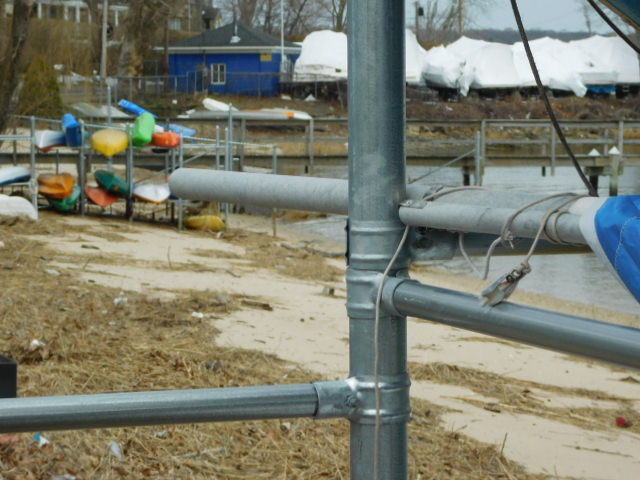
Winter detritus litters high tide marks along a dormant beach as it awaits community cleanup.
“Hey Alice,” I call to a neighbor passing up the hill while walking her dog in the bright morning.  “Happy Spring!”
“Just thinking the same thing,” she replies, “although it’s sometimes hard to tell,” she continued, gesturing to the piles and sheets of snow all around.
“Yeah, this week we’re living up to being called the North Shore.  We were just visiting the South Shore yesterday and the white stuff is basically gone.”
“Well, my yard looks like the North Pole or Greenland,” notes Alice.
“Ours too.  And no matter how warm the sunlight, the air is going to stay cold until the ice goes away.  At least the sun is getting hot.”
“Don’t forget it’s out longer too,” she adds.  “I for one love daylight savings time, when the evenings have returned as useful parts of our day.”
“Me too.  Well, enjoy the day.”
“Oh, that’s easy enough, with April around the corner.  C’mon Duff,” she tugs her pet onward.

I wonder if it is still too early to get some pansies to brighten up our patio.  The sun says no, the ground and air say yes.  I think I’m gonna give this decision to the sun.

Sunday

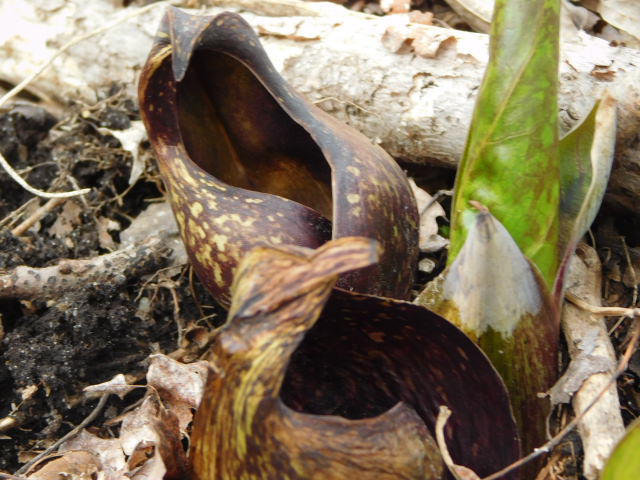
Skunk cabbage blooms already beginning to shrivel as leaves begin unfolding.
Just might rain, or maybe snow
Might feel warm or sub zero
Might blow winds or calm as glass
Just might stay brown or green the grass
Just might  be brilliant, or thick fog
Might sprout flowers, mud might clog
Might be predicted or perverse

Just might get better, or get worse

Marching On

Monday

  • Sometimes I fall back into the religious moods of my youth.  This time of year does remind me of Lent, a time of penance and deprivation before the full joy of Easter springs forth.  The weather promises wonderful things, then suddenly removes fine days as quickly as they have arrived, replaced with snow and cold and harsh windy rainstorms.  But always there is a gleam of promise in the near future.
  • In another metaphor, perhaps it is that nature begins to wake from what seems a long coma.  Signs are everywhere if I look, from small buds to grand flowers and emerging green shoots.  The entire local environment is in renewed ferment, if I search deeply.  Just, perhaps, not moving quickly enough to suit my impatience.
  • Magically, the mornings are darker and the evenings lighter.  Daylight savings time does not affect anything except people and their artificial hours, but perhaps even birds notice that the rhythms of those crazy humans have unexpectedly lurched an hour.  Or maybe everything ignores me as completely as I too often do everything.

Tuesday

  • March always seems a youthful season, a screaming newborn infant, juiced with potential and fully formed aspirations, but difficult to deal with.  Whereas autumn can seem morose in spite of its colorful beauty, spring is culturally a time of hope and optimism, in spite of the actual external conditions that may hang around (here at least) through mid or late April.  Certainly the signs of life are everywhere, forcing their way restlessly from hibernation or seed. 
  • Even heavily bundled up, I notice clumps of brilliant crocuses, glints of verdant tiny leaves, expanding buds fuzzing the outline of trees and shrubs.  If I pay more attention, on warmer days, there are solitary bees or other insects, and once in a while a swarm of gnats seemingly lost in the wilderness.  Life is awakening rapidly.  When I do not notice that, it is entirely my own failure of observation.  Another year, another spring, another launch into presumed happy times to come.

Wednesday

  • It’s an ill wind that blows good to no one.
  • Chill blustery gales at least make me appreciate my snug home. 

Thursday

  • Spring has become my season of anticipation.  I anxiously watch daffodils and crocuses, garlic and chickweed, swans and ducks,  bees and gnats,  willows and maples,  as they progress day to day.  So much is happening, so much is unwrapping.  Santa Claus rides down the wind every night, leaving presents to observe the next morning.
  • Sometimes it can get out of hand.  Why, I wonder, has the forsythia _ primed for weeks now _ not yet bloomed?  What is holding back the dandelions?  Who ordered this snow cover?  Too much worry, too much desire, and certainly an eroding memory which has jumbled up memories of what comes next.
  • March is all about hope.  I accept that this is still mostly winter, and each indication to the contrary is a miracle.  April, on the other hand, is mostly disappointment that it is not quite May.  On equivalently nice days, March can seem benign, but next month can appear brutal.  All is determined by context and expectation.
  • You may tell me I should anticipate less, expect nothing.  But I would answer doing so dulls and diminishes my happiness, perverse though it may be.  In the meantime, I am glad that March is finally here, dark mornings and all, blustery winds, chill frost, iced lands, with lovely gifts enough even for me if I simply open them with gratitude.

Friday

  • Each year around this time it seems appropriate to write a paean to skunk cabbage.  This unnoticed and unrespected native flower inhabits bogs and creek beds,  pushing up its odd and disturbing fleshy flowers well before anything else.  It is immune to late freeze, because it generates its own heat.  And all summer it brightens what would otherwise be dark mud with brilliant large green leaves.
  • But, precisely because of the conditions it requires, no one notices it.  I do not tramp through swamps with their clouds of insects.  I will not build a bog in my back yard to cultivate it.  It cannot be cooked, consumed, picked, nor really aesthetically appreciated.  But, for all that, I admire that it has found a niche in our modern world.  Not like the ragweed, taking advantage of humans disturbing soil, but able to flourish in all the dark hidden places that are just too much bother for us to rework to our needs.
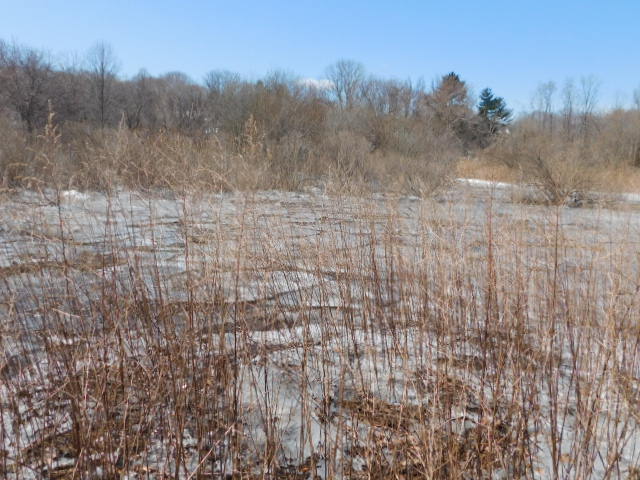
  • Note: the picture planned was not taken since everything is at the moment under several inches of ice.  This frozen field caused by an extreme high tide during a late spring storm.  

Saturday

“Hey, watch where you’re poking that thing,” comes the plaintive thin cry.
“Sorry, sorry, didn’t see you there, Alice” responds Rob Robin to the tiny daffodil he has almost pecked.  “Trying to find some unfrozen soil and not paying much attention.”
“You should have stayed away longer,” notes Alice, nodding in the chill breeze.
“You should have slept longer,” retorts Rob.
“Yeah, we’re all captives of capricious climate,” sings the flower.
“You can joke if you want.  For you it’s all a game.  You don’t even care if you’re covered in six inches of snow.  Me, I go hungry or worse.”
“I’m sure it will be better soon.  Here, you can try closer than that,” says Alice sympathetically.

“Thanks.  Sometimes it’s not so easy being the early bird …”

Sunday

Chilled snow frowns
Blinding sun smiles
Which, this day,

Shall I accept?

Desperately Seeking Solace

Monday

  • My friends and I are now late sixties, early seventies, and we have generally accepted that each day represents borrowed time.  There are too many reminders to ignore.  Our role models mostly long gone, well-known public personalities dying unexpectedly, relatives and those we loved afflicted terribly or vanished. 
  • Intellectually all lives are borrowed time.  Logically, we accept that we are mortal.  But viscerally, we expect to live at least one more day, one more year, one more always.  As personal times become more ominous, we often project our own fate onto the larger world, and see it crumbling like our own memories.
  • Solace is easily found in this wonderful abundant culture.  Food, leisure, warmth, distraction abound even for those of few means, and for those with even slight affluence the daily feasts and entertainments are far better than those of any ancient emperors.  But nagging thoughts curdle occasionally.  Our importance has generally shrunk, we are often ignored, sometimes in the way, tolerated or taken for granted.  We shrink active spheres to grandchildren or volunteerism, all noble, but not world-changing in the ways we thought of affecting the universe when we were twenty.
  • I get out with the sun and wind, listen to birds and waves, smile at passerbys in their hassled rush, enjoy the screams and laughs of children.  The news on various media is one vast soap opera. 
  • Life remains good.  I adjust my mind.  Borrowed time, like borrowed money, can be a useful commodity.

Tuesday

  • Compared to chattering civilization, nature seems secure and stately.  Hills and trees do not move, vistas seem wrapped in eternity, birds follow ancient scripts of activity and migration, seasons progress without variation year to year.  That perspective is comforting, but false.  Sand cliffs along the sound are eroding rapidly, even without the frequent incursion of humans, hills themselves are cut by streams, vistas disappear from view as forest grows larger, and the most ancient and massive trees eventually fall.  Bird patterns are harder to determine, but mixes and ranges of species change all the time.
  • The biologic term for rapid change in the global environment is “punctuated equilibrium.”  As long as things remain relatively steady, there is an orderly progression of life into various niches.  But on occasion, probably including the period we are living through, there are immediate far-reaching losses and opportunities.  After the nearly tropical winter we have been experiencing, I begin to wonder if in a decade we may see palm trees lining the harbors here.  Extinctions are numerous.  Great chunks of ecology have been erased _ particularly isolated pockets of uniqueness _ but vast common opportunities such as city and suburb have been opened up.  I try to accept all that without too much sadness, just as I try to remember vanished ancient social patterns of my youth without regret.

Wednesday

  • It can’t happen here.  It won’t happen here
  • It might happen here.

Thursday

  • We are now in the midst of the Bannon administration.  The president is an ignorant bitter old miser, who enjoys performing mean-spirited stand-up comedy.  Some see Steve Bannon as Hitler, he sees himself as Savonarola. I view him as Rasputin.
  • He’s beefing up ICE, a massive centralized police force answering to no one, which can act without warrants on mere suspicion, arrest people without cause, hold presumed-guilty arrestees indefinitely in concentration camps _ oops, make that “detention centers” _ until they can prove their innocence, ship the “guilty” off to probable death.   Probably soon all non-citizens will be required to wear some badge such as a yellow star when they are in public.  He encourages neighbors to report neighbors, just as Stalin-era children were encouraged to report parents.
  • In Russia, in 1913, nobody could foresee that in ten years they would be in the middle of a communal experiment, that another decade would bring mass famine and gulag slavery.  In Weimar German, few suspected that in ten years they would be living in a terrorist dictatorship, nor that a decade later everything would lie in ruins all around them.  Societies can change faster than we think.
  • Bannon has massively armed private armies _ oops, make that “citizen militias” _ that he can muster to clear the streets of opposition.  He screams epithets at immigrants and other scapegoat groups to direct the anger of his alt-right followers towards a simple reason for their troubles and failures.  He publicly declares that he wants to destroy everything that has made America the beacon of the world following World War II.  He performs his black-magic rites and whispers evil persistently into the empty shell of his nominal ruler.
  • It can happen here.  It is happening here.

Friday

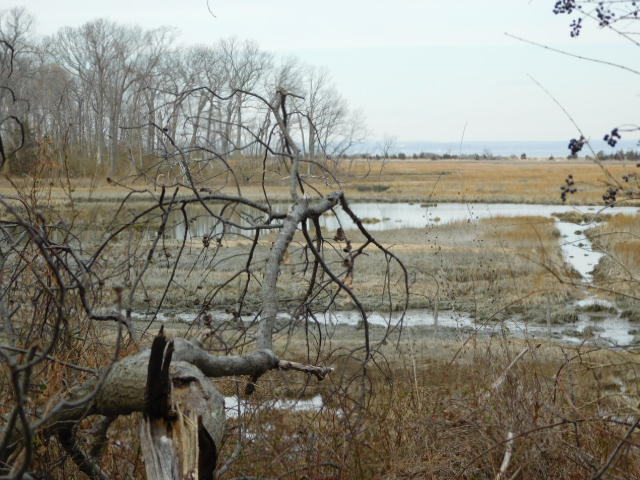
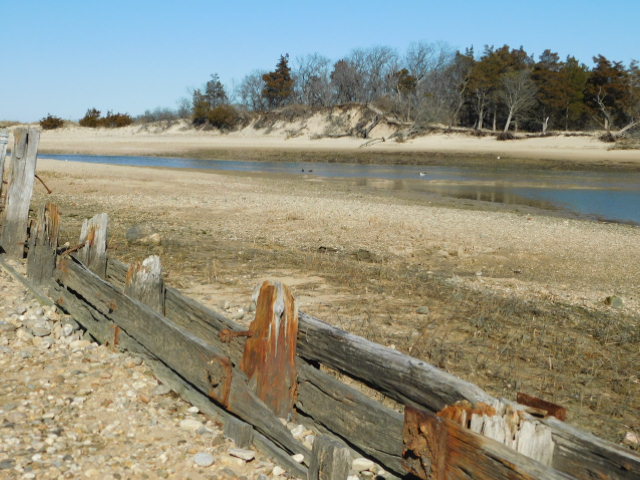
  • Late winter salt marsh lies dormant and soggy, under heavy skies, continually filled with the salty pump of the tides.  A quiet place, abandoned even by waterfowl.  In another month, standing in this spot will become uncomfortable with clouds of gnats, to be followed by swarms of mosquitoes, but right now insects bide their time in winter storage.  So there are on
    ly patterns of color, contrasts of blue and brown, interesting reflections and rotting signs of older usage such as fence posts along the drainage ditches.
  • People too are absent this afternoon.  I have as much solitude as is possible in this little overcrowded corner of the Northeast.  I’m grateful for such unexpected moments, which I didn’t even know I needed until they came upon me.  Away from the worries, and the hassles, and the chatter, I can imagine that the world goes on calmly as always, that it is greater than me and my trivial concerns, that the sheer mass of what exists can overcome transient stupidity.  Easy to believe, alongside this marsh.  Doubts will return as I head home.

Saturday

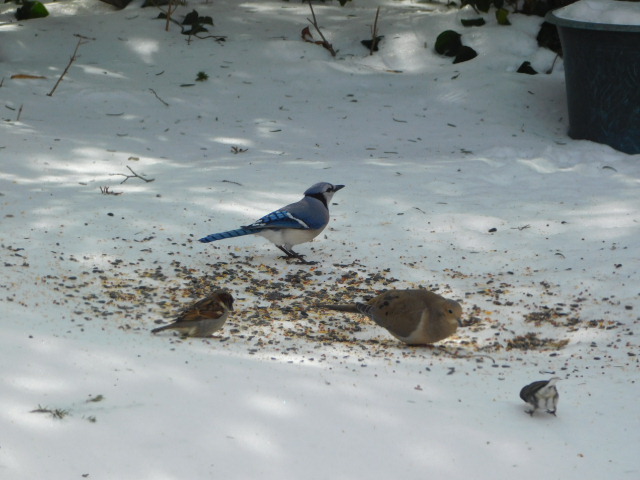
Starlings have swept into the backyard like a ravaging horde, emptying the bird feeders in less than an hour, thick in the trees, making a terrific unmusical racket.  “Karl, hey Karl!  What’s been going on?” shouts one glistening blue-black marauder to another.
“Usual, usual.  Clogging old maple trees in town, coating the cars underneath with well-placed shots, making patterns in the sky.  Been a good winter.”
“Sure has.  I don’t think I’ve been hungry an hour.”
“And cold?  No cold.  Why, this is almost as good as my aunt Burga describes Rome itself.”
“Ah, they’re always talking about the old country, aren’t they?”
“We’re just as good here, this season.  Wow, these idiots put out some kind of spread, don’t they?”
“Hey! You!!  Get out of here!!!” screams Wilhelm, jerking menacingly towards a terrified chickadee trying to grab a seed.  “Stupid little things act like they own the place.”

The flock takes up the common squawk,  and as the din reaches a crescendo, all wing off together to see if there might be more fun somewhere else.

Sunday

Each twelve hours, more or less
Surging tides relentlessly
Smooth sand shores with waves blown free
Leave no signatures to guess
What went before, to touch smell see
My random shards of memory
Resist oblivion’s soft process
No simple tale for history’s key
Like flashing ripples of bright sun
May blind my eyes but quickly done
Nevermore exactly run
Identical, yet ceaselessly

All transient in time’s caress

Hello, Lion!

Monday

  • Old proverbs and sayings are rarely examined for truth.  Most of them, examined logically, are incomprehensibly wrong.  “Darkest right before dawn”, “a penny saved”,  “what doesn’t kill you”, and, possibly the worst: “things work out for the best.”  But right up there is “March comes in like a lion and goes out like a lamb.”  Around here, March does what it darn well pleases, any given hour, day or week.  It is possibly the most fickle month of the year, and generally shows no progression to mildness.
  • Possibly for that reason, it seems such old sayings are dying out with my generation.  Newer and more applicable memes _ some just as insanely wrong, of course _ are coined daily from rap music and media sound-bites.  It’s been a long while since I’ve heard people except those my age quoting an old proverb, or applying a nursery rhyme to a situation.
  • To be sure, that is not much of a loss, although it represents just one more part of a once tightly-knit common culture fraying rapidly.  Undoubtedly a new binding of attitudes is taking its place among the young, but that is hardly comforting to those of us who feel more and more cut off from our roots.  I still think of March lions, and April showers, and merry May, and feel mild regret that my children don’t have the faintest idea what I am talking about.

Tuesday

  • As an occasional day turns warmer, sun begins to burn pale skin, and light extends into the evening, the quest for signs of spring and coming seasons becomes almost obsessive.  New garlic clumps are glowing green, after all, and early bulbs like crocuses can burst forth from improbable locations.  Brambles and other vines are ready to green and fuzz with opening leaves.  Birds frolic and couple and once in a while there is even a poor misdirected insect wandering about.
  • I pursue in an extreme up and down pattern.  Days filled with indications of astonishingly rapid vitality are followed by a week of cold grey stasis.  I’m grateful for the first swatches of color, but too quickly search for more.  I keep confusing this last month of winter with the first post-solstice months of spring, which have their own issues confounding my expectations.  I need to slow down, more than ever, and just enjoy the moments as they occur for what they are, never for what I hope and imagine they might become. 

Wednesday

  • Maybe it’s just my age, but lately tempus seems to fugiting much too quickly.
  • This year, winter appears to be leaving before it truly arrived.

Thursday

  • Boomers grew up into an American-dominated world.  Most of us thought it would always be that way, and that we would end up in the fifties-type society inhabited by our parents, without having to endure a depression or world war (unless WWIII killed us all.)
  • Lower middle class kids expected decent stable jobs with ongoing raises and more and more consumer products, a nice house in the suburbs, new cars every few years.  Upper middle class kids were indoctrinated as the best and the brightest, the glowing hopes of the world, stuffed with history and culture and science in the hopes of producing perfect little humans leading the way into a utopian millennium.
  • We tried to know an awful lot about the past.  That didn’t help us survive adulthood or get a good job.
  • So modern students concentrate on networking, the immediate, the here and now, never mind all that ancient boring garbage.  Morality is what fits today.  Survival is what happens in the next week.  Perhaps they are right.
  • I survey the world and am worried.  Well, that’s been the role of seniors since at least the dawn of agricultural civilization, when people could grow old.  My complaints mean as little as those of any other geezers in the last few thousand years.  For better or worse, it’s up to the kids now.  If only the ancient crones who desperately clutch powerful jobs would die or retire and get out of the way.  

Friday

  • Around now each year the willows begin to bud, fluffy and white, some peeking out timidly, some boldly bursting into display no matter what the temperature.  Grass which has browned and died back under layers of snow shows blushes of green.  There seems to be a (sometimes imaginary) haze of emerald or scarlet surrounding briar patches.  And already there has been at least one crocus open, while daffodils thrust restlessly with swollen buds.
  • Often in early March these first signs of breaking winter are welcome and almost incongruent to the hostile environment.  This year has been one of thaw and heat wave, worrisome if you are concerned about planetary warming, otherwise locally welcome.  At the moment, I am more concerned that exposure can be shattered by some still-possible event.  Deep freeze can destroy flowers and leaves,  trees with buds swelling are increasingly vulnerable to heavy wet snow.  But _ hey, I’m just a passenger _ so I watch and enjoy and marvel and am grateful for being able to wander freely outside as many hours as I desire.

Saturday

Sun beams proudly among his peers.  “Look what my clever local intelligence has accomplished,” he boasts to friend star Trapp.  “They’ve discovered all your planets already.  What are yourlifeforms doing?”
“Still slime and acids, I’m afraid,” responds Trapp timidly.  “Haven’t had as much time as yours, you know.”
“Don’t let him bully you,” chimes in Epsili.  “Water-based intelligence is a transitory phenomenon,  hardly worth noticing anywhere.  How long have your creatures been clever, Sun, if you can even call them that?”
“Well, they can trace their lineage back billions …” Sun hesitates.
“None of that now,” thunders Sirius.  “The actual creatures, the ones who supposedly found Trapp’s stuff.”
“At least a million planetary year cycles …”
“Yeah, yeah,” taunts Epsili.  “But how long with tools and social organization to actually look up and think about things?”
“A few tens of thousands ..”
“And with capability to look at Trapp and his planets?”
“Depends.  Maybe ten thousand, maybe a few hundred, I don’t know.  But they are clever now!” shouts Sun defiantly.
“Flash in the pan.  I’m willing to bet my Jovian giant that they’ve completely vanished in less than a century.”

Unfortunately, there are no takers.

Sunday

Social storms spew strife
Anger encases weep
Each morn worse than ever
Nature spins bright life
Always calm and deep
Sustaining genes’ endeavor
I know there’s no forever
Escaping mortal knife

But these times trouble sleep

S’no Break

Monday

  • Over the next two weeks or so, Huntington experiences changes in population and usage patterns.  Schools have their week-long winter break, whole families head south for sun or north for snow and the town, if not quite deserted, briefly seems less crowded.  Many elders who have endured the season fortified by knowledge of reward are leaving for longer periods somewhere warm, hoping to come back to mild noons and blooming flowers.
  • Weather for the next month is always fickle in the extreme.  Intense storms and cold may be followed by days of furiously thawing warmth.  During such warmth, there may be crocuses blooming.  Then, perhaps, more snow.  But, unlike the mood in early January or late December, such inconstancy is easy to endure, if only because we know it is inconstant and will change soon, and always toward the better.
  • Having grown up in antediluvian days, I never experienced a winter break other than an occasional few days off from school.  There were neither time nor finances available to go away somewhere.  Nor, for that matter, many places to go nor inexpensive ways to get there.  Somehow, throughout our working lives we never acquired the habit.
  • No regrets and no resentments.  There were compensations, and now I am at a point where I can ignore slippery streets and stay home rather than fight my way to an office.  Times have changed, but I have probably changed, at least psychologically, a lot less than I sometimes think.

Tuesday

  • True naturalists are fascinated by winter patterns.  Even the most common animals must somehow survive cold, famine, storm, and snow.  All birds cannot find outdoor feeders.  Squirrels have fur, but with insulation potential hardly matching that of people.  What do deer, raccoons, and mice eat?  And what is going on with all the various insects and bacteria we cannot see?  Not to mention the various and wonderful adaptations of the plant kingdom.
  • Winter world is in some ways more marvelous than summer.  It is easy to imagine active competition and synergy among organisms in a thriving environment, each growing furiously, acquiring nutrients and other necessities as quickly as possible.  A race to be best, or, in cliché, active survival of the fittest.  But winter is even more of a test, and yet mostly invisible to me as a casual onlooker.  Some organisms _ perhaps ranged too far on global warming _ will die during a cold snap.  Others will not find food under a foot of snow.  An odd, but rewarding, viewpoint for me to ponder as I await warming spring.

Wednesday

  • All work and no play …
  • All play and no work can become boring, so we tend to invent chores.

Thursday

  • My children only laugh when I claim Joan and I are taking a break of some kind.  To them, retirement is one long break, day after day, as we do nothing while they scurry about in their busy lives hemmed in by constant obligations.  Mostly they are correct.
  • From our own perspective, work and things to do have somehow accumulated enough to usually fill our days.  We have slowed a bit, and can do a little less than once upon a time, but for the most part these are actually golden years, and we can take hours to do as we wish or nothing at all.  In a lot of ways, it is a perfect way of life, and I am privileged to be enjoying it.
  • Since distant vacations require commitment and fairly large amounts of money, we have lately been deciding each year if we wish to overwinter.  A gamblers bet.  Will it be harsh or mild?  This year, for various reasons, we decided to stay north and take our chances.  At first, predictions were for one of the worst seasons ever, filled with storm and freeze.  Then reality happened.
  • So, at least most of the time, it has been pleasant.  Our breaks occur on sunny temperate days, or in going to stores or other indoor attractions.  We have not been stuck at home more than a few days, never too many days in a row.  These months have represented their own kind of change, when I could spend more time thinking and reading without the call of rushing outdoors or to some park.
  • Would I have enjoyed such a time when I was young and full of hormones and energy?  Probably not.  Back then, breaks were essential times to recharge and relax, but only in relation to doing so many things that were required, necessary, and, on reflection, accomplishments to be proud of.

Friday

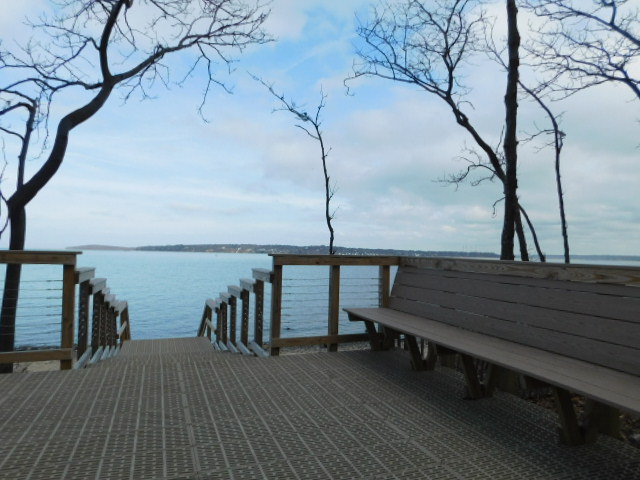
  • Waves crash ceaselessly on shore, wind erases all sounds of civilization near and far.  Voices of crowds are forgotten, automobiles are banished,  the hurry of things to do fades forgotten in the brisk cold.  Shells line the high water mark, in astonishing numbers.  Flocks of gulls parade about in compete ownership of this territory, which they will have to yield in a few months to equivalent flocks of humans.  Winter’s open beach border, cleared of snow by brine and tide, is a wonderful place.
  • Many other people know this, of course, and I share this afternoon with several.  Most remain in their cars, simply happy to enjoy the view without the pain of severe wind chill.  Fortunately, I have dressed or overdressed quite well, and can sit on a bench not isolated from touch and smell and sound.  We are all a unique brotherho
    od, privileged to have the time to be here on a prime weekday afternoon, and with the aesthetic longing to leave comfortable interiors and busy bazaars to experience a bit of the immense wider world.

Saturday

“So, Snow,” begins Pavement one sunny frigid morning, “What you been doing?  Haven’t seen much of you the last few months.”
“Been a tough year, very hard.  You guys had the drought to begin with, you know, that lingered through the late fall.  Then Cold Air got caught up somewhere up North.  So until this week, just couldn’t get around to doing much here.”
“I see your cousin West Rain is kicking up a storm in California.  At least he’s kept busy.”
“Oh, yeah, and Sister Betty has them cursing all over Europe.  I thought about helping out, but just ended up visiting friends in Canada and Maine.  At least it’s still pretty normal up there.”
“Well, good show this week, anyway.  You planning to stick around a while?”
“Pretty tough with Sun doing his thing more and more,” replies Snow.  “Might get in one more big performance, but no guarantees.  Like I said, been a tough year.”
“Not the same as the old days, for sure,” agrees Pavement.
“Nope.  Why I remember years when …”
“Changing times, changing climes, maybe gone for good,” Pavement interrupts.
“Hope not, but you may be right.  As I said, tough times.  Maybe catch you later, gotta melt now.”

“Au revoir, amigo”

Sunday

Quietly sitting, alone by the fire
Drained of ambition, worry, desire
Reading adventures of some distant place
Complete disembodied from this time and space
Some call it laziness, I call it free

Encompass a universe all within me.

A Philosophy Manifesto

A Philosophy Manifesto

From time to time I like to engage in longer essays.  This is a response to a recent article concerning the Berggruen Institute which hopes to use Philosophy to solve some difficult problems of modern civilization.

What is Philosophy

  • ·         Philosophy is the consideration of everything known and unknown as related to individual human consciousness.  Instead of a cute new nomenclature such as “Scientific Philosophy,” anything previous to the current century will simply be labeled “Classic Philosophy.”
  • ·         Classic Philosophy was greatly concerned with the meaning and truth of reality.  Philosophy must accept that we may have reached the limits of human understanding concerning the structure of the universe.  Within that structure, almost everything that is knowable is known.  Philosophy allows that all this may be wrong and we may live, for example, in a butterfly’s dream, but also accepts such speculation as irrelevant to daily human consciousness.  On the other hand, Philosophy accepts that the irrational and chaotic must be integrated into its framework as much as logic.
  • ·         A fundamental change in outlook has occurred.  We now understand that our universe, and life itself, are not static nor precisely fitted components, but rather a series of everything in dynamic tension often leading to temporary equilibrium.  Examples are centrifugal force and gravity, or lipids in a cell, or paired leptons.  Time is an arrow.

Who are Philosophers

  • ·         Unlike Plato, Philosophy should not define Philosophers as the best, brightest, or wisest.  Philosophers are all those in the great middle of humanity, adequately educated in their society, commonly recognized as sane most of the time.  Philosophers define meaning and purpose, as well as the way in which to achieve such goals.  In doing so, they recognize that contradictions and irrationality are necessarily part of any temporary dynamic solution.
  • ·         Philosophers, unlike Classic Philosophers, must accept common scientific conventions of reality.   In the physical universe, what cannot be observed, proved, and demonstrated is not real.  In the consciousness, what cannot be communicated with others is likewise irrelevant.  Anyone who does not meet those criteria cannot be considered a Philosopher.
  • ·         Each person contains a multitude of outlooks which nearly make them multiple consciousnesses.  Each person changes dramatically over time _ the child is not the adult, the adult of one year is not identical to the adult of the next.  All Philosophers must recognize that fact before reducing individuals to a bland axiom such as “everyone needs a purpose.”  They must most importantly recognize such in themselves.
  • ·         Logic is not sufficient for human experience.  This is why Philosophers recognize that artificial intelligence has no place in Philosophy.  Philosophers must be willing to utilize the frightening paths of intuition and common sense as much as they do axiomatic reasoning.
  • ·         Contradictions are integral components of tensions of reality.  Each of us is simultaneously important and unimportant.  My freedom conflicts with yours.  In differing situations, the same question has different answers.  Philosophers recognize that contradictions can only be contained, not controlled.

Common Objective Reality

  • ·         Anyone who uses electricity accepts our current understanding of common objective reality.  This is an integrated structure composed of scientific experimentation, technological application, mathematical modeling.  Two Philosophers can agree on the objective reality of a given tree _ how it is made, its internal system, its history _ without difficulty.
  • ·         Our experience of reality can only be communicated.  Two Philosophers may never agree on whether a given tree is beautiful.  One may consider it potential firewood, the other may revere it as a sacred example of nature.
  • ·         Common objective reality is aware of time, history, interrelations, and basic cause and effect.  It contains repeatable useful patterns such as making a fire.  It finds that yesterday is a useful predictor of today and a probable guide to tomorrow.
  • ·         Using common objective reality, Philosophers would agree that humans are social animals.  There is a clear context whereby humans fit into the universe, related to other animals by time.  There are vast studies of the way in which social interactions among humans have existed in the past and exist in the present.
  • ·         Common objective reality has discarded the notion of eternally static and balanced systems.  Everything, from the subatomic to the galaxy level, is in a state of impermanence maintained by inertia and conflicting forces and events.  Importantly, these tensions permeate life itself, which is delicate dynamic between various extremes of destruction.  An uncontrolled cell or hormone can kill.
  • ·         Although statistical probability is a useful tool, no local particular events can be predicted accurately.  We can never tell when a particle will decay, or if I will be alive tomorrow.  Chaos assures that any given event could result in any of vastly different consequences.  Speculations beyond the level of what we can observe _ such as the existence of other universes _ are irrelevant to Philosophy.

Big Questions

  • ·         Classic Philosophy was concerned with defining a common objective reality as much as it was with the experience of consciousness.  It was even necessary to define the tools for exploration.  What is the sun, for example.  Philosophy can consider most of this branch of inquiry satisfied for all practical purposes.
  • ·         The big remaining questions may not have answers.  They are somewhat like defining the requirements for a beautiful tree.  Perhaps the best that can be hoped for is to achieve clear communication on goals and tradeoffs. 
  • ·         (1) What is a good and just society?  What tensions must it utilize?  How can it balance its basic requirements for continuity and stability with the pressures of people seeking to change and optimize their own lives?  Must it have some purpose?  Just as important, how can Philosophy frame and discuss the issues involved?
  • ·         (2) What is a good life?  Here the experience of any Philosopher is as good as that of any other.  People have argued this for a long time, studied others, thought deeply.  Knowing we are social animals may help discard some unproductive approaches.  Some major concerns loop back to existing in what the individual considers a good and just society.   Others touch on how an individual feels meaningful and happy throughout a range of consciousnesses and years of aging.

Framework

  • ·         Philosophy cannot design perfect societies nor perfect lives.  Certainties approaching perfection only occur in the external universe.  No society will please everyone equally, and even a wonderfully adapted society in one time and place will fail in another.  A life worthy of emulation in some ways may be terrible in others.  This area of Philosophy seems nearly hopeless.
  • ·         Bromides melt upon examination.  “Greatest good for greatest number” ignores time and external competition.  “Do not kill” is obviously contingent on situation.  “Love thy neighbor as thyself” consistently fails in communal settings.  No letter of the law is always just, and the spirit of the law is largely subjective fog.
  • ·         Classic Philosophy must be discarded.  We know infinitely more than the ancients.  We have the technologic powers of gods.  We thrive in inconceivable numbers.  The globe is interconnected.  Millennia of history are available for examination.   It is true that people are still people, but even the common bounds of social intercourse (women, slaves, barbarians) which bound Classic Philosophers have been shattered.
  • ·         Philosophy is not impossible.  Current societies exist, continue, and some do quite well.  Individuals generally are happy enough to survive to another day and reproduce.  The social areas of Philosophy, like those of the external world, should always start at what actually exists and why.  Just as medieval philosophers wasted time attempting to turn lead into gold, modern philosophers attempting to describe utopia are foolish.

Quantum Humanity

  • ·         Classic Philosophy and much that has followed have a tendency to examine the individual, then the relation to society.  Philosophy recognizes that human relations are not so homogenous.  The implications of humans being social animals are that the individual is strongly affected by innate biology, and that social interaction is loosely related to that of other primates.  Although it is true that humans are infinitely socially adaptable, most ethnographic and historic studies show a lumpy pattern of interaction, rather than a smooth relation between one individual and another.
  • ·         Before adulthood humans are helpless and require social learning.  After adulthood their interrelations tend to resemble the valence shells of electrons _ individual, family, tribe, society, civilization.  All of these quanta interrelate in variable tensions.  The study and understanding of these tensions is of immense importance.
  • ·         The individual, in some ways, is no better known than to Classic Philosophy, which primarily understood from introspection.  However, acceptance of common objective reality focuses on biologic drives such as instinct and hormones rather than supernatural causes of emotions, moods, and outlooks.  We can change an individual’s perception by, for example, adjusting body chemistry with drugs.  It remains an open question whether one person in a happy, sad, or murderous mood is actually the same person.  It surely remains unknown to what extent a sixty year old is identical to the earlier five year old.  Philosophy must take account of the individual consciousness, for that is the only reason to try to understand.
  • ·         Generally, individuals clump into family units.  Family units of various types are usually composed of people joined by blood, law, and convention,  recognized as special by other social units.  Families often provide the primary interface for wealth, property, children, shelter, and so on.  Individuals within a family often have totally different interactions than they do with those outside this unit.
  • ·         Individuals then extend into a more tenuous relationship with tribes, often multiple, consisting of other individuals sharing some common purpose.  An individual may simultaneously belong to tribes such as those formed by employment,  neighborhood, or social class.  Each tribe tends to have its own norm and rules, although all tribes conform to the basic standards of the society in which they are formed.
  • ·         The cultural umbrella under which similar tribes operate is a common society.  Societies share rituals, enforce boundaries, agree on permissible behaviors.  A common cultural outlook fosters a strong “us versus them” division between those within one society, and those who are part of another.
  • ·         Finally, more important as the world became more connected and crowded, is the concept of a civilization.  Basically, a civilization arbitrates which people are human and which are not.  Shared general outlooks and values allow for vast differences in encompassed societies, but require destruction or suppression of alternative civilizations.  There could be, for example, no reconciliation between Timor with his piles of human skulls and the trading cities of the Silk Road. 

Methodology

  • ·         Philosophy must always center on the study of the individual consciousness.  Without that consciousness there is no reason to do anything.  The purpose of Philosophy is to provide useful patterns to our human pattern-association thinking so that we can be fulfilled internally, and exist adequately with other people.  This must remain the core rationale of any observations or conclusions.
  • ·         From an external perspective, societies resemble any other groupings in nature from ants and termites to elephant herds.  What social or internal tensions formulate their behavior? Although it is tempting to consider any given human statistically as just another termite, that is a false path that should be resisted.  From the standpoint of Philosophy, that one human is more valuable than whatever construct it is part of.  This implies that the study of individuals and society is so radically different from the study of common objective reality as to be nearly incomprehensible.
  • ·         Study of internal consciousness often begins with Socratic method _ querying oneself or another to solicit a useful consensus or discovery.  A fatal flaw is our multiple consciousnesses _ what we answer on a vacation beach in the morning will differ greatly from what we answer after a hard day at grimy work or after a few drinks relaxing with friends.  Socratic method relies on logic, and logic is a poor guide to consciousness over time, not least because consciousness is largely irrationally subjective and not part of common objective reality.
  • ·         Common Objective Reality must, of course, be considered, particularly as to what parts of social interaction are in this “reality” and what are not.  A person deprived of liberty because of a crime or dying from terminal disease is constrained situationally far beyond whatever their conscious desires and states.  Yet even here, the Philosophic consideration begins with the individual affected, less so with the social or physical events.
  • ·         Obviously the most important external tool is observation of individuals and the matrix in which they associate.  Observations must include historic and ethnographic studies, since no given slice of social behavior can possibly present the full range of viable possibilities.
  • ·         A vast literature consisting of fiction, mythology, religion, and internal observation exists to immensely aid in study of individuals and their response to various situations in the world.  Unfortunately, technology has rendered some of these almost valueless in the context of current culture.  Marcus Aurelius is deep a
    nd interesting, but bound by the limitations of knowledge in his time and responding to various pressures that no longer exist in the same form.
      Philosophy must be as careful to winnow out irrelevant information as it is to accumulate that which is useful.
  • ·         Matrix relations are an immense challenge.  Any change to _ for example _ the status of an individual within a tribe will also cause large and small perturbations in relations to self, family, society, and civilization, none of which can be ignored and all of which become simultaneously active.  Mapping dynamic tensions within all these groupings, let alone putting them into predictive formulations, is clearly a massive undertaking.  But it does mean that no studies can restrict themselves to tiny bits of the larger problem, as is commonly done in science.
  • ·         To complicate Philosophy further, all knowledge in the social area must be regarded as chaotic and fractal _ there is no ultimate smallest bit of axiomatic knowledge, and there is no possible way of predicting the outcome of any given event.  Statistical tension analysis with probability is the best that can be accomplished, but the limitations of that should always be recognized.
  • ·         Finally, Philosophy must accept that it no longer exists in the world of Classic Philosophy, no matter how comforting that may seem.  Knowledge and technology have totally reworked the paradigms, not only of society, but also of the consciousnesses of those who make up a society.  It is impossible for me to think as Aristotle did, although I may have some similarities.  The components of consciousness may be the same _ “I”, “you”, “them”, “it”_ but the manner in which it has been shaped is unrecognizable.

Immediate Requirements

  • ·         Just as Classic Philosophy required the development of logic and formal mathematical statements, and as the discovery of common objective reality required the development of scientific method and its technology, so Philosophy directed at human consciousness and social interaction will require the use of new and more powerful tools.  These may be provided by computers, data mining, and artificial intelligence.  Some of the workable results may be all but incomprehensible to humans.  But even now, games with relatively limited core representations and strategies provide surprisingly realistic outcomes for warfare, economic development, and evolving social patterns.
  • ·         Philosophy realizes limitations.  No system, however perfect, can predict the future enveloped in chaos, let alone the results of black swan events such as plague, famine, or nuclear war.  The immediate goal should be to develop tools that can work in any situation, however chaotic, and objectively observe, analyze, predict probabilities, and hopefully provide a blueprint for something better.  Ideally, in relatively stable situations, it would allow for modeling of proposed adjustments to social interactions.
  • ·         Since Philosophy in the social arena ultimately anchors on individual human consciousness, the incredible lack of any reasonable way to depict this state makes most other analysis highly suspect, if not impossible.  We require a way to examine anyone, including ourselves, and map it into a matrix including mood, outlook, possibility, volatility, variability, and so on.  Furthermore, this mapping should work across cultures and time, so that anyone, anywhere, could be similarly mapped. 
  • ·         We are in the medieval stage of describing individuals as social entities.  There is a hodgepodge of tests and scales relating to IQ, emotional status, interrelationships.  But there must be some consistent way of charting “a good honest hardworking middle-class woman.”  Ideally, this would be predictive of changes as a person grows older.  Obviously, this is dependent on also nailing down cultural-dependent descriptions such as “good” _ a good Nazi is not identical to a good Buddhist monk.  However, if even the basics of this measurement can be standardized, it should also be possible to discover and use multiple generic types to model social interactions. 
  • ·      
      
    Once a way of representing an individual social entity is formulated, a relatively trivial but complicated task will be to depict and utilize the various tensions that maintain a role in society.  These include internal self-to-self desires and controls, as well as those from the individual involving other random individuals, family, tribe, society, and civilization.  This is obviously a formidably massive undertaking, but with the help of technology should be able to reduce to a known and finite number of inputs in any situation.
  • ·         Philosophers themselves struggle with internal desires which vary and conflict with one another.  Desires change from moment to moment, affected by mood, chemicals, peers, and situation.  Yet it is also true that whatever the internal desires, their external manifestations most of the time are muted and made acceptable to social interaction.  Maslow’s hierarchy, Freud’s subconscious, are crude attempts to bring order, but they tend to be pathetically useless in actually describing what I want,  and how I pursue or repress that desire.  Yet without some way to chart desires and their results in a common and agreed way it will be nearly hopeless to advance Philosophy in the social arena.
  • ·         Social boundaries provide the tensions to control desires.  These may be set internally, for example by role models, or externally by family and other people.  Often these boundaries, although clearly understood and utilized, are nearly invisible to observation or even introspection.  Yet the most important of these _ for example that I generally would not kill someone if I were angry with them _ are commonly utilized in all phases of social interaction and law and should not be impossible to put into a standard model of behavior.
  • ·         When discussing boundaries, which actually provide the glue of a society, the first consideration is who or what defines them.  Boundaries are set internally, by other individuals, by the family and so forth.  Identifying the actual people or processes which set these boundaries is the normal starting point of much ethology, as it studies a culture.  Who or what controls the commonly accepted behaviors of a community?  But here, also, a standard notational method has not been provided.
  • ·         After boundaries (and aspirations) have been defined and accepted, sometimes an individual overcomes the tension restraining his desire.  In such case the society provides enforcers, whether police or peers, who restrain or punish deviant behavior.  Feedback of a sane person knowing enforcement exists acts to strengthen the tension holding his internal desires in place.
  • ·         A hidden role is that of mediators, who act like enzymes to facilitate interactions or reduce conflicts before enforcers take drastic actions.  Like definers and enforcers, the various mediating influences in a society should be discovered and mapped.  For example, a family member may be able to prevent an individual from acting against boundaries provided by his employment tribe. 
  • ·         With this structure in place, in a commonly accepted notational framework, further Philosophic work is possible.  Otherwise, there is little hope for achieving any more ambitious goals.

Intermediate Goals

  • ·         Decisions on intermediate goals of Philosophy resemble those of Classic Philosophy, but with definite technological and scientific breaks.  Can ancient societies _ with slave labor instead of machines, and viewpoints based on supernatural visions rather than scientific knowledge and  global interconnections and personal power _ offer any reasonable guidance for present and future societies?  Or must some entirely new ideas become fundamental to the inquiry?
  • ·         Introspection usually reveals that most people would like to be happy, and being happy usually means being allowed to do what
    they want.
      The actual desire may depend entirely on situation _ from getting enough food for the next meal to demanding reservations at the most exclusive restaurant in a city _ but there will be anger directed similarly at any institution or person who obstructs fulfillment.  People, of course, learn to generally handle desires within the contextual boundaries of the civilization, even as they may resent those borders.
  • ·         So a key question is how can a person feel free.  Can thoughts be shaped from childhood, can language be limited as in 1984, can drugs or entertainment or learning cause a complete internalization of cultural norms so that no angry conflict is ever experienced?  Or is freedom best instituted by allowing people to travel between societies, change tribes, abandon families, or even somehow exit civilization entirely?  The historic answer has been, of course, freedom lies in escape _ to another place, to a frontier, to some society or tribe more congenial to innate desires.
  • ·         So Philosophy must consider how truly different cultural societies can be maintained in an interconnected civilization.  It can never assume that one pattern will make all people happy _ even the actual Philosopher will discover that at various times, ages, and situations desires vary immensely.  But if multiple cultures are encouraged, how are boundaries set?  Two basic rules apply, enforced by the community of societies in a civilization.  (1) Any society must allow the free movement of anyone in and out of itself.  (2) No society may aggressively attack another civilized society, nor damage common property such as water and air.  Societies which violate those agreements must be destroyed by the global community.
  • ·         An easier task is maintaining multiple interlocking tribes within a society, because they can maintain themselves as necessary and are bound within the common culture of the society.  Today, many tribes are simply social media based agglomerations, but it is still uncertain if a tribal satisfaction is fully obtained without actual physical interaction.  In any case, one individual can easily belong to multiple tribes, leave or change memberships, and assume different roles in various places.  This is a traditional way of life for social humans, regardless of technology.  Warriors, for example, have often formed a specialized sub- tribe even within what are normally considered tribes.  Tribal memberships form the easiest way for an individual to achieve personal freedom.
  • ·         If the above structures are healthy, Philosophy need not concern itself with details such as rights and responsibilities, which are best worked out by people within any given society and tribe.  Nor need it concern itself overly with how an individual is controlled within the structure.  Nor is it required to  define rational interactions and plans.  In all cases, it is only at the level of civilization itself that Philosophy needs to worry about boundaries of everything and everyone within it.

Long Term Goals

  • ·         Let Philosophy assume that there will never be an adequate, single way to define and ensure the happiness of an individual nor to define a perfect society for all individuals.  The purpose of Philosophy then becomes how to define the minimum structure for a global civilization containing multiple societies.  The modern twist is that technology is at the point where a society, tribe, family, or even individual could strongly affect and even destroy the biosphere.  So, somehow, a global civilization must be assured that it is aware of, and can deal with, such existential threats.  How to do so while still allowing necessary variances in culture and behaviors will occupy Philosophers for some time to come.
  • ·         As noted, the strongest guarantor of freedom for the individual is the right to leave one society for another.  That freedom is only curtailed when a person or group becomes outlaws, literally outside the pale of civilization.  Outlaws must be dealt with mercilessly, so defining who is an outlaw becomes a difficult test of assigning boundaries on behavior and goals where global civilization draws the line of what can be allowed.
  • ·         It may be easier to define and pursue outlaw tendencies as social pathologies, amenable to early treatment as a mental illness.  This is dangerous ground, but necessary.  Philosophy has a tough nut to crack here, particularly between thoughts, talk, and deeds.  Yet hardly any time has been spent in a Philosophic manner considering this necessity.

Issues

  • ·         Within the context of what Philosophers should be considering, several issues stand out as most important, regardless of how neatly other concepts can be resolved.  These problems are already a global issue, and will only become more so as long a global civilization exists.  They form a kind of basic structure over whatever foundation Philosophy may discover for modern humans.
  • ·         Perhaps the most contentious issue must be that of global identification of each person.  The tools, of course, are already possible via DNA and embedded computer chips.  Without instant reliable tracking of anyone, anywhere, it is hard to see how a global civilization could continue to exist.  There are too many possibilities for unknown, untracked people to use technology to destroy great chunks or all of the delicate webs of culture.  The identification, like ancient tribal tattoos, is what brands anyone as a member of civilization, and makes possible the rights and obligations that entails.  By contrast, those without identification are automatically outlaws.
  • ·         The next most difficult problem is that of child-rearing.  For the most part a group of consenting adults should probably be free to do whatever they want within the confines of their society _ for example not seeking medical care, starving if they do not work, or constantly fighting with neighbors.  But children can never be considered consenting.  There must be some basic socialization and training before they become consenting adults that guarantees that every human born on the planet is raised with the core values and tools of civilization, whatever they may later do with that.  Children, in other words, can never be allowed to be educated and socialized as outlaws.  This will involve all sorts of nasty interventions, since family structure is another basic unit of human society.
  • ·         Making sure that adults, on the other hand, truly consent to their society is relatively simple.  Any ubiquitous device can provide a kind of emergency signal.  And the right to freely move then guarantees that a person unhappy in one situation may migrate to another.  With such a simple mechanism in place, strongly enforced, almost any permutation of adult interactions can be permissible, again given that such interaction does not threaten civilization itself.
  • ·         So what human rights does civilization itself guarantee?  Given the wide range of adaptable needs, desires, and requirements of any individual, perhaps Philosophy would be wisest to simply let this issue be decided within societies and other groups.  If we ignore children and perhaps the mentally disabled, the bulk of populations should probably be considered freely consenting adults in whatever situation they find themselves.  The only human right would then be that of being able to freely move somewhere else, with the aid of external civilization if necessary.
  • ·         So Philosophers must consider this mysterious “civilization” that somehow coordinates and oversees all its component societies.  Is it an association of “black helicopters” and mightily armed super troopers?  Does it poke cameras everywhere?  How exactly can it and should it monitor everywhere to assure that threats to civilization do not develop.  And, of course, if it were to have such awesome powers, how could it be kept under control?
  • ·         Along with that, the other side of the “human right” question, is what actions are absolutely prohibited and who decides what they are.  It could be imagined that building hydrogen bombs, for example, might be on such a list, or modifying disease viruses to be more virulent.  But where to draw the line, and who can be trusted to do so?
  • ·         Even if monitoring and prohibitions are clearly defined, what type of intervention is to be done.  If an entire society metastasizes, for example as in Nazi Germany, must that entire population be destroyed?  Are they simply dissolved and stripped of social standing?  What power is invoked to accomplish this, and how can anyone guarantee that such power is not abused?  Can such problems even be solved?
  • ·         Now, given the current developments in deep data and artificial intelligence, it may be tempting to imagine a true deus ex machina.  Let computers take care of civilization, and let humans otherwise be humans living out their interesting and peaceful lives.  In spite of science fiction, it will probably be fairly easy to assure machines do not become ambitious.  But, again, we know of the perversity of the universe, and it is obviously easy to imagine machine domination going horribly wrong.  Nevertheless, is such a setup, modified as it may become, necessary for planetary survival?
  • ·         In all these discussions, some words have connotations that may not be accurate.  For example, when most people speak of a “society” they tend to imagine a geographically constrained entity like a nation.  But there have always been non-geographic societies, such as religions and their monasteries.  Today immortal international corporations have far more power over lives than all but the strongest national governments.  Such a society intertwines everywhere.  Will human future _ should human future _ become based more on abstract associations involving global employment, or for that matter abstract associations of any kind based on internet affinities.  What does that do to any rational models of freedom, rights, consent, monitoring, and prohibition?  Even now, civilization has a hard time keeping corporations under control.
  • ·         And, finally, as indicated fitfully above, how does any model of human organization avoid the possibility of tyranny.  Philosophers have always known that technology tends to enhance tyranny _ it was far easier to escape a Native American tribe or a Greek city-state than the Roman or Chinese Empires.   If a true oversight civilization were put in place, and somehow turned tyrannical, could it ever be overthrown?  These, too, are eternal Philosophical problems.  Perhaps some genius can solve them as others did calculus.

Conclusion

  • ·         Philosophy can mean thinking about everything or nothing.  “Pragmatists” claim that only ideas which would make some actual difference in our lives are worth thinking about.  Since Philosophy is rooted in our individual subjective consciousness, almost any idea _ no matter how strange to others _ can make a difference to our inward landscapes and outlook.  However, Philosophy can also claim _ more legitimately than science or mathematical models _ to be the correct tool for assessing not only an individual human life, but also those lives interrelating to form social groups.  The need for that study has not changed from the times of the Tao Te Ching or Plato’s Republic.
  • ·         Internal consciousness and useful social interactions form the hardest problems any person faces.  Each life is unique and different, even though it may superficially resemble others.  Each society at each moment is an infinite blend of shifting situations, opportunities, tensions, and demands.  There is no easy, clear, nor simple way to “solve” these with logical declarations.  Philosophers should nevertheless attempt to formally describe and analyze what, after all, has been a few hundred thousand years of increasingly complex social unities, many of which have been astoundingly successful, even though also astonishingly varied.
  • ·         Our massive
    population numbers with immense impact on the planet biosphere itself as well as the awesome potentially apocalyptic technology available to any individual or cult makes this a task which must be undertaken with commitment and force.
      Useful answers _ even useful questions _ are required immediately.

Mild High

Monday

  • In spite of a recent instant blizzard, quick shot of deep freeze, and lingering ice storm, it’s been very mild around here.  There was practically no January thaw, because there was nothing to thaw from.  Even the blizzard was polite, following predictions exactly, beginning at 4am and snowing furiously by 8, letting everyone relax about making decisions to close or take the day off.  Finishing up by 3, so driveways and roads could be cleared.  More of an impromptu holiday than a worrisome event.  And, the day before, it was nearly 60.
  • Some see in this signs of global warming.  I tend to regard it as a typical example of average weather.  But there is no doubt that it has been a good winter for those of us who remain.  I’ve been able to get out to walk, wander parks, even sit outside with almost no particular preparation.  The few episodes of real cold were more invigorating than annoying.
  • Winter breaks begin, people fly off to warmer places.  Tomorrow arrives the feast of Valentines Day, either in commiseration or celebration of love-life.  Already we are halfway through the month, snowdrop flowers have been blooming at the end of the driveway, and birds seem to be mostly having a picnic.

Tuesday

  • A very warm day last week was a chance to sit at Halesite for an hour or so and watch water waving and sparkling and generally calming.  Geese strutted about behind me on their chattering gossip, gulls rode the dark surface serenely together, once in a while taking off for a circular flight just to prove they could still do it.  It’s been a great winter for resting immobile and letting the mind gradually slow down to match the inertia of the body.
  • As I grow older, I find it is sometimes profitable to rest like this.  A few years ago, and for all of my life before, I could hardly sit still.  If outdoors, I’d be moving somewhere, getting the blood moving, thinking grand or puny thoughts in rapid-fire.  Now I am grateful to rest lumpen on a bench, and let the gulls and wind do the moving, let the rest of the folks in the world engage in the great thoughts.

Wednesday

  • Carpe Diem.
  • Letting the day come to you is sometimes the best way to seize it.

Thursday

Today’s photograph a camillia in the wonderful Planting Fields arboretum in Oyster Bay, now in bloom.
  • Seeking patterns in everything, we instantly wonder if anything means more than it appears.  Does a comet blaze some prophecy?  Does a mild winter portend a warming world?  And once we have speculated that perhaps it does, we let imagination attach the most dire consequences to that meaning.  The comet shows a war is about to be lost.  A warm winter means the earth shall soon be rendered uninhabitable by rising heat.
  • But leaving that chatter behind, most of us fail to realize how unusual our climate actually is.  The ice ages, the entire history of our species, are incredibly out of line with a typically warmer Earth throughout its history.  Icy episodes occurred in the planet’s past, to be sure, but none while life existed.  None for the trilobites, none for the dinosaurs, none for most of the age of mammals.  Only in the last few hundred thousand years _ which hardly counts on the march of hundreds of millions _ has there been anything as odd as glacial advance and retreat.
  • We are still living in that weird ice age, when temperate-zones are far cooler than “normal” and when they can randomly swing many degrees into a new phase of glacial accumulation or melt.  The supposedly eternal trees and animals around me have co-evolved with humans to meet these challenges.  But what if those challenges go away?
  • It’s a fun speculation that can continue quite a long ways.  No doubt there is some warming going on.  Certainly humans are contributing to it.  But we should occasionally note that the warming predicted so far would merely return Earth to a climate approaching its average. 
  • Anyway, to paraphrase the old saying, one mild winter does not a climate make.  I note that since the perversity of the universe tends to a maximum, the actual weather this week has been quite frigid.  

Friday

  • Among the pleasures of winter have always been lonely beaches.  The few people who drive to the beach in cold and wind often just stay in their cars, experiencing nature in comfort.  A short stroll away from the parking lot provides splendid isolation, only the wind, wave slap, and gull cries to hear, sharp air and salt tang and crunch of shells underfoot, wide expanses of water and shoreline without a boat in sight.  An occasional dog walking its owner may break the solitude, but all go about enshrouded in heavy clothing and usually weightier thoughts.
  • I tend to visit when the air is coldest and the north wind howls churning up whitecaps.  Not only does it cut down on the “rabble” who try to share my space, but I find it a window into the primeval.  I imagine, briefly, the life of Native Americans and early colonists along these shores at such times, suppress an involuntary shiver, and am thankful once again for modern comforts.  Appreciation is one
    thing.  Endurance, at least in my soft old age, is something else entirely.

Saturday

Roots communicate mysteriously using chemicals and electric signals.  Barney the bulb comes half awake from some disturbance of his long winter rest.  “Agnes?” he asks.
“Wha?  Wha?” she mumbles.  “Leave me alone, I’m tired.”
“Did you feel that?”
“Didn’t feel anything.  Go back to sleep.”
Barney remains restless, and finally realizes it is Ruth, next door, who is sending out messages that the ground is clear and the sun is shining and the air is invigorating.
“But Agnes,” he says, “Ruth says it’s beautiful out and we should get going.”
“Ruth does this every year or so,” replies Agnes grumpily.  “We listen, we shoot up over the ground cover, everything is hunky-dory, and then wham! We get blasted back to soil level and covered with dark snow for weeks.  Go back to sleep.”
“But Agnes.”
“Look, do what you want Barney.  I’m not getting up for at least a month, and that’s final.”

Sunday

See
Flash sparkles on dark sea
I lounge in happy trance
Hard bench full sun warmly
Enchanted by this dance
As gulls float calmly dry
Or wing into bright sky
Breezes cool by chance
Veer, blow, sing, puff gently
Blued shadows now advance
All this staged to free

Me

Natural Escape

Monday

  • Many winters at this latitude, a kind of natural depression sets in, partly from cabin fever, partly just from short days, and, this year, from depressing events beyond our control.  We all try to escape at such moments, some on trips to farther, sunnier locales, others by participating in local carnivals and shows.
  • Nature provides an escape, as always, even in deepest winter.  We are fortunate to possess and be able to afford warmer clothing than any other time in history.  Even under feet of snow, the outward world shows details and abundance.  From stalwart trees with branches swaying gracefully, to local birds already engaging in the preliminaries of mating season, there are things to see.
  • And, of course, we should be grateful to maintain our normal rituals and comforts no matter what.  Electricity provides its various wonders, and the rhythms of work and family are hardly disturbed.  Even nature lovers on the coldest days can spend an hour in a warm car at a beach or overlook, rejuvenating their souls with vistas promising season to come, remembrances past.
  • The days already grow longer.  The harshest grip of winter is passing quickly.  Thoughts already turn to what must be done next, as seed catalogs arrive promising their impossible wonders.
  • We, too, are promising ourselves the impossible.  But nature has already accomplished it.

Tuesday

  • Sometimes it seems that winter holds less promise to enjoy the natural world than other seasons.  Oh, there are spectacles enough _ fantastic sunsets, cracking ice floes, deep snow with branches somehow bent double, even wintry frigid gales somehow braved by fat doves.  But the everyday glories of veined leaves and dramatic flowers are missing.  Somehow dull blueish lichen and brilliant greens of sea-moss are not in the same league.  Eventually it is hoped that better times will arrive.
  • Yet I find by February there are infinite things to experience on a winter beach _ even without being a biological expert like Charlton Ogburn  _ that will easily fill an hour peaceful study, if I have the fortitude and dress warmly.  Sealife remains mostly inaccessible, except as revealed by gulls happily cracking shells for dinner or feasting on a fish carcass.  There are the comical tiny bufflehead flocks diving and dashing off in unison, gigantic swans pairing and taking off on awesome noisy flights, universally common geese as always standing around until they feel a need to stretch wings, and an occasional cormorant who ignores his surroundings like any old monk.  Male ducks are already beginning to cut each other off from possible mates.  Once in a while a brave egret or two can be seen judging the current possibilities for something to eat in unfrozen shallows.  A wonderful time to spend time, too often ignored, I think, in our frantic search for the rare and unusual.

Wednesday

  • Avoid fantasy, deal with reality.
  • According to latest research, reality itself may be fantasy.

Thursday

  • Only those who have time and inclination can make use of truly escaping to nature.  For most of our lives we are scheduled into obligations of work, commuting, shopping, family.  These cannot be ignored, and precious few moments _ as well as no energy at all _ are left for staring at sunsets or walking through groves of trees.
  • I always tried to take the time at work to spend my lunch break outside even in the worst weather.  Of course there was little enough natural in the vast deserts of industrial parks, but always the sky, the air, a tree or two, and ubiquitous weeds.  If nothing else, they could mark the days and the seasons and remind me that there was more to life than fluorescent lighting, computer screens, and angry motorists.
  • Now I have time enough, and a laid-back attitude.  So I compose here, vainly preaching to those who cannot use it anyway _ just as I could never heed such advice in my younger days.  These notes are a kind of journal of thoughts, and in that I am no worse than many of the professional writers, journalists, and videographers _ who often have escaped the wheel of industrialism themselves _ and who vicariously allow us also to escape to nature and exotic lands without leaving our couch.

Bonus Thursday

  • Although this is not a daily events blog, it seemed a bow to nature was in order this morning. The first picture of the day was in fact taken yesterday when it was 55 degrees out.  The picture above is from this morning at 31 degrees in the middle of a blizzard which will dump around 15 inches in the area.  A different, but interesting, kind of natural escape.

Friday

  • With the lack of cold and storms this winter in Huntington, walking in the woods has been more an issue of avoiding mud than tramping thr
    ough snow.  Sports enthusiasts are quite disappointed.  Everyone else, not so much.  Already in some places, a hike through the undergrowth reveals that a lot of green leaves remain from last year.  As always, various rose bushes are putting out new growth. 
  • Although boring in concept, these unspectacular views allow contemplation of the rolling of hills, erosion of streams, erratic boulders, fallen giants and much more that is lost in the flush of heavy leaf cover and a desire to find some exotic flower or bird.  These are calming walks, but I find them just as much an escape from daily social chatter as any overwhelmingly exciting strolls in other seasons.

Saturday

“My, you’re looking fine these days, Jack.”
“Why, thank you Grace,” replied one cardinal to the other as they both happily pecked away at birdseed on the ground.  “Wish I could take credit for it, but …”
“I know, I know, happens to you fortunate guys every year around this time.  I’m lucky to get a bit of a blush on my head.”
“Oh, you look really fine, yourself,” noted Jack gallantly.
“Yeah, yeah, and that’s the season talking too…”
“We don’t get to choose who we are, or even much how we act, you know.  We just take what we can get and make the best of it.”
“Oh, ok,” cheeped Grace resignedly.  “Me too.  Like these amazing magical tidbits on the ground all the time, even in snow.  Just can’t get over it.”
“Well, about time to fly around a bit and get back in shape.  Need to get those hormones pumping to be as scarlet as possible.”
“Take care of yourself and watch out.  You stand out like _ well like a cardinal in the snow.”

“Witty too,” laughed Jack, winging his way into the trees on the way to another spring.

Sunday

Nature can effortlessly
Re-enchant us with all that we see
If we’ve failed or we’ve won
There is always the sun

To remind us what it is to be