Professional

English contains many slippery words. Not only are the meanings ill-defined in particular, but also connotations keep changing. New words take on nuance. Such a word in my lifetime has been “professional.”

Strictly defined in my youth, “professional” meant you were paid for doing a job, with a connotation that such was your primary income. A “professional,” such as a plumber, was also expected to be expert in the craft.

Even back then the meaning was slipping. One could not be a “professional” doctor or lawyer, since there could be no amateurs on account of licensing. As certification and regulation engulfed society, that has been more and more the case. These days only freelance workers can be deemed professional or not, depending on what they really do for a living.

And the connotation has equivalently slipped. “Professional”, like “expert”, has come to signify someone claiming true esoteric knowledge. But the severely narrowing focus of esoteric study has diminished faith that an “expert”actually knows anything useful about general problems and makes most of us suspicious.

“Professional” has thus sunk to a kind of description of minimal adequacy, with grudging admiration as in a “true professional” (there are no false professionals.)

I am professional nothing these days, and I do not miss the classification.

Shoot

I’ve lived in remote rural places and edgy urban areas so  I am well aware of and sympathetic to a desire to be able to defend oneself. I understand the comfort of a personal handgun keyed to the owner, limited to a few shots _ although in this day and age surely someone could come up with a more effective form of personal protection.

But war weapons _ assault rifles and the like _ are an adolescent fantasy. Their only real purpose is offense. And they corrupt society by forcing the militarization of the police.

The main fear expressed by supporters is that without access to such armament there would be no recourse against a corrupt government. But unless you have the military on your side there is no recourse anyway. Only in video games does an individual or group stand a chance against a modern state. But daydreams die hard.

I’m not sure banning such weapons would make much difference anyway. There are thousands of ways to die in a dangerous world _ cars being one of the main ones. And massive social damage is more likely to come from electronic sabotage or plague.

But we cringe every time another group of kids is slaughtered by a mad person with a grudge. At least we should try to make such events less likely.

Next Man Up

In modern team sports, athletes are gigantic and highly tuned which puts them constantly on the edge of injury. A common result is that the coach must inculcate a spirit of “next man up” among the players. Whoever is available must _ and will _ fill a gap no matter how great the person being replaced.

Democracy and capitalism were expected in my youth to work the same way. Kill a dictator and you might win a war. But kill a democratically elected leader and a thousand would spring up to carry on the fight. If a leading industrial captain dies, either his firm or competition will make sure production continues.

The only possible exception back then was the historic controversy over whether a genius makes a difference. Would this be the same world without Caesar or Napoleon? But even that has faded a bit now.

Which makes it all the more curious that our current crop of entrepreneurs and politicians consider themselves irreplaceable. This would be silly, except that they support hordes of sycophants who sing their praises each night and cut their taxes each day. ”They deserve it!” We each secretly believe that we are irreplaceable. Our logic contradicts  that intuition. 

Worshiping the wealthy is a bad bet.

Seasons

Good and bad often package together, can’t have one without the other. And so it is with seasons, as I write on this first day of vernal equinox in New York.

My wife complains that I do not make much of holidays so that “every day is the same.” Exactly why I like longer and shorter days, warm and cold, flowers and frost and brown stark tree limbs. Where I live no day is quite the same ever. And that does not even count the vagaries of weather, more active here than on a tropic isle.

Lately nature is unfortunately overshadowed by neighbors. Winter is mostly quiet, but spring is massive yard crew cleanup, summer extravagant construction, fall a cacophony of leaf removal. It’s often noisier than an airport in my backyard.

Fortunately I can escape to a park where the sounds are at least dulled by distance. And that is where I truly appreciate the magnificence of seasonal progression. Even in late winter, life changes week by week, and the pace quickens rapidly as the sun grows stronger.

For me, no day is the same, unless I hide inside and ignore all the miracles handed to me on a silver platter.

Sarcastic

My brother-in-law has honed his sarcasm to a sharp edge and uses it frequently. He thinks it makes him seem smart in the social circles he inhabits. I do not like it.

A healthy dose of skepticism is a useful attitude. We shouldn’t believe everything we hear. Cynicism adds the veneer that we are probably being lied to. I can accept that most of the time, because, after all, everyone does have motives.

But sarcasm is a holier than thou attitude. It implies that I am not only wrong, but ignorantly and stupidly wrong. Sure “things will be fine”, the “doctor knows what he is doing”, intimations of the exact opposite. Beyond pessimism into a kind of bitter knowledge of how the speaker knows the world really works.

And that’s the rub. Because a lot of sarcastic people including, at times, my brother-in-law, don’t know what they are talking about. Not only are they ignorant, but also willfully, proudly, arrogantly ignorant. And they truly believe that biting sarcasm makes them seem clever and important.

Oh, it’s only words. I know, just another minor irritant in the social sludge. As a habit it is more corrosive to the user than to the recipient. And of course I have my own issues of internal smugness.

Yet I think if the elite of the world were somewhat less sarcastic, it might be a better place.

Balance

Planets follow a stable and smooth momentum, greatly affected by gravity which is not even delivered (as far as we can tell) in discrete jumpy quantum units. Balance for people is not like that, as anyone who has tried to walk on a railroad rail knows.

From afar, our bodies appear in a lovely homeostatic serenity. Close up, we are a seething brew of forces and counter forces, reactions and counter reactions, always threatening to be out of control, swerving this way and that, knocked back on track by another process. Ecologies are much the same.

We should learn from that. Our life path should never resemble that of a planet. We need highs and lows, fits and starts, rush and stop. Adventure and contemplation, in struggle, making a satisfying whole.

That is the core of the problem with any kind of fanaticism. It lacks balancing forces, which means it lacks life and is as dead as a careening asteroid _ which can still, of course, cause damage.

We should always be on guard against obsession, for it is a dangerous runaway problem.

And, in spite of those telling us to strive to be all that we can be, the true goal is to become as chaotically balanced as possible.

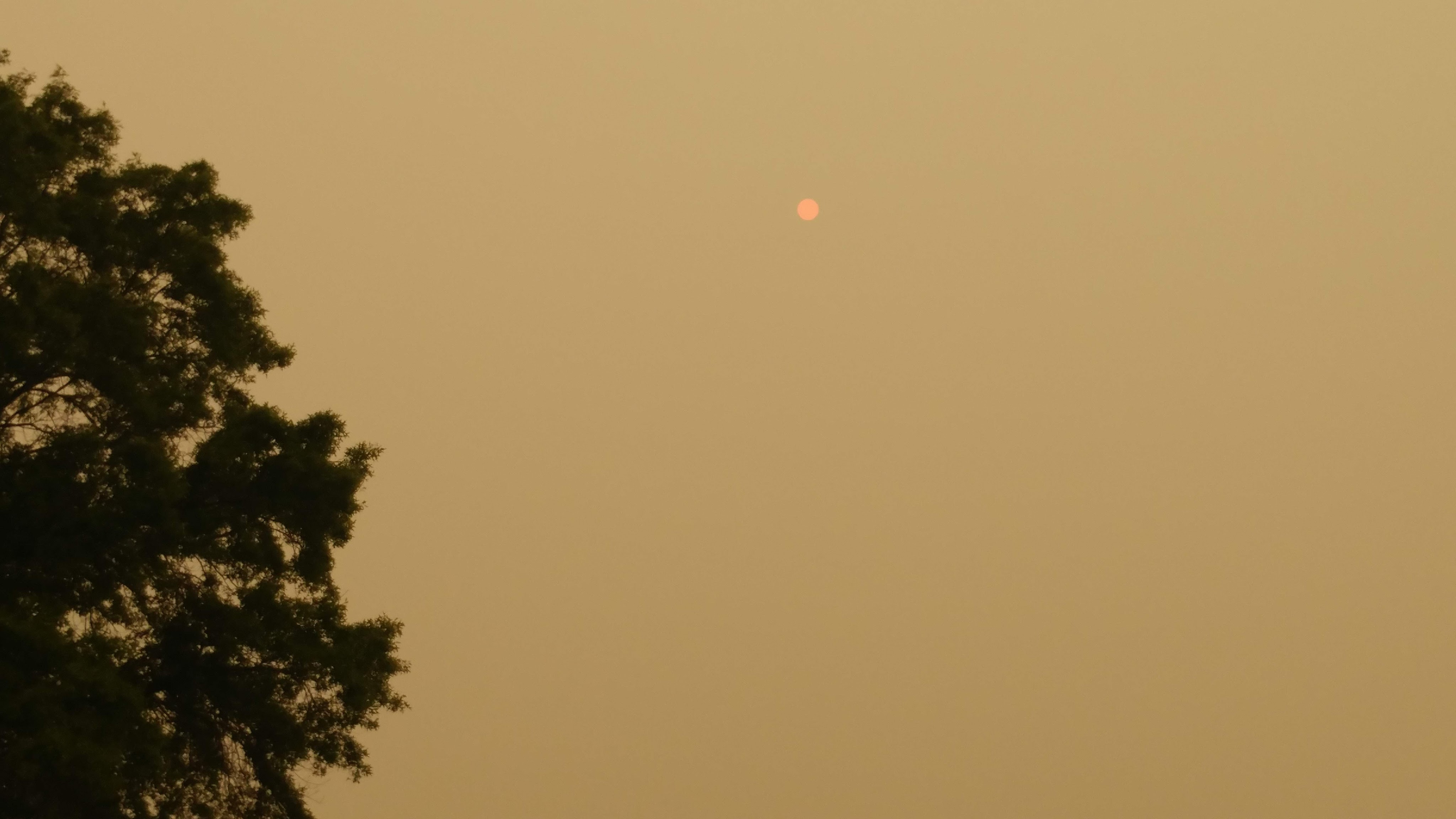
Red Smoke Day

An early childhood lesson for all of us is that one time events are not reliable predictors of the future. Being forgiven once for breaking a dish does not mean that such will always be the case.  Useful patterns come only from repetitive series. Even then, we are often mistaken in what is cause, what coincidence.

So a day of heavy smoke from Canadian wildfires blotting out midday sun in Manhattan does not prove climate change _ let alone climate catastrophe _ is real. Nor do a series of fires during consecutive dry years.  And it definitely does not prove human causality.

But in this debate, I sense a stubborn resistance to new theory, based only on what people are used to thinking. I am reminded of the cigarette debates of the fifties, when it was seriously argued that sick people prone to cancer were attracted by the curative properties of tobacco, and that cigarettes  worked for all those smokers who did not die of lung cancer (only because tobacco as medicine was not 100% effective.) And of the dire predictions about the millions of people to be burned alive in car crashes because they could not unbuckle their seat belts. Or, more to the point, of those who long ago claimed species could never go extinct because God had created them once. 

Human climate change _ and ecological disruption by all other human activities _ is increasingly verified as prediction. Whether or not red smoke confirms it is irrelevant. But sometimes such direct omens and harbingers of doom _ like comets in ancient days _ do more to change public opinion than any well-presented weighty scientific analysis.

Words can be ignored. Coughs and tears from dense red smoke everywhere much less so.

Merit

“Merit” gets a lot of use in current cultural memes. It is equivalent to what moral or great good used to be. Something that everyone should appreciate, strive for, and reward or applaud.

The problem is that merit _ like all those other values_ is really relative. Is there merit, for example, in not stealing a loaf of bread? Does it make a difference if you or your family is starving? We’ve changed the word implications, but the core issues still remain. 

“Ah,” apologists chime in, “but merit is a positive thing _ it simply means someone does something better than others. Not that someone tries but that they succeed. And that success is an objective fact we can all see, not some namby pamby feeling.”

I understand the argument. I find it lacking. Merit, like good, has too many preconditions, most of which we can never know. Merit, like any other value, should be judged partially by its difficulty.

“No! No!” cry the apologists. “Success is an objective thing!” Yet none of the billionaires claim to want a complete “competentocracy.” There is no glamor in being competent.  Deep in their hearts, most highly successful people are well aware that just as in ancient days much of our lives are determined not by our actions, but by circumstance and fate.

Scrooge Mob

Many online readers of the Wall Street Journal, spurred by the editorial page, have lately become Scrooge incarnate. Or maybe a combination of Marie Antoinette and that famous miser. Their comments are usually a combination of “are there no poor houses?” with “let them eat cake!”

I’m old and have forgotten a lot, but I do not remember the old USA, with all its faults, ever being so mean and plain maliciously, ignorantly selfish. A patina of Western civilized values was reflected even in our corporations and their minions. Now, even with untold comfort and wealth, the comments rain down from what seem a coven of cackling old witches casting curses, although I sometimes think they are actually from peevish, isolated adult children in their mom’s basement.

It is fascinating to observe how sinners accuse the innocent of their own sins. Those who do nothing for a living accuse others of being lazy. Those who steal from society and the government scream about everyone else cheating. Those who rely on the gifts of their ancestors claim everyone should be rewarded for their own meritocratic worth.

It’s sickening and silly.

My hope is that all this is probably shallow. In person, most folks are still reasonable. They shout in the confines of their sacred media, but outside its shell they are normal. Or maybe I’m just an

Braided Stream

Nobody knows, and I suspect nobody can know, the “true structure of reality.” But there is a current meme that claims there is a “multiverse” containing all possibilities coexistent with mine.

I have as much right as anyone to disagree.

My view of such a universe is less that of all possibilities in an infinitely dimensional block then a braided stream. Such waterways constantly diverge slightly and then not much later reform in generally the same direction. With proper perspective, they form a single current even though any given water molecule may go anywhere at any time.

And really, beyond flights of fancy, the imponderable question is time itself. We are unable to get a clue to its real nature. Unless we could somehow do so _ which I doubt _ we can never find “true reality”.

But all these exercises are really more about fable and the myths of meaning. It may be comforting to think that somewhere else things might have turned out differently or better. Mostly that gives us a better acceptance of our own path, or at least a comfort that it has not been worse.

Pursuit of the multiverse is, as most such quests,  a modern equivalent of tilting at windmills, or daydreaming in sunny meadows.