Magic Pebbles

It has been well known for over 50 years that we are made of “star stuff.” The original universe only contained hydrogen and helium and maybe a few other elements. Almost everything we require was built in the explosions of dying stars and the slow accretion of that matter. 

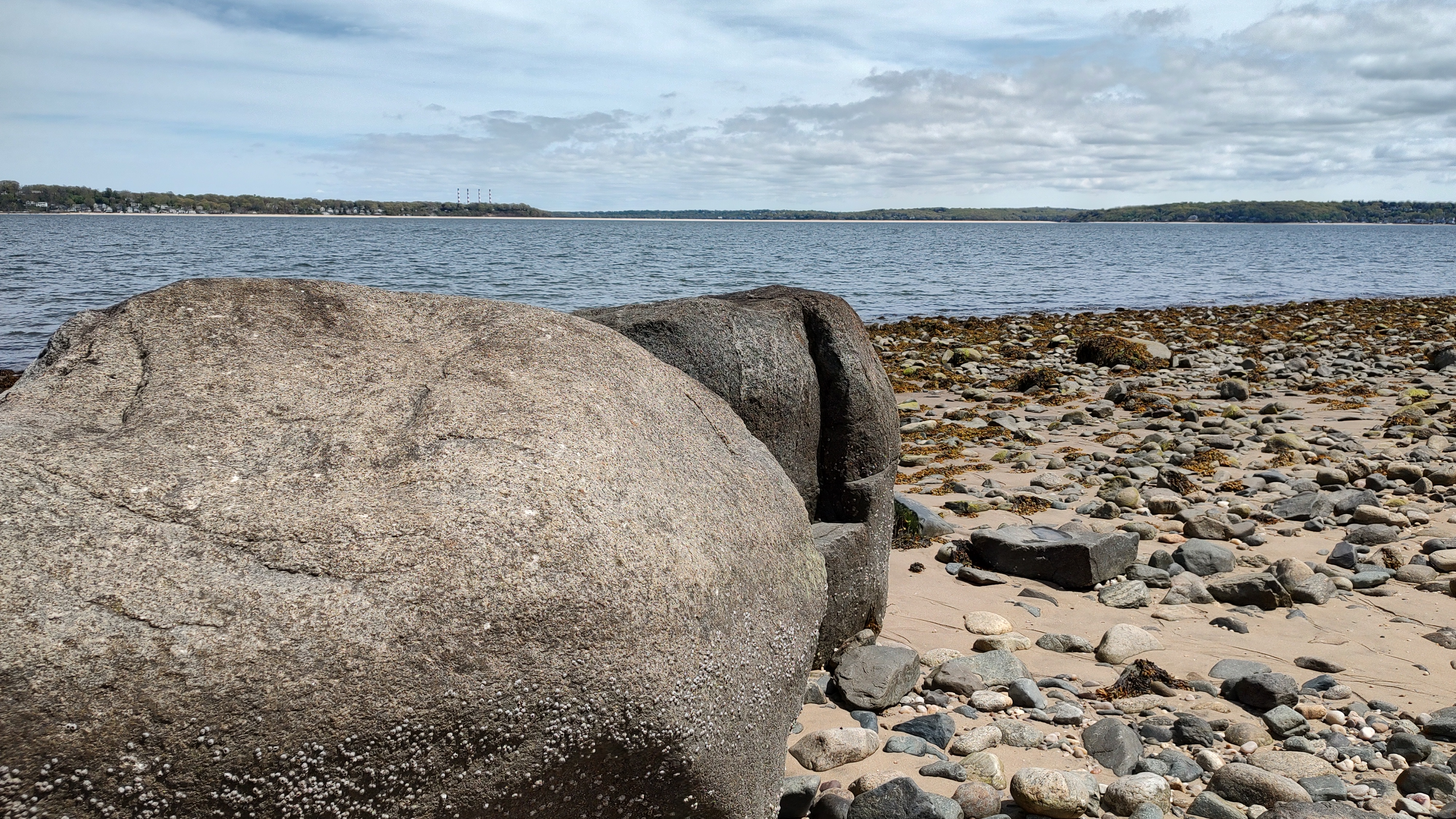
When I sit on a beach I try to ponder this grandeur. To see the pebbles all around me as constructed by near magical time and process. Of course, the sand on which the pebbles rest is just as amazing, being made of rocks formed by volcanoes, eroded, compressed, ground down again over the mere 5 billion years or so of this planet’s existence. 

The shells, from dead snails and clams and oysters, are more recent than I myself. The seaweed possibly only a few weeks old. Immense history lessons as I sit under a blue sky and blazing sun that concentrate this exact instant into my consciousness. 

The real miracle is that my momentary consciousness, floating free of the star stuff in my brain, can range over time and space to imagine such things. To imagine even more. To find ways to discover or “prove” such ideas. It leaves me breathless. 

I pick up a nice hot rounded pebble. Ancient stars in my fingers. And me – lord of my own universe, free to roam my thoughts and memories. 

Militants

American mythology is almost all active struggle. Conquering a wilderness, gaining and keeping your property, defending your rights, building for the future. Very little of our culture has ever been praised for being passive. We are generally proud of the belief that all our ancestors were in one way or another militants – in a good way of course. 

Unfortunately, struggle often became violent. Cowboys and Indians, labor and business, revolution from England, civil wars. Slavery. Even gangs and cities, immigrants, ranchers and farmers. 

As America grew in power, we projected this dynamism to much of the world. We tended to view most foreign places as just another frontier to be tamed. We like to think we were mostly helpful, but we were never meek. And when necessary, our militant sense of what was right turned violent.

I find “militants” today amusing. The militants themselves want to tame distant “frontiers” over which we have no control. The “counter militants” just want the militants to go away and leave them alone. And a lot of the concern over “free speech” antagonisms is just plain silly – snowflake versus snowflake.

One thing certain is that militants – and some violence – are truly at the heart of American culture. We are not alone in that, but we should at least acknowledge our biases 

Predictions

As little kids we rarely think about the future. Then, from adolescence through young adulthood, we are obsessed with it. Adults strive to make their own future as happy and secure as possible. Old folks increasingly dread it. Predictions are important.

At least in this culture. My probably simplistic images of other societies goes something like this: tribal and what used to be called primitive societies are fully engaged in each present moment – all past and future is equally vague “dream time.” Some cultures such as the Egyptians believed that all time was like the present – eternally the same. Buddhists believed in a great wheel, changing but repeating forever. Chinese time floated along like misty clouds and mountains, eternal but transient. And modern Europeans believed in an arrow of progress – even in religion – where actions in the present could determine the future. 

The “arrow predictors” have won, at least in this industrializing era. Those who figured things out and applied their ideas changed the world. Caring about the future, consequence, and planning have now turned into religious visions. 

Like other religious visions,these have also rapidly fragmented. So now we have predictions good and bad. Unfortunately often shaping our lives into fantasy as we are informed by various “experts” about what the future holds in store. 

We are just as blind about what will come as any homo sapiens ever was. We still only inhabit the moment. The predictions of our shaman equivalents – ” experts” – are just as unlikely and irrelevant as dream interpretations ever were. 

Evidence

In the last hundred years, the concept of “evidence” has undergone vast and confusing change. More scientific and “hard” _ good for prosecutors.  More esoteric and complex _  great for defense lawyers. And now easily faked by AI _ great for nobody. 

A typical crime in, say, 1900 had no photographs or video. No fingerprints or DNA. No trail of computer searches. Just means, opportunity, and motive. Sometimes eye witnesses, sometimes objects, but often guesswork. 

Then as now, the main clue for non-violent offenses was simple greed. The main determinant for violent crimes was relationship. Very few truly random attacks occurred. We have lived through the golden age of crime solving, although our ancient trial methodologies often ignore it. Video capture, DNA, psychiatry, written trails of past behaviors. The real problem has been how to reconcile the current near-certainty of guilt with the former “presumption of innocence.”

Of course, that all changes now. Constant surveillance, historic documents stored in media, everything can be completely manipulated and an alternate past “made real”. Proving anything. I could be convincingly shown killing my mother before I was born. 

It’s hard to predict how common sense will work out against artificial intelligence. But I am sure that in 100 years the rules of evidence we use now will seem as primitive to those then living as the rules of evidence in 1900 do to us now.  

Borders

Artists are often instructed that “there are no lines in nature.”  Nevertheless, most art does contain lines, which we easily interpret as nature. We have a facility to construct imaginary boundaries which are very useful to us. 

Some cultures – mostly those with a sense of private property – construct territorial lines over every clod of dirt or distant mountain. They claim to control the land thus enclosed, even though obviously sun, sky, light, sound, air, microbes, and the very molecules and atoms of which matter is composed ignore those imaginary boundaries entirely.

Ah _ but laws and people? There we believe we are on firmer ground. Inside or outside? What is allowed? What is forbidden? Citizen or foreigner? If borders are secure, we believe, we are secure and all will be well. 

Except that _ well _ things tend to be fluid. Of course armies can change map colors. But there are lots of invisible borders between, say, rich and poor, educated and ignorant, believers and infidels, the list goes on. And all those borders exist – like lines for an artist – only in the minds of those who think they see them. 

As in many human conditions, of course, what we imagine is often more important than what actually exists. Beyond that, we can elevate such trifles to cosmic levels and assume that by doing so all will be well. 

But we may be in for a big shock.

Ethical Morals

In spite of some commonalities, morals are local and tribal. They tell us who is like us, but only after we accept someone as in one way or another part of our extended tribe or family. Even someone with “no morals” must already have some basic relation to us. Outsiders don’t count – they have no more morality than animals. 

Morals tend to be habitual. They are acquired during the socialization of growing up human with caregivers. They naturally blend with those of the caregivers. Most have a rational basis for social success, and the most important are enforced by tribal law. 

Ethics, on the other hand, are generalized fairy tales. They may claim to be a distillation of morality, but they are anchored in a fragile logic that ignores the fundamental fact that many morals address our illogical and contradictory existence. Like passion or mood. What does ethics ever say about passion? 

As I aged, I came to distrust a reliance on logic as a basis for existence. Consciousness is not logical. It is an ineffable gift. How it is experienced cannot be tied to ethics. 

Morality may be crudely but effectively reduced to written law. But it can never be elegantly or sufficiently expressed in mathematic logic or brittle words. 

In the Country of the Specialists

“In the country of the blind, the one-eyed man is king.” Or he is seen as a madman, or a danger to society. We have fables and stories on all this. Yet in our own days, we live in a country of the specialists, and those who see more generally are usually in trouble. 

It is believed that specialization leads to wealth, fame, and happiness. You don’t get anywhere by being a jack of all trades _ okay but not excellent. That is a road to disaster. 

Unfortunately, being a specialist _ in terms of life and joyful consciousness _ is a terrible way to get through life. We have enough examples of fanatic obsession which worked in a tiny restricted area, but led to a life in ruins. 

The other odd observation is that lately specialists tend not only to be eccentric, but also to be unaware of anything else and afraid of certainty even in their own spheres of knowledge. Subconsciously they may realize that, for example,  staying out of direct sun, eating tons of nutritional supplements, or whatever other faddish notion (or actual discipline) they practice may not be the be-all and end-all – nor even the most important component – of a meaningful human existence. 

In the land of the specialists, the one-eyed generalist does not become king, must keep a careful facade to avoid being considered mad, and should just enjoy the universe that nobody else around him seems able to see.

Fake Food

Obviously, I follow the ancient maxim “when in Rome, do as the Romans do.” So I eat meat, fruit and vegetables, grains, and processed foods because everyone else does, not because I think it is right or best.

Honestly, I am morally queasy about slaughtering badly raised animals, enjoying strawberries and broccoli picked by near-slave labor, enjoying oats whose monoculture destroys the ecology, and encouraging the use of weird chemical treatments to enhance sales. But _ well, there they are. Some things I cannot affect. 

In the future, I suppose the “ultra processed” becomes the standard fare even of those in Rome. I can easily imagine folks happily living on a diet of corn curls, potato chips, and fried whatever all fortified with all the stuff necessary for healthy nutrition. I think of it as the “spaceship diet”, mostly made out of something like algae and seaweed. People would accept such a diet if it were healthy. Heck a lot of them and most kids do already when it is not. 

I know it would be better for animals, farm labor, and the entire environment. 

For now – not so much. The transition may take a while although I suspect that in only a hundred years our descendants will look back at our habits with a gentle amusement bordering on disgust. 

I need to be satisfied with cheese doodles. 

Daffodil

As I sit in mid-April, it’s been a good year for daffodils. They came up on time, but cool weather has kept them at peak form for weeks. Drifts of yellow cover patches of yards and hills. A complement to the also abundant forsythia. Golden spring with winter wind. 

Now the magnolias and cherries are beginning to spot the landscape with pink and white fluffs. Green leaves remain future visions, the background is blue sky, brown trunks and leaf litter, emerald lawns. 

I know daffodils are not native to Long Island. I’ll never know what was here a thousand years ago, nor even what Thoreau and Whitman might have seen. But the bulbs have naturalized completely, like the rest of us immigrants, and they do their part in spreading beauty. 

I’m grateful that so far the displays around here are pretty public. Daffodils do not hide behind the bricks of high walled private gardens. They crowd roadsides and parks. Even if a child plants a few somewhere, they may come back or even multiply for decades. 

I don’t want to make more of this than it is. The great meaning is simply the wonderful moment of existence, my appreciation to be part of it. Others may spin stories, and moral tales, and metaphors. I just like looking.

Soon enough this display will be over for another year. But wow – what a few weeks it has been!

Censorship

In order to survive as a social species, we all must practice a form of self-censorship. This can be as simple as never telling your boss what you really think, telling “white lies” to family to preserve the peace, or simply remaining quiet in the face of an obnoxious (or belligerent) fanatic. 

The typical “red line” to truly awful censorship is crossed when expressing an opinion becomes legally enforced. Can you be thrown in jail or worse for criticizing your boss, arguing with your wife, telling a neighbor he is wrong? In western civilization we try to retain as much “right to free speech” as possible.

This is in the possibly misguided belief that if all sides of an issue can be heard, the correct opinion will prevail. It’s almost as quaint as the idea that everyone no matter how ignorant or stupid should have an equal share in selecting a leader. Yet, for the most part, these two ridiculous propositions have often worked out. 

The problem has always been imagination. Although in the past limited by reality, opinion can now float free and unencumbered by hard checking. Upon a time, a person who said he could fly after eating a special food could prove it by jumping off a cliff before an audience. In the media age, no such luck.  We can no longer trust anything except what is right around us. And since we are sure of what we “know” we are certain the rest of the population would be better off if they never heard differently. 

Hard to figure out. We may need more cliffs