Floreal

Sunday

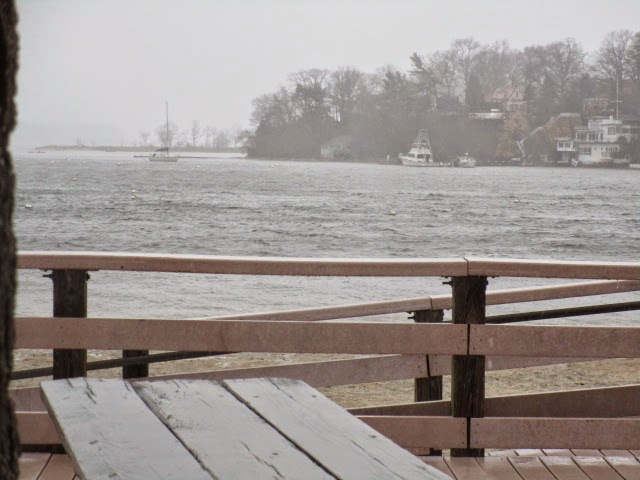
  • Traditional Chinese landscapes of ink on silk convey distance with the use of blank space and mists, skillfully leading the eye from foreground to distance.  What is left out is just as important as what is added.  That is in complete opposition to Western style landscapes, which normally saturate the surface and rely on perspective and slight softening of detail on the horizon to show how far away objects are.  Connoisseurs of each convention tend to regard the other as relatively primitive.
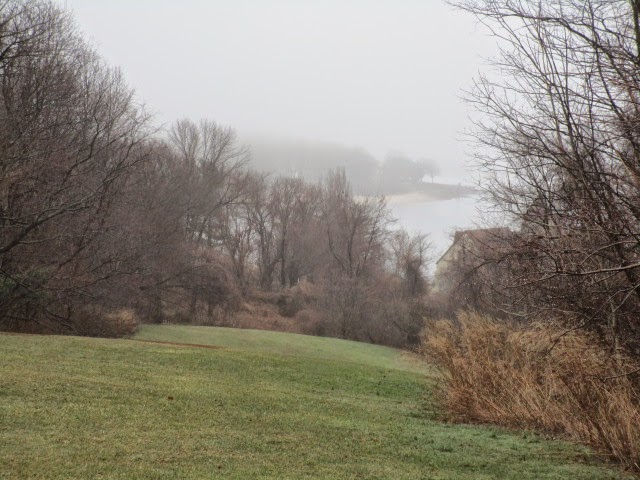
  • Conventions are curious things.  I see mostly in “Western” mode except for unusual conditions such as this heavy fog blanketing the harbor.  I assumed that the Chinese blanks were a philosophic choice.  And yet, now that photographic evidence is available of the mountains and streams which those painters used for models, it is obvious that such is the way such scenery truly looks.  I find myself always too prone to hasty judgement and lazy belief.

Saturday

  • This shoreline sunny, clear, and hot but the lighthouse outside the inlet is braying rhythmically.  Tendrils of what must be dense fog over Long Island Sound are seeping around the bend over toward Lloyd Neck.  Fog used to be a terror for commercial vessels in the days before radar, and for smaller craft before the more modern adaption of universal satellite positioning.  Now it is simply an inconvenience.
  • Winslow Homer made a wonderful painting on the subject called “The Fog Warning” which I used to study reverently at the Museum of Fine Arts in Boston.  A fisherman desperately rows back to his distant home ship as a thick cloud hovers ominously nearby.  Some pictures from that era are more like novels or theatrical productions than mere snapshots, we end up caring for the poor guy, wondering what will happen, how others will be affected.  Nothing so dramatic about to occur near Huntington, but nice to have the reminder of the old days, and for that matter me in my younger ones.

Friday

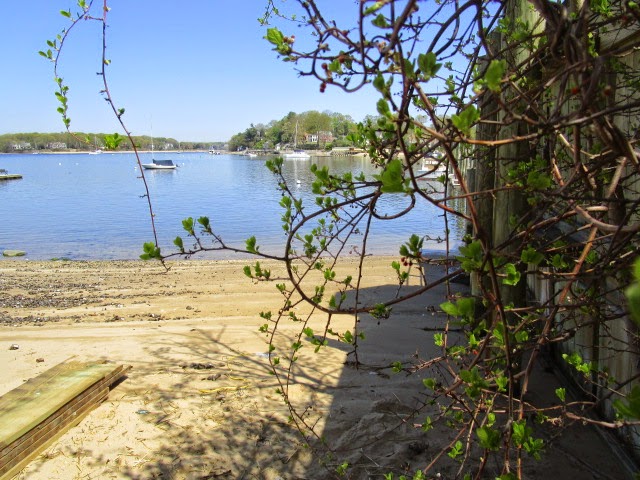
  • Almost summer, the leaves on the perennial vines of the bittersweet open, the hills completely greened, the harbor inviting and filled with pleasure craft.   Although the air is warmed, the water is not, and the inviting beaches are empty.  Children in school continue lessons in reading and writing and testing, parents at work continue desperately to remain relevant and to somehow accomplish impossible tasks, those doing neither often wish they were once again.  From now on, almost day by day, there will be more people taking time to enjoy the outdoors.
  • Those of us living in areas with seasons claim to love them all.  Spring is easy to praise: warm, not too hot, outdoor wonders not quite restricted by annoying insects (although the ticks have arrived already),  sand and trails not yet choked with crowds, clean colors all around, crisp air and brilliant sun relieved by showers recognized as absolutely necessary for vegetation.  And, most of all, we know it will go on forever _ the days are still getting longer, winter fades and next year is far off, a whole glorious summer lies pristine before us.

Thursday
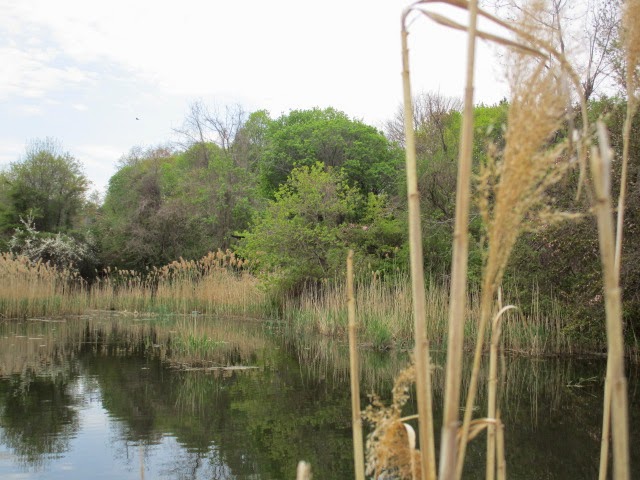
  • Varied hues of green now visible are enough eye candy even without any blossoms.  Missing the smaller spectacles merely because there are more strident attractions all around is unfortunate.  The real miracle, after all, is that the breathing vegetation recovers after hibernation, renewing the air, purifying the water, keeping the Earth going for everything else.  The pretty flowers and the delicious fruit are nearly trivialities in the grand pattern of life.
  • Just as for us, love and beauty and happiness are trivialities compared to the necessities to work and eat and take care of the requirements of the day.  Yet love and beauty and happiness are what we most consider and most desire and most remember.  The importance of material things hardly impinges on our need for the spiritual.  I like to consider contradictions like these, for if there is a key to understanding it lies less in reconciling them, than in accepting the impossibility of doing so.   

Wednesday

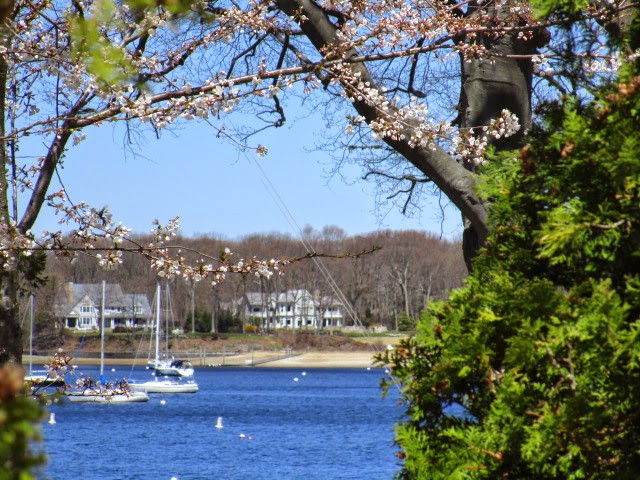
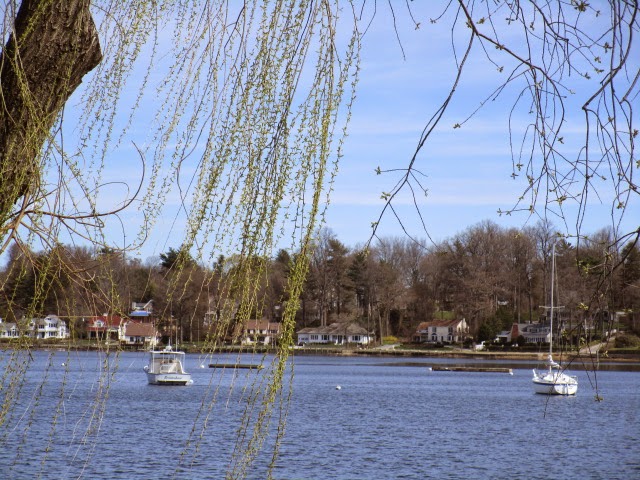
  • Some shots are too cute and easy, like this one from under a flowering cherry at Gold Star Battalion Beach.  Why plant a weeping cherry at the beach?  Who knows, but it was an inspired choice.  The far shore is finally being clothed in green, sailboats are sitting ready for coming weekends.
  • What I cannot show is the life under the surface waters.  Walking out on the boat dock barely visible in the center of this harbor, I looked down and was amazed to see a school of thousands of large fish, swimming in crowded unison, remaining still in the strong incoming tide.  My camera could not capture their subtle movements, but human eyes are adapted to see movement especially well.  Eventually the crowd moved on a ways, and I was left to ponder all the mysteries of which I remain unaware even in the places I
    think I know best.

Tuesday

  • Brief heat spell.  This is exactly imagined paradise _ sweet fragrances, plentiful birdsong, luscious colors, no wild beasts nor annoying insects, hot enough to roam naked.  Perfection distilled.
  • I am a poor candidate for the Garden of Eden.  I become bored pretty easily _ here I am walking around, thinking, snapping pictures, planning the afternoon.  That may be vice or virtue _ a vice now when contentment should rule, but a virtue when once I needed to earn a living or even later today when the yard needs some touchups.  As a destination, Paradise is pretty wonderful;  as a journey, not so much.

Monday

  • French Revolution committees invented the metric system, used worldwide by anyone doing serious measurements (obviously not American road engineers or food consumers.)  Less successful was calendar reform.  True, Gregorian months are meaningless and irrational (who knows what February stands for, and October is not the eighth month.)  Claiming history began in France, and numbering years with difficult Roman numerals (in a touch of hubris worthy of the NFL) was a hard sell, but beyond that, the monthly naming themes are hardly universal.  Thermador is not the hottest month in Tierra Del Fuego, and almost nowhere experiences the Parisian fogs of Brumaire.
  • Huntington shares nearly the same climate as Paris, so Floreal would relevantly describe our “Flowering Month.”  Like most Americans who cling to inches and miles (in spite of the insanity of food information like a 4 ounce serving containing 425 grams of fat), I enjoy a bit of quirkiness to keep my individuality.  Which is why I cultivate a thin layer of French cultural awareness.  I’m no Francophile _ I favor fast food over most French cooking _ but it’s nice to know another language somewhat, and keep up with events that have absolutely no relevance to my daily life (for example, French politics can be incredibly entertaining.)  Thus I glide through Floreal now, remembering French painters and phrases, just little different I am sure than most of the thoughts of those around me.

Prest-O-Pop

.
Sunday-

  • Pretty, shiny, clean, unusual red.  Careful not to touch, as poison ivy comes back in strength, untroubled by deep winters, heavy storms, or long droughts.  Definitely something to be seen only.
  • Even taking this picture seemed a bit of an adventure.  I looked down at my feet and there were the subtle little vines with their innocent looking buds reaching towards my sneakers.  Poison ivy used to be one of those things, like bee stings, that you just learned about as a child, with whatever consequences teaching you to be a little more careful in taking things for granted.  Nowadays, I suppose, cautious parents fearing deathly reactions keep children well shielded from such things. Perhaps, like Siddhartha’s father, they may find such isolation from reality has its own unintended consequences.

Saturday-

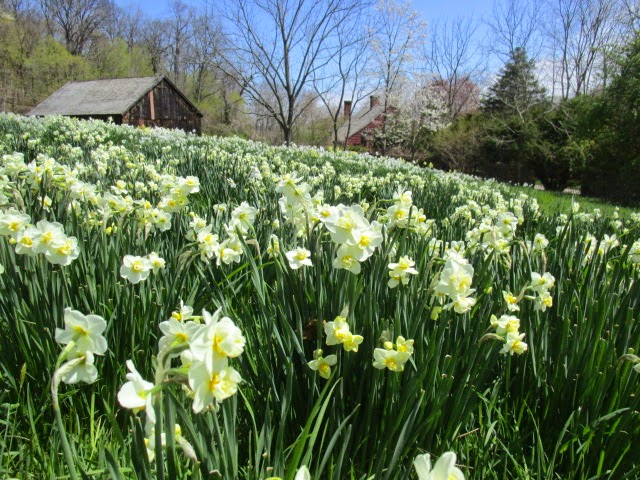
  • I wandered lonely as a cloud/That floats on high o’er vales and hills/When all at once I saw a crowd/A host, of golden daffodils;
  • This scene at Caumsett State Park of the 1711 Lloyd House and 1756 barn reminds me of the William Wordsworth poem.  Vast fields of naturalized daffodils are a remarkable feast for the eyes _ a synopsis of my contradictory views of landscape.  The view pleases me far more than would virgin forest which originally occupied  these slopes.  Like Thoreau, I contemplate the intersection of humans and nature and universe; like him, from a safe, civilized, and long-tamed bit of property. 

That floats on high o’er vales and hills,
When all at once I saw a crowd,
A host, of golden daffodils;

Friday-

  • Huntington’s Tulip Festival is in a few days, but the guests of honor look pretty sparse.  Sometimes whole fields of blooms can burst open in hours, but these don’t look quite ready to pop yet.  Picking a hard date, or even weekend, for events is always chancy.  The weather for the fall festival is frequently awful, and even in the summer there have been rainouts during the art show.  But predicting flowers in a season of unknown variables is impossible. 
  • Hecksher park is always nice this time of year.  I joined joggers and walkers and strollers and tiny tots and grim old folks taking laps around the pond, gawking at turtles and a huge white carp, not disturbing the swan on its nest.  Some days like this feel like old times, as if we could go back generations and whole families of different ages would be doing much the same thing.  A nice, gentle, feeling of connections through time.  I hope it remains in the far future.  In the more immediate near future, I will return when everything is open, one of the lucky people able to adjust my schedule to fit that of nature.
Thursday-

  • Flowers get all the glory, but newly formed leaves have their own infinite range of crisp shapes and subtle varied hues.  Like an individual lost in a crowd, each leaf comes to mean almost nothing except as it contributes to the whole.  This maple cluster has dull red cotyledons, dark and light greens freshly glistening, sharp edges, and intricate origami folds.  In a day or so it will be _ just another unnoticed spot on one of the numerous trees along this road as cars race by.
  • It’s probably too easy to make too much of this.  If there were a problem, I think it would be that we have so much attracting our attention that we miss the basic reality that there is always more to experience more deeply.  Our vision darts from tulip to magnolia to forsythia to cherry and once in a while notices sky or water.  Then it’s back to business, or the radio, or shopping, or worry or planning.  Who has time?  Only nature.  Only leaves like these.

Wednesday-

  • Buoys have been laid in the harbor for weeks now, and after a proper incubation period in the warmer weather, it seems they are hatching boats just about every day.
  • I used to resist using zoom too much as a false picture compared to a snapshot.  But any selection of anything, any art, any communication, is necessarily not the whole truth.  I remember a tale of the French artist Courbet where a hiker came upon him painting in a field.  The naturalistic landscape was beautiful, but as far as the traveler could tell had nothing to do with anything around them.  He asked Courbet, who silently pointed do a distant hill, where the onlooker finally made out the small bit of barely noticeable scenery.  So, sometimes, I use zoom and close focus which select and distort _ very much like my words each day.

Tuesday-

  • Cherries are now joining the parade of forsythia, daffodils, magnolias, tulips and other less spectacular colors.  Well, green is a pretty spectacular color if we consider chlorophyll as the main reason why the biosphere exists as it does.  But people tend to discount what is most plentiful.  For that matter, the deep blue sky is hardly an aesthetic slouch.  Around the bend, red-winged blackbirds have started their racket, warning passersby to keep their distance.  Soon their ancient battle with nest-robbing crows will begin again.
  • This week, in particular, the scenery changes over the mile that I walk from the inlet to the head of harbor.  The inlet is exposed to the open sound, from whence have been blasting constant frigid winds rechilled by the large expanse of cold water.  When I start, up there, spring has hardly started, trees are bare branches, leaves are only unfurling grudgingly, if at all.  But by the time I have reached Mill Pond, everything is open, even most of the trees, and what is not completely covered by foliage is at least decently cloaked.  And should I venture further, into town, well,  anything not open is probably killed off by the winter.  Birds must experience amazing differences as they swiftly dart around.

Monday-

  • Perhaps reflecting a violent streak in the culture, there are many references to explosions, bursts, and fireworks when describing what is happening all over the landscape.  A tree suddenly flowers.  A flower suddenly fades.  Leaves suddenly hide branches.  Grass lawns appear to jump a few feet tall overnight.  Whole hillsides are reworked, fields shift colors en masse.
  • I prefer a gentler comparison to popcorn or certain breakfast cereals.  While occasionally startling, these huge changes are never scary.  They are harbingers of better times _ each day makes it more certain that snowfall is banished for another 9 months or so, that temperatures will continue to edge a bit closer to comfortable.  Watching these cherry blossoms frame the water is simply  delightful.  Everything else is a grand pageant, which I am privileged once again to witness.

Ozlandia

.
Sunday-

  • Japanese woodcut artists such as Hiroshige were almost obsessed with the effect of water and wood, particularly pilings and bridges and boats.  They would no doubt have enjoyed this view from the dock.  In a few weeks, the semi-transparent views between poles will be completely obscured by the vessels tied up there.  Today, however, the still frigid gale seems to be keeping all the summer mariners warm at home.
  • One of the reasons I enjoy studying visual art is to gain the ability to compose or view scenes as if I were this artist or that artist.  To see the dashes of color as Monet, to admire the sky as if it were painted by Tiepolo, to find landscapes that Hokusai would have eagerly captured.  That enriches my life considerably, costs nothing at all, and, not least important in this day and age, hardly affects the environment at all. 

Saturday-

  • Continuing the tired old theme of the week, someone might say “strange weather we’re having around here lately.”  Not quite snowfall yet, but cold enough to happen.  The heavy coats, hats, and gloves are back on the more observant people, while others just shiver and mutter.  This maple blooms in hope of attracting insects, but most of them are still hibernating.  Everything is one grand glossy panorama, clear and crisp and wonderfully attracting until one steps into the cruel wind.
  • Spring is filled with promise and disappointments.  Like so much of our lives, we dream and are frequently let down.  I’ve fortunately learned to temper my dreams, which I suppose is what we old folks like to call wisdom.  I miss the ambition of my youth, once in a while,  then I settle back and contemplate that, after all, what I’ve got is not bad at all.

Friday-

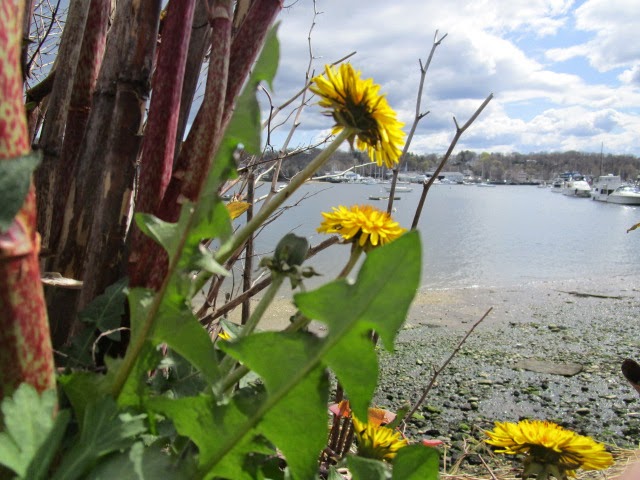
  • If dandelions were difficult to grow, they would be the pride of anyone’s garden.  The deeply serrated dark green leaves are interesting, the yellow flower large enough to stand out, even the final global seed puff unique.  They bloom continuously from early spring to late fall.  In a pinch, they are even edible. Plants would be sold at high markups, glossy catalogs would showcase the latest varieties from horticulturalists.  But they are prolific, ubiquitous, hardy, and almost impossible to eliminate, so they remain a kind of scourge.
  • I like them as weeds.  Other invasive species that colonize waste patches like ragweed take a bit of contemplation and forced mental adjustment to appreciate.  Dandelions always stand out, adding patches of gold everywhere singly or grand groups.  But the darn things don’t know their place, and head into my lawn, flower beds and patio. They not only take over, but just cannot be destroyed even if I pull out their entire foot-long tuber, and they pop up like magic almost day by day.  There’s some lesson there about the most perfect guest overstaying a welcome, but I’ll let you work that one out.

Thursday-

  • Magnolia on the lawn in front of “New Town Hall” which is the “old high school,” opposite the oldest Presbyterian church.   Sign notes the town was founded in 1643, not coincidentally in the middle of the English civil war against Charles I, the same year Louis XIV (a powerless seven-year-old) became king of France and the final year of the Chinese Ming dynasty.  The settlement was nominally part of the Dutch empire, although actually on the disputed frontier between New England and New Amsterdam.  Layers of history can be fun to add to a sedate beflowered landscape.
  • Tourists flock to Europe _ the old world _ to gawk at the wonders of the past.  I myself have done so.  We often fail to realize that many of those monuments happened simultaneously with the growth of what became the United States.  Here in the northeast, layers of previous generations lie almost as thickly as those in the narrow streets of Paris, if we just take the time to look them up.  Fortunately, we have an active historical society which can track just about every rock, nook, cranny and wall back almost to the day of founding.  

Wednesday-

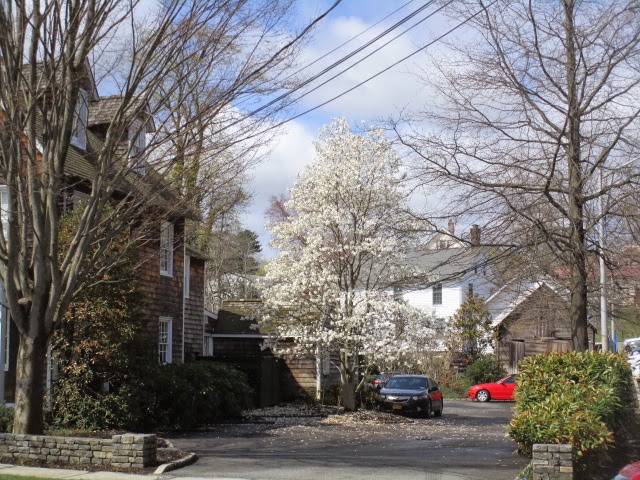
  • A scene in town, fairly capturing the ambiguity of the season.  Magnolia in full blossom, trees alongside seemingly completely dormant.  Come along the same path tomorrow or in a few days, and the magnolia may be fading rapidly, any one of the companion trees fully leafed.   The rhododendron in the lower right is just waiting for the right trigger.  The sunlight is brilliant and energetic, the temperature well above freezing, but nonetheless this spring has been colder than normal, and everything seems much behind schedule.
  • The insistent and ongoing transformation is pure magic.  By that, I mean it happens when I am distracted and looking away.  I stare all day at a tulip in the back yard _ a big unopened green bud on a long stem _ and nothing at all seems to be happening.  I look away for a while, trying to find more pleasant views or accomplish some chore or go to sleep, and when I look again it is a magnificent red.  Poof
    .  We think of the vegetable world as slow and deliberate, but at this time of year the processes may be zipping along faster than we are.  Especially, I admit, if you are my age.

Tuesday-

  • Appropriately for the theme, this week opens with a tremendous rainstorm, including midnight thunder and lightning and downpours seemingly capable of drowning anyone walking through them.  Nature seems all the more amazing for not only coming back from incredibly deep cold and suffocating snow cover, but also for brushing off heavy winds and driving water.  Just part of the normal. 
  • Hard to say if this is extreme because of climate change, or really if historically it is extreme at all.  Certainly individual yardsticks have been set recently, I will no longer say “I remember the snows of ‘77” _  Superstorm Sandy, the snows of 2014, and the cold of 2015 are everyone’s reference points.  This day is not nearly on that scale.  Since I am dry and warm and have nowhere in particular to go it is actually quite entertaining, and I have enjoyed watching sheets of rain and wind sweep across the bay.

Monday-

  • This week resembles that astounding moment in the Wizard of Oz when Dorothy opens the door and the movie suddenly transmutes from sepia to oversaturated brilliant color.  Now the sky becomes painfully blue, the grass a legendary green, the willow leaves sharply etched.  True, the treeline remains brown and bare, but close examination reveals that each tree will soon burst into full foliage.  Along the ground, various shrubs are preparing for spectacular display.  There are even little munchkins _ in the form of butterflies and bumblebees _ hesitantly venturing out, and just a hint of wicked monkeys _ mosquitoes and ticks_ in the not too distant future.
  • We are told about the brains of dolphins and dogs and the consciousnesses of birds and rats.  I have sympathy, for animals are life, and more intelligent animals are close relatives, and we are all united against a cold and uncaring universe of rocky planets and suns and deep space.  But dogs do not make movies nor write books and blogs, dolphins create no extended irrelevant metaphors to amuse themselves, rats are not critics of the literary efforts of their peers.  In addition to feeling oneness with all life, we must also appreciate our own uniqueness and the special gifts that our immense and unlikely knowledge of existence has given us each moment.

Springinging

.
Sunday-

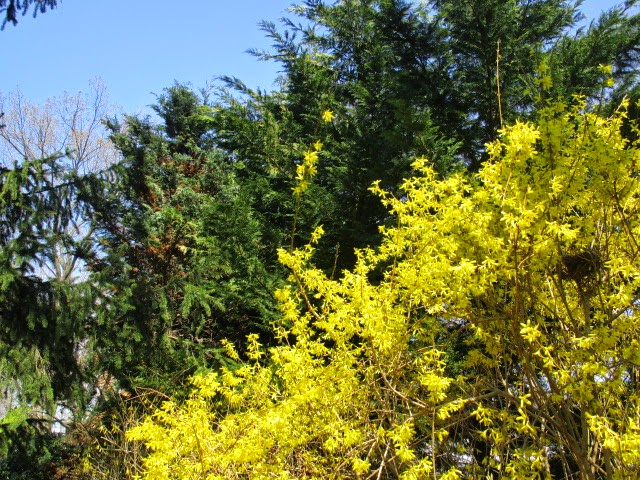
  • Blur the details a bit and this could model a nice abstract canvas.  Very warm day as various brilliant components of landscape start to detonate like fireworks.  Forsythia and daffodils now, tulips and magnolias starting, azaleas and cherries soon to come.  Each glance around becomes an enchanted gaze.
  • I spent the day in the yard, not even drifting the block or so down to the water, catching up on some outside chores and enjoying our own proper flowers and bushes,  each with a story to tell in remembrance of our lives.  Breaking a rigid schedule once in a while for good cause is the right thing to do.  Discovering fiddleheads emerging from leafy detritus in my backyard should be just as worthwhile as seeking something exotic along a more distant shore.   

Saturday-

  • April is proverbially filled with showers.  A cloudy misty day has its own loveliness, especially now that the forsythia adds a soft golden glow to the already glistening greens of lawn and young weeds.  People travel far to look for such scenes, Ireland is often mentioned.  For those with eyes and a bit of imagination, local scenes like this have most of the charm of distant places.  Even better, intimate knowledge of them day by day infuses the experience with the depth of linked knowledge.
  • Chinese brush painters could have created fine scrolls of this, Japanese wood block artists would have added a figure or two for effect, impressionists would have replicated the glow.  In my own poor way, I once tried to capture the feeling.  But the awesome fact is that art and photography are poor substitutes for standing here, listening to nature all around, feeling the universe flowing everywhere, and realizing that this whole immense landscape is unique to me this moment. It is only there because I take the time to pause and enjoy and remember.

Friday-

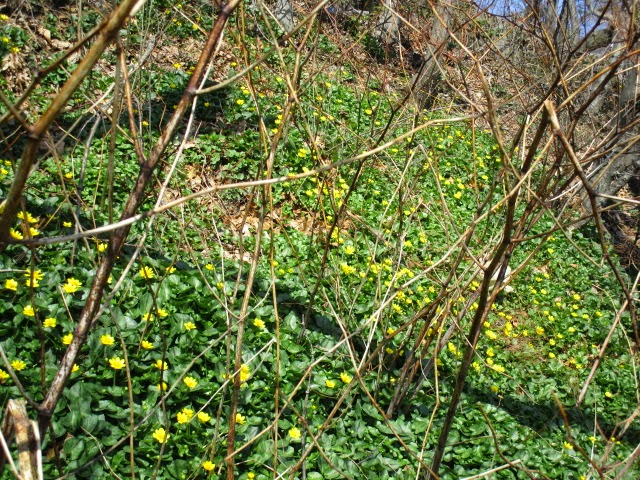
  • Nothing at all subtle about this patch of celandine covering part of an entire hillside.  An invasive and somewhat aggressive weed with brilliant crisp yellow flowers and shiny emerald leaves is even planted on purpose sometimes.  Like ragweed, it seems quite happy in mostly desolate spots where not much else can make a go of it.
  • Microclimates and tiny environmental zones are extremely noticeable this time of year.  A few degrees tilt towards the sun, a bend to shelter from the north wind, a boggy low ground or simply an inland valley with raised temperatures will show entirely different stretches of plants.  Forsythia blooms here but not there, ferns have emerged there but not here.  Even if the difference is only a few days, I can often walk through several such places in an hour, marveling at the variety.

Thursday-

  • Discovering hidden tiny surprises is one of the joys of early spring.  Here we have a very small plant which is probably a mint, all with miniscule purple flowers resembling orchids.  To properly appreciate it requires an ant’s-eye view.  A casual glance across the sprouting coarse grass in this weedy patch would have ignored it entirely.  For a week or so, such marvels are ubiquitous.
  • In such small details, I find encapsulated the contradictions of the age.  Each small flowering plant (a weed, truly) is a miraculous evolutionary survivor, with a pedigree as long as my own.  Yet it is a footnote to history, environment, climate, and development.  Well, in that, we are even closer kin.  Nobody will fight to save it in its fragile magnificence, nor will it make it into some coffee table book to make wealthy people feel they are paying attention to nature, but its individual struggle is just as awesome as that of any rain forest or tropical reef.  We must save the big things, of course, but we must remember we do so to preserve the small.

Wednesday-

  • Like some witch’s cottage tucked almost invisibly amongst a grove of trees, the old spring house at Coindre Hall (traditionally before refrigeration cheese and butter and milk could be kept fresh here with the cold running water in a relatively insulated space) squats gently above bursting clumps of dark green garlic.  Its walls, like all abandoned walls, have not escaped the urge of people to prove they exist by making marks on the universe.  This is a misty, gentle, warm day with birds almost deafening in massive symphony as they rush to finish mating and build nests.
  • I felt tired, and achy, and almost didn’t make it over here.  There was so much to do at home.  Some mornings are like that, when I suddenly realize I cannot possibly do all I think I must.  In this case, I figured I should really accomplish the one task I least felt like, and that proved to be the right choice.  One of those strange moments that are far more beautiful in totality than any specific element could ever indicate _ if I went on for pages and pages I could never explain why it felt so perfect.   

Tuesday-

  • These pussy willows are already going to seed, almost shocking given the sparseness of other visible activity.  But hidden processes are going on everywhere now _ under the water, through the water becoming murky as algae reactivate, under the ground where ants and termites and microbes and spores and fungi are busily keeping the planet alive, and everywhere above where mosses have started into their fruiting cycle as well.  There are so many humble unseen processes on which the biosphere is dependent, and many are hardly known.
  • The damage we have done to the planet in the last few centuries may be reversible, but that is hard to tell since so much of it we are not aware of.  The biosphere is mighty and flexible and resilient, but we have drenched large areas in poisons and contaminated the oceans with toxins, not to mention whatever effects may come from the gasses and industrial chemicals we have spewed into the atmosphere.  Our influence may be overstated _ I hope it is _ but the plain fact is that _ like underground insects, moss spores, and harbor algae _ we are all ignorant of what once was and what should be.  At least we should try to be conscious of what there is now.

Monday-

  • With highs near sixty and lows near forty each day for a week, a grand transformation is underway.  Definitively now the browns are giving way to blushes and shouts of color, spots and patches to begin with, cascading until becoming the dominant features of the landscape.  Miraculous rebirth so astounding that its novelty catches attention, even the most unobservant get caught up in the general excitement.   
  • Diligently seeking subtle signs of any growth for weeks now, I suddenly find myself overwhelmed by choice.  Life is once again everywhere,  charging forth with new banners almost each hour, regardless of outside conditions.  Almost by definition, any picture I take now has elements of convention.  I promise not to complain.

Fresh Scenes

.
Sunday-

  • April often looks gorgeous, but retains bite in frequent breezes.  Unwary folks take the day at face value and dress as if it were nearly summer, walk a while soaking up welcome sunbeams, then miserably fight their way back upwind, chilled to the bone.  Improbable pockets of warmth or pleasant cool embedded in a basically cold situation add to the difficulties.  Meanwhile, vegetation ignores everything except the expanded light and as long as temperatures remain above freezing vigorously continues its rampant path.  Animals have their own protections, even those birds now migrating through from warmer places.
  • I’ve learned, gradually, to overdress.  It’s hard not to be seduced by sunshine, dragged onward by clear air and sparking waves, feeling an inner spring in my step as I am also energized by the season.  But, at my age, prudence wins and this day I wear a heavy jacket and light gloves.  Looking like the ancient peasant I have become, I trundle along the road and greet joggers, pedestrians, and those walking their dogs in various states of what I consider undress.  Ah, the follies of the younger generation!

Saturday-

  • Almost desperate hope that chilled morning fog represents not only a transition from standing cold front to incoming warm one, but also that it signifies the final departure of a winter that has long overstayed its welcome.  Somewhere else, green leaves are glistening in dew and cherry blossoms gently waft on the breeze.  Somewhere else lovers stroll beneath bright warm skies gazing at profusions of flowers bursting from the ground.  Except for constant birdsong, here only the grass seems to have any notion of ongoing spring.
  • Even my philosophy of accepting each day as it comes sometimes is tested.  Sure, the fog is lovely in its own way, the chilled morning has its own charm, there is something wonderful about this mysterious world.  But enough is enough.  I am so easily thrown into confusion by such minor things, how will I deal with the greater tragedies of life inevitably to arrive?  Probably as I often have, by ignoring them until the last minute.  Then, somehow, just get through and try to remember pleasantly even the cold mists I have experienced.

Friday-

  • Wintry stasis this week, as the temperature has never left the thirties while precipitation has been constant, the north wind has blown unrelentingly, and the sun never broke through a heavy overcast.  Vegetation kept slowly emerging, birds kept appearing more frequently and noisily.  This Andromeda bush in front of the living room finally bloomed.
  • Sometimes it may seem I am partial to “native” species and “original” landscapes.  But I am not nearly so naïve as not to accept the beauty of imports like azaleas and tulips as well.  I try to enjoy what actually exists, however created, no matter what it replaced.  Life is constant change, our aesthetics must recognize that reality.  By the same token, weather like this is not cause for grand discontent, whatever we may expect, whatever paper claims is “normal.”  Reality is each moment, however much we may wish it differently, and our spiritual test is to appreciate that we are living through it.

Thursday-

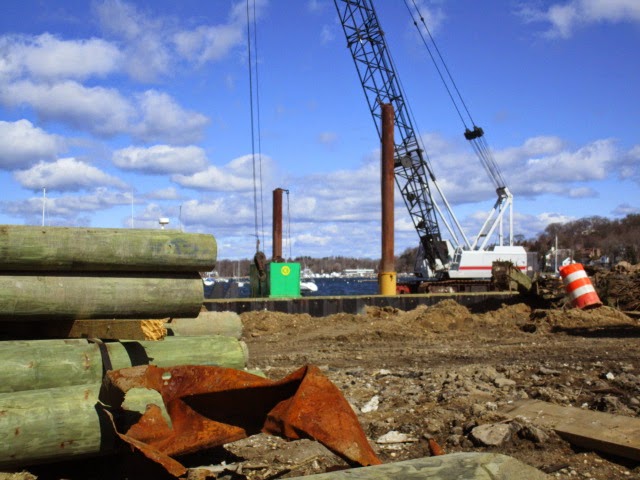
  • Still photographs may give the impression that this harbor is a quiet refuge from the bustle of civilization, but it is as noisy as anywhere else.  Cars, hammers, construction, leaf blowers, sirens all pierce the air.  Here the town dock is being rebuilt, pile drivers jamming in bulkheads.  Huntington was founded in 1653, only twenty-odd years after the Pilgrims, and has always been a busy place.  Halesite has always been the town port, where the deep water ended and marsh began.  Periodically, everywhere along a tidal waterfront must be renewed or it falls into permanent unusable decay.
  • One of the glories of our culture is that we can realistically appreciate our past.  Ignorant folk may glorify or denigrate what went before _ aborigines, colonists, farmers, suburban developers _ but all of them were people like us, happiness, pain, loss, and gain.  We are fortunate to have records here _ massive original town documents carefully preserved, eventually including photographs almost from the time photography first became available.  I love being able to look at a site like this and see not only the pilings and rocks but the layers of shellfish-based native settlements, lumber and local pottery and fish being shipped out by sailing vessels, clams and recreational use now, Nathan Hale, tidal mills, old trolley line, “town gas” production, and even, in my own residence, an odd succession of mostly terrible bars and restaurants.

Wednesday-

  • Just over a week or so ago, this hillside contained a marvelous tracery of white lines sparkling in sunlight, the result of a late snowfall.  At the time there was no hint of green.  Now the brambles are filling with color, and a close inspection will show buds beginning to burst out of each thorn-studded vine
    .   A week further on, the full transition will be underway as this patch of earth becomes impenetrable except to birds and small animals.  Soon the only brown to be seen will be tree trunks standing and fallen.
  • Not a nicely composed picture, I know.  Just a wall of stuff.  Really, isn’t this how we see most of the world, most of the time?  A jumbled painted canvas, often in our way, something we just have to chart our way through to get where we are going?  When I walk, I have time to regard it otherwise, but otherwise I am no different.  The frozen nature of a photograph or painting, its usual attempt to focus attention where we often do not, is one of the main attractions of the medium.

Tuesday-

  • If there is not, there should be a paint hue named “April Green.”  New growth has a peculiar brilliant color that strikes through the existing soft patinas of old sienna and umber.   A complementary shade would be “April Red” for the strong dark blush of new buds and vines beginning rejuvenation.  Whole hillsides are now subtly becoming cast in those two filters, a transformation easy to miss until it is suddenly overwhelming.
  • Noticing such things has always been a primary value of sketching or painting as a hobby.  Nowadays, the more impatient culture uses cameras, of course, and I also find that a useful reason to look more closely at what I otherwise fail to see.  What is often missed is that photography, like most arts, is a meditative tool for the user.  That aspect ought not be lost in our mad dash to share everything in lottery hopes of becoming rich and famous.

Monday-

  • Like life itself, language contains beautiful ambiguities.  A word is defined by context much as behavior is modified by habitat.  Fresh can mean cold, pure, presumptuous, unsalted, new, clean.  April is all those things, and as the poem says, contains more than a tinge of cruelty.  Momentous transitions are occurring, the world is constantly renewed and for all the hope of lying on the grass and watching clouds roll by, the air is often bitterly chill and the wind strips off body heat.
  • Those of us living in such climates claim to enjoy the challenge and opportunities.  We like being invigorated, we say, unlike those who live in places warm and green all year round.  We find  lessons and interest in the thousand little changes each day _ I often find I can hardly keep up with so many so often _ then greening of the briars, the constant bulb blooms, the swelling and uncurling buds, the parade of waterfowl, the mating antics of creatures great and small, not to mention the first hints of insects.  The sky here is pure blue, awaiting the certain rains which may fall for the next few days, more of what our fresh spring will inevitably deliver.

Emergence

.
Sunday-

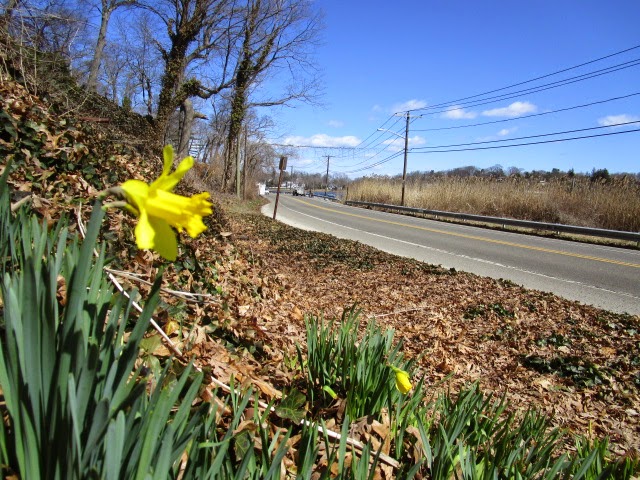
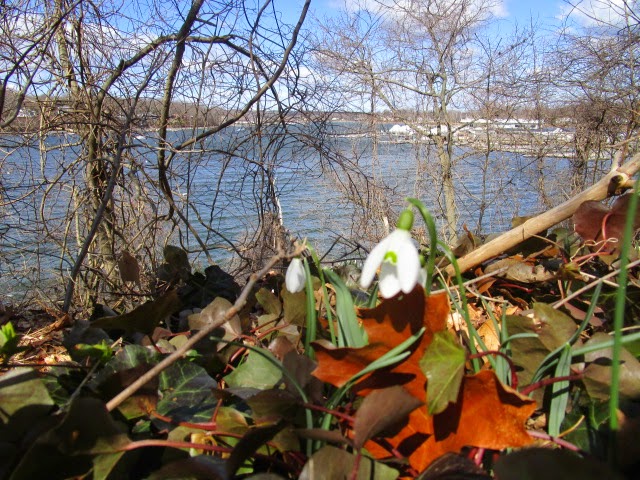
  • Showdrops in leftover leaves, a couple selected from large clumps growing on the bluffs on the east shore.  Beyond the bare vine network brilliant blue sky promises a lovely day.  But this morning, the sun and wind are involved in a classic struggle recalling the old fable.  Where the sun shines and the wind is blocked, hats and gloves come off, where the wind howls and the sun is shaded, covering head and hands is hardly enough.  Looks beautiful, no matter what.
  • I am easily pleased for a little while, then hope for better.  Twenty degrees warmer than a week ago is wonderful, ten degrees more would be far more delightful.  A snowdrop is fine, but where are the daffodils?  And when all that happens, in due course, my insatiable desires will continue to elevate unabated.  Kind of a curse, but one that forces me to always appreciate the infinite varieties of our world.

Saturday-

  • Sap rising, leaves unfurling on honeysuckle on the fence overlooking the inlet.  Most of the tangle remains blasted and brown, but underneath the basic patterns and essentials remain, the spark survives, and miracles of near-resurrection occur once again.  Every bit of new growth after such a long dormancy is a wonder and cause for rejoicing.
  • All of this affects my spirit tremendously.  Some philosophies claim we should remain detached, take all as it is, be unaffected by the ebb and flow of event and circumstances.  Once in a while I try such an approach, and then reject it.  It doesn’t fit my own tides and emotions.  I love spring, exalt in summer , savor autumn and endure winter.  Being willing to let my spirit flow with sun and rain, cold and heat, calm and storm, bloom and blast _ ah, that is a joy of being conscious.

Friday-

  • At Hecksher park, turtles climb out of the pond to sun themselves on the banks of a few islands or swim slowly about, heads in the air.  This one seems to be resting in a small stream, but as it never moved it’s hard to tell if it is really resting or dead.  Seems a tragedy to make it through such a difficult winter, only to miss the spring, even for a turtle.  Otherwise, except for the happy screams of herds of young children at the playground, only the warmer temperature gives strong hints that the season is finally progressing.
  • There are not many animals in my photos.  I don’t pretend to be a photographer, and purposely use lower grade equipment, slow shutter speed, low resolution shots.  That’s unfashionable _ I’ve read reviews of new cell phone cameras where a young woman describes capabilities with all the tenderness, excitement, anticipation, and sheer lust more appropriate to a lover.  Some even here have telescopic lenses the length of rifles.  For me, another minor tool, a sketch rather than a finished artwork, and usually incapable of capturing wildlife.  Able to snap shots of turtles, however, especially if they are not alive.

Thursday-

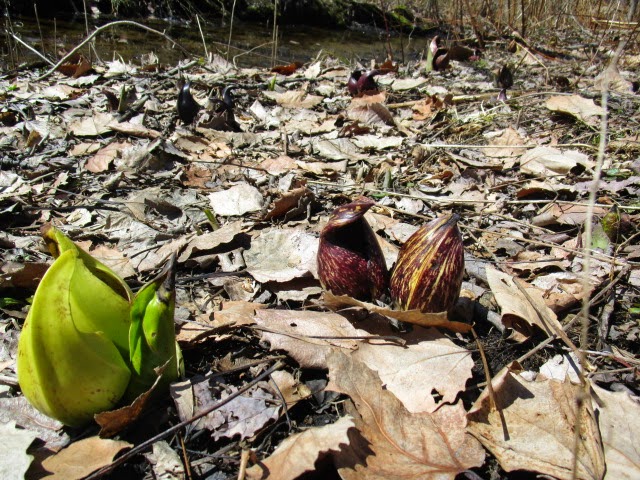
  • In a forlorn marsh formed by a tiny brook that is more of a drainage ditch, in a forgotten back woodlot at Mill Dam Park, this reliable grouping of skunk cabbage is always fully in bloom by now.  Being endothermic (generating its own heat) its flowers are only slightly affected by yearly variations in snow and cold.  At least enough early insects are around to have guaranteed its survival _ and it is almost everywhere,  particularly in places where people do not even want to walk.  An overlooked native wildflower holding out against human encroachment on own terms.
  • I hope that such survival means other species will also make it through this epoch.  We pave our cities and fill suburbs with strange exotica and carry invasive disruptions floral and animal throughout the world.  Farmlands have become vast barren chemical monocultures.  Wildlands and parks set aside are isolated and often on land that nobody wants for anything else, lacking the niches necessary to support any variety.  Yet skunk cabbage is still doing well, a harbinger of spring, and a few other plants and animals seem to be creeping back into our worlds.  I don’t give this hope much percentage of success, mind you, but it is at least possible.

Wednesday-

Huntington Harbor 11743
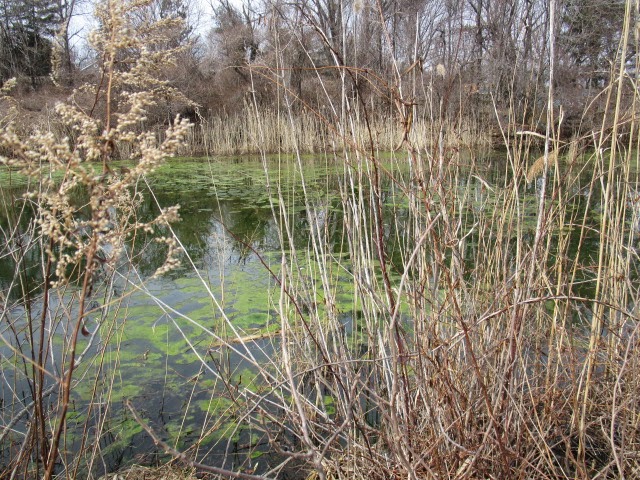
  • April arrives looking pretty much as March did.  The evergreens are bright and cheerful, but the only other real sight of green is this verdant scum on the pond at Coindre Hall.  Most years it hasn’t shown up until much later, perhaps the underground water supply is warmer than usual.  It does provide an interesting aesthetic harmony with the browns of the reeds and weeds.  Nature always surprising and always correct in its artistic judgement.
  • Scum is life as much as we are.  An awful lot of our genes are shared, and we require almost exactly the same environmental conditions.  Most of us have grown taught that we must be all that we can be, do all that we can do, that only being excellent counts.  I wonder, sometimes, if being scum doesn’t count too.  Not that I want to be scum, nor encourage you to strive for i
    t, but I believe a human life without fantastic recognized achievements is just as meaningful in experience and being as that of any of those exalted by historians and publicists.  We are each one of nature’s masterpieces.

Tuesday-

  • As the snow melts away, revealing sprouting weeds and greening shoots with a flower here or there, other objects emerge.  Some trash was here before the winter snows, but a lot of it gets layered on between snowfalls, and remains hidden for months.  Some artists might find in all this some kind of aesthetic vision.
  • Not me, however.  Garbage is garbage.  I admit that I have been pleasantly surprised this year that the actual amount is a lot less than I expected.  I suppose the deep cold and constant precipitation made everyone keep their car windows shut tightly, so less opportunity to litter.  Probably less pedestrians as well, certainly nobody on bicycles.  All will now revert to form, and it will be a race between new growth and new human detritus.

Monday-

  • First flowers, first honors.  This clump by the harbor always seems to manage to push up yellow buds before other crocuses in more favored locations.  Old leaves and remnants of last year’s flowers lie all around, soon to be cleaned up by the caretaker in a fit of spring fever.  Certainly a cheery sight, on a cold day with overnight snow yet again.
  • Crocuses are imported, but pretty well adapted and naturalized.  Since studying evolution, I never saw nature again as I did when I was a young child.  Even opening early is a ploy in survival and competition, gentle though it may seem.  Survival is not all red tooth and claw, sometimes it is being first, or even waiting until last, or a faint color difference, or basic luck in where you happen to be.  Not unlike our lives.

Nautical Necessities

Sunday-

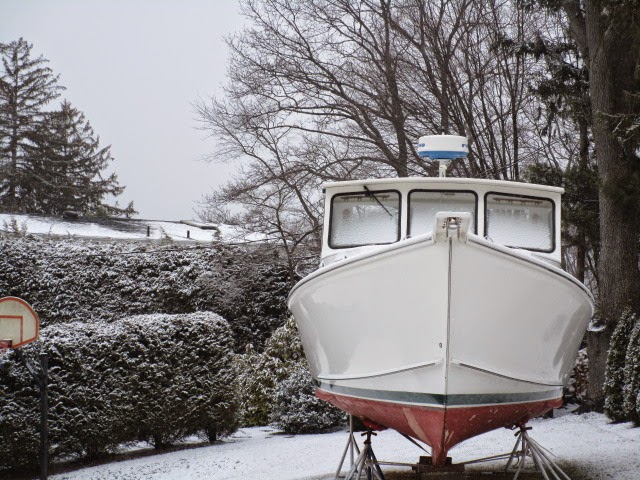
  • Someday the weather will break and our neighbor will get this back in the water.  He has been busy these last few weeks, getting off the tarp and fixing everything he can.  A boat is a lot of work.  There’s a saying that “the second happiest day in your life is when you buy a boat.  The happiest is when you sell it.”
  • Any hobby can consume us.  That is part of being fully human, and makes us feel more alive.  I have had my own passions and enthusiasms for which I am grateful.  There are far worse ways to direct your days than to dream of open waters and strange shores.  Nevertheless, each of us, blinded by inner certainty, finds it easy to ridicule whatever that other guy is doing.  I try, often unsuccessfully, to keep such an attitude under control.

Saturday-

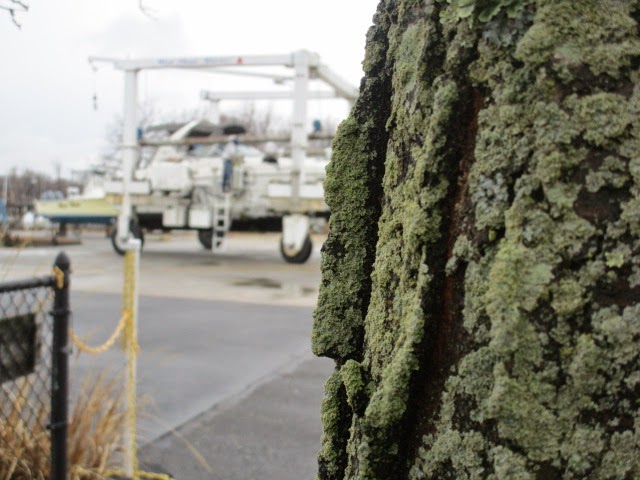
  • Another boat about to be lowered to join the recreational fleet.  In spring, under the right conditions of luminosity and humidity, lichen can glow with almost supernatural fluorescence.  Contrary to myth, it does not grow only on the north side of trees.  Around here, trying to navigate out of the forest using green on trunks would simply lead to frustrated madness and eventual starvation.
  • I’m frankly surprised that neighbors _who frantically, expensively, noisily, and chemically attempt to turn their lawns into rugs without a leaf or dandelion blemish _ allow lichen to remain.  Surely there should be yard crews scraping and scrubbing the stuff off, maybe polishing the rough bits of bark as well.  Corporations like Ortho and Scotts are probably ramping up such an ad campaign already.

Friday-

  • Work will have to be done, but sometimes a beautiful day is just a beautiful day, a lovely scene need not mean something more than itself.  Traditionally, perfect days are sunny and warm, but there is a bewitching softness in cool light fog and the luminous grey light that coats everything in silver shades.  Heavy air damps sounds of machine civilization, so that birdsong is more penetrating and remarkable.
  • Even though I know all this, there is sometimes a difficulty in getting on all the necessary gear and leaving the warm bright house into dark dank soup.  Once I have made the transition, the experience can be wonderful.  Making that transition out of a comfort zone is the problem.  Make of it what deeper spiritual metaphors you will.

Thursday-

  • Like visions from Ahab’s nightmares, shrink-wrapped leviathans congregate along docks and are beached in every square yard of available flat land.  Perhaps all that plastic, soon to be removed, will be recycled, but the extremely wealthy who play with these toys are not known for ecological awareness.  Admittedly, none of these are quite on the scale of Moby Dick, but some which dock later in the year would be well worth harpooning.  Needing to have something really big to prove worth has been a human characteristic since at least the time of the Pharaohs.
  • More by necessity than virtue, I have rarely been so afflicted.  Lacking the means to own, I learned to enjoy simply by observing.  That gained me the additional delightful ability to regard a leaf floating along in the current with as much pleasure and enthusiasm as if I were roaring about swiftly in a mechanical monster.  Like all people with no real choice in the matter, I think of my own behavior as morally superior.

Wednesday-

  • Twenty-odd degrees plus harsh wind _ no matter _ the calendar declares the buoys must go out.  From now on weekend mariners want to believe they could take their boats for a spin anytime they get the notion _ even though they will not really ever have the time nor inclination until nearly July.  A lot of maritime work must be done in nasty conditions, at least these guys will be able to motor over to Halesite and get some coffee and hot chocolate.
  • Technology frees us from being slaves to the weather, which is on the whole a good thing.  But that also means that artificial requirements and inflexible calendars encourage us to ignore the weather altogether, except when it slaps us in the face with a big storm.  How often have I been trapped in an office during a fantastic spring morning, only to find that by the weekend dank chill driving rain trapped me inside my house!  Even now, I find myself too driven by schedules when I should be open to serendipity.

Tuesday-

  • With typical Gallic overstatement, the French have just celebrated the “tide of the century” (which comes every eighteen yea
    rs) and hordes of onlookers watched places such as Mt. St. Michel surrounded by higher and lower water than normal.  There are no forty foot differences here, but anyone tied to the bottom of one of those pilings would not survive the next cycle _ the depth varies more than it seems at first glance.
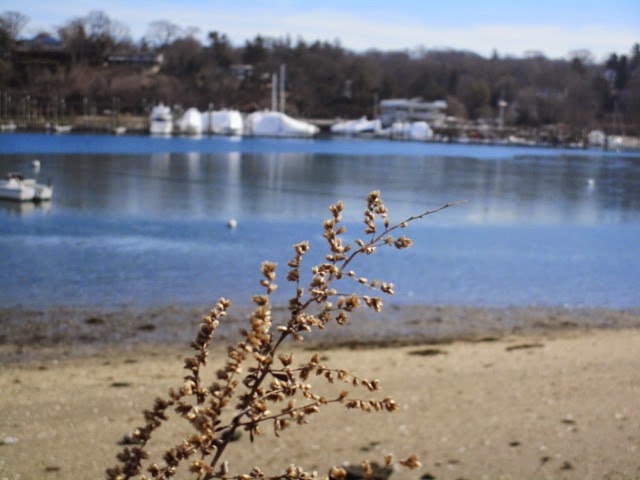
  • Communities along this shoreline must pull floating docks up on the beach each fall to avoid the ice, and refloating them in the spring requires a keen coordination of high tides, acceptable weather, and weekend mornings when residents are available to help pull the ropes.  As the harbor also continually silts up _ well evident here in the mud flats _ mariners must be also aware of the times of day they are likely to run aground.  I love the varied panoramas presented by newly exposed seaweed or high waves slapping against bulkheads, a continuing drama without end, always the same, always different.

Monday-

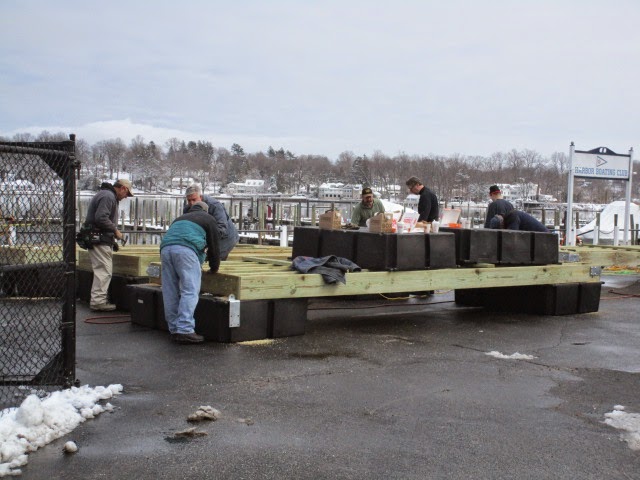
  • March, like February, has been exceptionally frigid and snow filled.  But as farmers always knew, there is no use waiting for weather to match mood.  Chores must be done in anticipation of seasons, regardless of the day.  So around here it is time for the docks to be repaired, or in this case rebuilt from scratch.  The activity is not unlike that of little European fishing communities in the old days, each boat club and neighborhood pitching in on common work for a while.  Up next, naturally, will be working on the boats themselves.
  • I did a lot of this when younger, but like so many things I have had to give up some of it with age.  For me at least, age is not an illusion, and overdoing something can require a long recovery.  Pushing too hard can lead to long-term ill effects.   As a spectator, I enjoy the hard work of the younger crowd, and remember when I was involved more completely.  Then I walk on with nothing more to do but think and eventually write.  Not morally better, not worse, just as it is.

Welcome Equinox

Sunday-

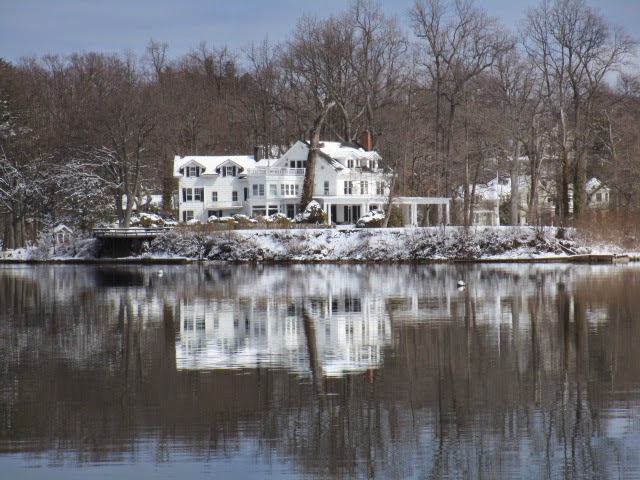
  • Spring usually accompanied by breezes and winds of various degrees, so reflections from a relatively calm bay surface are rare.  Reflections are easily ignored in the need to select what is important from a field of view _ after all, they will never interact with the “real” physical world.  In fact, they are more easily admired in pictures than in life, and used to be a staple for cardboard jigsaw puzzles.
  • That is why I find that photographs tend to lie.  This house is not so near, when seen from my vantage point, without the use of the zoom.  This selected scene does not jump out of all the surroundings.  Just about everything in my field of view is cut out, and other senses are missing entirely.  Like much of what I focus on, I have created a beautiful lie.   

Saturday-

  • Four inches of heavy white.  California and Brazil are dried out, the rest of the world is overheated, but around here it has been a winter like those of the mythic 1800’s.  All that has been missing is a horse and sleigh to compose a Currier and Ives print.
  • A half-empty guy would declaim how much better things could be.  Being more the half-full type, I’m glad it’s not worse.  For example, if any of the trees had seriously leafed out yet this kind of storm could be a disaster.  It’s sometimes hard being Pollyanna in a Cassandra epoch, but at least it works for my daily life.

Friday-

  • Crystalline air, brilliant sun, sharp wind.  The range of pure blues and soft browns is fabulous, each breath is delightfully clean.  Maybe the temperature does not quite meet expectations for the season, perhaps the season itself seems a bit nastier than normal, but on its own terms this day is another miracle.
  • I hide too much behind polarized sunglasses, tinted windshields, or double-paned glass.  I stupidly miss the incredible clarity of color unless I consciously strip my eyes and spend long minutes trying to see.  I become so wrapped in remembering the past, fearing or anticipating the future, that I ignore the core existence in this moment that is what I really am.  My lament is all the more foolish by being entirely my own doing.  The world is always there in all its glory, but I must make the effort to engage.

Thursday-

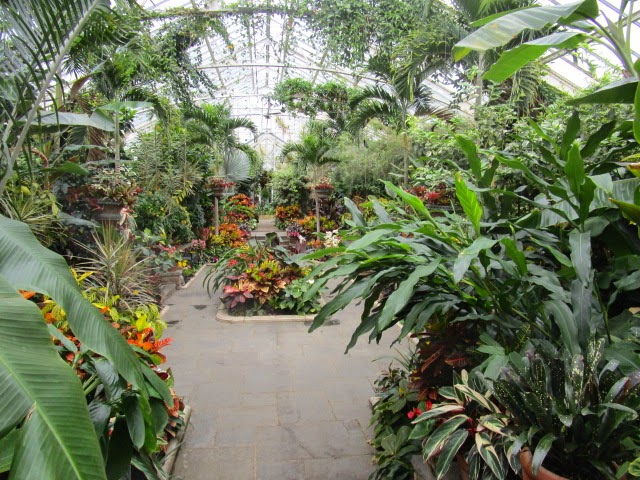
  • Deep freeze has returned, but there are local escapes such as this greenhouse at Oyster Bay Arboretum.  Wonderful in all seasons, it is especially (nicely) shocking in mid and late winter.  For anyone impatient with the pace of Mother Nature this is a fine rest stop along the way.
  • Like everyone else, I take for granted the civilized miracles around me _ fresh flowers and food all the time, light and heat at the touch of a button, easy rapid travel to places like this, and on and on.  Ancient and not-so-long-ago kings, emperors, and potentates would have given large chunks of the kingdom for comforts we almost ignore.  Sometimes I reflect too much on nature _ which it is absolutely important to reverence _ while forgetting the daily conditions that allow me, especially at my age, to be able to enjoy it so completely.

Wednesday-

  • The differences between early and late winter can be subtle indeed.  The only real clue in a picture like this is the color of the grass.  Of course, in actual experience, there are a few more indicators such as birds and, for that matter, people.  By the end of the winter, many folks and their dogs have adjusted to just waiting out the dark and cold days and taking advantage of any nice ones.  At onset of snow, it was all exciting and “invigorating.”
  • Humans are instinctually pretty unaffected by season _ I am part of one of the most adaptive species that ever lived.  We don’t depend on weather sun or moon for mating or much of anything else.  A few are affected by seasonal disorders, and we all experience flu or pollen and other specific maladies often associated with a given set of months, but for the most part we get up, d
    o what we must, and deal with whatever has been spread out before us.
      My main difference is psychological _ what is spread before me here seems a harbinger of warmer and nicer mornings soon to arrive, simply because I know it is equinox in a couple of days.

Tuesday-

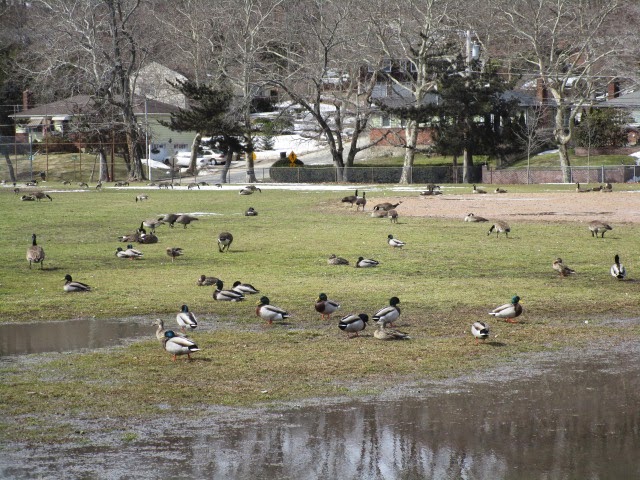
  • No ballplaying here!  There have been reports that in various parts of the island geese and ducks are starving because the marshes froze over so long and so completely.  The huge groups here apparently decided to try the comforts of civilization.  While the surface is waterlogged and the subground solid ice, there will be no competition from the softball leagues that pop up like crocuses with the first warm days.
  • Informally, it seems to me there are definitely a lot fewer birds around than there were back in January before all hell broke loose meteorologically.  Our backyard feeder attracts a fraction of the swarms it once had.  Yet there is plentiful birdsong and a few unfortunate victims still run into our windows each week.  These guys seem fat and happy enough.

Monday-

  • In just about a week, harbor is practically ice out.  Still parts frozen over, but any boats that want to go somewhere have clear channels cleared by others, and certainly nobody would try to walk on the treacherous half-frozen slush that is left.  The hills have basically cleared back to brown, so each sunny day raises the ambient stored warmth.  Not too many new craft out yet, but that will change soon, and the buoys that usually wait for official spring will be settled into place in the next few weeks.  Activity keeps picking up, both natural and man-made.
  • It’s hard to say which is worse _ a long hard winter with a sudden spring or a lingering one which teases forever.  I have no say in the matter, so I accept whatever comes along.  It certainly seems that this year the astronomical calendar is racing ahead of the seasonal one _ this could be a typical mid-February many years.  Maybe there will be a sudden jump and blossoming as April rolls around, but I’m not going to hold my breath.


Anticipated Thaw

Mon-

Huntington likes to retain a small-town atmosphere, some of which involves periodic parades.  This is the annual St. Patrick’s Day setup, a bit early so as not to conflict with other, later, grander ones around the region, particularly in New York City.  Children like the excitement, parents like the generational connections as they remember other parades they attended with their parents, only the motorists on the closed major highways are really upset.  Vendors (none of Irish descent) sell various green trinkets appropriate to the occasion.

Parades are one thing that has surprisingly not changed much since I first remember them.  There are still marching bands, decorated cars, walking functionaries.  People have a few beers and cheer whatever may come along.  Everyone is glad to celebrate almost anything as a break in what has been a dismal winter.  Thank fully,  these events have not yet been invaded by electronics other than too much amplification of the speeches of those who think they are important.  But that, of course, has also always been traditional.
Tue-

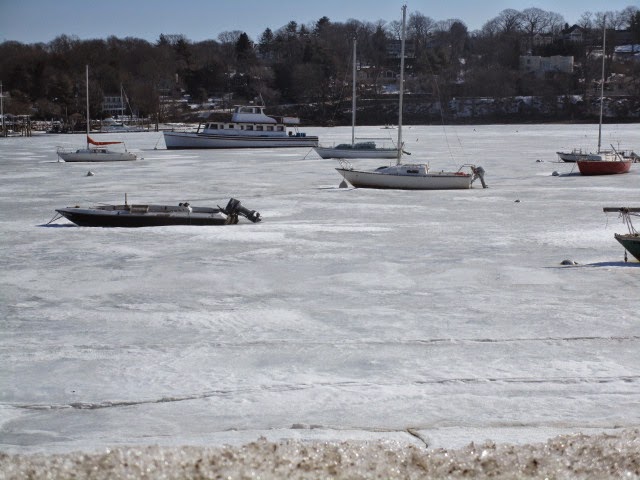
Icebound boats are rare, especially this late.  Usually, some enterprising clammer or other has cut a path out to the inlet, seeking riches while the supply to market is relatively restricted.  Either the ice is too thick this year, or the baymen are discouraged by the unrelenting cold.  This picture will be fully changed in one week, already the pack is breaking up from the end of the harbor, ducks and geese and swans flocking into the open waters.

It’s been nice flying in from somewhere else, having missed the daily drudgery, only catching the last glamour of what was hopefully the final snowstorm.  Not having had to endure the hardships _ like most tourists _ I am free to be enchanted by the beauty.  Since I am not planning to fly out again, I can confidently state that after only a week of this I am also about to cry “enough already!”
Wed-


Snowpack remains deep and hard to walk on, but dogs and their (nominal) masters have packed parts of the hill here at Coindre Hall into solid ice.  With warmer temperatures, the inlet is completely open, and the rest of the harbor covering is quickly receding.  From the picture alone, it could be late December or early January, but actually standing outside there is too much solar radiation and other subtle signs that this is late in the season.


Naturally, by now I am very anxious for any signs of spring.  The first green shoot appearing above the first cleared garden soil, the first hint of grass, the slightest swelling of tree buds.  Meanwhile, it is impossible to miss the increased birdcalls, although this year even their mating activities seem subdued.  Nature will take its course and all will unfold into glorious bloom, but meanwhile we try to fast forward and are simply frustrated.
Thu-


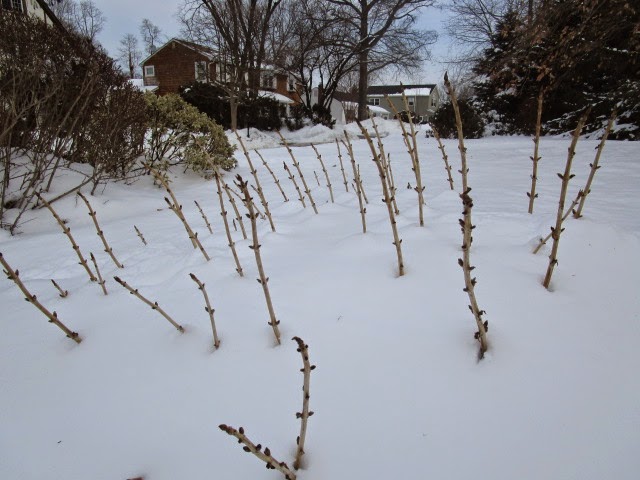
It’s a certainty these hydrangeas will not bloom again this year _ the buds have been blasted once again.  Now there is simply the question of whether the roots survived or not.  The same with the fig trees and many other ornamentals and invasives _ plant and animal.  The coldest month in almost a hundred years will cause some problems in what has been a long and slow extension of growing zone over the decades.


I keep hearing people exclaim that they are ready to move “I can’t take this any more.”  Fortunately, our society will permit them to do so without much aggravation.  But I wonder what they will say if hurricanes hit three years in a row, or heavy flooding, or deep drought.  How many times should we fly from the aggravations we know to those we know not of?  Perhaps it is generally better to stay put and adapt yourself as much as possible.  Easy for me to say _ I escaped the worst of it this time.
Fri-


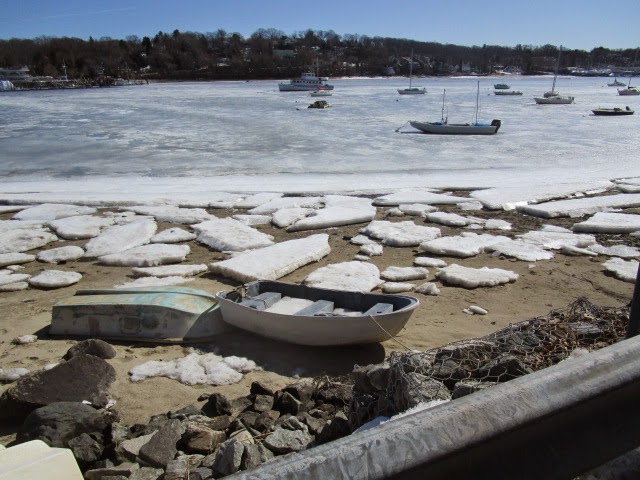
Yes, this represents melting and breakup, but it is late and the ice floats are so thick that boats still cannot punch their way through here nor on any of the other near bays.  No icebreaker has been called, although I did see one frustrated clammer walking out to his boat and attempting to chop a passage out.  A few less hardy boats have been crushed and sunk, only their masts showing through the crust.


One day in the fifties, and the rest deep freeze at night, thirties during the day, and in spite of the best efforts of the sun, winter is taking its time.  A few areas have now opened on the ground where the drifts were lower, and in these I can sometimes see a green or red shoot.  A few birds have come back to the full feeder, but the numbers are less than a tenth of what they seemed to be in January.  Last year there were robins everywhere, and not a sighting so far.  But, on the bright side, no snow has fallen for a week now _ I guess that’s progress.
Sat-


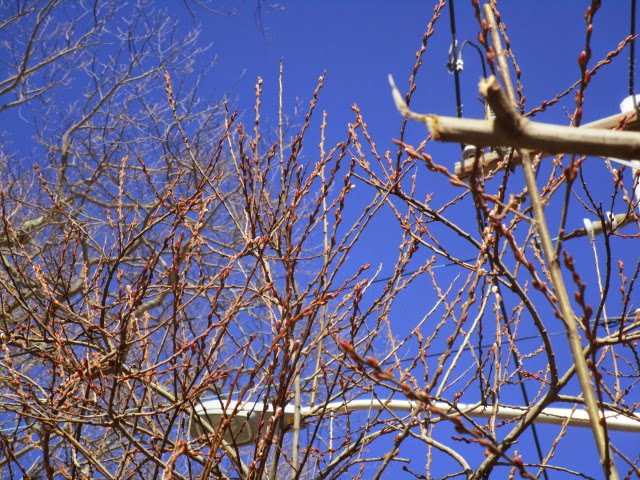
Spring advances here and there, the natural world begin to stir to its mysterious rhythms of duration of daylight, warmth, and internal clock.  High up, the pussy will buds are swelling red, soon to open into soft grey.  Where snow has melted back, there are leftover blades of greenish grass.  I imagine that could I peer beneath the waters alongside me, I would be amazed at the activity.  Lichen is glowing brightly whenever the frequent rains arrive.  If I dared to walk through the still deeply-piled woods and perhaps dig a bit, I would surely find fruiting moss and skunk flowers in bloom.

The trick, I find, is not to keep waiting and hoping for a perfect day, with brilliant sun and no wind and warm air and life just so, but to start by assuming each day is perfect and then find reasons that it is so.  What is, just is, and that is the wonderful and amazing world we are privileged to inhabit for a while. 
Sun-


Fog can be interesting not just for its blurring effects but for the many metaphors our minds manufacture concerning it.  Somehow it can come to represent the future, or the state of our knowledge, or the meaning of our lives.  Once in a while it seems almost evil, hiding what might be threats.  Other times it seems a soft cocoon against the harshness of the outside world.

Fog is also prevalent as seasons and weather patterns change, when warm and cold collide, one way or another.  I find it a useful marker of changes to come, a separation from what was to what will be.  That is my own mind’s metaphor, of course.  One of the deeper questions I can ask about life is whether the fog itself is more real than my perception of it.


Flash Frozen

Mon-

“Relax, you’re here!” goes a local slogan, and “Just another day in paradise.”  Truly the weather has been gorgeous, the green vegetation relaxing, the flowers beautiful.  Logical thinking and planning is banished as the mind concentrates on the possible patterns of randomly breaking surf, the interesting jiggles of various lumps of flesh, the happy laughter of folks of all ages.  The biggest question each day is “what will we eat for dinner?” and the greatest plans involve avoiding painful sunburn or hangover tomorrow.

Shallow Randian conservatives fear such wallowing in lethargy, believing people must be lashed to do great things with striving driven by harsh necessity.  Vacation provides a necessary antidote proving we are also pure animals, with happinesses, experiences, and appreciations that are incomprehensible to words and logic and plans.
Tue-

I sat on the warm balcony and watched the expected sun rise, through clouds, as we prepare to return home tonight.  Tomorrow there will be no balcony, no warm breeze, but certainly a sunrise.  Our lives are filled with expectations we scarcely notice _ the sun will come up, the airplane will get us home, the house will be fine, electricity will be on.  For that matter, an expectation that I will wake up tomorrow to deal with a driveway that has apparently been covered by a developing glacier since we left.

It has been nice, for a while, to let go of the expectations and plans and worries and just take each moment as if there were no other, wasting time watching the water go nowhere, sifting sand through idle fingers.  It will, I suspect, be equally nice to start doing what has to be done once more, with expectation and outcome and consequence.  All part of the balance of things.  Right now, we have a few hours to enjoy so we shall do so.
Tue-


Jets take us thousands of miles in hours, from one climate to another.  Barefoot in the sandy shore in the morning, home to snowbound landscape at midnight, looks like a foot of heavy cover. 


I marvel at the convenience of energy all around and used promiscuously _ the jet, the lights of Ft. Lauderdale under us as we left, the car getting us back from the airport on plowed roads, the house warm and well lit.  I’m too soft to survive as an aborigine, too old to have made it as an Iroquois in this landscape some five hundred years ago, and I am grateful every time I accept the bounty of modern convenience.  I know our usage of resources has consequences, all profound, some unimaginably horrid, but can I stop?  Would I even want to?  And, if I did, what would it accomplish beyond making my life experience immediately miserable?

Wed-

Settled in and with some effort back to normal, when we are hit with another storm.  Beautiful this morning, fresh white on branches.  No doubt more magical to those who have been away from it all for a month.

Only last year did I give in and get a snowblower, reasoning that hiring a guy to plow the driveway had changed economics significantly _ at today’s rates three heavy snowfalls pay for my machine.  I knew I could no longer do it by hand,  the back had begun to hurt a little too much afterward, and massive unusual exercise could become scary itself.  So I join in my little bit of making our neighborhood unlivably noisy.  Guilty _ I actually enjoy using my new toy.
Fri-

Snow just keeps coming _ although a respite is promised soon.  Those who have lived through a month of this are very very tired of it.  The novelty of fresh white on everything can wear off pretty quickly, especially if it makes doing everything else more involved and difficult.  Yes, it’s beautiful, but….

I’m amazed at my adaptability.  Three days ago it seemed normal to watch the sun come up as I sat in pajamas on an outside balcony,  to walk a sandy shore barefoot, to sweat on hot palm-lined streets.  Yesterday seemed normal also as I cleared the driveway of its seven new inches, or this morning as I wandered in down parka to get the morning paper.  It can be almost frightening to become aware of the massive changes I take for granted, day by day and over the years.
Sat-

With the coldest February since 1934, the harbor has frozen significantly.  Old timers insist it is still less solidly blocked then when they were young _ probably the ocean water is much warmer now.  Compared to recent winters, however, this is pretty unusual.

The sun shines brightly now, melting ice even when the temperature is in the teens.  A slight change in wind patterns and the great thaw begins.  Some of spring should be pretty rapid this year _ my mind is certainly ready for it.  Already I anticipate the Andromeda, snowbells, and red leaf shoots.  Running a bit too far into the future, but equinox is only a few weeks off.
Sun-

Sunset and sunrise occur everywhere regardless of climate or season.  If not too obscured, they are always beautiful, even in Siberia or the Sahara, if there is anyone to see (whether anyone will notice is a different matter.)  Cosmic realities are far beyond the trivial worries of whether it is cold or warm.

As all philosophers eventually discover, cosmic truth has little to do with individual daily life.  Whether it is warm or cold does in fact matter a great deal to me, and a lot of other “minor” things too, such as if I am decently fed and happy.  We may try to transcend this mortal shell, but mortal fragile shell it remains, and it reminds us constantly.  I try to remember to pause and appreciate sunset, for it is good to do so, but not at the expense of ignoring the everyday mundane world that I inhabit each moment.