Tidal Rave

Sunday

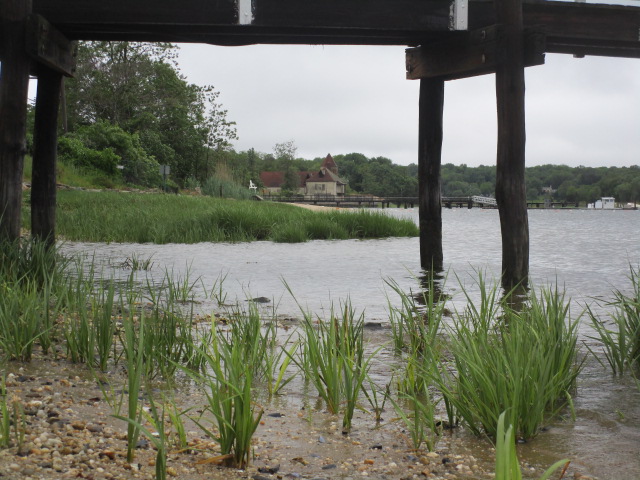
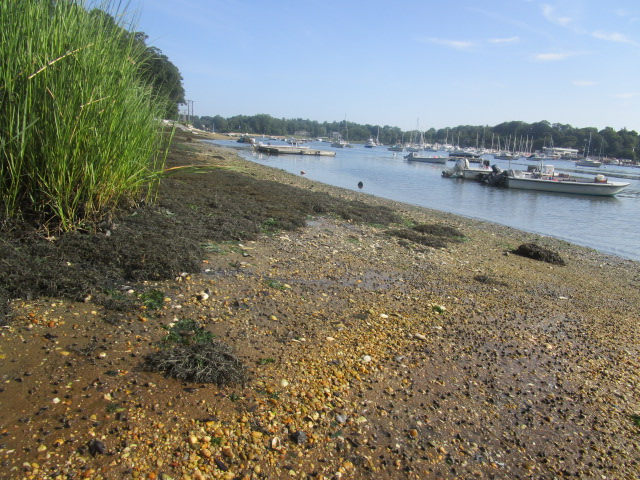
  • For a small harbor, Huntington has widely varied bottoms.  In addition to sand and clay deposits once used for pottery and brickmaking, there are mud flats, and rocks, and grasses and, for that matter, piers and deep water off the various bulkheads and docks.  Nobody goes into the water without some kind of footwear _ not only is the muck unpleasant but there are sharp broken shells, annoying edged rocks, and the detritus of centuries of sunken boats, industrial activity, and shoreline dumping.
  • Being scoured twice a day, the intertidal area is hardly as forbidding as you might think.  Here there are almost pristine pebbles, exposed seaweed, and a closer look would reveal periwinkles, mussels, and clams, abundant even in these polluted times.  Seagulls make a nice living, once upon a time, people did also.

Saturday
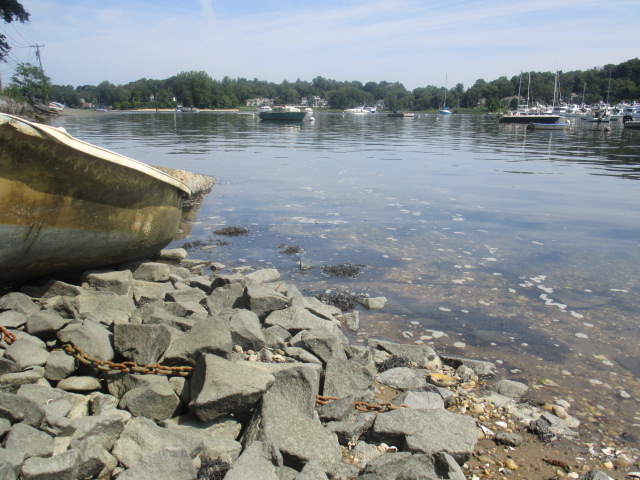
  • A careful observer can easily determine if tide is coming in or going out simply from observing the state of the sands and rivulets nearest the wave line.  Another indicator, under the right conditions, is the brown scum of bubbles caused by air pockets and dried dust floating up as the water rises.  In this case, the bubbles have detached to form little brown patches on the water. 
  • I admit that in this, as in so many other things, I am hardly a careful observer.  Sometimes I see more in my pictures of a scene later than I did at the scene itself.  When I closely examine the rocks here, the stained dinghy, the corroded chain, each seems marvelous in its own way, and would not seem out of place in a modern art gallery somewhere _ especially, I suppose, inland where folks have never seen such things.  Beauty can come in many guises.

Friday
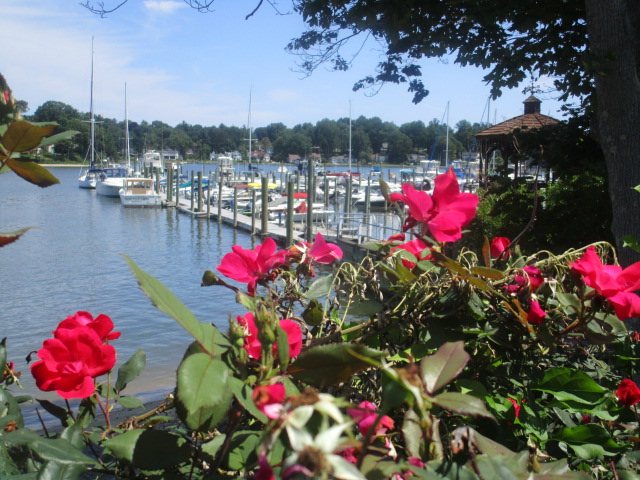
  • Imagine an old gentleman wearing a long robe sitting in this gazeebo and then (if you had the proper temperament and training) you could create a fine Chinese brush painting of this scene.  Working it backwards, this helps you understand the models used for those lovely colored ink on silk works existing since antiquity.  A photograph is hardly better.
  • Life without accomplishment is empty.  To accomplish we must have short and long term goals, plans, tasks and obsessions, which focus us and ignore irrelevancies.  But even artificial constraints, such as the theme I use each week, can blind us to a great deal.  This scene has nothing to do with tides, and has been available each morning, and I have not seen it.  Not a fault, just another contradiction, a zen realization that reality is never truly known.

Thursday
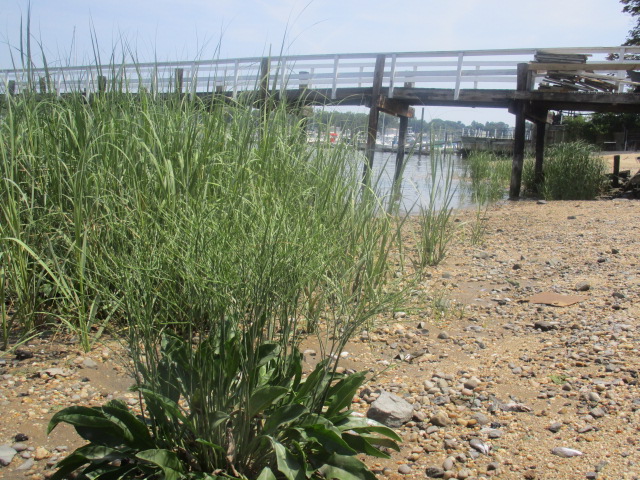
  • The least interesting moments occur mid tide, when bleak sands are revealed and fascinating mudflats still lie hidden.  Full tide is lovely as a lake, low tide is filled with marvels revealed.   Mid tide _ well, this is the actual tidal zone, of course, within the borderlines of all that thrives here, and yet it seems stony and barren and boring. 
  • I cast my moods and judgements like stains upon my experiences, coloring it almost beyond recognition.  I expect clams and crabs and shells and a shipwreck or two _ I find broken bleached ruins.  On another day the same umber sands and sea lavender glow with the brilliance of stained glass.  Mercurial irrelevant perceptions are surely one of the perverse glories of being exactly what I am.  

Wednesday
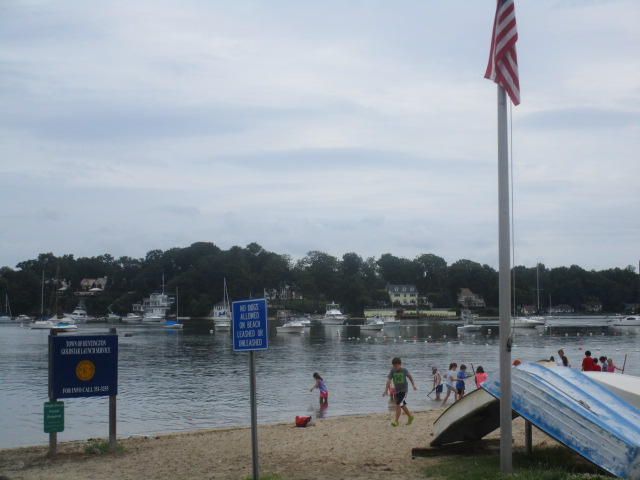
  • Full flood tide at Gold Star Battalion Beach.  People prefer the ocean when it is low _ more beach to share, a greater water area to spread out in, and varied zones of wave intensity.  But at most Huntington beaches, low tide is shunned _ too much flotsam, jetsam, and organic detritus floating in the reduced volume.  Children are sternly warned not to get heads wet, any mishap induces moments of panic.  E. Coli is treated as if it were bubonic plague.
  • Every day many fatal car accidents occur, but we ignore them.  Our ancestors coped with high childhood mortality, women dying frequently in childbirth, death from starvation or wild animals or exposure or incurable contagious diseases always threatening.  Yet today what we most fear are sore throats, upset stomachs, minor diarrhea, or earaches, maybe an infected scratch.  We’ve lost perspective.  I suppose we could learn to exist with such horrors once again, as the unfortunate refugees in the Mideast and elsewhere are doing at this very moment, but I hope it never happens.  Parents worrying about the possibility of earaches is a wonderful sign of civilization working. 

Tuesday
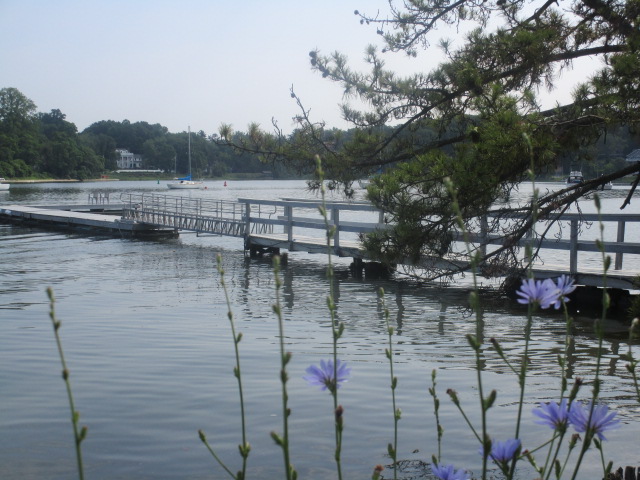
  • Coastal fishing, marine navigation, recreation, and infrastructure depend on tides _ not only high or low, but incoming or ebbing _ which are maddeningly exact.  Almost every six hours the state flips, almost every seven days a given hour will have the opposite tide, a few miles of shoreline severely impact timing, and of course the ocean is _ almost _ the opposite of the Sound.  And all the activities and tide levels themselves are also affected by temperature, local and distant weather, alignment of sun and moon, unpredictable waves, time of day, and season.  For anyone not a professional dealing with it daily, it might as well be completely random.
  • Humans tend to grumble.  Rain on weekends, cold weather on summer vacation, low tide when we want high.  Only those privileged to live along a tidal shoreline for a while can understand how profoundly different it is from a river or lake.  I consider the harbor tides one of the finest attractions of living where I do, even when they upset my plans.

Monday
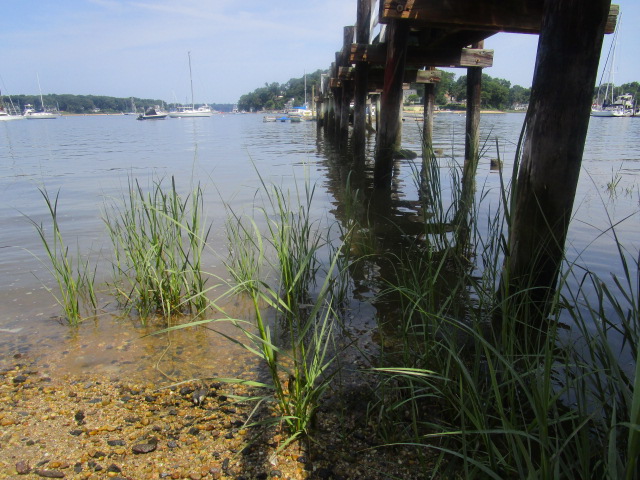
  • Earth’s diameter is just about 8000 miles; the biozone from the top of breathable air to bottom of ocean depths is barely 8,  and for all practical purposes even smaller than that.  Comparisons of density are even worse, since life exists only around the lightest components.  The surface area is a vast 200 million square miles, but of course three quarters of that is water.  The rest is mountains, desert, fields, ice, and forest, with a few lakes thrown in.  The intertidal zone may be locally pervasive, but represents only a thin tiny ribbon along salt water coasts.  In that inconsequentially tiny environment exist immensely rich and diverse ecologies.
  • I think about that when strolling the shoreline.  I too am inconsequential compared to everything, but inhabit what feels like a tremendously rich personal universe.  Life, they say, began in the oceans and had to get through this barrier to start inhabiting the land.  I am more of the fiddler crab type, never venturing into the depths on one side, nor testing the dryness on the other.  Waving a claw at neighbors and running from shadows constitutes quite enough excitement for me. 

Nifty Shades of Green

Sunday

  • This green world is excessively noisy on Saturday mornings.  The din of chain saws, shrub trimmers, lawn mowers, and leaf blowers, intertwined with shouts of crews and rumblings of giant trucks carrying gear, begins at dawn and scarcely lets up until dusk, when the mosquitoes reclaim their territory.  Perhaps that is why there is no one ever sitting in the Adirondack chairs or on porches wrapped around immense houses.  More likely, people who can afford property around here lead busy busy lives with no time to just hang out and enjoy the fruits of their labors.
  • I think the saying “youth is wasted on the young” could be extended to “wealth is wasted on the wealthy.”  A lifetime lived in sloth is wretched indeed.  But a lifetime without long moments of appreciation is a shadow of what we should be.

Saturday

  • It was traditionally hard to paint a convincing mid-range picture of trees, although Ruisdael and Hobbema did so with limited palette.  Distant woods, as here, could be blurred and blued and blotted in with shadows,  close-up foliage could be treated carefully as still life, but capturing the actual experience of trees in-between required the out-of-the-box theories of the Impressionists.  They were able to replace the effect of constant motion and color changes of rustling leaves with dabs of exaggerated complementary colors.
  • I find Pissarro the master for such landscapes.  His canvases scarcely match photographs of the same subjects, but you feel as if you have actually been there looking around.  I have frequently walked out of a museum after hours with the Impressionists to discover the world itself sparkling in ways I never imagined.  It’s strange to realize that plain old dull greens can be treated so garishly and suddenly burst into realistic scenery through the magic of our eyes and brain.    

Friday

  • A trumpet vine hovers over the tidal inlet at West Neck Beach.  Most animals react to the unusual in their environment because that represents either danger or opportunity.  Something orange where all is green and blue, something moving where all is still, or still where all is in motion.  Humans encourage this perhaps to excess, risking overload of the senses.
  • I am always surprised that even as nearsighted as I am, any strange movement attracts my attention.  Naturally, when trying to set up a picture, I am conscious of what might add interest to the landscape.  The obverse of this is how quickly we apply filters and can ignore and dismiss anything that we have already evaluated, which is why I am frequently oblivious to what I have just seen or heard.

Thursday

  • Salt marsh stretches away at high tide in Lloyd Harbor, a haven for egrets and ospreys and lesser birds, fish, crustaceans, insects, grasses, and of course uncountable bacteria, protozoa and other lesser denizens of any open water.  All seems in perfect harmony, a quiet lagoon where everything lives deeply specialized in its own niche.  Moralists of various persuasions offer quaint proverbs and tales trying to show how cooperation, or struggle, or adaptation, or resistance are the cardinal rules of the natural world which society should adopt.  From the time of the earliest fables, however, people have recognized those lessons as entertaining, but false and often irrelevant.
  • We know, as our ancestors did, as every human has ever known, that we are not the same as everything else.  Unique among the complex life forms on the planet, each of us is an expert in being unspecialized and flexible.  The true tale is that if necessary, we could figuratively take the place of anything in the landscape.  You and I might not like it, but we could, and often do, as when we settle into an awful job.  Gloriously alone, you and I are also miraculously able to know what we like, what we don’t, and what might make our experience better.

Wednesday

  • Matisse’ famous painting Luxe Calme et Volupte is named after Baudelaire’s poem “There, all is beauty/ luxury, calm, and voluptuousness.”  Huntington is south of Saint-Tropez, more on the latitude of Naples, but Matisse might have recognized the humid light, if not the verdant overwhelming vegetation.  Certainly William Merritt Chase and his circle demonstrated that impressionism works on Long Island, although nobody would ever describe the LIE _ even during a dead-stop traffic jam _ as calm.
  • I’ve always enjoyed fantasizing about people such as Matisse painting on this hill, or Caesar marching his troops along the shoreline, or some Gibbons of the future sadly musing on the ruins of underwater Huntington.  When technicians speak of artificial intelligence do they assume that means a capacity to experience voluptuousness, or to daydream impossibilities?  We are more than our experiences or logic,  more than pattern matching machines, more than dots on some statistical chart.  You and I are never merely what we accomplish, never simply defined by how others judge us.  I can also
    be, on good days, “luxe calme et volupte.”

Tuesday

  • July weather has become classic summer _ hot, humid, storms possible anytime.  That seems completely normal and unremarkable _ what is usually remembered are extreme events of temperature, precipitation, or wind.  But normal is never guaranteed _ people may look back and sigh “recall that last glorious July of 2015, before the world went mad.” 
  • We hardly ever evaluate what we live through properly _ minor events like an assassination can trigger a world war, a normal business panic can become a decade-long depression, a temporary lack of rain can dry into an epic drought.  Death, taxes, gravity, the sun, yes we can probably count on those, but everything else remains unknowable.  That is why I try to grab happiness as it comes by.  Sometimes that is hard or impossible, but when happiness is available even for moments, I should cherish that impermanent and never certain treasure.

Monday

  • A wily old woodsman could determine a calendar date almost as well as someone with access to a cell phone.  A glance at the crowns of trees, for example, narrows the possible season considerably.  Closer examination of leaves would yield a pretty good guess simply with their state and color.  Tender young growth in the spring is mostly pale and yellowish, tinged with streaks of red, always delicate and clear-cut, often unfurling.  As the summer progresses, every hue darkens as if it becomes suntanned, insect infestation creates holes and ragged gaps, weather and drought turn whole branches brown, and nothing seems to grow at all.  Even without recourse to the state of flowers _ which are of course a dead giveaway for anyone _ trees and shrubs tell a remarkably complete story.
  • What always surprises me is not that such variety of shades of green exist, for I see them easily when I try, but that I so often ignore them totally.  Even when trying to communicate exactly what I perceive, I remain at a loss.  Unless you work for a paint company coming up with luscious descriptions of your wares, or are a struggling writer trying for variety in prose, there is never much reason to go beyond “green.”  We have synonyms and modifiers, but I hardly ever use them in daily speech.  Just another of the grand, unnoticed, fractal wonders of my existence.

Flags & Firecrackers

Sunday

  • Could be a historic old colonial home on the harbor _ well, not really, but it looks the part, and it is patriotically decked out.  What anyone considers history is always relative anyway.  In some places it is anything over fifty years old, in others a thousand.  At the rate of change in most of the world, something saved from last month or last year should get a historic marker and designation.  Modern civilization is perhaps too adapted to novelty.
  • It’s been a hard acceptance that I myself have slid into historic status.  What I remember is as long gone for younger generations as the roads of Rome or the gardens of Babylon.  Was it really like that, they ask amazed, as I once did to my grandparents.  Sometimes that realization is sad, sometimes I’m just grateful I survived through it all, sometimes it seems irrelevant, sometimes it seems the most important element of my life.  One thing constant through it all, and I hope it remains so for a long time, has been fireworks and picnics on the Fourth of July.

Saturday

  • Little flags pop up like mushrooms now.  Maybe it’s a universal human trait. Switch the language on the sign, substitute the national colors of your choice, and this could be anywhere in Europe in the last two centuries.  The whole phenomenon is endearing until it suddenly turns virulent.  A difficult balance.
  • Difficult balance is what life is all about.  Tension between overpopulation and extinction, tension between homeostatic systems like blood pressure and temperature, tension between social freedom and security.  Irresolvable contradictions somehow leading to temporary dynamic situations that manage to continue on.  At this time and place, from my viewpoint, little flags are terrific decoration and symbolic of a mostly good outlook on life.   

Friday

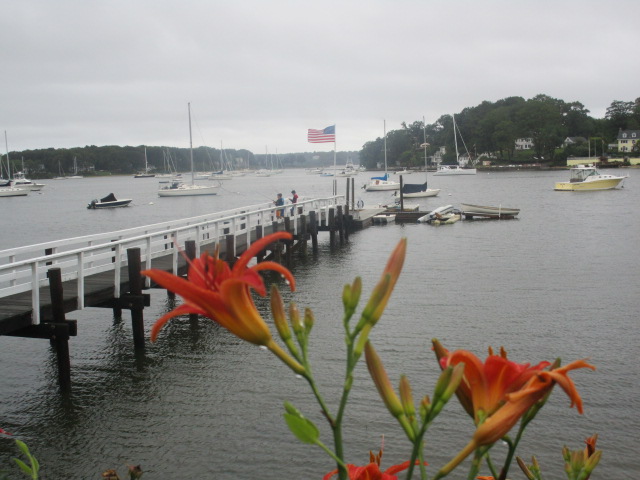
  • Of course, just because the indigenous flowers are less on display does not prevent cultivated varieties from their own ostentatious celebration.  These lilies are in full glory right now, as are many exotic species which most people have added to tiny microenvironments around their house.  It’s amazing how people like to keep their grounds beautiful, even in a culture that rarely prizes beauty in and of itself.  Easier and more rewarding to simply accept that people like to decorate their homes than to worry about the evolutionary or cosmic reasons why that should be so.
  • In some minds, this flower bed would be far better stripped and pulled back into climax forest.  I can’t help but think of those as Luddites,  futilely railing against change.  I would not like these flowers replaced by gloom, ferns, and mosquitoes _ there’s quite enough of that in the Adirondacks and Catskills.  I admire the intense joy emitted by these blooms and others like them, the feeling that others do care greatly about living things, the realization that even during the most rational of barren economic ideologies we engage in pure pointless showmanship because we enjoy it. 

Thursday

  • As this drying dock weed illustrates, grand fireworks of native flowers are pretty much over.  Trees have bloomed, meadows are no long swathed in color.  There will be plenty of isolated flowers and fruits from here on, but everything is racing to grow as quickly as possible.  The world is engulfed in green, except where cultivated in gardens.  Insects have their own rhythms, last night for the first time numerous lightning bugs arose spontaneously from the lawn as twilight deepened.
  • I’ve been privileged over the last few years to be fully engaged in local seasons.  Nature is completely enchanting and fulfilling when we can pay enough attention to it.  Fortunately, I can still be astonished at the perfection of a bee visiting a purple clover, or a dragonfly flitting over a pond, elements which now come into their own until fall once again dictates major change.

Wednesday

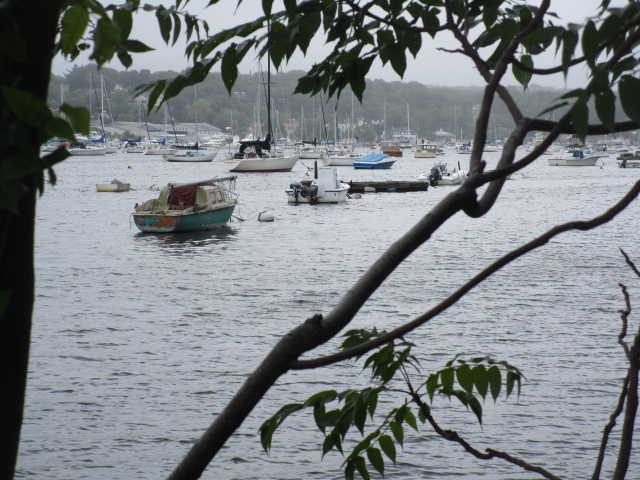
  • Thermometer in the eighties,  fine firm wind, brilliant sky, schools empty, but only a few sails, one big, one small.  In fact, the harbor this late morning is surprisingly empty on the waters, although the sand has quite a crowd.  No matter, a fine, colorful and quiet activity out there, to celebrate being alive and aware.
  • Perhaps everyone else is off worrying about far-away Greece or China,  or equally distant Christmas sales.  More likely, they have decided to wait for next week to declare summer holiday.  In the meantime, a wee bit desperate, I seize on anything I might fit into my definitions, a modern Humpty-Dumpty.   Stretching the definition of flag, perhaps, but colored cloth is colored cloth.  Of course, by that token bathing suits and other apparel should count as well.  

Tuesday

  • Original Impressionists loved to show flags in their landscapes, seascapes, and townscapes.  It was an opportunity to add dashes of pure vibrant colors to their otherwise sparkling but pastel palette.  France was apparently chock full of flag displays at the end of the nineteenth century.  Every summer, Huntington harbor also brightens up with bits of cloth flying everywhere.
  • Sometimes a theme doesn’t work out well.  For some reason, the usual pennants festooning the boats remain in storage this year _ for that matter I’ve only seen one or two sailboats.  Since I can’t very well photograph the firecrackers sounding each evening, and my camera will not capture fireflies or fireworks, finding something to say may tax my inventive powers.  On the other hand, my mouth often outpaces my brain, so all may be well.

Monday

  • Continuing alliteration:  _ first Fourth festivals fizzle.  Watching California and the West in drought, living where the rain falls frequently and plentifully from the sky seems a pretty good deal.  It certainly hasn’t hampered the efforts of these young folks fishing.
  • I welcome clouds, rain, mist, snow, fog as magical costumes on the normally clear and bright landscape.  Perhaps that is just a rationalization, an acceptance of the inevitable, but I honestly like such variation.  Even in this season, when every day is a fabulous holiday different from the one before in almost every way, I find special details such as the drops of rain hanging on the day lilies profoundly entertaining.  I also feel sorry for those who do not have the time, resources, inclination, or wisdom to do so.

From Mountains to Shore

Sunday

  • Pine trees on the beach were severely damaged by the horrific winter, and at least one is dead.  Those that remain are putting out new needles and cones.  Evergreens are easily overlooked amidst the spectacular sparkle and pop of the deciduous trees, shrubs, and flowers.  Green as always, chugging along, unnoticed, quietly taking their place in the background scenery.  As complex a miracle of nature as anything else, the end result of as long a tale of survival and struggle and adaptation as any sunbather down here.
  • Chinese and Japanese painters loved painting pines, sometimes just for the joy of evocation, sometimes as moral lesson, often enduring snow or wind or rain.  I have sometimes seen myself as more of a lonely pine tree just getting through life adequately than as one of the more spectacular vegetative specimens.  There are no “pine lovers shows,” no “best pine in its class” awards.  But I do my job, I try to stay green, and I endure as well as I can.  There is beauty in that approach to life as well, at least so I tell myself.

Saturday

  • Some smaller berries and fruits and many seeds are now in the midst of one of the basic species survival strategies, what  Confederate General Forrest called “fustest with the mostest.”  By making many edibles available early, potential offspring have a chance to be eaten and scattered with excellent chances of staking out the best ground before anything else.  Not coincidentally, many of these are in brilliant colors and attractive shapes.
  • All nature becomes an extravagant cornucopia now.  Yesterday I passed a linden tree that was humming loudly _ turned out to be countless thousands of bees attracted by the strong sweet perfume from the blossoms.  Each day I take ten or so pictures, and there are way too many to use.  Each one different, unique to this exact time of year, illustrating some unusual perspective.  A wonderful time to be aware of nature.

Friday

  • In the Northeast, untended ground immediately reverts to scrub and woodland.  Unfortunately, interesting forest ecologies can take centuries to develop.  Meadows, on the other hand, provide an immediate paradise for an astonishing variety of plants, insects, birds, small mammals and their predators.  They are also human-friendly, providing open views brushed by cooling breezes which keep the mosquitoes and other pests at bay.  However, maintaining a meadow takes time and money.
  • Caumsett State Park provides expanses of meadows in all their mature glory.  Migrating birds find respite, as does anyone overwhelmed by the crowds, traffic and noise only minutes away.  I often find more solitude here than I could in the wilder areas to our north.

Thursday

  • At first glance after a trip to the mountains Huntington Harbor seems an example of humans crowding out nature.  Scenes that only a Manhattan-dweller could consider natural _ boats and houses and roads and cars and people without end, square mile after square mile.  And yet _ the initial impressions are not of houses, but of forested shores and reedy wetlands in the foreground.
  • There are an awful lot of trees right here _ as there even are in Brooklyn.  Moreover, there is more diversity of trees, shrubs, flowers, and landscapes than in the vast but somewhat monotonous vegetative cover upstate.  What I continually forget is how complicated the world really is, how contradictory its various tensions (for example between civilization and wilderness), how impossible it is to have one true conception of its immensity.    Traveling may broaden the mind, but it also deepens understanding.

Wednesday

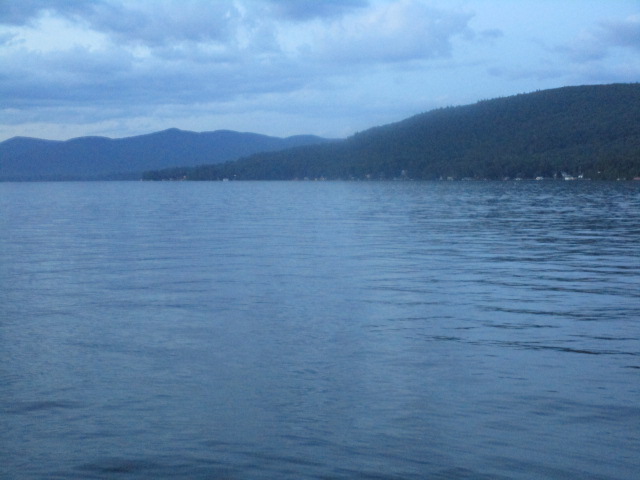
  • At twilight, mountains and lake seem deserted.  Air feels pure, water crystal, only sounds of natural wind and wave.  But, of course, this air and the rainfall it produces are tinged with residual pollution of an entire continent to the west and the industrial machine of China across the vast Pacific.   These forests were logged once, and at least along the shore are heavily developed with vacation homes, hardly virgin.  Isolation is not quite an illusion, but the planet remains interconnected even here.
  • Our generations hold the future in balance.  I am perhaps less active than I should be, but I am not convinced that frantic activity, even in a good cause, is the answer.  I truly believe Thoreau; I honestly feel we must learn to be content to save ourselves and the Earth.  Not to be poor savages, of course, but to learn when better and more are wrong, when it is time to be satiated and say “enough.”   The paradox is that to live such a life as an example is the only effective way to prove the point, but to live such a life is by definition to have almost no external impact.

Tuesday

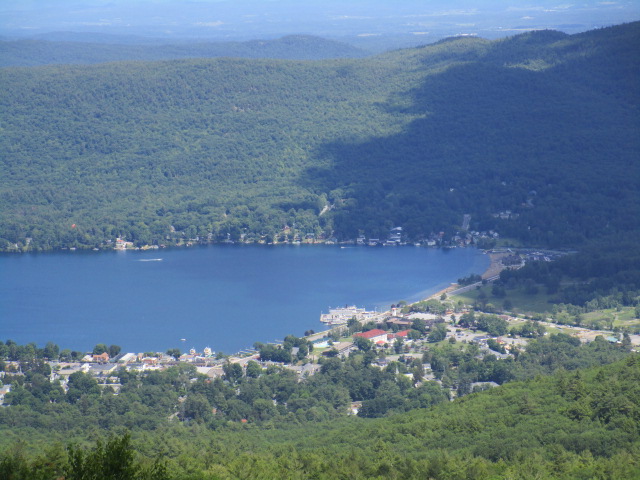
  • People live in these mountains, although in relatively small clusters along highways threaded through the Adirondack wilderness.  Lake George village is larger than most _ obviously because of its lakeshore assets.  The “last of the Mohicans” was fighting here in the French and Indian War a century after the founding of Huntington.  Fort William Henry with its massive timberworks followed a year later, but has never since been important except as a tourist attraction.  Before air conditioning, a trip to the mountains in the summer was something wealthy people could do for a week or a month when they grew tired of the ocean, even building a hotel here on the peak reached by cable railway.
  • What I find here is the past, hardly prettied up.  Farmers settled the bottomlands but the winters and rocks defeated them, loggers tore down the remaining virgin forest and moved on.  Scars and signs of ancient settlement are thick in the dense second-growth forest, now a respectable hundred years old or so.  Towns continue to fall into decay, abandoned buildings aging into picturesque ruins, in spite of attempts at revitalization.  And, in our own family, we spent some summers up here in the eighties when our children were small.  Since that time, seemingly everything away from the interstates has stayed in suspended animation.

Monday

  • No, this is not Huntington.  A long drive upstate is refreshing in a way that a plane ride is not _ one begins to understand the immensity of distance.  Our ancestors and native Americans appreciated the vastness of the continent far more than we do.
  • I try to limit myself locally, and steep wisdom from long contemplation of small and usual things.  But as with any concentration, I tend to see the reality of the entire world though its sharp specialized lens.  It is refreshing to be forced to recognize that my microcosm is only a microcosm.  More than enough for me, infinitesimal compared to the whole.

Solar Midlife Bash

.
Sunday

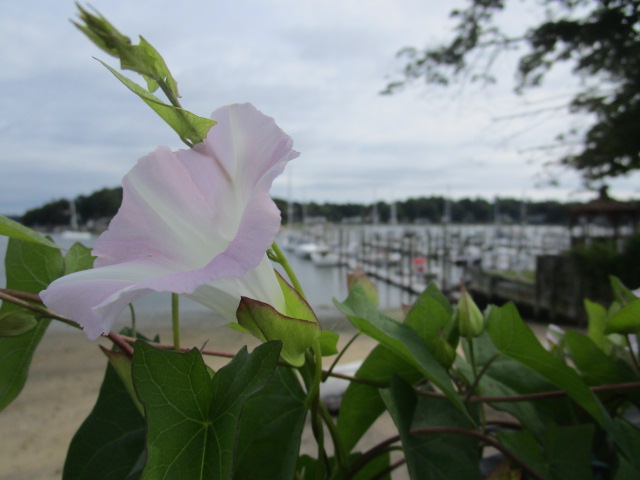
  • Field bindweed has lovely and abundant blooms.  It grows profusely anywhere _ especially gardens.  It can overrun cultivated spaces and plants, choking them out, as kudzu is reported to do in the south.  Pretty much like civilization itself.
  • No matter how much I patrol and pull, bindweed never goes away.  I guess it gets delivered by birds.  It’s like a miniature version of Jack’s beanstalk _ jumping up from nothing to feet long overnight.  Why this, ragweed, and kudzu have not taken over the entire world is a mystery _ but you get more understanding of farmer’s use of herbicides when fighting this more intimate battle.


Saturday

  • Just barely possible to make out light green berries ripening on this cedar tree _ too high up to get a close shot.  Most of the trees are setting fruit by now, using all the extra energy available into trying to start a new generation.   Trees seem to be the most patient of Earth’s inhabitants, but they have to rush along during solstice like everything else.
  • No outside stone alters around here _ at least none that I know of _ and I doubt if any of the neighbors are getting up at five or so in the morning to catch a glimpse of a rising sun.  They’d be disappointed today in any case, because the clouds are thick.  But the exact moment of the sun’s northern apogee is far less important than the fact that it is occurring, and we will be hurtling back again towards the long darkness in another six months.

Friday

  • Cascading flowers bursting like a fireworks finale.  Sun beams benevolently, as it has steadily for billions of years.  Hard to believe this beautiful four-o-clock is a weed.  Harder to believe that it and humans are closely related.  Both species the end products of eons of adaptation, survival, and change.  Closer examination of cell structure and energy cycles yield even more wonders than the external appearance of this marvelous bloom.
  • In my high school, not all that long ago in years but a medieval era in biological knowledge, genetic mapping was in its infancy.   It was even possible to believe in ancient multiple spontaneous generations of life, at least of single-celled organisms.  Today, a miraculously tight web of tensions, patterns, and chromosomal control binds even plants and animals into a single family, with far less differentiation at the lowest and most important levels of cell division and organization than we should reasonably expect.  Life on Earth may or may not be unique in the universe, but there is no remaining doubt that on this planet everything alive is a close cousin, all tied to that sun which for all intents and purposes has remained eternally unchanged, birthday after birthday. 

Thursday

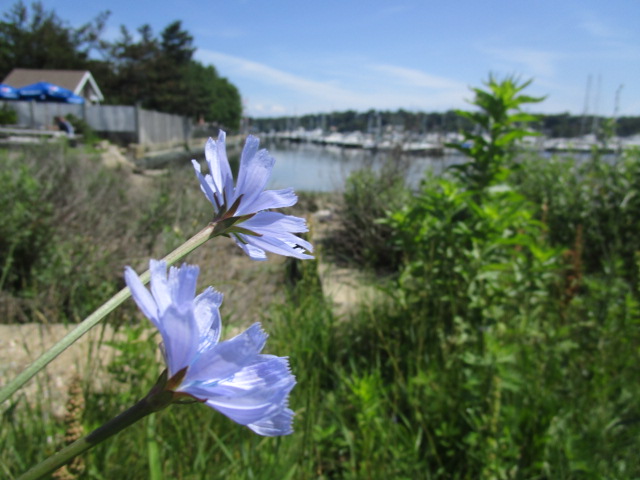
  • Pale blue chicory is a reliable indicator that summer has arrived to stay.  It adjusts to the variations in seasons, and when the blooms finally appear not only is frost gone, but also most chilled evenings and mornings.  The scraggly stems and leaves win no prizes, and it is sometimes hard to understand how a structure so skimpy can support flowers so beautiful.  Blue is a welcome color in a landscape filled with yellow, red, and green.
  • I always had a strong affinity for chicory, a hardy individualistic plant that thrives on the most unpromising soil.  It never grows in massive stands like ragweed, chokes out no other plants, makes do magnificently with what is available.  When an area becomes too fertile and crowded, it moves on.  I think that if I were a plant, I might be like that.

Wednesday

  • For those with fortunate lives, the everyday world seems intensely beautiful.  Nobody can deny pain, worry, fear, and helpless anger.  Loveliness is not a panacea for all cares of the human condition but it can be medicinal.  Ignoring such simple joy to do “more important things” eventually shrivels the soul.
  • I have fallen much into slothful ways as I accept aging.  Throughout my life I tried to appreciate my environment even in the midst of the necessary rush of work and family.  Now there is more time for contemplation, and acceptance that a view like this could hardly be improved. 

Tuesday

  • Clouds, mist, fog, rain, snow _ all aspects of th
    e same phenomenon _ seem to be antagonists of a beautiful day.  They are as much creations of the sun as golden beams on a beach.  Identical viewpoints during such varied conditions may hardly seem related.  An artist could emphasize the beauty in each, maybe increase our appreciation.
  • I once considered art a capture of the extraordinary, but I now realize that its main value is in helping me experience the ordinary.  When meditation quiets my inner voice,  what remains is susceptible to re-enchantment with the world as it exists, not as I imagine it to be.  When art captures my soul, it opens me to what a true miracle a raindrop represents.

Monday

  • As e.e. cummings happily announced, each day is the sun’s birthday.  In the north temperate zone, an environment shared by ancient Druids and current Huntington residents, the annual solar birthday is also crucial.  At summer solstice the mighty golden orb is renewing all life where once winter had triggered dormancy awaiting the hopeful return of the lifegiver.  In that respect, this is a midlife party, when one is full of directed energy and authority, not yet tinged with possible diminishment,  a time for cheering and celebration and belief that the status quo  can continue nearly forever.
  • For many years, I adhered to our technical schedules of school and business _ relative calm in the summer, dreams and plans in the fall,  heads down work in winter, and feverish reevaluation and attempts to complete tasks in the spring _ almost the opposite of the cycle of our farming ancestors, but perhaps more in tune with that of even more ancient hunter-gatherers.

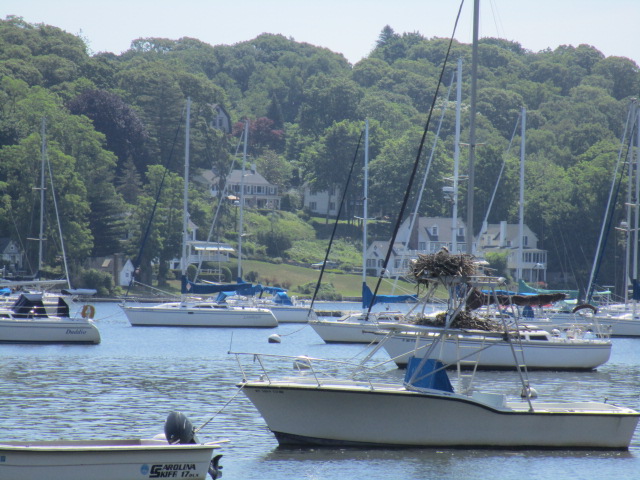
As a nature bonus today, I include an (amateurish) quick shot of an osprey nest newly constructed on a boat in the harbor, and also a link to whales sighted around here memorial day ( http://patch.com/new-york/huntington/beluga-whales-spend-memorial-day-huntington-harbor-0) .  Whether these are oddities or harbingers has yet to be determined.

Primed!

.Sunday

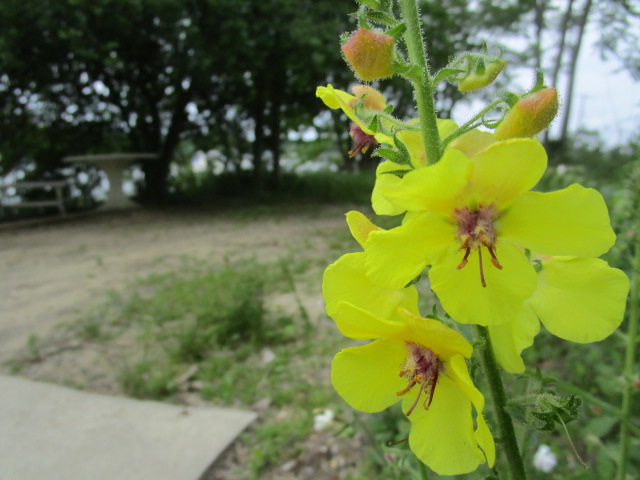
  • Low growing small yellow wildflowers spring up in an almost unused patch of nasty dirt, on which more cultivated plants would wither and die.  On the other hand, these are never found invading gardens and lawns.  There must be all kinds of useful lessons in that, but they have all been twice-told, and in any case are always less true than complex reality.  Modern minds wish there to be clear rules and logical reasons,   but the cruel fact is that often the universe is ruled by luck and happenstance as much as by grand organizing forces.  That is especially true for life, in all its manifestations.
  • My views have evolved to believe that importance is in the details.  It is the particulars of this or that plant _ not the species but the individual plant _ that meaning comes into play.  That is true of all life, and all people, and even my daily thoughts and actions.  Our tendency is to think grand symphonies, while forgetting the individual notes of which they are composed.  Tiny forgotten and overlooked patches of beauty like this should be a reminder to consider elements, tensions, and contradictions just as much as selected items that confirm our desire for order.

Saturday

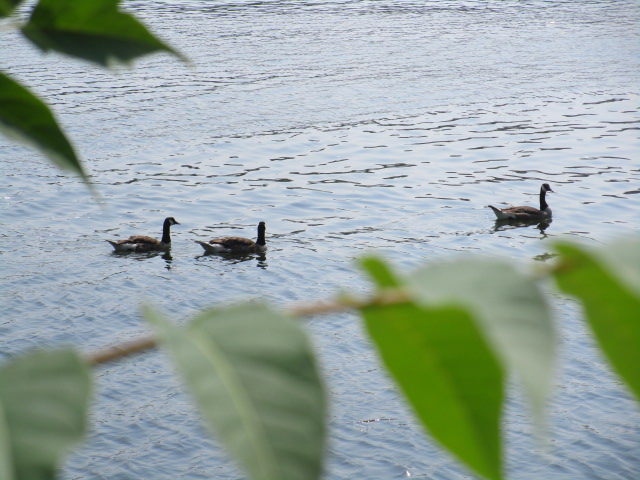
  • Like shoppers in a mall, geese more or less aimlessly form into impromptu lines and paddle hither and yon.  With all the tender new growth everywhere, it must be a fine time to be an avian vegetarian.  Nature in full bounty, plenty for everyone, no worries.
  • Geese and squirrels comfort me, simply because it is fun to see such placid and playful creatures somehow surviving in the middle of everything, bringing a bit of wilderness to city and suburb.  Although sometimes annoying, neither of the species approaches the difficulty I’ve had with raccoons, rabbits, or deer, for example, or that some are encountering now with coyotes, foxes, and bears.  They are a constant reminder that we still share the planet, and should strive to keep it so. 

Friday

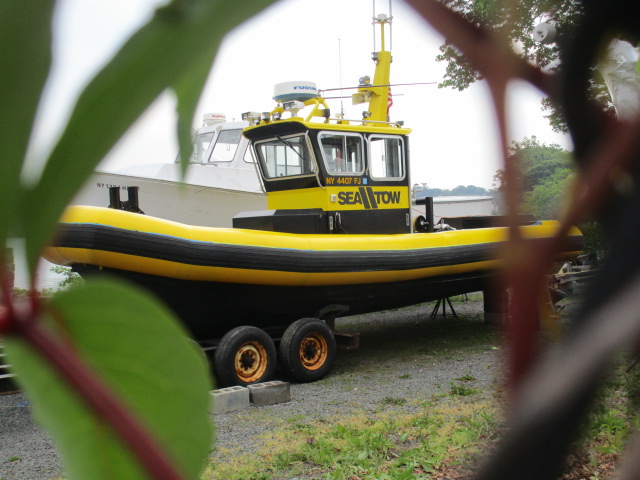
  • Seatow looks like a child’s storybook caricature of a brave little tugboat.   Its primary duty is to retrieve boats _ often sailboats _ whose motors have failed.  Like most leisure activities, using the wind for motive power is fun as long as you don’t have to get anywhere in particular in a hurry.  Used to be stranded mariners would have to wave, holler, shoot off flares, or hoist appropriate flags to hail a rescue.  Now getting help is as easy as ordering a pizza.
  • When we first moved here, everyone said I would soon be bitten by the “boat bug,” but so far I have proved immune.  I don’t mind a few hours every year or so on a big ship like a ferry.  Generally, I regard nautical trips much as I do golf _ “a good walk wasted” _ without even having “a good walk.”

Thursday

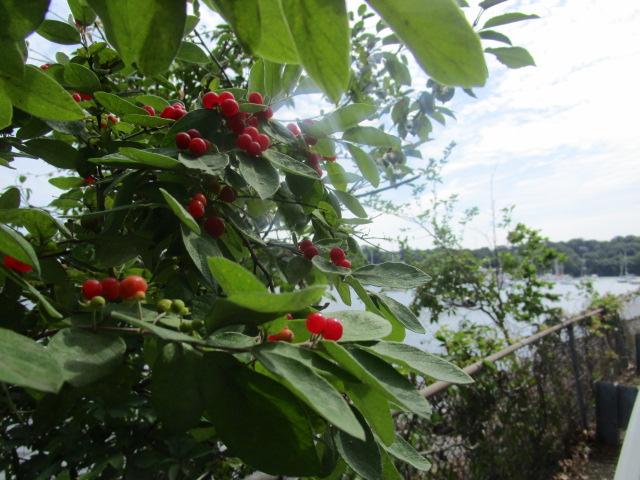
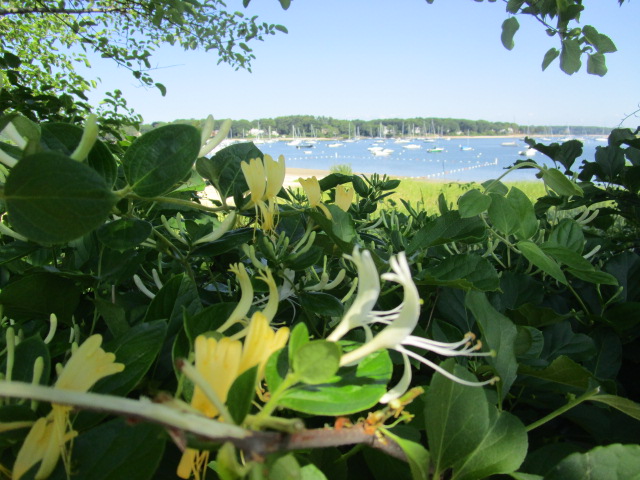
  • On certain calm days, an unsuspecting passer-by may be awakened from reverie by an odor.  The dense sweet perfume of honeysuckle thickly clustering on hedges and fences is unmistakable.  It joins other subtle background odors from vegetation and salt tang of the tides.  Not all scents are pleasant _ car exhaust,  exposed mud flats, decaying fish die-offs, or bags of clams inexplicably set by the side of the road during high heat.  All form part of the unconscious fabric of existence to certify that we are awake and not dreaming.
  • My sense of smell is woefully worse than that of my wife; I taste less accordingly.  But even I was brought up short by this pleasant cloud emanating from otherwise subtle flowers.  Along the breezy harbor, such olfactory intensity is rare, since any concentrations are usually rapidly dispersed by a strong clean wind fresh off the sound.  I strive to remember that not all of what I experience is sight and sound, not all of who I am is logic and words.

Wednesday

  • Wonderful new blooms appear each day.  This catalpa blossom, by itself, would probably win prizes at some winter shows.  But it arrives in clusters, often high up, and kind of disappears into a general impression of a big tree with white flowers.  Only by pausing and looking intently is full beauty revealed.
  • Of necessity, I used to rush around as much as anyone else.  Ours is a culture which rewards activity and I spent much of my life half-blinded watching goals.  I do not regard that as a waste, just a different period, and I am now fortunate to be able to spend more time in appreciation.  I admit that my body and hormones are also less likely to rebel during meditation (or even demand it), possibly to the good, but good or bad a fact to which I must adapt.

Tuesday

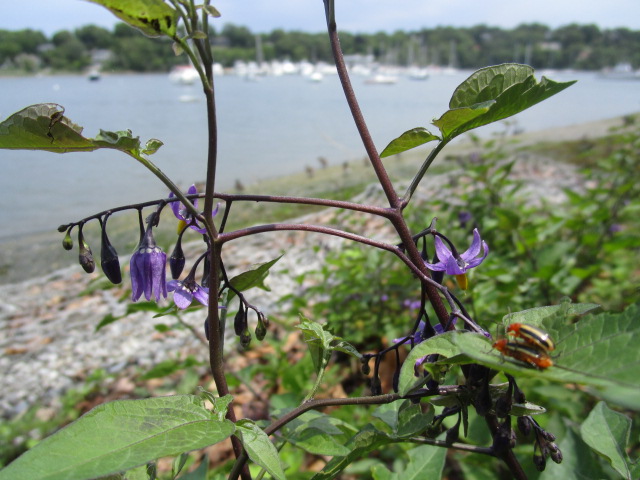
  • Most folks drive along this road around forty miles an hour, concerned primarily with not hitting other people, going off the rails, or running into parked cars.  Some even slow down a bit to take in the view.  Even pedestrians are often so wrapped up in inner clamor that they merely scan the horizon, enjoy vessels bobbing on the waves, once in a while take a picture of some striking panorama.  But few take any moments to study the infinite small miracles of which this is all composed.  Such as this lovely nightshade plant, with its intricate flowers of purple and gold ready to start becoming brilliant red berries.  Or the two beetles going at it desperately on a leaf, unaware of the prying camera.
  • I try to be aware of small details, but of course that is impossible and overwhelming and, in the end, just as futile as ignoring them altogether.  I want to gaze on the panoramas too.  And I have my own tumultuous inner thoughts _ such as thinking about what I may write here _ threatening always to drown out my immediate perceptions.  Life and consciousness are complicated and marvelous and only when I start taking any of it for granted am I truly becoming lost. 

Monday

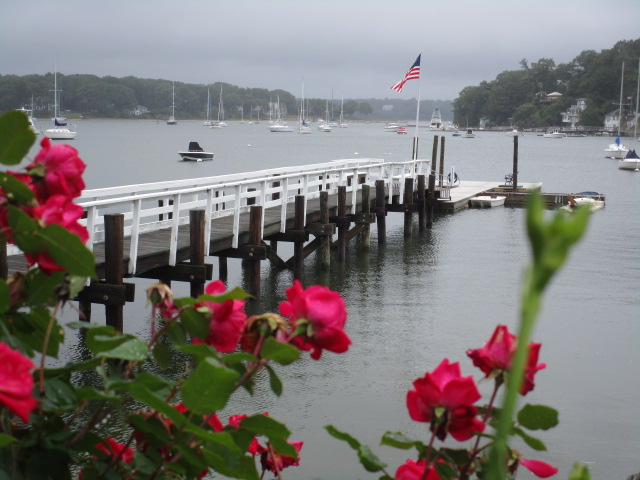
  • The rose family is blooming profusely, boats float densely, people anxiously enjoy a perfect day here or there.  Each season in the Northeast year by year is a little different, some with more or less rain, more or less cold, more or less cloud cover.  This one has been pretty cool and quite dry.  But more and more, everything is ready and primed for use as solstice and the Fourth of July loom.  Soon vacations will explode, beaches will be packed, sails will unfurl, schools will empty, businesses will slip into semi-dormancy.  Even in a 24×7 world, old customs die hard.
  • I’m as impatient as the next guy.  Where are the hot days, when will the water warm up?  I try to be in tune with the seasons, but seasons have their own varying rhythm and I rush ahead.  A cold damp day now, for example, would have been a welcome blast of heat back in February.  But my expectations are already slipping into late July, while the meteorology acts like early May.

The Right Stuff

Sunday

  • Full display of Darwinian struggle as each plant tries to grab moisture, nutrients, sunlight and outgrow the others lest it be left to wither and die.  “Survival of the fittest” obviously, “nature red in tooth and claw” viciously competing,.  But natural selection does not occur in one afternoon, survival strategies are annual, seasonal, and extremely specialized.  Perennials like the reeds and roses have their own clocks, annuals like the ragweed and grass have others, and flowers on roses or clovers are timed with precision to become pollinated and produce fruits at different times to avoid some of the crush.  Tolerating variety, thus avoiding the diseases and insect plagues that infest monocultures, is a more subtle way to make it to another generation but sometimes more effective than wiping out all competition.
  • My peers and I were taught that the mission of science was to simplify and find basic laws and causes, and in that we usually made assumptions that went way too far.  The cheetah chasing two gazelles on the plains _ obviously the survivor will be the swiftest.  Nature, we thought, will perfect simply to swifter and swifter until an ideal form is reached.   If that were true, birds would rule the world.   Humans, we thought, would perfect to smarter and smarter. Environments and niche survival is complicated and messy.  We are finally understanding our own avoidance of niche environmental traps is also complicated and messy, and potentially species-endangering.  It remains an open question whether intelligence as we know it can be harnessed for more than a few thousand years without self-destruction.

Saturday

  • By now, everything that can be growing is doing so, exposing the casualties of a difficult winter.  This beach rose is a reminder that even with all the right stuff _ sun, air, water, nutrients, warmth _ nothing much happens without what used to be called the “vital force.”  Back in the days of Galvani and Frankenstein, biologists confidently predicted that by adding just the right electric spark to just the right assortment of chemicals life could be spontaneously generated.  That has proved not to be the case, in spite of many experiments.  Nor can the force be transferred from a living organism to a dead one _ nothing will bring this bush back to life.
  • Back when I went to school, scientists were also confident that they had nearly cracked the deep mysteries of the universe, at the final layer of quarks and leptons.  Developments in quantum mechanics, chaos theory, and fundamental structures of reality have shaken that belief.  It may be that some levels of our reality are truly unknowable, unpredictable, and uncontrollable.  I wonder if “life force” will not turn out to be as elusive as dark energy, phantom strings, and entropic time itself.

Friday

  • Weeds seem to get by with very little.  No nutrients, no water, blasting sun or deepest shade, they are always present and almost always doing very well.  It helps that anything that lives under such adverse conditions is usually just labeled a weed without regard to particulars.  After the next war, probably the only life left to live (and thrive) on Earth will be bacteria, cockroaches, and ragweed.
  • Weeds always seem prototypical Americans.  Industrious, hardy, colonizing, forcing out whatever might have been there first, smothering landscapes in a monotonous blanket of conformity.  I have to admire them for their grit and pluck and immense survival skills.  On the other hand, I regret the niches and odd wonders that are obliterated in their triumphant progression.

Thursday

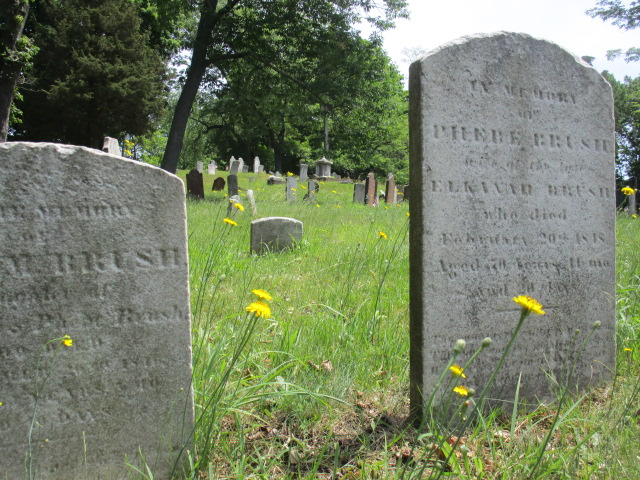
  • Trees, hawkweeds, myriad grasses growing robustly in Huntington Historic Cemetery.  Tablets with names, dates, and bits of wisdom or advice are scattered about in pale echo of Ozymandias, with hopes that loved ones and posterity would remember or care.  One true legacy of those who “rest” here, of course, is the nutrients returned to the soil so the cycle of life can refresh and renew.  Another is providing a place of repose for the weary traveler, who can quietly contemplate vanity and mortality.
  • Daily papers claim retiring baby boomers desire to “leave the world a better place.”  Since nobody agrees on the meaning of “better” in such a context, what is really meant is that old people want to stay in control as they age and after they die.  I wish such egotistic popinjays would gracefully step aside, but as has ever been true, only death itself can allow the world to become whatever it will be. 

Wednesday

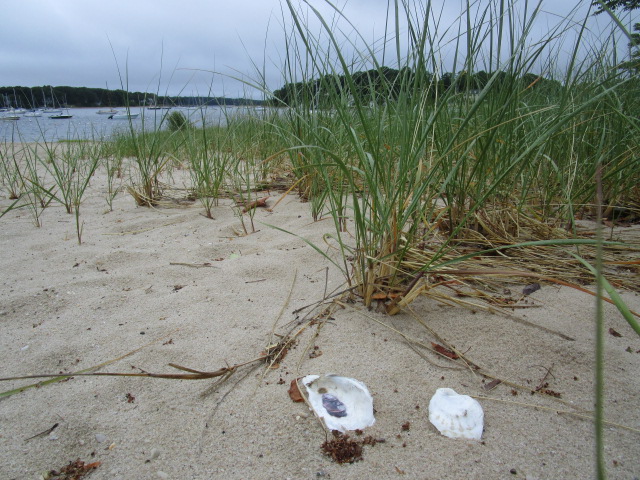
  • Dune grass colonizing a bit of beach away from bathers and children.  In this it is helped by a developing symbiosis with poison ivy, which keeps humans out far more effectively than signs.  Although there seems to be scant moisture available, constant seepage from underground streams along this shore provides dampness most of the year for thirsty roots.  The oyster shells were probably deposited by a feasting gull after being dropped and cracked open
    on a rock, pavement, or unlucky car in the parking lot.
  • I believe we need to preserve vast wilderness and semi-wilderness for the health of our planet and biosphere.  But I do not wish to live near nor visit such reserves.  But in the more civilized and tame surroundings I prefer, I love these inconsequential intrusions of uncultivated nature.  There is a lot to learn, and even more on which to spiritually center, by observing dune grass, gulls, oyster shells, and poison ivy.   Our place and meaning intertwines with theirs, and I do well to reflect on such things deeply and often.

Tuesday

  • Spartina has not suffered from lack of water this spring.  Grasses are probably the most numerous flowering plants in any environment except rainforests and open water.  It’s easy to ignore them, but each has its own beauty and niche.
  • I read once in a gardening book that the most permanent thing anyone will ever plant is a lawn, which may be around for centuries, unlike most trees and shrubs.  A single blade of grass is fragile, just like an individual human (in spite of Robinson Crusoe.)  But a clump of grass is as tough as a tribe, a meadow nearly as indestructible as a civilization.  I wonder if we should not consider ourselves more a bit of a lawn than masters of the universe. 

Monday

  • For some time now, there has been abundant sunshine and warmer temperatures.  The missing ingredient has been moisture, which finally arrived last night with storms and a cold front, although more is needed to saturate the parched soil.  These ferns and other non-flowering plants will appreciate it.  For all the annuals from here on it is a sprint to solstice, taking advantage of maximum solar energy, building incredible vegetative structures from water and trace minerals and the atmospheric carbon dioxide.  Within weeks meadows will be in extreme bloom and insects too will explode into the sudden bounty. 
  • Perversely, I am already taking this all for granted.  The world is completely green _ well, it was so yesterday.  What’s new?  The dark brown winter and glaring cold snow cover is forgotten.  I’m already seeking novelty _ bright flowers, exciting sunsets, people’s vacation activities.  There are fine advantages to living in the moment, but there is also a dangerous shallowness to perceptions.  I try to balance and remember and meditate more deeply, but I find myself also seduced to a quicker pulse by the long days and soothing warm breeze and even gentle rainfall.

Prepping Summer

Sunday

  • Boats stored ashore have been launched, leaving open lots at this marina.  Seeking to capitalize on a new worldwide craze, a “stand up paddle” enterprise has opened here the last few summers, renting out the necessary equipment for this sedate activity.  But those stuck on land waiting for customers don’t want to be too bored, so they have set themselves a little barbecue and picnic area behind the marina headquarters, where they will sit and talk and listen to music in the breezy afternoons.  Right now, the water is still a bit too frigid, but that will change in a few weeks.
  • All along the roadside, and up and down our neighborhood, cars line streets as college graduation and high school reunion parties get into full swing.  We have to drive carefully to avoid strangers walking around, some of them confused from the beer in hand.  Happy times for the young, optimistically looking forward to a life as long and beautiful as the next months are sure to be.  Happy times for the elderly, who have survived another harsh winter and whose joints have begun to ache a bit less.  Sun shines, perfect warmth, life is good.   

Saturday

  • The Harbor Boat Club house perches high on a hill over vast docks and waterfront area.  It’s all spiffed up for the coming season, as are the nautical appendages.  Soon the hill will be full of parties and people, as the peak time of graduation, weddings, and other celebrations arrive.  But now it sits often empty, ready but in suspense.
  • Back in the fifties, before this area was so metropolitan, my wife’s cousin’s family rented this house and grew up there.  There were dolphins swimming the waters, and baymen making a living with shellfish and lobster, and an occasional fuel barge delivering oil to the head of harbor.  And lots of open lands around the water, where her brothers could camp out on fine summery evenings.  I never saw that, but I viewed my own scenes that are no more.  I cannot imagine what will be here come another sixty years, but if people survive there will probably still be beach houses and parties.

Friday

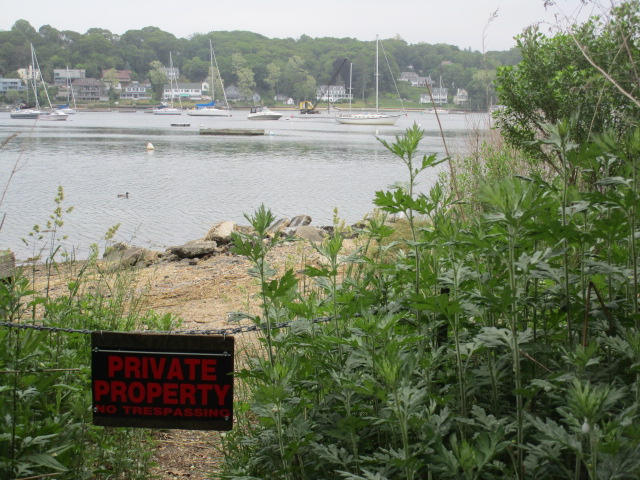
  • For some folks, getting ready for summer involves posting signs telling other people to stay away.  This desolate point of sand has been used for decades by occasional fishermen, and nothing else.  But it is jealously guarded by the same family that claims, based on original deeds wrenched from native Americans, that they own the entire shoreline and roadbed, even though it has been a public thoroughfare for centuries.
  • Perhaps it is descendants terrified that they might have to work for a living instead of being supported by the deeds of their ancestors.  Maybe it is the work of lawyers who warn of lawsuits should someone slip into the water and catch a cold (much too shallow to drown.)  Probably it is simply selfish misanthropes enraged at the possibility that someone might be enjoying for free what they could make a buck on.  In the far future, similarly handicapped descendants of the first moon colonists will no doubt be trying to collect royalties  from anyone looking up at the sky, and a percentage of any energy generated by the tides.

Thursday

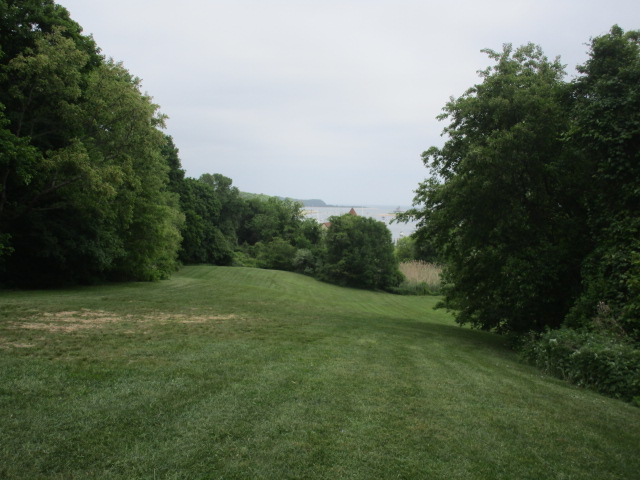
  • Freshly mowed lawn invitingly spread at Coindre.  Long Island sound beckons off in the mist, trees are majestically verdant, visitors have been thinned by the noisy operations of the riding mowers.  Public parks are a wonderful antidote against libertarian capitalistic dogma.  In this case, it took the bankruptcy of the original magnate followed by the eventual bankruptcy of the catholic school that bought it at distress prices to have it eventually fall into the hands of the county.  But who would seriously claim that the community has lost freedom by this, or that the incentive of the selfish has been thwarted by having such a jewel available to all?
  • Often unnoticed until budgets become onerous, parks do demand upkeep.  Without mowing, these fields would be far less inviting, the view far less beautiful.  I accept my part of that expense, here and elsewhere, grateful that so many people can use it.  Yet I also realize that in another small way, we pollute the planet with exhaust fumes; in another small way we waste money that might be better spent.  Nothing in real life is as uncomplicated as presented in books, or pamphlets, or the screechings of demagogues anxious to take their place at the public trough.

Wednesday

  • Enough boats and nautical power in this one marina to defeat Xerxes, and probably to give Admiral Nelson a pretty hard time.  Yet this navy, having no commercial nor military purpose, remains mostly docked.  The amount of money this culture can spend on frivolous leisure activities is staggering.  But certainly, boats to have a good time are somehow better than the same number ready to kill enemies, or even than this fleet being required for livelihood with fisherman working hard and unforgiving seas every day. 
  • I am stunned by the wealth and power displayed.  I overlay, in my mind, the last four hundred years, and see the changes rushing onward and over everything.  More particularly, I am aware of the last fifty, even the last quarter century, when what was a sleepy bedroom hamlet of New York transformed into a crowded manicured suburb.  Like many of my aging peers, I regret what has been lost.  Like them also, I try to accept the changes in good grace and weave them into the fabric of my worldview.   The owners of these vessels do not care and surely have their own worries.

Tuesday

  • Locust blossoms whip about in a strong breeze, partially obscuring the working dock in the Mill Dam race.  Around two hundred years ago this was a busy spot with the tidal mill grinding grain from area farms, and shipping loading and unloading from the sail-powered boats in the harbor.   A working dock is just a floating raft with a couple of outboard motors bolted on _ this one has a hoist to take care of buoys.  Not really pretty,  nor for that matter, the canal itself.
  • I enjoy these forgotten industrial back areas, which occur everywhere.  Neglected, repurposed, fallen into ruin, they have a more gritty charm than when cleaned up and sanitized.  They always remind me of the hidden corners of my own mind _ anger, frustration, fear, envy, boredom, all the sins.  I’m a bit ashamed of them, aware of their ugliness, but I also know that without them I would be insipid and less complex and hardy than I am.  Areas where the industrial tasks of experiencing life can be performed, often out of sight, always necessary.

Monday

  • Memorial Day jam to get boats in the water and begin summer.  The next month is filled with frantic, often anticipatory, activity.  The weather is still iffy, children remain in school another month, work goes on at full pace for most.  College students are home and often taking up temporary jobs.  But people grasp weekends, workers map vacations, children (and teachers) dream of extended days off, employers plan on being shorthanded.  Everyone and everything is geared to the fine months to come.
  • Retirement has provided me the leisure to avoid most such preparation, because the important day is now.  Do I deserve such good fortune?  Of course not _ people hardly ever deserve credit nor blame for what happens to them.  I will take credit for having the opportunity to explore my world and taking advantage of it.  On such terms, this period of my life is an ongoing incredible gift.

Greenery

Sunday

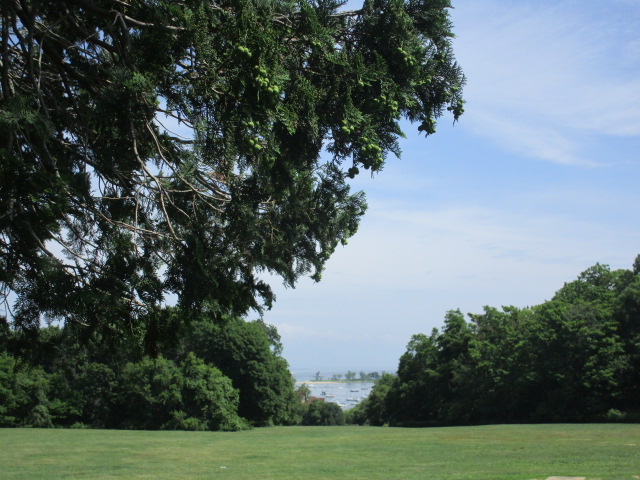
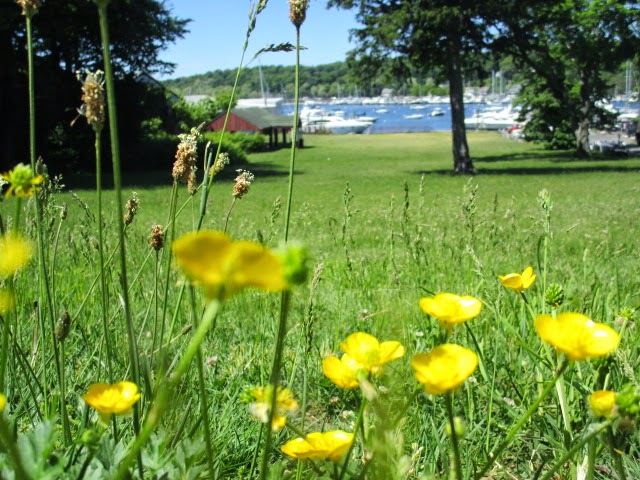
  • Summery view over the meadow at the Halesite park on the site of the ancient pottery works.  This is a tiny, neglected, overlooked bit of open land, although a shot like this makes it seem larger than it is.  Buttercups add a note of festivity which will be temporarily removed with the next mowing.  A few large trees have been lost here to storm and age over the last few years; surprisingly that has improved the  vista.
  • I try not to get too cute about novelty angles like this, which required lying in the grass (thus, I have been informed, risking my life by exposing it to ticks.)  Likewise, I try to come up with some at least slightly different thought each day.  Surprisingly, neither of these tasks is so difficult as it seems.  Any moment at any place in the world is too much for us to comprehend and contains all the novelty anyone would ever need.  Even more so my mind, unbounded by time and with fantasies that escape the realm of the physical cosmos altogether.

Saturday

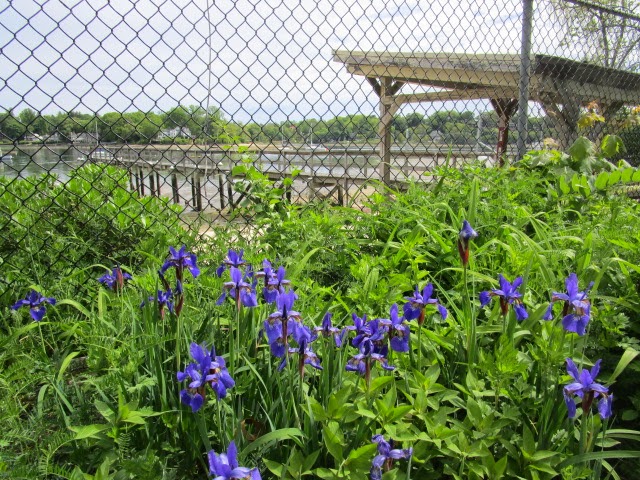
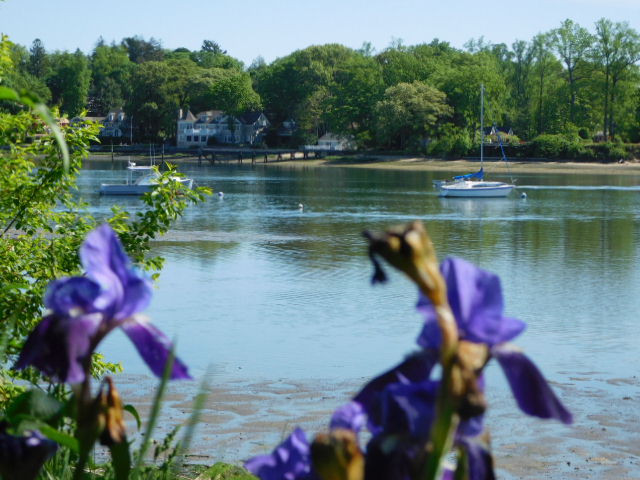
  • Blue Irises in a roadside garden lovingly attended by a private beach club.  But this is not nature, claim purists.  Yet neither are the dock, nor shelter, nor chain link fence, nor, for that matter, the road from which this picture is taken.  Maybe the division is wrong _ people are, after all, part of nature too.  What they carefully tend and present, however out of place in a strict nativist ecological sense, is just as natural as a meadow cleared by lightning strike, or ponds created by beavers.
  • Anyway, it is completely idiotic to present Huntington as an area seeking to preserve its native rural character.  Not only is it far more urban than rural _ with thick population, wires everywhere, gas and water lines under the ubiquitous roads _ but “rural farms” themselves resulted from clearing native forests for crops.  I am grateful that people make efforts to beautify even tiny bits of ground for the enjoyment of us all.

Friday

  • Wisteria covers a tree by the old mill pond at Cold Spring Harbor.  The inlet is behind the camera, this is just about the exact spot that in the early 1900’s marked the division between the town and dock areas and the upscale “Casino” hotels and estates along the shoreline.  Well-off people would come out from New York City by steam train or steamer boat for a day trip or weekend to taste some of the glory of the “Gold Coast” in its prime.  All gone now, as are many things from that era.
  • Wisteria is hardly subtle, often blanketing huge trees in clusters of light purple blossoms, but somehow it is easy to miss in the foliage as I go by.  It takes an effort to appreciate, and I admit my picture does it no justice.  Another example of how I need to sometimes slow down and look hard to see what’s really there.  T’would be a sin to take all this wonder for granted, and assume there is something better right over the next hill.

Thursday

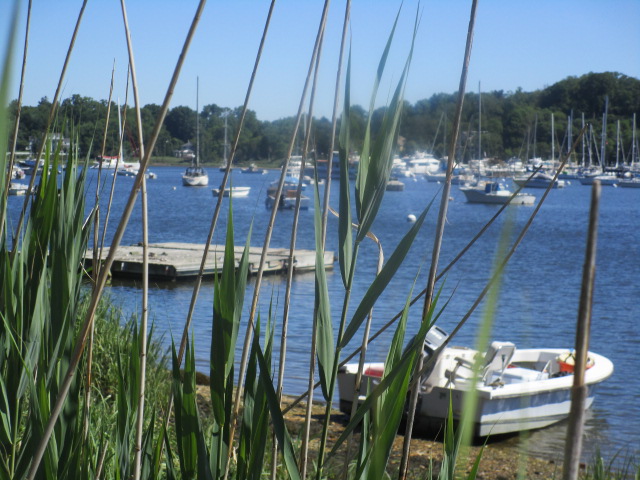
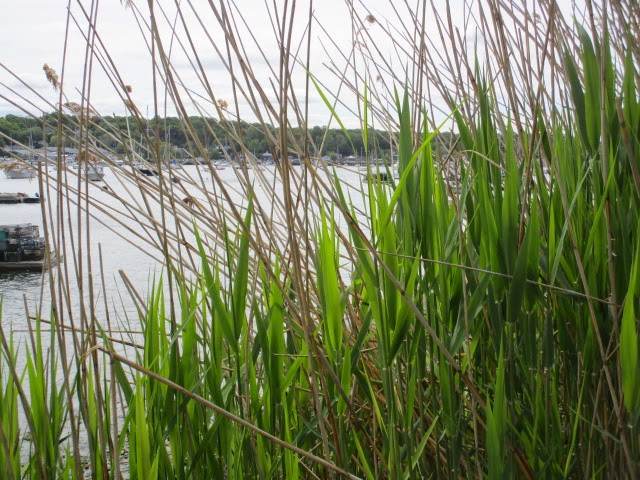
  • Out with the old, in with the new!  Fresh reeds have almost replaced the brown ones, which have withstood all the ravages of winter and spring storms so well.  Now broken brown stalks line parts of the harbor in thick mats, gradually decaying away to floating detritus, muck, and probably food for some aquatic creatures.  That is the way of life, that even the strongest go away, and younger take the stage.
  • This is easy to accept intellectually, and even beautiful to see in action, but it also cuts deeply as I myself age.  In spite of philosophy and rationalization, I regret loss of my young man full of promise and my middle-aged man filled with purpose and importance.  I was strong, I survived the storms, I am still here brown and stiff _ but the younger green shoots are all around and soon will take over completely.  Spring, as well as autumn, has lessons in mortality and humility.

Wednesday

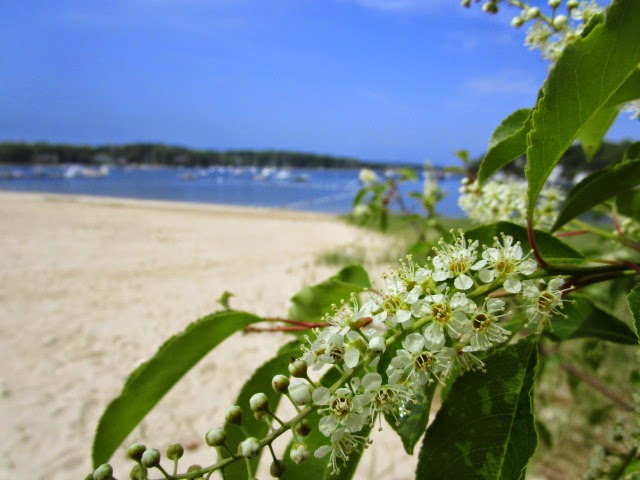
  • This weekend kicks off the bureaucratic start of summer, when fees are collected at parks and beaches.  Lifeguards will be on duty, the buoys for swimming are already out, although the water is far too cold for all but the most hardy.  These chokecherry trees will be ignored by the crowds rushing onto the sands for some sun and open views.  Most of the boats will be taken on their inaugural seasonal voyage, even if it only amounts to a mile or so.
  • Meanwhile, plants have taken advantage of the warm turn of weather to expand aggressively.  Every day, ragweed seems to have jumped another foot.  Weeds spring up in our garden and suddenly cover newly planted flowers.  Shaggy shrubs need trimming.  I’m sure if there were man-eating flora around, it would be claiming its first victims.  

Tuesday

  • Seems early for beach roses, but they bloom as they will.  All of a sudden transformations are staggering, one succession following another, waves of blooms fading away into fruit.  Not enough time to really appreciate the cherries _ they are long gone.  The azalea blooms fall massively in downpours, but rhododendrons are stepping up with even larger flowers.
  • I want to tell it to all slow down, give me some time to enjoy each bit a while longer, but petals keep falling and new leaves obscure color.  Time will not wait for me, not only the spring days but each year rushing by, no matter how horrified I may become at its pace.  I must spend the effort to intensely see and experience instead of doing something “more important” which I have scheduled in ignorance of what truly matters.

Monday

  • No mountains as in the Rogers and Hart song, but greens have taken over, swamping the efforts of azaleas and dogwoods.  Many many shades of green, lots and lots of leaves.  It’s an aggressive grab for sunlit territory from smallest weed to mightiest oak.  Even the harbor water is turning murky, algae paint the rocks.
  • I’m more like Hansel and Gretel than Leatherstocking _ woods seem dreary and dangerous.  Tree after tree, might contain a witch or wolf or bear, definitely have snakes and biting insects.  Usually more fun to view from a distance than to follow rutted muddy trails endlessly, hoping for a clearing to arrive.  Here, of course, is all civilized and parceled out, and the most dangerous wild beasts are unleashed dogs and angry property owners.

Merry, Merry

.
Sunday

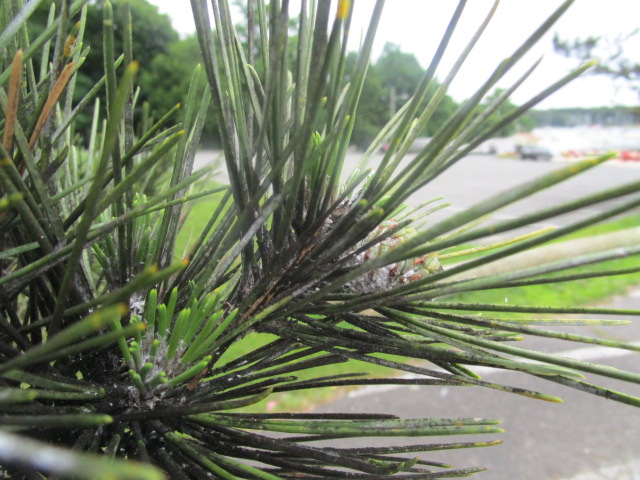
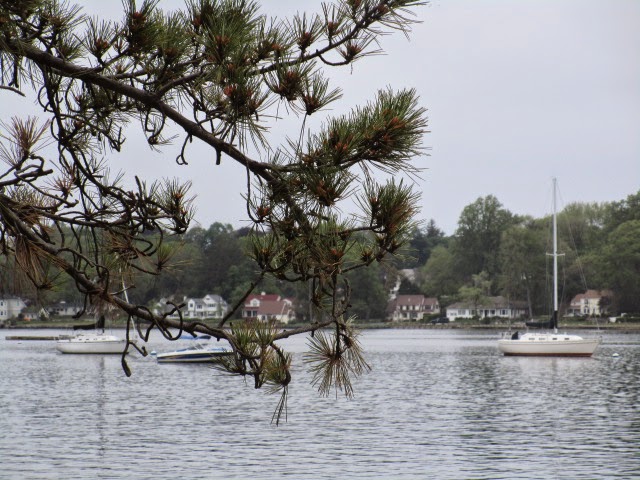
  • Changes in evergreens are not so obvious as those in deciduous trees, but new needles are being grown and flowerless fertilization spreads invisible pollen everywhere.  This pine is one of the last survivors along the shoreline, although there are still pine trees all around.  They, along with the spruces, are now being threatened and killed by invasive boring insects.  The hemlocks have fought blight for years.  Nature is never so benign as we romantically imagine.
  • Compositions like these remind me of Ma Yuan, a Chinese painter of the Song Dynasty (around 1200).  “One Corner Ma” was famous for putting all the detail in one corner of the silk, and leaving most of the surrounding area to the imagination, with just a hint of soft ink indicating a misty horizon or vast waters.  One reason to enjoy art is to realize that other people can see and think a bit differently than we do, and to occasionally inculcate their insights into our own consciousness.

Saturday

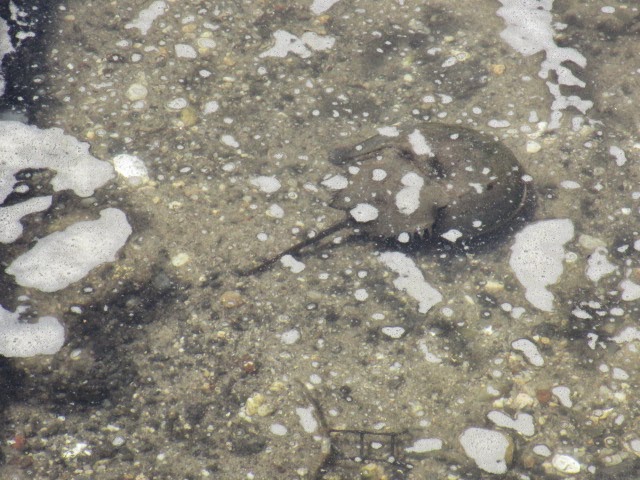
  • Waterfowl have had chicks, fish have spawned, and now it seems to be time for the horseshoe crabs to mate.  This one is slowly circumnavigating a restricted dock area in Northport in motions resembling a drunken Roomba vacuum cleaner.  Perhaps a little confused by looking for a beach area where there is none.  Usually, eggs are laid into shallow depressions dug along the high tide level.  These are everywhere, numerous, an apparently inexhaustible resource even though now harvested for various purposes.
  • As inexhaustible, no doubt, as the lobsters and fish that once graced these waters in plenty.  We think the environmental catastrophes have taken time, but really it was all in a blink shortly after 1950.  And the worst is, although we now are aware and even trying to protect our resources where they are obvious, like here in an active public park, the worst atrocities are still occurring out of sight, in deep ocean or hidden rain forest.   Well, I must accept what there is, I suppose, and be grateful for so many of these, right here, right now.  I’m glad public opinion, at least, seems to be starting to gain a little maturity about the need to protect our world.

Friday

  • Anywhere is now gorgeous.  These azaleas happen to be at the harborside park in Northport, but with the luscious new green on each tree other colors are almost superfluous.  It’s nearly a crime to be stuck inside, as so many are.  And, no matter how pretty the photograph, it can never do justice to reality.
  • Northport is a few miles from my usual walk, and I have broken my self-imposed discipline of only showing places I can reach on foot.  It’s not boredom, exactly, but it is boredom, generally.  Why worry, you ask?  Because I firmly feel that unless you impose limits, you cannot reach mastery.  Like having a certain structure in a sonnet or haiku.  Our choices are nearly infinite , there are very few external constraints, and if I try to extend too far, I may miss becoming profound.  Contemporary arts, I think, are a little ragged now _ our culture’s most beautiful work seems to be in crafts where artisans respect their materials and tradition deeply by accepting artificial traditional boundaries.

Thursday

Fresh new scene, he thinks.
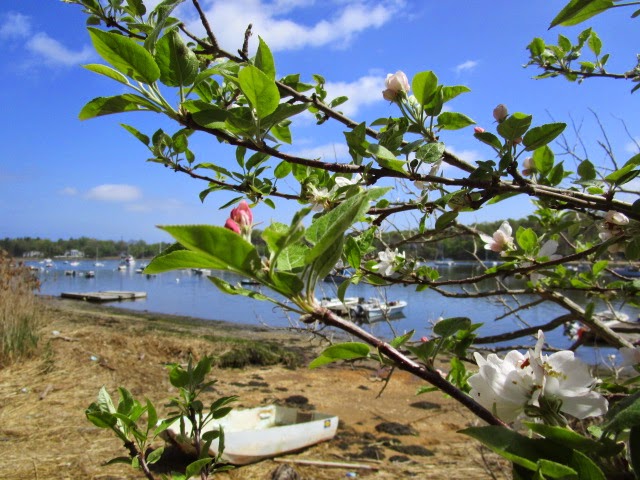
Blossom drift frames azure wave

Aged: six billion years

Wednesday

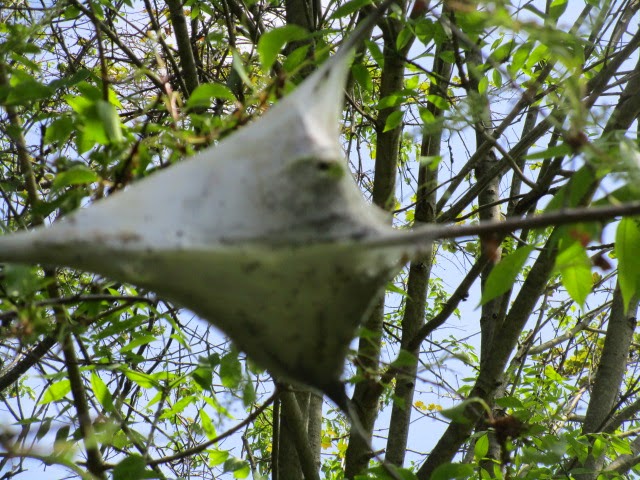
  • Tent caterpillars preparing to march out en masse and munch through tender young leaves.  A few days of extraordinary heat bring insects out in force.  Bees of all kinds, flies, even a butterfly or two.  Gnats hovering annoyingly right in front of eyes, fortunately no mosquitoes.  And that’s only what’s visible _ the ants and termites and whatever else lives in tree trunks and old leaves and underground largely pass unnoticed.  A bonanza for the swallows, which can be seen darting about overhead in the twilight.
  • There are not too many odes to tent caterpillars, or to mosquitoes for that matter, but they belong on earth as surely as we do.  Just not exactly where I am.  Put them on a reservation somewhere _ a wilderness they can inhabit in their own way as we do ours.  Ah, yes, that idea didn’t work, did it?  My environment is vast and complex and not comprehended and perhaps there is a place in it even for the things that bother me.  I try to cultivate that attitude, but sometimes it is extremely difficult.
Tuesday

  • It’s hard to hate delightful fluffy tiny goslings, all balls of fur waddling around behind their parents.  Inevitably, strollers pause and smile and sometimes take pictures.  Yet they grow up to be annoyances, filling parks with their waste, taking over golf courses and playgrounds.  Of course, one is impossible without the other, symbolic of the contradictions of the world.
  • We enjoy natural things, but we think they should stay in their place.  That’s the trouble, as Darwin noted _ life never stays in its place.  It overproduces, and fills old places, and finds new ones, and ingeniously adapts and evolves into ever more niches.  We have been guilty in the last few centuries of stomping stuff into containers a bit too much, or carelessly destroying environments because we think we have more right and better usage than what was there.  What is nearby _ like baby birds on a shoreline _ becomes all the more precious when we realize our loss.

Monday

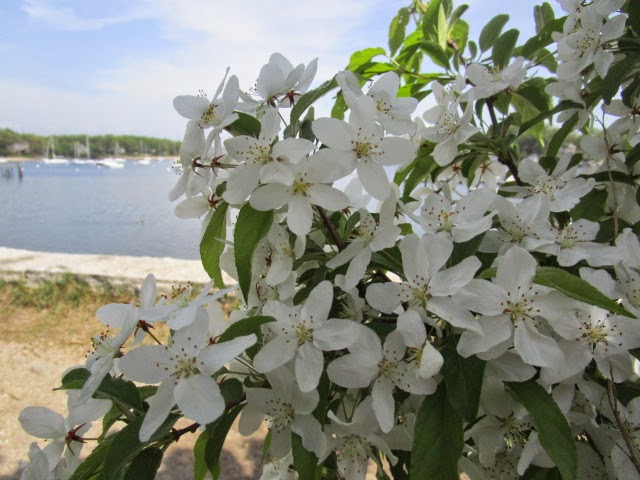
  • Apple blossoms bursting on the only fruit tree along the waterfront.  May is a romantic month, filled with hope and optimism, as nature seems to reconquer the whole world.  Goslings have hatched, fish have spawned, every weed is leaping up in profusion, and grass seeks to cover everything with a mat of green.  Besides, folks can walk around in shorts and tee shirts, happily unencumbered with the heavy detritus of the last few months.
  • Only a curmudgeon ignores this reality, and fortunately I have not reached that jaded state yet.  My blood and thoughts quicken as much as anyone’s.  I know that in a few months the magic will wear thin, the weeds will seem oppressive, the heat will combine sweat with dust into annoying mud on my brow, and I will wish for relief from the burning sun at midday.  But this moment is almost perfect, and almost anything seems possible, and I would be a fool indeed not to wallow in joy.