Berry Happy

Monday

  • Berries are everywhere, along with fruits, nuts, seeds, even hidden tubers.  Although some are stunted from lack of water, like children everywhere lives of offspring were prioritized by parents, and the crop remains far too large to be fully consumed by birds or the few remaining small ground animals.  Some will hang on through winter, when finding enough to eat is a different matter entirely.
  • Once upon a time in much of our Northern hemisphere, this was harvest time and harvest moon, with final picking, pickling, canning, drying, salting and smoking.  Busy days and nights storing bounty against the certain famine to come.  Today _ well according to most media, harvest moon is just some curiosity to point out to youngsters, another irrelevant tidbit from the past like the names of months.  Most of us claim to be overworked, but at least as frost approaches again, I think we are clueless as to what our ancestors accomplished.  

Tuesday

Fruits promise future
Encapsulate life gone
Carry

Universe complete

Wednesday
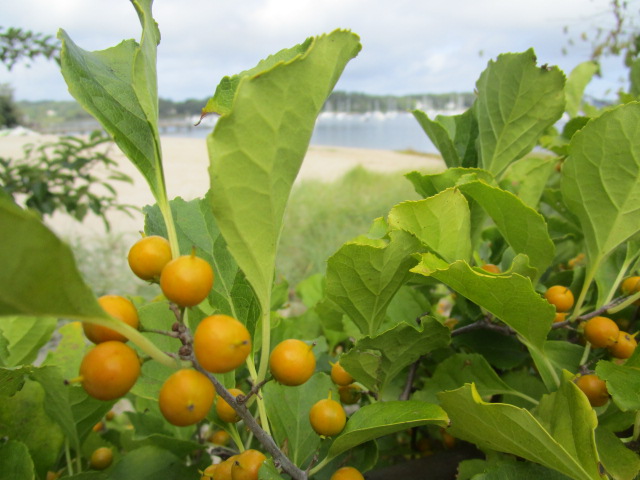
  • Berries, unlike most seeds and nuts, tend to attract attention with color or scent.  They sit in field or forest flashing a bright “eat me” message.  Seems a peculiar way to do things, going to all that work only to have offspring begging to be consumed.  Ah, but the fruit is not the seed, and the undigested seed falls wherever it is dropped by animal or bird, enclosed in a handy packet of fertilizer.  Such long-term complexity is astounding.
  • Many berries are nutritious and delicious for humans, although others try to keep our species from bothering with them, like this hard, dry, tasteless and (for all I know) poisonous yellow variety.   I came late to berry appreciation, although these days I have them on my cold cereal every morning.  When I was a kid, the only way to get them year-round was as some kind of jelly or jam, since the natural harvest season for any given berry is often short indeed.

Thursday

Met Joe coming out of Been & Jerry’s on Main street, waffle cone in hand.  “That looks good!  What flavor?”
“Cherry Garcia,” he responded happily, wiping his mouth with a paper napkin.  “I like cherries, especially after the pits are removed.”
“Ah, but I think the sugar helps,” I said.
“Of course, of course.”
“Tell me,” I asked, “I’ve been wondering because I read so much about it.  Do you think that berries and vegetables and all tasted so much better when we were growing up?”
“Well, you know, I could taste things a lot better back then.”
“Agreed, but to read some of the reviews now, once upon a time each bite was an orgasmic sensation.  I don’t find strawberries or tomatoes or _for that matter _ cherries remarkably different than I remember.”
“Well, I do know store tomatoes were pretty awful for a while.”
“Yeah, but that was true even back then.  We grew our own _ I guess tomatoes might be nicer just picked from our garden, but everything else was just fruit and whatever.”
“I liked most of them better in jam or with sugar,” he admitted.
“I know nobody wrote them up.  The farm stands didn’t get much beyond fresh and local.  Sometimes sweet, especially for the corn.  But nothing matched current fantastic descriptions of luscious heritage crops.”
“Capitalism in action,” Joe noted.
“They can get away with it,” I said, “who’s going to remember or call them out anyway?”
“The old days were always so much better,” sarcastic.

“I think it’s too many food writers with nothing real to do, and maybe too much food.”

Friday

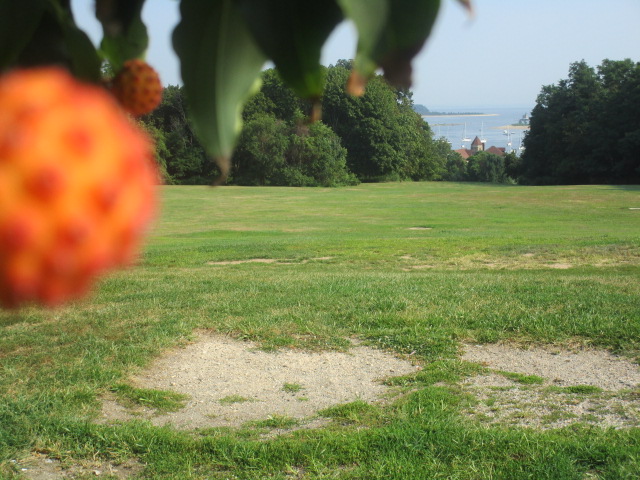
  • Small fruit like this crabapple is hard to distinguish from berries, and for that matter by common scientific definition a lot of what are called berries are “really” fruit.  But a berry is just one of the many sub-specifications of fruit in general. Sometimes it’s more fun to go with the
    obvious and decide anything within a certain size range is a berry for all intents and purposes.
  • Our age has a mania for classification, for we have largely convinced ourselves (like primitives supposedly used to think about photographs) that by fully describing something in words we have captured its soul.  In a nutshell, that represents the problem with all those who gabble on about artificial intelligence and how a computer “like us” will soon be constructed.  The name of the thing, the description of the thing, a model of the thing, are not the thing itself, and wisdom respects that.

Saturday

  • Like children, we smugly believe that a workable theory explains everything, and we gain control by knowing.  Thus it has been with evolution.  Lots of time.  Drive to reproduce. Overproduction of offspring, some of them genetically varied from parents.  Survival of the fittest.  Bingo, nothing more to be said.  Before that the theory was just a simplistic _ a god or gods who created everything just so just for us. 
  • Anyone who pulls themselves out of the madness of basic simplicity realizes that even if basic ideas like “survival” or “gravity” or “atoms” are “true”, their manifestations in our real world are certainly not.  In a way, it is the exact opposite of Plato’s cave.  Instead of the “ideals” outside the cave casting shadows which we take for real things, the real things we know cast shadows into our logic which create models we mistake for reality.  Reality always is what is, our explanations are necessarily incomplete (but useful) ways to gain power over our environment.
  • Berries, fruits, seeds are examples of incredible complexity.   Stationary plants that use insects to cross pollinate to produce enticing fruits to be eaten and spread farther than the wind could carry.  Animals that eat the fruits.  Insects that need the flower pollen.  Environments to support everything.   And sure, some smart aleck will show how any particular part of it is easily explained with a simple modification of this or that theory, until another layer of infinite onion is peeled off and yet more fantastic anomalies are revealed. 
  • I admire science as much as anyone, and believe it is a better tool for human control than anything else.  What I am not sure of is that a tool for control is necessarily the best tool for figuring out what should be done.  It’s the old “use the hammer for everything because we have a hammer” problem.  The need now is not to stop using science nor to limit its applications, but rather to understand that in certain areas we have better tools that we should be concentrating on. 
  • The analogy I would close with would be cooking.  Scientifically, we can more and more finely describe and tune how to make and season a given dish, such as a cheese omelet.  But sometimes we want a steak, or ice cream, or salad.  Understanding why we want such things, how they might make us happy or unsatisfied,  how much of a role cooking should play in our lives, and our very thoughts concerning meals and memories and how each of us is totally different from each other rapidly become too complex for any equations which can be applied to our fast-moving “real” world.

Sunday

  • All mammals learn by observing others, as well as through their own senses.  Humans add to that being able to convey information with modulated sounds or irregular marks on some surface.  Poison ivy seems to be a combination of all three _ warnings by parents, experience with leaves, and unappetizing appearance of the berries themselves.  Birds and other wildlife apparently enjoy these immensely.
  • By the time the fruit appears, even the most stubborn child has learned that shiny three lobed leaves should be left alone, which is fortunate because otherwise there might be some wicked poisonings in the fall.  It takes longer for older folks to realize that even the bare vines are hazardous, and burning smoke doubly so.  Yet for all its inconvenience, poison ivy is much too hard to root out entirely, and pretty enough if left alone.  So we follow a live and let live philosophy, one of the few rigorously enforced by both man and nature.
Equal Times

Monday

  • Now night becomes longer than day, warmth is lost not only because there are extra hours to radiate into space, but also because at these upper latitudes light rays hit with diminishing force.  Ancient peoples in the Northern Hemisphere mythologized that evil demons were eating the sun. Now with fire and electricity people conveniently ignore such superstitions and logically move indoors to enjoy the benefits of science.
  • We have our own mythologies: that an individual can control his fate, that a culture can ignore environment.  Hermetically sealed people dismiss climate and relentlessly concentrate on what matters  _ wealth, power, entertainment.  If descendants survive our orgies of destruction, they will no doubt look back with a wiser philosophy and wonder about us _ the demons who wrecked their world.

Tuesday

All days are lovely, if I take the time
Moods generate beyond known bounds of space
Internal visions, filters finely honed
Each tame my world, force it as I wish
Cast a spell _ enchantment or dark curse
If all were gone, still I my universe
Could build, project, imagine as I dare.
When I am gone, entire this infinite
Must also vanish, swift as fragile thought
Meaningless as bubbles bursting free.
I love and care and know that this must be:

That nothing else can e’re exist as me.

Wednesday

  • Went to the city yesterday, and toyed with the idea of taking a picture or two.  But with the Pope and UN and President all arriving later this week, there will surely be more than enough pictures to satisfy anyone.  New York City is filled with people, Long Island is filled with people, Huntington is full of people.  There are people everywhere around here _ it’s one of the most densely settled places on the planet _ even though this blog attempts to give some impression of solitude and lonely meditation in its pictures and thoughts.
  • But the question rises to mind _ how often do we consider seven billion others just like us (alive at this moment, the dead would double that number.)  How many of those have I heard of, even to remember a name?  A few thousand but no more, were I forced to list names.  We each try to excel and be important in our little circles and tribes, but looking at the larger picture we vanish like protozoa when the microscope is no longer available.  That is not to claim anyone is unimportant _ just that fame is irrelevant beyond our immediate environment.  I need such humbling thoughts once in a while. 

Thursday

Wayne and Joan sitting in the park after lunch in Northport.  Cool breeze, warm sun on an early fall afternoon.  Brilliant colors, many dogs, almost no children who are in school until a little later.
“Oh, look, there’s a cute one,” says Joan.  “I wonder what type that is?”
“Smallish, brown, four legs and a tail,” answers Wayne.  “That’s all I know or need to know.”
“You’re impossible.   Not a Pomeranian, but,”  meanwhile her thoughts wander as they often do to her poor little companion, dead these three years now.  None of these as cute or nice as my little angel.  Wish he were here so I could show them a perfect pet.
“Look at that beautiful boat,” he points to a colored sailboat swinging in to the large dock.  Oh here we go again, on and on about the dog.  Why doesn’t she just look around and enjoy the day?
“Maybe I should get a new one.”  Of course he could never be like my little angel and you never know if it will turn out nasty.  But at least a little dog would pay more attention to me than my husband does.
“If we got a boat it would be something like that, but of course I don’t want a boat,” continued Wayne stubbornly for the hundredth time, trying to change the subject.  Well, I guess that’s what we old people do, chew the same old cuds over and over out here in the pasture.
“Like you say, though, it would limit our travels and does take some care.”  But, on the other hand, we hardly ever seem to do anything exciting anyway.
“That sun and the sparkles are just perfect for paintings.”  The trouble is, it never stays a dog but turns into a little child that requires all kinds of effort and can never be left alone.  Well, no use creating waves.  I’ll just enjoy being here with so many fine vistas.

And so it went, for an hour, two streams of conversation barely registering, two streams of consciousness in alternate universes.  The trouble is, as you get on in years, you tend to stay in a comfort zone with a few people, and all those people tend to tell the same stories and topics over and over again.  The advantage, of course, is that we all forget conversations almost as fast as they occur.

Friday

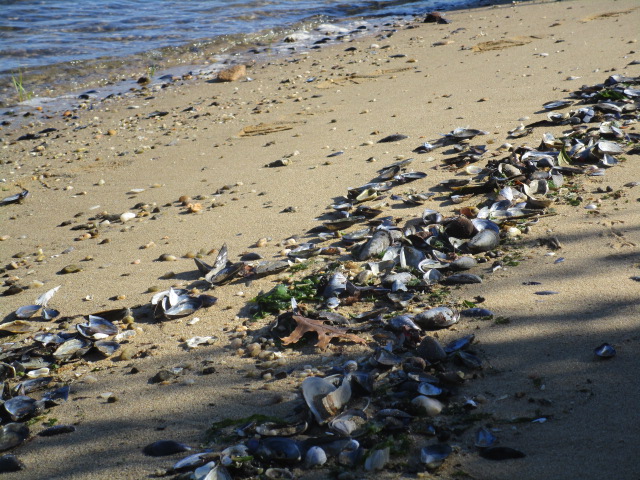
  • Scenes are distant, but near is important.  Shells marking the tide line along the sand remind that although we are part of a grand vista, we are also just little fragments of flotsam washed up by endless waves.
  • I try to marvel at near as well as far.  Closely inspect the petals of a flower, take pains to study a seed or leaf.  Often I fail, in too much in a hurry to bother.  The tiny as well as the large surround me with miracles, and I am the poorer for not recognizing them each moment.

Saturday

  • Obviously, everything changes.  Yet we assume there is an underlying solidity to the universe.  A rock will remain an inert rock, a tree will grow, water will stay in an ocean.  That seems simple truth, and we frame our thoughts to accommodate the pattern.  Such simple truth is wrong.
  • Matter is not solid, but a strange blend of forces in tension, leptons leaping in and out of existence, nuclear forces pushing or pulling other forces to form atoms, atoms ignoring a hurricane of neutrinos and other subatomic “particles”, once in a while interacting with a passing photon.  The earth does not simply go around the sun, it is in a precarious balance of gravity pulling one way and inertia another.  What seems to be equilibrium is the result of contrasting forces, each forever ready to break the current illusion of stability.
  • Life is even more so.  Our bodies do not maintain a steady temperature  _ certain processes raise heat, others carry it off, and when it goes too far wrong we die.  Likewise with countless biologic “norms” that we take for granted, but which are almost magically balanced _ until they are not and we are no more.  Processes build on one another to larger cycles _ hunger, sleep.  Everything changes, but much changes within certain boundaries.
  • All these discoveries are recent and counterintuitive.  Our concept of society has yet to catch up with what has been learned.  Economics, government, religion still assume natural balancing states rather than uneasy and temporary accidents of countering vector forces.  Yes, we know about equations for supply and demand, and checks and balances for rulers.  But supply and demand, for example, are not solid in themselves, but rather composed of infinitely and indeterminately fluctuating energies.
  • Amazingly, we still accomplish great things, plan and deal with problems, get by with little more than our intuitive understandings.  Perhaps, at this point, we should trust that intuition more than quasi-scientific logic. 

Sunday

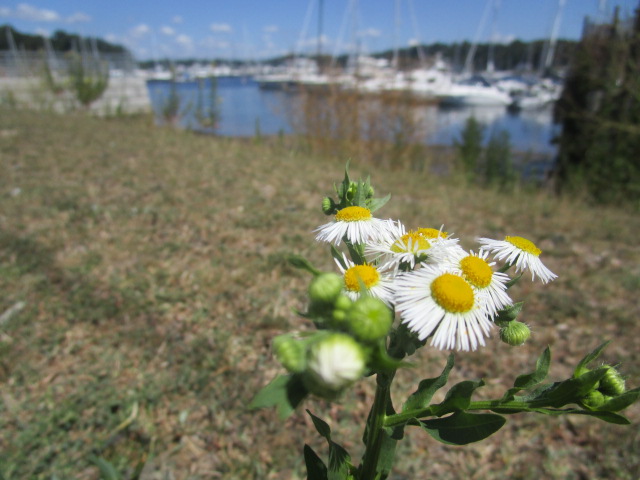
  • Final trio of showy wildflowers are goldenrod, asters, and Montauk daisies usually blooming last.  A few stubborn blossoms remain on other plants, ragged and scattered, especially the annuals that have now mostly dried to stiff brown.  Even these daisies show significant damage from the extended and deep drought this summer.
  • Cultivated gardens will continue to show color until the first frost, when the final performance will be given by maples and hickories and beeches.  But we all know that this is just a matter of time, and pretty quickly advancing time at that.  Already in the evenings I can be tempted to turn on the heat, and it’s nearly frightening how dark early mornings have become, and how quickly late afternoon shadows transmute to night. 

Ragged Edges

Monday

  • Days quite warm, evenings may require a sweater.  Trees lush full green, yellow orange red tinges peeking here or there.  Half the annual wildflowers and weeds are brown, ragged, and dry while the rest are showing signs of becoming the same.  Harvest is producing more than anyone can eat, but already production is falling and soon crops will be complete.
  • Alone amidst life on earth (and possibly anywhere) humans are blessed and cursed by being able to imagine the future, doubly so by being able to communicate those visions to others.  That results in our grandest triumphs and most despicable disasters.  As we project and plan what might be, we crowd the beaches and waterways today, imagining the harsh weather to come.  I worry about food, shelter, age, children, civilization, my house and a thousand other notions great and small.  But my anchor of sanity remains this particular, and most glorious, today.

Tuesday


Old man sits alone
Feeding flocks of pigeons,
Dreams

He is Emperor

Wednesday

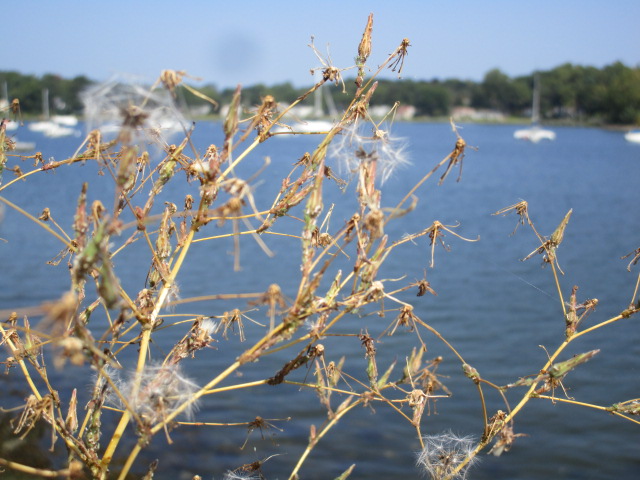
  • Hard to tell exactly what these are, but they demonstrate the principal of the season.  Fluffy carriers bearing seeds have almost all been dispersed by the wind.  Parent plant has done its duty and now simply awaits rain and other elements to recycle it back whence it came.  There are more and more of these remnants every day, contradicting the humid heat and brilliant sunlight which seem to claim nothing happening
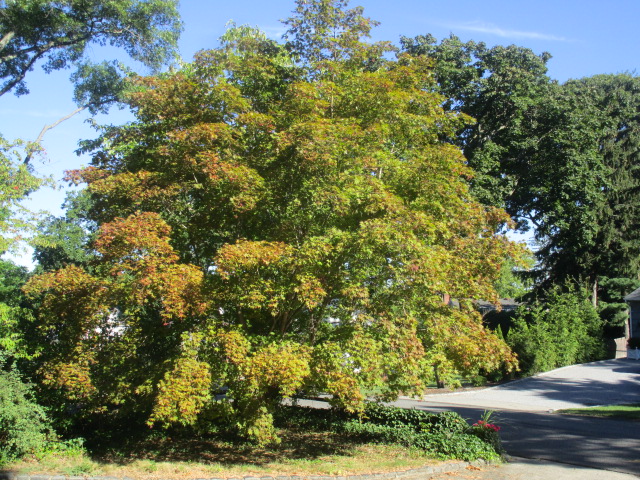
  • As in spring, each hard look at anything is a revelation.  Trees that appear green actually are yellowing _ the very hues of entire landscapes have changed.  We tend to focus on dramatic foliage of fall, but that has begun already, even in deepening greens of evergreens.  I seek not to rush the seasons, but to notice the more subtle marvels that keep me more interested than hurried glances would provide.     

Thursday

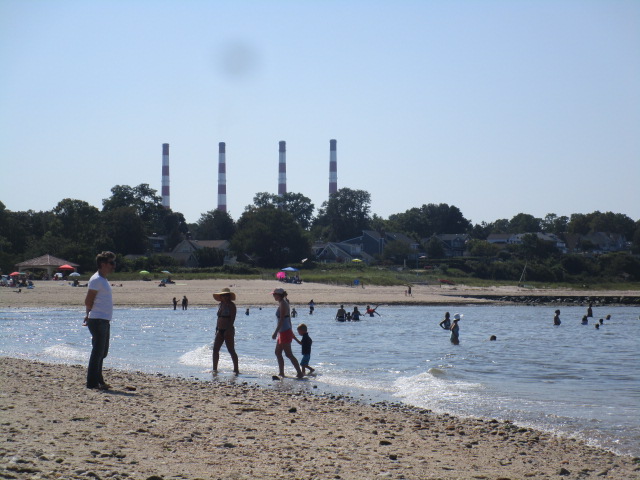
September afternoon nearing ninety, even here along the beach, smoggy trees on the shoreline opposite as powerboats race and sailboats add notes of grace.  We’re just cooled off from a dip, dripping in old cloth chairs.  Children speaking all languages laugh and screech, adults yell and jabber, a polyglot happy crowd.
“Don’t see why they can’t control their kids,” complains Joan, as she does frequently.  “We knew how to teach our own how to behave.”
“Too many lower classes, all over,” adds Marge.  “Too many, too poor, nothing like when we grew up.”  Another constant refrain.
“Well, when we grew up it was _ what _ 2 billion or so.  Now at 7 and climbing.  Problems to be expected,” says Jim.
“Our son,” I note, “expects a plague to wipe out just about everyone.  And my investment counselor is constantly worried about global worldwide collapse.”
“No wonder, with younger generations like these coming along to try to take over.” Marge slaps at a greenhead fly.
“Born again expect the rapture, a lot of nut religions expect the final apocalypse any moment.”
“But Bill,” I reply, “almost everyone everywhere has expected some immanent end of everything at any given moment.  For at least a few thousand years.”
“And some of them were right!” exclaims Marge.
“Of course,” I gesture around at numerous clumps of aged beachgoers, “we elders could solve a lot of the problem by just dying off like we used to.”

“Don’t know about all that,” Joan adjusts her sunglasses.  “All I know is I can’t stand the yelling.”

Friday

  • Hard to call rain a “ragged edge”, especially when this island is running a ten inch annual deficit.  Besides, everyone is back at school or work or shopping, all safely indoors, so who cares?  Somehow, there remains a strange distaste for people to get wet from rain, even though they happily take a shower each morning and swim whenever they please.
  • I care less, especially if it is warm.  These days, I just throw on a poncho and walk in my own little shell, like one of those hermit crabs down on the tidal sands.  Heavy rain, mist and clouds form a welcome variation sometimes on clear hot skies unending.  Unless this weather should overstay its welcome, of course.

Saturday

  • Many claim the American Empire, like that of the Romans, is in decline and fall.  Intellectuals cite Edward Gibbon,  common folks center on movies of bread and circuses and lonely last legions.  People seem to think that we may lapse into dictatorship overnight, that within twenty years all that we are and have stood for will have disappeared, that lonely peasants will pass ignorant days fearing the howls of wolves in the encroaching forest.
  • Like the American Empire, Rome took centuries to rise.  The Republic had already conquered the Mediterranean and most of Western Europe.  The century before Augustus was filled with bloody slave revolts (Spartacus) and bloody “temporary” dictators (Sulla, Pompey) and bloody Senate infighting.  All Caesar and Augustus (both from Patrician families) did was formalize the changes that had already happened and make the government manageable again.  But the change from Republic to Empire was not instantaneous, not at all like, for example, Hitler.
  • The Roman Empire also took its time falling.  It lasted 450 years in almost full vigor in the West, over a thousand while shrinking in Constantinople in the East.  Pax Romana was mostly welcome, with relatively light 5% effective taxes, cohesion that encouraged trading wealth, and secure stability for its citizens (not so much for its huge slave population, of course.)
  • Those causes of the fall?   There were bread and circuses, to be sure, although the bread was more part of the salary of the lower level bureaucracy and merchants, while the circuses were often exemplary executions of condemned criminals and war prisoners.  What ended up really hurting (in addition to trying to control so vast an area with Roman numeral arithmetic and horse-speed communications) were incursions of barbarians who had learned Roman tactics and technology, driven by drying climate change.  A plague that may have killed a quarter of the Empire’s population in the early 400’s didn’t help.  And after the fall, much of the basic culture hung around, preserved in small feudal kingdoms and the increasing networks of the church.  
  • Gibbon himself blamed a different prime cause: the fundamentalist superstitious Christian religion, which made people concentrate on their spiritual future rather than secular present.
  • Certainly, America will decline and fall.  How, when, over how much time, for what reason, and what its legacy will be must be left to future historians, not to silly shallow authors peddling dark fantasies or ignorant immoral politicians who would claim the Earth is flat if that delivers a few more votes. 

Sunday

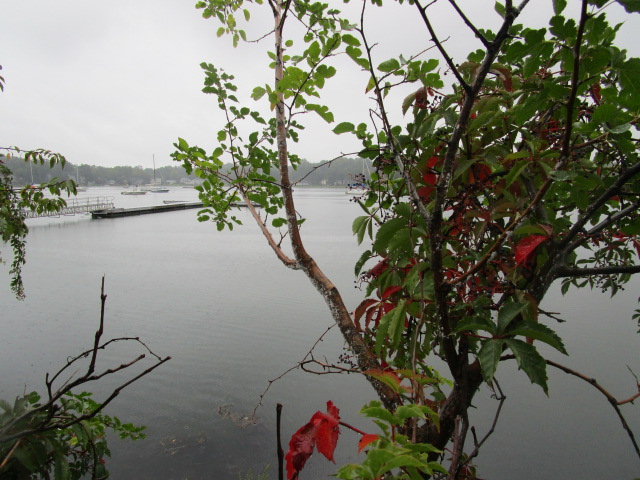
  • Rain has finally arrived, psychologically terminating deep summer with clouds and a major drop in temperatures, especially at night.  Already boats flee the water, beaches are emptied, tasks of preparation (like getting out snow blowers, cleaning gutters, checking heating systems) are being contemplated.  Soon enough there will be leaves to rake and outdoor furniture to protect.  Yet, for all that, it is still summer, still warm, and when the sun returns there will be sufficient days to visit parks and enjoy long walks in cooler air.
  • For those who truly love seasonal change, and do not pay lip service to it because such changes must be endured, these transitional times are perhaps even more beautiful than the heart of each quarter year.  I find this helps me mark and remember what I have done, place my life and experience into a moving context, and resist the temptation for each day to just be like the last and the next.  With modern convenience, of course, everywhere we live is truly potentially a static meteorological paradise, conditioned by heat and air conditioning in transportation, work, housing, and shopping.  I am an old reactionary, and wander about in my poncho as rain falls and wind blows, a madman among civilized multitudes.

Summer Swansong

Monday

  • Planned to lead with a picture of a swan, but no shorebirds around this morning except a few crows and a solitary cormorant.  Perhaps all on vacation, perhaps scared off by frantic vibes of impossibly numerous shell-shocked humans rushing about in panic.  “Where did the summer go?”  “Oh, crap, its back to school/work/daily grind.”  Even retired people, who have seeming escaped that seasonal wheel of sorrow, are mostly planning how to get through the coming winter or (more philosophically) how to engage in meaningful projects to add purpose to their self-perceived irrelevant lives.
  • I’ve always like the romantic concept of a swansong _ a brief glorious act immediately before death.  A curious term _ and I won’t spoil it by looking up the origin.  Etymology is much more easily determined on the internet than political “truth” or historic fact.  I think it well fits this last week of freedom, as everyone tries to cram a last bit of relaxed happiness which becomes impossible knowing what will immediately follow.

Tuesday

Summer going, sun drifts south,
Through days of humid hot
All this green, hard to believe,
Soon turns to brown and rot.
Cycles come and cycles go,
Cycles flow again.
Massive change, except that I,
Alone remain the same
And yet I know, remembering back,
I’m not as in my past.
A larger cycle, once ignored,

Now looms to close at last.

Wednesday

  • If summer end is a tragic opera, goldenrod is the messenger bearing irrefutable proof in its long solo that the final act is nearing.  A few other flowers dot the woods and fields, but none so overwhelmingly turning entire hillsides and shorelines yellow.  No matter what it may feel like outside, goldenrod’s sign is September.
  • I rush seasons as much as anyone.  There are still many fine times, spells of heat, lovely sunsets, relatively long days, and a hoped-for final Indian summer.  But worse weather is immanent, not infinitely far off as it seemed in June.   Nature has adapted to all this, and so should I, but sometimes there remains a hint of sadness not simply at this summer gone, but at all summers I so well remember.

Thursday

Old people nursing beers at Finley’s, late afternoon, grumbling as usual.
“Too bad old King Canute is dead,” says Dan.  “He could run for president.  Holding back the tides would save billions or trillions, and it’s no more impossible than what the other candidates are promising.”
“When did kids get so stupid?” asks Jean.
“Magic,” mutters Bill.  Everyone looks at him in expectation.  “We boomers are the last generation to understand the world.  Everything now is magic _ nobody knows how technology, global trade, society, anything really works.”
“Yeah, I think you’re right,” Allen agrees.  “Politicians are all shamans _ do the right spell and poof.”
“Right,” replies Bill.  “The republicans think all the problems are caused by little devils that can be exorcised with the right slogans or talismans like a four thousand mile long fence.  The democrats claim they can tame Lady Fortuna and force her to distribute her fickle favors more equitably.”
“I blame the schools,” states Flora.  “They teach anything is possible.  We all know anything is not possible.  You can’t turn lead into gold.  When people think anything is possible, nothing is possible, and nothing gets done.”
Jean responds “So the kids aren’t stupid?”
“Sure they are,” Dan looks around.  “The masses are stupid and willfully ignorant.  The educated elite have them wrapped around their little fingers.”
“I wonder,” Bill continues darkly as he finishes his beer, “I wonder what will happen when the magic goes away?”

Friday

  • This is the first extended hot and very dry period this year, although rain has been below average.  Some vegetation is beginning to show effects, although the trees remain relatively untouched since there is abundant ground water.  But all the plants are now being triggered into survival and shut-down mode as the days grow shorter.  There will be no compensating new growth on these branches as there would be in the spring.
  • I bask in the late summer glow, going swimming, enjoying sweaty walks in nothing but tee shirt and shorts, marveling at nature.  But there is a small part of me like the trees, getting ready to slow down and hibernate, concentrate on indoor and internal mental activities, develop my own resources and projects.  It’s silly to worry about the coming winter, which after all lasts two months at most.  Right now I look forward to rain, and brilliant foliage, and the first snowfall.  By then, of course, I will much lament the loss of these final weeks of the season.

Saturday

  • We pride ourselves on being reasonable and scientific, always believing in cause and effect, unlike primitive peoples.  But cause and effect in itself is not scientific _ any human who ever lived knows that eating will ease hunger and getting cut will bleed.  It’s just that before science, it was easier to take shortcuts and assign most causes to spirits or gods.  As far as I can tell, there are many primitive thinkers among us now, many running for president.   I propose a few causes (and solutions) that I expect to hear any time soon:
  • Climate change is not caused by human activity.  God intervened to create modern man using the highly unusual ice ages.  Now that the God of humans has died, the planet is reverting to its natural paradise-for-dinosaurs equilibrium.
  • The Mideast is populated by crazy fanatics.  Obviously living in a desert drives anyone mad.  We should remove everyone from deserts, possibly by seeding the sand with radioactive waste from nuclear power plants (thus solving two problems at once.)
  • Our government is a mess, all branches, all levels, from top to bottom.  Our government is 99% composed of lawyers.  Thus lawyers, in addition to being naturally sleazy and evil, are totally incapable of ruling a country.  There should be a constitutional amendment banning anyone holding a law degree from ever running for elective office.

Sunday

  • Ragweed rules triumphantly,  pollinated and seeding for next year.  As far as it is concerned, everywhere is as fertile as Indiana,  each climate as welcoming as the Amazon basin.  Perfectly adapted for the modern world, which humans colonize and disturb and ignore each year.  Some say it is an ugly and ungainly plant, but it fills all the peripherally noticed borders of our views in solid green, contributing subtly but strongly to what seems natural and right.
  • If the meek are to inherit the Earth, ragweed will no doubt be among them.  If I am a weed, I could do worse than to emulate this survivor.  Were I such, I would not complain of destiny, or poor soil, or adverse growing conditions, or lack of rain, nor envy the cushy situations of other plants and prettier flowers, all well-tended in gardens.  I would just accept my space and flourish.  My meditations are unexpectedly enriched.

Home Bound

Monday

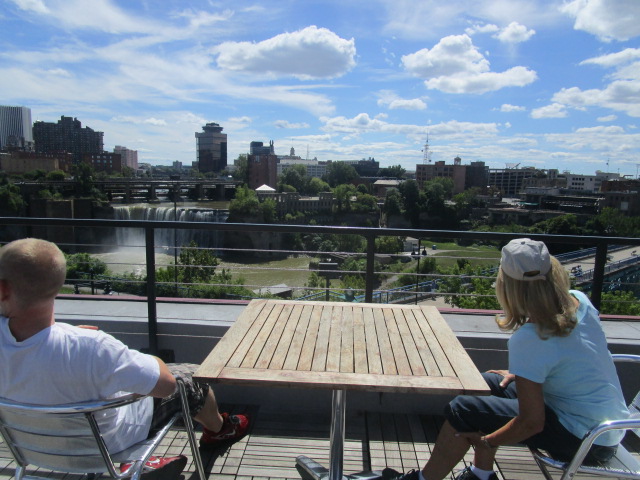
  • The High Falls of the Genesee river furnished the power to mill much of the western grain traveling along the early Erie Canal.  Rochester was known as “Flour City,”  but since then the area has hardly lived up to potential, rusting and industrial.  The city keeps trying to make this into a hip new area, but the recession broke the first efforts.

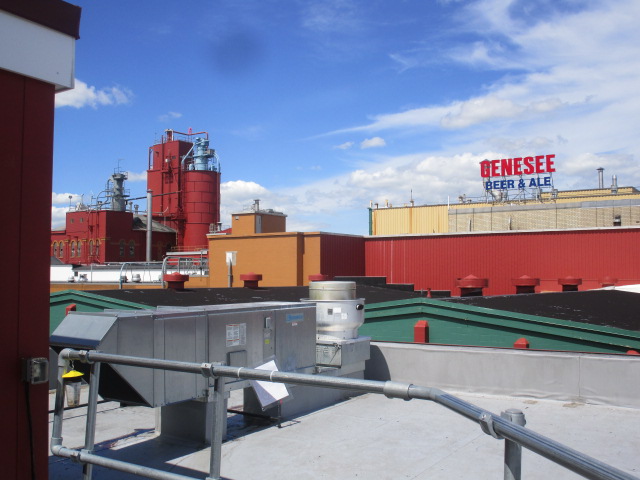
  • Meanwhile, the Genesee Brewery (a real big affair over a hundred years old) realized what a prime location they occupied on a cliff opposite the falls, and has recently built a large beer museum, tasting room, and restaurant.

  • It’s a pleasant place to spend afternoon August hours, plastic cups of Genesee beer in hand, on the roof deck, listening to a live band playing Rolling Stones classics.  A pedestrian footbridge over the gorge carries tour groups, couples wanting pictures, and on this particular Sunday, a person marching with a Puerto Rican flag from the nearby festival.
Tuesday

  • Lake Ontario extends to the horizon North, has wide sandy beaches and surprisingly large waves, capable of wrecking sailing ships in the old days.  A huge metropolitan park with carousel occupies one corner of the intersection with the Genesee, where the seemingly inactive “Port of Rochester” welcomes shipping to the United States.  Small restaurants line the docks along the river, and a half-mile walkable breakwater extends to a lighthouse.
  • New York never fear running out of drinking water _ half its border is on this lake, and almost all the water and snow that falls on lower Canada passes through here on the way to the St. Lawrence.  For those that prefer a less civilized experience, a few miles up the shore there is a large park with undeveloped beaches _ still sandy _ beneath high bluffs almost as wild as when they were first encountered by Europeans.
Wednesday

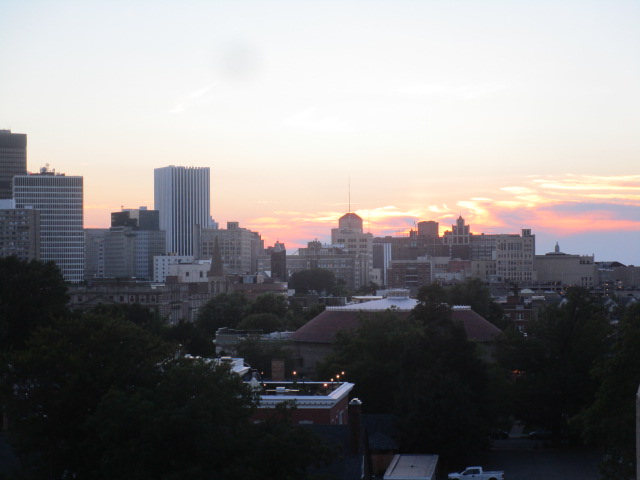
  • The Strathallan has the best location in Rochester and knows it.  Taken over by Hilton a few years ago it has renovated upscale (sadly in my opinion) to become a prime destination for weddings and corporate events.  One of its new amenities is a rooftop café to overlook sunset on the skyline with a beverage of choice.
  • I was a little shocked to discover that we had traveled far enough west that the sun goes down a half hour later in this time zone than it does in Huntington.  I tend to think of the world as discontinuously greater.  When places like this were founded, every local time was different.  Nobody cared. Only the coming of the fast railroads forced the issue by making our standard time zones so that train timetables would make sense to anyone.  We watched the later sun go down, looking exactly like the earlier sun does back home, if we only take the time to go out and experience it.

Thursday

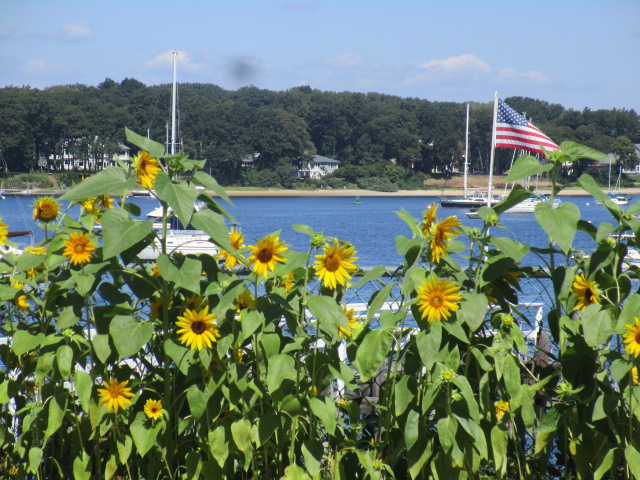
  • Newly opened rows of sunflowers greet my return to the usual haunts.  Surprising changes can occur to the environment in less than a week.  Even more surprising changes to my outlook.  A good vacation helps me reorient and establish new perspectives.
  • The ride up was an adventure:  heavy dead stop traffic jams all through New York, then just when we thought we could relax, the nasty sound of something under the car detaching and dragging along pavement.  With that eventually cleared up, driving through a Niagara from the skies outside of Syracuse.  On the other hand, it made us appreciate a country where cars can be repaired in the middle of nowhere in half an hour, automobiles and roads don’t care about rain, and a comfortable lodging and adequate food await at day’s end.  The trip back, by contrast, was like a car commercial _ well above the speed limit, no delays under clear skies, only light traffic the whole way until within a few miles of home, where one of the local roads was being torn up by the water utility.

Friday

  • Rochester’s Seneca Park Zoo is smaller than Huntington’s (18 acre) Hecksher, but manages to contain _ in addition to the usual suspects (monkeys, sea lions, snakes, fish, birds) _ a snow leopard, an Asian tiger, a white rhino, two polar bears, four elephants, and three lions.  Here the king of beasts surveys the fat luscious snacks parading below him.  In another area a bald eagle, probably injured with flight feathers clipped, preens alongside a pond.
  • I bring this up because sometimes I feel caged and clipped in what I do here.  Any artisanship requires limits to allow mastery, and in this day and age most limits are self-imposed and completely arbitrary.  This current blog format has served me well, but I want to experiment a bit over the next month, and maybe
    settle into something different.  The pictures will remain similar, but the thoughts they trigger may veer in different directions.  Nature is inexhaustible, my commentary on it far less so. 

Saturday

  • Nights are cool and dry, days delightfully warm with heat in full sun.  Adequate rainfall has kept most foliage lush.  Yet, for the observant, summer is winding down.  Nights come on more quickly,  the sun is moving south.  Some trees are showing hints of fall color.
  • I claim to love all seasons, but like everyone around here I sometimes wonder in the depths of winter if it is worth the trouble.  Tuned to the culture of my youth, when September marked a time of returning to school or beginning the push to end-of-year at companies I worked for, I find this is the time for resolutions and plans and projects.  The challenge is always to find the best ways to use enforced indoor activities.  And so, more than New Year’s, I start into thinking about the next year and what I want to accomplish.

Sunday

  • Spartina dispersing seeds into late summer wind and wave.  More miracles, that beds of grass can come from such tiny dry kernels.  Contemplating the spread and continuation of life _ positive impossibility rather than evolutionary competition _ can be far more rewarding than studying the entire remainder of the cosmos, stars and all.
  • I can be religious in the sense that I believe there is an awful lot of the reality of our universe that nobody is capable of understanding.  I’m no neo-Platonist _ our reality is far more substantial than shadows in a cave _ but our reality is only part of much more.  I am not religious in that I think worrying about it, trying to figure it out, or submitting to my own or other’s ideas of what metaphysical reality (or purpose or meaning) may be is completely futile, silly, and almost a blasphemy on merely accepting and appreciating existence.

Openscapes

Monday

  • Huntington is blessed with many landscapes, seascapes, townscapes, and harborscapes.  Language mavens were obsolete before anyone got around to naming mallscapes, ballparkscapes, and parkinglotscapes, among others, but those are here as well.  A photograph from a cheap camera in such a place never really captures the view nor invokes the actual experience, but it can give an idea.
  • I try to come up with a theme each week that unifies my daily entries somewhat, and in this case I am trying to be more general than usual.  We’re driving up to see our son in Rochester on Thursday, where there are farmscapes quite different from the few remaining on Long Island, and vineyardscapes much more vast.  So, for a while, I will concentrate on the large rather than the small.

Tuesday

  • Skyscapes, of course, are available to anyone anywhere who is not locked in a cell.  Some are more dramatic than others, but all bestow a sense of freedom. 
  • It takes a professional photographer, with an artist sensibility, to truly record a sense of such things.  I see well enough, but do not have the technical skills to convey much.  On the other hand, the purpose of this blog, if it has any beyond keeping me occupied, is to encourage people to open their eyes and hearts to all the fantastic opportunities that surround us all the time.  Suggestions, then, are all I can offer.

Wednesday

  • Few hillscapes exist in Huntington (or even Long Island.)  This area is just a big pile of sand left by the glaciers.  Still, there are bluffs along the North Shore and long ridges (called moraines) further inland.   Huntington exists where it does because three passes through such obstacles allowed easier access to the interior by horse-drawn wagons.  Even small hills can be steep, and for draft animals (or people of a certain age) any hill is too long.
  • I probably picture this hill too much.  On the other hand, there is something to be said for knowing a locale intimately through years, seasons, and changes.  Utrillo painted Montmartre as if he had caressed each wall (and possibly had, returning from the bars.)  Corot treated Fontainebleau forest as his own private garden.  I find an awful lot of professionals these days concentrate too much on the same famous feature and put all their effort into effects.

Thursday

  • Temporary farewell to tidal vistas.  Rochester is four hundred miles away, through cities, forests, mountains, plains, fields and at least one huge swamp, crossing once nearly impossible barriers like the Sound, Hudson river, deep ravines, high bluffs, following the only early (water) path connecting the East Coast to the center of the country.  Seven-odd hours, taking it all for granted.  Hundreds of years ago, most people in Western Europe hardly traveled more than five or ten miles from their village; until very recently almost everyone else in the world did the same.  Today such a person is considered a sheltered recluse.
  • By such standards, I am almost a habitual hermit.  I try to appreciate the daily miracles _ even the man-made ones of abundant food and water, electricity, medicine, entertainment.  But once in a while, we break out a bit, and at such times I strive to view such things as wide clear highways and fast cars not as ordinary conveniences, but as magical passages to places that are different enough to refresh my sense of perspective.  

Friday

  • Didn’t take pictures of farmland, although much of western New York was flush with crops, having received adequate rainfall this year.  Hard to remember that New York is a major agricultural state, fortunately situated in the event of global warming, since it is unaffected by sea level rise, is not within any models of severe systemic drought, and would only benefit from a few additional degrees of temperature especially in the winter.  Of course, tourism, as the main (only) street of Canandaigua demonstrates, remains a strong element everywhere.
  • I’ve told my son to purchase land up there, only half jokingly.  Unfortunately, because of the time scales involved, only governments and corporations (and wealthy aristocratic land-holding families) gain much from long term trends.  The rest of us must get by in our mayfly lives with whatever short term events are going on.

Saturday

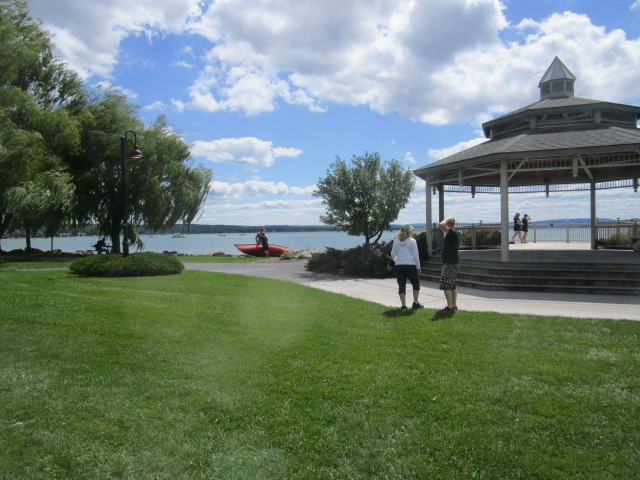
  • Lake Canandaigua, one of the Finger Lakes, demonstrates why folks upstate do not feel deprived of water activities even without an ocean, sound, or salt-water bays.  Unaffected by tides, the docks are a little unsettling to someone used to high pilings. 
  • I had hoped to take lots of pictures of farms and fields, which were qui
    te plentifully in evidence while on the thruway.  But as it turned out this was a complete family vacation, and our son is an urban professional no more into spending time looking at cows and corn than any of his peers in Manhattan or any other city.  So I’m making do with whatever pictures I did take.  Trust me, however, we passed lots of farms just getting here and back to Rochester.

Sunday

  • Gritty Monroe street, a block from Wayne’s apartment, resembles in some ways the old Greenwich village, the only difference being that there are back yards and tree lined side streets behind it.  But the ambience of all kinds of odd people _ bikers, transvestites, near-hippies, young professionals and college students provides an interesting mix, which he claims is mostly kept in check and is a lot less frightening than it was ten years ago.
  • The south side of Rochester is the good side, not the one with crime and murders and urban poverty.  It is slowly gentrifying, but never sank particularly low, and has a wonderful housing stock.  Hopeful government redevelopment and infrastructure improvement is in evidence all over.  In the meantime, rents and houses are affordable.  It’s lovely on a hot August afternoon, in its own way.  We have been assured it is far less so in the middle of February, although even with snow piled high a vast assortment of restaurants and bars of all types stay open.

Late Bloomers

Monday

  • Late blooming wildflowers like this thistle are now in full stride.  Their strategy is to avoid the mad dash of the early spring and summer when everything else competes for resources like mad; bide their time to bloom when insects and sunlight are guaranteed to be plentiful, the temperature is warm, and the ferocious pace of the earlier plants  has eased up or ended.  The downsides, of course, are that rain can be infrequent, solar energy each day diminishes, and the growing season becomes very limited.
  • I also love cultivated species which add color where there would normally be little.  Their particular strategy is to completely throw in their lot with humans.  If the people disappear, so do they.  And, yes, I know that is anthropomorphic drivel, but isn’t it fun?  Doesn’t that give us a better perspective?  Fairy tales exist to help shape our world view.

Tuesday

  • Admittedly, this time of August has few spectacular wildflowers or weeds.  Nothing equivalent to a Lady’s Slipper or Crabapple smothered in pink will be in view.  This sea lavender, with many lovely but extremely tiny flowers, is a good example.  As if more mature plants tend to have more somber displays.
  • At any age I thought I had it all figured out.  Ongoing circumstances always forced changes in attitude.  Now, like other older folks, I often claim to be mature, experienced and wise.  When I break out of such reveries, the only appropriate response is uncontrollable laughter.
Wednesday
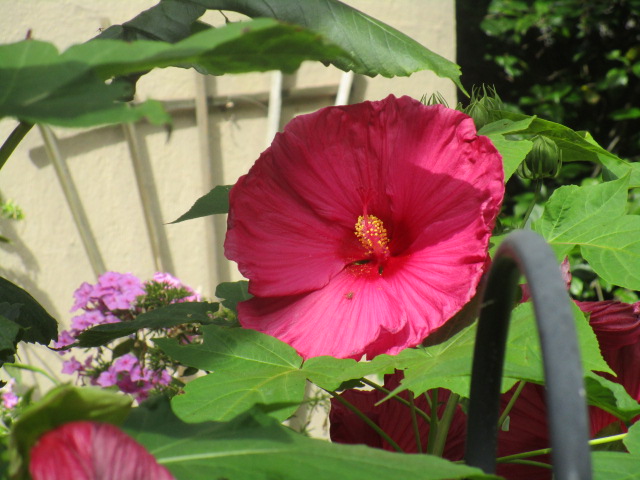
  • Domestic and cultivated flowers now take up the slack in unusual outside colors.  Gardens are in full bloom with annuals and perennials and exotics, such as this hibiscus which somehow survived the harsh winter and is doing marvelously.
  • I do tend to concentrate on the wilder side of harbor sights, but the fact is Huntington is cultivated and mostly tame suburbs.  It’s silly to pretend that these man-made and beautiful landscapes are not just as much a part of the world as any roadside weed or springtime woodland wildflower.

Thursday

  • Queen Anne’s Lace has been opening its wide white heads for a while now.  Soon each will curl into a basket and brown up as it dies.  It’s one of the reliable signs that summer is well past midpoint and autumnal equinox is not far away.
  • As I have grown older, particularly since I turned sixty, it seems I have more time in each day to enjoy the outdoors.  Yet unfortunately my memories are less capacious than they once were, and no matter how much I pack in on each walk it seems to dribble away far faster then, for example, certain recollections of long ago and far away.

Friday
  • One of the few thistles along the harbor this year.  It’s amazing how the same apparently barren spot of cracked roadside can support an entirely different set of plants from one year to another, probably depending on rainfall, temperature, and the randomized dropping of birds and breeze.
  • Almost everything I find now is non-native, even “invasive”.  We feel sorry for the crowded-out original and less-hardy original inhabitants.  Of course, it is necessary to remember that this works both ways _ in Europe American ragweed is a tremendous problem _ we probably made out better on this particular exchange.

Saturday
  • Not sure what these are springing up in the narrow sands at a tiny beach at head of harbor.  Certainly showier than a lot of the other species which tend to be more tucked away than showy.
  • I used to know all the names, or rush to references if I did not.  But as Gertrude Stein said, what’s in a name after all?  Someone who first classified it christened it in some Latin nouns and adjectives, which almost nobody uses anyway.  And the “common folk name” changes from locale to locale.  Better to just accept it as the miracle all such things are.

Sunday
  • Another relatively tiny wonder, also now unknown to me.  Probably in the compositae or astor family.  Beautiful enough for its own needs of propagation, of course, or it would not be here.  This desolate area has nothing planted purposely except a few straggling pines and skimpy beach roses added by the town when they rebuilt the park next door.
  • The bees are now extremely busy in our gardens, crawling around phlox and dahlias.  I’m always amazed at the sheer number of different insects _ giant bumblebees, tiny honeybees, earwigs, and of course the unseen cicadas constantly singing from the trees above.  I often have trouble realizing how much independent life our little area supports, and it is somehow a comfort given the dire stories we are fed each evening.

Hot Fun

Monday

  • A long spell with temperatures near ninety every day, some with breezes some calm, scorching sun.  Kids and many adults on vacation.  Water has heated up nicely: even on Monday beaches are crowded, various craft cram the waterways, and children play at catching crabs and chasing minnows with nets.  Early in the day, on a low tide, there is still some solitude to be found.
  • Not long ago, I loved lonely beaches.  I could not sit still and would walk miles along the sand as the rest of the family sat and absorbed sun.  Now I’ve slowed down a lot, and enjoy places with lots of activity, where I also sit and, I suppose, add something to the ambience.  Even on a brutal day, beaches this time of year are a far nicer place to hang out than the air conditioned prisons our TV doctors are always stridently telling elders to hide in.   

Tuesday

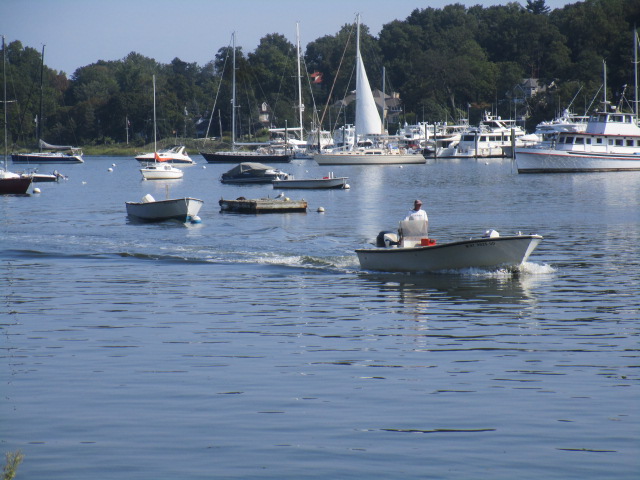
  • Folks heading for their power boat permanently moored in deeper water.  Small boats barely afloat serve to ferry them out and back, the mooring is swapped for the duration.  Even in these civilized areas, theft of such small craft is not unknown.  An even more difficult problem is some being left to decay and rot along the shore when owners move or die or become disinterested.  On occasion the town clears out the whole roadside bank.
  • I never quite understood the buoys themselves, but they are lifted in early fall and distributed anew each spring.  That must be done by professionals _ the spacing must be such that winds and tides will not cause collisions _ and each one requires payment to the town and is jealously guarded by its owner.  In any case, this is the “poor man’s solution,” the rich far prefer marinas with docks, security, gas, food, and everything else including help if it’s needed.

Wednesday

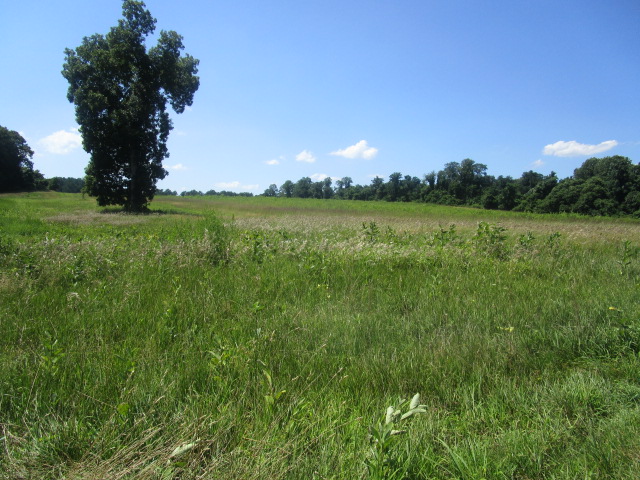
  • Nowhere on Long Island is pristine _ perhaps not even primeval before the first Europeans arrived.  Yet walking along dirt roads through the woodlands and coming upon a meadow of grasses and milkweed like some reminder of centuries ago can allow some contemplation of man and nature.  More so, of course, when there are few other people around.
  • We live on one of the most crowded and developed areas of the planet, so even the parklands are frequently filled.  Like many antisocial people, I have the gift or curse of being easily alone in a crowd, sensing others more as if they were flocks of geese (or passenger pigeons?)  One almost sure way to have maximum room is to go against the grain _ wet cool weather along the beach, or as today inland in humid heat that sends everyone else to the shore.
Thursday

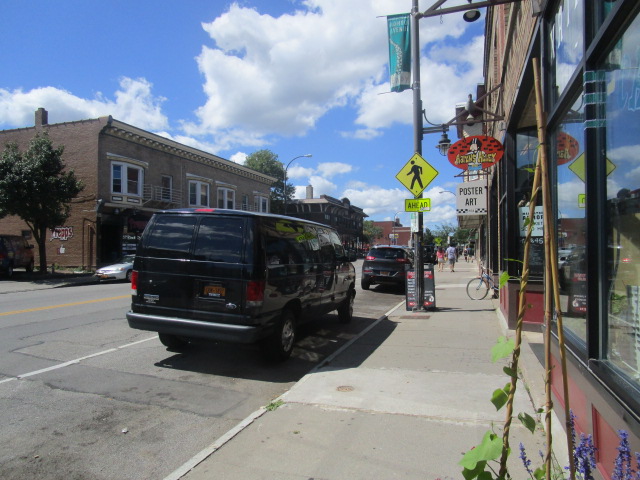
  • When Americans mostly lived along the Eastern Seaboard, and dreamed of being the next Rome (but exceptional!) Long Island Sound was dubbed “The American Mediterranean.”  On a hot August day with sun sparkling on wind whipped waves as sailboats dart about, it almost seems true.  Of course that effete European lake never experiences any winters like this body of water.
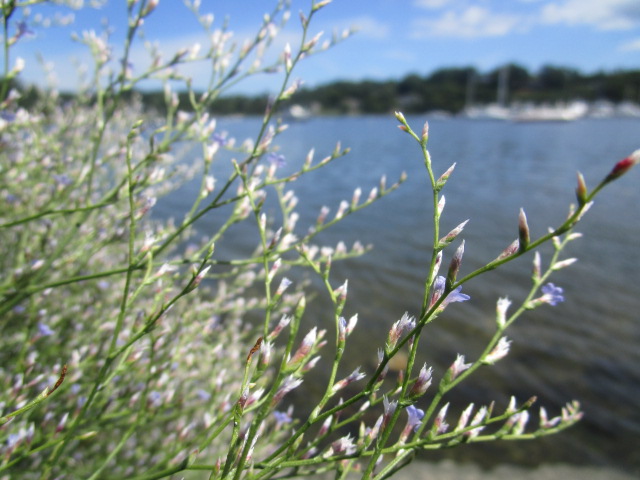
  • We have plentiful public beaches and open areas, grace of bygone wealth and ancestral pride.  Some claim my boomer generation will bequeath nothing but ashes, but I think our record of environmental cleanup, social responsibility, heritage preservation, scientific research, economic growth, and knitting the world with commerce, culture, and electronic communication compares favorably with any others.  This bay, for instance, is cleaner and more alive than it was when we came into adulthood.

Friday

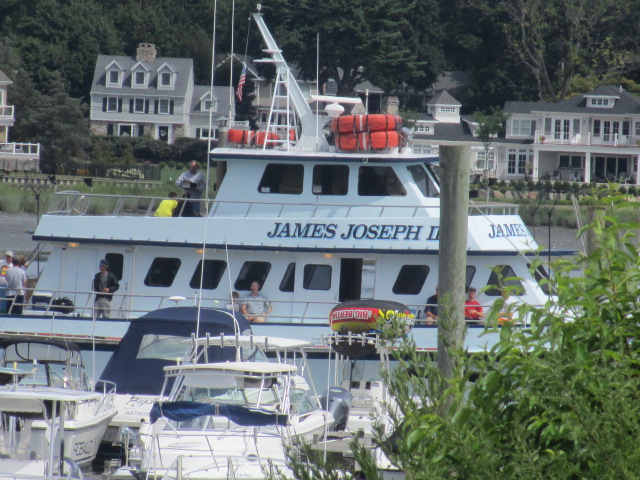
  • The James Joseph goes out several times a day from the town dock, through the inlet and sets up just offshore on the Sound.  Although it can be chartered, it’s mostly just families going out occasionally to fish for something a decent size.  They must be successful, for the boat is usually followed by a huge flock of seagulls feasting on the thrown overboard remains of the cleaned fish.
  • I find it hopeful that there are such activities remaining.  Fish populations must be relatively ok for this to pay well enough.  And I do agree that most true sportsmen tend to be conservationists.  More than that, this helps to protect the local environment more than donations to some remote wilderness, which is also necessary, but infrequently encountered by most of us.

Saturday

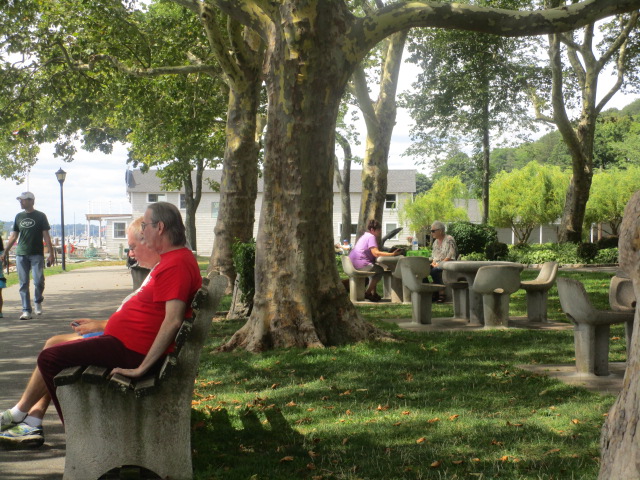
  • This scene from Northport looks like an impressionist painting of the Paris Tuilleries.  People sitting, talking, eating, walking dogs, and mostly watching other people accented by brilliant harbor background.  In times of incessant  electronic immersion, it’s comforting that ancient human patterns and behaviors can sometimes prevail.  Probably people have gathered thus in beautiful places forever.
  • I was amazed to see a couple playing serious chess on an inlaid concrete table.  Once I would have thought doing any more than taking in the spectacle and moving on was a severe waste of my time.  Now, slower and possibly wiser, I am just one of the crowd, letting a golden afternoon slowly drift from future
    to past without any of my help at all.

Sunday

  • Small children need active play, no matter what time of year.  Even in high heat of summer, park playgrounds like this one at Hecksher are wonderful spots.  Sometimes in the overwhelming affluence of this culture, parents try to recreate everything in their backyard.  That can be a losing proposition, since various parks offer variety of scenery, and ranges of equipment to keep kids from being quickly bored.  Plus toddlers grow so fast that often back-yard construction is out of their age group within months.
  • For a while, it seemed playgrounds were being dumbed down to such rigid safety standards that all that was allowed was sliding down a short plastic tunnel.  Happily, I see, swings and merry-go-rounds and jungle gyms are back in fashion.  Total safety is always an illusion, since any of us can severely hurt ourselves stepping off a curb or getting into a bathtub. 

Ripe

Sunday

  • Catalpa seed pods look like giant string beans.  Most are higher in the tree.  The sheer overabundance of everything has always amazed people, leading some like Malthus to gloomy thoughts and predictions, and eventually providing Darwin with the underpinnings to his theory.
  • I usually just walk by without noticing.  Green on green takes a little effort to make out until they darken later in the year.  Yet this tree is producing the next generation as vigorously as any hickory (whose nuts are becoming large enough to dent the hoods of cars carelessly parked under it.)

Saturday

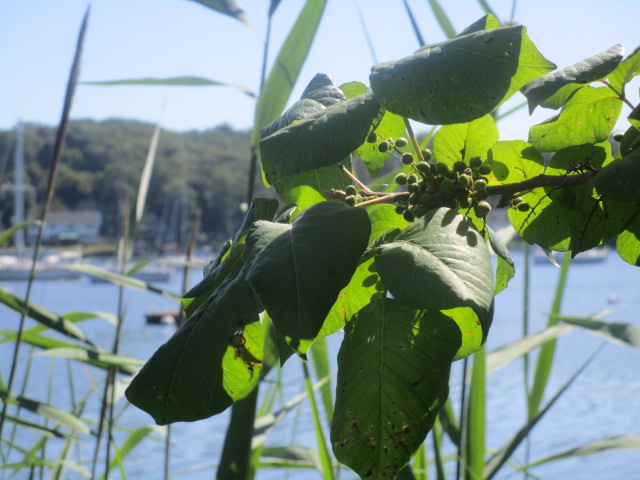
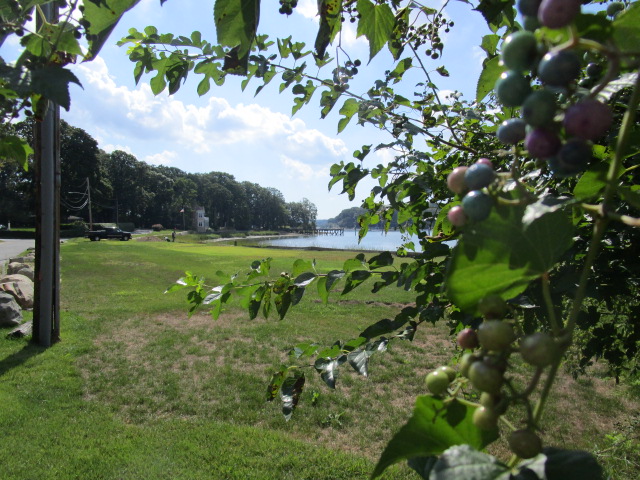
  • Hard to even get close enough to photograph the small berries of poison ivy.   That’s no real trouble, since it would be extremely nasty to eat them.  Perhaps this was the original tree of knowledge of good and evil, and it was rewarded by making its leaves and fruits toxic to people.   Animals do not, apparently, share the same allergic reaction.
  • As far as I know, there has never been an attempt to domesticate or even use poison ivy for food or medicine.  It’s one plant that by luck or careful coevolution goes its merry way everywhere without folks doing much more than swearing as the itch later develops.

Friday

  • Renaissance Christian concepts of the tree of knowledge of good and evil depicted an apple, but even a cursory scan of internet information shows how complex and universal those concepts were in many times, places, and religions.  The standard American understanding came from bible illustrations largely based on European painters.  The common apple is very much a creation of humans, aptly illustrating knowledge and, if one is into good and evil, even the dangers of meddling in genetic s.  Lately even more evils of pesticides and fungicides to create unmarked fruit, or the breeding of ever more prolific but tasteless abundance.
  • My life has been long, relatively happy, and filled with incidents I enjoy remembering.  It is difficult to resist feeling there is some divine purpose, but easy to decide most other people’s conceptions of the same thing are ridiculous.  So I enjoy bible stories as science fiction morality tales, but I prefer modern fables of the same general type.  An apple, however, still recalls Durer and Michelangelo which provide beautiful images enriching my imagination.

Thursday

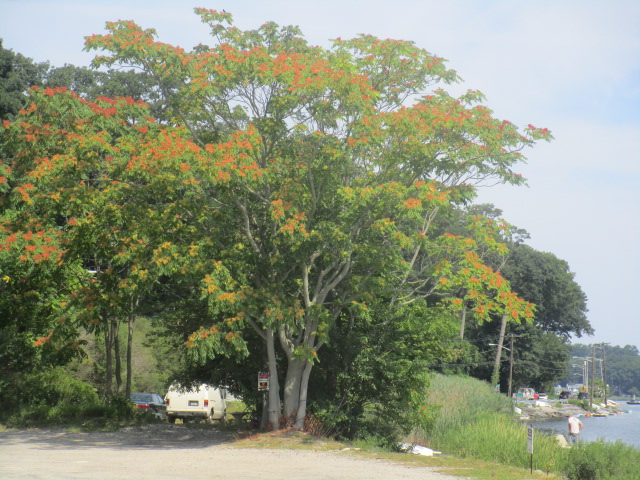
  • Like a long introductory oboe solo, ailanthus seeds deepening into burnt orange herald summer’s future demise.  Since these invasive trees are easily controlled and their pollen apparently does not cause allergies,  they are well tolerated and even beloved by city dwellers.  Some marketing genius gave them the common name “tree of heaven,” which didn’t hurt their cause.
  • Much summer remains.  Today is very hot, but who knows what may come.  We take comfort in averages, but averages are made of heat waves, cold spells, tremendous storms, long droughts, and calm times.  Those are what we actually experience, and even if the rest of the summer hews to average it may consist of strong contrasts.  So also the portents  of any change _ it will surely come, when and how are hardly certain.

Wednesday

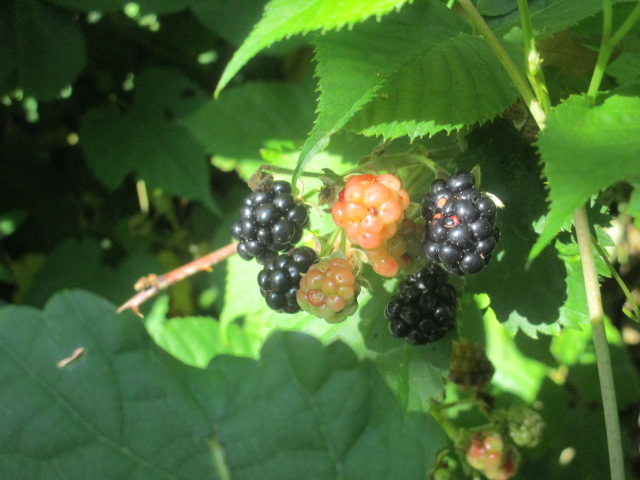
  • Apparently in olden days a summer chore for frontier children was to go out daily with a bucket to pick the ripening wild berries.  Lovely sunlit dewy mornings, clean air, birdcall all around, a pleasant fantasy.  But any chore is work, especially daily, and although perhaps less brutal than some of the other things children back then had to do, it involves stultifying heat and humidity, vicious insects, thick brambles, and disappointment.  Any ripe fruit, like these blackberries at Coindre Hall, are also rapidly harvested by wild creatures.
  • I can imagine perhaps one pleasant morning a year doing such a thing for fun.  Then, being a child of my own age, I realize there are more interesting ways to spend my time, such as useless writing.

Tuesday

  • Rose hips can be made into a nice tea, but it would be hard to subsist on them.  “Paleo diet” fans claim once people left the tropics, they had to eat nothing but meat, although game is also hard to procure every day in extreme cold or drought.  Only the development of staple crops such as cereal grains, potatoes, and corn allowed seasonal famine in temperate zones to be (largely) overcome.  That also led to domesti
    cation with useful byproducts of eggs and milk.  Without agriculture, life with winters or monsoons is chancy and difficult; with it, at least the elite (and the culture it transmits) can usually survive.
  • The “natural” fruits and berries around here are products of long human development.  It is hard to find anything that could be used as a food source that has not been touched and “improved” for use by our species.  Unlike some, I have never yearned for a return to the healthy diets of the past.  For that matter, I am grateful for electricity, chemicals, fossil fuels, and all the other “horrors” of modern food supplies which allow me to eat my fill of anything anywhere at anytime of year.

Monday

  • Everything rushes towards maturation.  Goslings, cygnets, fish, crabs, and infinite varieties of seeds and fruits grow rapidly.  Farmers are overwhelmed with produce, which will continue a few more months until decreasing sunlight and eventual frost bring an end to this year’s production.  Nature accelerates its annual increasing slope towards deepest winter. 
  • People take a bit longer.  My wife and I sat on a dock last night watching the sun set.  It only takes three months to see almost a hundred sunsets, few of us will experience a hundred summers.  Of those hundred, many are when we are helpless children, or increasingly declining adults. According to 1960’s biology, I am genetically useless; according to Spencerian Darwinianism I am harming the species by holding back the most fit.  Human society _ especially civilization _ is supernatural in the sense that it upends almost all natural laws, including those that would have killed me off a long time ago. 

In Heat

.
Sunday

  • Fat city for scavengers, wading birds, and others.  Egrets pluck abundant minnows from the shallows, cormorants dive for minutes at time seeking slightly larger prey, this seagull feasts on a fish carcass thrown overboard after filleting (which is much better than sending it to the town dump.)  The size of the head indicates it was taken in the open Sound, just a short trip past the inlet.  Amazing that such remain relatively abundant.
  • We’ve lost lobsters, dolphins, seals, and oysters from the harbor proper, although oysters may be making a comeback.  It’s hard to imagine how bountiful this area was four hundred years ago, for the natives and first colonists.  But I admit I am surprised that dolphins and seals still roam the open waters,  and that huge fish can be caught frequently from a large party boat that departs Halesite every day.  I hope that means the world is not in quite so desperate shape as I often fear. 

Saturday

  • Fiddler crabs menacing each other at muddy low tide.  So many of the smaller and stranger life forms have even odder sexual and survival patterns.  Happening all around are some form of procreation and development of new moon shells, whelks, horseshoe crabs, periwinkles, seaweed, diatoms, protozoa, bacteria, and who knows what else in the countless variety of a summer briny soup.  All that can be seen are often the tragedies _ empty oyster and clam shells picked clean by gulls, carapaces of dead horseshoe crabs.  And yet, even in these polluted and crowded shores, life is throbbing to the seasonal rhythm.
  • I know nothing of, for example, the mating habits if any of fiddler crabs, nor anything of their life cycle.  Yes, I know all that could be quickly gleaned from an internet search.  But if I cannot know everything, of what value to me is knowing such details?  I find it more important to take the time to notice that the crabs are crawling around, dashing for cover at every shadow, and filling their days incomprehensibly in the hot sun.  Sweating here beside them I am a part of the dance in a way I can never be in front of a computer screen or book, no matter what I think I am learning.

Friday

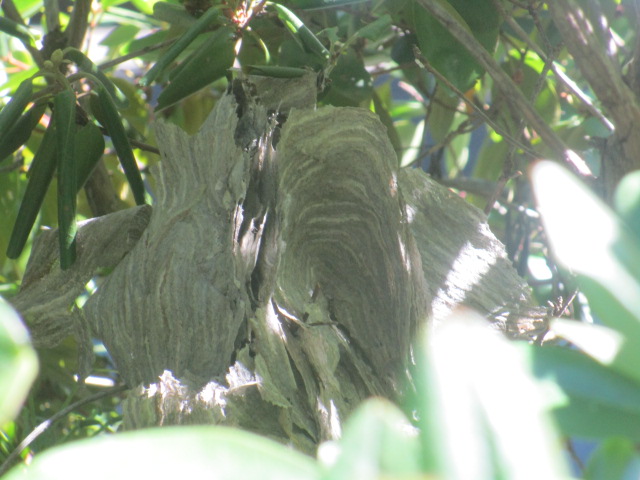
  • Beehive in a shrub.  Seems to be real bees, not wasps, hornets, or yellow-jackets.  With all the flowers around the yards, bees are welcome sights.  Industrious and important parts of any ecology, and severely threatened by pesticides, parasites, and other dangers in recent years.  When there are lots of bees, it is easy to feel that things are right with the world.
  • But, like a shepherd confronting a wolf kill, I am conflicted.  Part of me considers it a privilege to be hosting a beehive on our front yard.  But another part loudly claims “it’s our yard!”  Bees sting _ trimming, weeding, and general work in this corner will be all but impossible.  Can’t move them without destroying them.  Maybe the winter will get rid of them naturally, but if not?  Ah well, for now procrastination seems the best policy, especially since they didn’t sting me when I disturbed them by pulling out a grape vine.  

Thursday

  • Cold front moved through last night with splatter of rain and subdued thunder.  Today thermometers read the same, but air is crisp and clear, far seems near, colors sparkle.  Sweat dries immediately instead of running in rivulets and drips.  Heat is not just heat.
  • Time for cultivated species to shine.  Most roses and all crops would not survive without cultivation and care, but they are still beautiful and necessary.  Arguments rage as to what is natural and what is “secrets with which we dare not meddle,” but humans take every genetic accident they consider useful and cause it to triumph over other, better suited, species and varieties.  No real value judgements here, just pointing out logical inconsistencies. 

Wednesday

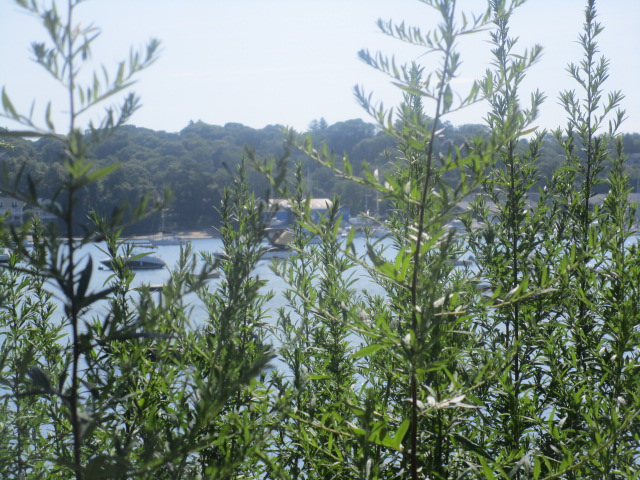
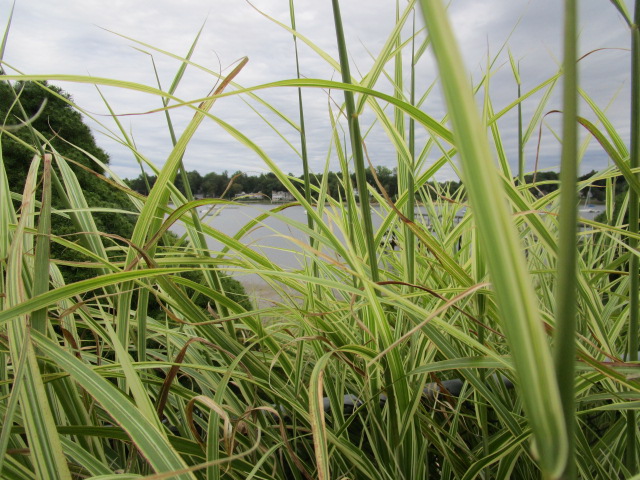
  • No cotton around here, but the phragmites are high.   A day may be hot even with constant cloud cover, the world slowly braised and wilted together.  If the sun breaks through, frantic admonitions will be issued on media for everyone to stay inside and drink approved liquids.  Adding to hysteria, alerts and warnings of smoggy air quality as if mustard gas were arriving on the Western Front.
  • (Some disconnected neurons contend the pink flowers are Joe Pye Weed, but I wouldn’t put money on it.)  When I was young, before much TV weather or air conditioning, I never remember my parents telling me that I didn’t have to mow the lawn because it was too hot (and July was always too hot in Philadelphia.)  My track coach would issue us a salt pill before sending us on a ten mile training run _ it was thought water would give us cramps.  Like all older generations, we think the next ones are less and less rugged, more unable to handle the simplest problems, and it increasingly annoys us that they seem to muddle through just fine.  

Tuesday

  • Although now is the beginning of fat time of year, when there is lots of food for everything, it is also the beginning of stress and attrition.  Voracious insects attack foliage, any long periods of missed thunderstorms and other rainfall lead to stressed leaves, curling brown on outer edges.  Accidents and other issues cut into newly born populations.  But it’s glory time for ragweed, ready to take over where anything else has failed.
  • Ragweed almost requires people, because its main requirement is that we disturb the land frequently and render it completely unnatural compared to its “native state.”  Of course, that image is somewhat silly _ ragweed evolved long before people, taking advantage no doubt of natural disasters that also upset equilibrium.  When I think of things as dichotomies _ stable or disturbed, natural or man-made, even beautiful or ugly, useful or not _ I am deeply into a pattern that is true in my own mind, and perhaps shared by a few other similar humans, but in no way objective nor in a formal sense “correct.”  In my arrogance, it is easy to forget that is always so.

Monday

  • “It’s too darn hot” goes the old song.  For much of the natural world _ birds, fish, many plants, some mammals _ sex has wrapped up for another year.  For those species, it’s all about the next generation, like ripe grasses along the roadside.  There are more animals, as ruthless nature begins the winnowing process.  Insects are probably still madly procreating, which spiders are quite happy about.
  • In spite of the Kinsey report, humans seem to manage to “sport” in all but the most extreme conditions.  Lately, many of them refuse to be winnowed.  A growing problem _ yes, that’s a pun.  Anyway, the race is on as to whether we can control the urges of our species or let them run wild until inevitable catastrophe.  Hot bright sun on this hazy morning, lush scenery and even our toys ready for water play, should provide reasons enough for us to seek to preserve our miraculous heritage.