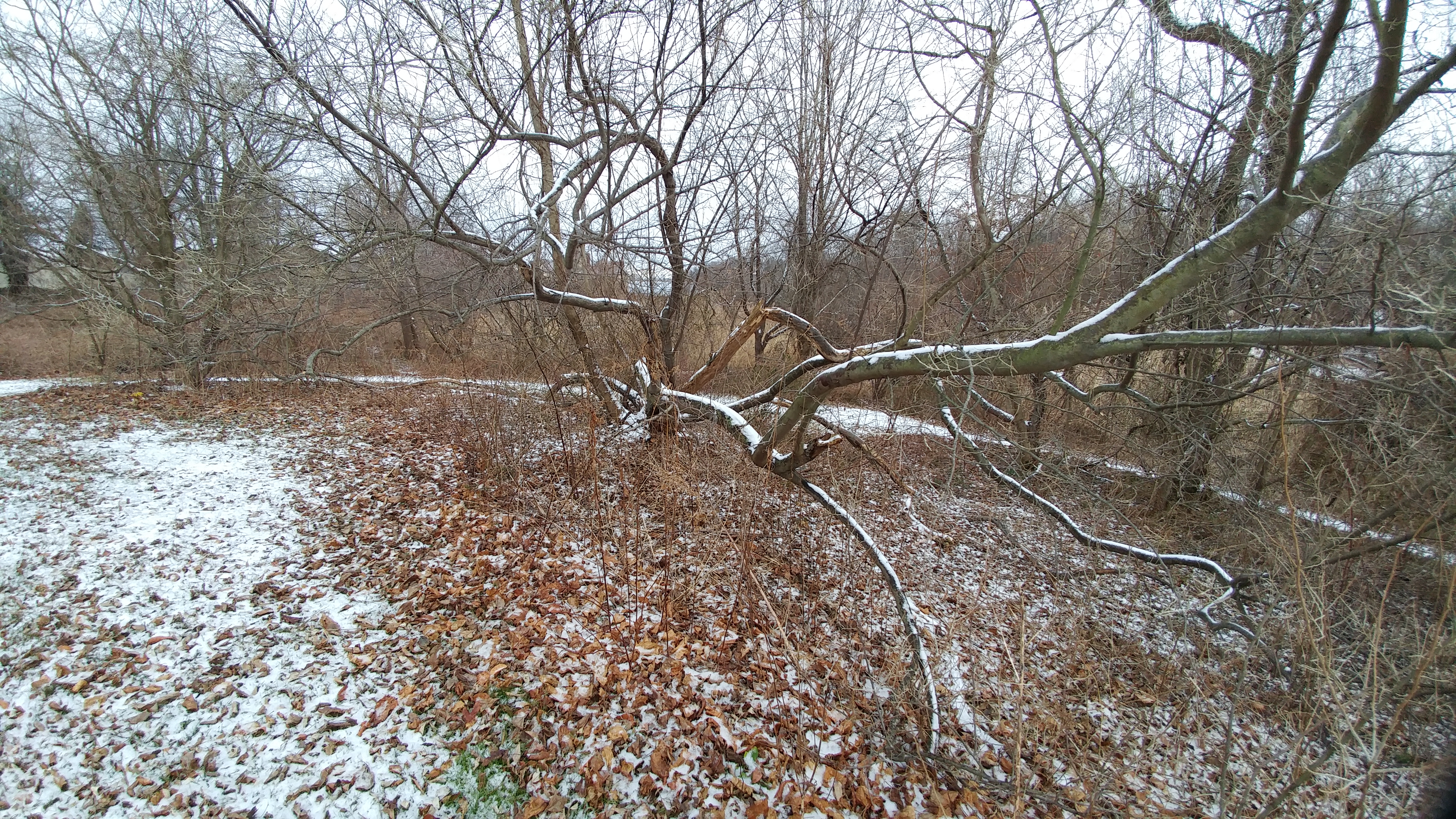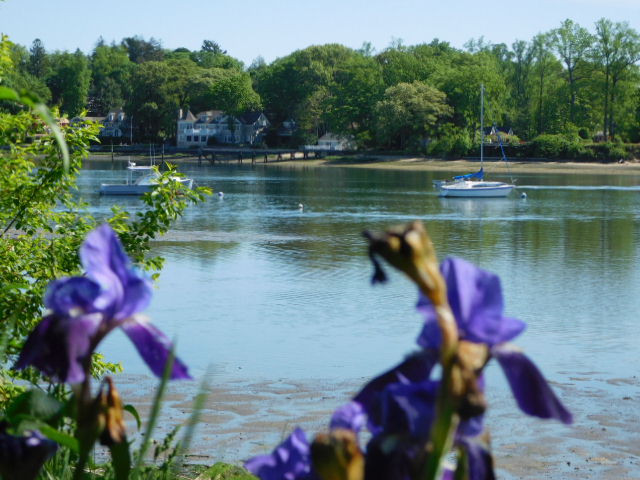
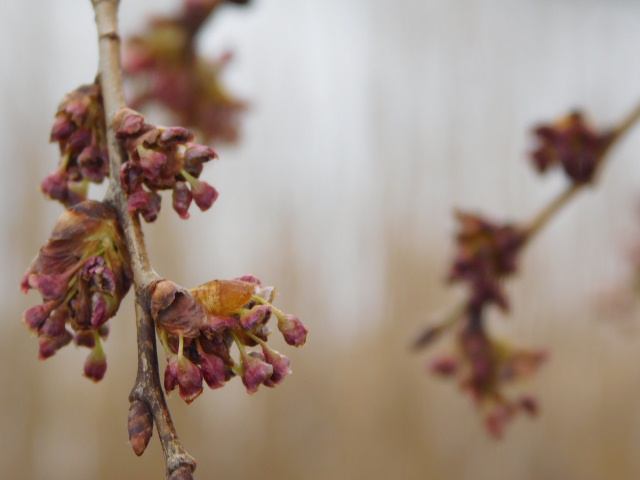
No Extravagant Equinox

Relentlessly, silently, new growth and promise creeps from what long appeared dead growth.

Equinox has come and gone, with only TV meteorologists paying attention.  Spring has arrived, they claim, but it is still cold, and the land remains dormant.  Oh, the sun is brighter, and longer, and there are moments of warm hope.  Birds arrive from the south, chipmunks come out of hibernation, any time now pockets of insects will float on the breeze. 

But an industrial culture hardly notices.  No flags, bagpipes, or marching bands down city streets.  No wild party celebrations.  We’ve had Mardi Gras and St. Patrick’s day and soon the (anti-festival) of Income Tax Day.  Equinox goes by with less of a whimper than even Summer or Winter solstice.
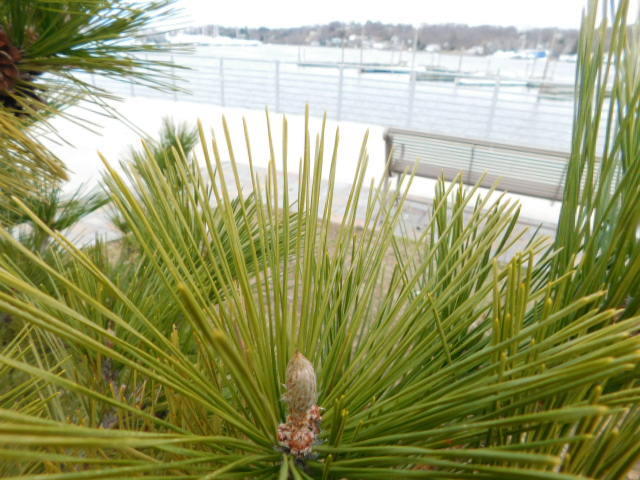
Sky winter grey, air February cold, but bright hopes shine for those who know where to look.

In ancient, agricultural and hunter days, there were rituals for the various moons of the seasons, careful calculations of solar events, occasional sacrifices to the various gods.  Especially on the great Northern land masses, it was critical to know when the days reached certain points, for the stars, sun, and moon guided when to plant, when to do other preparation for the climax of natural cycles.

Spring signs are often confusing.  Crocus, forsythia, greening grass, animal mating ritual all occur to their own needs and rhythms.  Appearances deceive, for water can be warming, ice thinning, earth reawakening with almost no outward sign.  The sun, however, provides a relatively stable fixed point from which farmers and hunters can confidently say _ in one locale _ that this is likely to happen now.

All that is lost to us.  We have a rich and interesting culture, but it is not oriented to solar, nor even terrestrial, events.  Equinox hardly matches the excitement of basketball tournaments or the start of soccer and baseball training. 
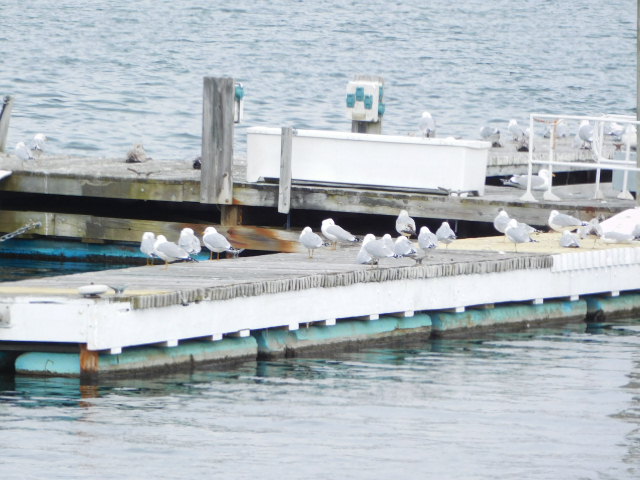
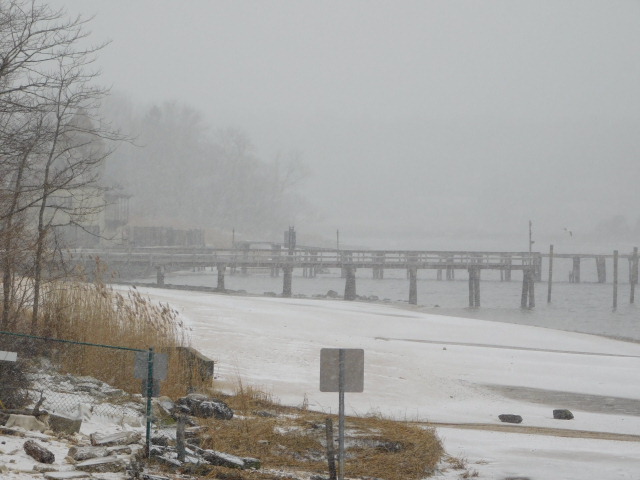
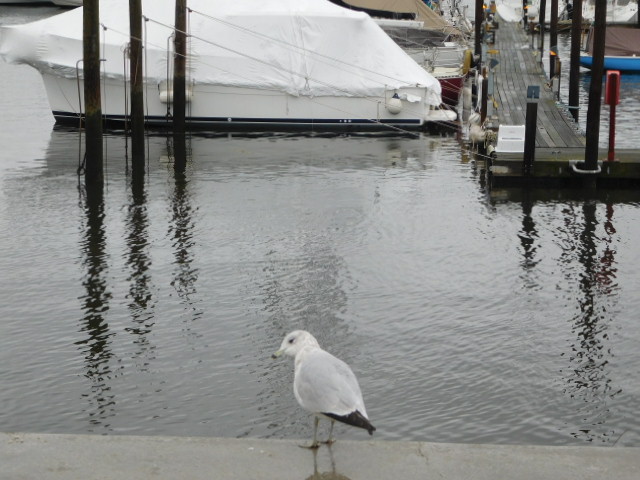
Seagulls rule the dock until the masters of absent vessels try to take it over once more.

Clocks and watches and automobiles and electricity and indoor malls and electronic entertainment and … well the list is endless … have destroyed our sense of cosmic time.  We live seconds and hours and even days that are artificial.  Seasons have little meaning, for work continues with only scattered interruptions.  Besides, almost anyone can escape to another climate anytime for a weekend or longer.

I am not complaining.  In the “natural order” of not long ago, I would have probably been dead over thirty years ago, certainly dead ten years ago, and if I had somehow managed to attain my current years I would have been a lonely and pain-racked cripple, unable to do the simplest tasks of the culture.  Today I eat well, I drive, I live a life that is “normal” for these wonderful times.

Paradoxically, that means I am one of the few folks who have the time and energy to actually enjoy seasons, nature and the old-time celebrations of a sun-based seasonal calendar. 

As A Child

Jumbled relics line the shore, each mysterious and magical, ignored by those over 3.

Every young grandchild is above average in every way.  My wife and I find that we had largely forgotten our own sons’ toddler years, when we were too busy to think or notice much more than how we never got any sleep.  Now that we babysit a two-and-a-half year old, I am constantly amazed at how rapidly humans become competent.

We thought we childproofed our house, but we were wrong.  Clever hands and inquisitive mind.  A little while ago he was babbling incoherently, now he easily orders everyone around.  Shaky crawling has given way to study runs, jumps, and spins.  Expensive baby toys are no longer relevant.  Impossible puzzles have become boring exercises. 

Each day, it seems, another ability manifests.  Cutting, or counting a little higher, or recognizing a complex symbol as a letter, or remembering the pages of a storybook.  Following complicated instructions, knowing how to get older people to do things, finding interesting ways to become interested in the world.  Showing, at times, fierce concentration to obtain mastery.    

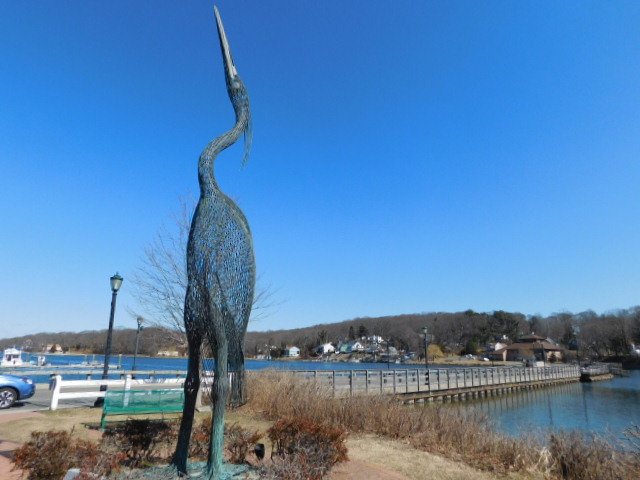
A fortunate few manage to hang on to a sense of whimsy as they grow up, some of them produce unexpected sculptures.

Some people, particularly the lonely, now claim consciousness and intellect for various species.  That all depends on definitions.  Dogs, bred to be both useful and appealing, are the most commonly noted.  There seems to be majesty and intelligence behind those big eyes.

But compared to what any normal child in their third year can do, the rest of the animal kingdom is pretty dumb.  They cannot respond to a complex choice (“would you rather go outside or sit and watch tv?”),  they cannot manipulate blocks into a building which then then play with as a fire station, they cannot draw a circle on a chalkboard, nor learn to sing along with myriad songs.  Watching a person grow at this age easily demonstrates why humans have become, for better or worse, masters of the planet.  Without really exerting themselves too much.

Ripples and reflections and rocks under shifting light _ a natural abstract artwork for those with eyes to see and just a little more time than most of us have.

We all ask: why do perfect little angels grow up into something else?  But adults are amazing too _ we just take everything for granted.  We take ourselves for granted.  We are not simply logical machines, we are not just wetware instinctively reacting to the environment.  Truthfully, no person who contemplates existence ever believes they understand the reality of our being.

This is a cynical time, in which we all consider ourselves worldly-wise.  Each of us is Hamlet _ able to recite “what a piece of work is man …” but finally agreeing with him that each of us is just temporary futile dust, of no consequence to anything.  Our little toddler is certainly “a piece of work,” and hopefully has a long way to dustdom.  In his simple momentary happinesses, I find my own better equilibrium with our miraculous universe. 

Coiled

Often by mid-March andromeda has been blooming a while, but not this year

When I was working, early March was the easiest time.  New annual projects were in their most productive and least annoying stages.  Commuting was relatively mindless and hassle free.  There was no envy of passing the day at a beach or park.  And increasing daylight promised that vacation and outdoor fun, not to mention late spring holidays, were just over the horizon.

Now, brilliant sunshine deceives.  I spring  out the door into what I think will be a glorious experience, and am hit in the face and bones with biting raw chill.  I frantically seek signs of emergence of life, and find them (if at all) creeping much too slowly for my taste.  Where are the daffodils?  Where the pussy willows?  Alas, only in the supermarkets, flown in from foreign lands.

My environment remains coiled.  The force of spring runs in maple sap, bulbs are gathering strength, migratory birds are already on the way north.  Mating antics break out in wildlife everywhere.  Careful examination reveals that indeed tree buds are beginning to swell and color, briars and roses are unwrapping leaves.  But all resembles sprinters prepared for the starting gun, coiled for action, motionless at the moment.

A few clusters of rose leaves brighten my increasingly desperate examinations.

March is, after all, part of winter.  Ski resorts do landmark business.  People flee to relax on warm beaches in the south of Florida or always-warm Caribbean.  Snowblowers, shovels, and salt must be kept at the ready.  Evening soup is preferred to salad.

But as equinox approaches, we remember similar daylight back in September, when all was still warm, trees green, and the outdoors lingering in hospitality.  The cruel differences are not quite apparent as I gaze out the window.  

Fortunately, we humans are also aware of time and cycles.  I know, intellectually at least, that September is a crueler harbinger of a long dark cold time to come.  March is the beginning of new bursting joyful life.  Both take a little while to get fully underway.

Bulbs shoving up in earnest, now leaves must be cleared and fertilizer applied on the thawing flower beds.

Like those in ancient tribes, I find it elegantly easy to anthropomorphize nature.  Spring is posed, ready to move, just awaiting the perfect moment.  Animals and plants are moving into position in the coming extravaganza.  The wind is cruel, the storms capricious, mother nature fickle.  Each cold snap or snowfall seems a personal affront, each day over fifty degrees a reward.

Science is a fine thing, civilization wonderful, but we remain deliciously tied to our prehistoric instincts.  In some ways they are more captivating and real than all our logical constructions.  March can be crueler than April, and is easily visualized as being so on purpose.  That gives us perspective, and for all we know is true reality.

Comin’ Tomorrow

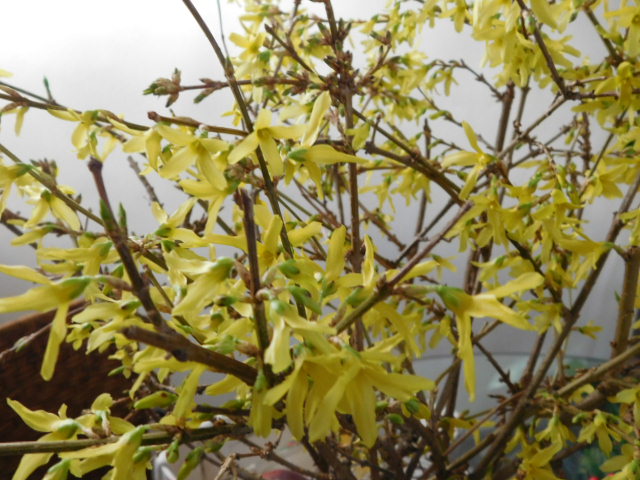
Forced forsythia still bloom extravagantly in the kitchen, promising better days outside.

Took a frosty morning walk along frozen paths at Caumsett State park, enjoying clear blue sky, bare tangled woodland, brown meadows.  Horses soaking up strengthening sunshine, beech leaf buds surprisingly swelling, a chipmunk early out of hibernation scampering on a leaf, and daffodil shoots barely peeking above the soil here and there.  Late winter harbingers of spring recalled all my other springs as if nothing has changed. 

Away from the constant cries of print and electronic media, the world seems well.  But I am informed that it is not, that in 12 years or less than a century _ or possibly next week _ environmental disaster will kill everyone, or civilization will crash into desperate anarchy, or human dreams will finally end in nihilistic failure.  The beech tree and the chipmunk are deceptively normal:  I am enjoying the last glories of a doomed planet.

An old depression-era song goes “don’t know what’s comin’ tomorrow.”  Nobody does.  Any savant who claims knowledge of what will be in 20 years is a charlatan.  Extrapolations, predictions, prophecies have a way of twisting into strange forms, even though some of them may get some things right, in some kind of way. 

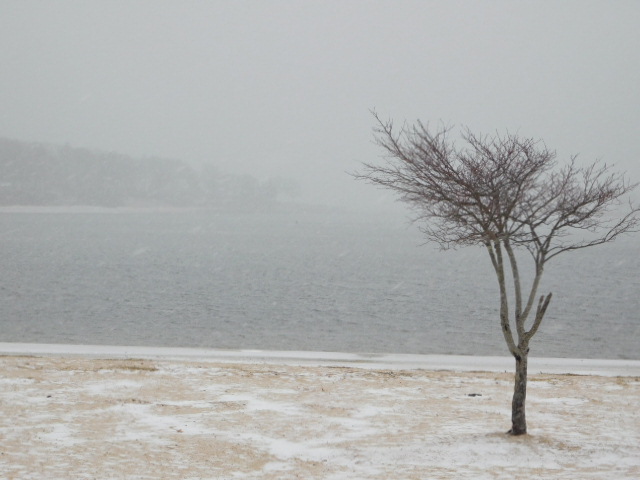
March contains nasty snowstorm surprises, each one hawked as the next grand disaster.

I may be cynical because as part of the boomer generation I have often heard, and occasionally heeded, experts crying wolf for over seventy years.  “Ban the bomb” and the “Population Bomb” and millions of other doomsday scenarios have come and gone.  Life, culture, reality have endured.  Maybe this time scientific experts are right.  I remain too jaded to worry.

Individual existence has always been precarious.  None of us know if we will see the next weekend.  All of us know we will not see the next century.  Science has tried to seduce us into seeing reality in the long, geologic view.  Consciousness, however, is measured in moments, not eons.  My personal story is hardly different than that of any peasant in any other age, when famine or plague or barbarians or simple bad luck could ruin all hopes, and even being, in an unexpected instant.

This time is different, they chant.  The problems are not individual, not local.  This time is everywhere, global, for all time.  I understand intellectually, but viscerally I still exist today under clear blue skies, watching a chipmunk run.  I sip a glass of water, read a book, write this as I always have. 

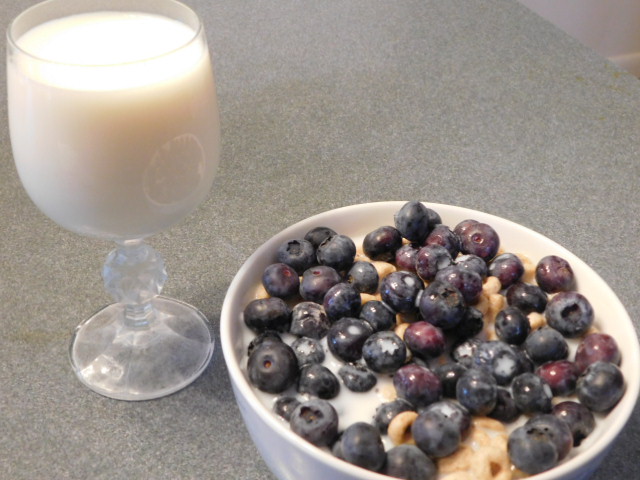
My seemingly simple breakfast is composed with oats from the Midwest, blueberries from Chile, milk from upstate NY, all using energy to grow, prepare, package, transport _ industrial civilization on a grand scale.  

The ditty continues: “travlin’ along, singin’ a song, side by side.”  Each day which remains is special.  These moments are special.  The future may hold terrors, or everything may work out nicely, but I will never know.  Trying to know is futile, and I confess that I regard most of the gestures of many others as useless superstitions, placebos of the mind.  Bicycling to work will no more stave off carbon disaster than wearing a saint’s relic will prevent black death.  But it makes us feel we are at least doing something.

After my walk, I remember trees abundant over hills, horses romping as breath glows around them, and countless geese taking a sedate crowd walk across a field before one panics and the rest take startled flight with raucous cries.  Tomorrow _ well I don’t know.  I will fight for memory preservation of today, never extended forever.

Cold Comfort

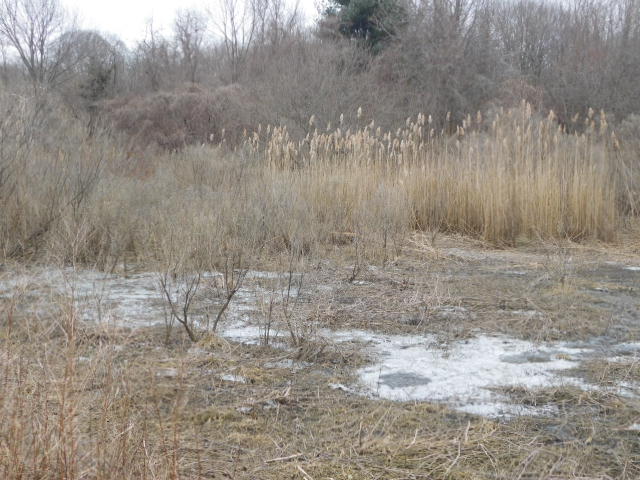
Ice barely skims puddles during this year’s freeze/thaw gymnastics.

Around here, some people love the winters.  Others despise, endure, ignore, or accept its cold and snow.  When I worked I was often happiest in winter because I did not think I was missing out on anything else.

Most residents claim they like the change of pace, the natural reset.  We get fabulous cycles of spring, summer and fall.  My own feelings are probably the result of growing up in a similar environment; perhaps we are always eventually happiest where we recall our childhood.

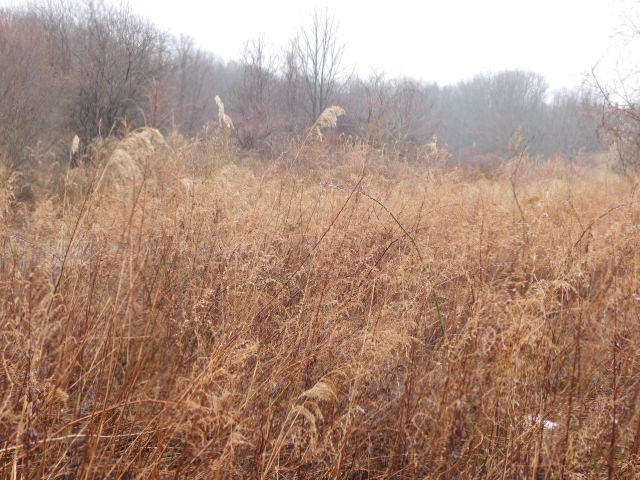
But sometimes, day after day can be wearing.  We have fortunately avoided heavy enduring snow cover this year, but by late February with no signs of breakout, winter has worn out its welcome.  Not even the tips of spring bulbs are showing, except for a few snowdrops.  Brambles have no baby leaf shoots.  Grass remains brown.  Bright sunny days are a kind of mockery.

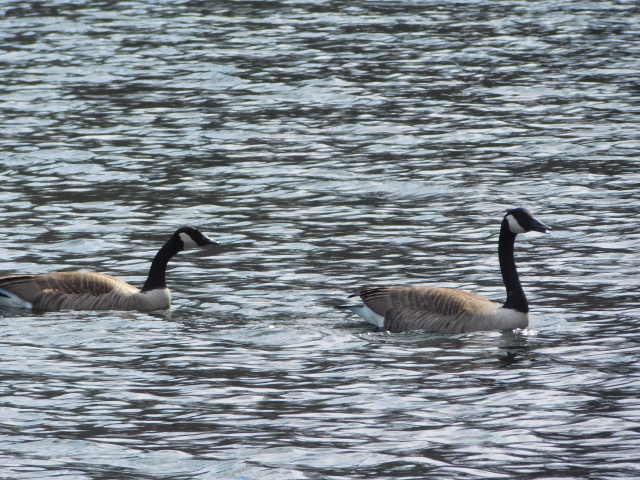
Male geese display as much frantic pre-spring bravado as any human males at the local bar scene

Enervation and cabin fever are likely afflictions.  It is all very well to try to meditate or think deep thoughts, to catch up on reading or entertainment, to go out to eat or attend various events.  We are fortunate to live in a society that offers so much.  And yet …

Sometimes when it is 23 outside, and clouds promise chill wind or damp snow, it is awful hard at my age to jump out of bed.  I become prone to just sitting with an empty mind and no ambition whatsoever, content with memories and less.  Any activity a bit too much to begin.

However, when I do get a move on, when I ramble through silent muddy woodland trails or near-tundra meadows, I am profoundly grateful for the unusual quiet and solitude.  Everyone else seems to be somewhere else, my whole immediate environment is mine alone.  King of the world.  Empty spaces all around, as close to nature as it is ever possible for me to be.

In spite of occasional power takeoffs with frantically flapping webbed feet, swans emanate total calm.

Besides, the glide to spring is in full force.  Days are much longer, sunsets much later, daylight much sooner.  Most puddles melt when hit by the increasingly strong rays of the sun.  If I search hard enough there are plenty of signs of life stirring, from the frisky squirrels stealing from the birdfeeder to the swans beginning mating flights over the harbor.  Rumor has it that a local park already offers lessons in maple-sugaring. 

The best thing about the end of February is that these deepest of winter hours also hold the most hopeful promises of what is to come.  For one more year, I have survived the bleakest times, and any terrible weather day is simply a temporary setback. 

Truly nothing to complain about.  I’m warm, well fed, healthy and entertained.  By all measures, a genuine king of life.

Fading Omens

Raindrops and fog are just as pretty as flowers glowing under clear sunny skies.

Our environment is so infinitely rich that we often fail to notice the absence of something.  Unconsciously, we are tuned to detect threats from something, rather than nothing.  That is why the so-called sixth extinction is so insidious. 

I would worry if thousands of dead ducks floated on the harbor, but I am less aware that this year instead of scores of buffleheads I have seen only two.  I would be aghast at masses of dead monarch butterflies carpeting my yard in summer, but rarely pay attention to the fact that there are few where there used to be many.

Extinction in our times is not often massive.  It is a phenomenon of less and less, becoming none.  It is not suddenly in one area, but gradually everywhere.  That is the most frightening aspect of the tragedy, that we will be mostly unaware until it is too late.

Truly empty puppy cove, not even a seagull or crow, let alone a wild duck.

Children of the suburban post-war era are used to vanishing local wildness.  I grew up familiar with roaming box turtles, ground-nesting birds, various types of snakes, odd insects.  As they disappeared, I assumed there were still lots more over the hills, upstate, in the jungles described in National Geographic.

On Long Island, only forty years ago, there were lobsters being harvested nearby, toads in the sand of the south shore, bats flying at twilight.  My wife remembers seals in Huntington harbor.  We assume that they have simply moved to better places.  We are overoptimistically wrong.

Life is tenacious.  There are lots of squirrels, pigeons,  gulls, rats, raccoons and mosquitoes.  Current worries are diminishing bees and other useful insects, a drop in numbers of horseshoe crabs, but they are still easily found. 

For years, migrating bird counts have been plummeting, a sign that all is not well elsewhere.  Articles from alarmed scientists note the end of many species, a disastrous fall in insect activity, the possible collapse of rain forests.  But those are far away, out of sight, out of mind, as I take my local walk.

Weeds will certainly survive any human apocalypse, and all unknowing will provide what was once considered beauty to an unappreciative world.

I like to fantasize that something will be done, that it all will work out, that somehow my childhood Pleistocene paradise will be saved or will save itself.  Logically, I understand that such is too late already. Looked at one way, humanity is just another natural catastrophe, like an asteroid.  No more use to lament extinct birds or frogs than extinct dinosaurs.

I grew up thinking nuclear war would destroy everything.  It has simply taken a little longer.  Back then, I knew there was nothing I could do about it.  Still feel the same way.  An awful lot of people voted in an anti-science administration.  An awful lot of people are willing to kill a rain forest to have a new floor.  An awful lot of people need to eat and are willing to do whatever it takes.  Me yelling “stop” at them has no effect whatever.

So at times like this, I simply put it all in one bucket and enjoy a possibly dying world as I am enjoying a soon-to-die self.  There are still wonderful experiences, still possibilities.  Maybe all the rest will work out, but I will never know.

Ch’ill

Passing heavy snow shower reminds us how much worse this winter could have been.

Winter has seemed relatively mild, in spite of an occasional visit by the polar vortex.  Only major snow near Thanksgiving, ongoing a less-than-half-normal amount.  There remains lots of time, but with equinox peeking around the corner of the next month, the length of days and angle of sun would already make lingering snow cover for weeks unlikely.

The harbor has never actually frozen over, certainly no mini-icebergs.  A few times the fresh water floating on top from shore seepage has formed a light skim, and once or twice severe cold with wind froze even salt spray on the docks.  But those times have been few and far between, and Huntington remains an ice-free port.

On the other hand, for our own extended family, seasonal illnesses seem to have been circulating since early December without letup.  Flu or norovirus or something unnamed is always being fought off, coming on, being endured, clearing up, or finally gone.  With toddlers, young adults in health professions, and elders who like to shop, it seems that someone has always had something to donate to the stew for the next round.   Being stuck inside together all day in extremely dry heat doesn’t help.

The famous “Blizzard of 1888” didn’t come along until March 11 of an unusually mild winter, so nothing is certain about the rest of this season.

Nature even seems to be holding back.  There are far fewer birds than normal in the local waters, not even so many at my backyard feeder.  Only squirrels seem up to their regular numbers.  I only hope that avian crowds have found more congenial spots somewhere else, and that our empty waves do not portend something worse.

Often by now, a “January thaw” or some other week of warmth would have started bulb shoots and some buds well on their way, might have slightly greened grass.  Not this year, all remains brown and seemingly lifeless.  A few snowdrops at the end of the driveway are doing their best, and I shall cut my traditional forsythia branches to force indoors, but I’ve seen mid-February’s with a lot more signs of spring.

Hard to remember this beach packed with blankets, bikinis, teens, toddlers, parents, and elders as it will be again in a few months.

In dead of winter, especially when health is shaky, I find it too easy to sink inward and forget spring is coming followed by long seasons of summer and fall.  Retired, I read and eat and perform repetitive tasks each day, so that all days seem like the same day.   Getting dressed and going into the chill is an adventure. Another cycle has begun, and its progression will eventually seep into my bones, then flow into my soul. 

Spirit World

Is our reality as insubstantial as reflections on calm harbor water?

Some people age into religion.  Consciousness of mortality brings out the best and the worst.  Perhaps the oddest aspect of this change of perspective is that there is so much diversity in our “religious impulse.”

I am well aware of multiple realities.  I encounter, for example, one set of things I have definitely experienced while asleep.  I experience another set, with more rigid rules, when awake.  I may be happy or sad within instants when confronting exactly the same scenario.  Daydream imagination, unfounded worries, or specious plans are constant companions.

Rarely do these different aspects of my consciousness fully interact.  The rules of my awake self do not apply in dreams, nor vice versa.  The mood of this moment vanishes rather than clashing with my next mercurial emotion.  I accept this complexity and contradiction as part of the mysterious miracle of existence.

I believe my contrasting experiences are each real within my universes.  Dreams of flying over fields or taking a detested test or talking with dead friends are memories as sharp as those of going to the grocery store yesterday morning.  Since all remembrances are suspect, dare I judge which is more real than the other?

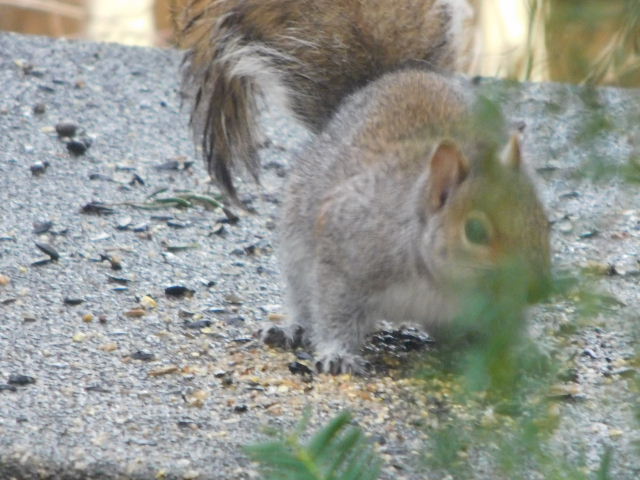
Where do I fit, where do other people fit, and what about all the rest of it including this squirrel?

But that is my personal universe.  We can both remember going to the supermarket together, but our dreams are sealed from one another.  I may see you in my dreams; you do not simultaneously find me in yours.  I know the “whole” universe is mysterious and unknowable, so none of that distresses me.  I accept that “ultimate reality” is truly ineffable _ we are incapable of knowing it.  And I leave it at that.

I object to others who would try to force their own rigid alternate visions on me.  I encounter personal “truths”, they find their own,  each is unique.  I refuse to believe any prophet knows more than I do about how I experience life.  Anything beyond what we call “objective reality” _ which is to say the passage of days, the effect of gravity, the happiness of a good meal, and so on _ is disputation in vapor.   

The more fervent the preaching, the faster I run. 

Standard reference for resurrection are deciduous trees _ I prefer these nearly-blooming snowdrops.

Science is a fine thing, but it is only a tool.  Human existence is as ineffable as the cosmos it inhabits.  Scientific measurement of purpose, joy, love, friendship is cold and useless.  Like any tool, science has proper uses and improper applications. 

People are fine-tuned to be people.  What we can experience is what we should experience, and at least in some sense that is what “reality” means.  Moreover, people are social creatures, and some of our existence requires interaction with others.  We can share bread, we can share work, we can share love: we can only share individual visions through the power of words.  In spite of the claims of ancient philosophers and prophets, words are not the basis of my spiritual worlds.

Midwinter Silence

I’d like to claim the sky is often quiet, but that would be a lie.  It is, however, always beautiful

Fast paced times and consumer obsession result in loud suburbs.  Spring begins the building season, until late fall _ cement mixers, lumber deliveries, hammers, bulldozers, dawn to dusk.  Earlier spring echoes with chain saws and leaf blowers, which scream into early winter.  Always overhead jets, always around sirens, summer filled with motorcycles, helicopters, trucks, cars, dogs, music, outdoor parties. 

Winter has become the only period of grace, when gentle sounds of nature are not eliminated by mechanical cacophony.  I walk beaches and shores, listening to the crunch of leaves, occasional birdcall, slap of wave on rock, wind in branches, geese flying, profound hush.  Once upon a time, I assume, quiet was a normal state.  In any case, it is unusual enough now that I find myself almost shocked when I pause a moment and hear _ nothing at all.

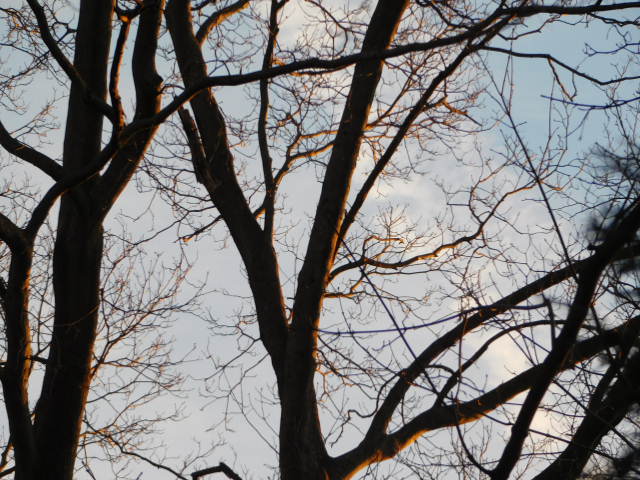
It is so easy to ignore the common everyday miracles of our existence _ sight and color and sleeping tree limbs.

Like the old but true cliché of steam train whistles echoing for miles across the plains, noise in the suburbs carries more widely than in cities.  Houses torn down across the harbor, trees cut on far hills, garbage trucks many neighborhoods over are easily and always heard.  No barriers baffle any sound, and dense population with money to burn means that something is always being done somewhere.

Once in a while, in midwinter, a deep snowfall will hush even this neighborhood.  At least until the snowplows and snowthrowers come out, around nine or so.  I am guilty myself.  It’s a facet of this way of life never remarked upon in sales brochures. 

In fact, lately, almost everyone stays inside most of the time, shutting away the world with insulation and thick glass.  The few times anyone ventures outside, for a barbecue or to direct garden work crews, they come equipped with loud music.  Which, of course, just adds to the general decibel level.

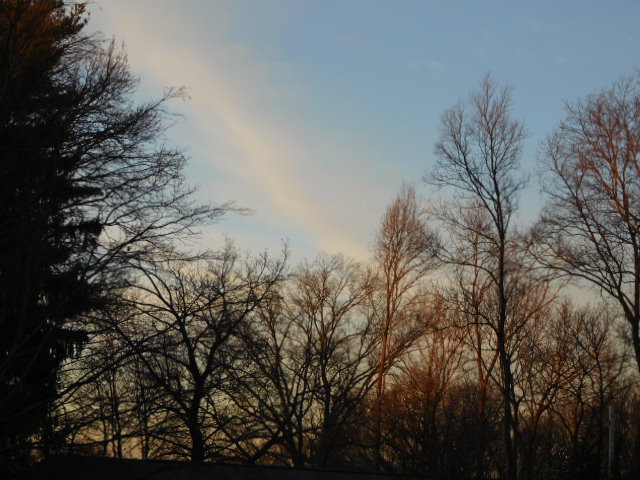
Sure, another take, why not?  Frigid but lovely as another sunset fades.

Beauty may be an elitist affectation.  Appreciation of the world is difficult when you are starving, threatened, or in great pain.  Perhaps most of our ancestors could not enjoy silence, perhaps, like us, they just accepted their environment, focused on what was important, and ignored the rest.

Everyone today hides from noise.  In hermetically sealed houses, in massively soundproofed cars, in specially designed buffered space at work and restaurants and shops. Or they shield themselves with noise cancellation earphones, or blasting headwear music. 

They miss, thereby, the cries of gulls overhead, the crash of waves, and the more subtle notes of birds in bush, breaking twigs, wind in pines, and footsteps on frozen turf.  My solitary pleasure in midwinter silence. 

Tiny Adventures

Sprinkle of snow, windy cold have cleared this park as effectively as jungle fevers.

Fads come and go as people try to cope with stressful madness of modern life.  “Slow food,” mindfulness, meditation and many commercially trademarked solutions promise at least some relief.  I have found myself enjoying what I call “tiny adventures.”

An adventure has been famously defined as “something that when you are having it you wish you were somewhere else, but when you are not having it you wish you were having.”  My adventures are not quite like that.  They are merely actions that take me a little bit out of my comfort zone _ walking in the woods on a frigid day, going to an event instead of sitting on the couch.  True explorers are laughing their heads off at my hubris.

I don’t care.  Adventures are largely an attitude.  Some travelers on cruises and world tours never leave the comfort of their settled consciousnesses, just as some diners hardly notice what they are eating.

Horror writers and film directors can transform birds into adrenaline-provoking menaces.

A recent winter walk provides an example.  The temperature was just below 28 degrees _ nothing too formidable _ but near-gale winds blasted out of the Northwest.  I bundled up in long underwear, heavy socks, insulated boots, wool cap, and down mittens.  Then I took a two mile walk along a local causeway facing Long Island Sound.

Half of that was directly into the gusts, which were whipping up whitecaps on waves which unusually were almost as high as on the ocean.  Spray fumed up from rocks, smart birds were huddled in sheltered coves.  Once in a while I was nearly knocked over.  Time seemed suspended in furious motion.

Rewards were beauty, solitude, and a sense of natural peace.  I felt a connection to the “real world” that never happens in my house or car, or in some brightly lit store.  And when I finally returned to the parking lot to drive home, I had the relaxed feeling of having accomplished something memorable.  Not quite a trip to the North Pole with a sled dog, but within my limits an extraordinary moment.

What might be? Tree spirits?  Rock kobolds?  Pond sprites?  Snow elves? Imagination has no limits.

OK, you are right, common thrills like this are simply being more conscious of our environment.  Like eating with comprehension, or becoming mindful of everything we take for granted.  It is just that I find it a little easier to jar into this appreciation pattern when I am doing something a little bit out of the ordinary, or something which I could easily have avoided to take it easy.

I find the world full of the possibility of such tiny adventures.  A ride on a New York Subway rivals anything at Disney.  Driving the LIE can flash moments of sheer terror.  Watching seagulls on a deserted beach for half an hour is very like a visit to a zoo.  To an outside observer, my world may seem constricted and claustrophobic, but from my perspective it is wide enough for all time.

Laugh at this old guy as you will.  I find days full of marvels, where others see only grey boredom.  As long as my imagination can fuel enhanced senses, I will appreciate these chances to be somewhat more than I usually am.