Nesting

I wanted a bird nest, but those around here are too hidden for my feeble attempts

People in the New York Metro area have been asked to remain mostly at home, a directive made easier by the abnormally cold and wet spring we have been enduring.  Watching flowers, birds, leaves, strong wind, constant showers, and other seasonal signs has been better accomplished from warm rooms or heated cars.  A brief dash, well bundled, is what most of us manage, even to view the tulips in the park where the show goes on even through the festival has been cancelled.

I am used to seeing goslings hatch around now, although they are often associated with me wearing shorts and tee shirt rather than heavy coat and ski mask.  But I noticed three broods following their parent along seaweed shoreline in howling winds at thirty two degrees.  A harsh way to be introduced to the world.  Meanwhile, I am observing nests being built in several bushes around the house, mostly protected from the elements, definitely hidden from the hawks.
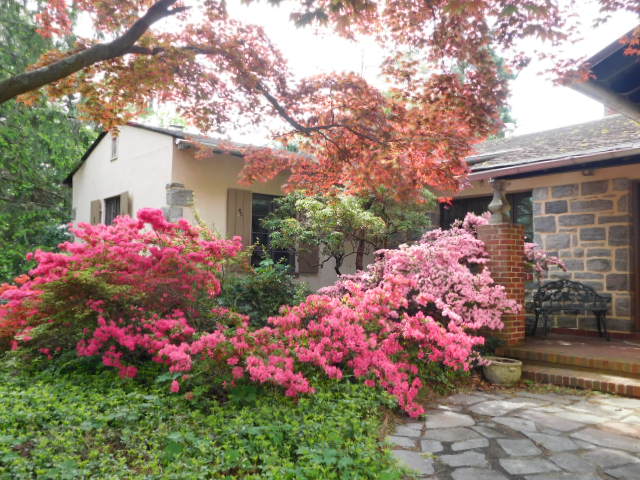
Azaleas in gorgeous apparel, covered in blossoms and bees.

Nature continues, regardless of what humans and weather may do.  Squirrels are chasing about, chipmunks are out of hibernation, bees and gnats and flies fill the air.  Birdsong is far more noticeable now that aircraft are absent. 

In spite of the drumroll of death, which is terrible, and “dire” predictions of the economy to come, and great angst about how society may change, this can be seen in some ways as a happy spring.  The air is clear for the first time in years.  The environment seems to be making a comeback.  Scenery far and near is incredibly beautiful.  We are reminded once more of the majesty and awe of existence.  Perhaps even my neighbors are bored enough to enjoy nature when they get tired of listening to grim media news.
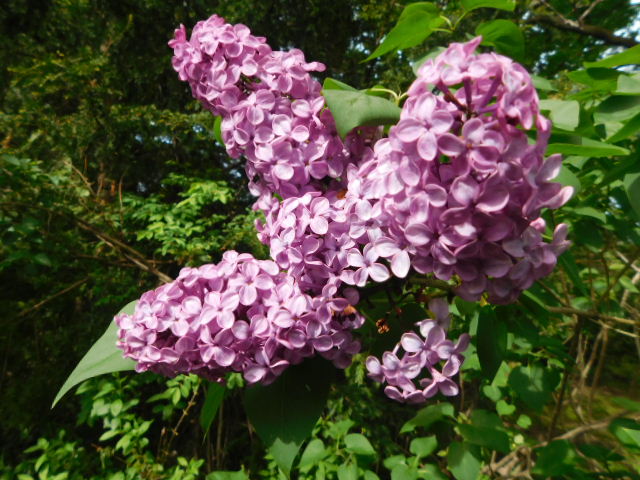
Lilacs heavily perfume our yard as birdsong fills the air.

I have lived in a deceptively secure and predictable world.  There is always food.  A child’s death is unexpected.  Old people think themselves young as they pass eighty years.  But not long ago, it was not so, and we were more like those geese.  Most children, like goslings, died before they were five.  People wore out fast, were old by forty, and incapacitated by sixty, an age which relatively few achieved.  At least a few times in every lifetime there were famines or plagues or wars.  We had hoped to be done with all that; it is jarring to suddenly encounter something like them, even here, even now.

An eternal human hubris is to perceive the world as unchanging, followed by the even more incredible belief that we control our lives.  We can certainly control our inner thoughts and mental existence, but as any survivor of any tragedy knows, much still lies beyond our power.  When change comes, especially awful change, it is hard or impossible to accept.  When good change occured, for the last fifty years or so, I have taken it for granted. 
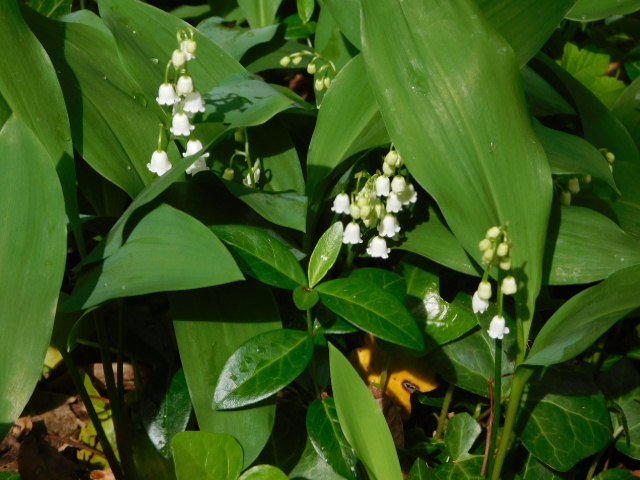
I try not to forget the subtle, like these almost hidden lilies of the valley

Full spring now, cool perhaps, maybe too much rain, but glorious.  The annual visual spectacular repeats, and cycles of the seasons still comfort me.  I enjoy sky, wind, trees, flowers, cardinals, jays, robins, squirrels, and our dashing little chipmunk and (as long as I stay away from the TV) am incredibly grateful just to be aware. 

Competence

Once a garage, reclaimed by elements, final destination of all our efforts.

Our stucco house has brick decorations below the windows.  In this long semi-incarceration they came to my attention as I sat in the warming sun with little else to do.  And I thought how little real competence I have in my world. Any Sumerian laborer could probably make bricks and lay them better than I could.  In fact, of all my vast environment, I am capable in very few activities. 

This world of marvels is constructed of fragile relationships.  Experts and specialists mine and grow and plan and build.  Sometimes I impose a certain order, but mostly I simply accept the end result.  I can buy food, I can sit on a purchased chair, I can look at my house.  But I could no more grow my food, make my chair, nor build my house than I could regulate my internal temperature or mindfully digest my meals.  Magic surrounds and permeates my existence.

With effort, I can appreciate the beauty of flowers as much as “primitive” people

What competence have I attained in over seventy years?  Some fleeting and now irrelevant electronic coding.  Some upon-a-time ability to work collaboratively with others.  Mostly, even now, an ability to plan a little and react a lot as unexpected situations arise.  A bit of ability here, a bit there, none extraordinary.

Schoolday myths proclaimed the Jeffersonian joys of yeoman farmers.  Full independence on a self-sufficient homestead where everything was crafted by the owner _ an American metaphorical ideal.  Yet, like all childhood stories, that whole concept was flawed from the beginning.  No farmer mined iron and forged his own tools, built not only his gun but also the machines to construct the parts, ate only the produce planted and harvested by his own hands.  From the beginning, people specialized, gaining surplus from what they did best to pay for what they could not do at all.

I certainly do not know the medicinal and magical properties of nature as well as my ancestors.

Capitalism loves fluid roles which shun competence_ ideally, any worker can be replaced, nobody is indispensable.  That’s ok, because the associated lie is that with luck and hard work, anyone can succeed and prosper in anything.  A competent person rises to become wealthy, famous, and remembered forever.  Artisanal crafts are worn down to machine-capable rote tasks, with an interface anyone can perform.  Driving a car when first invented took a skilled chauffeur.

Retraining is a vicious pretense which proclaims that competence can be easily transferred.  Throw someone out of a job at which they have become competent for years and make them do (badly) something they have never encountered.   Also, sever all their current implicit connections _ lateral ties to fellow employees or clients for example.  Then let them go naked into the marketplace to start over.  Sixty year olds are treated as if they were fifteen.  This massive and intractable flaw in modern consumer capitalism is what will eventually lead to its overthrow.

Weed in a perfect lawn?  Or a symbol of what I do not understand?

Competence is not purpose.  One learns competence in reference to doing something, even if that something is as mundane as laying bricks.  It often takes years to become good at a task, when actions are all but unconscious and errors are intuitively avoided.  Competence most clearly shows when things go badly _ especially as tasks become more complicated.

Finally, competence does provide an element of pride and self-worth.  Who we are is inevitably tangled with what we do.  But the only competence any of us can keep with certainty is that of our approach to life.  It must be secure, flexible, and reliable.  Good luck with that … 

Noiseless

Sometimes it is easier appreciate the visual when not assaulted by other senses.

Silent Spring is not my reference.  Yes, the English language makes a clear difference between “noiseless” and “less noise,” but how should we define the noun?  I do not regard birdcalls, wind in trees, nor even the shouts of children as noise.  Leaf blowers, chain saws, automobiles, heavy construction, and low jet airplanes, on the other hand, are obnoxious intruders on the symphony of natural sounds.  This pandemic April has been a time mercifully free of human engine roars.

The sound of silence around here has until recently been missing.  All hours, every season, mechanical clamor is relentless from near and far, above and below, around and about.  But this month, enforced shutdowns have eliminated a lot of trucks and cars and planes and local projects.  I could sit outside and hear trees in the breeze, the taps of woodpeckers, the warning calls of bluejays.  Even occasionally the rustle of leaves as squirrels race through the underbrush and up branches.  Sometimes the buzz of fat early bumblebees drifted by.

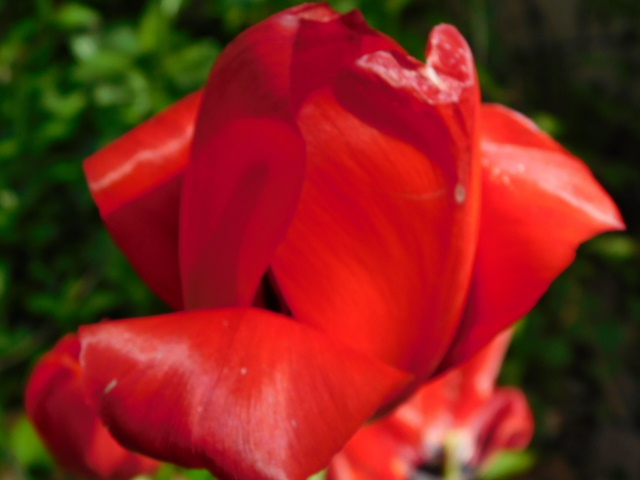
Tulips have passed full glory and are passing individually or en masse.

Like Boccaccio’s Florence, much of affluent Huntington has fled to less infested places.  Traffic is abnormally sparse.  Many neighbors have gone South or West to visit friends or linger in vacation homes.  The less affluent remain behind, but they have temporarily been prevented from their normal loud activities (because the rich are not around to make them do so.)  There is often a surprising lack of pedestrians on our local streets, because the gloomy cold weather has also damped excursions.

In the last few days, however, demon-spawned yard crews have begun to erupt once more, with their insanely oversized infernal gas engines spewing smoke and commotion.  So far those episodes remain sparse and nearly tolerable, but it is a worrisome reminder of what must soon return.  All the more reason for me to savor quiet while it remains available.

Tulips have passed full glory and are passing individually or en masse.

Maybe, eventually, people will rethink the demands of civilization.  Up until this plague, there were only two ways to deal with noise pollution.  One was to huddle hermetically behind triple-pane never-opened glass and hide inside in peace and comfort.  The other was to outcompete the cacophony by blasting nearby noise of one’s own choice _ through earbuds or boomboxes or outside speakers.  I wonder if after this interlude, some folks may not come to enjoy natural silence.  But I suppose probably not.  Noise, like most pollution, spills into common space; one lout spoils the environment for everyone within miles.

For nearly the first time, crews are forbidden on Sunday.  Many people sleep in.  I had a wonderful walk through the nearby park, admiring the cherry blossoms, young leaves, and green lawn.  Red winged blackbirds have returned to the pond, to begin nesting amongst the reeds, not yet attacking anything that comes too near.  A blissful natural calm, reminding me of my youth in less crowded and far less raucous places.

Like everyone else, I ponder what comes next, what changes may occur.  Maybe the whole world will return to what it used to be, increasing noise and all.  If that be the case, I must treasure these noiseless moments never to return, as if I were on vacation from modern civilization.  I must open my door and visit the paradise that has so briefly interrupted everyone’s frenetic brass bands.

Deciduous

Japanese maple resembles tiny artistic paper cut-outs.

Flowers are sublime in April, especially if it is cool so that daffodils, forsythia, and tulips can linger.  Only memories of crocuses remain, but grass awakens.  Yet for all that beautiful and striking activity, it is deciduous trees such as maple, oak, hickory, and beech that steal the show. 

Some trees perform full acts.  Magnolia hogs any scene, except perhaps where mature cherry blossoms briefly filter clouds.  Dogwood and crabapple creep forth, sometimes bursting out in the right warm microclimate.  Gigantic tulip trees will soon sport blossoms that are rarely seen from below.

Sprightly baby dogwood leaves are delicious light green.

Have any child crayon winter and summer pictures, and you will demonstrate our innate understanding.  Winter trees are brown lines, summer’s are lush green lollipops.  Professional photographers and painters realize that identical vistas become entirely different.  What was once exposed is hidden, what had been a jagged horizon becomes nearly smooth.  It is often difficult to recognize the same place in pictures taken at different seasons.

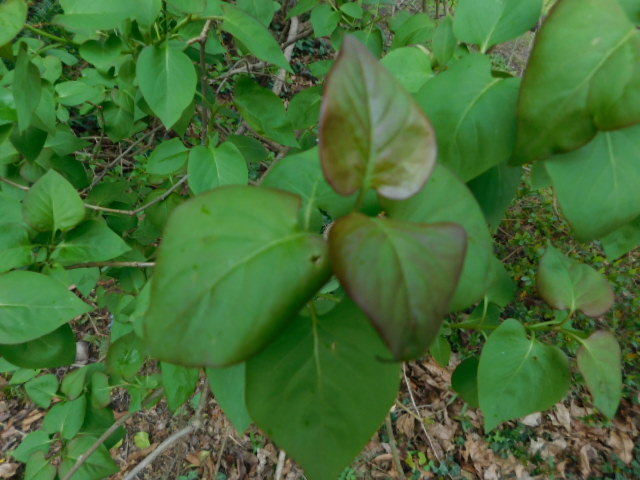
Uncurling lilac leaves can appear almost menacing.

Trees provide our most important spring metaphors.  Apparently visibly dead for months, they suddenly burst out in frantic activity and remake themselves into the very picture of life.  Except, of course, for the ones that do not, which is yet another important lesson.  Everyone at one time or another hopes to be like a tree that comes back from adversity, or like a tree that can sway in the frantic vernal wind without breaking, or like an ancient but mighty oak grown from a small acorn, or simply like a reliable companion which proves that _ appearances to the contrary _ it is not over yet.

Once leafed out , trees are exposed to danger.  A late snowstorm can break branches, as can the excessively strong winds of passing weather fronts.  That demonstrates how deceptively strong deciduous trees can be.  We have viewed their apparently fragile skeletons for months, and are surprised that such thin frameworks support an immense waving weight.  But if we think about it, much of our construction, our houses, our furniture depend on relatively light, strong. tough wood.

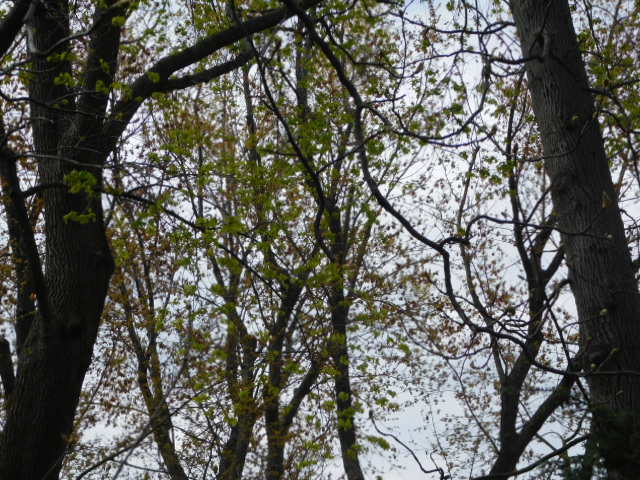
Linear sentinels in winter begin to soften with vernal promise.

I once read that there was a measurable change in global atmospheric oxygen level when the great deciduous forests of the northern landmasses leaf out in spring.  I’m too lazy to verify it, but it sounds nice and might be true.  Certainly on a local level these trees cut pollution, remove irritants, provide welcome shade in summer, and are generally fine things to have about.

I could never dismiss beautiful flowers on evergreen azaleas, rhododendrons, privet, and hollies.  I would not ignore the spectacular blooms on forsythias and roses.  Conifers present swaths of grace all year long.  But the miraculous  transformation of groves of deciduous trees around Huntington in this season is a truly wondrous spectacle that I too often take for granted.

Humpty Dumpty

With few cars, boats, planes air almost as crystalline as 400 years ago.

As the pandemic drags on, everyone shrieks “what next?”  Has the world changed forever?  Can Humpty Dumpty be repaired?  Is the modern industrial cornucopia destroyed leading us into a dark age of want?   Anxiety crests not merely because of terrible predictions, but also since all outcomes appear equally probable.  Dare we have hope?

The word “dire” has become a pandemic in its own right among talking heads and instant experts.  Truly “dire” outcomes have so far, fortunately, remained fictions.  The hospital system has not collapsed, people are not dropping dead in the streets, whole towns and industries are not being buried daily.   The shape of this disease is not that of world apocalypse.

I suspect that we may look back on this moment as the birth of reoriented individual philosophy,  just as the Victorian Belle Epoque was shattered by WWI and the Roaring Twenties collapsed with the stock market.  Those events in themselves were bad enough, but what genuinely changed forever were attitudes.  After 1917 nobody believed that the march of progress and enlightenment was inevitable; after 1929 the dream that everyone would become millionaires through stocks lay in ashes.

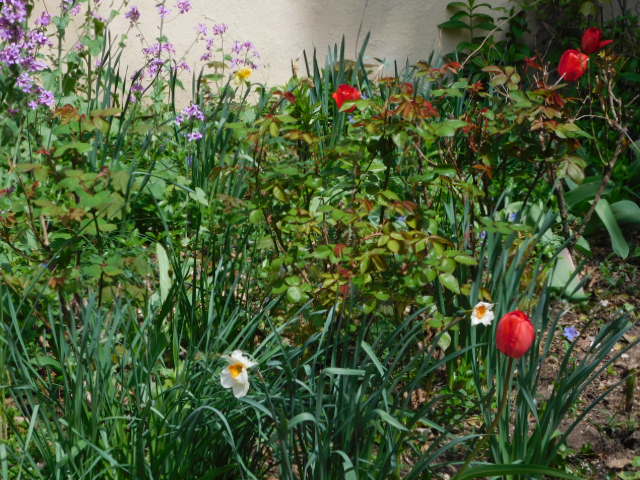
No roses to smell yet, but April a fine time to admire flowers anyway

Messianic experts (of which I am not one) predict that future society will change in unimaginable ways.  Perhaps equality will reign, health care will rationalize, folks will nurture families, individuals will remold into sanity.  The lion will lie down with the lamb, manna will fall from heaven.  Me, no.  I suspect it will be much like rebuilding after a (minor) earthquake.  Rubble cleared, a few vistas completely new, much reconstructed to same appearance but with new inner structure.

Experts also intone that we flounder in the spreading mess of a broken egg that cannot be reconstructed.  Global trade, international travel, personal freedom are all about to vanish with the snows of yesteryear.  Me, no.  I think we merely accelerate the trends that were already clear: brick and mortar retail will reorient to entertainment and sales, for example.  Perhaps metered, paid, accountable work from home (as opposed the previous frenzy of unpaid work from home) will become more common.  I point out that, so far, populations have not been decimated, few people scarred forever.

In the meantime, a month or so in the worst hit areas has been like life in an offseason vacation resort rather than horrible end of world.  Yes, many old people have died, but still a relatively small percentage of elder population, an almost unnoticeable part of the work force and youth.  Inconvenience and financial worry have affected just about everybody, but there is still strong belief that normalcy will return sometime soon.

Unknowable if summer will be lonelier than usual on bays and at beaches or stores.

In fact, many supposed society-wide cultural changes are little different than those constantly occurring for all individuals as life events happen.  Getting married or divorced, losing or gaining a job, moving out or in, having a child, changing a career, medical emergencies, and so forth are all desperate times for anyone to go through.  Anyone deals with stuff like that periodically.  We are adaptable creatures.

Ordinary life has an inertia that is hard to change, and which is very tough.   A few days or even a month of change is not too hard to accept.  We relax, freed from routine and let cares and daily worries subside for a while (although these are soon replaced by others.)  But after a while we itch to “get back in the groove” or “get on with it.”  And, in most cases, within a short while we do in fact pick up exactly where we left off.  Perhaps this massive shut down is different.  A lot of stores and restaurants, for example, will never return.  But most of those were in difficult straits already _ we should not forget how often similar establishments turn over in the best of times.

Perhaps real changes will be subtle and only take effect over time.  People may resist taking on jobs, for example, that require frequent short trips when meetings can be done electronically.  Patterns of eating may shift to less fad and more comfort.  Even the “ultimate” goals of life may be reevaluated and result in new combinations of drive and purpose.  But few of these will occur in a flash of immediate enlightenment.

Unrolling ferns are comic releaf amidst decaying detritus of autumn.

In this particular pandemic none of the physical plant has been destroyed.  Oh, transportation networks have been disrupted, some strongly and possibly forever.  Certain stores and restaurants will never return as they were.  But the airports and airplanes and ports and boats and roads and railways still exist.  Buildings remain strong and usable.  Even the subtle inter-weavings of supply chains are available in slightly different form.  It is not like a war zone, nor even a hurricane.  On the other hand, that was also true in 2008 and 1929.

Fortunately for Northern Hemisphere psyches, the worst seems to have happened at the end of winter.  Spring should provide some optimistic rays of hope.  Maybe not the worst of times, nor the best of times, but just the normal let’s adapt to whatever happens times.  Like always.

Tidal Flats

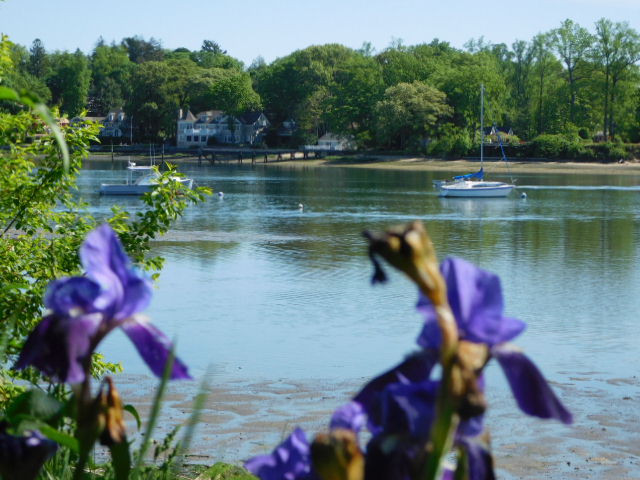
Low tide at our neighborhood dock.

Living along a sheltered tidal bay provides opportunities to view multiple worlds.  The interface between earth and water in such a place is quite different, daily, than is the case with rivers, streams, or ponds.  Those may overflow once in a while, but here we have tides that require docks to be raised many feet, often ridiculously above sea level, other times all but submerged.  And, along the shoreline of Long Island, are “flats” composed of mud and sand.

Mudflats and sandbars may be wide or slim, full of grass (in summer) or filled with brown stubble, smooth or punctuated with rocks.  Fiddler crabs scurry about in warmer months, horseshow crabs dig hollows to lay eggs, clams squirt jets of water as one walks about, preferably barefoot.  Usually there are bird tracks, often overlaid with those of dogs and children.  Bits of flotsam and jetsam (look up the difference!) mark the high tide lines.  Where currents are right, moon and whelk shells pile up among those of oysters and clams, occasional dogfish eggs.  And, certainly, seaweed. 

Ducks and swans and geese and egrets and (in season) terns and cormorants float or stalk or dive as minnows breed in shallow water, and clams or periwinkles are exposed when water recedes.  Low tide provides spectacles of flocks either sitting around or playing nearly incomprehensible avian games.  Gulls float above it all, an occasional osprey cruises overhead carrying a fish back to its nest.  Varied hawks may wander over the bay far from their usual haunts in warm meadow updrafts, ignored by those below.

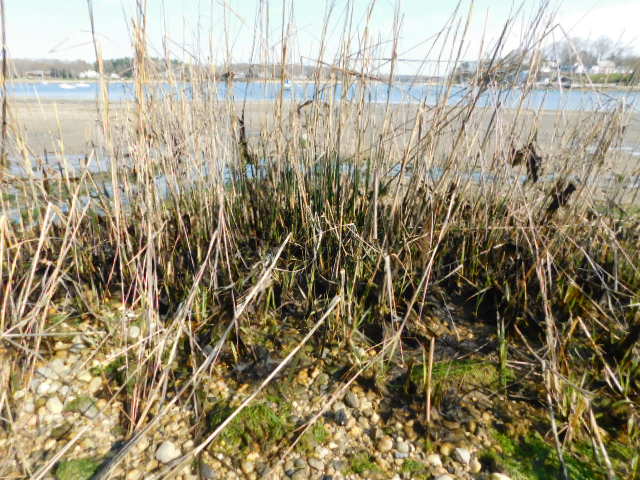
Green shoots relentlessly slice through old growth and seaweed.

Right now, early spring, the flats awaken.  Green shoots spike through broken brown stalks.  Huge mud rafts reestablish root connections with foundational sand.  Sadly, I note they are diminished each year as water levels rise.  The floating detritus of decayed reeds form thick piles dictated by hidden currents _ exposed above the tideline they swarm with newly hatched insects.

The vast scene illustrates a symphony of transition.  Before the ice ages, none of this existed.  After the great melt, it will all be gone once again.  The ecology has undergone massive changes as people ruined a natural paradise seeking to make it more to their liking.  No more lobsters, hardly any oysters, seals and dolphins departed, birds scarce.  It remains incredibly beautiful, in spite of human forms forced on it by those wishing to live along the shore.

A miniature example of braided river deltas everywhere formed by underground stream.

At low tide, rivulets wind their way into the distant waves as they form miniature braided Mississippis.  Swans stretch necks to lie flat for sips of fresh water.  In places, ancient ditches dug to drain salt flats still channel inflow and out.  My memories recall playing with our children as we built dams and sent flotsam “boats” on a perilous journey out to sea. 

People go to ocean beaches to scan empty vistas, to watch huge breakers, to swim in surf.  This bay is far more casual, with low wavelets (except in storms) and often more rocks than soft sand.  Mosquitoes can be frequent, an occasional greenhead fly painful.  There are recreational boats of all types _sail, yacht, jet ski interspersed with active commercial clam rakes.  Lately paddle boards have become a vehicle of choice.  I find more to see on a bay than on the vast, intimidating, ocean.

Water scenes calm the soul.  Imagining the infinite and eternal comes naturally.  As it was, so shall it ever be, and I am just a (pick your choice) pebble, wave, bird, or passer-by.  Anthropomorphism reigns _ mighty waves, ceaseless surf, relentless tide and all other elements seem to have purpose and will.  I am humbled by the vast cacophony of sound and sight and smell, and feel.  Carefree as the sun visibly crawls its arc.  

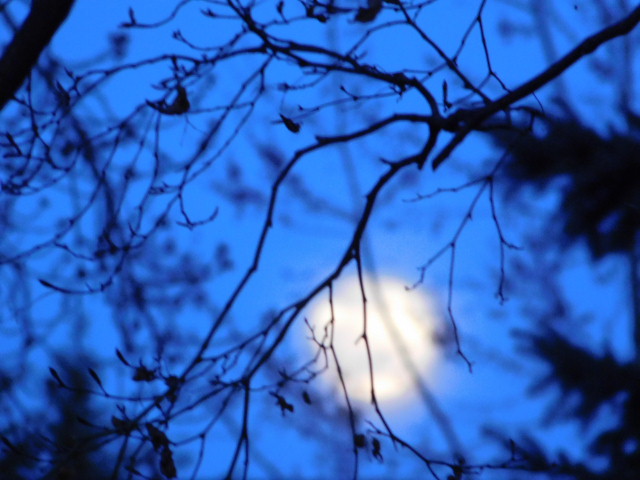
I’m not a photographer, so this fuzzy moon is all I could get.

Tidal lands never ignore the moon.  They are never exactly in synch _ tides are insanely complex to predict _ but they are partners.  Seasonal moon variations affect height in spring and fall, phases are always an indicator of when there may be floods.  Sea life, of course, is fully attuned to these rhythms which determine many mating cycles.

Spring on Huntington tidal flats is a wonderful time.  Life is springing up anew, although often in subtle ways.  Migrant birds return as overwintered residents frisk about.  People often remain indoors because of chill winds, so a sense of solitude can still emanate from empty expanses.  Not least, the bustle and worries of a difficult social world can be _ for a little while _ left behind and ignored.

Rambles

Sometimes a good ramble includes brambles.

There is an old New Orleans funeral song (I like the George Lewis version): “Didn’t he ramble/he ramble/he rambled all around/in and out of town./Didn’t he ramble/he ramble/ he rambled ‘til the butcher cut him down.”  It is bright and cheerful and incorporates an attitude to life that I think is all too rare today.  Maybe it would be good for us to do a bit more rambling, a bit less logical pursuit of imagined goals.

Of course, such an attitude is heresy in an era of “purpose-driven” meaningful lives.  People are constantly told that to be happy they must have an easily-encapsulated moral philosophy _ almost a sloganized motto_ of what they should do.  Each moment should be devoted to whatever shiny objective they have chosen to add the luster of pride to their dreary little lives.  Media is filled with puritanical admonitions to live frugally in hope of future glory.

A ramble, by definition, has no destination.  It is valued for itself.  It glories in unexpected enrichment as a person strolls undirected over woods, meadows, beaches, roads, city sidewalks, ugly terrain, or wherever a path may be available.  Variety is certain.  The mind is as free as the body, and comes up with unique ideas to match strange perspectives.  At the end nothing much has been accomplished, and there is no shiny trophy commemorating a task well done.  Rewards of a good ramble are entirely self-contained and as transitory as the next breeze.

Rambles can happen inside the house or out in a yard

Now, I am not saying it is not good to do something constructive sometimes.  There are periods of life that require intense single-minded concentration on a task.  Rambling all the time is just as corrosive as constantly striding heedless towards some destination.  Each phase of life is rewarding, in its own way, and is part of how we have a fully experienced existence.  Sure, spend some time thinking of nothing but that project that you think needs to be done.  But, as the saying used to go, smell the roses along the way _ sometimes stop working on the project and wander around the garden doing nothing.   There are an awful lot of moments in a lifetime, they can be spread into a grand profusion of activities.

Civilization now provides infinite resources of knowledge, possibilities, and challenges.  To cope with ever-more-detailed specializations, society has raised crops of pointy-headed experts.  Each of these has a myopic view of the universe that they encourage us to follow.  And, to be honest, the most lucky and driven of those creatures often become rich and famous.  But from any perspective other than their own, much of what they advise is counterproductive to a rich and full life. 

How would your funeral sound?  Would they play “didn’t he ramble?” and mean it?  Would you prefer weeping, or a long obituary in a prominent journal?  Maybe a mix.  I usually don’t waste much time thinking about life after me _ other folk’s problem.  I certainly never try to imagine looking back from a casket.  But I would like to think that, at least, there would be few regrets.  Those would include not having taken advantage of this miracle world that was offered, not simply strolled about and been grateful.

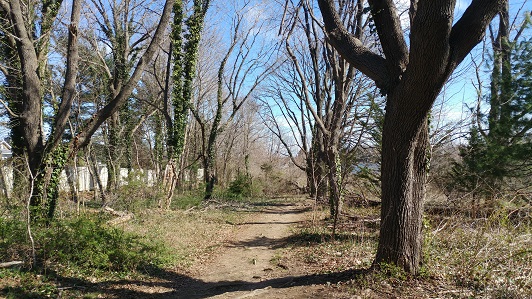
Woods always engage my imagination in unusual ways.

Society demands we not think that way.  Society is an ant heap.  Use up soldiers, drive the workers, keep the queen safe.  An individual is essentially unimportant and fully replaceable.   What any given ant thinks does not matter at all.  I am not, I do not want to be, such an ant.  At least not all the time.  I spent my ant years commuting and in a career, but even then I broke out whenever possible.  We are richly endowed to be much more than ants in our own noggin.  Do not put a lot of faith for your own personal salvation in the needs of the anthill.

Let us never forget that a good ramble always includes legs in motion.  It is not virtual viewing on a computer simulation.  It is not reading a book.  It is not even pursuit of a hobby.  It is, from external perspectives, “wasted time.”  But that wasted time must include using the body, moving along sidewalks or over hills, looking actively at whatever comes into view, listening to the environment, and letting the brain roam as unchained as the feet.

Rambles provide a good anchor for celebration in our very weird universe.  We are fated not to understand everything, and that is ok.  We are mortal, and we adjust to that grim ending.  But we need not listen to experts, work an ant’s routine, nor mutate into potatoes on a couch.  A ramble is a cure for almost everything, and (as an expert) I advise it whole-heartedly.

Atmospheric Blues

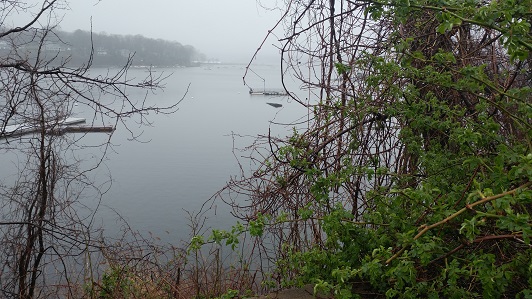
Invisible air even heavy with mist only blurs a springtime hill.

“Why is the sky blue?” is the quintessential child’s question.  Adults could query “Why is the air clear?” or “Why can we see?” or even “Why can we breathe?”  Short scientific explanations about blueness refer to scattering of light by molecules.  Details about which molecules are most involved on earth (nitrogen and oxygen) and why humans have evolved to perceive blue and use oxygen are usually omitted.  On other planets, we now surmise, the sky might not be blue at all.  Even on our own turf, different eyes on different creatures will perceive it much differently (if at all) than as a “blue experience.”

With many important things on our minds, we usually pay no attention to the sky and air around us.  Perhaps a sunrise or sunset captures a moment of reflective beauty.  Perhaps a storm interrupts our well-laid plans.  Pollution _ local or global _ may cause indignation, but most of us happily step into the trees at a park and glance at a blue sky; smile and look away.  No rain, bright sun, things are good.  The way it always was, and always should be.

Fog is incredibly metaphoric but also intensely sensually real.

Early science fiction was really about society, but it tried to avoid pure fantasy.  So for the most part almost all extraterrestrial stories _ from space opera to carefully crafted parlor mysteries _ took a blue sky as given.  Intelligence, it was supposed, required certain normalities, the atmosphere being one.  In doing so, it was simply following ancient and medieval convention.

Until recently, air and blue sky just were, filling the universe wherever there was not solid land or water. Sophisticated ancient cosmologies imagined crystal spheres floating on air, Medieval European visions assumed breathable atmosphere continuously from heaven to hell, early science figured air filled all the empty space around the moon, sun, and planets.  Eventually, space was filled with ether, then vacuum.  Discovery that atmosphere is a thin shell around our sphere projected that other celestial bodies must also be surrounded similarly.  Only in the last hundred years were we informed that some planets, stars, moons and asteroids have none, some have superheated noxious gases, some have cold dry wind lacking oxygen, and some have nearly unimaginable mixes of peculiar gasses.  Few, so far, indicate an oxygen/nitrogen composition.

Most air is nitrogen, but most effects of air are from water.  Extraterrestrial searches seek “goldilocks” planets _ not too big, not too small, just the right distance from a sun to provide liquid water and gravity to keep it in place.  Meanwhile, geologists increasingly believe our aquatic envelope has been provided by accidents like the moon’s creation, or just enough volcanic action to provide an aerosol sealant, or a molten core to generate a protective magnetic shield, and other exotic local accidents and solar cycles.  Water may not be nearly as common a component even at “perfect” planets as we like to imagine.

And, of course, that all-important oxygen, which is only there because of just the right type of bacteria doing their thing for billions of years.  Incidentally providing a protective ozone shield for just-enough mutations leading to a relatively mild evolution without radiation poisoning.  Another just-right consideration.  Without that, blue sky pretty much vanishes, not to mention anyone like you to see and appreciate it during a lunch walk.

Rain is very common _ possibly weeks on end _ around here in late March.

Do you ever consider how it stays the way it is?  How do water and oxygen keep heading back up and down.  People point to trees, but it is probably really viruses and bacteria and fungi, many in the oceans, that keep our oxygen level as it is.  It is waves and evaporation that keep water in the air.  It is an ozone shell that helps trap the water which floats towards space, a van-allen belt that keeps hydrogen from being stripped and lost.  There are so many complexities to maintenance of our sky that the mind boggles, even before we consider how many billions of years it has been relatively stable.   

Every breath we take is an infinitely convoluted procedure to achieve continued existence.  Each glance we make into a blue sky is an insanely moderated chain of chemical and electrical reactions that somehow gives us experience from photons.  Every memory we have of storm or cloud or clear sky is impossible to comprehend as neurological storage.

Most amazingly, we do not have to understand any of it to appreciate it.  Surely the earliest humans enjoyed blue sky as much as we do, at least unless they were hoping for rain.  So what if, like many other things, it is insanely more complicated than we think.  A child can appreciate it, with or without annoying wonder, and so can we.

Logic of Chaos

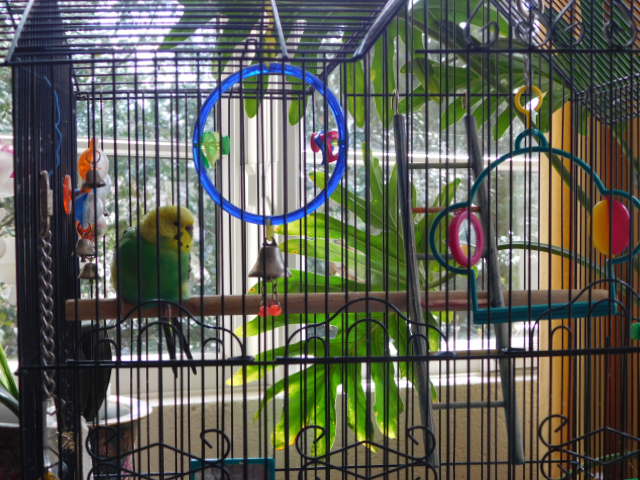
Like a bird in a cage, we are happily protected as long as civilization continues to provide food, water, and shelter.

A hundred years ago, educated people believed that the scientific universe was a pretty rational place, ruled by action and reaction, cause and effect.  If you knew the positions and vectors of everything at any given moment, you could easily extrapolate everything else, forward and backward in time.  Only ignorant religious people thought an omnipotent intelligent god could overrule that sterile logic.  It was merely our feeble understanding of today that made life so unpredictable.   But eventually science rediscovered chaos and indeterminacy.  Sociologists and economists noted “black swan” events.  And now civilization is suddenly finding how disruptive a chaotic pandemic can be.

Rationally planning the future is a wonderful fantasy that works much of the time.  It is analogous to an integrated circuit _ cheap and reliable, easily discarded and a new one acquired.  The flaw in integrated circuits is that they are integrated _ they cannot be repaired.  Even a trivial break can irreparably destroy its functionality.  Planned futures vanish just as easily _ a carefully prepared nest egg can be lost in a momentary market crash, the detailed construction of a perfect retirement shattered by an unfortunate medical diagnosis or automobile accident.

Daily predictability is not applicable to the long term.  Nevertheless, each day, we do wake up the same age, in the same situation, facing the same problems and joys.  Our car will start, work will commence, the sun will come up, weather will conform to average.  Over the long run, those items may change a lot, but day by day they continue in the same old groove.  Unless there is a disruption.  And history indicates that an unpredictable disruption is almost predictable.

Panic occurs when our ability to control the situation deteriorates.  Normally, we can be pretty sure that if we do not have milk in the refrigerator today we need to buy more for tomorrow’s breakfast, taken care of with a quick shopping trip.  Broken cars need a mechanic, rain requires an umbrella. We have a calming belief that we control that aspect of our lives.  Yet if a storm or disaster disrupts the supply chain we worry, people grab, stockpile, panic.  Tiny inconveniences like lack of bread or deep puddles culminate in mass anxiety.

Spring theatrics continue to advance regardless of the plight of the local human population.

There is such a thing as “normality,” where we usually live.  But normality is not guaranteed.  It is simply inertia and cannot account for unexpected events.  Chaos also guarantees that nobody can determine the right bets to make _ hedging against the normal, as it were.  Maybe the price of milk will skyrocket, maybe it is tulips, maybe gasoline will be unavailable.  Sink resources into the wrong thing and you may end up with a refrigerator full of sour curds and a lot of lost opportunity.

In any crisis, experts offer advice.  Most of what people want to hear is how to control the outcome.  When nothing is offered, or suggestions are impractical, we will follow any superstition to warm our hearts with an illusion.  Washing hands, avoiding eye contact with strangers, drinking lots of ginger ale _ whatever we hear and want to believe _ become necessary for peace of mind.  Because of the placebo effect _ a great deal of this superstitious behavior actually works to that end.

In the modern integrated-circuit world, where everything has to go just right or nothing works, we have come to trust movie scenarios.  A coronavirus pandemic seems very like the Zombie apocalypse.  We will all soon be lurching around eating each other.  There is a rush of fear, a spasm of irrational behavior.  And then day goes by after boring day, and tasks must be done, and no bodies are littering the neighborhood.   And life goes on.

Extended contemplation of fragile beauty soothes my spirit regardless of other circumstance.

There will be lots of chaos to come.  Scientists and preachers have been telling us for years, sometimes for thousands of years.  Chaos is one of the foundations of the universe.  But so are cause and effect and logic.  We need to be aware of uncontrollable unpredictable chaos, but we can also learn to mitigate its effects.  To some extent, we can even evoke control by determining what to focus on.

As for me, equinox has arrived, spring blooms enliven the landscape, the sky is blue, and I still feel pretty good.  None of my neighbors is pounding on my door with a bloody detached hand.  If this is really the end _ I don’t think it is _ so be it.  A passenger on the Titanic can listen to the band playing and enjoy the music until the sea closes in.

Skunk Cabbage

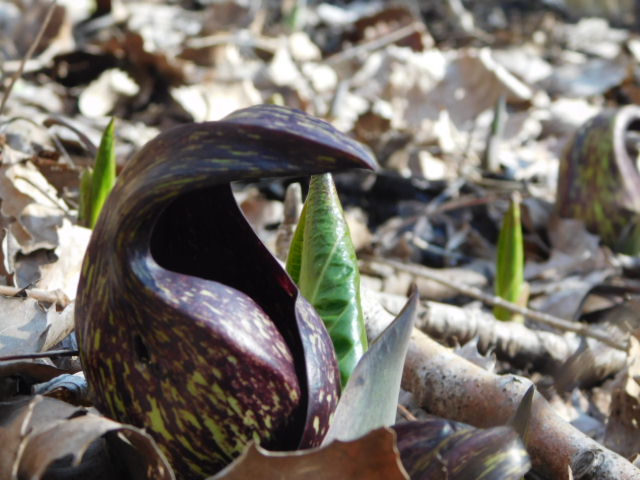
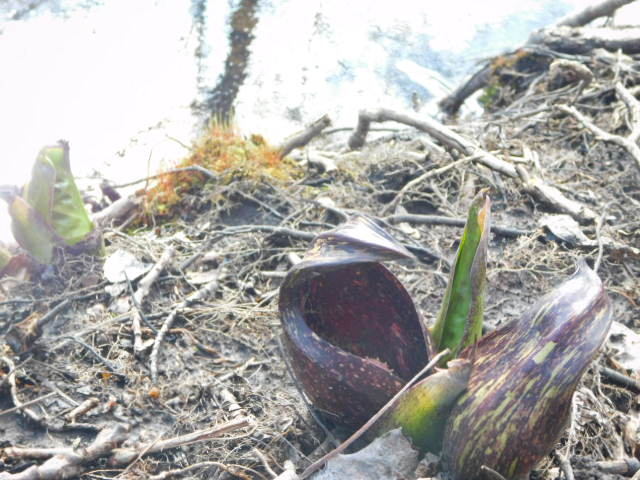
An odd flower almost 4 inches high, inconspicuous in its native bog.

Daffodils and forsythia get all the glory.  Let us rather compose an ode to the unloved, unnoticed, forgotten.  Around here, skunk cabbage provides such marvelous metaphor.  Early colonists hoped that its brilliant early lovely huge green leaves would provide a tasty and nourishing source of vitamins after long winters of snow and ice.  Great disappointment when they tried, and hence its name.  No industrial uses have subsequently been discovered.  It could go extinct without anyone noticing.

Skunk cabbage grows in wet marshy places on which nobody wants to farm nor to build.  Lately, its environment has been shrinking because those habitats were either flooded with dams, or filled in for development.  Where it survives, it is quite hardy, remaining through the years in niches that seem all but impossible.  It is up early in March, flowers weirdly crunching underfoot of the unwary.  By April, its emerald presence is unmistakable, since it thrives in huge colonies. 

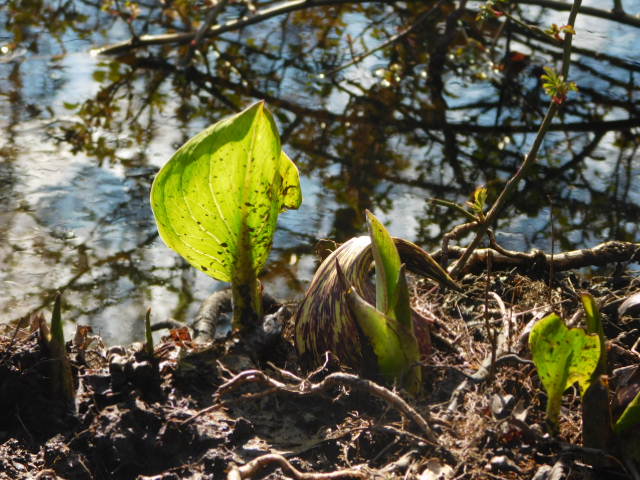
Early-appearing leaves look delicious and are easy to see

Part of the excitement of looking at a skunk cabbage is that the flower is endothermic.  That is, it generates its own heat, which allows its early emergence.  Another part is just that the flower itself is so unique and strange.  And I wonder what insects it expects to come and pollinate at such a frigid time of year.  (Yes, I know I could look it up, but sometimes I like wonder to remain a bit magical and mysterious.)

Thrill of the hunt occurs each late winter when I head into a local bit of woodland to see whether that patch of skunk cabbage still remains.  Like that O’Henry story about the last leaf, I am heartened to find it is still there, somehow.  Then I have a lot of sympathy realizing that I am probably the sole soul who will stop by to notice.

And what is the purpose of skunk cabbage?  Again a lesson, because the only point of that organism, and probably mine as well, is the perpetuation of a particular genetic structure, or, in older parlance, that particular form of life.  Any given plant will be gone in another year, eventually flooded or buried, and possibly all descendants of this group will vanish forever without a trace.  Does that make it meaningless to have bloomed and grown now, for all its intangible effect upon the world?

Beauty is always available in mixtures of earth, water, and life.

My own purpose relating to this plant is similarly in question.  I will not be able to save this environment, I will not be able to assure this plant remains, I will not be able to control sea rise or drought or continental drift.  Heck, bulldozers might arrive next week, toxic chemicals might have done their work before I arrive each spring to look.  No, I am helpless as a protector.  I can at least appreciate its effort and its existence.  I can see it as a vision, as a symbol,  as a connection to the past, as a hope for the future. 

I am grateful for my relationship with the humble skunk cabbage.  I have followed it in various places for the last fifty years or more.  As a measure of my own life and as a harbinger of my eventual meaning.  If there is a bit of enlightenment which follows from my meditations, I am even more thankful.