

Corporate Citizen

Our ancestors hundreds of years ago were vexed by how to treat public stock companies. They invented the common sense idea of an “incorporation” which literally imagined a tissue of laws and ownership as a flesh and blood creature. Gradually that simple metaphor _which allowed an application of legality to an abstract concept _became embedded in world capitalistic culture.

So far, so good. The modern mistake has been in extending that phantom concept not as a domestic animal, but as a full citizen. Domestic animals are subject to restrictions and laws, but nobody mistakes them for their owner. The racehorse does not pay taxes, the dog does not vote, the cat does not hire a lawyer to mandate better meals. Unlike the famous lines of Mitt Romney and pet lovers everywhere “hamsters are not people.”

A legal convenience has become a legal absurdity. A corporation should be completely stripped of citizen status _ by constitutional amendment if necessary. No political good comes of treating a dog as a somewhat disabled human.

Corporations, in fact, are simply a disguising mask thrown onto a bureaucracy that may or may not produce things, but definitely can own and manipulate things. But we should never think the corporation itself “wants” anything nor has any citizen rights any more than a racehorse does.

The fact that humans using those masks can severely impact society and government is a major travesty of the age.

Getting Rich

“Being rich” has almost as many definitions as being happy. Mostly it means having enough _ love, health, wealth, security, whatever. But the most common idea of getting rich in this society is having lots of money.

That narrows the problem considerably, although there is the pesky problem of exactly what “lots” means. JP Morgan once quipped something to the effect of “if you have to think about how much it costs to maintain a yacht, you can’t afford it.” In the same sense I would say if you constantly feel constrained by lack of money you are not rich.

We easily agree that there is some level of affluence _ security, food, freedom, etc _ beneath which the idea of being rich is silly and wrong. But above that level, almost none of us agree. As much as the average person? More than the neighbors? Approaching the lifestyles I see on media? An almost endless set of possibilities.

Extending Morgan’s point, I would claim that if you have to think about money all the time you are not rich. My simple personal solution has obviously been to train myself to be content within my means so I don’t have to think about money all the time. Within limits, that has worked extremely well.

So I feel rich, although others (including my wife) would not agree. But for me, my opinion matters, and my definitions are correct.

As An Artist

We are frequently advised to “get some perspective.” “Look at the larger picture”, “see the forest rather than the tree.” But the complexity of exactly what that perspective may entail is ignored.

I may see a fine landscape as simply a beautiful vision. But there are other lenses. A developer may lay out a new housing tract, road, or factory. A geologist may search for signs of minerals. A historian imagines the human presence in the past. A general scouts for advantageous military positions. And on and on.

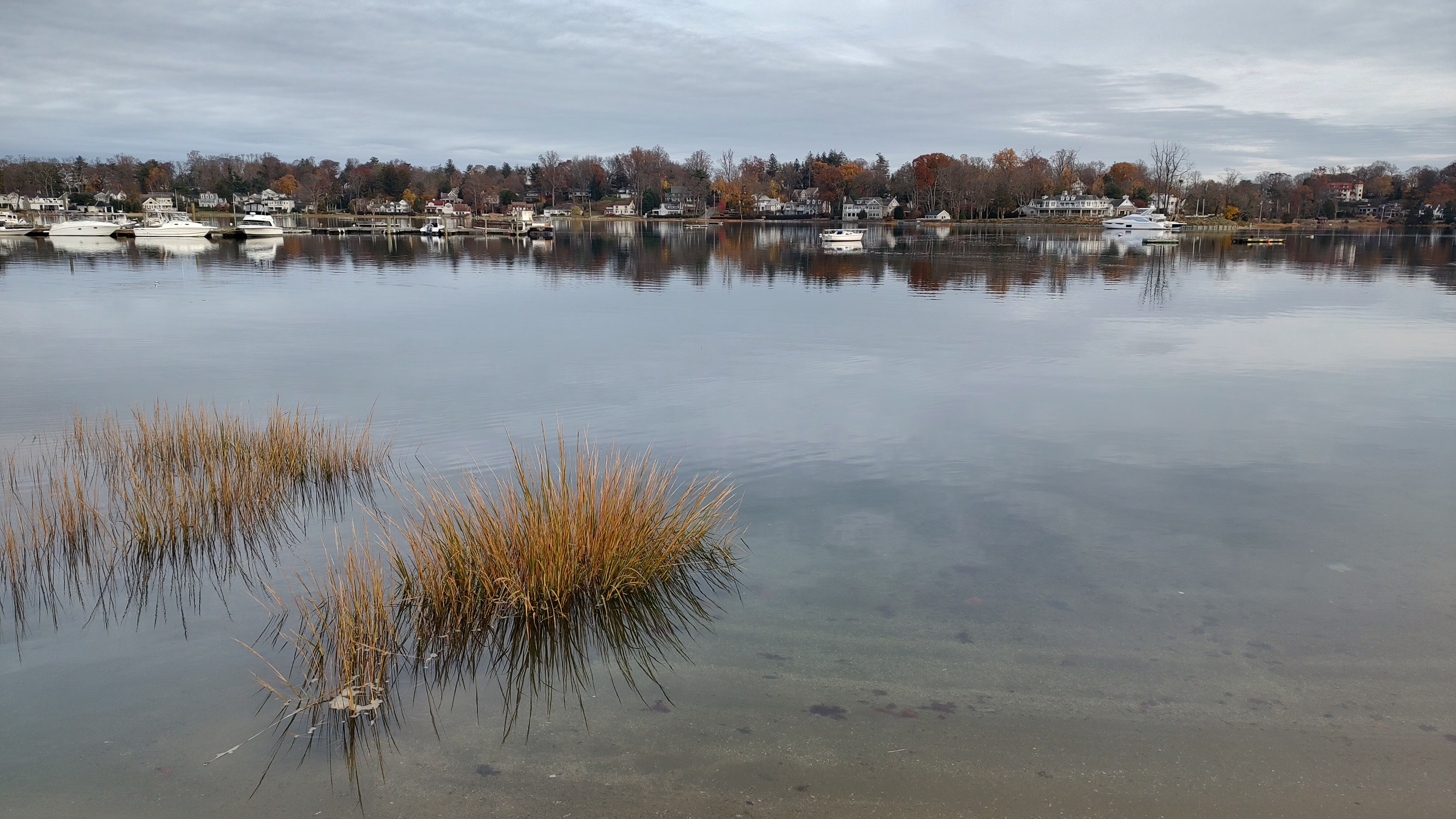
I am usually the simple beautiful vision guy, although I sometimes slip into other modes. My favorite, and one I cultivate, is to see as an artist. This lets me carefully study lines, shadows, colors. Review balance and selection and focus. What should the imagined picture convey? And then flip through treatments _  Durer, Rembrandt, Monet, Cézanne _ and media. A wonderful exercise.

I find a similar technique useful with how I see my daily life. How do I imagine my primary self today? Am I an old man, a roving intelligence, a homeowner, a parent, a taxpayer, whatever? All true, all incomplete, all useful.

In all that, I am happy to take walks, remember my life, evaluate my present, plan for the future. And, if I am lucky, just for a little while, see as an artist.

Nature Red

“Nature red in tooth and claw” was one old take when Darwinism was new. It followed Spencer’s declaration that evolution was “survival of the fittest.” Both implied that the biggest, strongest, and meanest would and should win in the game of life.

Yet although our elites often subscribe to similar ideology, we rarely encounter such behavior in real life. The elites do not knife each other, the violence is often by poor losers. Most success comes to us by cooperation with our tribe, and acceptance of tribal laws, silly though they may be.

Of course there are horrible wars, mass murder by states, mass death by starvation and circumstance. But the societies mostly involved in such chaos are rarely the ones that continue and survive.

Luck is more in play than we want to believe. And behavior which tends to win at evolution may not be what we imagine. The early bird may get the worm, but may also be breakfast for predators while the late bird dines in relative safety. Things are both more simple and more complicated than any aphorism.

But we are a quickly moving society, no time for sophistication, and aphorisms fit our needs. And they are very useful to apologists for all the billionaire “makers.”

Reality Games

There was recently an internet headline “mammals expected to become extinct from heat, drought.” Turns out that would be in a few hundred million years as continental drift jams a continent together.

That is presented as “scientific reality.” But one big problem is that it is not “relevant reality.” It does not affect my life one iota. There are an awful lot of scientific facts and speculations like that drifting around these days, some as clickbait, some from serious studies. But I still need to breathe, eat, and work today.

Another issue is conflation with what is relevant. If heat death is inevitable, why worry about climate change? It enforces a kind of numbness on any endeavors. In the long run _ well in the long run nothing matters, so why should I get out of bed? 

Our core issue is that science is not consciousness. Reality differs when approached by either mathematical models or hormonal desires. I am not a “long run” creature. I live in the series of isolated moments of the present that science cannot quite figure out. 

From this we get the frequent evils of reality games. Most involve absurd predictions into the foggy future. A dash of such is, of course, excellent and allows us to advance technology. But immersion in such scientific reality games can only lead to hallucination, depression, and immobility.

Influencer

There seem to be an astonishing number of new “twinkle toe” jobs that did not exist in my youth. People paid to paint fingernails, walk dogs, blow leaves, document their every meal with photographs. I’m a cranky old man, of course, but I still think of real jobs as growing food, making steel, or at worst maintaining the paperwork organization of a business.

The well-paying field of influencers has me baffled. There have always been a few wealthy, or loud, or well connected who could leverage their positions to inform others what they think was proper. Like Emily post, I suppose. And many others, like sheep, would follow _it’s easier to go with the flow than to rebel against every minor little thing. 

But the rise of our slush cash society now leads to a few people who can determine what to wear, where to be, how to dress. Their internet dictates determine pricing and availability: is a given handbag or sneaker worth $10 or $1,000? That too has always been with us from the days of ancient aristocracy.

My guess is that it is pure distraction, a form of meditation. Paying attention to how the silverware is placed or what kind of hat you are wearing on what kind of hairstyle lets one ignore the usual, nasty, meaningful, everyday decisions that are always with us, not to mention blanking out the apocalyptic predictions hitting us from all sides.

Parents as Gods

A trope of the times is that parents are super beings, good or evil, who shape us all our lives. We emulate them or revile them, but their effects and examples are with us always and influence us deeply, if only subconsciously. Consequently, conscientious modern parents take their duties fanatically.

As a student of real history, I know how false this image is. We are formed by all our experiences, children are educated by the adults around them, but parents are generally just more “big people.” Certainly in my own case I saw my parents as fine folks, with many traits to be adopted, but also just adults with an extra role as my parents. Joan’s family was prone to a little more hero worship of her father.

And never forget that in the not so distant past there were slaveowner parents, Nazi parents, witch-burning parents and on and on.  Hardly the right kind of gods …

We are never slaves of the past, unless we choose to be so. We can pick and choose freely among role models. For the most part, we can escape and transform any past experiences to anything we want. Only those who want to wallow in victimhood use the past as an excuse for the present.

Because of all that, I am horrified by the intrusion of “parents’ rights” into education. As in most of our current culture, it seems that only the most ignorant and fanatic among us are so sure they are right that they will seek to disrupt what calm and normal people believe in, and which will allow a child to learn to function in society. “I know what is right for my children” is stupid, wrong, and has a touch of the slave holder. I cringe as these loudmouths take over our institutions.

Village Privacy

At least as a metaphor, “village privacy” is an oxymoron. There is none. That is why people _ especially in Western cultures _ have traditionally run away from small local towns to the fresh start and anonymity of big cities or a frontier. 

When everybody knows everything about you, that means you are judged, prejudged, and evaluated with prejudiced awareness of all your previous activities and plans. The past is always with you. You are never free and secrets are impossible.

On the other hand, in a village you are fairly secure from your neighbors. You know who is what and what they are likely to do who is honest or helpful or not. Strangers are the dangers. If such a society is stifling, it can also be remarkably cohesive. That does not, of course, mean such cohesiveness is necessarily good or fun for any given individual. 

The reason I mention all this is that we approach a global village status, at least electronically. If you are not known to the increasingly integrated electronic systems, you don’t exist. And existing without electronic recognition is in fact becoming all but impossible

The terrifying truth, for those immersed in Western ideology, is that there may soon be no city nor frontier to which to run for a fresh start. A universal ID solves an awful lot of problems, and it is already de facto embraced by the wealthy and middle class, who cherish their credit cards and internet identities.

And global privacy? Well you know…

Consequential Speech

Fanatic partisans of free speech assume an absolute immunity that is not implied in the “right.” It may, and probably should, be true that one should not go to jail just for saying something. But that little ”just” contains barbs.

For one thing, free speech does not imply anonymous free speech. The speaker should be connected with the words. Anyone who shouts “fire” in a crowded theater has no right to not be identified as the instigator of the panic. Privacy is not part of the equation. 

Similarly, free speech does not mean “free of consequences.” If someone dies or is injured as a result of what someone says, blame should be assigned. Legal procedures should be involved. Nobody has the right to injure someone else with made up fantasies.

Basically, the main flaw in our free speech “rights” interpretation may be that shield of consequence. It should be much easier to sue for damages in the case of deliberate lies and imaginary accusations.

That’s where it gets sticky, unfortunately, for authoritarian countries restrict anything which may “damage the state”. Yet free speech should have some legal guardrails, particularly with respect to those injured by false accusations. Set a low bar for most private libel action.

I’m disturbed not only by the current excess of free speech, but also even more by the lack of common sense and established fact as counter balance.

Age Appropriate

Traditional political wisdom claims that anyone who is not a radical when young and a conservative when old is an idiot. In the modern era I would further subdivide a normal life into four 20-year stages: childhood, young adult, middle-aged, and elder. Plus, beyond 80, “coda.”

Any true moral or philosophic guide must realize that it needs to be flexible. Even simple rules like “do not lie, cheat, or steal” vary by circumstance. And few circumstances change as much for us as human beings as simply aging.

I’m not going to attempt to generalize too much, nor to try to be too specific. Obviously, the young are more adaptable and more restless than older folks. And they are afflicted by many other attributes, often driven by age-related hormone issues.

What is sad in all this is advice to a person in any of those subsets to pick an inappropriate philosophic guideline and stick to it, thick or thin. Nothing is more ridiculous than a youth playing wizened guru, nor an ancient wreck pretending to be as young as springtime.

Life can be long, and should be varied, and points should never be awarded (internally) by being consistent. For all the blather about capitalism and religion, the real key to Western economic and cultural dominance has always been a belief that an individual could change and start over. 

When we do, we should find some position that agrees with our situation, and adopt an outlook which serves our current existence.