Wind Chill Wind

aWind is by nature fickle, and my photography day dawned completely still

Childhood memories get sharper after middle age, seeming to reference ancient times that were more extreme and sharply defined.  “You don’t get winters like we used to …”  Deep freeze, however, is often ameliorated by compensating images (in my case) of roaring wood fires in oil drums beside a skating creek.  A child is small, so snow seems deep.  Nevertheless, I do not recall high winds as much of a concern, perhaps because we were kept inside when they blew. 

Local weather is only on average affected by climate change.  This winter here has been relatively mild, but contains occasional sharp dips.  Storms are intense, even if mostly rain.  And strong wind, even very strong wind, has been almost constant.  Since the advertisement of wind chill by media, numbers are all about how cold it would feel if you didn’t have any clothes on, which is kind of silly.  But such measurement is as pervasive and ubiquitous as TV meteorologists themselves.  Wind chill has become more accepted than mercury readings.  Yet, even now, allowance is hardly made for how greatly humidity affects how we experience temperature. 

Modern civilized folks take food, electricity, water, and warmth for granted.  Nobody is so poor they cannot find a coat, or a public space to hang out in.  The days of folks shivering in threadbare cloth on icy street corners _ except by choice _ seems long past.  But how cold is it, wind chill or not?  Some of us need layer after layer plus hats scarves and mittens.  On the other hand _ a few years ago I saw a guy running after dark in sandals, shorts, and T-shirt when the temperature was near twenty.  It is well known that some physiques love cold, and fat is a good insulator.  So even if we could agree on the “objective” temperature, what each of us may feel varies considerably from one to another.
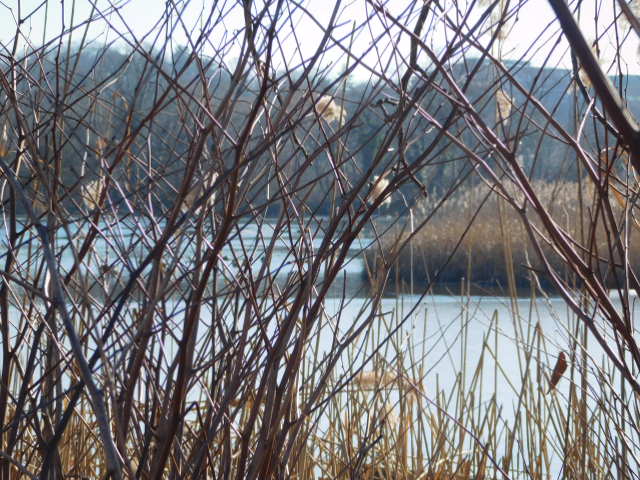
Calm lovely pond and sky, delicate reeds, a niche of nature in suburban sprawl

Logically, it seems easier to add warm clothing when necessary in a cold climate than to try to remain cool in a hot one.  Winter hardly seems much of a warmth issue, even outdoors, in a time when technology has given such wonderful new fabrics.  Ski resorts and skimobile sales attest to this, of course.  But along with easy comfort has come great laziness, and some folks hate being anywhere that is not a constant range of, say, 72 to 75 degrees.

Seasons can be magical but also depressing.  Cycles proving that time is passing faster than we wish.  Reminders of mortality as blossoms die and branches become naked.  This is offset by the rush of hope as spring surges and promise of summer glows in the near future.  Not to mention that many bugs and weedy nuisances are kept in check.  But mostly, I just enjoy the temperate natural play of time and temperature, like a great spectacle with constantly changing opening performances and replacement by totally new productions every three months or so.  That most certainly includes winter, a time to meditate and reflect.
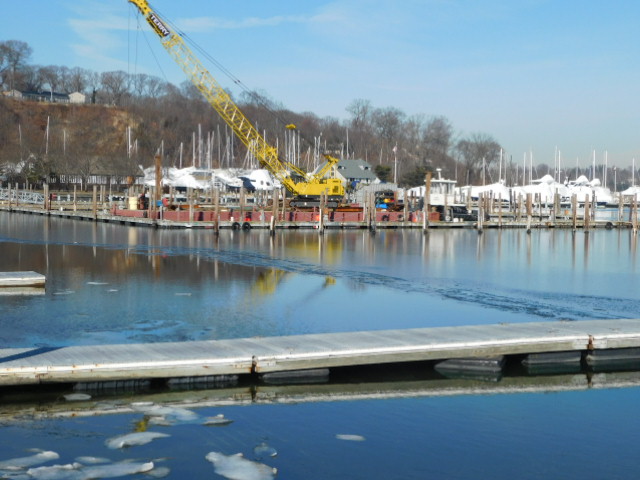
Dockwork never ceases unless the harbor freezes solid, an unlikely event in recent memory

Those of us who remain in Northern climates like to think of ourselves as busier and more industrious than the indolent folk of lazy warm lands.  They lie around under palm trees all year, sipping drinks from dawn to dusk, occasionally selling a t-shirt to get by.  We, on the other hand, must do something or become bored with cabin fever.  We consider ourselves forced by the cycle of nature to plan ahead like proverbial ants for tough times certain to come.

That is all mythology now, if ever true.  Everyone works just as hard or as little everywhere as anyone else anywhere.  And in the depth of frozen howling winter,  dealing with slippery streets and drafty houses or frozen pipes, having to wear layer after layer to get from door to door _ well, being in sunny warm greenery all the time looks pretty good.  After all, it’s where we all began to evolve, we should enjoy it more.  But usually mythology of one type or another is what gets us through the day, and most of us easily adapt our personal myths to circumstance.
Leaving Leaves

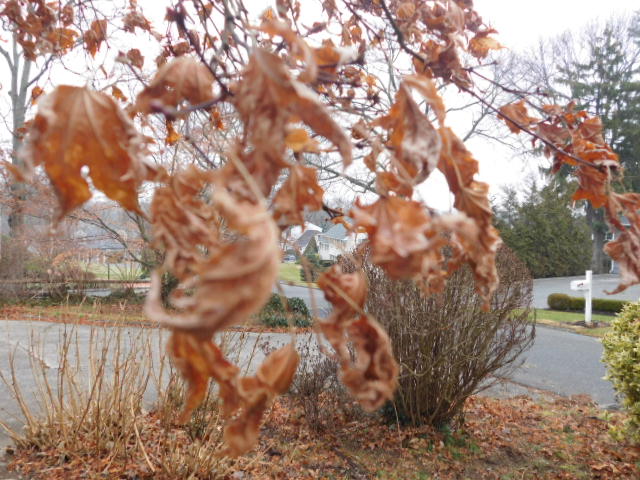
Some leaves seemingly resist giving in to the season.

This year, nature has left unusual drifts of shriveled brown leaves clinging to the Japanese maple outside our living room window in mid-January.  It is a little worrisome _ what could it mean _ some strange malady?   I stare at and through them each morning, and even tried tugging them off only to find each one fiercely held.  Another small mystery, which only spring can solve.

Huntington sits in the middle of a deciduous forest ecology, which on its own runs through maple and oak to climax beech and hickory.  Scattered fir or pine groves break up the monotony, once upon a time chestnut was abundant.  Usually the lush canopy falls by the first week in December, but this season stretched a bit longer.  With no snow yet on the ground, leaf blowers continue to ruin silence from near dawn to dark as yet another yard crew ekes out a few more dollars for food and fuel, paid by the hour, taking their time even in bitter cold.

We raked leaves quietly by hand when I was younger, mostly to keep thick mats from smothering grass.  We burned piles in the back yard.  A few patches and strays always remained and nobody complained.  Now, of course, we can no longer burn, but the clean smell of wood fire has been replaced by nasty uncombusted gasoline fumes, a bad trade.  Suburban normality evolved _ if that is an appropriate description _ to a need to have an absolutely living-room-clean lawn in winter.  In the next century perhaps all trees will be cut down and replaced with paved piazzas.

Oh the horror of leaves decaying naturally on a suburban property!

One of the problems with today’s “service economy” is that _ like aristocrats of old _ we lose a lot of natural feedback.  Meals are preprepared whether in restaurants or the freezer.  Clothes come from big bins and racks.  Food magically appears in ever-open stores.  And property is just something to be seen out of a window.  Without true connection to cooking, making, finding, or tending we lose perspective and fail to appreciate the world.  We wander mindlessly as faux connoisseurs of shallow trivial impressions.

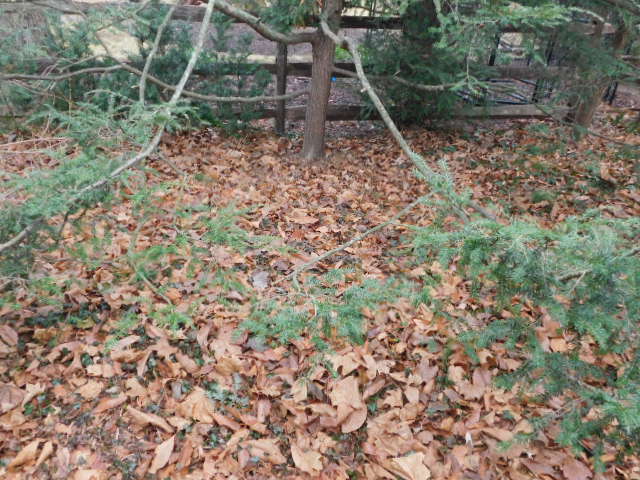
In Caumsett park, leaves coat forest floors thickly through November and the rest of the winter.  Somehow, they are all reabsorbed by spring, enriching soil with nutrients and organic material.  Nobody, as far as I know, thinks this unnatural and hideous.  But, if things keep on, perhaps in the future robot armies will be dispatched to remove each leaf immediately (and then be sent to beaches to be swept clear of sand.)  In the meantime, I enjoy kicking through piles and hearing the rustle underfoot, even appreciating mottled brown tones everywhere.

Lately, I’ve left most leaves on fern and flower beds.  The ferns seem to appreciate a more normal environment and respond vigorously and without difficulty when fiddleheads erupt, endure later dry heat spells much more easily.  Flower beds, I admit, are more for deep freeze protection and I do clear off most of the detritus when I begin to plant or as tulips and daffodils emerge.

Some suburban leaf obsession is simple ignorance, some misplaced desire for full control, some misguided conformism.  All ignores the facts of common cycles.  Leaves do fall, they do decay, and perhaps nobody likes to be reminded of our eventual and certain fate in our human cycle.  The frequently quoted proverb “dust to dust” would be more accurately and organically rendered “leaf to leaf.”  Perhaps then we could view autumn and winter as useful metaphors of our own real destiny in the larger scheme of time and space.  Remaining leaves then could represent both memories and promise.

Winter Shore

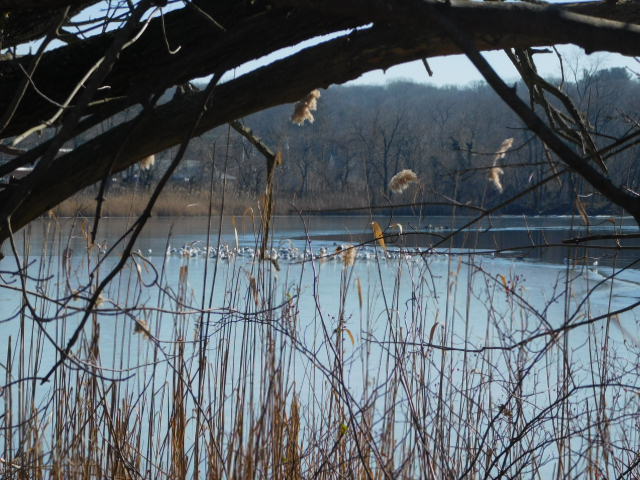
– Dormant grasses before an open distant sky

From a beach or esplanade, winter shorelines on Long Island are as beautiful in winter as in all other seasons.  Because of the long history of New England in general and Huntington in particular, we are blessed with abundant public access to water views, some in parks, many roadsides.  Unlike some places, most development is hidden under trees, partly from climate, partly from low density housing, so distant shores often appear uninhabited when gazing across the waves of Oyster Bay or other ubiquitous wetlands and inlets that surround our island.

Seen from the North Shore, Connecticut is usually just a hazy blue ribbon across wide Long Island Sound.  Underfoot sands crunch with innumerable moon shells, fewer oyster and clam shells than there should be, and less plastic flotsam than one would expect.  Gulls, geese, ducks, ospreys, crows and egrets are fairly numerous, dwindling populations of migrating and other birds add to worry that nature is in trouble.  Yet on a frigid January morning all is deserted and quiet, I listen to surf and the swish of sand, and almost imagine that I am viewing the world in a more pristine time.

This place is basically a giant sand bar formed when the Wisconsin glaciation receded twenty one thousand years ago.  As such, it was always doomed to a short life in geologic time, although its disappearance may have been significantly accelerated by oncoming sea rise.  Thus it postdates the emergence of modern humans from Africa and perhaps was created simultaneously with the migration of people to North America.  Folks were living here by eleven thousand years ago.  From the first, it was heavily wooded, and stuffed with game, shellfish, and marine bounty in general.  Before the European invasion, corn and other crops were widely grown in clearings and on the fire-cleared Hempstead plain.  By all accounts it was peaceful and as near a paradise as possible for Neolithic tribes.

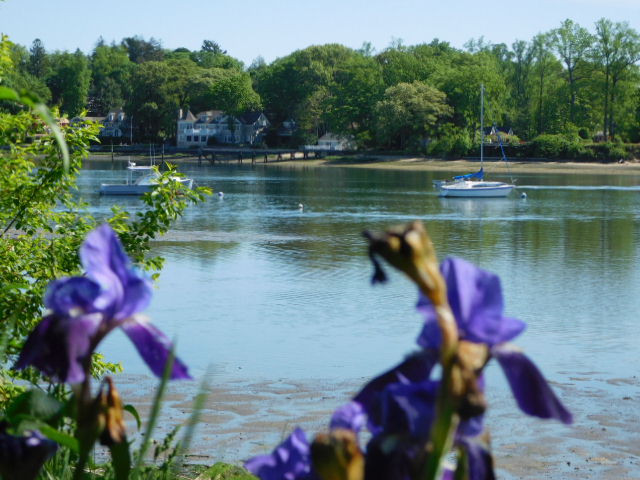
Crystal waters display pebbles behind rippled reflections

The water is almost hypnotically clear on another early Sunday morning.  Sixty degrees _ a January thaw although we have not had much to thaw from.  The local beach is deserted, not even birds.  Houses crowd adjacent hills, boats are removed to storage.  Lovely blue sky streaks under scudding clouds as it ever has done.  A mild breeze brushes my hair;  water from an underground spring bubbles gently behind me as it forever flows into the bay.  One lonely seagull meets another high overhead above decaying piers.   Repose and meditation in another beautiful place on this Earth which we must treasure.

Even in the short half century during which I have been aware of Huntington harbor, it has changed dramatically.  Some old structures from colonial times have fallen into ruin and been removed.  Many houses have been rebuilt partially or totally, as new mansions crowd previously vacant lots.  The old oil and coal depot is now a marina, and the barge that once conveyed fuel is sunk in puppy cove and long decayed.  Boats elbow each other in summer, dolphins which my wife saw in childhood are long gone, lobsters vanished decades ago.  Diebacks of marsh grass are increasingly evident.  There are, in short, few signs of the environment getting better.

On the other hand, water scenes remain a joy.  Waterfowl in declining but still relative abundance fly about, squawk on sand, float majestically.  Children play at the beach in summer, dogs race endlessly, old folks just sit and reminisce.  Cars still slow down on the shoreline drives, happy for a few moments to have spectacular views that do not require trips on an airplane.  And for those few, like me, who have the time and desire, there are hidden pockets of wonders from unexpected wildflowers to magnificent sunset, storm, and peaceful dawn.

So what is real?  The historic paradise of centuries ago, the short few hundred years of European dominance, the presumed decay now, or the projected destruction of all this by climate change already making its mark in toppled trees and too-high tides?  Unlike many around here, I am aware of all of them, yet only my moment really counts for me.  That is a selfish attitude, but natural for a human consciousness.  Should I feel residual guilt at all that society is wreaking on the environment?  Or should I just accept what is and enjoy my remaining days as I can, even accepting trash and destruction alongside the beauty and life?  No answer, perhaps not even a meaningful question.

The Old Days

Daily breakfast. Fresh milk from hundreds of miles upstate, processed oats from a thousand miles away, berries flown 5000 miles over the equator, fish oil from an ocean, exotic coffee. Modern miracles everyday.

Old folks edit memories into nostalgic golden auras, young folks have no ancient memories to edit.  By default, the old days become fantasies filled with shining knights, noble warriors, nature priestesses or the like, and endless summer beckons.  Men were men, a simple world calmed the spirit, and strong beliefs helped everyone through dark times.  Each individual who imagines those daydreams also imagines themselves as one of the winners _ always a knight or warrior or princess, never a slave or peasant, surely never shivering famished in winter.

The really old days need not harken back to Greece, Mesopotamia, Egypt, or Neolithic China.  We have trouble conceiving of daily life before 1900, and cannot really grasp it before 1850.  No electricity or plumbing, food preservation mostly using salt, horse manure (and worse) stinking everywhere, almost no bathing especially in winter, violence rampant, heavy drinking because of bad water, frequent hunger and desperate cold.  Women always pregnant, often dying in childbirth.  Almost half of children dead before the age of ten.  Men crippled or killed by machinery, beasts, infections, and other men.  You don’t realize how tough the human race is until you dig deeply into true histories of such times.

My Pennsylvania childhood in the fifties is nostalgically seen as a golden age.  We were taught that we were the exceptional people, inheritors of the earth, the vanguard of coming wonders.  But that was based on a world where all other industrial powers had been ravaged by war, their most productive citizens killed, cultural illusions destroyed.  Worse was to come in places like China and Africa as new ideologies replaced the old.  But we kept on working in untouched America, confident that it was our virtue that made us strong.  Even so, children were placed in iron lungs from polio, poisons were freely emptied into land and water, junk piled up in unseen lots, and the “melting pot” of culture was rude and crude and kept certain groups in helpless poverty.

Fog an appropriate metaphor for both past and future.

Today many worry about the dire effects of climate change.  Others consider threats from artificial intelligence, and the always fragile logistics of a technological civilization.  Doomsday worries have been common since people could first construct and tell stories.  In my childhood it was mostly nuclear war. 

But local personal doomsdays have always arrived with the four horsemen _ war, famine, plague, and ubiquitous death.  Villages and provinces have been wiped out.  Losses of over half the population have been common.  Today, those problems are both more real and more abstract _ real because most problems are truly universal and global, abstract because so far they are all merely possible rather than actual.

Back then, it is true, the numbers were less.  A few billion, rather than seven going on nine.  Especially in the Americas a lot of open land which is open no more.  More spread out into rural communities, rather than jammed into massive cities and clustered suburbs.  Some say, “too many people, the planet will certainly be destroyed, species go extinct.”  Granting some of that, it may not be so bad as claimed, no petri dish of a bacterial culture that will end up eating itself.  Population overload is one of the least worrisome problems these days _ humans certainly have ways to take care of it without plague or massacre.

Looking back or looking ahead? Not quite sure.

Everyone wants to believe in Neverland fairy tales, where we all stay young and vibrant and the world is a fantasy of constant wonder.  You know what?  That almost describes today, for about half the world’s population.  Maybe we can bring up the other half into similar fortune, and let everything we worry about vanish into the horror realities of the old days.  That, anyway, is my unrealistic new year’s wish.

New Year, Old Thoughts

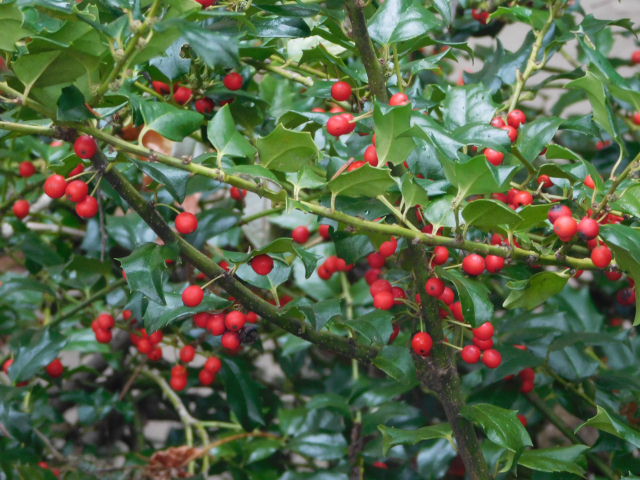
Holly bright and cheerful great way to start a new solar cycle

Back to the blog!   After nearly ten years of daily writing, sometimes weekly writing, always thinking when I walked or woke, I was less afflicted by writer’s block than by writer’s fatigue.  With babysitting for a grandchild and general activities thrown in, trying to maintain a necessary thinking schedule had just become overwhelming.  So last year was mostly a glorious reprieve, when I could walk the woods or the shore or the sidewalks of town with nary a heavy thought clouding my fragile brain.  But, I admit, the days have become a trifle dull and boring, so here I am at it again.

Media carries so much angry chatter that simply commenting on wind and rain and flowers and patterns of folks seems absurdly quaint.  I am sure I cannot avoid an occasional reference to what passes for mass “current events.”  But most of the day I am not so concerned with the invective of the talking heads, nor the ponderous claims of the Wall Street Journal, New York Times, and other reliable news providers.  So I will try to keep my thoughts within a mile or so of where I am, colored by what I actually experience hour by hour. 

Call me Dr. Pangloss.  I read a great deal of history, and I remain convinced that this particular period of civilization, for most of us _ and especially for my middle-class American milieu _ is the best it has ever been.  There is lots of food, massive entertainment, adequate medicine, electricity and all kinds of gadgets to salve the deteriorations of old age.  Sure, I know it is fragile, I know there are disasters lurking everywhere _ but when you study history assiduously you realize that for any given individual, it has always been thus, and often far worse.  Day by day, this civilization is not so bad.

I also realize I am checking out sometime soon, so will probably not be witness to many of the colossal disruptions to come from climate change, artificial intelligence, and the general propensity of the human race to create and usually escape from horrible disasters.  In my personal life, I try to live each day as if it is my last, going to sleep with a clear conscience and leaving very little undone.  Long ago I realized my impact on culture and planet was illusory and insignificant, and I maintain that stance.

Finally, as a senior, low tech is my preference.  Computer blogging is as modern as I wish to be.  Writing, reading, avoiding viral posts and instant gratification obsessions with self are meaningful goals.  To compose carefully, write lucidly, and edit cleanly will remain my sole true satisfactions in this new bloggish endeavor. 

Impeachment

It seems no Republican politicians have ever sat on a grand jury, which is the equivalent of an impeachment inquiry.

I have.

Defense does not enter into a grand jury proceeding.  The crime of which a defendant is accused is explained with reference to actual law.  Evidence is presented.  Witnesses give testimony.  The defense has no right to learn what is said or who said what _ that is what is meant by “sealed”.   At the end, a majority (not everyone) in the jury must decide it is proper to bring an indictment and continue to trial.

Only at trial is evidence presented publicly, and witnesses revealed.

The only difference between a grand jury and an impeachment inquiry is that the law in question is loosely defined.

Republicans, however, pretend this is actually a secret trial.  They claim that any witness testimony is “hearsay,” that videos and documents are falsified, that interpretations of confessions are open to question.  “Yes, I did that, so what,” becomes “Of course I did not do that.”  And that “high crimes and misdemeanors” is meaningless short of actual murder (in spite of the impeachment of another president for fibbing about consensual sex.)  Such was obviously not the intent of the clause, or crimes would have been further specified directly.

For those of us who been on a grand jury, all this is crystal clear.  But nobody ever accused politicians _ even lawyers _ of being particularly well educated even in the basic traditions of our democracy and legal system.

Apocalypse Sometime Soon

It’s a delicious, warm, golden, mid-September day at Caumsett State Park. Wheat is heavy in fields, yellow flowers everywhere, hard to imagine the Apocalypse.  Eastern philosophy _ cycles within permanence _ tends to believe there will be another September;  indefinitely more with wheat and flowers extending into practical eternity.  Western philosophy, on the other hand, focuses on beginnings and endings and change and thinks the end may come at any time.

Western apocalypse was imagined long before biblical flood or Atlantis sinking or even before there was history. Then the Roman Empire fell and Christianity proclaimed the final day always just around the corner.  For thousands of years everyone _ East, West, and elsewhere _ endured constant mini-apocalypse as the horsemen of plague, famine, and war rode forth.  More recently, we feared nuclear Armageddon, Malthusian overpopulation, and vanished resources.

Ah, but you say this time is different.  As technological Masters of the Universe we really can destroy everything.  Nuclear disaster, boiling climate, ocean death, species extinction. Other doomsday scenarios are a dime a dozen. Civilization seems hell-bent on suicide and there is nothing any individual can do.

In these matters you cannot trust old people, drunken bums, abject failures, avaricious preachers, or myopic experts.  Especially not old people, who wake each morning facing a nearer and more certain personal apocalypse.  Many of them claim the world is rotten, nothing is as good as it was in their golden childhood, and maybe it is time to end everything before it gets worse.  The rest hide away passing the time to oblivion in any way they can ignore anything outside their shell.

I don’t know.  For seventy years Fate has relentlessly confirmed that I cannot predict either particular or general futures. So I remain optimistic. The world is massive.  It continues to provide infinite wonders. Like this lovely afternoon.

Rooms Full of Elephants

Elephants lurk inside all our logical conversations about what to do next.  The roof is leaking, windows are broken, a room has collapsed but we ignore that and try to settle on the color we will paint the walls.  From an outside perspective, most of that talk is irrelevant.

Climate change is treated as if it were a simple addiction or behavior, like alcoholism or obesity.  “Oh, we will just stop drinking/eating/using fossil fuel.”  It is past that point, more like cancer, and cannot be cured so easily, if at all.  Severe storms, drowned coastlines, mass famine, wars over resources, and other calamities unforeseen will test our will as severely as plague outbreaks in Europe in the middle ages.

Medical care in America resembles ancient (50 years ago) retail merchandising.  Probably some innovative massive disrupter, such as Amazon, will rework the whole corrupt and rotten system almost unsuspected.  Technology is awesomely advancing, ridiculous bureaucratic inefficiencies clog the system _ this is low hanging fruit waiting to be plucked.

The myth of work as meaning is vaporizing quickly.  The wealthy pursue avocations that they consider work, everyone else struggles with uncertain income and time demands that increasingly suck away all 24 hours of life.  Automation and artificial intelligence are making most industrial patterns of the last few centuries completely useless.

The political, enlightenment, and capitalist ideals of Western Europe are tarnished and being replaced by the actuality of Chinese-style corporate capitalism and universal surveillance.  Many people will gladly trade dangerous “freedom” for security.  Already this creeps into America,  the rest of the world no longer looks to the US as a role model, especially given our politics verging on imperial despotism and our frequent mass murders.

International elites are on the cusp of remaking themselves into genetic and cyborg-enhanced superhumans.  The old adage that “the rich are not like you and me” is becoming all too true.  Beyond the human challenge lies the possibility of new species, or even replacement by machine.

Human biology is basically tribal, even if most humans easily belong to more than one tribe at a time (workplace as well as home neighborhood, for example.)  To some extent, the story of civilization has included trying to define larger and larger tribes _ regions, nations, religions/philosophies _ as important.  What new communications and other capabilities mean to society as a whole is inconceivable.

There are other probably major disruptions that you and I can think of, and even more that we cannot.  Pretending that things will continue as usual with a few adjustments here and there is inconsequential folly.

Relevant Political Ageism

I am in my early seventies, relatively healthy and vigorous, and have many friends the same age and older.  We are undoubtedly marvels of this age, a growing segment of elders never experienced by previous generations and civilizations.  But I am not what I was even ten years ago, certainly not what I was in my prime middle age.  In spite of their frequent protestations to the contrary, neither are my peers.  Among other things, we have much less energy, are far more rigid in our beliefs and outlooks, and react badly to the unexpected.  I do not find us wiser than anyone else.

While there are lots of examples of bad young political leaders, it only takes a moment to remember some of the worst who aged badly _ Hindenburg, Mao, Louis XIV.  In general, especially in perilous times, I would prefer to have a younger person in charge.  As presidents go, we frequently forget that Washington was 57, Lincoln 52, F. Roosevelt 51, Eisenhower 62 when they took office.

And now, in a maelstrom of environmental, technical, and social upheaval, the gods are offering us a motley assembly of ancient crones.

Trump is a cackling old crazy uncle, charming with outrageous tales that everyone can ignore, waxing more extreme by the day, only caring that people tell him how great he is because he has done so much.  Biden sits as somnolent paterfamilias, trying to hold the family together by reminiscing about days gone by.  Warren is the ancient harridan, raving like Cassandra about doom and repentance.  Sanders rants like any mad disheveled pensioner on a soapbox in a city park.

Ageism in leaders should be taken into account.  Although nobody wants to hear it, old people are not young people.  Old people are not adapted to the perils of a rapidly changing world.  It is time that fact was called out and emphasized in the selection of our next nominees.

Harris for President

I try not to get too upset about politics, since there is little I can do about them and honestly they hardly impact me.  But I was brought up to think there is a duty to at least discuss issues in a democracy, and I also was filled with respect for ideals which made America the hope of the world.

So I will put in a plug about how impressed I am with Kamala Harris.  In interviews she seems to think before she speaks, actually answers questions instead of just spouting talking points, and all in all seems to be intelligent, well informed, centrist, and balanced.  I am tired of old people who tend to be very shrewish and inflexible.  I think many of the Democrats are qualified and would fill an administration wonderfully.

But Kamala Harris has a welcome nasty streak which will be necessary in this election.  Trump is making it “us against them”, where his “us” is a corrupt mob of increasingly proto-fascist self-entitled bumpkins.   It is going to take someone who can fire up our opposition into an almost equivalent frenzy to match his attempt at grabbing dictatorial powers.  Every vote from everyone opposed to the loss of our values, virtues, and historic mission will need to be mobilized to defeat this threat.  Kamala Harris seems to have the best chance of doing so.