Rip Van Winkle

When the coronavirus pandemic ends _ or at least becomes controlled _ most people seem to believe the world will return to “normal.”  But I think we will discover that very little will be the same.  Ancient customs we took for granted will be gone forever.  New outlooks and practices which would formerly have taken years to come to fruition will be in place.  We will be just like Rip Van Winkle, waking up after a two or three decade sleep into a society we hardly recognize.

A short essay can hardly enumerate even the broadest changes.  A quick survey would note that the nine-to-five job at an office is probably gone with the horse and buggy.  Travel will be vastly more complex.  Restaurants will never return as they once were.  Technologies which were only gleams in inventor’s eyes will be rampant.  And society itself _ its makeup of families and property and rules and ideals and goals _ will frighten any who cannot adopt.  Short term confusion clears with new paradigms invisibly but firmly in place.

Will it be better or a kinder and gentler world?  Probably not.  Changes are just changes, society may take routes none of us ever desired (like an acceptance of security over freedom.)  We may pine for the nostalgic golden age before the plague, but nothing will bring back that imagined sunny world.  Climate change will become increasingly vicious, forcing adaptations that would frighten our ancestors.  The struggle to determine what is truth or fact may play out in internal wars as vicious as those of the European Reformation.

There are good and bad options in all this.  Technology affords all kinds of possible wonders.  But, unlike the politicians, I am not going to say that those of us now living in American and Europe can much influence the path of history.  Environmental destruction is far advanced, industrial societies with different core ideologies challenge global supremacy,  the comforting predictions of the enlightenment that an educated free populace will be progressive and “better” are obviously wrong.  No matter whether we adhere to the idea of historic trend and imperative or to the hope that great leaders change the future, neither of us is one of those great leaders.

Rip Van Winkle eventually just decided to have a drink and watch the world go by.  No use starting over and becoming frustrated.  The new world will be for the young and the very young, and to them that environment will be the “normal” _ and they will laugh and cry at what we were and had and did with our lives and the lost fortunes of the Earth before.

Unwilling to Heal

Lately, we are being told that America is divided and should try to heal.  “Reasonable” folks, especially conservatives and Republicans encourage me to do so.  I find it increasingly impossible.  More than that, I think it is an irresponsible course of action.

I believe in science, enlightenment values, tolerance, and American idealistic patriotism of the fifties.  I worked most of my life, am grateful for our country and culture, admire capitalism, and like to consider myself decently open-minded, well-educated, and aware of my own faults.  Furthermore, I think this is a wonderful peak of world civilization, even though it faces existential threats from climate change, automation, nuclear-armament, and civil strife.  I like to believe there are ways to continue the long climb to paradise.  

The “other side” frightens me.  It appears to be composed of self-victimized losers who apparently cannot find good jobs and blame everyone but themselves.  It is funded by nostalgic fat old people who think their thirtyish drugged children are just having fun down in the family basement where they live and constantly play violent video games while caressing firearms and dreaming of a cleansing apocalypse.  Why should I try to “heal” with such vicious racist louts who have enclosed themselves in a cult mentality that despises me and has no desire to change?

I curse the enablers who have tried to forge that mob into a power base, much as the French aristocracy and bourgeoisie did with the poorest peasantry (to their ultimate chagrin) before 1789.  Some “conservative” cable personalities are demagogic spokespersons who ignore truth and decency to improve ratings.  Some companies mindlessly fund wretched bigoted politicians simply out of habit against possible increased regulation.  Well-meaning intellectuals put up with it all because they consider it free speech. 

Unlike many of my peers, I am worried about the glorification of our military.  That has turned into a pretty good, pretty elitist job, with lots of benefits.  Not least of which is increasingly becoming part of the militarized police departments when soldiers leave the service.  I know we need the armed forces.  I continue to regard them as a necessary evil.  I have never disliked soldiers themselves, but like the founding fathers and Eisenhower, I mistrust the institution.

What can I do?  Life is complicated, but lately lazy people want it simple.  Slogans like “stop the steal,” “black lives matter,” or “lebensraum” are far more effective than well-thought-out four-hundred-page philosophic tomes.  I am afraid the answer is I cannot do much.  But of all my limited available actions, refusing to “heal” with the other side probably remains the most viable.

Coronavirus like Smoke Inhalation

My notion of the day is that smoke inhalation is a decent metaphor for coronavirus.  This is because of the concepts of toxic dispersion and viral load.  In other words, it does not matter if one encounters a few viral bits, but rather if enough bits are present to overwhelm the normal filtering defenses of the body.

Think of smoke outside.  You hardly notice smoke from a campfire unless you are sitting right on top of it for a while.  Even being near a forest fire hardly matters, although the air quality declines.  One rarely hears of a person dying from smoke inhalation while they are in a field.

Inside, it is a different story.  Smoke is trapped depending on ventilation and size of the room, and quickly becomes lethal.  A bandana or towel (mask) may help for a while, but eventually it is useless and only the rescue equipment worn by first responders is effective.

Think of infected people as campfires, some very smoky, some less so.  The rest of us go about with or without bandanas, near them or further away, rarely affected by smoke outside, but potentially stricken by being near them for a while in close quarters, somewhat like death from carbon monoxide poisoning.  These people may put blankets over their own fires, but this is only partially effective.

And finally, to stretch the metaphor perhaps a bit too much, think of age as height.  Those breathing air higher up in a room will be more affected than those (like children) near the floor.  And, of course, a lot depends on the state of your lungs.

On A Beach

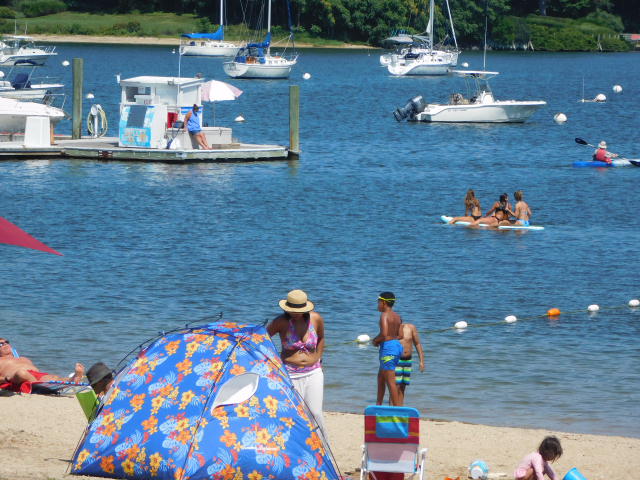
Kayaks and paddleboards have multiplied quickly over the last decade.

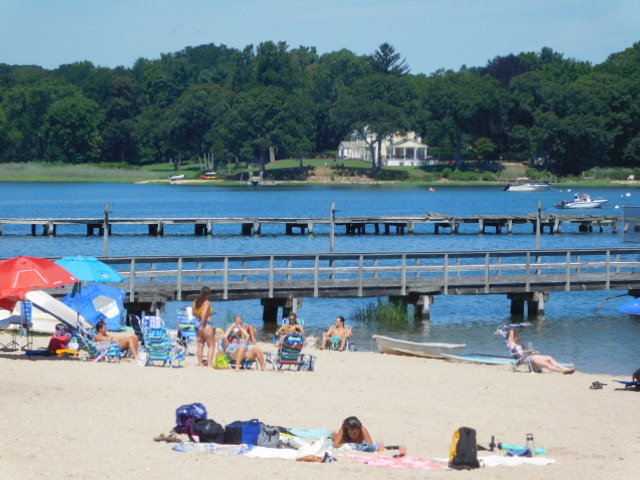
Heat wave has temperature in lingering humid nineties; with many others I sit on the local bay beach, dipping in every few minutes as I overheat while enjoying the scenery.  Children and grandparents and couples, and teenagers, and parents, and solitary old people mill around, splash, or sleep.  If a few of them were digging clams, I could almost believe myself back in the social environment of the late Pleistocene, on summer shores before bathing suits were necessary or invented.

This is a social scene.  An unarmed lifeguard provides security enough.  Everyone is enjoying themselves, their group, nature.  Nobody is staking out private property, everyone is pretty happy.  A few loud screams and laughs from young kids, perhaps a voice too loud here and there.  But all is calm and seems to show people well-adjusted and content just to be alive, not at all the ferocious beasts of Darwinian struggle, nor the mobs of dystopian fantasies. 

Armed with only moral authority, Lifeguards easily maintain common courtesy.

One of the inherent problems of “social science” is on full display.  None of these individuals is a “typical person.”  The two year old is different than the 8 year old.  That old woman has different outlooks than the braying fat young man.  Some are smiling at children’s antics, others merely annoyed.  Even those exactly in the same age group _ like the various toddlers in their puddle jumpers _ are doing very different things _ some scream, some splash, some cry, some just build sand castles.  To say they are all “equal” is a stretch, to claim each can be defined in the manner of a chemical element is insane.  The full complexity of human existence and its meaning is out in the open, on sunny sand.

In this pandemic summer, “clumping” of subgroups is more common than usual.

Oh, you exclaim, but this is not typical.  These people are on vacation from “real life,” the true daily grind.  They are sated with food, content with existence, mindlessly escaping (temporarily) from worries.  When they leave, they will be totally different.  They will never have enough food, they will never be content, they will always worry.  They will struggle endlessly against each other for their never-achieved place in the world.  Why, even as you watch them now, some get bored, some leave, some even begin to annoy others.  This shows our basic restlessness.  We quickly revert to prowling predators.

Hot overhead sun symbolizes stability, ceaseless waves breaking on shells signal ongoing patterns, and just maybe the way these individuals and groups interact in this setting is more appropriate for science and social engineering studies than what crazed teenagers do on the battlefield.  Humans are a social species, and they conquered the world not as individuals, but as tribes.  The most successful tribes took over others not as single warriors, however fierce, but as organized bureaucrats with an elite skimming production from complacent masses.

Except for marks of tides, this bay shore resembles a lakeside resort.

Imagine, then, that we have not a glimpse of utopia, but rather of our ancestral heritage, when the world gave us all we needed to live without too much work.  Like those ancient South Sea Islanders of whom we read, before they were corrupted by the modern world.  Work?  No, almost everything, even the daily fishing routine, becomes a kind of non-hassled play.  Can’t machines somehow make our world like that all the time?

My utopian fantasies fade as a cloud covers the sun.  Letting thoughts wander far from the daily grind has always been useful.  We remember Archimedes running naked down the street shouting “Eureka!” or Darwin slowly cogitating on strolls through the woods.  People lately have wanted politicians to “do more” and keep their noses to the grindstone.  Others scream everybody should get back to work. Just maybe that is exactly the wrong methodology to figure out a better way to control and appreciate this world.

Ode on a Plastic Urn

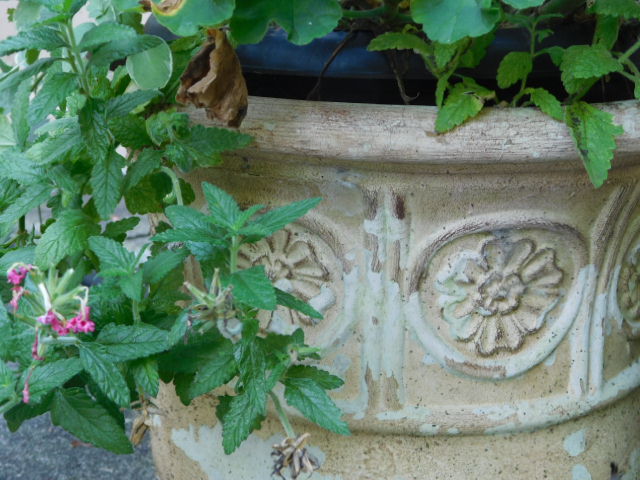
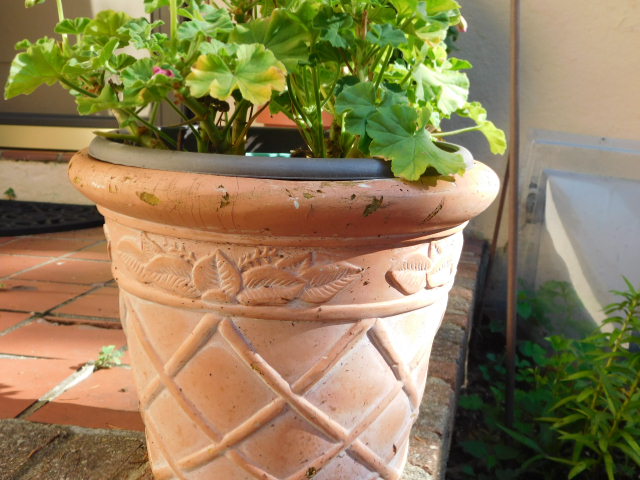
Serves its purpose nicely, but will never be in a museum.

As my wife carefully tends patio pots filled with treasured annuals, I am reminded of the poem Ode on a Grecian Urn (1819) by John Keats.  In the course of a relatively long meditation about the decorations on an ancient vase, he provides the famous lines:

… Heard melodies are sweet, but those unheard

  Are sweeter; therefore, ye soft pipes, play on;

…  ‘Beauty is truth, truth beauty’—that is all

    Ye know on earth, and all ye need to know.

Over the course of a long life, I have discovered that my idea of truth constantly changes.  I resist the word “evolves” because that seems to imply the idea of progress or at least increased complexity.  I find that sometimes I agree with philosophic or religious points of various types, and later I do not, and then I may change my mind again.  Beauty is a fine concept, but exactly how would it ever relate to Truth?  When truth is, for example, being swamped at sea in a hurricane or attacked by a grizzly bear, it would be had to appreciate the beauty of the situation.  And I have heard many melodies much finer than any I could imagine on my own. 

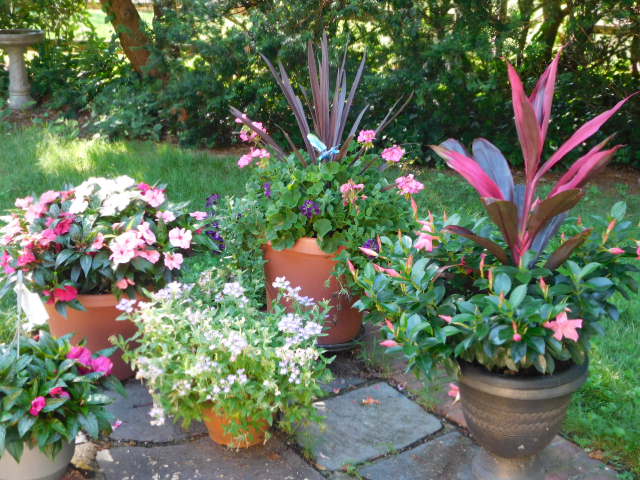
Patio arranged with almost Mediterranean sensibility.

Part of the charm of this poem, of course, is its focus on a rare ancient product of Classical Greece, an admired culture.   Youths, surrounded by flowery fields, chase each other without a care in the world playing flutes.  Captured in artistically painted ceramic, they will never know pain nor grow old nor have to work for a living.  Utopia in a nutshell.

Such esoteric fancies would probably not arise from plastic containers in the back yard.  As it turns out, none of ours are painted with delicate thoughts, but even if they were, they would be disregarded as common, trashy products of mass production.  No plastic urn will survive millennia.  Besides, I suspect that Grecian urns were pretty common in Greece at the time.  It is only the ravages of centuries that have made them rare and thus worthy of contemplation.

I do happen to agree (at the moment) that life is beautiful.  At least for me, right now.  But I also am aware that there is a lot of ugliness around, and a lot of “just so” that is hardly worthy of assigning some aesthetic judgement.  Truth, on the other hand, turns out to be complicated, fractal, and contradictory.  I can always manipulate my judgement to appreciate beauty, but no matter how carefully examined, truth remains elusive and almost never fully welcome.

Is this beautiful?  Depends, like all aesthetics, on who you ask.

Beauty is quite enough, sometimes.  Flowers provoke reflections on nature and time and meaning, as well as being simply marvelous in themselves.  Colors are magic, patterns are enchanting, bees hum harmonies of ecology.  Blossoms constantly fade as others promise bloom.  Once in a while perfume lingers in sultry wisps.  Birds chirp anthropomorphic happiness, squirrels playfully dash everywhere.

Joan has provided the human touch, selecting and arranging perennials, pots, hanging baskets, and plastic urns to display what she considers the most perfect arrangement.  She shapes high and low, red and blue and orange, small leaves and large, other infinitely complex internal judgements of aesthetics, until she considers it as right as can be.  Or at least as right as it can be on our budget.  I simply sit and marvel, and pretend the plastic is ceramic, the molded decorations done by some master craftsman, and even project a ghostly image of a goatherd and his sweetheart racing through verdant meadows.

A nice niche to provoke minor thoughts, all I ask in summer.

No Keats, I, but revised:

… Heard melodies are sweet, all those unheard

  Are nothing; whatever plays, I listen;

…  ‘Beauty is truth, truth beauty’—that is one

    Of many lovely thoughts, each contradicts the last

Thunderstorm

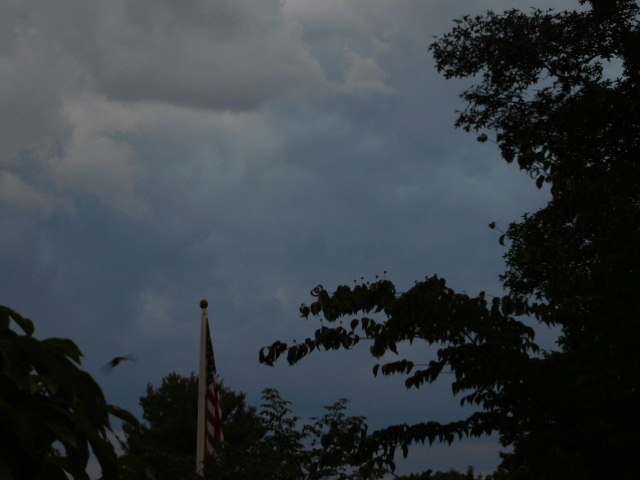
Storm clouds over stores, actual weather and metaphor combined.

Formulating complaints is a specialty of elders.  Sometimes we claim the past was better, sometimes we lament  things did not turn out as we wished, but mostly we are certain things now are never as they should be.  Weatherwise, not long ago it was too cold, then too dry _ now it is much too hot, and a deluge arrives way too often.  July is often a month of thunderstorms.

Frequency and severity of storms does seem to be increasing, a feature of climate change.  As oceans warm and wind patterns shift, scientists predict extreme events much more likely.  Long dry spells may be followed by huge water events.  Common localized storms will increase in intensity as heat speeds up gusts of wind and delivers more moisture from saturated atmosphere.   Trees that have stood for hundreds of years are toppling everywhere.   Computerized weather prediction models seem to be failing drastically.

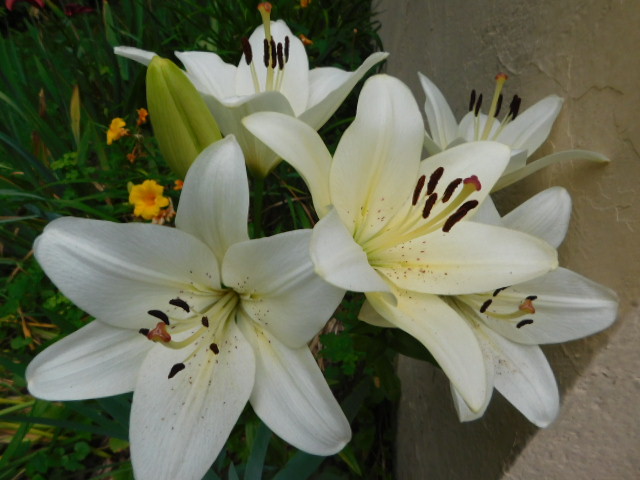
Lovely lilies survive downpours, but are will be killed by tiny red invasive beetles.

People hardly care.  We are no longer farmers.  We are no longer barbarians paying attention to the gods and spirits of nature.  If it floods, we stay home.  If it is hot, we turn on the air conditioning.  If one crop fails in the Midwest, we import food from somewhere else.  We think we are civilized, technologically secure, safe from harm.  Science will save us, even as badly applied science causes most of the troubles.  We’ve banished the gods, eliminated the spirits, and we say we rely on cold logic and facts.  But, of course, we ignore facts when we do not like them, and logic is easily twisted any which way by clever argument.

Dark purpling skies in the northwest herald approaching lightning and thunder.

This year, powerful thunderstorms seem to underline the equivalent social unrest.  Distant rumbles and flickering flashes on the horizon warn that danger approaches.  Media warns of problems far away, but far away is growing closer all the time.  “Those people” are becoming “these people” and eventually ourselves.  A few folks remain oblivious sitting on the beach until the last minute, walking under threatening clouds, ignoring all on the chance that it will miss this area.  And, anyway, they know there is little they can do to affect whatever outcome occurs.

There is also a social feeling in the air, not unlike the ionization one can sense when lightning is immanent.  Hair stands on end as electrical opposites charge.  Social polarization is evident on all sides, on all politics, in every conversation.  People shout and grumble and condense internal gripes.  Everyone is unhappy, and everyone senses that something big, potentially catastrophic, is about to happen.

Sometimes, as huge thunderheads draw near, it seems I live in the twilight of the gods.  Soon this world with all its problems and glories will be washed away into myth.  Lightning will crack, thunder will boom, rain will cascade, wind will howl, trees will split and fall, roads will wash away, crops will be flattened, homes will be destroyed.  Afterwards there may be a new landscape, even with a rainbow, but it will never quite be the same.

Before and after the rain passes, beauty remains transcendent.

Then again, I recognize an old man’s pessimism.  Most storms do no such damage, nature recovers from even major disasters like earthquakes and volcanos, people are well insulated and we believe we can overcome anything. 

So, the complaint for the day, as once again humidity suffocates each breath as heat blooms in blasting sunlight.  Surely there will be more storms this afternoon.  Just as surely, tomorrow will dawn with birds and vibrant colors, clouds or not.  Anything else would lead to annoying boredom.

Daylilies

One day open per bud, thick clusters of sword-leaves, almost a wildflower.

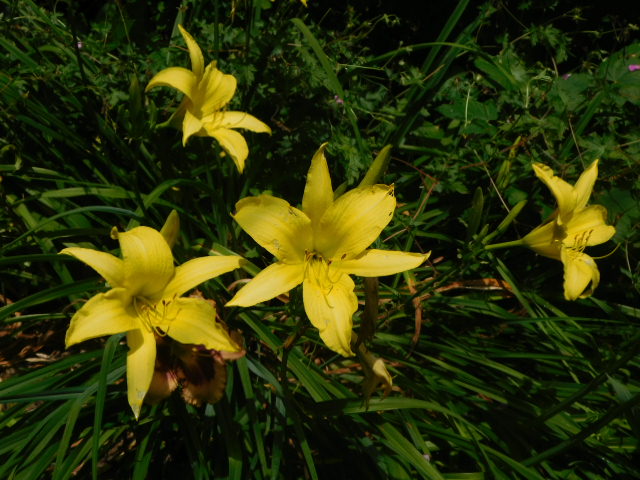
Daylilies remind me of that Biblical phrase: “Consider the lilies of the field, how they grow; they toil not, neither do they spin.”  Those hardy flowers seem to effortlessly take over spaces which other plants ignore.  A shimmering patch can choke out surrounding weeds and seem almost a beautiful mirage on a barren hillside.  Yet the darker side is that each bloom, as the name declares, is on display for only 24 hours before it shrivels and gives way to another.

For years, hedonists have seized on that saying to explain why work is not necessary.  Let life flow, and there will be enough for everyone.  Of course, this flies in the face of daily evidence _ sitting around like a dumb plant does not create a happy human.  We have wants and needs and even satisfactions from accomplishing things.  Work is a valuable part of social humanity.

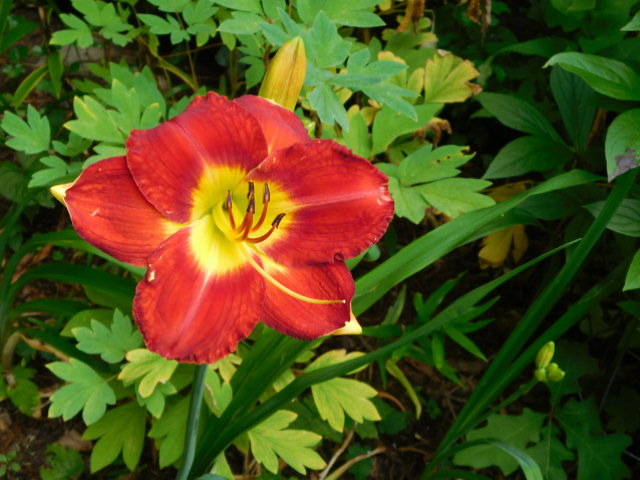
Less hardy varieties show differing looks.

Industrialization arrived with memes of Spenserian Darwinism.  Nature red in tooth and claw, life brutal nasty and short.  An early hardworking bird gets the worm, the rest starve.  Evolution constantly drives out the weak and badly-fitted, hardworking folks are just like top predators.  Most must be sacrificed so that the few can lead the species forward into some imagined wonderful future.  And, by selfish extension, the wealthy and powerful can rest happily assured that they are the most fit, the smartest laborers, and the spearhead of nature’s ascent.

Daylilies, like everything alive, are an endpoint of evolutionary “struggle.”  I suppose the species got tough as the weak shriveled.  Yet, as the example of the dinosaurs prove, some survival is dumb luck.  Some of the dumb luck enjoyed by daylilies (and many invasive species) is the massive ecological engineering done by people, including planting them.  And although flowers and trees are (we are assured) always engaged in a competition for scarce resources, day by day and hour by hour the life of a giant oak or a daylily patch hardly seems as terrifying or exhausting as Hobbesian  theory predicts.  Maybe our own jobs should reflect that observation.

Brilliant sparks out of a dark background always cause me to smile.

Which brings me to the evangelistic American religion of work.  Social Darwinists neatly summarize that as society becomes perfect, capitalism will assure that the worthy become wealthy, the poor deserve their poverty, action leads to improvement, and, in short, a working job is the stigmata of our revealed holiness.  When people refuse to work, society crumbles.  When people fail to recognize the legitimacy of wealth as held by the current elite, civilization will collapse.  No medieval kings nor Assyrian priests ever expressed basic conservatism better.

I did what I consider my share of socially approved work, and was adequately rewarded.  I put in a lot of hard labor, but I also recognize I benefited from a big mixture of dumb luck, including my basic genetic mixture and birth situation.  Since I retired I continue to pursue projects and localized unpaid tasks, which give me personal reward.  I remain open-minded about the current American system.

Metaphors or anthropomorphic triggers _ but daylilies are mostly just beautiful fun.

What is individual purpose, how is a life judged?  That is the proper function of any religion, including obsessive capitalism.  Sometimes, meditating on flowers, beauty seems enough.  Other times, watching an osprey snag a fish, beauty alone seems strained.  I have no answers, and in lovely summer I often even stop asking questions.  My mind becomes just another short-lived flower of the moment.

Frantic

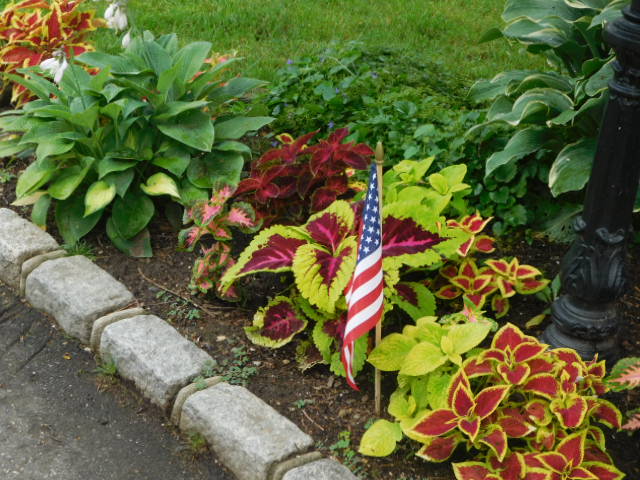
A touch of July Fourth patriotism amidst the neighbor’s coleus.

Madness reigns throughout nature as midsummer passes.  Everything not yet hatched is racing to do so.  Annuals are greedily sucking moisture from the ground, handicapped this year by a pretty nasty drought.  Trees are already in full foliage glory, building limbs and roots to survive for years to come.  A glance each cool morning, a stroll each sultry afternoon, a reflection each evening shows ongoing activity.  Once in a while huge storms shake the soul.

As always, it is easy to run everything through our amazing anthropomorphic filters.  Sun and thunderstorm perform like gods to amaze us.  Weeds invade carefully cultivated flower beds.  Insects display resilient determination, butterflies float happily, bees work industriously.  Children and even aged adults invent entire mythologies which interpret and explain complex behaviors and interactions.

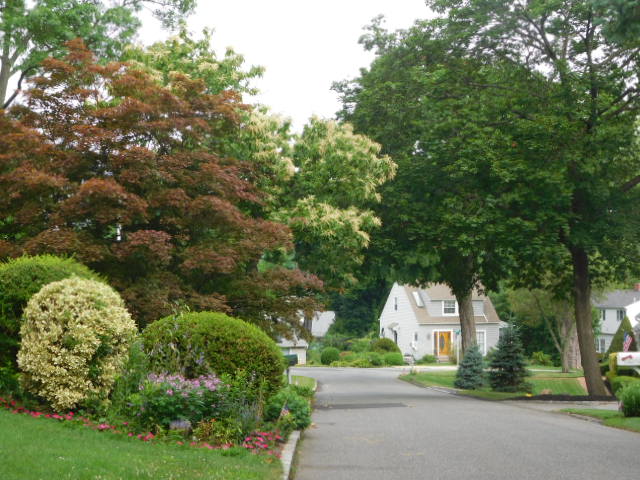
Bucolic suburban street scene seems mostly nature

On the ground grass has already browned here and there.  Summer flowers bloom cascading crescendos, each niche attracting particular pollinators.  Fruits begin to ripen on berry bushes and apple trees.  Cultivated perennials like hibiscus and roses are everywhere, uncultivated invaders like ragweed and bamboo carpet vacant lots.  From one week to another views transform completely as if the world is one a giant stage set.

Robins hop randomly for worms.  Swallows swoop ceaselessly over meadows.  Dragonflies are beginning to show, lightning bugs arrived a few weeks ago, bees wonder what all the fuss is about.  Dreaded mosquitoes and ticks are about to become real nuisances, and in deep woods or late evening on the beach gnats crazily seem to aim for our eyes and ears.  “No See Ums,” native Americans supposedly named them, very appropriately.

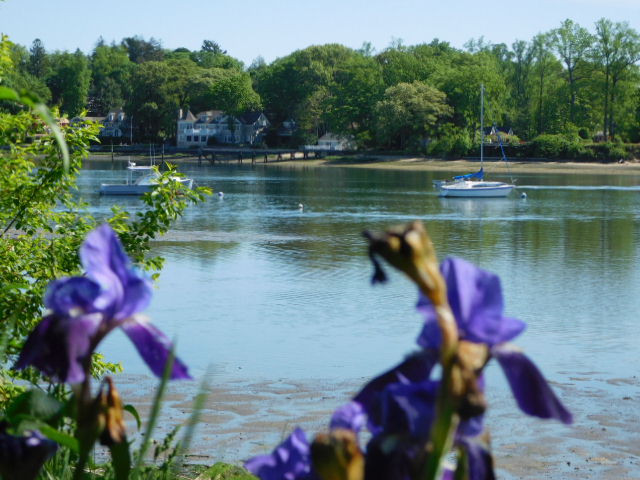
Harbor waters have begun to turn murky with algae; seaweed arrives in increasing abundance with each high tide.  Horseshoe crabs are almost done annual rituals, but still ply shallow waters.  A few tiny schools of tiny fish flash about, safe from bigger fish so far, but easy prey for egrets and diving terns.  Fortunately, no stinging jelly fish pulsating almost invisibly.  And tremendous events underwater, where none of us can see.

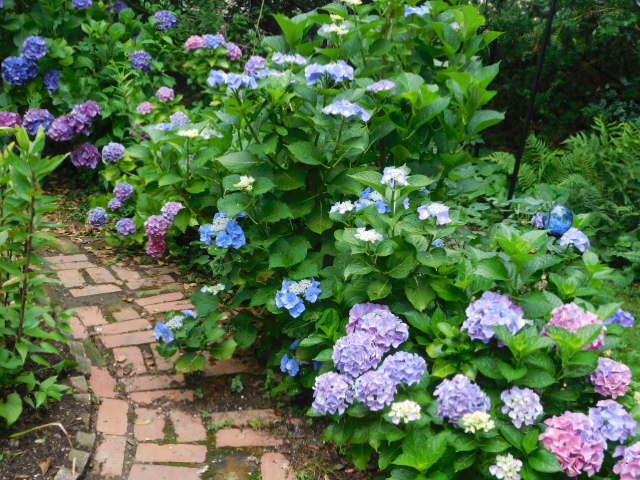
Backyard gardeners create niches resembling corners of Versailles

People are part of nature too, of course, and desperately try to retain their own seasonal rituals.  But this year has been difficult, with pandemic fears and “social distancing” even in parks and beaches, more crowded than usual.  Everyone adapts more or less, but fondly remembered last year seems as distantly alien as the last days of the Roman Empire.  Yet children play in the water, run on the sand, yell in the back yard, stare at ladybugs or caterpillars on a leaf, flinch from a huge spider.  Much remains the same.  A big change is that adults, usually worn down from work and just wanting to relax a little by doing nothing while on vacation, are more bored and restless and search for something interesting to do.

Lazy hazy crazy days are genuinely here.  Summer has begun, fireworks light the sky, and we regretfully begin the long slide to autumn.  Already nights descend sooner, foliage darkens, birds have finished nesting.  Over two months of glorious days to go, yet already a melancholic undertone becomes perceptible.

Lightning Bugs

Should take pictures of bugs, but midsummer flowers are so beautiful

Arthropods _ including insects _ are the most diverse and most populous of the “higher” animal organisms.  They are all very strange creatures.  It is hard to imagine we share the same DNA foundation, and are cousins some multi-eons back.  Some _ like mosquitoes _ I could quite well do without.  Others _ like bees _ are helper friends and I worry about their survival.  And then there are multitudes _ like butterflies and lightning bugs _ that “simply” add beauty and wonder to our world.

Late June of each year arrives with the surprising emergence of lightning bugs.  There is no sign of them until suddenly one evening, perhaps as I take out trash, there are sparks glittering here and there.

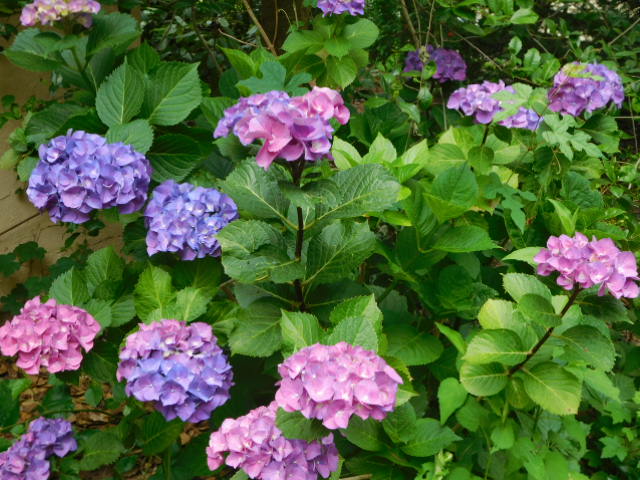
Blooms attract insects, and I am willing to not spray and accept any losses.

Sometimes I need to look twice to be sure it is not an illusion.  And then more and more arrive as days go on.  Their patterns zoom about, and like an evening fog their luminescence lifts higher and higher as darkness prevails, beginning level with the grass, ending the evening up near the top of trees.  Where and how these mysterious creatures spend their days and the winter I have little idea, although once in a while one of them may do the equivalent of a flying stumble during daylight.

They are a wonderful reminder of childhood.  Catching them is easy enough, three-year-olds master the simple upward scoop in no time.  Cruel-five-year-olds have learned to dismember them and paste glowing globs on arms and face.  Into early adolescence, some kids put them in jars for “study,” all too frequently and tragically forgotten.

These lilies are being destroyed by an invasive orange beetle

Pesticides, children, lawn mowers, birds, whatever _ how can they ever survive?  Yet they do, reminding us once again of the amazing persistence and regenerative capacities of nature.  A few bugs become multitudes in no time _ again witness those mosquitoes.  Some of them may even adapt quickly so that sprays no longer affect.  I continue to lament what seems a dearth of old reliables _ where are the tent caterpillars and gypsy moths and monarch butterflies of yesteryear? _  but some of the old ecology somehow continues.

Perhaps I am too old to attach much meaning to this.  Each day is a miracle, with wonderful treasures still available if I open my senses.  Lamentation of what used to be, fear of what may arrive are less my concern than when I was younger and presumably had more power.  A thrill of discovery, of unexpectedly finding nature renewed, another summer marked, are enough.  Whatever may come, lightning bugs are here now.

Unnoticed millipedes and ground crawlers love cool shade under ferns.

False optimism, you may shout.  Guilty as charged.  Some may approach each evening grimly aware that all is an illusion.  We are doomed to die when we are born.  There is much wrong with the world.  Even more seems to be getting worse by the hour.  And nobody listens to our lament.  But _ there goes another flash _ and my mercurial mind is once again turned to happy memories renewed.

Poisons

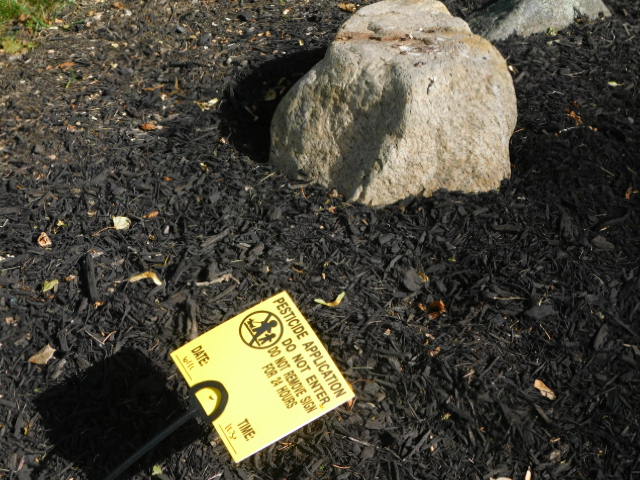
An all too common sign around our neighborhood.

I’ve lived immersed in poisons.  Some of them were natural _ evolution handled most of those toxic effects.  We should note that nature itself presents many toxins, from elements like arsenic and uranium to toxins from venomous animals,  to deathly fungal mushrooms and hemlock plants . But the last century has been one long miasma of newly discovered and created chemicals, usually claimed to be harmless, but nobody knew for sure, and certainly nobody knows right away. 

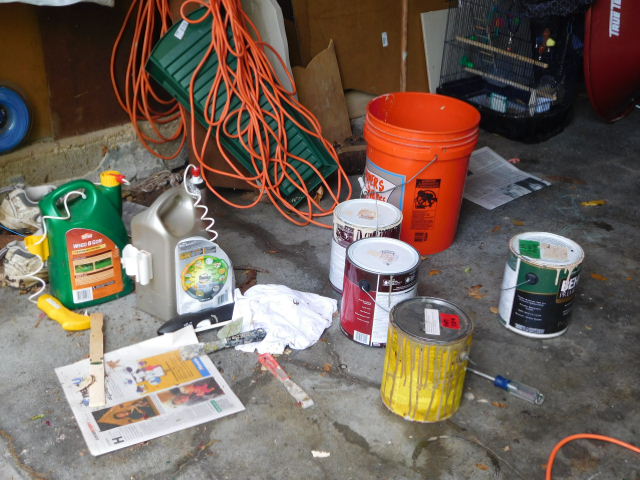
Those sublimely remembered good old days of the fifties were an immense waste dump.  Everyone figured of one pound of something useful (like DDT) worked well, five pounds would work even better.  Pesticides, herbicides, and unconstrained byproducts of processes old and new poured into the environment.  Fish and birds died en masse.  Babies developed strange maladies.  Adults were exposed to coal dust, asbestos, industrial cleaning agents.  Wearing gloves or masks (or even following directions) was for wimps.  Streams ran black, smog obscured cityscapes, any unused patch of ground could be used as a dump for old oil, paint, or unknown liquids. 

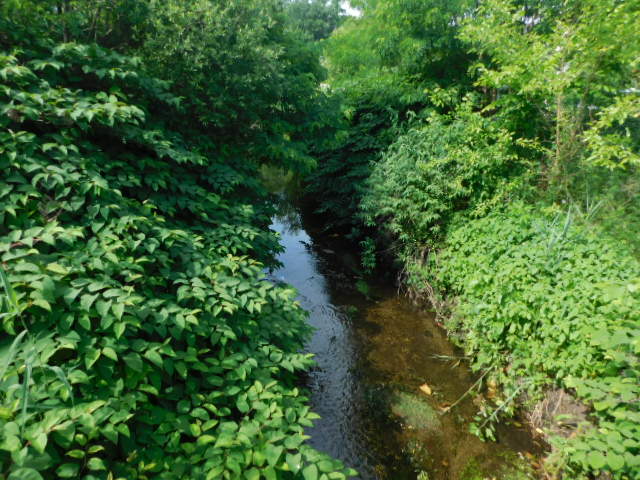
Nevertheless nature seems to do ok, even in this junk drainage behind a drugstore.

In these strange new days, it seems everyone is increasingly scared of chemicals.  Never mind that everything is built of chemicals _ any of them must be bad.  Why, just look how horrible their names sound!  So we have “organic” and “cleansing” and some fairly obscure witchcraft practices to deal with.  Meanwhile, my same neighbors who would never touch a regular old apple happily spray their yards and homes, accept combustion products from yard machines, and drink bottled “pure spring water” contaminated with plastic molecules.  I sometimes think masses of people have simply been “reeducated” from one set of ignorances to another.

Mea Culpa

Enumerating poisons in our environment is useless, especially when we remember that just about everything is a poison in strength _ even water.  And it is hard to make a case that we must avoid their use entirely _ mosquitoes are annoying and a health risk, herbicides do feed the planet.  What bothers me is the unthinking contradictions I see around me.  People trying to cut out poisons in foods, for example, while dumping them around and in their homes.  To be honest, I think we do use somewhat less per capita than my parents’ generation, but on the other hand there are so many more capitas these days, which is a heavy load on the natural environment.

From here, the environment seems just dandy.

Is there some reasonable solution?  Sure _ less people.  Well … yeah … but …  That’s the trouble, every solution has too many residual problems.  Conservation would be nice, environmental awareness is great _ but everyone seems to want that boat or to have the ability to fly to some vanishing bit of jungle elsewhere in the world.  I saw a crowd the other day staring and photographing a once-common big yellow butterfly as if it were a rare creature _ and today it is, perhaps to be gone in a year or so.

A concentration of people into cities might be helpful.  Keeping the poisons we use constrained into small geographic areas would be the best outcome.  Farms as we know them may already be giving way to robotic workers and different ways of raising things like meat.  Meanwhile I’m enjoying my last few years admiring what remains, and trying to keep my own poison requirements as low as possible.